
166
Chapter 30
Case Study 1
This is a difficult situation as the auditors are preparing a report at the
request of their client which is, effectively, in support of a loan application
and which will be relied on by the bank in connection with the advancement
of finance facilities.
The auditors’ have two tasks
xReport on present liquidity
xReport on the company’s ability to repay the loan
167
The first part requires them to, effectively, review and audit a Statement of
Financial Position at a suitable date close to the present date and gather
sufficient reliable evidence to validate that Statement of Financial Position.
The second task requires them to review the directors’ forecasts and
comment on the assumptions contained therein.
Case Study 2
What type of assurance is being sought?
How will the reporting accountants deal with the issues they have uncovered
in the context of their report?
168
How will the report be worded?
Examination question
Imperiol
(a) Matters to be considered (before accepting the engagement)
ŶThe form of prospective financial information (‘PFI’) – a ‘business plan’.
This could include any, or all, of the following elements:
– a statement of business objectives and goals
– profit forecasts
– budgeted statement of financial positions
– cash budgets
– capital budgets
– manufacturing plans
– a statement of assumptions and variables.
169
ŶRecipients of the report – has a specific bank and/or venture capitalist been
selected? Have negotiations commenced?
ŶHal Falcon’s competence and experience – Hal Falcon should not accept the
engagement unless the firm has experience of reporting on PFI. Even then,
the firm must acquire sufficient knowledge of the business to evaluate
whether all significant assumptions required for the preparation of the PFI
have been identified.
ŶImperiol’s business – its economic substance and stability. There have
already been a number of restructurings and the latest proposal is to focus
on one core activity ‘building systems’. Imperiol may therefore be less stable
and have a greater exposure to risk because its activities are no longer
diversified.
ŶWhether information will be for general or limited distribution – this will
determine the suitability of caveats and disclaimers restricting circulation of
Hal Falcon’s report thereon. The wording of these should be agreed with
Paulo (e.g. in a proforma report attached to the engagement letter).
ŶForm of opinion required – for example, ‘properly compiled’ and ‘presented
on a basis consistent with accounting policies normally adopted’ rather than
an expression of assurance.
170
ŶTime available – Hal Falcon must have enough time to carry out all
necessary procedures on the PFI before providing a report on it. Also, if the
report is needed before the December 2X10 figures are audited, the most
recent audited (i.e. reliable) data available to Hal Falcon will be for the year
ended 31 December 2X09.
ŶThe acceptability of any limitations – when the form and content of the PFI
has been determined, Hal Falcon should clarify the scope of the engagement
and whether there will be any restrictions placed on available information
(e.g. if there will be access to board minutes).
ŶHal Falcon should be allowed to communicate with Discorpio:
ŶWhy Discorpio, Imperiol’s auditors, have not been asked to report on the
plans. Perhaps their knowledge of the business would be incompatible with
the PFI. Whether Discorpio have previously reported on PFI for earlier
restructurings.
171
ŶThe degree of secrecy required – this may go beyond the normal duties of
confidentiality not to disclose information to outsiders (e.g. if unannounced
staff redundancies form part of the restructuring proposal).
ŶThere may be an opportunity to offer external audit and other services to
Imperiol (e.g. internal audit).
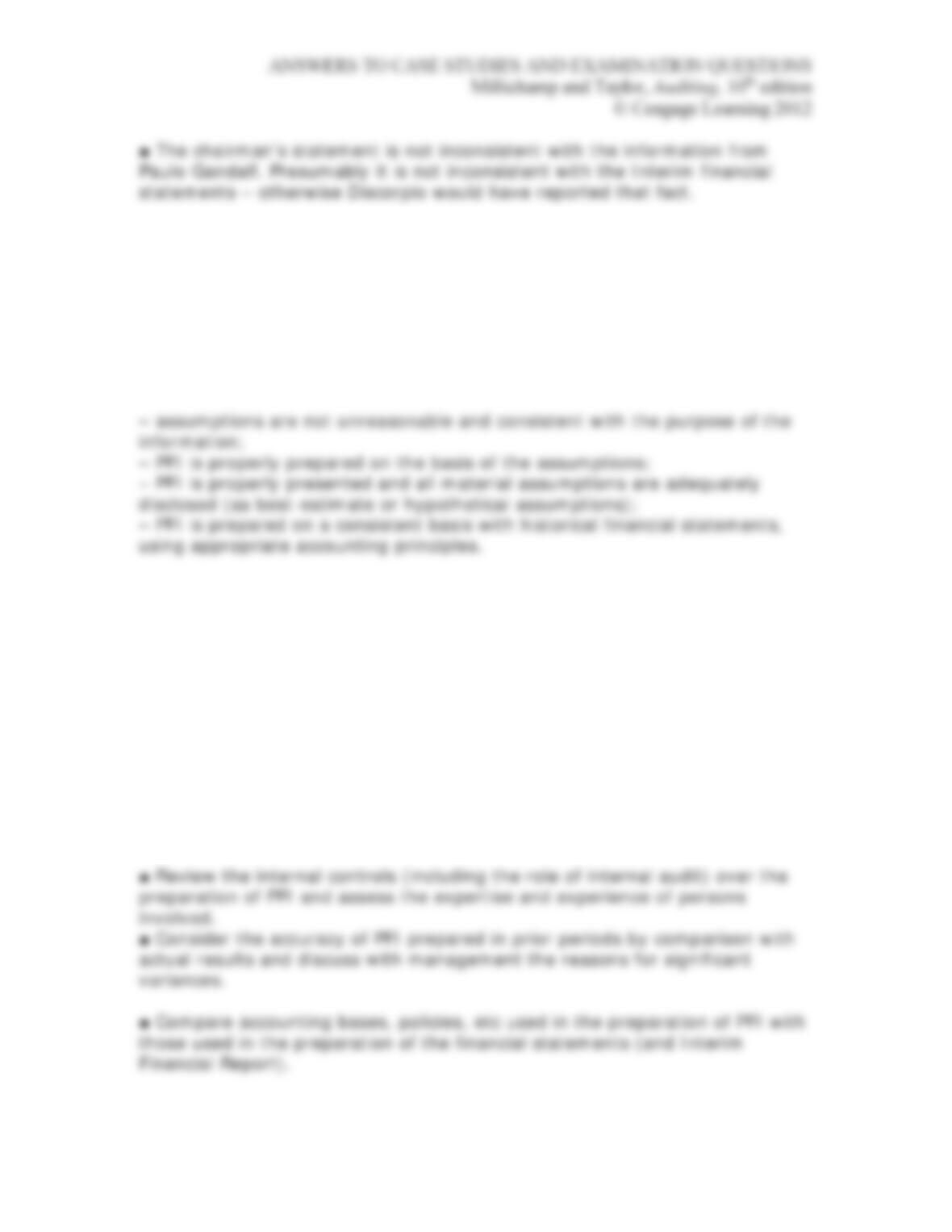
ŶThe objective of the reporting engagement – for example, to ensure that:
(b) Procedures to be undertaken
Tutorial notes: Although part (a) can be addressed without any reference to
the Interim Financial Statement information given in points (2) and (3), as
suggested above, marks will be awarded to candidates who make relevant
points. To avoid repetition of procedures for both elements of the business
plan and to make points specific to each, the following answer has been
planned and structured around three subheadings.
Profit forecast and forecast statement of financial position
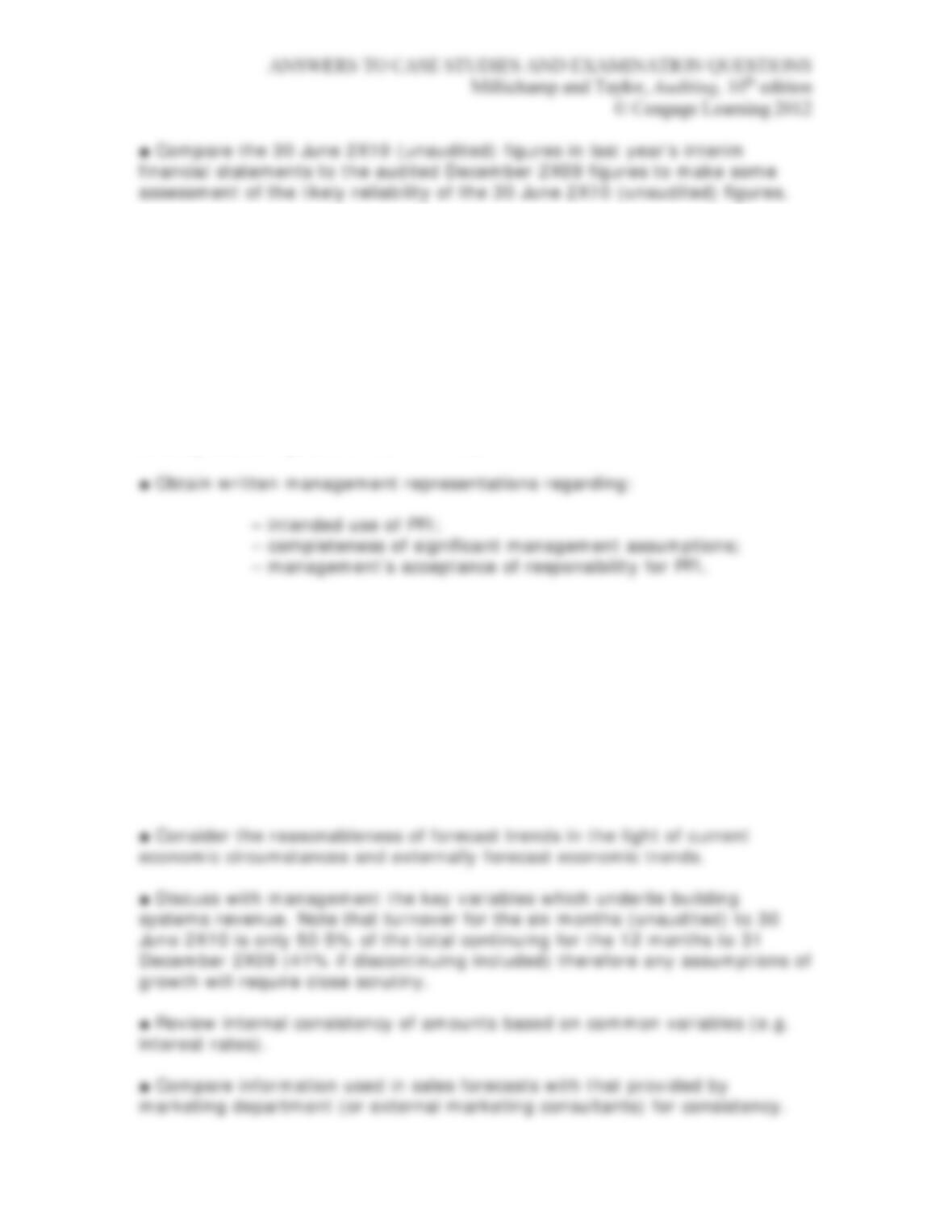
ŶMeet with Paulo and the management accountant to ascertain how PFI is
prepared.
172
ŶCheck the arithmetic accuracy of PFI (i.e. reperform calculations).
ŶConfirm the inclusion of an appropriate estimate of income tax expense
(including deferred tax) in the profit forecast and forecast statement of
financial position.
ŶPerform analytical procedures (e.g. calculate ratios and perform tests in
total) to assess the reasonableness of the interrelationship between items in
the statement of financial position and profit forecast. For example, interest
charges should have increased in line with the 43% increase in interest
bearing borrowings (65·4 /45·7 = 1·43).
Profit forecast
ŶDiscuss with Paulo the basis on which profit has been forecast (e.g. if
turnover has been extrapolated from June 2X10 or December 2X09). If from
June, compare actual (unaudited) revenue and costs for the six months to 31
December 2X10.
ŶConsider the implications of assumptions (e.g. if building system sales are
assumed to grow without any further costs being incurred in product
innovation).
173
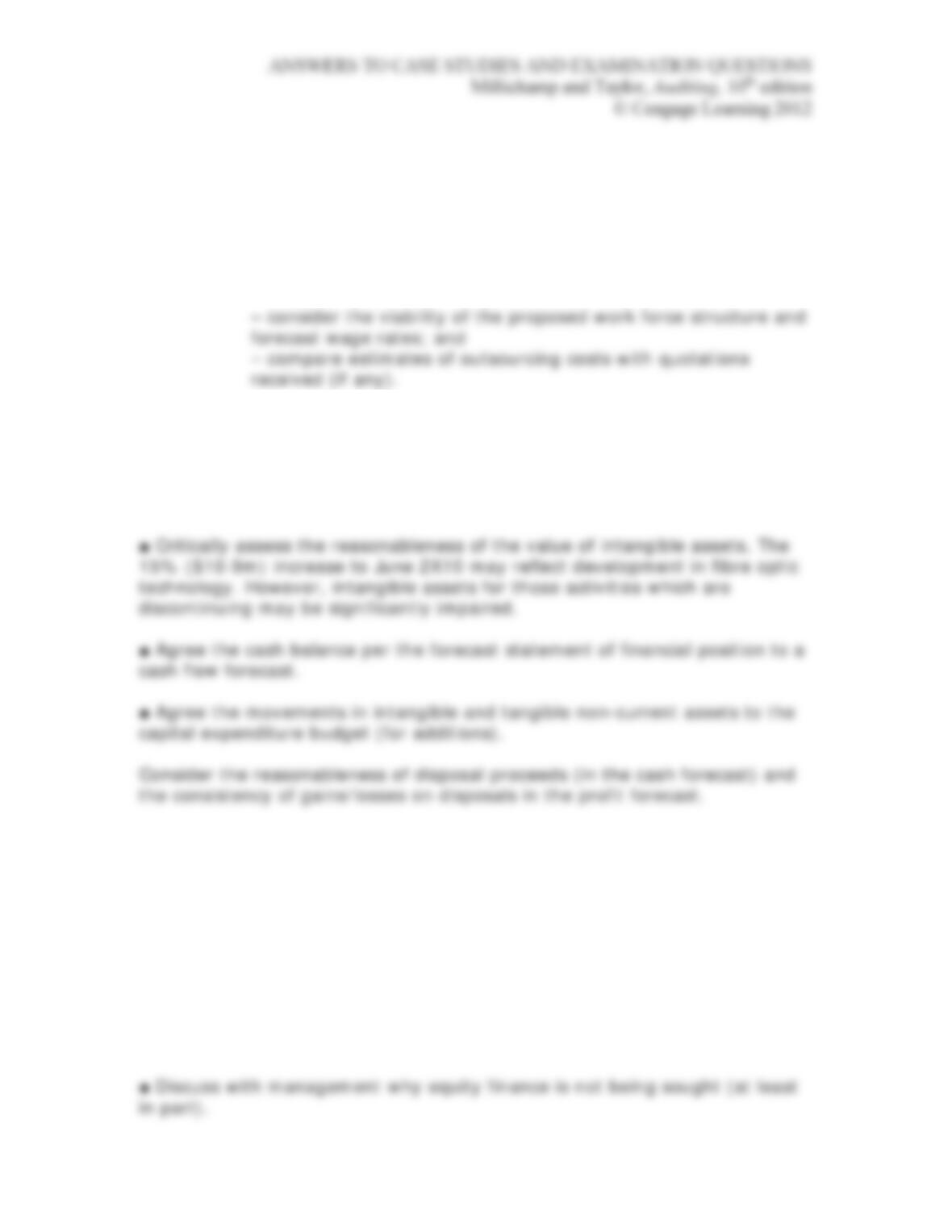
ŶAssess the adequacy of depreciation/amortisation charges against the
capital expenditure budget (additions) and the consistency of rates used in
the preparation of financial statements.
ŶReview cost levels against available information for reasonableness. For
example:
Forecast statement of financial position
ŶDiscuss with management the need for and adequacy of provisions for the
discontinuance of electrical and telecommunications accessories and
household durables.
ŶAgree validity of movements on reserves (net reduction) and accumulated
profits (negligible increase). For example, agree to forecast profit and
consider whether there is any ‘recycling’ (e.g. of a revaluation surplus).
ŶAgree the movement of interest-bearing borrowings (in particular) to the
cash flow forecast.
ŶAssess the impact of disposals of assets (for the discontinuing operations)
on existing interest-bearing borrowings. For example, consider whether the
terms of the loans may make them repayable if securitised assets are
disposed of.

174