Chapter 3—Review of a Company’s Accounting System Key
1. Which of the following is a contra account?
2. Which T-account is incorrect?
3. Which accounts are increased with debits?
4. Which of the following is a permanent account?
5. Which of the following is a nominal account?
6. In terms of debits and credits, which types of accounts will have the same (debit or credit) normal balances?
7. Information related to the Franklin Company for the calendar year 2010 follows:
Liabilities, December 31, 2010
$400
Assets, December 31, 2010
700
Dividends distributed during 2010
90
Liabilities, December 31, 2009
250
Assets, December 31, 2009
350
Assuming no capital stock was issued during 2010, the net income earned by the Jones Company during 2010 was
9. Which of the following is an economic resource that should be depreciated over the accounting periods
estimated to be benefited?
10. Which of the following rules is incorrect?
11. When you prepare a journal entry, the standard format is to list all
12. Which of the following errors will be detected by a trial balance?
13. The basic purpose of a trial balance is to
14. What relationship exists between the general journal and the general ledger?
15. The entire group of accounts for a company is referred to as the
16. An example of a transposition is
17. A prepaid expense is
18. The Cosmo Construction Company received $12,000 for six months rental income in advance on November
1, 2010, and credited the Rental Revenue account. The required adjusting entry on December 31, 2010, would
include a
19. Which of the following adjusting entries involves the recognition of an accrued expense?
20. On March 31, 2010, the Trident Company purchased a two-year fire insurance policy. Tricot recorded the
purchase by debiting Prepaid Insurance and crediting Cash for $12,000. Which of the following adjusting
entries should Trident prepare at the end of 2010?
21. Adjusting entries are made
22. On April 1, 2010, Milligan Company paid $5,280 for a two-year insurance policy. On that date, the
company charged an asset account. The correct December 31, 2010, adjusting entry would be
23. On August 1, 2010, Green Company paid $4,320 for a three-year insurance policy. On that date, an expense
account was charged. In the adjusting entry on December 31, 2010, there would be a
24. On June 1, 2010, Whipple Corporation received $2,520 in advance for a two-year rental of some land and
properly credited Unearned Rent. In the adjusting entry at December 31, 2010, there would be a
25. On February 1, 2010, Zeus Company received $36,000 in advance for a three-year rental of land, and
credited Rent Revenue. The correct December 31, 2010 adjusting entry would be
26. On May 1, 2010, Arch Corporation borrowed $2,500 on a two-year, 6% note payable. Interest is due and
payable at the end of each six months. Arch makes all interest payments on schedule. The correct December 31,
2010, adjusting entry would be
27. Posting is the procedure of transferring information from the
28. Which of the following is an accrued expense?
29. An accrued expense is an expense
30. When cash is debited for rents that are collected but are not yet earned, the amount credited should be
31. The balance in deferred (unearned) revenue accounts represents amounts that are
Earned
Collected
I.
Yes
No
II.
Yes
Yes
III.
No
No
IV.
No
Yes
32. Rental receipts for the period July 1, 2010, through June 30, 2011, were collected on June 30, 2010. The
effects of these economic events on the 2010 financial statements for unearned revenue and rent revenue are
Unearned Revenue
Rent Revenue
I.
Increase
Increase
II.
Increase
Decrease
III.
Decrease
No effect
IV.
Decrease
Increase
33. An adjusting entry normally affects
34. The Rogers Company uses the straight-line method to depreciate its equipment. On May 1, 2010, the
company purchased some equipment for $200,000. The equipment is estimated to have a useful life of ten years
and a salvage value of $20,000. If depreciation is to be recorded for each month the equipment is owned, how
much depreciation expense should Rogers record for the equipment in the adjusting entry on December 31,
2010?
35. On November 1, 2010, the Morrison Company purchased a two-year umbrella insurance policy for $3,000
and recorded the transaction by debiting Prepaid Insurance and crediting Cash. Which of the following
adjusting entries would be used by Morrison to properly account for prepaid insurance on December 31, 2010?
36. On June 1, 2010, Barker Industries purchased a one-year comprehensive insurance policy and paid the
annual premium of $12,000. Which of the following could not result from the acquisition of the insurance
coverage on June 1?
37. Accrued revenues
38. The Victor Company rents numerous properties throughout the year. Victor pays rents in advance in some
cases, and in others, rents are paid after the rental period expires. The following data are included in Victor’s
December 31 balance sheets:
2010
2011
Prepaid Rents
$70,000
$30,000
Rent Payable
$50,000
$35,000
During 2011, Victor paid $200,000 in rentals. In its income statement for the year ended December 31, 2011, Victor should report rent expense of
39. Which of the following is not a type of adjusting entry?
40. The accountant failed to make the adjusting entry to record the amount of interest owed on a note to the
bank at the end of the year. This error would cause an overstatement of
41. Prior to preparing the organization’s financial statements, the accountant prepares
42. The accountant failed to make the adjusting entry to record the unpaid wages of its employees as of
December 31. This error will cause
43. The accountant failed to make the adjusting entry to record the depreciation for the year. This error would
cause
44. The purpose of closing entries is to
45. Which of the following accounts would not be closed to Income Summary during the year-end closing
process?
46. With closing entries, you would expect to find all of the following except
47. On October 1, 2010, Billy’s Beach Umbrellas borrowed $2,000 on a 12%, one-year note payable. Interest
was payable semiannually. A correct adjusting entry was made on December 31, 2010, and a correct reversing
entry was made on January 1, 2011. The entry that should be made on March 31, 2011, is
48. Which of the following adjusting entries would not be reversed in the following accounting period?
49. If the credit subtotal is greater than the debit subtotal in the Income Statement columns of a worksheet, the
difference
50. On a worksheet, which account will not be extended to the Balance Sheet columns?
51. Which statement is true?
52. On a worksheet, the balance in the accumulated depreciation account should be extended to which column?
53. The Yellow Company made year-end adjusting entries affecting each of the following accounts: Office
Salaries Payable (credited); Depreciation Expense (debited); Unearned Rental Revenue (debited); and Prepaid
Insurance (credited). Which account is likely to appear in Yellow’s reversing entries?
54. Which of the following adjusting entries would be the most likely to be reversed?
55. The Thomas Company has an accounts receivable account in its general ledger, and it also maintains a
subsidiary ledger that contains an individual account for each of its customers who buys merchandise on credit.
Which of the following statements about the general ledger account is not true?
56. When reconciling its accounts, Ajax Company found the accounts receivable general ledger account had a
balance of $30,000, and the accounts receivable subsidiary ledger account balances totaled $28,000. The most
likely reason for this difference was
57. An organization will typically utilize a subsidiary ledger to
58. The total of the individual customer account balances should equal the balance in Accounts Receivable,
which is the
59. Which of the following transactions would be recorded in a sales journal of the type illustrated in the text?
60. Marge Company has all of the special journals that were described in your text (other than the voucher
register) as a part of its accounting system. Which of the following journal entries would therefore be recorded
in Marge’s general journal?
61. Which statement is true?
62. Which statement is not true?
63. The Clipper, Inc., uses the accrual basis of accounting. Clipper’s rent expense account had a $14,000
balance at the end of the year. The prepaid rent account had a $5,000 balance at the beginning of the year and a
$7,000 balance at the end of the year. How much cash was paid for rent during the year?
64. The Waller Company uses the accrual basis of accounting. Waller Company’s wages expense account had a
$510,000 balance at the end of the year. The wages payable account had a $23,000 balance at the beginning of
the year and a $45,000 balance at the end of the year. How much cash was paid for wages during the year?

65. The Slaughter Company uses the cash basis of accounting. Slaughter Company collected $850,000 from its
customers during 2010. Customers owed Slaughter $50,000 of accounts receivable at the beginning of 2010,
and $90,000 of accounts receivable at the end of 2010. What is Slaughter’s sales revenue for 2010 under the
accrual basis of accounting?
66. The Mercer Company uses the cash basis of accounting. Mercer Company made $500,000 in payments to
its suppliers during the year. Mercer’s beginning inventory was $20,000, and its ending inventory was $35,000.
In addition, Mercer had a beginning accounts payable of $50,000 and an ending accounts payable of $70,000.
What is Mercer’s cost of goods sold under the accrual basis of accounting?
67. The Cutter, Inc. uses the accrual basis of accounting. Cutter’s insurance expense account had a $25,000
balance at the end of the year. The prepaid insurance account had a $5,000 balance at the beginning of the year
and a $1,000 balance at the end of the year. How much cash was paid for insurance during the year?
68. The Small Company uses the cash basis of accounting. Small Company made $28,000 in payments to its
suppliers during the year. Small’s beginning inventory was $2,000, and its ending inventory was $1,000. In
addition, Small had a beginning accounts payable of $7,000 and an ending accounts payable of $4,000. What is
Small’s cost of goods sold under the accrual basis of accounting?

69. Several accounts are listed below:
a.
Purchases Returns and Allowances
b.
Sales Discounts
c.
Wages Expense
d.
Allowance for Doubtful Accounts
e.
Unearned Rent
f.
Income Taxes Payable
g.
Dividends Distributed
h.
Interest Revenue
i.
Inventory
Required:
List the accounts above that would normally have a credit balance.
70. Several accounts are listed below:
____
a.
Cash
____
b.
Retained Earnings
____
c.
Unearned Subscriptions Revenue
____
d.
Purchases Discounts Taken
____
e.
Accounts Payable
____
f.
Accumulated Depreciation
____
g.
Dividends Distributed
____
h.
Sales Revenue
____
i.
Capital Stock
____
j.
Rent Expense
____
k.
Prepaid Insurance
____
l.
Interest Income
Required:
In the space to the left of each account, place a (P) if the account is a permanent (or real) account or a (T) if the account is a temporary account.
71. Events concerning the Elton Company for 2010 are described below:
a.
On September 1, 2010, a two-year comprehensive insurance policy was purchased for $3,600. The payment was debited to Prepaid
Insurance.
b.
On December 1, 2010, a customer paid $950 in advance for services to be performed in January of 2011. The payment was credited to
Unearned Revenue.
c.
On January 1, 2010, the office supplies account had a $250 balance. Supplies costing $2,500 were purchased during the year. At
December 31, an inventory count showed $100 of supplies on hand.
d.
On December 31, 2010, $3,200 of unpaid employee salaries had accumulated. No entry for these salaries has been recorded.
e.
Straight-line depreciation is recorded only at year-end and is being used for a building that was purchased at the beginning of 2005 for
$25,000, with an expected life of 30 years and an estimated residual value of $2,500.
f.
The income tax rate is 30% on current income. Pretax income before the above adjusting entries was $38,700.
Required:
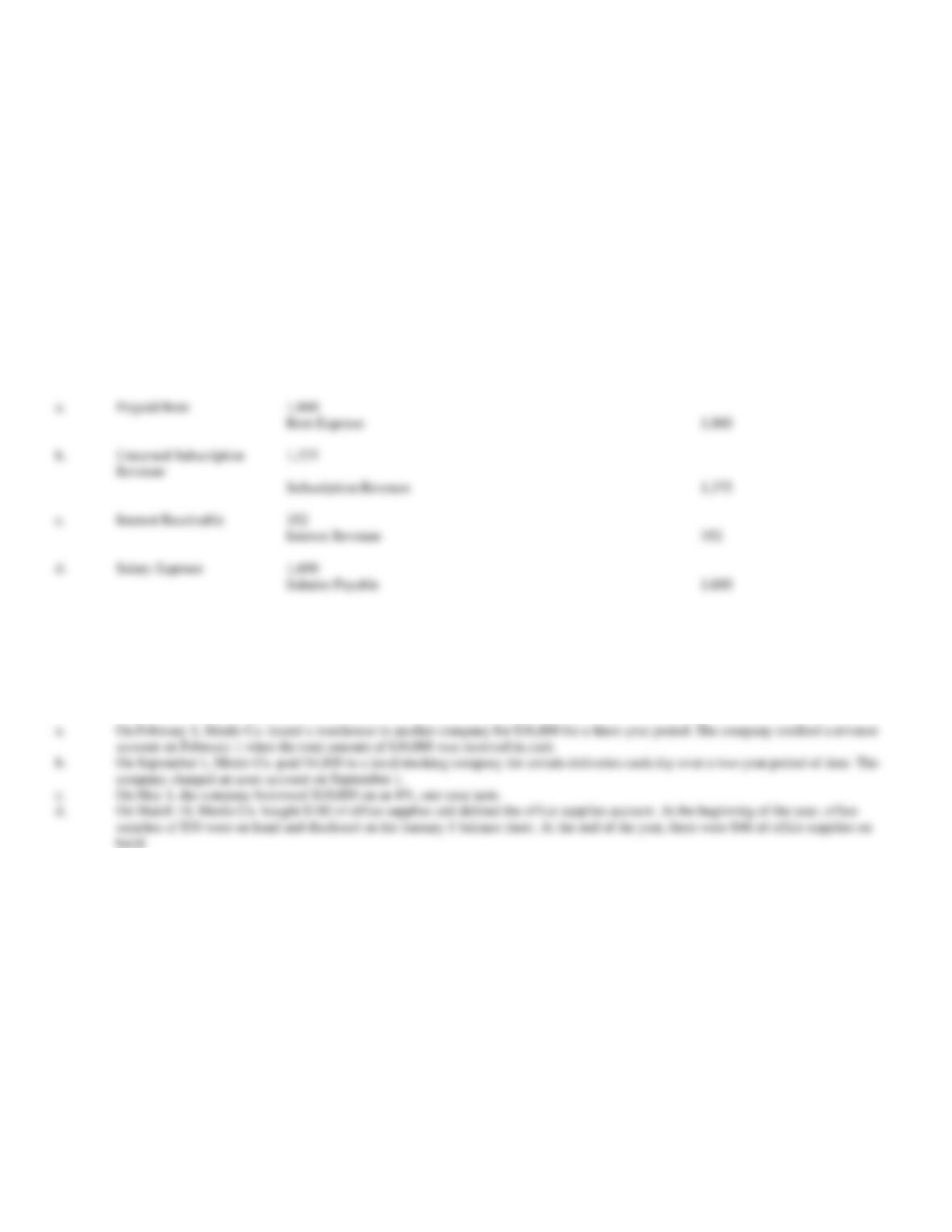
Prepare the appropriate December 31, 2010, adjusting entry for each item, or indicate that an adjusting entry is not necessary. Assume that Elton’s
transactions were initially recorded in real (balance sheet) accounts unless otherwise indicated.
Insurance Expense ($3,600 ´ 4/24)
Prepaid Insurance
600
No adjusting entry necessary
Office Supplies Expense
2,650
Office Supplies
2,650
Salaries Expense
3,200
Salaries Payable
3,200
Depreciation Expense-Building
Accumulated Depreciation-Building
f.
Income Tax Expense
9,450
Income Taxes Payable
9,450
0.3 ($38,700 – 600 – 2,650 – 3,200 – 750) = $9,450
P
T
P
T
P
P
d.
T
T
P
P
f.
P
T
72. Several transactions for Buckner, Inc., are presented below. The company adjusts its books only at year-end.
a.
On August 1, the company rented some land from another company for $2,160 for a three-year time period. Buckner charged an
expense account on August 1.
b.
On February 1, Buckner received $6,000 for a four-year technical service contract. Buckner is performing the services evenly over the
four-year period. The company credited a liability account on February 1.
c.
On May 1, Buckner loaned $4,400 to another company on a 12%, one-year note.
d.
The weekly (five-day) payroll of Buckner amounts to $2,000. All employees are paid at the close of business each Friday. December 31
falls on a Thursday.
Required:
Prepare adjusting entries for December 31.
73. Several transactions for Menlo Co. are presented below. The company adjusts its books only at year-end.
On February 1, Menlo Co. leased a warehouse to another company for $36,000 for a three-year period. The company credited a revenue
account on February 1 when the total amount of $36,000 was received in cash.
On September 1, Menlo Co. paid $4,800 to a local trucking company for certain deliveries each day over a two-year period of time. The
c.
On May 1, the company borrowed $10,000 on an 8%, one-year note.
a.
Prepaid Rent
1,860
Unearned Subscription
Revenue
1,375
c.
Interest Receivable
Interest Revenue
Salary Expense
1,600
Salaries Payable
1,600
Required:
Prepare adjusting entries for December 31.
74. Triple Play Company engaged in the following transactions during the month of August:
August 4
Purchased $2,000 of merchandise on account, terms 1/10, n/30.
5
Returned $300 of the merchandise purchased on Aug. 4 because it was defective.
6
Purchased a machine for $4,000. Paid 20% down and signed an 8%, two-month note for the balance.
8
Purchased $800 of merchandise and paid $820, which included freight.
13
Paid the balance due on the purchase of Aug. 4.
Required:
Record these transactions in a general journal, assuming Triple Play uses a periodic inventory system.
Aug. 4
Purchases
2,000
Accounts Payable
2,000
5
Accounts Payable
300
Purchase Returns & Allowances
300
6
Machinery
4,000
Cash
800
Notes Payable
3,200
8
Purchases
800
20
Cash
820
13
Accounts Payable
1,700
Purchases Discounts
17
Cash
1,683
Rent Revenue
25,000
Unearned Rent Revenue
25,000
Delivery Expense
Prepaid Delivery Expense
800
Interest Expense
533
Interest Payable
533
d.
Supplies Expense
164
Office Supplies
164
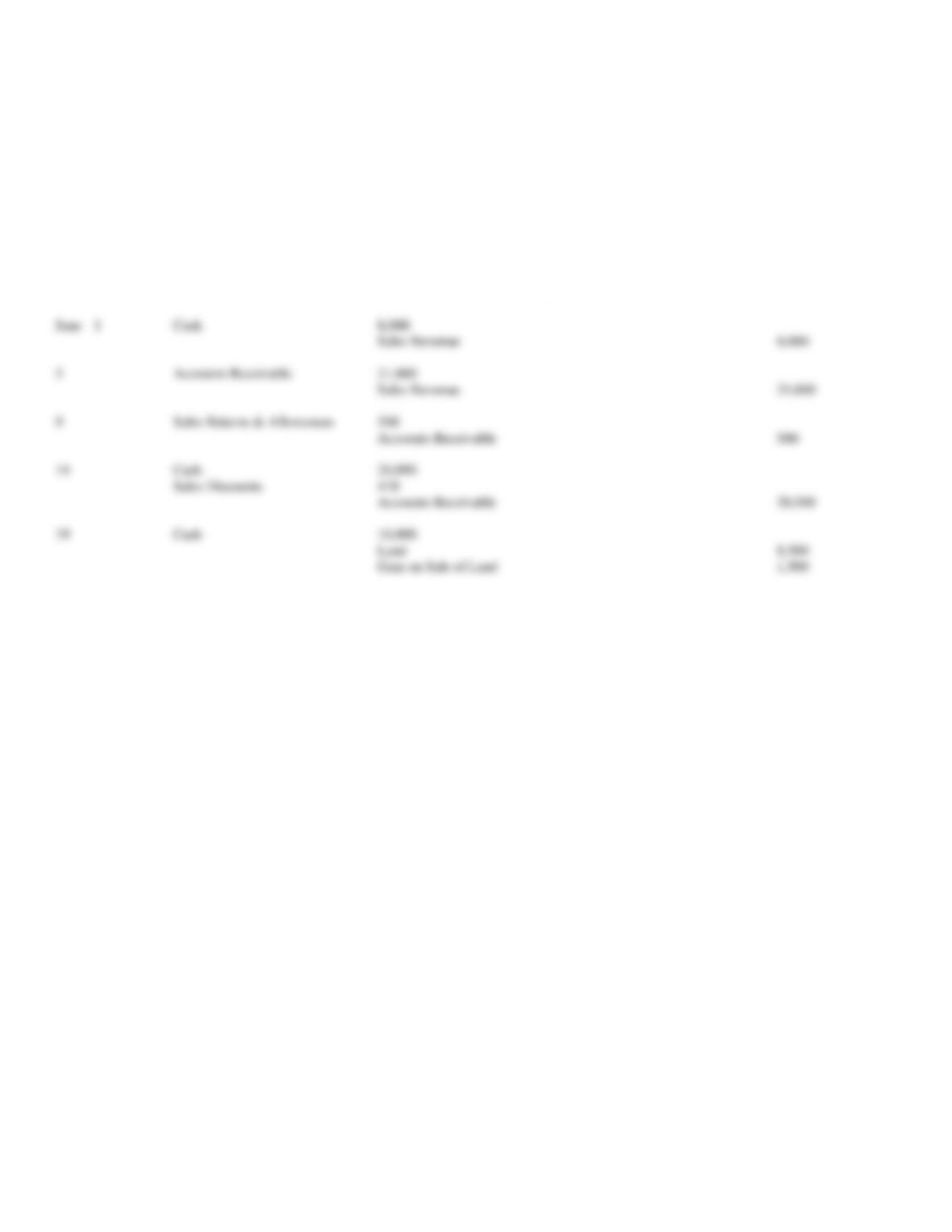
75. Fox Corp. engaged in the following transactions during the month of June:
June 1
Made cash sales of $8,000.
5
Made credit sales of $21,000, terms 2/10, n/30.
9
Customers returned $500 of merchandise from the June 5 sale because it was defective.
14
Received payment for balance due on the June 5 sale.
19
Sold land that had originally cost $8,500 for $10,000 cash.
Required:
Record these transactions in a general journal, assuming Fox uses a periodic inventory system.
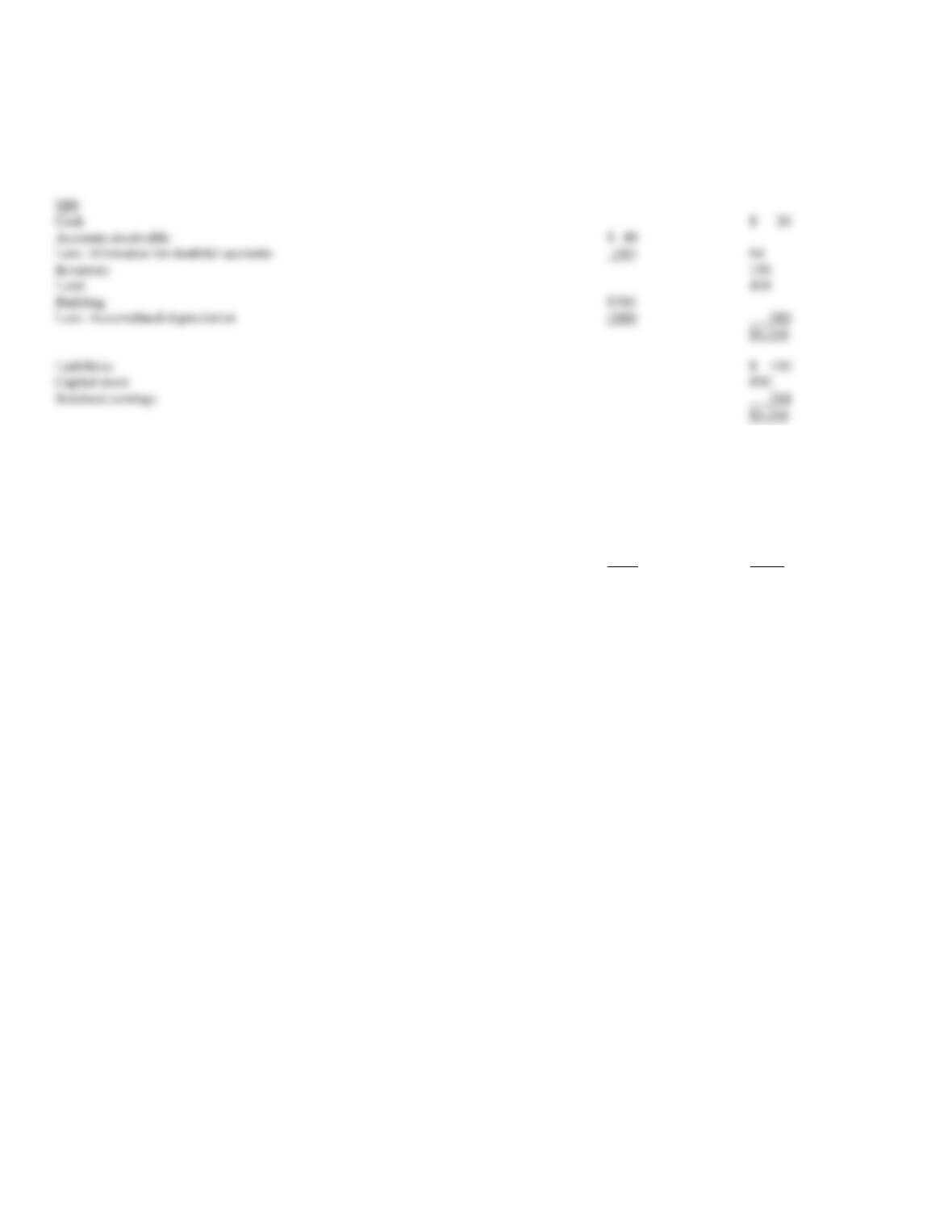
76. The following information was taken from the accounting records of Ace Builders at the end of the year.
Land
$424
Capital stock
850
Inventory
156
Accumulated depreciation-Building
180
Liabilities
150
Cash
20
Allowance for doubtful accounts
16
Retained earnings
244
Building
760
June 1
Cash
8,000
Sales Revenue
8,000
5
Accounts Receivable
21,000
Sales Revenue
21,000
9
Sales Returns & Allowances
500
Accounts Receivable
500
14
Cash
20,090
Sales Discounts
410
Accounts Receivable
20,500
19
Cash
10,000
Land
8,500
Gain on Sale of Land
1,500
Required:
Calculate the amount of gross accounts receivable.
77. The following are selected account balances of the Robertson Company:
Debit
Credit
Cash
$ 5,200
Inventory, January 1, 2011
8,000
Sales Salaries Expense
11,000
Sales Revenue
$97,000
Inventory, December 31, 2011
7,500
Sales Returns and Allowances
2,000
Accounts Receivable
22,000
Purchases Discounts Taken
1,000
Purchases Returns and Allowances
2,000
Sales Discounts Taken
1,500
Purchases
70,000
Freight-In
2,200
Prepaid Rent
7,000
Cash
$ 20
Accounts receivable
$ 80
Less: Allowance for doubtful accounts
(16)
Inventory
Land
Building
$760
Less: Accumulated depreciation
(180)
580
$1,244
Liabilities
$ 150
Capital stock
Retained earnings
244
$1,244