
32
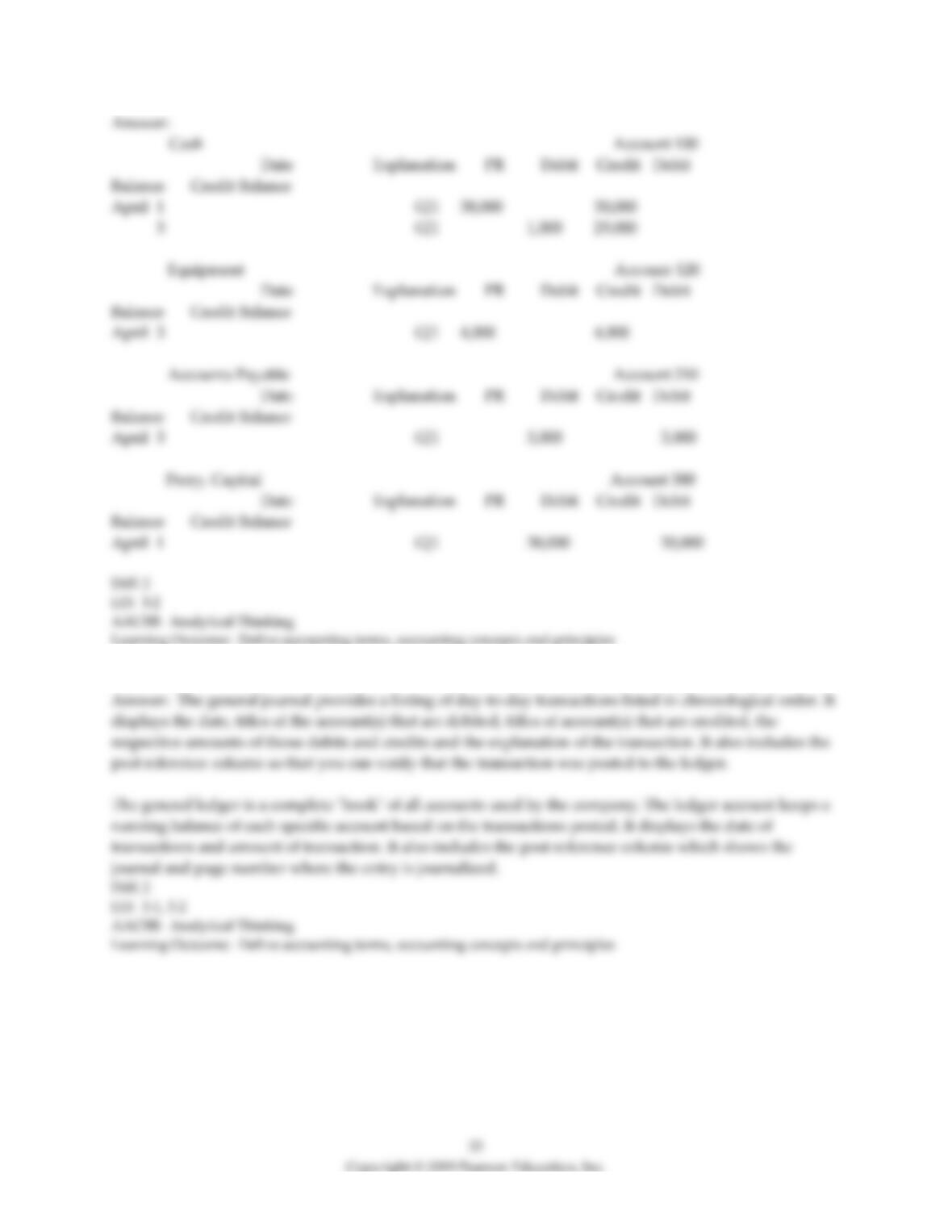
24) Post the following transactions to the ledger of Perry Company. The partial chart of accounts of Perry
Company is as follows:
100 Cash
120 Equipment
210 Accounts Payable
300 Perry, Capital
GENERAL JOURNAL Page 1
Date Acct. Titles and Description PR Debit Credit
April 1 Cash 30,000
Perry, Capital 30,000
Cash investment
April 5 Equipment 4,000
Cash 1,000
Accounts Payable 3,000
Purchased equipment
Cash Account 100
Date Explanation PR Debit Credit Debit
Balance Credit Balance
Equipment Account 120
Date Explanation PR Debit Credit Debit
Balance Credit Balance
Accounts Payable Account 210
Date Explanation PR Debit Credit Debit
Balance Credit Balance
Perry, Capital Account 300
Date Explanation PR Debit Credit Debit
Balance Credit Balance
25) Describe the difference in information contained in the general journal vs. the general ledger.
3.3 Learning Objective 3-3
1) If the debit and credit totals of a trial balance are not equal, it could be due to the following type of
error:
A) Failure to record a transaction
B) Recording the same erroneous amount for both the debit and the credit sides of a transaction
C) Incorrectly calculating the debit side total of the trial balance
D) Recording the same transaction more than once
2) If the business records a number as 971 and it should be 179, this error would be called:
A) a rearrangement.
B) a slide.
C) a transposition.
D) None of the above
3) If a trial balance is not equal, you should first:
A) re-compute the ledger balances.
B) trace all postings.
C) re-add the trial balance and calculate the difference.
D) match debits and credits in the journal.
4) Which of the following errors would cause the trial balance to be out of balance?
A) The payment of utilities expense was recorded as a debit to Rent Expense for $97 and a credit to Cash
for $97.
B) The payment of an account payable for $100 was recorded as a debit to Cash, $100, and a credit to
Accounts Payable, $100.
C) The collection of an account was not recorded.
D) The payment of an account payable for $700 was recorded as a debit to Accounts Payable for $700 and
a credit to Cash for $7,000.
5) Which of the following transactions would cause the trial balance to be out of balance?
A) A debit to Cash and a debit to Equipment for the same amount
B) A credit to Cash and a debit to Supplies for the same amount
C) A debit to Accounts Receivable and a credit to Accounting Fees for the same amount
D) All of these answers are correct.
6) A $1,500 check written for supplies was journalized and posted as $150. The entry to correct this error
is:
A) debit Supplies, $1,350; credit Cash, $1,350.
B) debit Cash, $1,350; credit Supplies, $1,350.
C) debit Supplies, $150; credit Cash, $150.
D) debit Cash, $150; credit Cash, $150.
7) Proof that the dollar amount of the debits equals the dollar amount of the credits in the ledger means:
A) all of the information from the journal was correctly transferred to the ledger.
B) all accounts have their correct balances in the ledger.
C) only the ledger is accurate; the journal may be incorrect.
D) only that the debit dollar amounts equal the credit dollar amounts.
8) In preparing the trial balance of the J&J’s Bridal Service, the Withdrawals account (which had a normal
balance in the general ledger) was listed as a credit for $900. What will be the difference between the debit
and credit sides of the trial balance?
A) $100
B) $210
C) $310
D) $1,800
9) The trial balance:
A) includes all accounts with a ledger balance.
B) includes assets, liabilities, capital, withdrawals, revenues and expenses.
C) ensures that debits equal credits.
D) All of the above are correct.
10) To correct an error made in the journal (prior to posting in the ledger):
A) erase the error and write the correct entry.
B) write a new journal entry correcting the original entry.
C) No adjustment is required.
D) None of the above is correct.
11) When the trial balance includes a debit column total of $10,390 and a credit column total of $10,910, it
is probable that:
A) a transposition error occurred.
B) a $260 debit was recorded twice.
C) a $260 credit was recorded twice.
D) a $260 debit was recorded as a credit.
12) The trial balance lists the accounts:
A) alphabetically.
B) in the same order as in the ledger.
C) all debits first and then credits.
D) in the order of highest dollar value.
13) A trial balance is a list of the accounts and their ledger balances.
14) The trial balance proves the accuracy of the ledger.
15) A slide is evenly divisible by the number 8.
16) The trial balance listing is in the opposite order of the chart of accounts.
17) Journalizing a transaction with both the debit and the credit for $87 instead of the correct amount of
$78 will cause the trial balance to be out of balance.
18) If the trial balance is in balance, it proves that all transactions were properly journalized.
19) Correctly posting a transaction twice will cause the trial balance totals to be unequal.
20) A slide is an error that results when zeros have been added or deleted when writing an amount.
Example: 10,000 is written as 1,000.
21) The order of the flow of accounting data is to (1) post in a ledger, (2) record in a journal, (3) prepare a
trial balance.
22) The dollar amount of the debits must be equal to the dollar amount of the credits for each transaction.
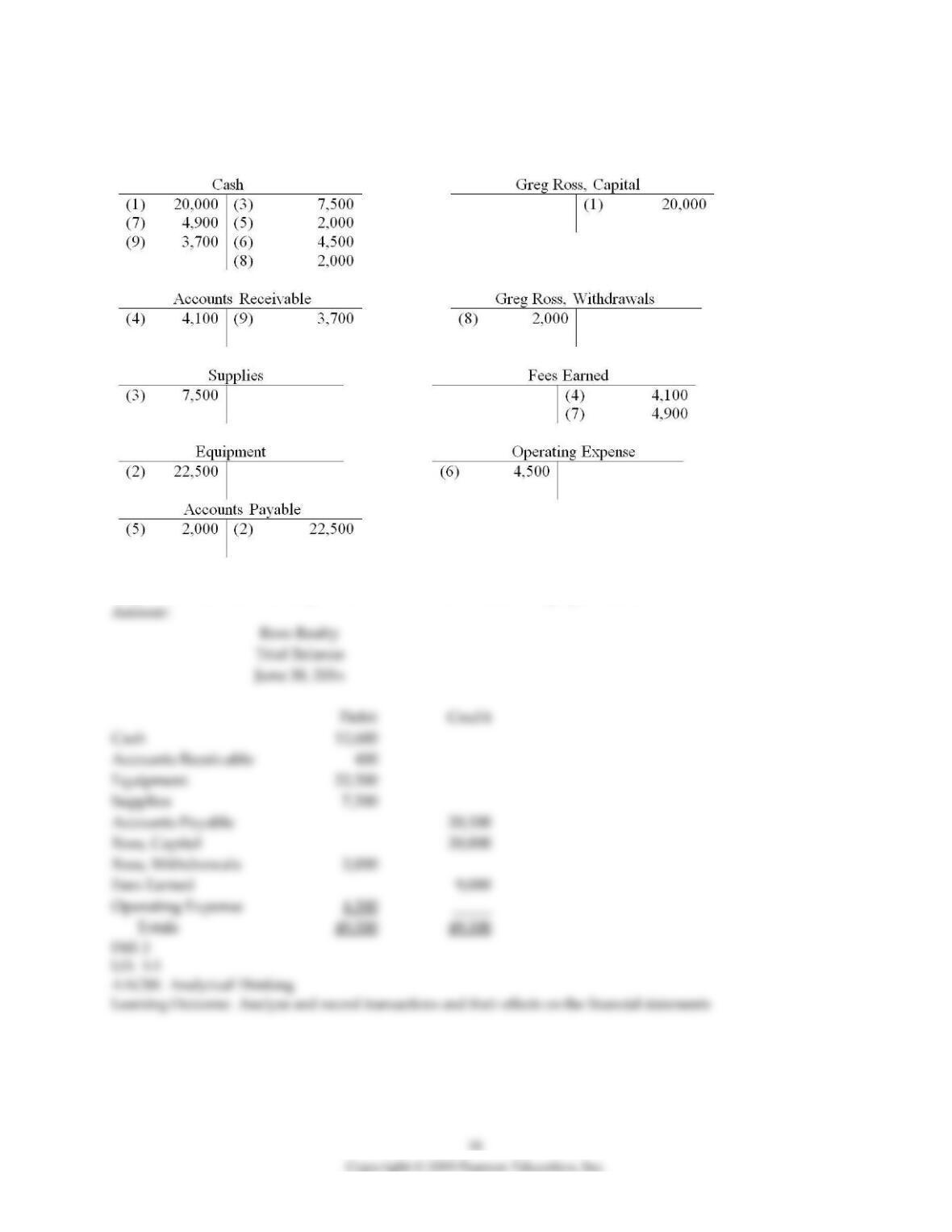
23) All nine transactions for Ross Realty for June, the first month of operation, are recorded in the
following T accounts:
Prepare a trial balance, listing the accounts and their balance in proper order.
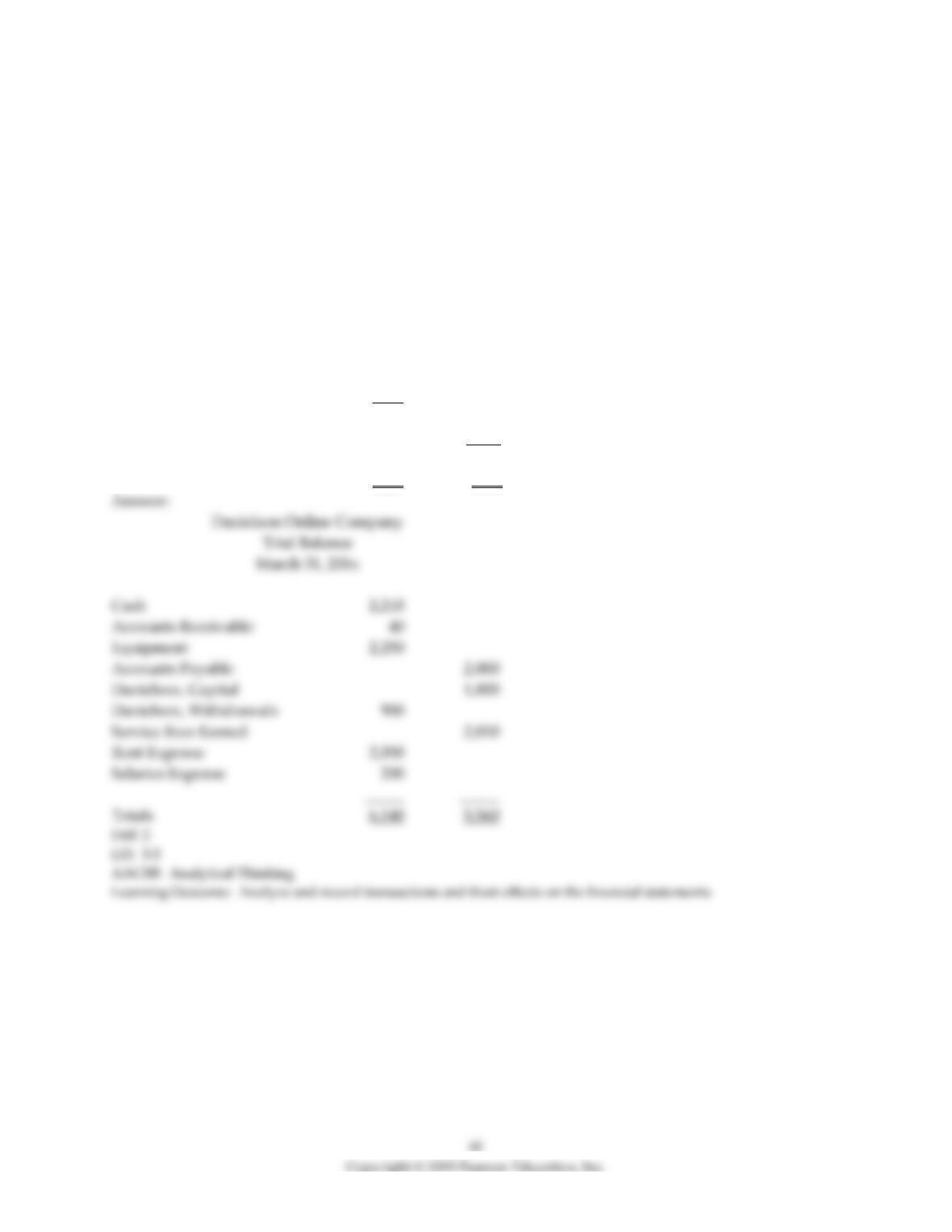
24) The following trial balance has been improperly completed. All the accounts have normal balances.
Prepare a corrected trial balance in good form.
Danielson Online Company
Trial Balance
March 31, 201x
Salaries Expense 200
Rent Expense 250
Accounts Receivable 40
Equipment 2,250
Danielson, Capital 1,800
Danielson, Withdrawals 900
Service Fees Earned 2050
Accounts Payable 2,000
Cash 2,210
Totals 6140 5560
25) John, a new employee, is not sure of the effect the following unrelated situations would have on the
accuracy of the financial statements. Identify the account(s) that are affected and if the trial balance would
balance.
a. Equipment was purchased for $900 cash. The debit was recorded properly, but the credit was omitted.
b. A debit to Cash for $250 was posted as $2,500; the credit was posted correctly.
c. A purchase of supplies on account for $75 was posted as a debit to Supplies and a credit to Cash.