
101
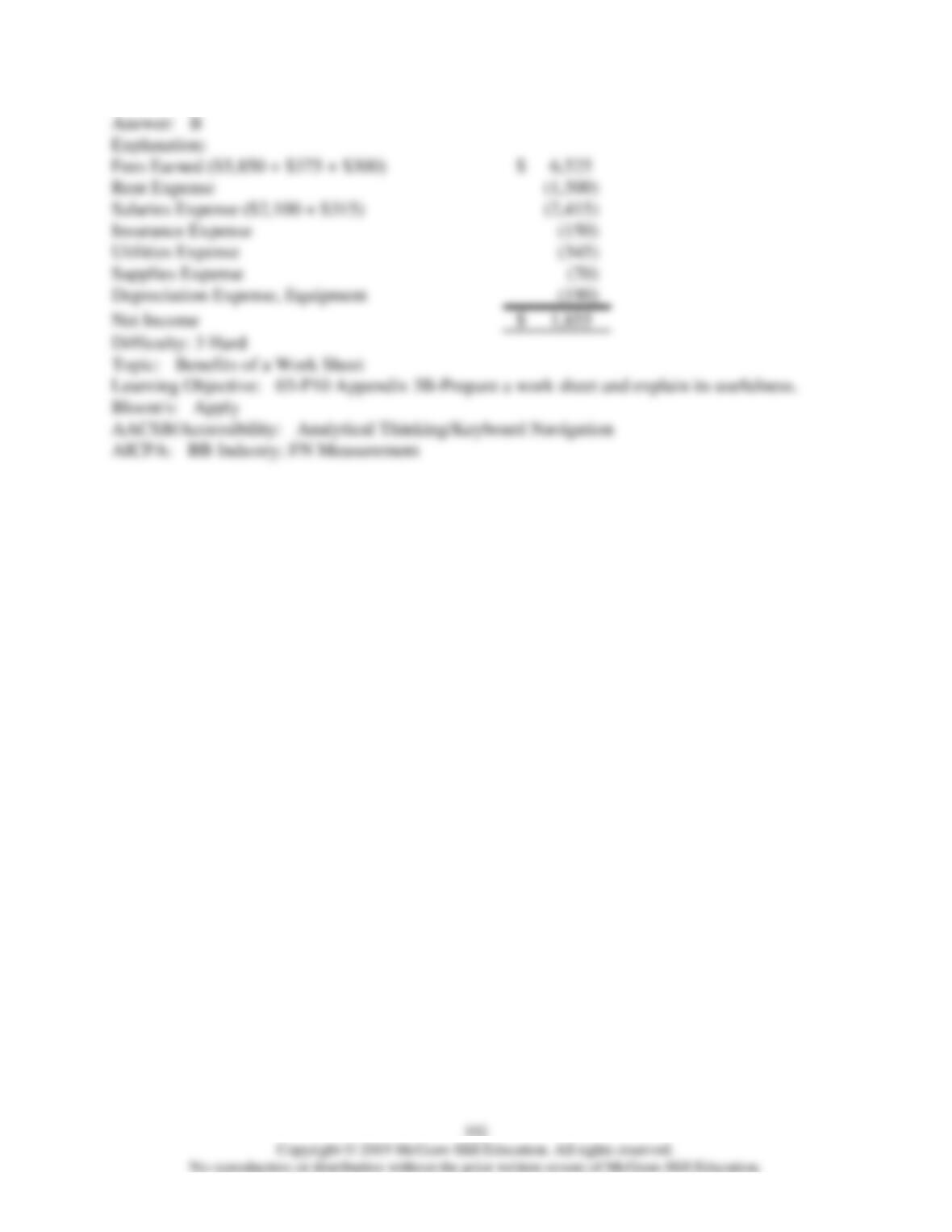
269) A company’s December 31 work sheet for the current period appears below. Based on the
information provided, what is net income for the current period?
Unadjusted Trial
Balance
Adjustments
Debit
Credit
Debit
Credit
Cash
975
Accounts receivable
300
Prepaid insurance
3,600
150
Supplies
180
70
Equipment
10,320
Accumulated depreciation—equipment
190
Accounts payable
1,140
Salaries payable
315
Unearned fees
4,500
375
Retained earnings
9,180
Dividends
1,650
Fees earned
5,850
375
300
Rent expense
1,500
Salaries expense
2,100
315
Utilities expense
345
Insurance expense
150
Supplies expense
70
Depreciation expense—equipment
190
Totals
20,670
20,670
1,400
1,400
A) $1,400.
B) $1,855.
C) $1,905.
D) $2,060.
E) $4,670.
270) A company’s December 31 work sheet for the current period appears below. Based on the
information provided, what is net income for the current period?
Unadjusted Trial
Balance
Adjustments
Debit
Credit
Debit
Credit
Cash
1,975
Accounts receivable
1,000
875
Prepaid insurance
1,600
650
Supplies
330
115
Equipment
8,320
Accumulated depreciation—equipment
720
190
Accounts payable
1,140
Retained earnings
9,110
Dividends
1,050
Fees earned
7,250
875
Rent expense
1,300
Salaries expense
2,300
Utilities expense
345
Insurance expense
650
Supplies expense
115
Depreciation expense—equipment
190
Totals
18,220
18,220
1,830
1,830
A) $3,305.
B) $4,180.
C) $2,350.
D) $2,540.
E) $3,225.
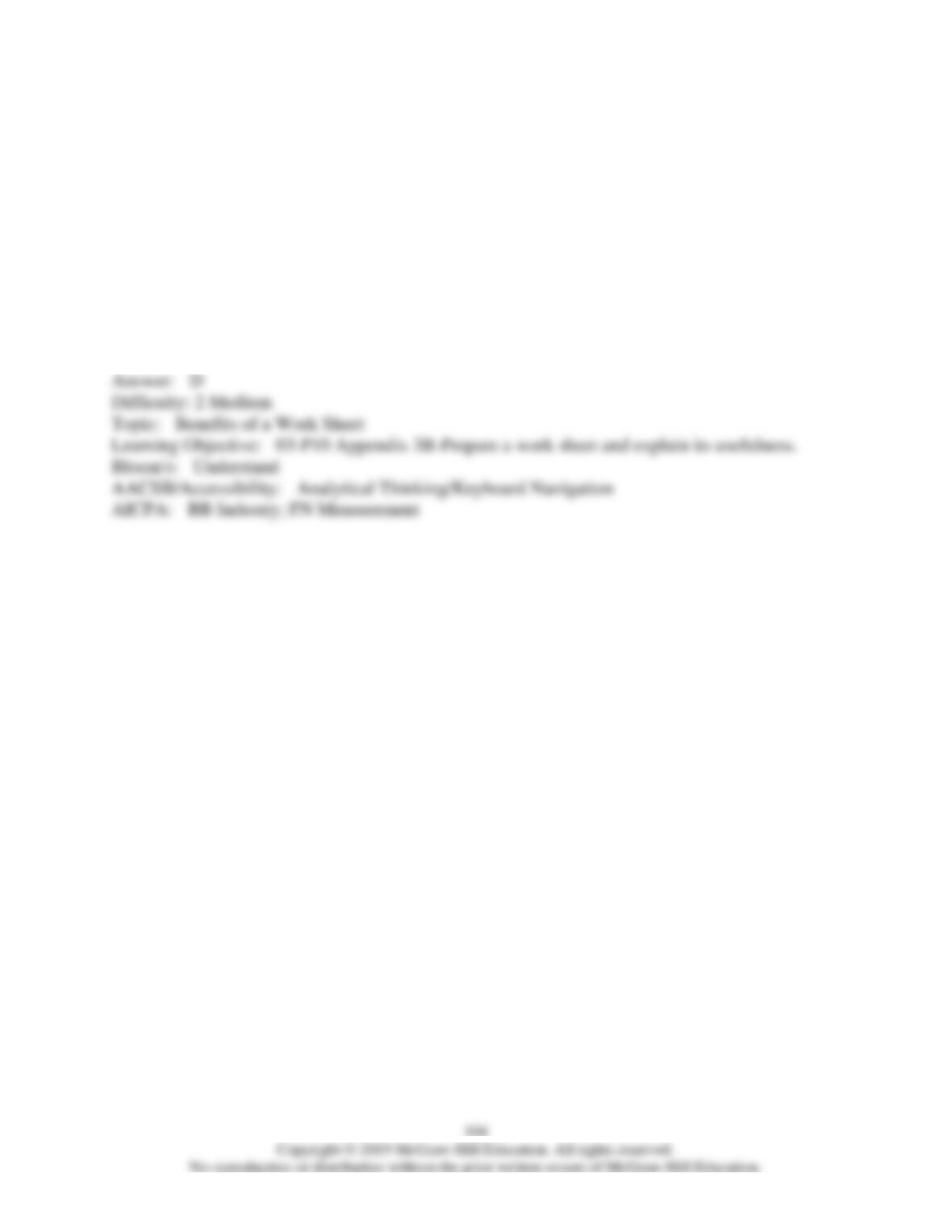
Fees Earned ($7,250 + $875)
$
Rent Expense
)
Salaries Expense
)
Insurance Expense
)
Utilities Expense
)
Supplies Expense
)
Depreciation Expense, Equipment
)
Net Income
$
271) Which of the following errors would cause the Balance Sheet and Statement of Retained
Earnings columns of a work sheet to be out of balance?
A) Entering an asset amount in the Income Statement Debit column.
B) Entering a liability amount in the Income Statement Credit column.
C) Entering an expense amount in the Balance Sheet and Statement of Retained Earnings Debit
column.
D) Entering a revenue amount in the Balance Sheet and Statement of Retained Earnings Debit
column.
E) Entering a liability amount in the Balance Sheet and Statement of Retained Earnings Credit
column.
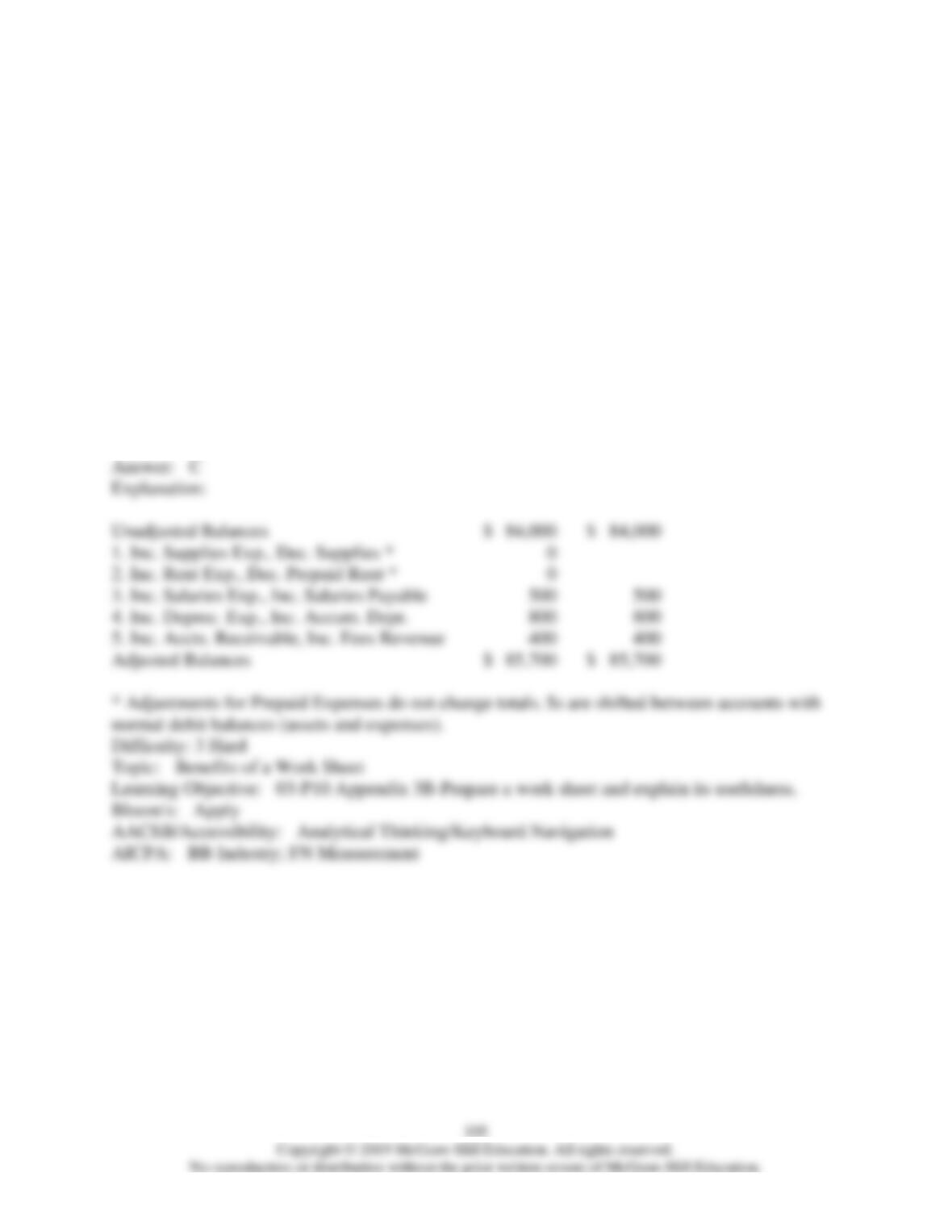
272) The Unadjusted Trial Balance columns of a work sheet total $84,000. The Adjustments
columns contain entries for the following:
1. Office supplies used during the period, $1,200.
2. Expiration of prepaid rent, $700.
3. Accrued salaries expense, $500.
4. Depreciation expense, $800.
5. Accrued service fees receivable, $400.
The Adjusted Trial Balance columns total is:
A) $80,400.
B) $84,000.
C) $85,700.
D) $85,900.
E) $87,600.
273) The balances in the unadjusted columns of a work sheet will agree with:
A) the balances reflected in the company’s financial statements.
B) the balances reflected in the company’s unadjusted trial balance.
C) whatever balances management has decided to report.
D) the balances in the company’s post-closing trial balance.
E) the balances management budgeted for the accounting period.
274) In the process of completing a work sheet, the accountant determines that the Income
Statement debit column totals $83,000, while the Income Statement credit column totals
$65,000. To enter net income (or net loss) for the period into the work sheet would require an
entry to
A) the Adjustments debit column and the Adjustments credit column.
B) the Unadjusted Trial Balance debit column and the Adjustments credit column.
C) it is not practical to enter Net Income (or Net Loss) on the work sheet.
D) the Balance Sheet & Statement of Retained Earnings debit column and the Income Statement
credit column.
E) the Income Statement debit column and the Balance Sheet & Statement of Retained Earnings
credit column.
275) The special account used only in the closing process to temporarily hold the amounts of
revenues and expenses before the net difference is added to (or subtracted from) the retained
earnings account is the:
A) Income Summary account.
B) Closing account.
C) Balance column account.
D) Contra account.
E) Nominal account.
276) Castillo Services paid K. Castillo, the sole shareholder of Castillo Services, $5,700 in
dividends during the current year. The entry to close the dividends account at the end of the year
is:
A) Debit Dividends $5,700; credit Cash, $5,700
B) Debit Retained earnings $5,700; credit Dividends $5,700
C) Debit Dividends $5,700; credit Retained earnings $5,700
D) Debit Retained earnings $5,700, credit Salary Expense $5,700
E) Debit Income Summary $5,700; credit Retained earnings $5,700
277) High Step Shoes had annual revenues of $185,000, expenses of $103,700, and dividends of
$18,000 during the current year. The retained earnings account before closing had a balance of
$297,000. The entry to close the Income Summary account at the end of the year, after revenue
and expense accounts have been closed, is:
A) Debit Retained earnings $297,000; credit Income Summary $297,000
B) Debit Retained earnings $63,300; credit Income Summary $63,300
C) Debit Income Summary $63,300; credit Retained earnings $63,300
D) Debit Income Summary $81,300, credit Retained earnings $81,300
E) Debit Retained earnings $81,300; credit Income Summary $81,300
278) High Step Shoes, had annual revenues of $185,000, expenses of $103,700, and paid
dividends of $18,000 during the current year. The retained earnings account before closing had a
balance of $297,000. The Net Income for the year is:
A) $185,000
B) $63,300
C) $81,300
D) $360,300
E) $378,300
279) High Step Shoes, had annual revenues of $185,000, expenses of $103,700, and paid
dividends of $18,000 during the current year. The retained earnings account before closing had a
balance of $297,000. The ending retained earnings balance after closing is:
A) $185,000
B) $63,300
C) $81,300
D) $360,300
E) $378,300
280) A company had revenues of $75,000 and expenses of $62,000 for the accounting period.
Dividends of $8,000 were paid in cash during the same period. Which of the following entries
could not be a closing entry?
A) Debit Income Summary $13,000; credit Retained earnings $13,000.
B) Debit Income Summary $75,000; credit Revenues $75,000.
C) Debit Revenues $75,000; credit Income Summary $75,000.
D) Debit Income Summary $62,000, credit Expenses $62,000.
E) Debit Retained earnings $8,000, credit Dividends $8,000.
281) The following information is available from the adjusted trial balance of the Harris
Vacation Rental Agency. After closing entries are posted, what will be the balance in the
Retained earnings account?
Total revenues
$
125,000
Total expenses
60,000
Retained earnings
80,000
Dividends
15,000
A) $65,000.
B) $80,000.
C) $130,000.
D) $145,000.
E) $280,000.
282) The following information is available for the Higgins Travel Agency. After closing entries
are posted, what will be the balance in the Retained earnings account?
Net Income
$
42,500
Retained earnings
130,000
Dividends
12,000
A) $75,500.
B) $184,500.
C) $99,500.
D) $160,500.
E) $130,000.
283) The following information is available for the Noir Detective Agency. After closing entries
are posted, what will be the balance in the Retained earnings account?
Net Loss
$
17,600
Retained earnings
289,000
Dividends
32,000
A) $239,400.
B) $274,600.
C) $303,400.
D) $289,000.
E) $257,000.
284) The Retained earnings account has a credit balance of $37,000 before closing entries are
made. If total revenues for the period are $55,200, total expenses are $39,800, and dividends are
$9,000, what is the ending balance in the Retained earnings account after all closing entries are
made?
A) $37,000.
B) $35,400.
C) $43,400.
D) $28,000.
E) $52,400.
285) The Retained earnings account has a credit balance of $37,000 before closing entries are
made. Total revenues for the period are $55,200, total expenses are $39,800, and dividends are
$9,000. What is the correct closing entry for the revenue accounts?
A) Debit Income Summary $55,200; credit Revenue accounts $55,200.
B) Debit Revenue accounts $37,000; credit Retained earnings $37,000.
C) Debit Revenue accounts $55,200; credit Retained earnings $37,000.
D) Debit Revenue accounts $55,200; credit Income Summary $55,200.
E) Debit Income Summary $37,000; credit Retained earnings $37,000.
286) The Retained earnings account has a credit balance of $37,000 before closing entries are
made. Total revenues for the period are $55,200, total expenses are $39,800, and dividends are
$9,000. What is the correct closing entry for the expense accounts?
A) Debit Income Summary $39,800; credit Expense accounts $39,800.
B) Debit Expense accounts $37,000; credit Retained earnings $37,000.
C) Credit Expense accounts $39,800; debit Retained earnings $39,800.
D) Debit Expense accounts $39,800; credit Income Summary $39,800.
E) Debit Income Summary $39,800; credit Retained earnings $39,800.
287) The Income Summary account is used to:
A) Adjust and update asset and liability accounts.
B) Close the revenue and expense accounts.
C) Determine the appropriate dividend amount.
D) Replace the income statement under certain circumstances.
E) Replace the Retained earnings account in some businesses.
288) A company paid Jen Rogers, its sole stockholder, a total of $35,000 in dividends during the
current year. The entry needed to close the dividends account is:
A) Debit Income Summary and credit Cash for $35,000.
B) Debit Dividends and credit Cash for $35,000.
C) Debit Income Summary and credit Dividends for $35,000.
D) Debit Retained earnings and credit Dividends for $35,000.
E) Debit Dividends and credit Retained earnings for $35,000.
289) A company’s ledger accounts and their end-of-period balances before closing entries are
posted are shown below. What amount will be posted to Retained earnings in the process of
closing the Income Summary account? (Assume all accounts have normal balances.)
Retained earnings
$
7,000
Dividends
9,600
Revenue
29,000
Rent expense
3,600
Salaries expense
7,200
Insurance expense
920
Depr. Expense-equipment
500
Accum depr.-equipment
1,500
A) $16,780 debit.
B) $7,180 credit.
C) $16,780 credit.
D) $18,280 credit.
E) $23,780 credit.
$
29,000
Credit
Debit
Debit
Debit
Debit
earnings
290) It is obvious that an error occurred in the preparation and/or posting of closing entries if:
A) all revenue and expense accounts have zero balances.
B) the Retained earnings account is debited for the amount of the net loss for the period.
C) the income summary account is debited for the amount of net income for the period.
D) all balance sheet accounts have zero balances.
E) only permanent accounts appear on the post-closing trial balance.
291) At the beginning of the year, a company’s balance sheet reported the following balances:
Total Assets = $225,000; Total Liabilities = $25,000; Total Paid-in capital of $100,000; and
Retained earnings = $100,000. During the year, the company reported revenues of $46,000 and
expenses of $30,000. In addition, dividends for the year totaled $20,000. Assuming no other
changes to Retained earnings, the balance in the Retained earnings account at the end of the year
would be:
A) $116,000.
B) $136,000.
C) $24,000.
D) $96,000.
E) $104,000.
292) At the beginning of the year, Sigma Company’s balance sheet reported Total Assets of
$195,000; Total Liabilities of $15,000; and Total Paid-in capital of $60,000. During the year, the
company reported total revenues of $226,000 and expenses of $175,000. Also, dividends during
the year totaled $48,000. Assuming no other changes to Retained earnings, the balance in the
Retained earnings account at the end of the year would be:
A) $174,000.
B) $78,000.
C) $171,000.
D) $120,000.
E) $123,000.
293) After preparing and posting the closing entries for revenues and expenses, the income
summary account has a debit balance of $33,000. The entry to close the income summary
account will be:
A) Debit Dividends $33,000; credit Income Summary $33,000.
B) Debit Income Summary $33,000; credit Dividends $33,000.
C) Debit Income Summary $33,000; credit Retained earnings $33,000.
D) Debit Retained earnings $33,000; credit Income Summary $33,000.
E) Credit Retained earnings $33,000; debit Dividends $33,000.
294) The trial balance prepared after all closing entries have been journalized and posted is
called the:
A) Unadjusted trial balance.
B) Post-closing trial balance.
C) General ledger.
D) Adjusted trial balance.
E) Work sheet.
295) Which of the following accounts showing a balance on the post-closing trial balance
indicate an error?
A) Office Equipment.
B) Accumulated Depreciation-Office Equipment.
C) Depreciation Expense-Office Equipment.
D) Retained earnings.
E) Salaries Payable.
296) Which of the following accounts showing a balance on the post-closing trial balance
indicate an error?
A) Land.
B) Dividends.
C) Accounts Payable.
D) Unearned Revenue.
E) Prepaid Insurance.
297) Which of the following statements is true?
A) Retained earnings must be closed each accounting period.
B) A post-closing trial balance should include only permanent accounts.
C) The work sheet can be substituted for preparing financial statements.
D) By using a work sheet to prepare adjusting entries you need not post these entries to the
ledger accounts.
E) Closing entries are only necessary if errors have been made.
298) Reversing entries:
A) Are optional.
B) Are mandatory.
C) Correct errors in journal entries.
D) Are required by GAAP.
E) Are prepared on the worksheet.
299) Karl Company accrued wages of $7,350 that were earned by employees unpaid at the year-
end. Assuming Karl uses reversing entries, which of the following entries correctly reverses the
accrued wages at the beginning of the following year?
A) Debit Wages Expense $7,350; credit Cash $7,350.
B) Debit Wages Expense $7,350; credit Wages Payable $7,350.
C) Debit Wages Payable $7,350; credit Cash $7,350.
D) Debit Cash $7,350; credit Wages Expense $7,350.
E) Debit Wages Payable $7,350; credit Wages Expense $7,350.
300) All of the following regarding reversing entries are true except:
A) Reversing entries are optional.
B) Reversing entries are recorded in response to accrued assets and accrued liabilities that were
created by adjusting entries at the end of the previous accounting period.
C) Reversing entries are used to simplify a company’s record keeping.
D) Reversing entries are dated the first day of the new accounting period.
E) Reversing entries should not be the exact opposite of previous period adjusting entries.
301) Reversing entries:
A) Are necessary when journal entries have been incorrectly recorded.
B) Are a required step in the accounting cycle.
C) Will often result temporarily in abnormal account balances in some accounts.
D) Are required only if the company uses accounting software to record journal entries.
E) Must be made before preparing the post-closing trial balance.
302) The purpose of reversing entries is to:
A) Simplify a company’s recording of certain journal entries in the future.
B) Correct errors made in previous journal entries.
C) Ensure that closing entries have been properly posted to the ledger accounts.
D) Make certain that only permanent accounts are carried forward into the next accounting
period.
E) Complete a required step in the accounting cycle.
303) All of the following statements regarding a work sheet are true except:
A) A worksheet aids in the preparation of financial statements.
B) A worksheet reduces possible errors when working with many accounts and adjustments.
C) A worksheet is not useful in planning and organizing an audit of financial statements.
D) A worksheet helps in preparing interim financial statements.
E) A worksheet shows the effects of proposed or “what-if” transactions.