KEY: Cash flow and current assets MSC: ACBSP-APC-09-Financial Statements
128. Unearned Revenue was $600 at the end of February and $750 at the end of March. Service Revenue
was $4,200 for the month of March. How much cash was received from revenue during March?
a.
$5,550
b.
$4,050
c.
$2,850
d.
$4,350
SHORT ANSWER
1. Which two broad account categories are used to determine net income? Define each category and list
two examples of each type.
2. How and why is the matching rule applied to the cost of a building?
3. What are the three things that must be done in order to accomplish accrual accounting?
4. What is the purpose of adjusting entries?
5. Distinguish between a deferral and an accrual.
6. In the space below, state whether each situation is a deferral or an accrual.
______
a.
Unrecorded interest on savings bonds is $1,530.
______
b.
Property taxes that have been incurred but that have not yet been paid or
recorded amount to $2,068.
______
c.
Legal fees of $5,780 were collected in advance. By year end, 60 percent
were still unearned.
______
d.
Prepaid Insurance had an $1,800 balance prior to adjustment. By year end,
50 percent was still unexpired.
______
e.
Salaries earned by employees by year end but not yet paid or recorded
amounted to $3,310.
______
f.
Services totaling $1,380 have been performed but not yet recorded or
billed.
a. Accrual
d. Deferral
b. Accrual
e. Accrual
c. Deferral
f. Accrual
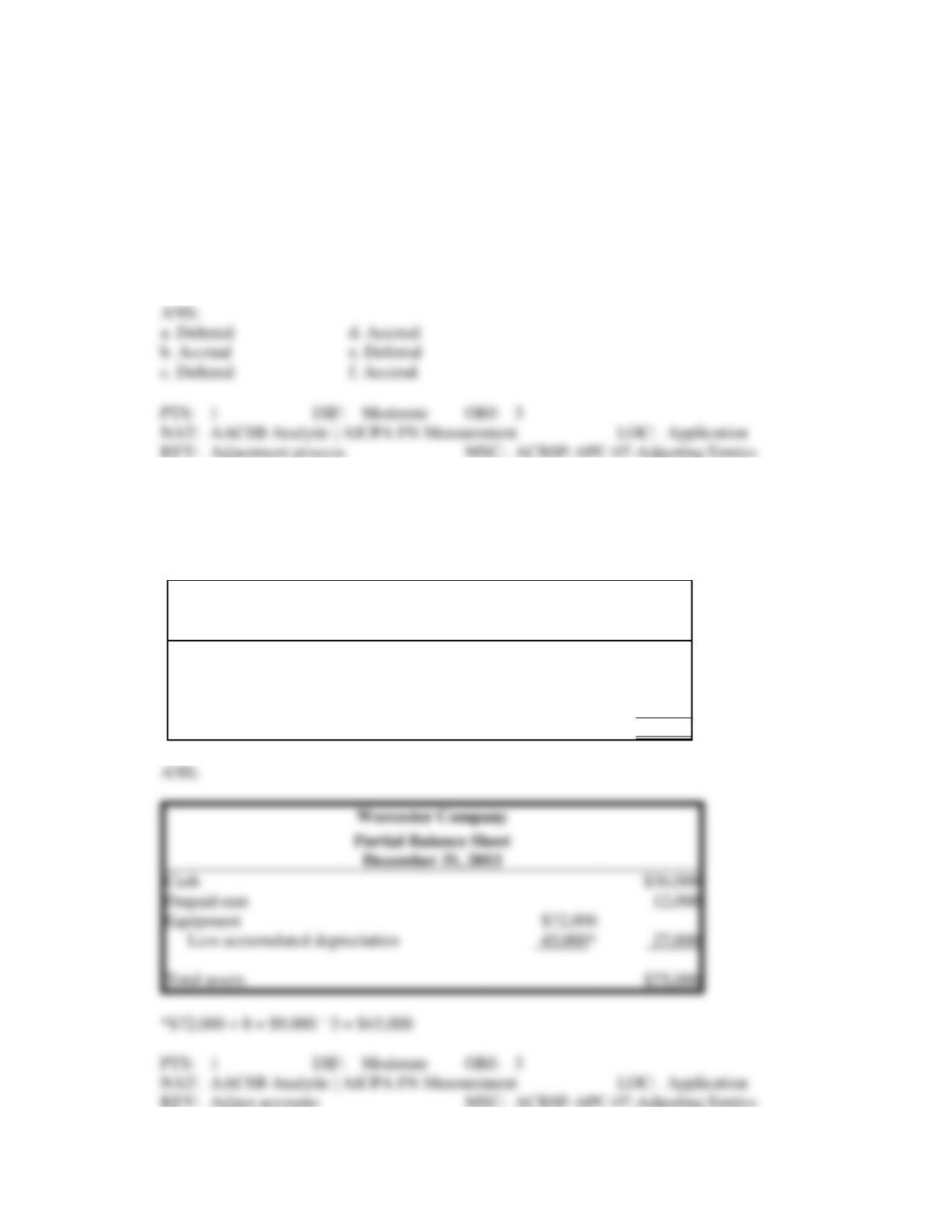
7. In the space below, state whether each situation is a deferral or an accrual.
______
a.
Depreciation on machinery is $7,200 for the accounting period.
______
b.
Interest that has been incurred on a loan but that has not yet been paid or
recorded is $675.
______
c.
Office supplies of $965 were on hand at the beginning of the period.
Purchases of office supplies during the period totaled $640. At the end of the
period, $120 in office supplies remained.
______
d.
Commissions amounting to $975 were earned but not yet collected by year
end.
______
e.
Prepaid Rent had a $2,500 balance prior to adjustment. By year end, 50
percent had expired.
______
f.
Federal income taxes for the year were estimated to be $4,680.
8. Worcester Company purchased equipment for $72,000. The equipment has an estimated useful life of
eight years and will be worthless at the end of that time. In the partial balance sheet below, show
exactly how the equipment should be disclosed after it has been used for five years. Also calculate
total assets.
Worcester Company
Partial Balance Sheet
December 31, 2013
Cash
$36,000
Prepaid rent
12,000
Equipment
____ __
Total assets
$___ __
Cash
Prepaid rent
Equipment
Less accumulated depreciation
Total assets
a. Deferral
d. Accrual
b. Accrual
e. Deferral
c. Deferral
f. Accrual
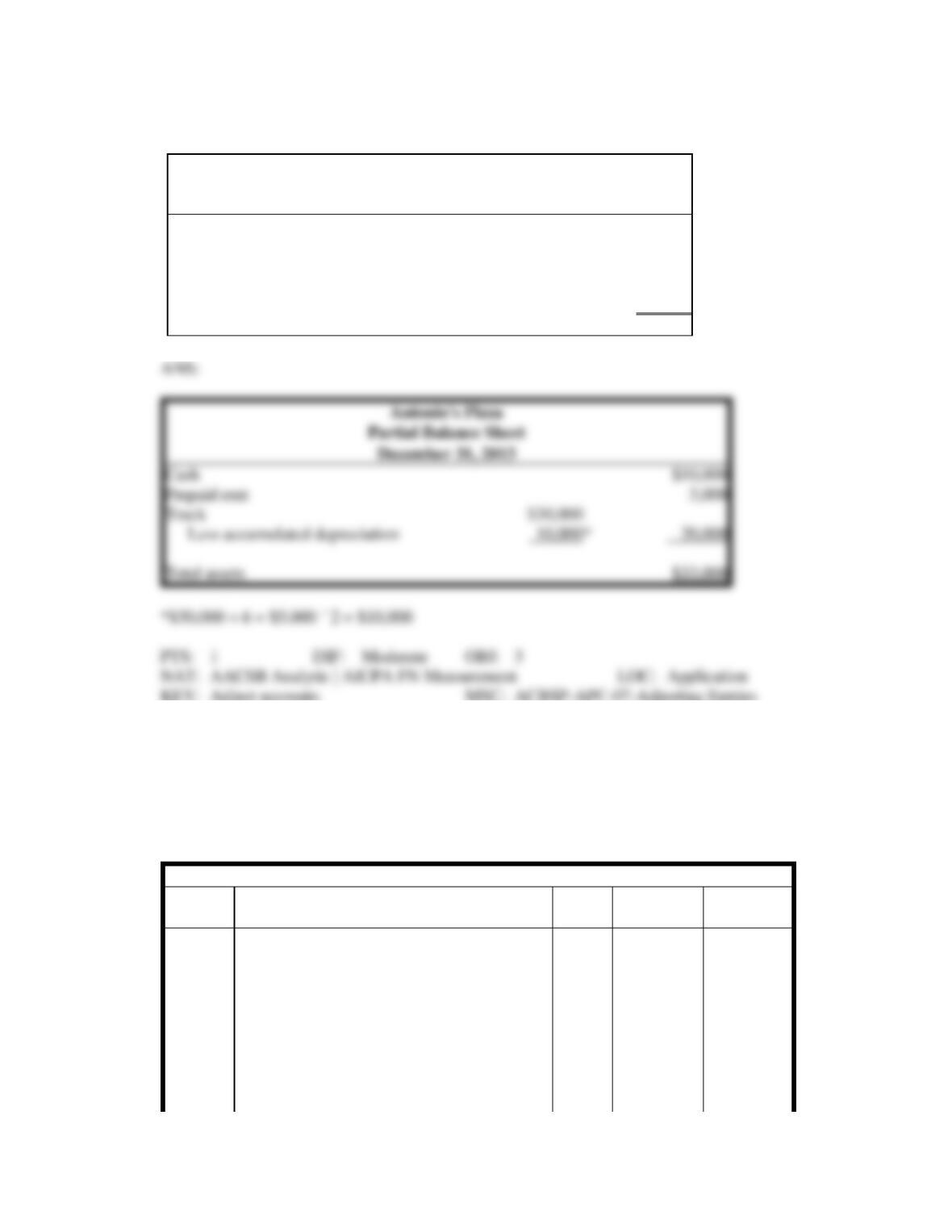
9. Antonio’s Pizza has a delivery truck it purchased for $30,000. The truck has an estimated useful life of
six years and will be worthless at the end of that time. In the partial balance sheet below, show exactly
how the truck would be disclosed after it has been used for two years. Also calculate total assets.
Antonio’s Pizza
Partial Balance Sheet
December 31, 2013
Cash
$10,000
Prepaid rent
3,000
Truck
______
Total assets
$___ __
10. An examination of the Prepaid Insurance account shows a debit balance of $3,670 at the end of the
accounting period before adjustment. Prepare journal entries to record the insurance expense for the
period under each of the following independent assumptions:
a. An examination of insurance policies shows that insurance costing $1,200 has expired during the
period.
General Journal
Page 1
Date
Description
Post.
Ref.
Debit
Credit
Cash
Prepaid rent
Truck
Less accumulated depreciation
*
Total assets
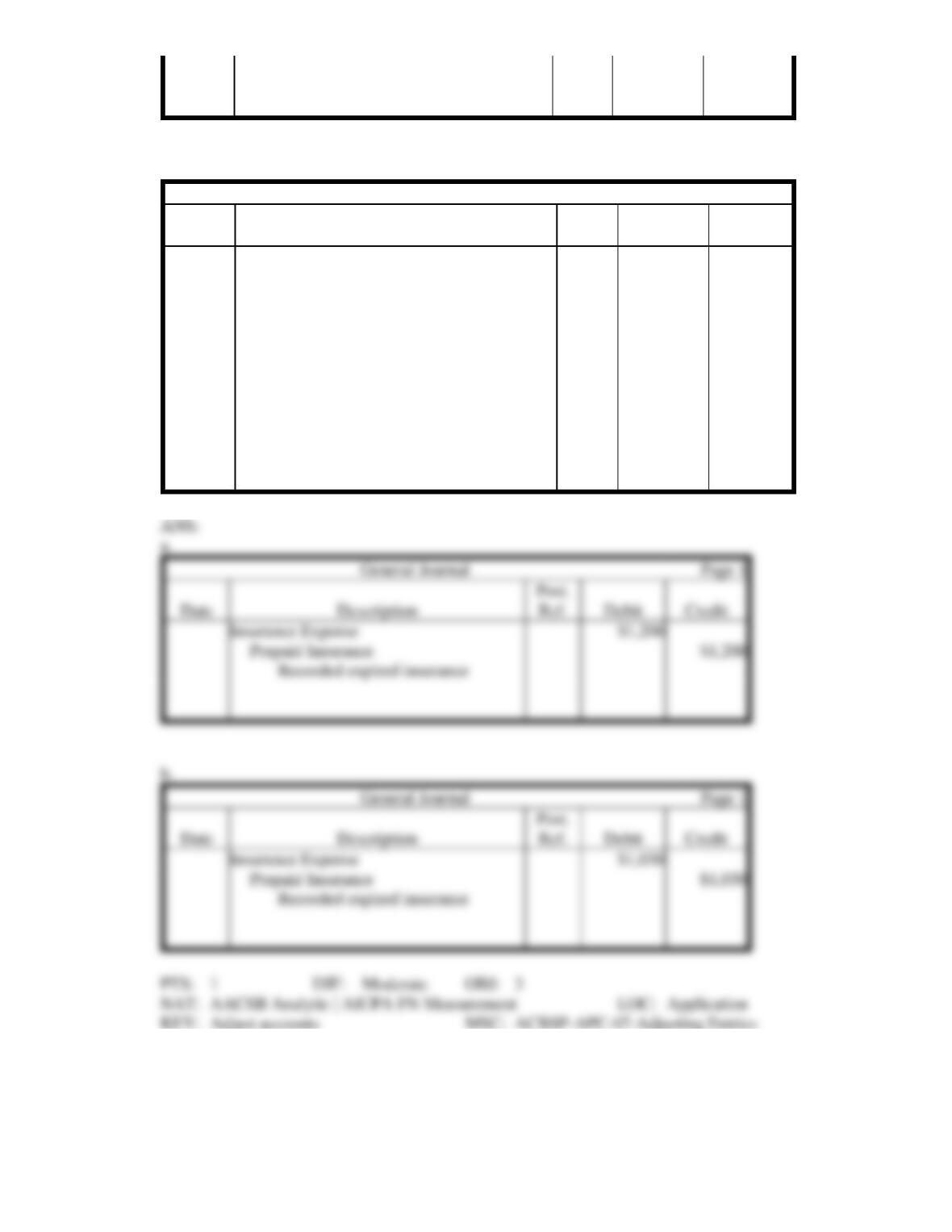
b. An examination of insurance policies shows unexpired insurance of $2,640 at the end of the period.
General Journal
Page 1
Date
Description
Post.
Ref.
Debit
Credit
11. Dukes Press pays wages of $12,000 every Friday for a five-day workweek. September 30, the last day
of the fiscal year, falls on a Tuesday. In the journal provided, prepare the September 30 adjusting entry
as well as the October 3 follow-up entry when the wages are paid. Omit explanations.
Insurance Expense
Prepaid Insurance
Recorded expired insurance
Insurance Expense
Prepaid Insurance
Recorded expired insurance
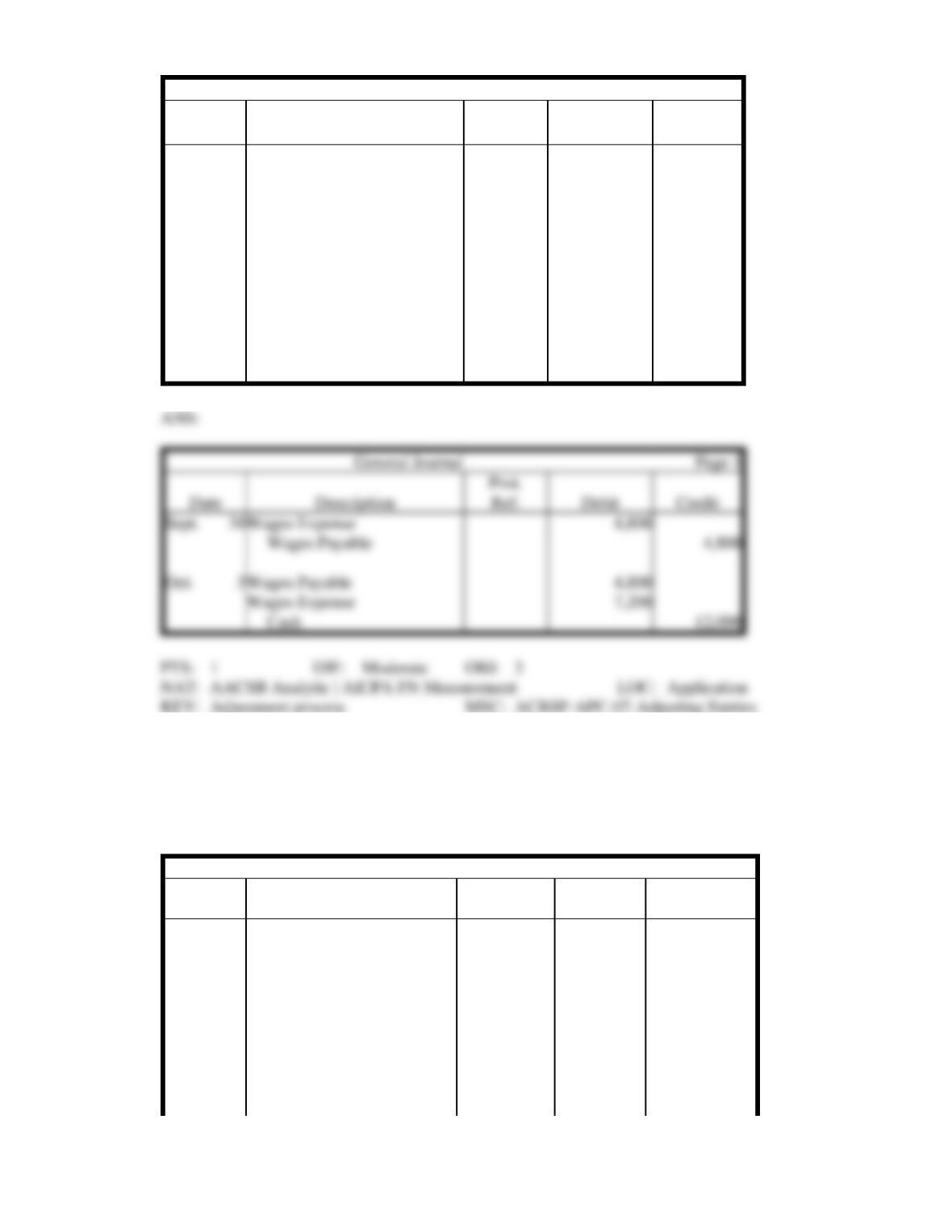
General Journal
Page 1
Date
Description
Post.
Ref.
Debit
Credit
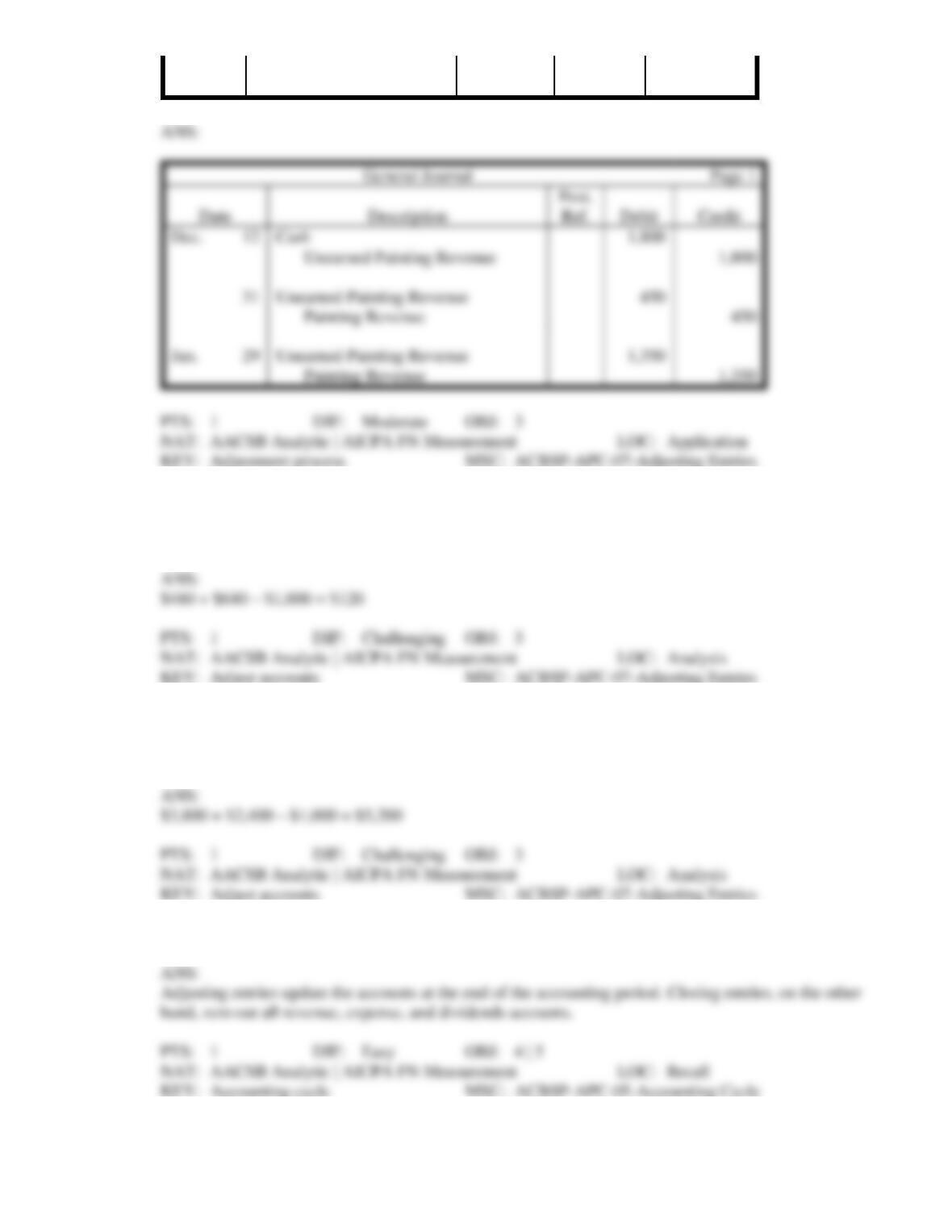
12. On December 12, Roger Kent, a painter, received $1,800 in advance for performing a service that
would extend into the following calendar year. By December 31, he still had three-fourths of the
service remaining to perform. In the journal provided, prepare the December 12 entry, the December
31 end-of-period adjustment, as well as the entry on January 29 when the job was completed. Omit
explanations.
General Journal
Page 1
Date
Description
Post.
Ref.
Debit
Credit
General Journal
Page 1
Sept.
Wages Expense
4,800
Wages Payable
Oct.
Wages Payable
4,800
Wages Expense
7,200
Cash
13. Bristol Enterprises had supplies on hand costing $480 on December 31. During the same year, supplies
costing $1,000 were purchased, and $640 in supplies were consumed during the year. What was the
cost of supplies on hand on January 1 of that year?
14. Dowling Company had supplies on hand costing $1,000 at the beginning of the year and $2,400 at the
end of the year. During the year, supplies totaling $3,800 were consumed. How much was the total
cost of supplies purchased during the year?
15. Distinguish between adjusting and closing entries.
16. The following steps in the accounting cycle are presented out of order below. Arrange the steps in the
proper order by placing a number from 1 through 5 in the blanks provided. Also identify each step as
either a recurring activity (RA)—one that would be repeated during the fiscal period—or an
end-of-period activity (EOP)—one performed at the end of the accounting period.
______ a. Record entries in a journal.
______ b. Adjust the accounts and prepare an adjusted trial balance.
______ c. Close the accounts and prepare a post-closing trial balance.
______ d. Analyze business transactions from source documents.
______ e. Post entries to the ledger and prepare a trial balance.
17. During the performance of the steps in the accounting cycle, trial balances are prepared at three key
points. Using specific names where applicable, discuss the time of preparation and the purpose served
by each of these trial balances.
18. What broad purposes are accomplished by closing entries?
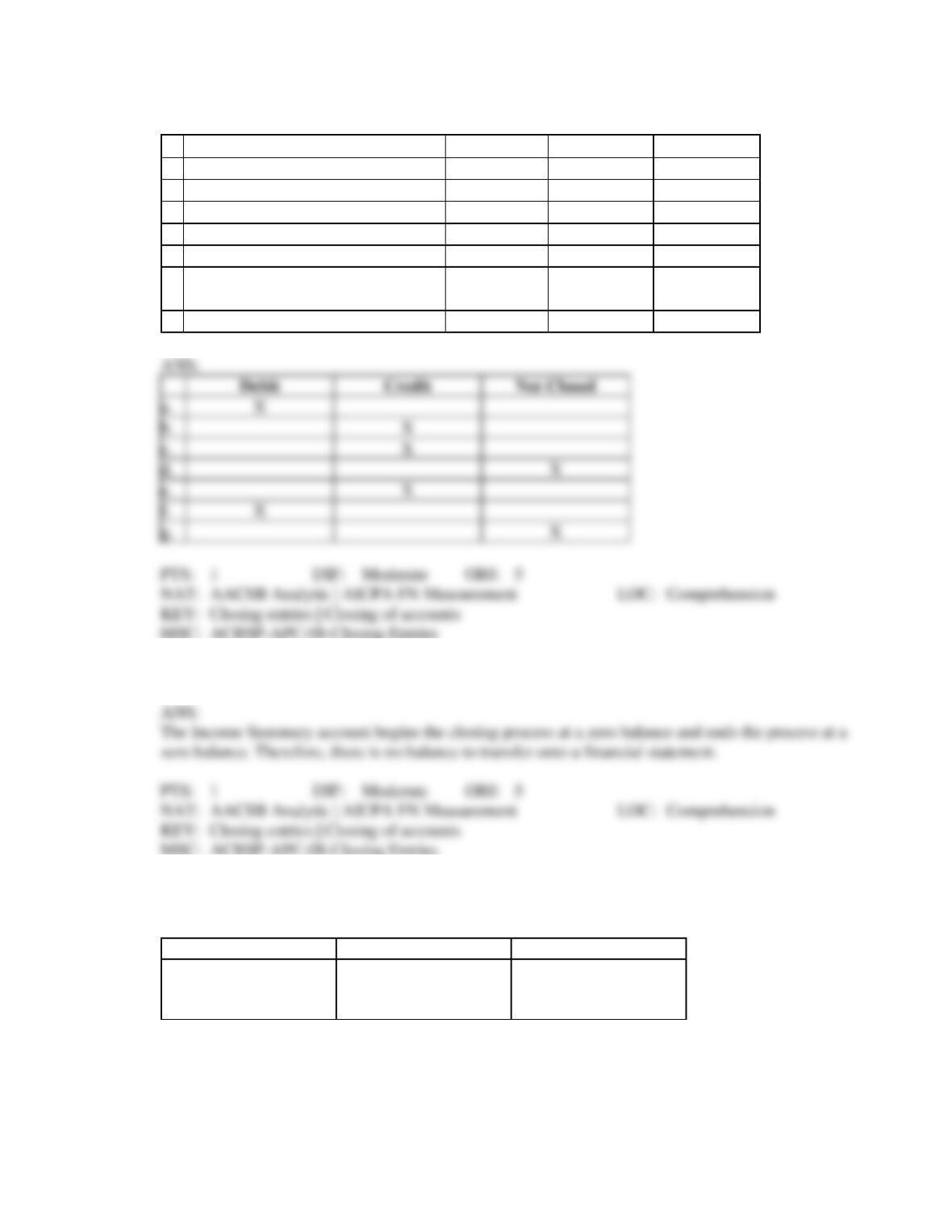
19. Indicate with an X in the appropriate column the type of entry to be made to close the following
accounts:
Debit
Credit
Not Closed
a.
Fees Earned
b.
Telephone Expense
c.
Dividends paid
d.
Cash
e.
Depreciation Expense–Equipment
f.
Income Summary
(assuming a net income)
g.
Retained Earnings
20. Why will the Income Summary account never appear on any financial statement?
21. The following amounts are taken from the balance sheets of Baltic Corporation:
December 31, 2013
December 31, 2012
Accrued liabilities
$44,000
$37,500
Prepaid expenses
14,000
18,500
During 2013, expenses related to accrued liabilities were $30,500, and expenses related to prepaid
expenses were $21,000.
a. Compute cash payments related to accrued liabilities.
b. Compute cash payments related to prepaid expenses.
22. The end of year income statement for Plymouth Company showed rent expense of $21,600 and
salaries expense of $14,400. The related balance sheet account balances at year end for last year and
this year were as follows:
This Year
Last Year
Prepaid rent
$2,400
$ 0
Salaries payable
800
1,600
a. Compute cash paid for rent during the year.
b. Compute cash paid for salaries during the year.
MATCHING
Match each definition with the correct term below.
a.
Used to determine that all temporary accounts have zero balances.
b.
The postponement of the recognition of an expense already paid.
c.
Accounts that begin each accounting period with a zero balance.
d.
Increases in stockholders’ equity resulting from selling goods.
e.
Revenue that is received in advance of goods delivery or service performance.
f.
Accounts that carry their end-of-period balances into the next accounting period.
g.
The recognition of a revenue or an expense that has arisen but not been recorded during
the accounting period.
h.
Decreases in stockholders’ equity resulting from the cost of selling goods.
i.
Used after making adjusting journal entries to ensure that debits equal credits.
j.
Revenues that a company has earned by performing a service or delivering goods but for
which no entry has been made in the accounting records.
1. Unearned revenues
2. Adjusted trial balance
3. Post-closing trial balance
4. Revenues
5. Temporary accounts
6. Accrual
7. Expenses
8. Deferred expense
9. Accrued revenues
10. Permanent accounts
PROBLEM
1. Susan Kane won the mayoral election in the City of Ashley partly on the basis of her charge that Allen
Ross, the former mayor, was responsible for the budget deficit. After taking office, she hired a major
international accounting firm to straighten things out. This excerpt appeared in an article from a
leading business publication, West End Business Review:
[A riddle]
Q: When is a budget deficit not a deficit?
A: When it is a surplus, of course.
Ashley Mayor Susan Kane was once again caught with egg on her face last week as she and her
financial advisers tried to defend that riddle. On one hand, Comptroller Jim Guan [a Kane appointee],
explaining $75 million in assets the mayor [Kane] hopes to hold in reserve in the 2013 Ashley city
budget, testified in hearings that the city had actually ended 2011 with a $6 million surplus, not the
much-reported deficit. He said further that the modest surplus grew to $54 million as a result of
tax-enrichment supplements to the 2011 balance sheet.
On the other hand, the mayor stuck by the same guns she used last year on her predecessor. The city
had ended 2011, under the Allen Ross administration, not merely without a surplus, but with a deficit.
The apparent discrepancy can be explained.
Like most U.S. cities, Ashley operates under a modified accrual accounting basis. This is a
combination of the cash basis and the accrual basis. The modified accrual basis differs from the
accrual basis in that revenue is recorded when it is collected. The collection of Ashley’s parking tax,
which is assessed on all city parking lots and garages, is an example.
The tax is assessed and collected on a quarterly basis but the city doesn’t collect the amount due for the
last quarter of 2012 until the first quarter of 2013. Under ideal accrual methods, the parking revenues
should be recorded in the 2012 financial statements. Under a cash approach, the revenues would be
recorded in the 2013 budget. What the city did before was to record the money whenever it was
advantageous politically. That, combined with the infamous revolving funds, allowed the city to hide
the fact that it was running large deficits under [former] Mayor Ross. That also means that no one
really knew where the city stood.
The auditors are now reallocating the parking revenues to the 2013 budget but are accruing other
revenues by shifting the period of collection from a year in the past. Overall, more revenues were
moved into earlier fiscal years than into later years, inflating those budgets. Thus, the 2013 deficit is a
surplus.
The article concluded:
The upshot is that both Mayor Kane and Mr. Guan [the comptroller] were correct. There was a deficit
in the 2011 corporate or checkbook fund, but because of corrections taking place now, a surplus exists.
a. Do you agree with the way the auditors handled parking revenues? Support your answer by
explaining which method of accounting you think a city should use.
b. Comment on the statement, “Systematically applied accounting principles will allow all to know
exactly where the city stands.”
2. Joan Miller owns an advertising agency. One of the adjustments her accountant made at the end of
July was $360 for unpaid wages of the secretary. Joan Miller might ask, “Why go to the trouble of
making this adjustment? Why worry about it? Doesn’t everything come out in the end, when the
secretary is paid in August? Because wages expense in total is the same for the two months, isn’t the
net income in total unchanged?” Give three reasons why adjusting entries can help Joan Miller assess
the performance of her business. (Net income was $1,600.)
3. Answer the following questions. (Show your work.)
a. Equipment is purchased for $48,000, to be used for eight years. Assuming zero value at the end of
eight years, what is the equipment’s carrying value after two years and three months?
b. Prepaid Insurance has an $800 balance prior to adjustment. By year end, one-fourth has expired.
What will be the balance in Prepaid Insurance after the adjusting entry has been made?
c. A company purchased $210 in supplies during the year, recorded $120 in Supplies Expense, and
ended with $350 of supplies. What was the beginning balance of Supplies?
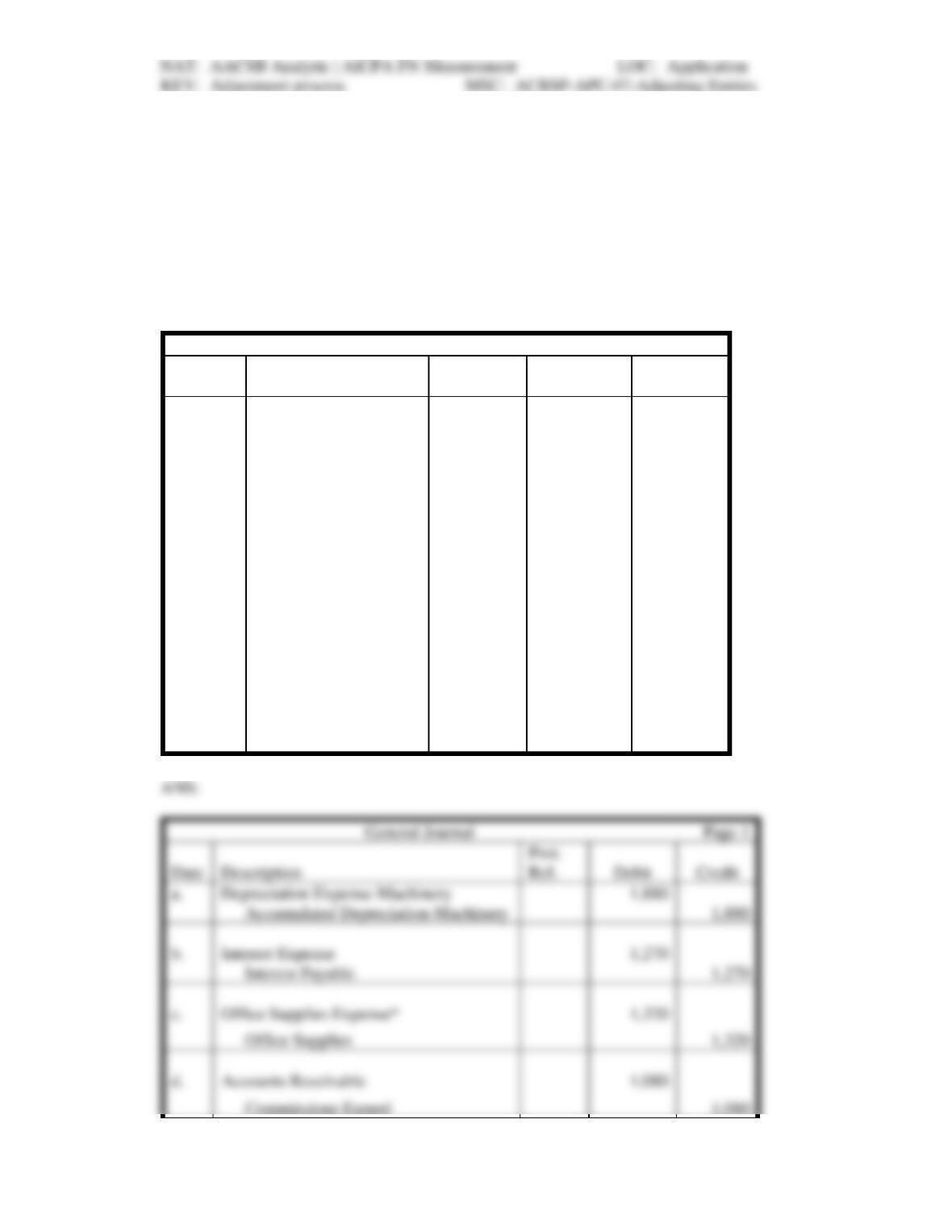
4. In the journal provided, prepare adjusting entries for the following items. Omit explanations.
a. Depreciation on machinery is $1,880 for the accounting period.
b. Interest incurred on a loan but not paid or recorded is $1,270.
c. Office supplies of $1,200 were on hand at the beginning of the period. Purchases of office supplies
during the period totaled $400. At the end of the period, $280 in office supplies remained.
d. Commissions revenue amounting to $1,080 were earned but not recorded or collected by year end.
e. Prepaid Rent had a $16,000 normal balance prior to adjustment. By year end, 50 percent had
expired.
f. Federal income taxes for the year are estimated to be $6,500.
General Journal
Page 1
Date
Description
Post.
Ref.
Debit
Credit
Debit
1,880
1,270
1,320
1,080
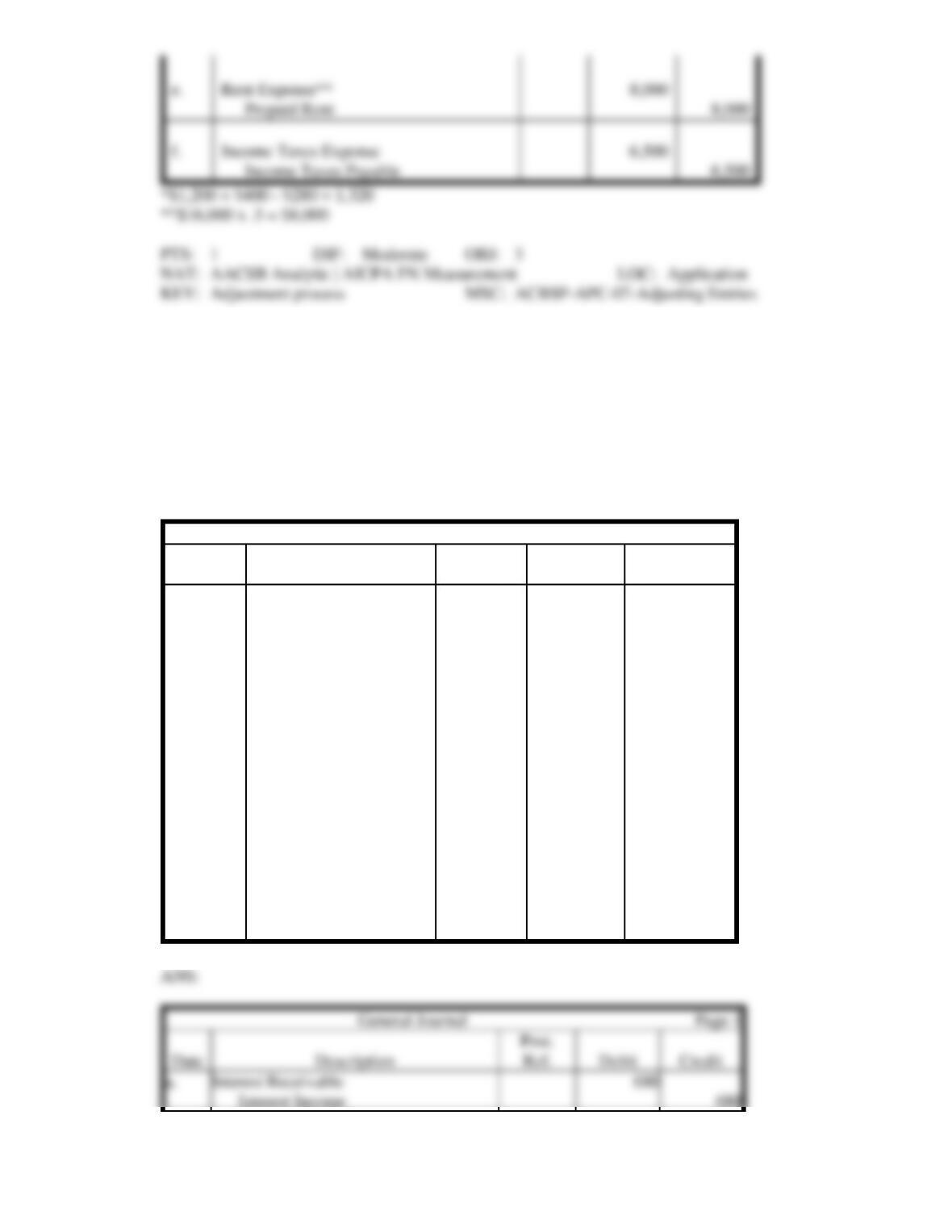
5. In the journal provided, prepare adjusting entries for the following items. Omit explanations.
a. Unrecorded interest on savings bonds is $680.
b. Property taxes incurred but not paid or recorded amount to $540.
c. Legal fees of $5,000 were collected in advance. By year end, 80 percent were still unearned.
d. Prepaid Insurance had a $1,600 debit balance prior to adjustment. By year end, 25 percent was still
unexpired.
e. Salaries incurred by year end but not yet paid or recorded amounted to $1,375.
f. Services totaling $900 have been performed but not yet recorded or billed.
General Journal
Page 1
Date
Description
Post.
Ref.
Debit
Credit
Interest Receivable
Interest Income
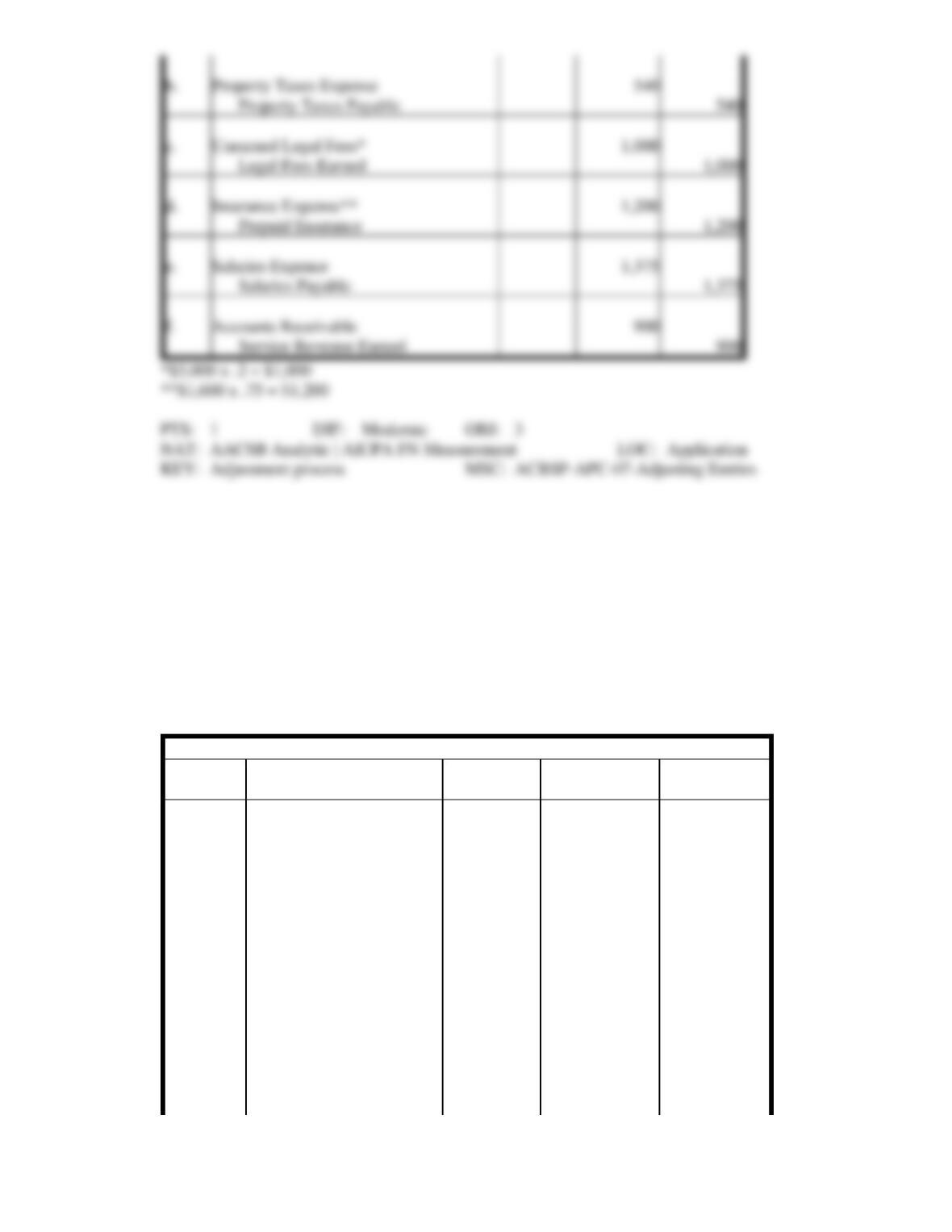
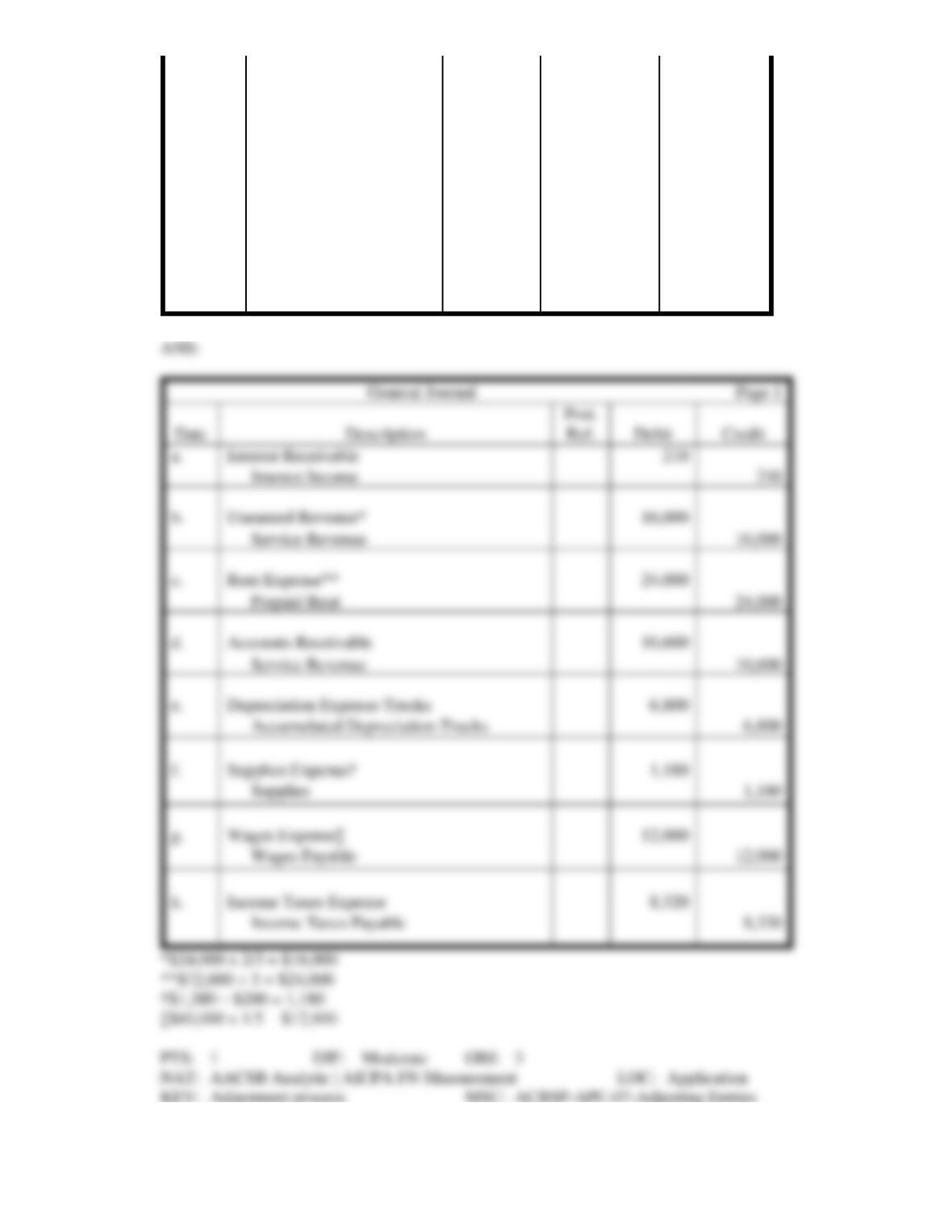
6. In the journal provided, prepare year-end adjustments for the following situations. Omit explanations.
a. Accrued interest on notes receivable is $210.
b. Of the $24,000 received in advance of performing a service, one-third was still unearned by year
end.
c. Three years’ rent, totaling $72,000, was paid in advance at the beginning of the year.
d. Services totaling $10,600 had been performed, but not yet billed.
e. Depreciation on trucks totaled $6,800 for the year.
f. Supplies available for use totaled $1,380. However, by year end, only $200 in supplies remained.
g. Payroll for the five-day work week, to be paid on Friday, is $60,000. Year end falls on a Monday.
h. Estimated federal income taxes were $8,320.
General Journal
Page 1
Date
Description
Post.
Ref.
Debit
Credit
Property Taxes Expense
Property Taxes Payable
Unearned Legal Fees*
Legal Fees Earned
Insurance Expense**
Prepaid Insurance
Salaries Expense
Salaries Payable
Accounts Receivable
Service Revenue Earned
7. In the journal provided, prepare year-end adjustments for the following situations. Omit explanations.
a. Accrued interest on notes receivable is $560.
b. Of the $7,200 received in advance of earning a service, one-third was still unearned by year end.
c. Two years of rent, totaling $24,000, was paid in advance. By year end, four months’ worth had
expired.
d. Services totaling $685 had been performed, but not yet billed.
e. Depreciation on trucks totaled $1,700 for the year.
f. Supplies available for use during the year amounted to $3,400. However, by year end, only $700 in
supplies remained.
g. Payroll for the five-day work week, to be paid on Friday, is $6,000. Year end falls on a Tuesday.
h. Estimated federal income taxes were $2,100.
General Journal
Page 1
Date
Description
Post.
Ref.
Debit
Credit
Interest Receivable