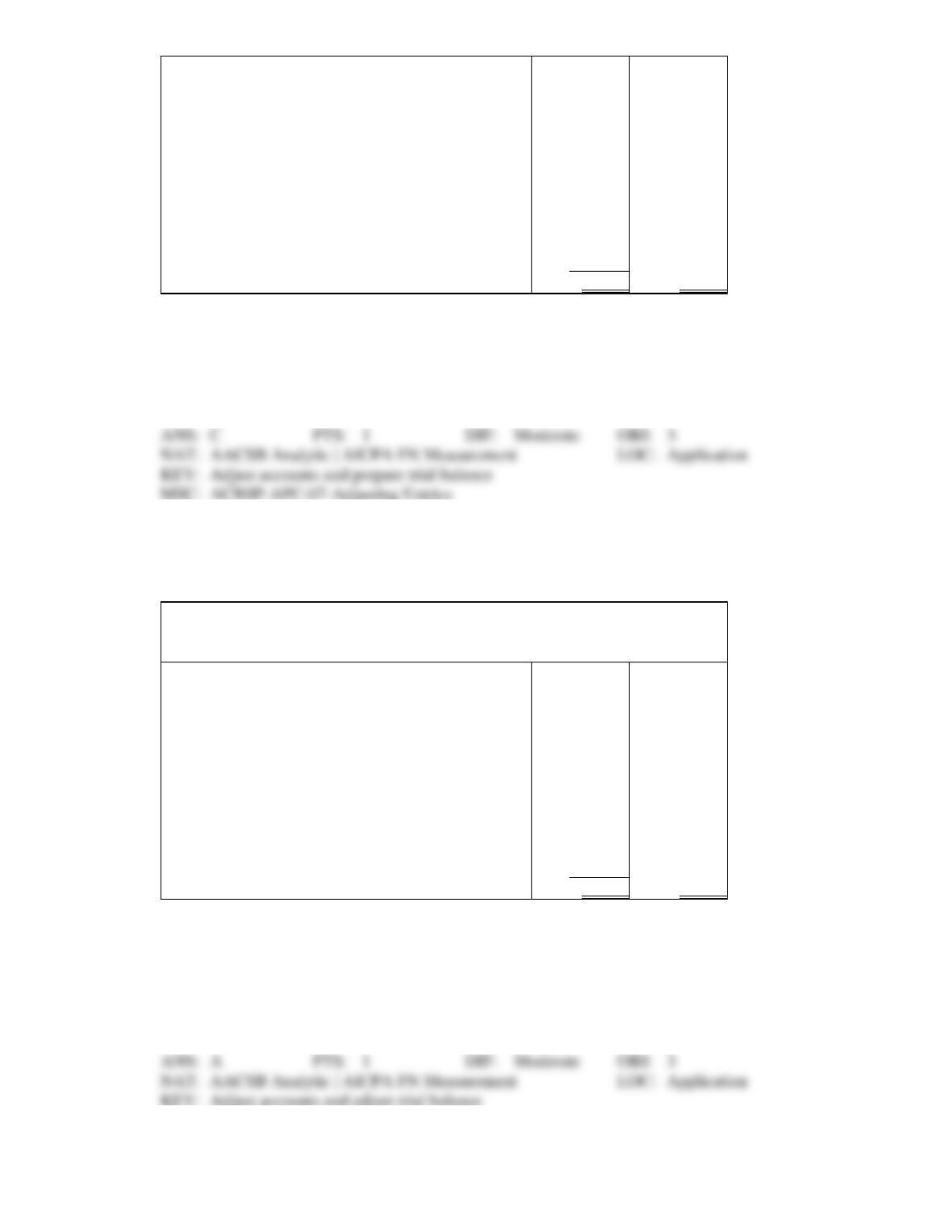
Cash
$ 400
Accounts Receivable
1,000
Prepaid Insurance
100
Supplies
300
Office Equipment
800
Accumulated Depreciation–Office Equipment
$ 400
Accounts Payable
600
Common Stock
1,200
Service Revenue Earned
1,000
Salaries Expense
200
Rent Expense
400
______
$3,200
$3,200
If the estimated depreciation for office equipment were $400, the adjusting entry would contain a
a.
debit to Accumulated Depreciation, Office Equipment for $400.
b.
credit to Office Equipment for $400.
c.
credit to Accumulated Depreciation, Office Equipment for $400.
d.
credit to Depreciation Expense, Office Equipment for $400.
63. Use this information to answer the following question.
The trial balance for Barnstable Corporation appears as follows:
Barnstable Corporation
Trial Balance
December 31, 2013
Cash
$ 400
Accounts Receivable
1,000
Prepaid Insurance
100
Supplies
300
Office Equipment
800
Accumulated Depreciation–Office Equipment
$ 400
Accounts Payable
600
Common Stock
1,200
Service Revenue Earned
1,000
Salaries Expense
200
Rent Expense
400
______
$3,200
$3,200
If as of December 31, 2013, the rent of $200 for December had not been recorded or paid, the
adjusting entry would include a
a.
debit to Rent Expense for $200.
b.
debit to Rent Payable for $200.
c.
credit to Cash for $200.
d.
credit to Accumulated Rent for $200.
64. Use this information to answer the following question.
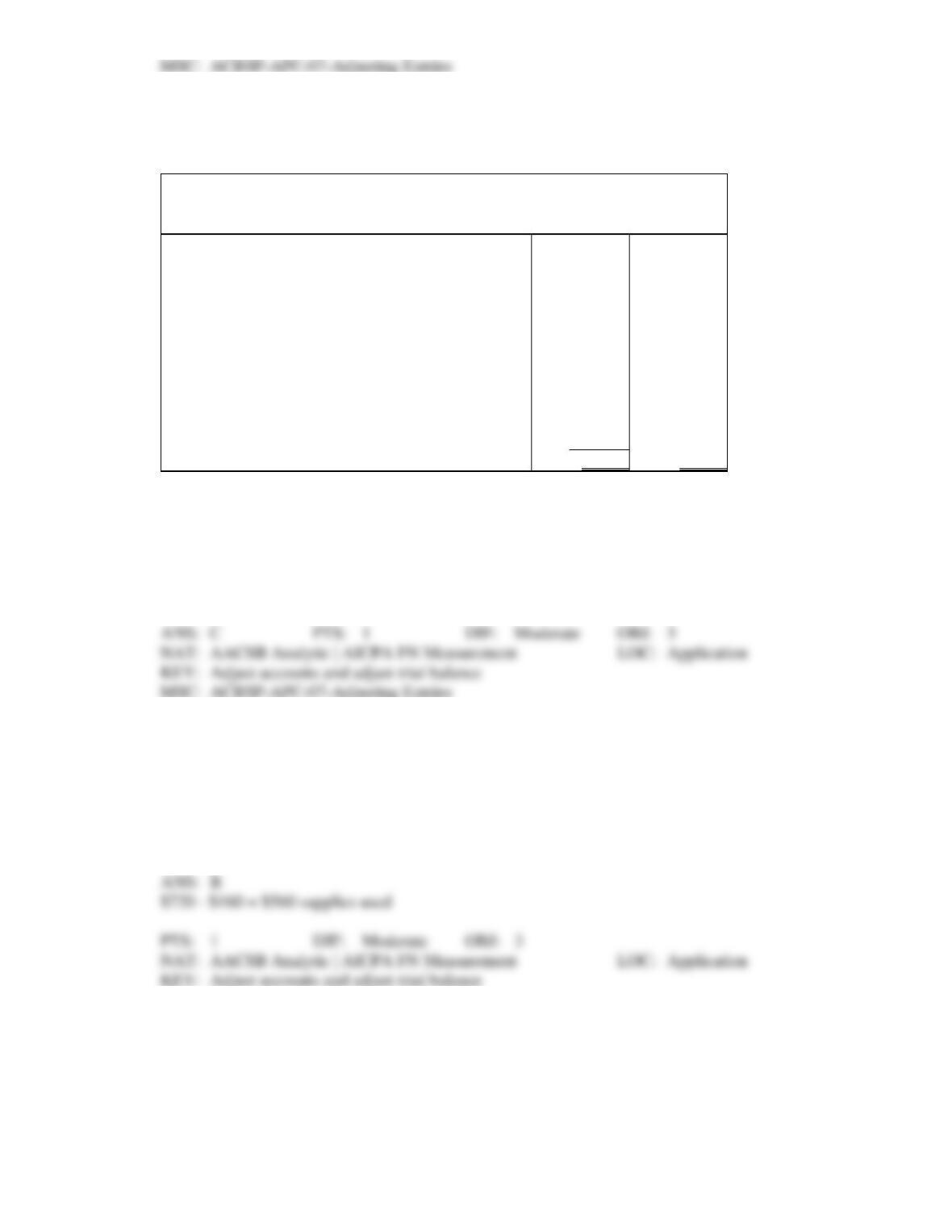
The trial balance for Barnstable Corporation appears as follows:
Barnstable Corporation
Trial Balance
December 31, 2013
Cash
$ 400
Accounts Receivable
1,000
Prepaid Insurance
100
Supplies
300
Office Equipment
800
Accumulated Depreciation–Office Equipment
$ 400
Accounts Payable
600
Common Stock
1,200
Service Revenue Earned
1,000
Salaries Expense
200
Rent Expense
400
______
$3,200
$3,200
If services totaling $250 had been performed but not billed, the adjusting entry to record this would
include a
a.
credit to Unearned Service Revenue for $250.
b.
debit to Service Revenue Earned for $250.
c.
credit to Service Revenue Earned for $250.
d.
credit to Service Revenue Earned for $750.
65. The Office Supplies account had a $720 debit balance at the end of the accounting period before
adjustment for supplies used, and an inventory of $160 worth of unused supplies was on hand. Which
of the following is the required adjusting entry?
a.
Debit Office Supplies Expense $160 and credit Office Supplies $160.
b.
Debit Office Supplies Expense $560 and credit Office Supplies $560.
c.
Debit Office Supplies $160 and credit Office Supplies Expense $160.
d.
Debit Office Supplies $560 and credit Office Supplies Expense $560.
66. Use this information pertaining to the Essex Corporation to answer the following question.
1.
The corporation’s Office Supplies account showed a beginning debit balance of $400 and
supplies purchased of $1,600. There were $600 of supplies on hand at year end.
2.
Depreciation on a building is estimated to be $10,000.
3.
A one-year insurance policy was purchased for $4,000. Three months have passed since the
purchase.
4.
Accrued interest on a note receivable amounted to $200.
5.
The company received a $7,200 advance payment during the year on services to be performed.
By the end of the year, one-fourth of the services had been performed.
The adjusting entry for Office Supplies would be
a.
Office Supplies Expense 1,400
Office Supplies 1,400
b.
Office Supplies Expense 1,600
Office Supplies 1,600
c.
Office Supplies 1,400
Office Supplies Expense 1,400
d.
Office Supplies Expense 600
Office Supplies 600
67. Use this information pertaining to the Essex Corporation to answer the following question.
1.
The corporation’s Office Supplies account showed a beginning debit balance of $400 and
supplies purchased of $1,600. There were $600 of supplies on hand at year end.
2.
Depreciation on a building is estimated to be $10,000.
3.
A one-year insurance policy was purchased for $4,000. Three months have passed since the
purchase.
4.
Accrued interest on a note receivable amounted to $200.
5.
The company received a $7,200 advance payment during the year on services to be performed.
By the end of the year, one-fourth of the services had been performed.
The adjusting entry for depreciation on the building is
a.
Depreciation Expense – Building 10,000
Accumulated Depreciation – Building 10,000
b.
Accumulated Depreciation – Building 10,000
Depreciation Expense – Building 10,000
c.
Building 10,000
Depreciation Expense – Building 10,000
d.
Accumulated Depreciation – Building 10,000
Building 10,000
68. Use this information pertaining to the Essex Corporation to answer the following question.
1.
The corporation’s Office Supplies account showed a beginning debit balance of $400 and
supplies purchased of $1,600. There were $600 of supplies on hand at year end.
2.
Depreciation on a building is estimated to be $10,000.
3.
A one-year insurance policy was purchased for $4,000. Three months have passed since the
purchase.
4.
Accrued interest on a note receivable amounted to $200.
5.
The company received a $7,200 advance payment during the year on services to be performed.
By the end of the year, one-fourth of the services had been performed.
The adjusting entry for the insurance policy is
a.
Prepaid Insurance 1,000
Insurance Expense 1,000
b.
Insurance Expense 3,000
Prepaid Insurance 3,000
c.
Prepaid Insurance 3,000
Insurance Expense 3,000
d.
Insurance Expense 1,000
Prepaid Insurance 1,000
69. Use this information pertaining to the Essex Corporation to answer the following question.
1.
The corporation’s Office Supplies account showed a beginning debit balance of $400 and
supplies purchased of $1,600. There were $600 of supplies on hand at year end.
2.
Depreciation on a building is estimated to be $10,000.
3.
A one-year insurance policy was purchased for $4,000. Three months have passed since the
purchase.
4.
Accrued interest on a note receivable amounted to $200.
5.
The company received a $7,200 advance payment during the year on services to be performed.
By the end of the year, one-fourth of the services had been performed.
The adjusting entry to record the accrued interest on the note is
a.
Interest Expense 200
Interest Receivable 200
b.
Interest Payable 200
Interest Expense 200
c.
Interest Receivable 200
Interest Income 200
d.
Interest Income 200
Interest Receivable 200
70. Use this information pertaining to the Essex Corporation to answer the following question.
1.
The corporation’s Office Supplies account showed a beginning debit balance of $400 and
supplies purchased of $1,600. There were $600 of supplies on hand at year end.
2.
Depreciation on a building is estimated to be $10,000.
3.
A one-year insurance policy was purchased for $4,000. Three months have passed since the
purchase.
4.
Accrued interest on a note receivable amounted to $200.
5.
The company received a $7,200 advance payment during the year on services to be performed.
By the end of the year, one-fourth of the services had been performed.
The adjusting entry to record the amount of service revenue earned during the accounting period is
a.
Service Revenue 5,400
Unearned Revenue 5,400
b.
Unearned Revenue 5,400
Service Revenue 5,400
c.
Service Revenue 1,800
Unearned Revenue 1,800
d.
Unearned Revenue 1,800
Service Revenue 1,800
71. A company’s five-day weekly payroll of $2,940 is paid on Fridays. Assume that the last day of the
month falls on Wednesday. Which of the following is the required adjusting entry for the month end?
a.
Debit Salaries Payable $1,764 and credit Salaries Expense $1,764.
b.
Debit Salaries Expense $1,764 and credit Salaries Payable $1,764.
c.
Debit Unpaid Salaries $1,764 and credit Salaries Payable $1,764.
d.
Debit Salaries Expense $1,176 and credit Salaries Payable $1,176.
72. The adjustment for estimated income taxes would include a
a.
credit to Income Taxes Payable.
b.
debit to Unearned Income Taxes.
c.
credit to Income Taxes Expense.
d.
credit to Cash.
73. The adjustment entry for the expiration of prepaid advertising, originally recorded as an asset, is
a.
Advertising Expense – Debit; Prepaid Advertising – Credit
b.
Prepaid Advertising – Debit; Cash – Credit
c.
Advertising Expense – Debit; Cash – Credit
d.
Prepaid Advertising – Debit; Advertising Expense – Credit
74. In November, cash is received in advance of rendering services. Assuming that the services have been
performed by December 31, the adjusting entry would be
a.
Unearned Service Revenue – Debit; Cash – Credit
b.
Cash – Debit; Service Revenue – Credit
c.
Unearned Service Revenue – Debit; Service Revenue – Credit
d.
Service Revenue – Debit; Prepaid Services – Credit
75. The entry to record depreciation on machinery is
a.
Accumulated Depreciation–Machinery – Debit; Cash – Credit
b.
Depreciation Expense–Machinery – Debit; Machinery – Credit
c.
Depreciation Expense–Machinery – Debit; Cash – Credit
d.
Depreciation Expense–Machinery – Debit; Accumulated Depreciation–Machinery –
Credit
76. In July, a company pays three years’ insurance in advance. The December 31 adjusting entry is
a.
Insurance Expense – Debit; Prepaid Insurance – Credit
b.
Prepaid Insurance – Debit; Insurance Expense – Credit
c.
Insurance Expense – Debit; Cash – Credit
d.
Prepaid Insurance – Debit; Cash – Credit
77. Failure to adjust for accrued wages at year end will result in an
a.
overstatement of expenses.
b.
understatement of assets.
c.
overstatement of common stock.
d.
overstatement of net income.
78. Failure to record depreciation at year end will result in an
a.
understatement of total assets.
b.
overstatement of total assets.
c.
overstatement of expenses.
d.
overstatement of total liabilities.
79. A company recorded office supplies in an asset account when the supplies were purchased. Failure to
take inventory and make an adjusting entry will result in an
a.
overstatement of liabilities.
b.
understatement of revenues.
c.
understatement of assets.
d.
overstatement of stockholders’ equity.
80. An adjusted trial balance is prepared to
a.
test that the ledger is in balance after the accounts have been adjusted.
b.
facilitate preparation of the adjusting entries.
c.
both test that the ledger is in balance after the accounts have been adjusted and facilitate
preparation of the financial statements.
d.
facilitate preparation of the financial statements.
81. Which of the following accounts would appear on an adjusted trial balance but probably would not
appear on a trial balance?
a.
Depreciation
b.
Accounts Receivable
c.
Service Revenue
d.
Prepaid Rent
82. Which of the following accounts probably would be larger in amount on an adjusted trial balance than
on a trial balance?
a.
Accumulated Depreciation
b.
Cash
c.
Prepaid Rent
d.
Store Supplies
83. Which of the following accounts probably would contain a smaller dollar amount on the adjusted trial
balance than on the trial balance?
a.
Office Supplies
b.
Accumulated Depreciation–Equipment
c.
Cash
d.
Wages Expense
84. Which of the following accounts would be found on the credit side of the adjusted trial balance?
a.
Service Revenue
b.
Office Supplies
c.
Dividends
d.
Rent Expense
85. Which of the following accounts would most likely be found on both a trial balance and an adjusted
trial balance?
a.
Utilities Expense
b.
Insurance Expense
c.
Supplies Expense
d.
Depreciation Expense–Equipment
86. Which of the following accounts probably would not appear in a trial balance but probably would
appear in an adjusted trial balance?
a.
Accumulated Depreciation–Machinery
b.
Accounts Receivable
c.
Insurance Expense
d.
Unearned Revenue
87. If no adjustments are needed for a particular company, its
a.
trial balance will be identical to its adjusted trial balance.
b.
post-closing trial balance will be identical to its trial balance.
c.
trial balance, adjusted trial balance, and post-closing trial balance will be identical.
d.
adjusted trial balance will be identical to its post-closing trial balance.
88. On which financial statement does the Income Summary account appear?
a.
Statement of Retained Earnings
b.
Balance Sheet
c.
Income Statement
d.
It doesn’t appear on a financial statement
89. Which of the following accounts is not closed during the closing procedure?
a.
Income Summary
b.
Revenues Earned
c.
Retained Earnings
d.
Rent Expense
90. Which of the following accounts is a real account?
a.
Wages Expense
b.
Machinery
c.
Service Revenue
d.
Depreciation Expense–Machinery
91. Which of the following is not a permanent account?
a.
Cash
b.
Common Stock
c.
Insurance Expense
d.
Accounts Payable
92. Which of the following is a nominal account?
a.
Retained Earnings
b.
Income Taxes Expense
c.
Accumulated Depreciation–Furniture
d.
Retained Earnings
93. Which of the following is not a temporary account?
a.
Interest Income
b.
Utilities Expense
c.
Sales Revenue
d.
Notes Payable
94. An important purpose of closing entries is to
a.
help in preparing financial statements.
b.
set real account balances to zero to begin the next period.
c.
set nominal account balances to zero to begin the next period.
d.
adjust the accounts in the ledger.
95. An important purpose of closing entries is to
a.
update the nominal accounts at year end.
b.
set permanent account balances to zero to begin the next period.
c.
help achieve the goals of the matching principle.
d.
transfer net income or loss to Retained Earnings.
96. Which of the following accounts is not closed?
a.
Dividends
b.
Common Stock
c.
Interest Income
d.
Income Summary
97. The post-closing trial balance differs from the adjusted trial balance in that it does not
a.
include balance sheet accounts.
b.
include income statement accounts.
c.
take into account adjusting entries.
d.
take into account closing entries.
98. The post-closing trial balance contains
a.
nominal accounts only.
b.
both real accounts and nominal accounts.
c.
real accounts only.
d.
neither real accounts nor nominal accounts.
99. Formal closing entries ultimately will affect
a.
the Common Stock account.
b.
total Liabilities.
c.
the Retained Earnings account.
d.
total Assets.
100. Failure to prepare formal closing entries will produce a misstated
a.
Income Summary account balance.
b.
Retained Earnings account balance.
c.
Accounts Receivable account balance.
d.
Accounts Payable account balance.
101. After all closing entries have been posted, which of the following accounts is most likely to have a
nonzero balance?
a.
Income Summary
b.
Utilities Payable
c.
Rent Expense
d.
Service Revenue
102. Which of the following accounts is not found in closing entries?
a.
Dividends
b.
Income Summary
c.
Retained Earnings
d.
Accumulated Depreciation–Equipment
103. When there is a net loss, the entry to close the Income Summary account is debit
a.
Retained Earnings and credit Income Summary.
b.
Income Summary and credit Retained Earnings.
c.
Net Loss and credit Income Summary.
d.
Income Summary and credit Net Loss.
104. Which account bypasses the Income Summary account in the closing process?
a.
Revenue from Services
b.
Depreciation Expense–Building
c.
Dividends
d.
Wages Expense
105. Closing entries will
a.
decrease the Retained Earnings balance.
b.
most likely either increase or decrease the Retained Earnings balance.
c.
not affect the Retained Earnings balance.
d.
increase the Retained Earnings balance.
106. The post-closing trial balance would not include which of the following accounts?
a.
Unearned Legal Fees
b.
Dividends
c.
Accumulated Depreciation–Office Equipment
d.
Retained Earnings
107. Which of the following accounts might appear in the adjusted trial balance but not in the post-closing
trial balance?
a.
Depreciation Expense–Building
b.
Retained Earnings
c.
Unearned Revenue
d.
Income Summary
108. Probably the last account to be listed on a post-closing trial balance would be
a.
Income Summary.
b.
Retained Earnings.
c.
Wages Expense.
d.
Wages Payable.
109. Which of the following could not possibly be a closing entry?
a.
Debit Income Summary and credit Dividends.
b.
Debit Income Summary and credit Retained Earnings.
c.
Debit Retained Earnings and credit Dividends.
d.
Debit Retained Earnings and credit Income Summary.
110. The Income Summary account is credited in the entry that closes
a.
the expense accounts.
b.
the revenue accounts.
c.
the Dividends account.
d.
net income.
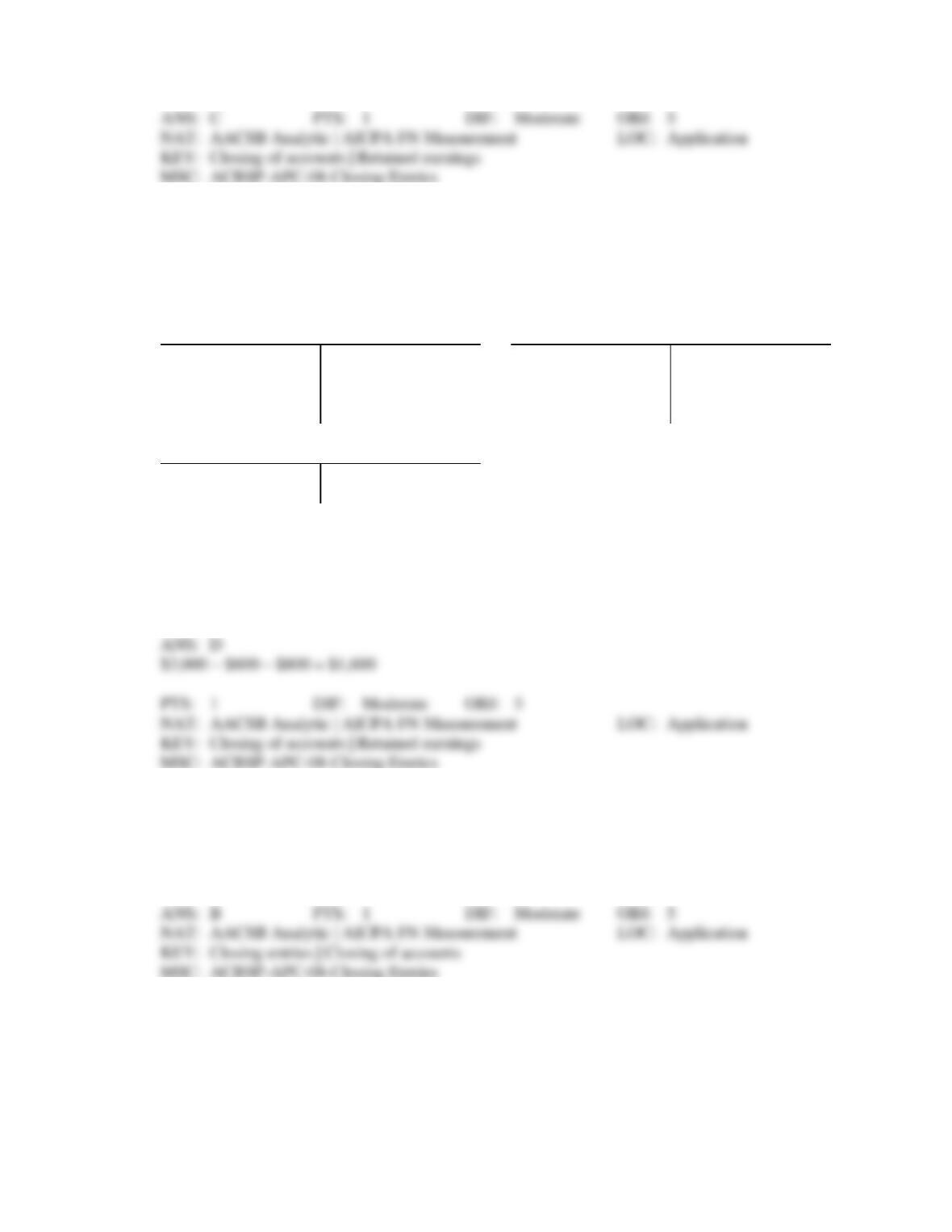
111. Use this information to answer the following question.
The Retained Earnings, Dividends, and Income Summary accounts for Dukes Corporation for the
accounting period are presented below in T account form after the recording and posting of closing
entries:
Retained Earnings
Dividends
12/31 600
1/1 3,000
3/1 200
12/31 800
12/31 800
6/1 200
9/1 200
12/1 200
Income Summary
12/31 1,800
12/31 1,200
12/31 600
Dukes’ beginning Retained Earnings balance is
a.
$600.
b.
$1,400.
c.
$3,000.
d.
$1,600.
112. Use this information to answer the following question.
The Retained Earnings, Dividends, and Income Summary accounts for Dukes Corporation for the
accounting period are presented below in T account form after the recording and posting of closing
entries:
Retained Earnings
Dividends
12/31 600
1/1 3,000
3/1 200
12/31 800
12/31 800
6/1 200
9/1 200
12/1 200
Income Summary
12/31 1,800
12/31 1,200
12/31 600
The ending balance of Retained Earnings is
a.
$200.
b.
$400.
c.
$1,400.
d.
$1,600.
113. The entry to close the Dividends account is debit
a.
Income Summary and credit Dividends.
b.
Retained Earnings and credit Dividends.
c.
Dividends and credit Income Summary.
d.
Dividends and credit Retained Earnings.
114. Use this information to answer the following question.
The Retained Earnings, Dividends, and Income Summary accounts for Dukes Corporation for the
accounting period are presented below in T account form after the recording and posting of closing
entries:
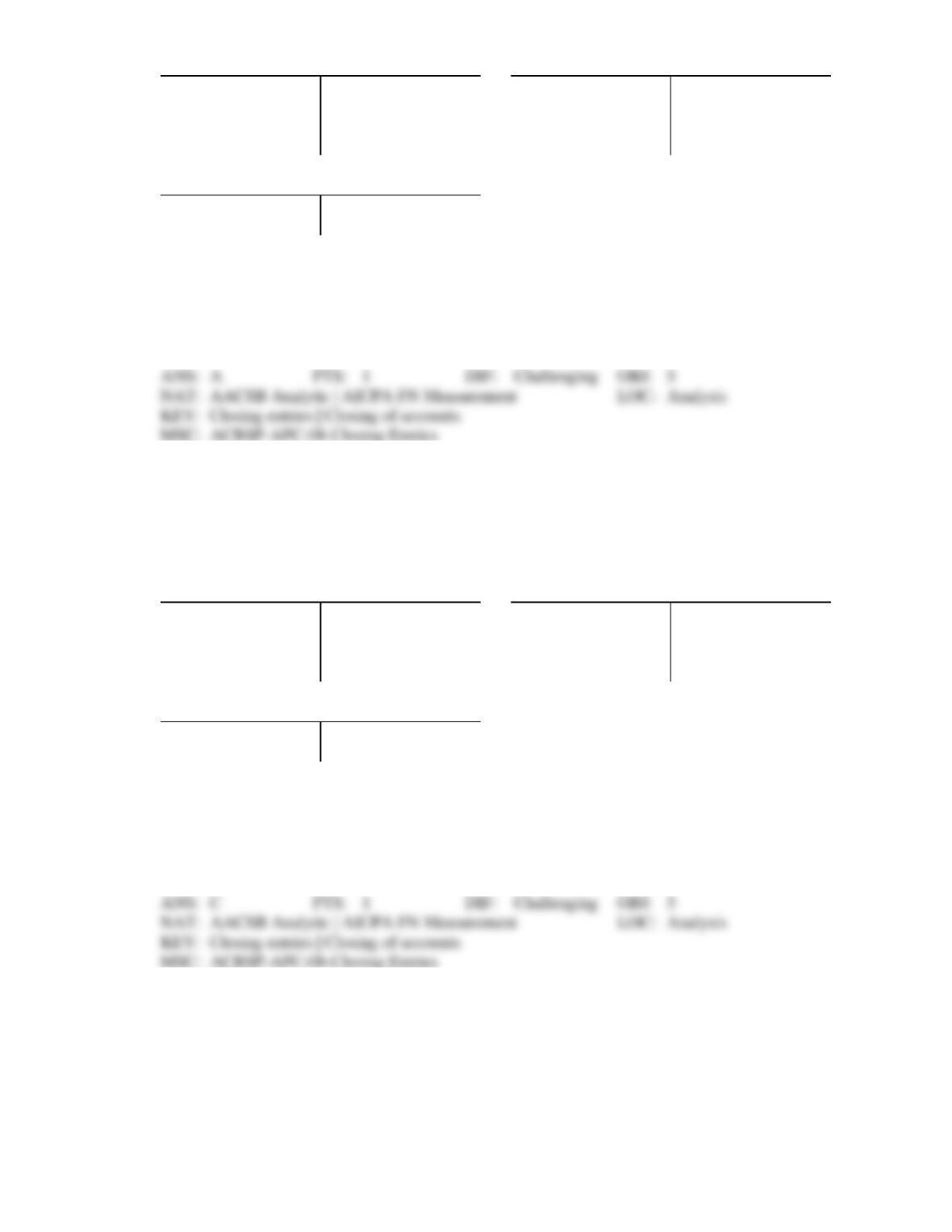
Retained Earnings
Dividends
12/31 600
1/1 3,000
3/1 200
12/31 800
12/31 800
6/1 200
9/1 200
12/1 200
Income Summary
12/31 1,800
12/31 1,200
12/31 600
The amount of revenue earned for the period is
a.
$1,200.
b.
$1,800.
c.
$1,400.
d.
$600.
115. Use this information to answer the following question.
The Retained Earnings, Dividends, and Income Summary accounts for Dukes Corporation for the
accounting period are presented below in T account form after the recording and posting of closing
entries:
Retained Earnings
Dividends
12/31 600
1/1 3,000
3/1 200
12/31 800
12/31 800
6/1 200
9/1 200
12/1 200
Income Summary
12/31 1,800
12/31 1,200
12/31 600
The amount of net income (or net loss) for the period is
a.
$1,800 net income.
b.
$1,200 net income.
c.
$600 net loss.
d.
$600 net income.
116. Use this information to answer the following question.
The Retained Earnings, Dividends, and Income Summary accounts for Dukes Corporation for the
accounting period are presented below in T account form after the recording and posting of closing
entries:
Retained Earnings
Dividends
12/31 600
1/1 3,000
3/1 200
12/31 800
12/31 800
6/1 200
9/1 200
12/1 200
Income Summary
12/31 1,800
12/31 1,200
12/31 600
The amount of dividends for the period is
a.
$800.
b.
$200.
c.
$1,000.
d.
$1,200.
117. Under which circumstance would one less closing entry than usual be made?
a.
When the Retained Earnings account is zero prior to posting of closing entries
b.
When a net loss has been suffered
c.
When revenues have not yet been collected
d.
When net income is zero
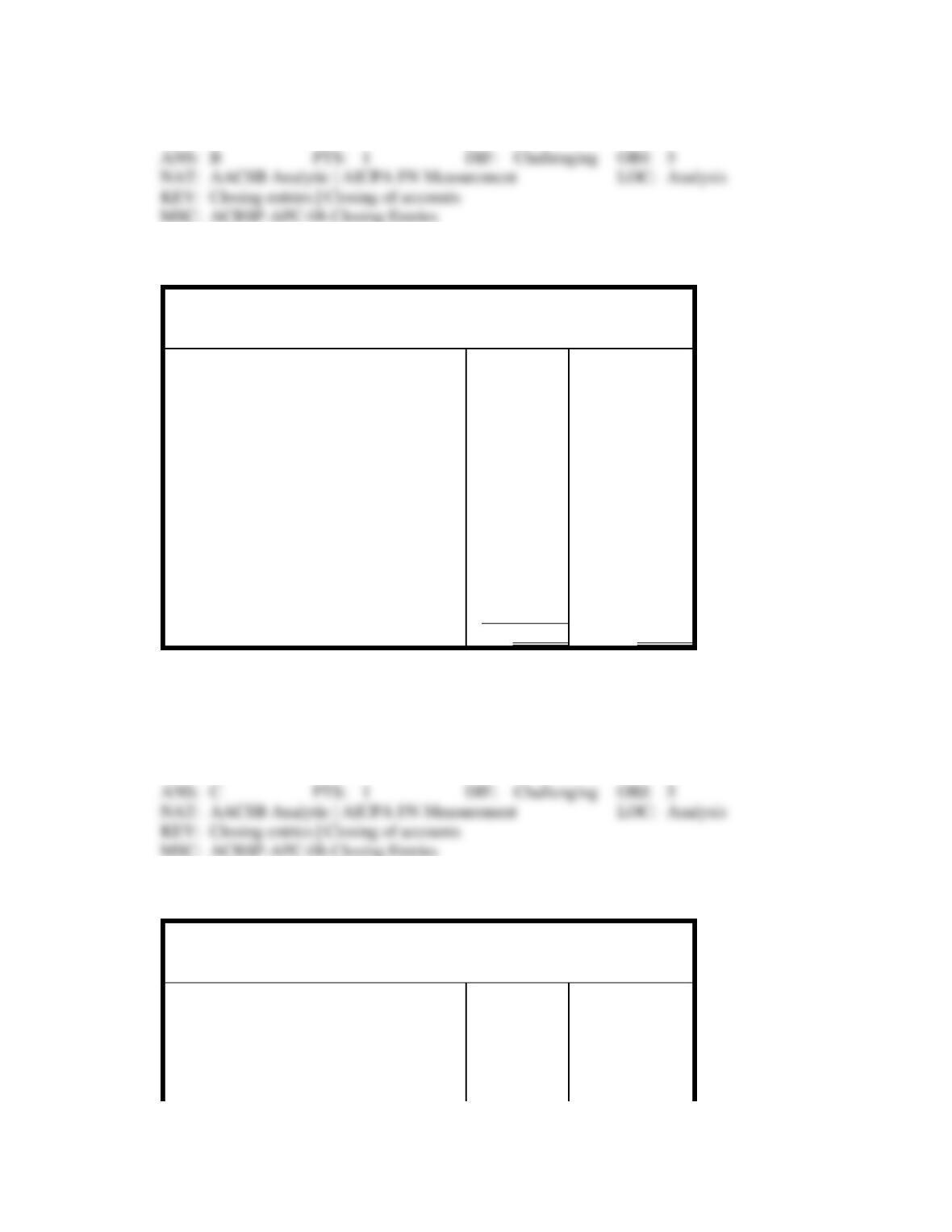
118. Use this adjusted trial balance to answer the following question.
Nantucket’s Marina
Adjusted Trial Balance
December 31, 2013
Cash
$ 5,000
Accounts Receivable
7,000
Supplies
3,000
Prepaid Insurance
5,000
Dock
24,000
Accumulated Depreciation–Dock
$ 6,000
Accounts Payable
12,000
Common Stock
20,000
Dividends
8,000
Boat Rentals
34,000
Depreciation Expense–Dock
2,000
Wages Expense
13,000
Insurance Expense
4,000
Income Taxes Expense
1,000
_______
$72,000
$72,000
The entry to close the Dividends account includes a
a.
debit to Dividends for $8,000.
b.
debit to Retained Earnings for $8,000.
c.
credit to Retained Earnings for $8,000.
d.
credit to Income Summary for $8,000.
119. Use this adjusted trial balance to answer the following question.
Nantucket’s Marina
Adjusted Trial Balance
December 31, 2013
Cash
$ 5,000
Accounts Receivable
7,000
Supplies
3,000
Prepaid Insurance
5,000
Dock
24,000
Accumulated Depreciation–Dock
$ 6,000
Accounts Payable
12,000
Common Stock
20,000
Dividends
8,000
Boat Rentals
34,000
Depreciation Expense–Dock
2,000
Wages Expense
13,000
Insurance Expense
4,000
Income Taxes Expense
1,000
_______
$72,000
$72,000
The entry to close the Boat Rentals account includes a
a.
debit to Retained Earnings for $34,000.
b.
debit to Income Summary for $34,000.
c.
debit to Boat Rentals for $34,000.
d.
credit to Boat Rentals for $34,000.
120. Use this adjusted trial balance to answer the following question.
Nantucket’s Marina
Adjusted Trial Balance
December 31, 2013
Cash
$ 5,000
Accounts Receivable
7,000
Supplies
3,000
Prepaid Insurance
5,000
Dock
24,000
Accumulated Depreciation–Dock
$ 6,000
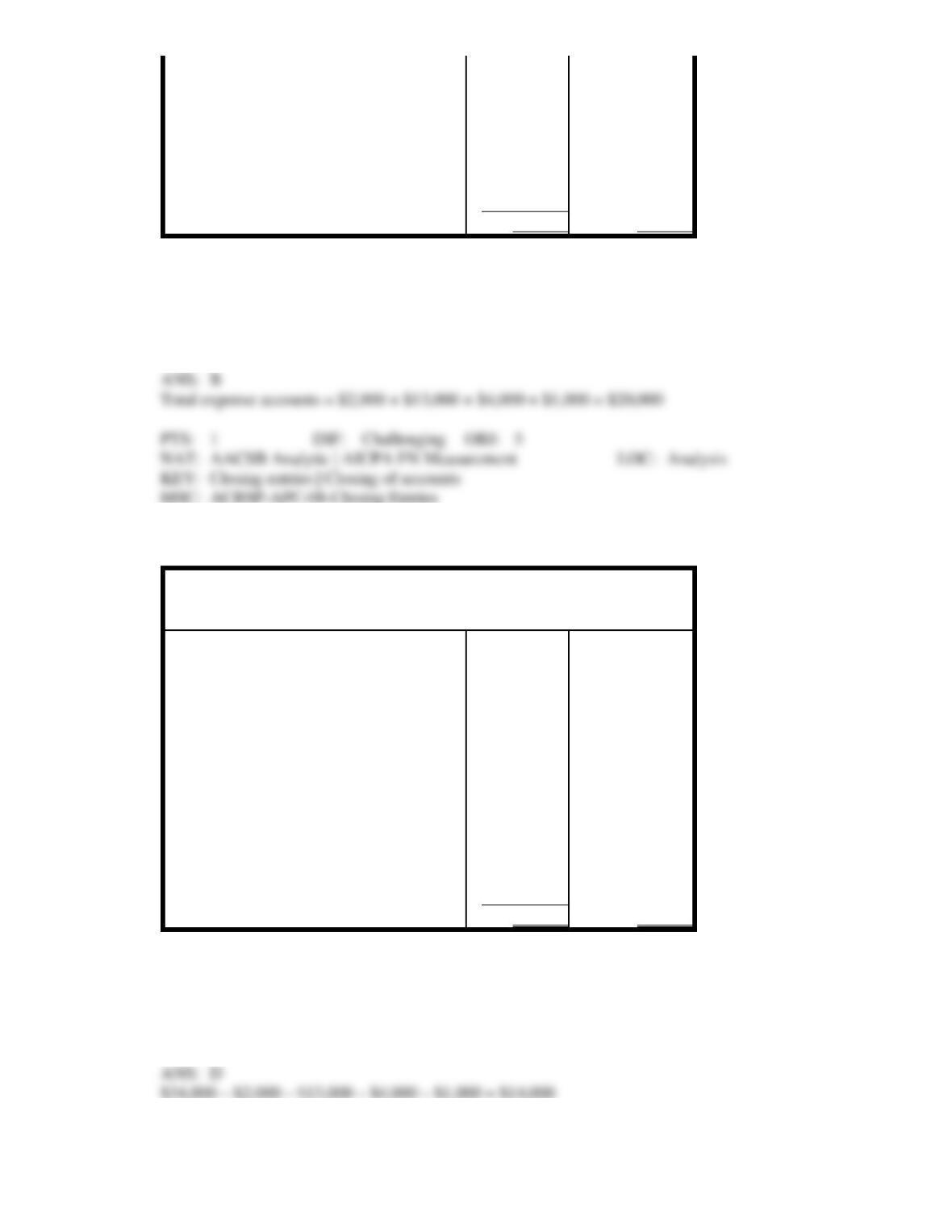
Accounts Payable
12,000
Common Stock
20,000
Dividends
8,000
Boat Rentals
34,000
Depreciation Expense–Dock
2,000
Wages Expense
13,000
Insurance Expense
4,000
Income Taxes Expense
1,000
_______
$72,000
$72,000
The entry to close the expense accounts includes a
a.
debit to Retained Earnings for $4,000.
b.
debit to Income Summary for $20,000.
c.
debit to Insurance Expense for $4,000.
d.
credit to Retained Earnings for $40,000.
121. Use this adjusted trial balance to answer the following question.
Nantucket’s Marina
Adjusted Trial Balance
December 31, 2013
Cash
$ 5,000
Accounts Receivable
7,000
Supplies
3,000
Prepaid Insurance
5,000
Dock
24,000
Accumulated Depreciation–Dock
$ 6,000
Accounts Payable
12,000
Common Stock
20,000
Dividends
8,000
Boat Rentals
34,000
Depreciation Expense–Dock
2,000
Wages Expense
13,000
Insurance Expense
4,000
Income Taxes Expense
1,000
_______
$72,000
$72,000
The amount of net income (or net loss) during the period is
a.
$32,000 net income.
b.
$9,000 net income.
c.
$10,000 net loss.
d.
$14,000 net income.
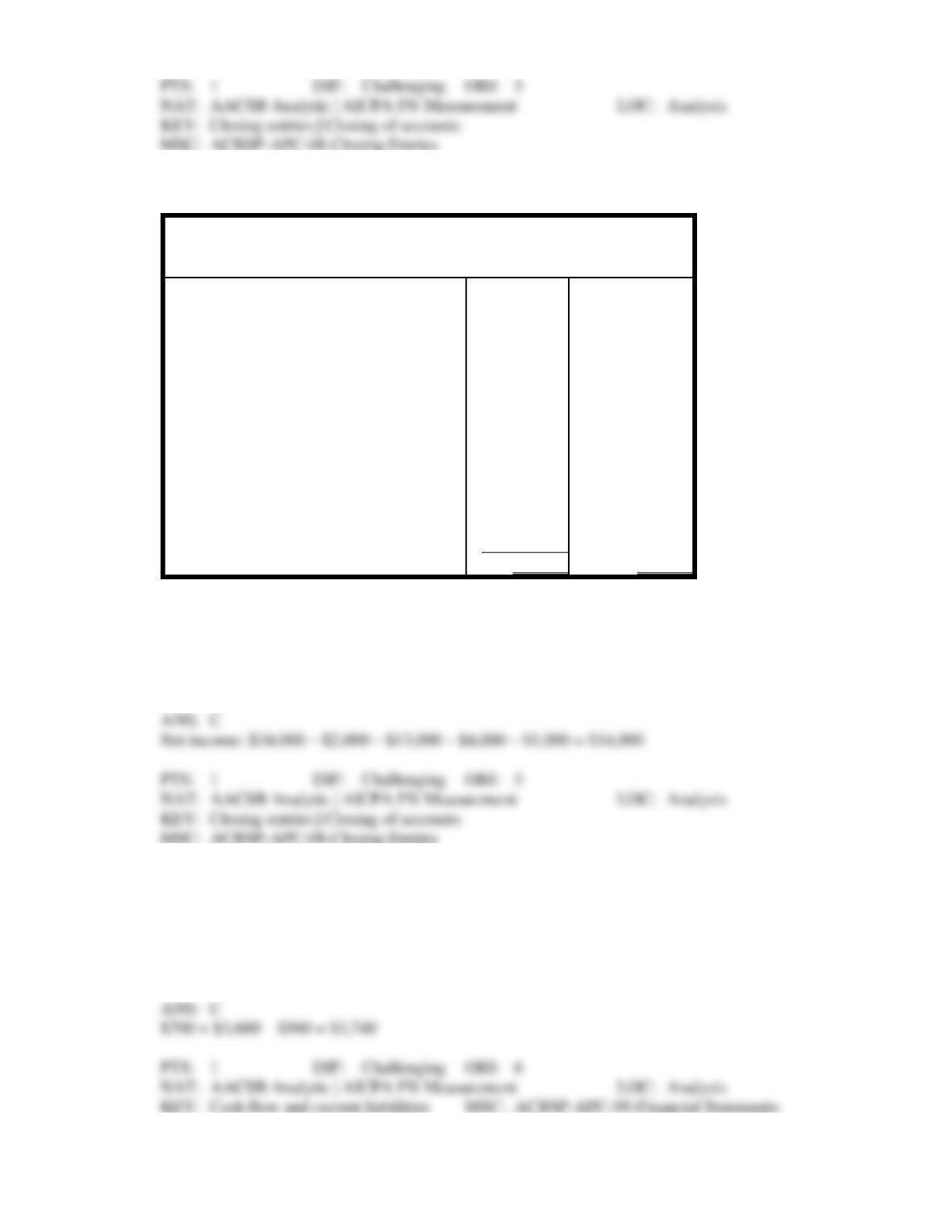
122. Use this adjusted trial balance to answer the following question.
Nantucket’s Marina
Adjusted Trial Balance
December 31, 2013
Cash
$ 5,000
Accounts Receivable
7,000
Supplies
3,000
Prepaid Insurance
5,000
Dock
24,000
Accumulated Depreciation–Dock
$ 6,000
Accounts Payable
12,000
Common Stock
20,000
Dividends
8,000
Boat Rentals
34,000
Depreciation Expense–Dock
2,000
Wages Expense
13,000
Insurance Expense
4,000
Income Taxes Expense
1,000
_______
$72,000
$72,000
The entry to close Income Summary includes a
a.
credit to Common Stock for $16,000.
b.
credit to Income Summary for $24,000.
c.
debit to Income Summary for $14,000.
d.
debit to Retained Earnings for $32,000.
123. Wages Payable were $700 at the end of October and $560 at the end of November. Wages Expense for
November was $3,600. How much cash was paid for wages during November?
a.
$3,460
b.
$4,860
c.
$3,740
d.
$2,340
124. Unearned Revenue was $2,400 at the end of May and $3,000 at the end of June. Service Revenue was
$10,600 for the month of June. How much cash was received for services provided during June?
a.
$10,000
b.
$5,200
c.
$11,200
d.
$16,000
125. Prepaid Rent was $800 at the end of May and $1,300 at the end of June. Rent Expense for June was
$520. How much cash was paid for rent during June?
a.
$620
b.
$820
c.
$1,020
d.
$1,220
126. Accounts Receivable was $750 at the end of November and $525 at the end of December. Revenue
totaled $4,775 for December. How much cash was received from revenues during December?
a.
$6,050
b.
$5,000
c.
$4,550
d.
$3,550
127. Office Supplies were $1,800 at the end of January and $2,280 at the end of February. During February,
Office Supplies Expense equaled $840. How much cash was paid for office supplies during February?
a.
720
b.
$3,120
c.
$3,720
d.
$1,320