
Chapter 3: Accrual Accounting Concepts
81. Which transaction would be recorded in a cash basis system of accounting?
a. Purchase of equipment by signing a note
b. Purchase of supplies on credit
c. Sale of goods against a note
d. Sale of goods for cash
82. ASE Company sold goods, receiving $35,000 in cash and $15,000 on credit. How much
revenue should it record under the accrual basis of accounting?
a. $35,000
b. $15,000
c. $50,000
d. $50,000
83. The accrual basis of accounting recognizes:
a. revenues when cash is received and expenses when cash is paid.
b. revenues when earned and expenses when cash is paid.
c. revenues when cash is received and expenses when incurred.
d. revenues when earned and expenses when incurred.
84. Working capital is calculated as .
a. current assets less stockholders’ equity
b. current assets less current liabilities
c. stockholders’ equity plus current assets
d. current assets plus current liabilities
85. The quick ratio is computed as .
a. quick assets divided by current liabilities
b. quick assets divided by current assets
c. current assets divided by stockholders’ equity
d. current liabilities divided by current assets

Chapter 3: Accrual Accounting Concepts
86. Three measures useful in assessing liquidity and the ability of a company to pay its current
liabilities are , the current ratio, and the quick ratio.
a. working capital
b. debt equity ratio
c. net profit
d. interest coverage
87. Which of the following is true about quick ratio?
a. It is computed as quick assets multiplied by current liabilities.
b. It includes cash, inventory, and short-term investments.
c. If it is less than 1.0, it raises liquidity concerns for creditors.
d. It is a suitable measure to derive the profitability of the company.
88. From the following data for David ProElecticals, calculate the quick ratio.
Cash
$ 68,500
Accounts receivable
130,000
Inventories
213,000
Prepaid expenses
25,000
Total current assets
$436,500
Less current liabilities
275,000
Working capital
$161,500
a. 1.6
b. 0.7
c. 0.3
d. 1.5
89. On the statement of cash flows, the cash flows from operating activities section would include:
a. receipts from the issuance of capital stock.
b. receipts from the sale of investments.
c. payments for the acquisition of investments.
d. cash receipts from sales activities.

Chapter 3: Accrual Accounting Concepts
90. Which of the following should be deducted from net income in calculating net cash flow from
operating activities using the indirect method?
a. A decrease in inventory
b. A decrease in accounts payable
c. Preferred dividends declared and paid
d. A decrease in accounts receivable
91. Which of the following should be shown on a statement of cash flows under the financing
activity section?
a. The purchase of a long-term investment in the common stock of another company
b. The payment of cash to retire a long-term note
c. The proceeds from the sale of a building
d. The issuance of a long-term note to acquire land
92. Cash receipts from interest and dividends are classified as:
a. investing activities.
b. operating activities.
c. either financing or investing activities.
d. financing activities.
93. Depreciation on factory equipment would be reported in the statement of cash flows prepared
by the indirect method in:
a. the cash flows from financing activities section.
b. the cash flows from investing activities section.
c. a separate schedule.
d. the cash flows from operating activities section.
94. Which of the following should be added to net income in calculating net cash flow from
operating activities using the indirect method?
a. An increase in inventory
b. A decrease in accounts payable
c. Preferred dividends declared and paid
d. A decrease in accounts receivable

Chapter 3: Accrual Accounting Concepts
95. Which one of the following should be added to net income in calculating net cash flow from
operating activities using the indirect method?
a. A gain on the sale of land
b. A decrease in accounts payable
c. An increase in accrued liabilities
d. Dividends paid on common stock
96. On the statement of cash flows prepared by the indirect method, a $50,000 gain on the sale of
investments would be:
a. deducted from net income in converting the net income reported on the income statement to
cash flows from operating activities.
b. added to net income in converting the net income reported on the income statement to cash
flows from operating activities.
c. added to cash received from the sale to determine cash flows from investing activities.
d. deducted from cash received from the sale to determine cash flows from investing activities.
97. Accounts receivable arising from trade transactions amounted to $62,000 and $78,000 at the
beginning and end of the year, respectively. Net income reported on the income statement for
the year was $125,000. Exclusive of the effect of other adjustments, the cash flows from
operating activities to be reported on the statement of cash flows prepared by the indirect
method are:
a. $109,000.
b. $141,000.
c. $125,000.
d. $140,000.
Chapter 3: Accrual Accounting Concepts
98. The net income reported on the income statement for the current year was $310,000.
Depreciation recorded on fixed assets and amortization of patents for the year were $40,000
and $9,000, respectively. Balances of current asset and current liability accounts at the end and
at the beginning of the year are as follows:
End
Beginning
Cash
$ 50,000
$ 60,000
Accounts receivable
112,000
108,000
Inventories
105,000
93,000
Prepaid expenses
4,500
6,500
Accounts payable (merchandise creditors)
75,000
89,000
What is the amount of cash flows from operating activities reported on the statement of cash
flows prepared by the indirect method?
a. $233,000
b. $289,000
c. $387,000
d. $331,000
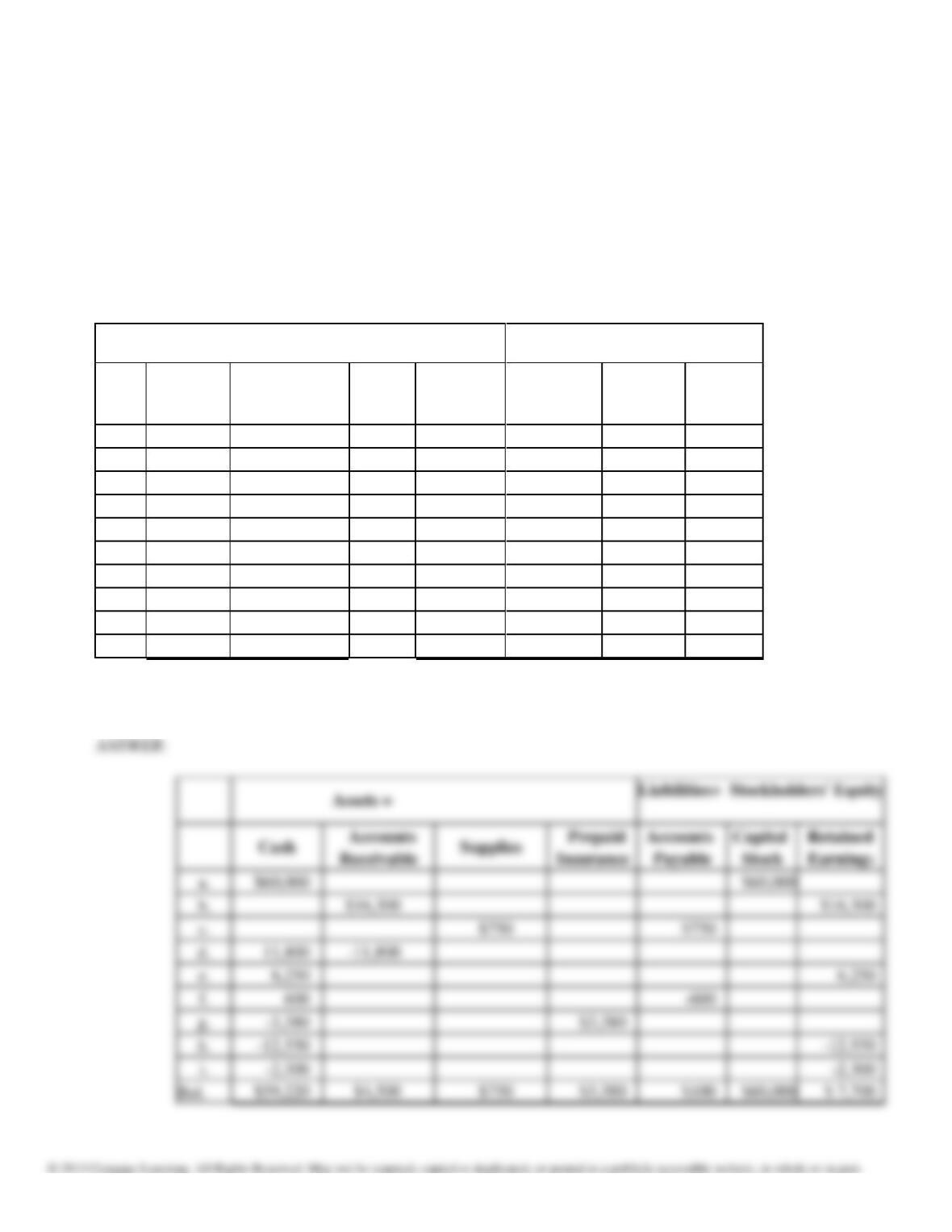
99. Describe the differences between the cash and accrual bases of accounting.
100. When are sales recognized under the cash basis of accounting? When are expenses
recognized?
Chapter 3: Accrual Accounting Concepts
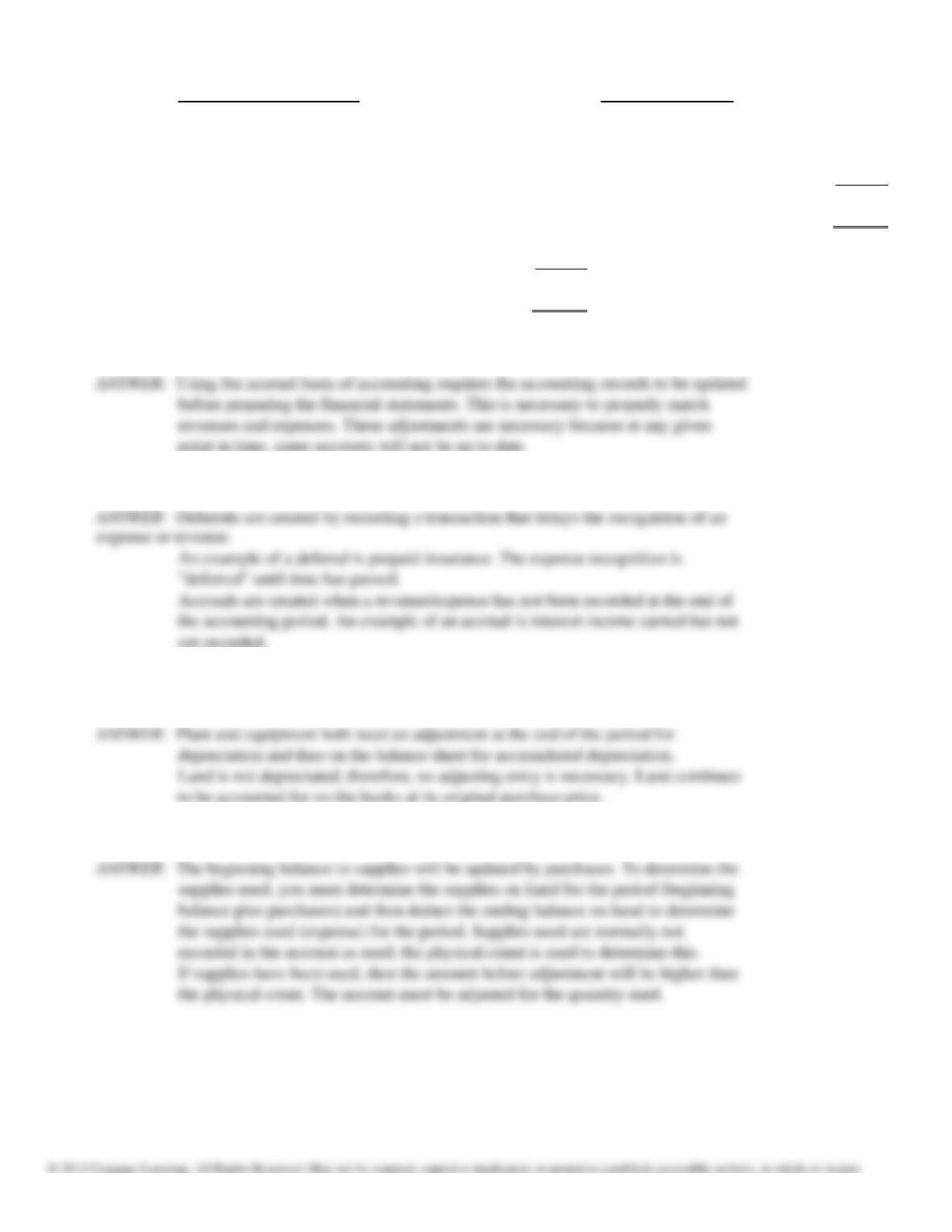
101. Assume the November transactions for Camindo Co. are as follows:
a. Received cash of $60,000 from investors in exchange for capital stock.
b. Provided services of $16,300 on account.
c. Purchased supplies on account $750.
d. Received cash of $11,800 from clients for services previously billed.
e. Received $6,250 for services provided from clients who paid cash.
f. Paid $600 on account for supplies that had been purchased.
g. Paid $3,380 for a one-year insurance policy.
h. Paid the following expenses: wages, $7,800; utilities, $1,000; rent, $3,750.
i. Paid dividends of $2,300 to stockholders.
Record the transactions, using the integrated financial statement framework that follows:
Assets =
Liabilities + Stockholders’ Equity
Cash
Accounts
Receivable
Supplies
Prepaid
Insurance
Accounts
Payable
Capital
Stock
Retained
Earnings
a
b
c
d
e
f
g
h
i
Bal.
Calculate the November 30 cash balance and the amount of net income for November for
Hoover Co.
Chapter 3: Accrual Accounting Concepts
Statement of Cash Flows
Financing
$60,000
Income Statement
Service Revenue
$16,300
Operating
11,800
Service Revenue
6,250
Operating
6,250
Expenses
-12,550
Operating
-600
Operating
– 3,380
Net Income
$10,000
Operating
-12,250
Financing
-2,300
Ending cash balance
$59,220
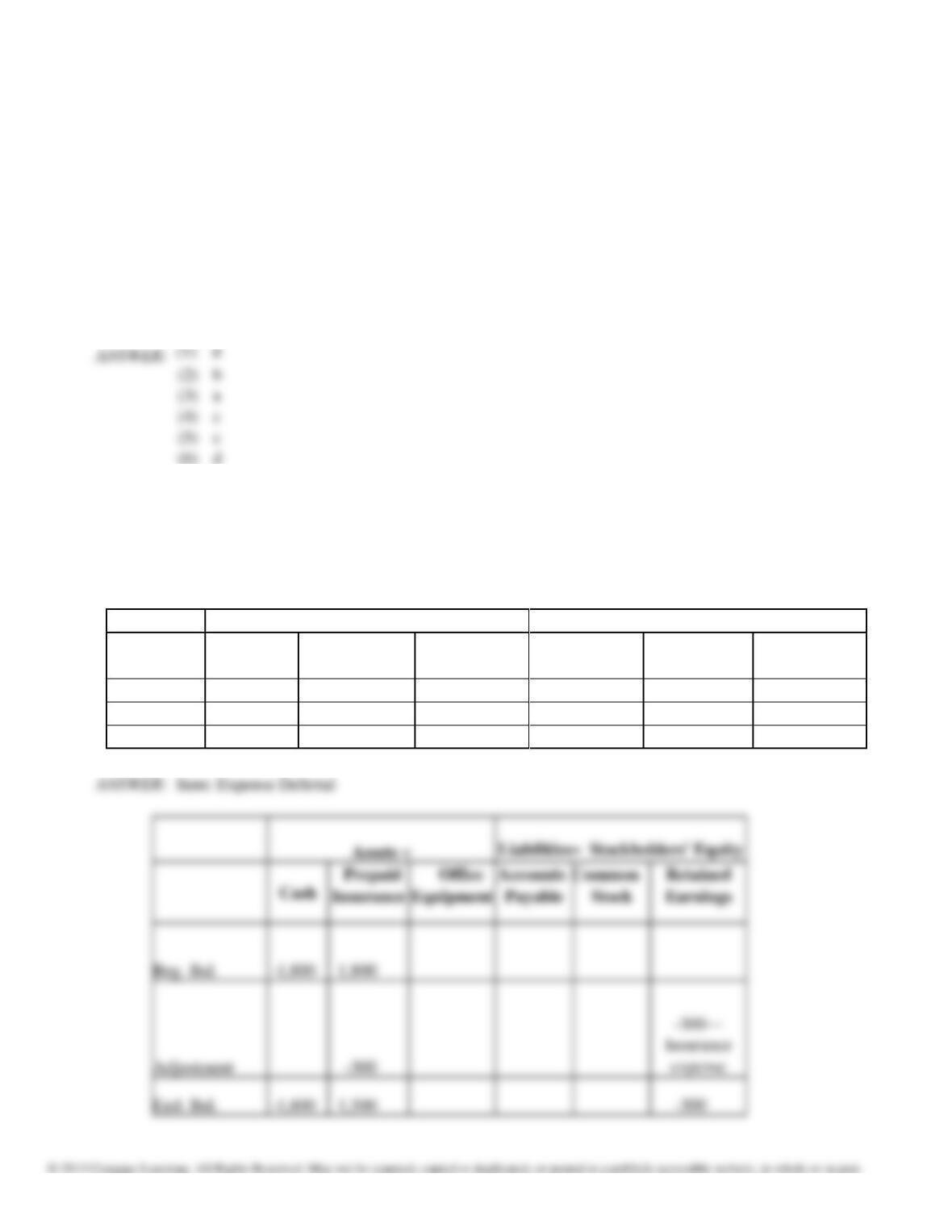
102. Describe the end-of-the-period adjustment process. Why is it necessary?
103. Describe deferrals and accruals.
104. Under the balance sheet classification of property, plant, and equipment, some accounts need
adjustment and others do not. Which do and why? Which do not and why?
105. Why is a physical count of supplies necessary at the end of the accounting period?
Chapter 3: Accrual Accounting Concepts
106. Classify the following items as:
a. accrued revenue (accrued asset)
b. deferred revenue (unearned revenue)
c. accrued expense (accrued liability)
d. deferred expense (prepaid expense)
(1) Three months’ rent paid in advance
(2) Rental income for six months received in advance
(3) Jobs completed but not yet billed at month-end
(4) Interest payable accrued on a note, but not yet paid
(5) Telephone bill owed but not yet paid
(6) A three-year premium paid on auto fleet insurance policy
107. Identify the type of adjustment necessary (the type of item involved) and record the transaction
for the event. Make sure to include the ending balances after adjustment.
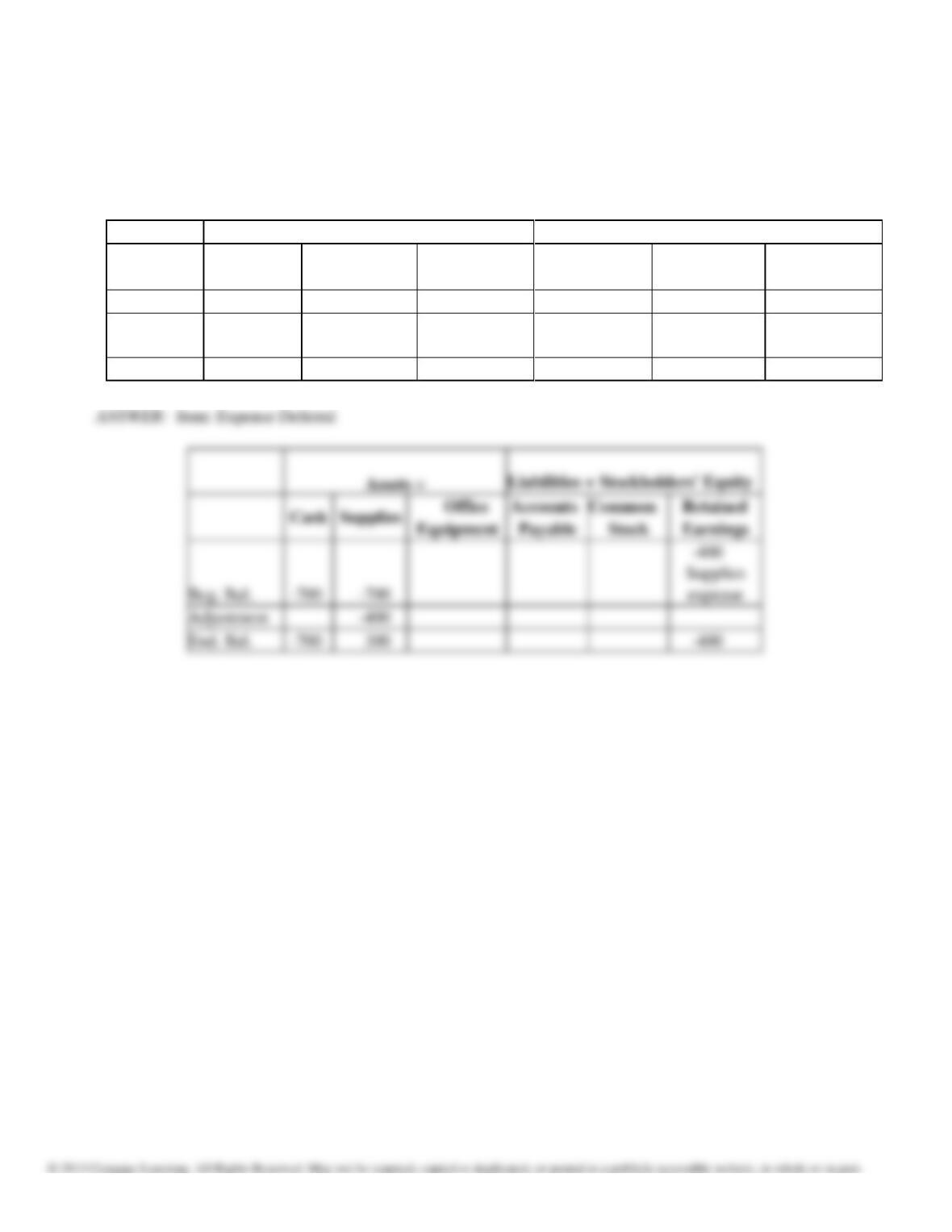
Assume that on June 1, 2015, Carter Lights Corp. had paid $1,800 in advance for a 6-month
insurance policy. The June 30 adjustment is:
Assets =
Liabilities + Stockholders’ Equity
Cash
Prepaid
Insurance
Office
Equipment
Accounts
Payable
Common
Stock
Retained
Earnings
Beg. Bal.
-1,800
1,800
Adjustment
End. Bal.
Chapter 3: Accrual Accounting Concepts
108. Identify the type of adjustment necessary (the type of item involved) and record the transaction
for the event. Make sure to include the ending balances after adjustment.
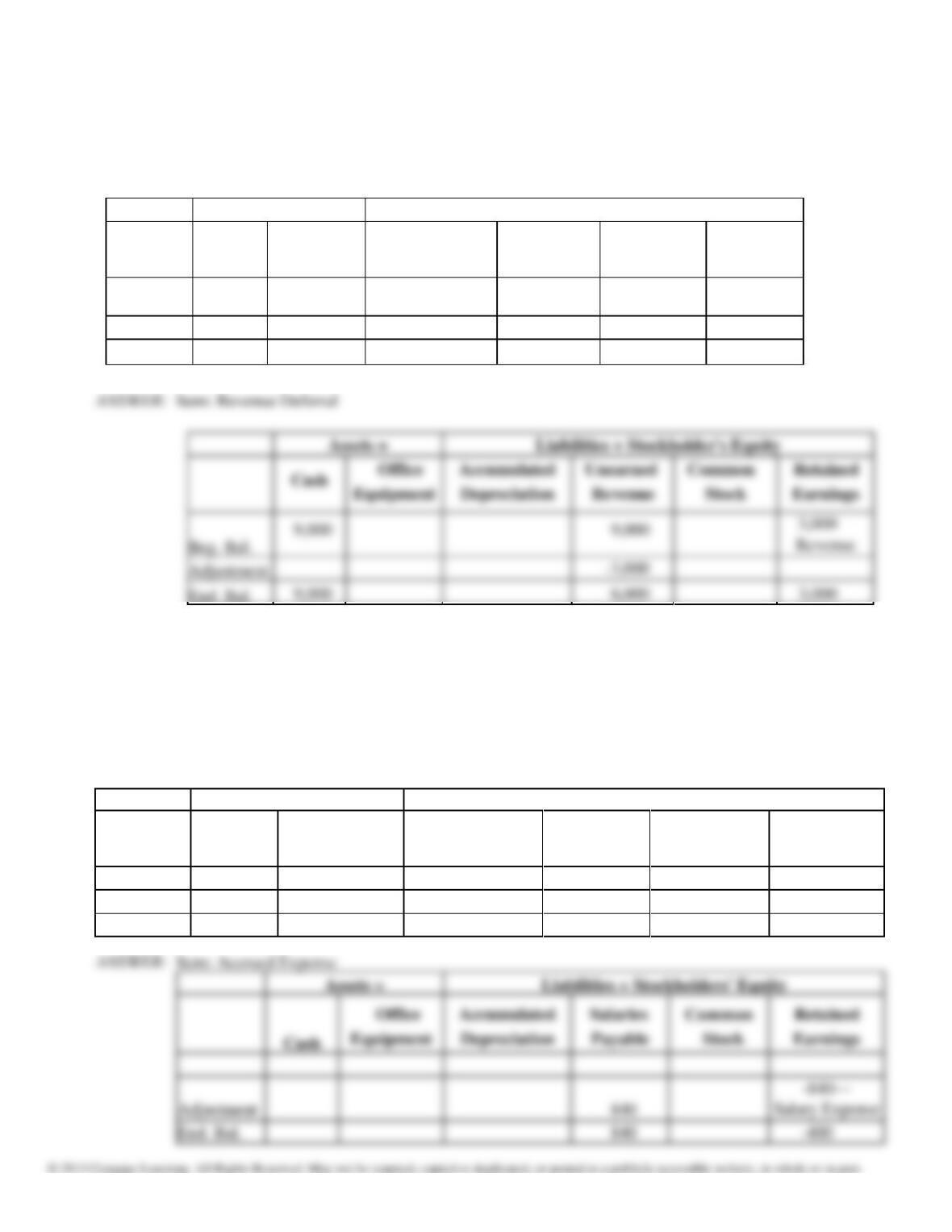
Assume that on June 1, 2015, Tasty Sausage Corp. has a balance of $100 for supplies. On June
6 it purchased $600 in supplies for cash. On June 30, at the end of the accounting period, there
are $300 of supplies on hand. The June 30 adjustment is:
Assets =
Liabilities + Stockholders’ Equity
Cash
Supplies
Office
Equipment
Accounts
Payable
Common
Stock
Retained
Earnings
Beg. Bal.
-100
100
Supplies
purchased
-600
600
End. Bal.
-700
700
Adjustment
Chapter 3: Accrual Accounting Concepts
109. Identify the type of adjustment necessary (the type of item involved) and record the transaction
for the event. Make sure to include the ending balances after adjustment.
Assume that on June 1, 2015, Tasty Sausage Corp. received $9,000 in advance to provide
sausages over the next three months. The June 30 adjustment is:
Assets =
Liabilities + Stockholder’s Equity
Cash
Office
Equipment
Accumulated
Depreciation
Unearned
Revenue
Common
Stock
Retained
Earnings
Beg. Bal.
9,000
9,000
Adjustment
End. Bal.
Unearned
Common
Adjustment
110. Identify the type of adjustment necessary (the type of item involved) and record the transaction
for the event. Make sure to include the ending balances after adjustment.
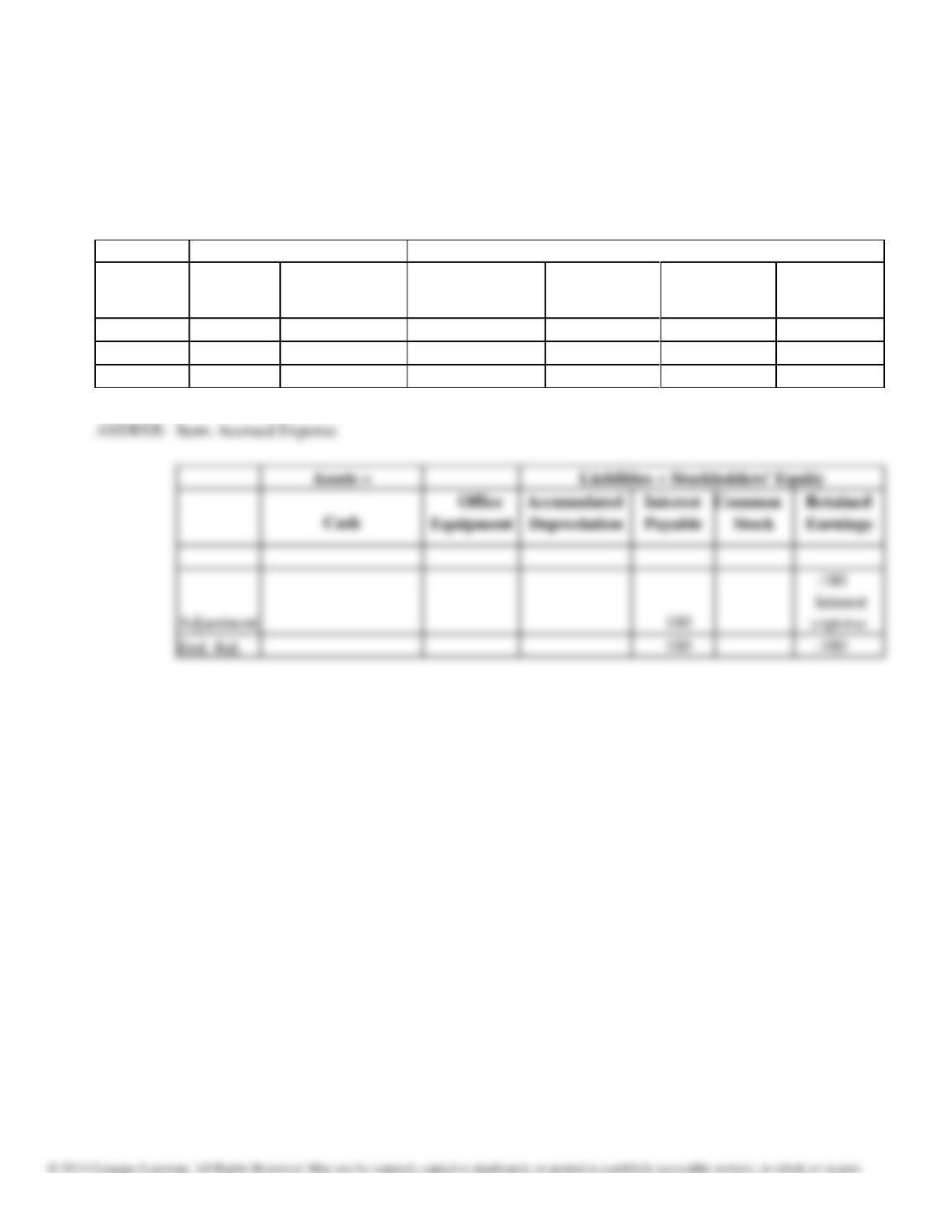
Assume Mover Lights Corp. pays salaries on the 28th of each month. Light stuffers earn
$280/day with a 7-day work week. June 30th is the end of the accounting period. Light stuffers
have worked on the 28th, 29th, and 30th but have not yet been paid for those days. The June
30 adjustment is:
Assets =
Liabilities + Stockholders’ Equity
Cash
Office
Equipment
Accumulated
Depreciation
Salaries
Payable
Common
Stock
Retained
Earnings
Adjustment
End. Bal.
Chapter 3: Accrual Accounting Concepts
111. Identify the type of adjustment necessary (the type of item involved) and record the transaction
for the event. Make sure to include the ending balances after adjustment.
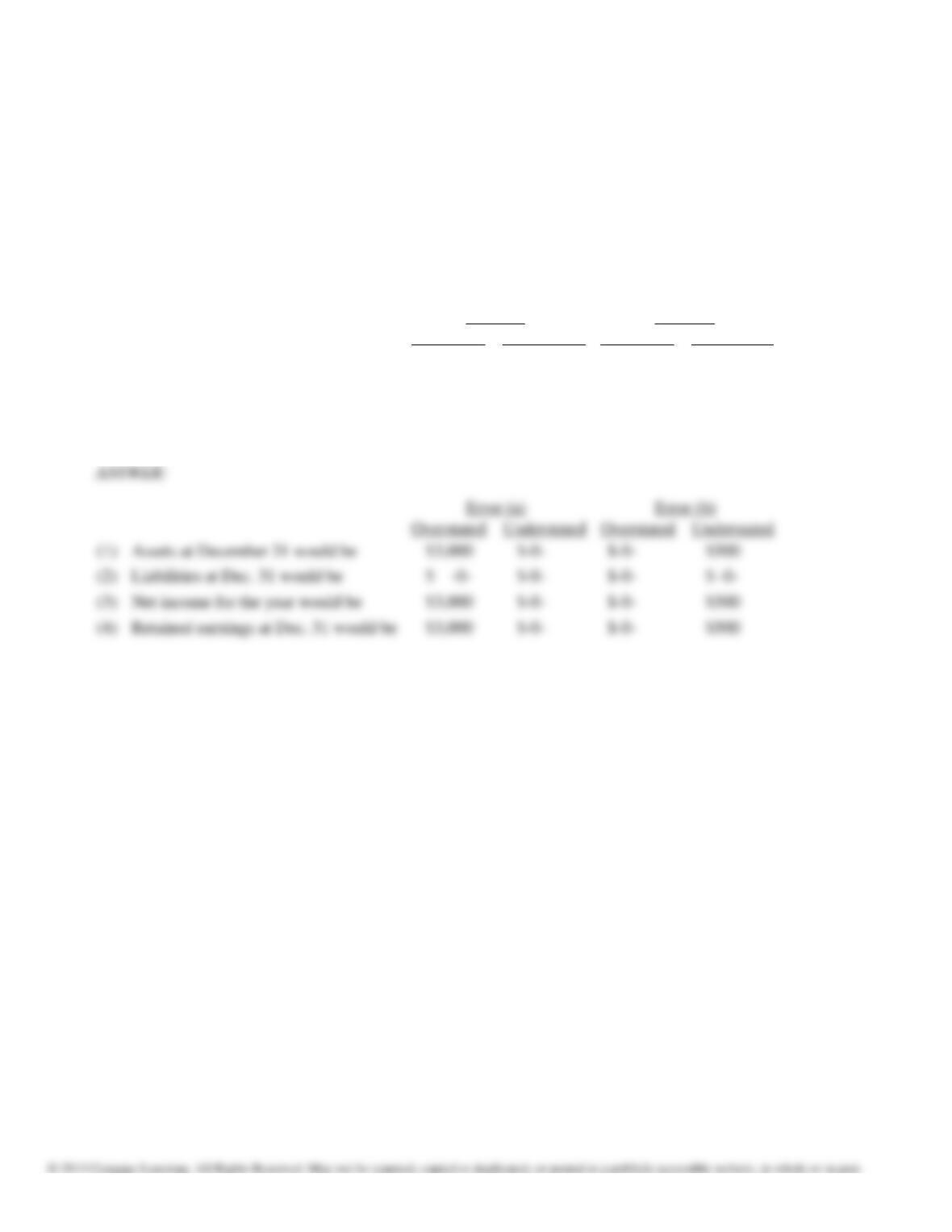
On June 1, Carter Lights Corp. borrowed $38,000 from the bank by signing a promissory note
from the bank, with 7% interest. The note is due in three months. Interest for June has been
incurred but not yet recorded. The interest to accrue for June is $180. The June 30 adjustment
is:
Assets =
Liabilities + Stockholders’ Equity
Cash
Office
Equipment
Accumulated
Depreciation
Interest
Payable
Common
Stock
Retained
Earnings
Adjustment
End. Bal.
End. Bal.
Chapter 3: Accrual Accounting Concepts
112. At the end of the fiscal year, the following adjusting entries were omitted:
(a) No adjusting entry was made to transfer the $3,000 of prepaid insurance from the asset
account to the expense account.
(b) No adjusting entry was made to record accrued fees of $500 for services provided to
customers.
Assuming that financial statements are prepared before the errors are discovered, indicate the
effect of each error, considered individually, by inserting the dollar amount in the appropriate
spaces. Insert “0” if the error does not affect the item.
Error (a) Error (b)
Overstated Understated Overstated Understated
(1) Assets at December 31 would be $ $ $ $
(2) Liabilities at Dec. 31 would be $ $ $ $
(3) Net income for the year would be $ $ $ $
(4) Retained earnings at Dec. 31 would be $ $ $ $
Chapter 3: Accrual Accounting Concepts
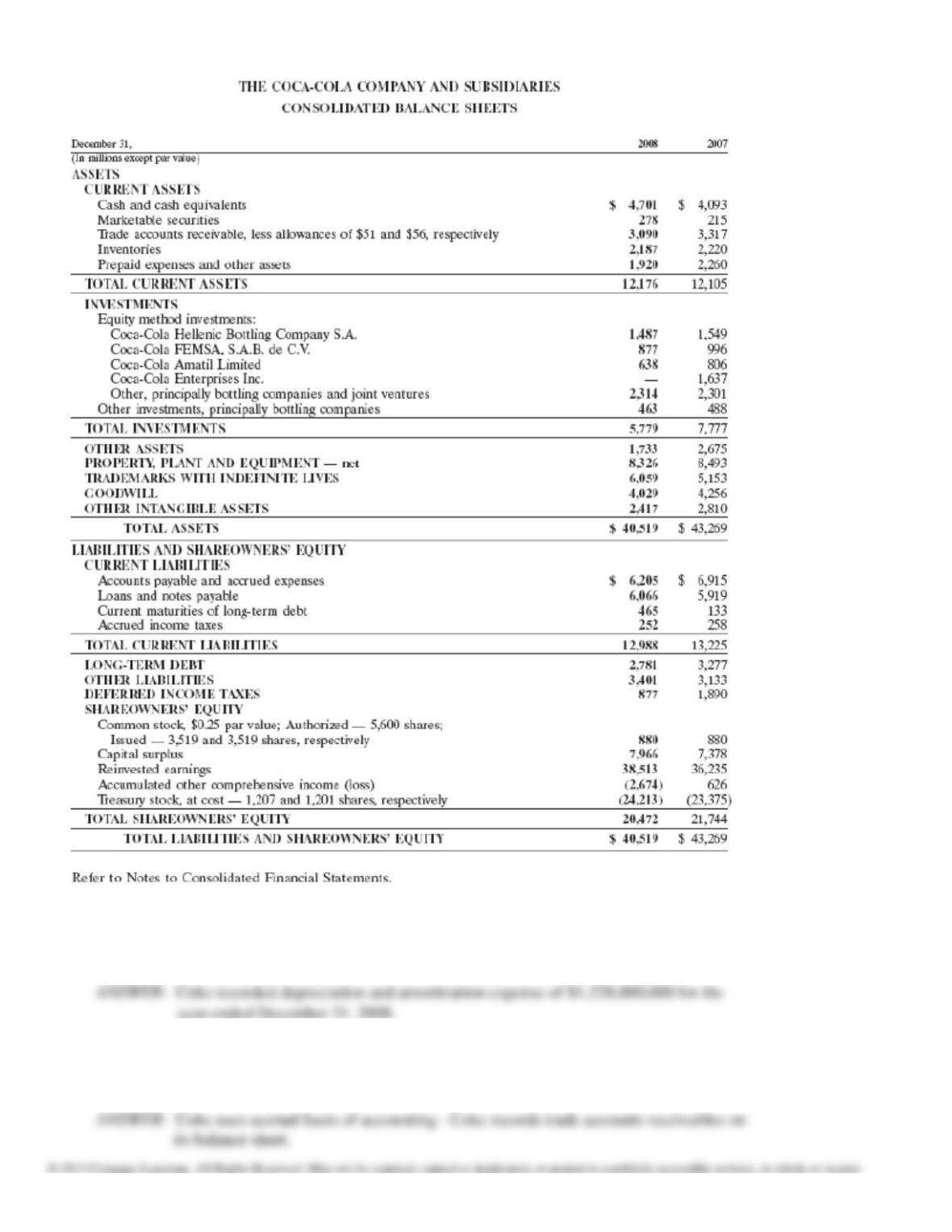
113. Refer to Coke’s Statement of Cash Flows. What amount of depreciation and amortization did
Coke record in 2008?
114. Refer to Coke’s balance sheet. Does it appear that Coke uses the cash or accrual basis of
accounting?
Chapter 3: Accrual Accounting Concepts
115. Electroyo Corporation’s accumulated depreciation increased by $8,500, while patents
decreased by $2,800 between consecutive balance sheet dates. There were no purchases or
sales of depreciable or intangible assets during the year. In addition, the income statement
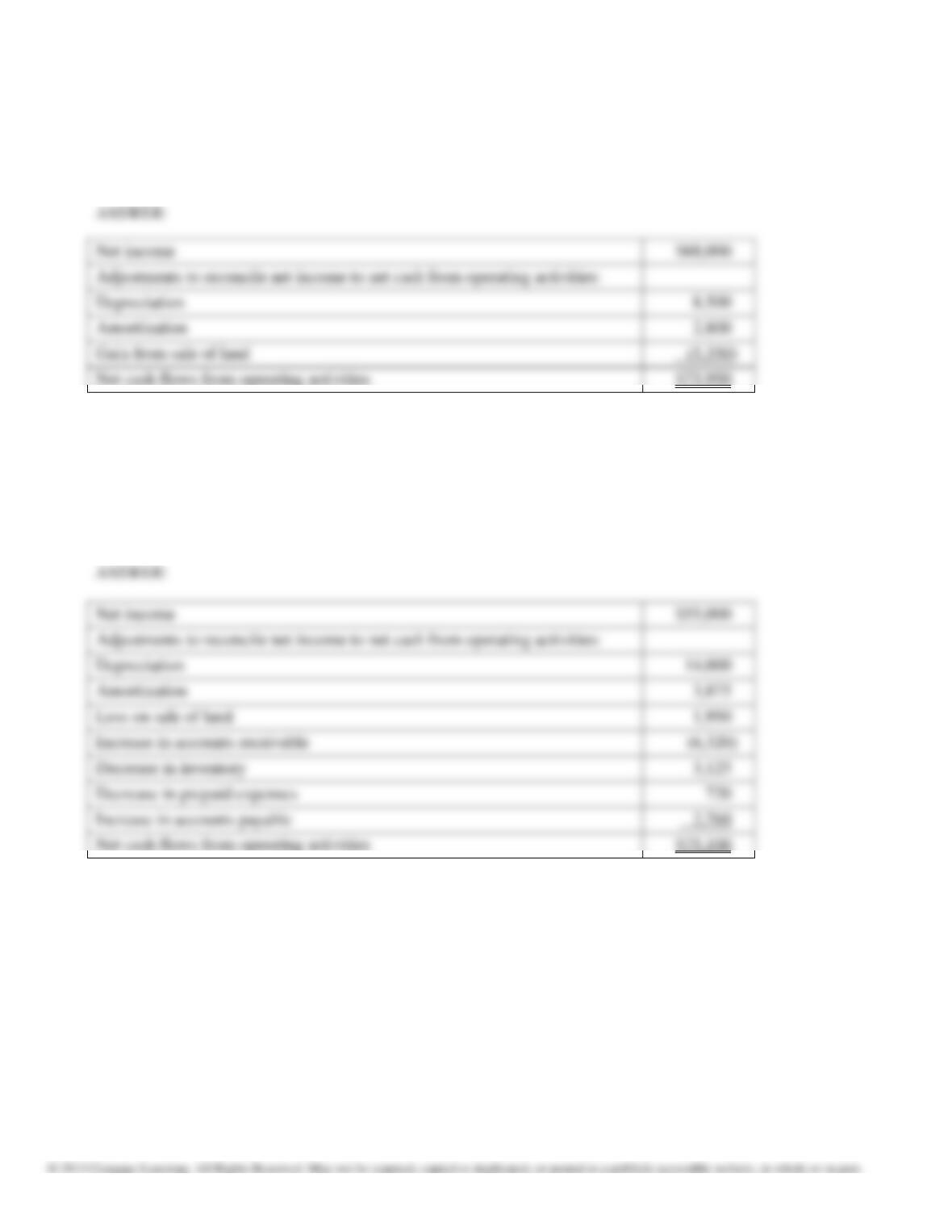
showed a gain of $5,350 from sale of land. Reconcile a net income of $68,000 to net cash flow
from operating activities.
116. BlueInk Corporation’s accumulated depreciation increased by $14,000, while patents
decreased by $3,875 between consecutive balance sheet dates. There were no purchases or
sales of depreciable or intangible assets during the year. In addition, the income statement
showed a loss on sale of land of $1,950. Accounts receivable increased $6,320, inventory
decreased $3,125, prepaid expenses decreased $720, and account payable increased $2,760.
Reconcile a net income of $55,000 to net cash flow from operating activities.