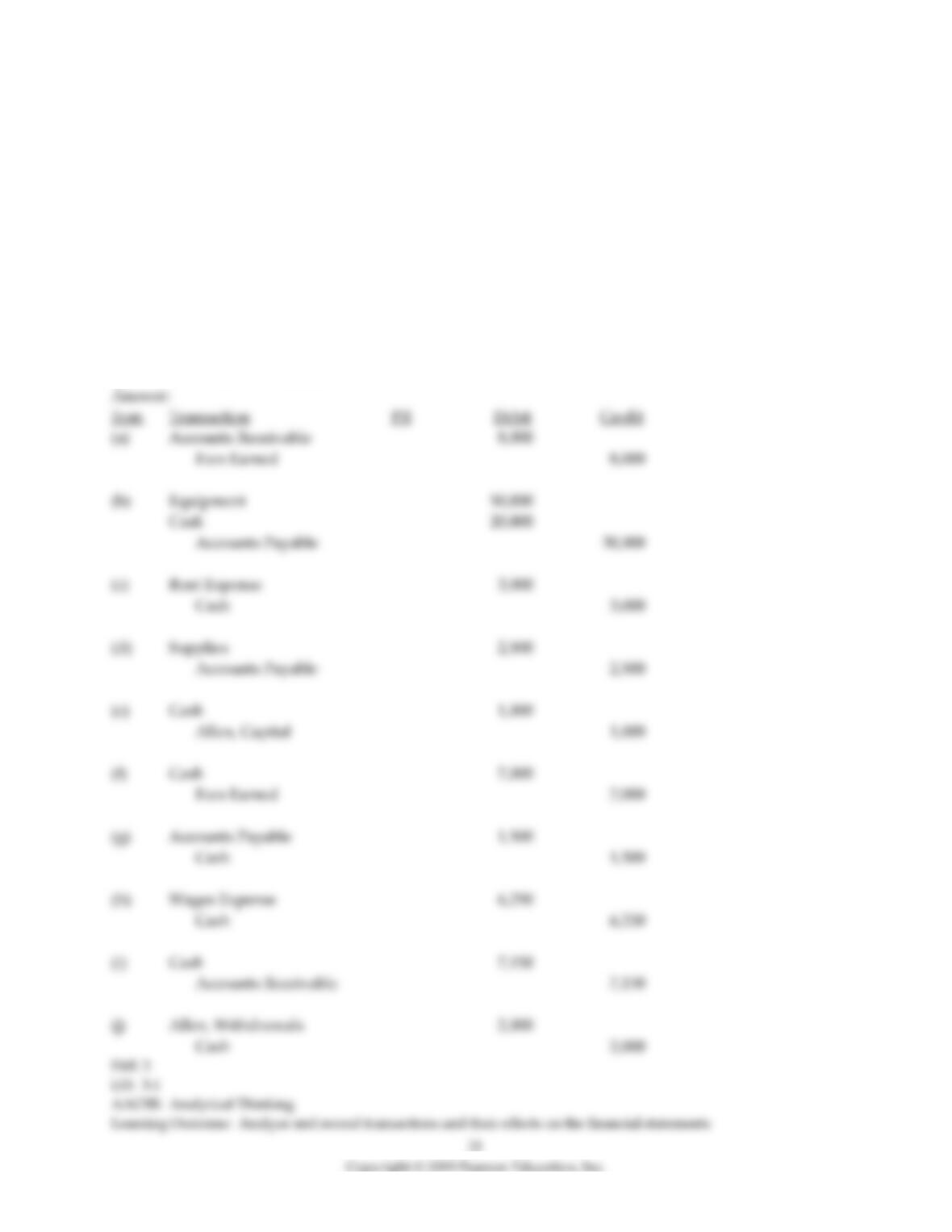
69) Record the following selected transactions for January in a two-column journal, identifying each entry
by letter:
(a) Earned $8,000 fees; customer will pay later.
(b) Purchased equipment for $50,000, paying $20,000 in cash and the remainder on credit
(c) Paid $3,000 for rent for January.
(d) Purchased $2,500 of supplies on account.
(e) A. Allen $1,000 investment in the company.
(f) Received $7,000 in cash for fees earned previously.
(g) Paid $1,500 to creditors on account.
(h) Paid wages of $6,250.
(i) Received $7,150 from customers on account.
(j) A. Allen withdrawal of $2,000.

22
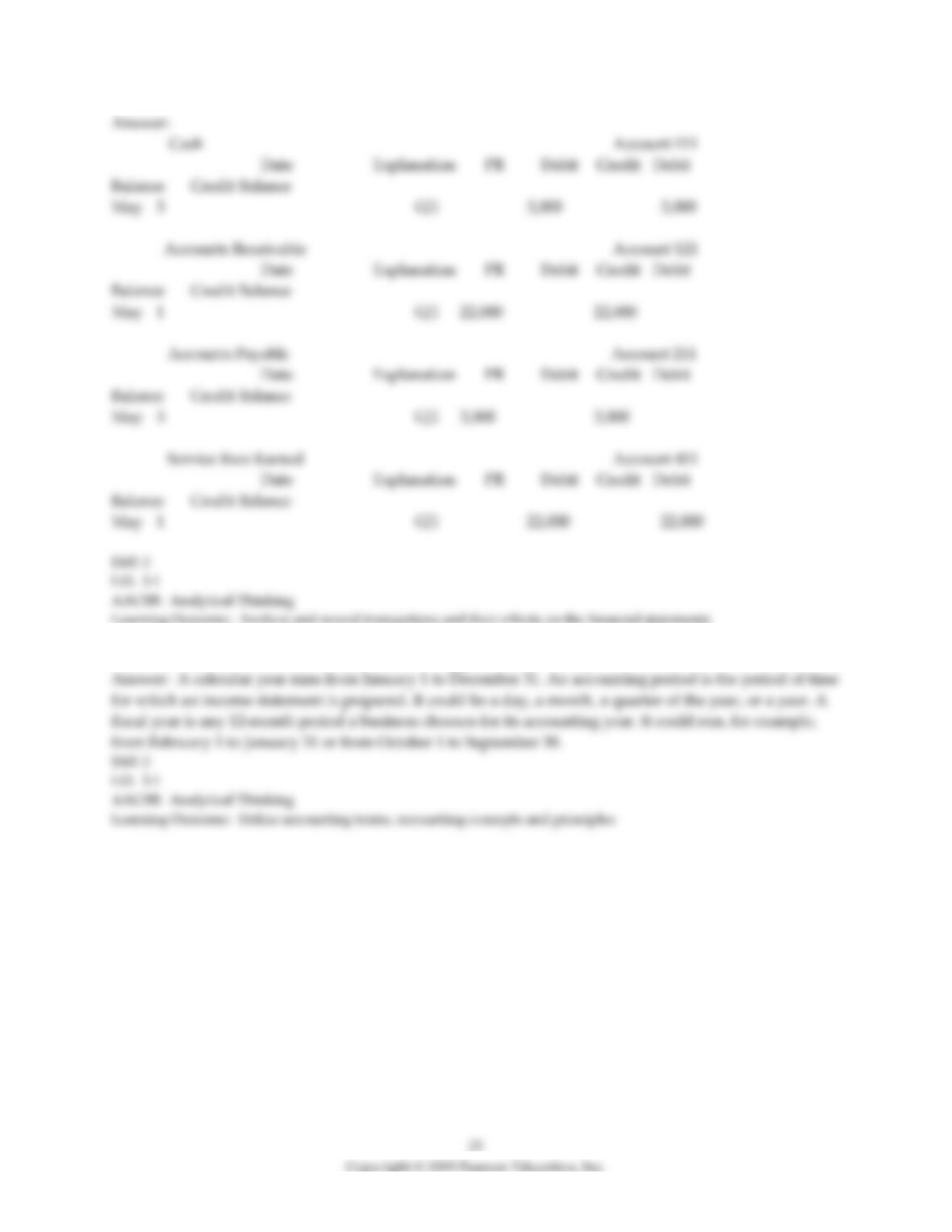
70) Post the following to the ledger of Smith Services. The partial chart of accounts is:
111 Cash
121 Accounts Receivable
211 Accounts Payable
411 Service Fees Earned
GENERAL JOURNAL Page 1
Date Acct. Titles and Description PR Debit Credit
May 1 Accounts Receivable 22,000
Service Fees Earned 22,000
Billed customer
May 5 Accounts Payable 3,000
Cash 3,000
Paid amount due
Cash Account 111
Date Explanation PR Debit Credit Debit
Balance Credit Balance
Accounts Receivable Account 121
Date Explanation PR Debit Credit Debit
Balance Credit Balance
Accounts Payable Account 211
Date Explanation PR Debit Credit Debit
Balance Credit Balance
Service Fees Account 411
Date Explanation PR Debit Credit Debit
Balance Credit Balance
71) Define and discuss a calendar year, accounting period, and fiscal year.
72) Provide an explanation for the following journal entries:
a) Prepaid Rent debited, Cash credited
b) Office supplies debited, Cash credited
c) Cash debited, Capital credited
d) Utility expense debited, Cash credited
e) Accounts Payable debited, Cash credited
73) Complete the following entries by using a “debit” or “credit.”
a) Received payment from a customer. Cash would have a: ________
b) Owner makes an investment of equipment. Capital would have a: ________
c) Paid rent in advance. Prepaid Rent would have a: ________
d) Billed a customer for services rendered. Revenue would have a: ________
e) Paid an advertising bill received last month. Cash would have a: ________
f) Owner withdrew cash. Withdrawals would have a: ________
74) What are interim financial statements?
75) Complete the following questions based on the journal entry below:
GENERAL JOURNAL Page 1
Date Acct. Titles and Description PR Debit Credit
June 1 Cash 110 6,000
Accounts Receivable 112 6,000
a) Date of Journal entry: ___________
b) Name of account debited: ___________
c) Name of account credited: ___________
d) Provide an explanation for this entry: ___________
e) Page of Journal: ___________
f) Account number for Cash: ___________
g) Account number for Accounts Receivable: ___________
3.2 Learning Objective 3-2
1) The purpose of posting is to:
A) record the transactions in chronological order in the journal.
B) provide an explanation of the transaction.
C) update the account balances in the ledger.
D) correct a previous entry.
2) Posting is performed by transferring information from the journal to the:
A) balance sheet.
B) trial balance.
C) ledger.
D) income statement.
3) The general ledger:
A) is after the trial balance.
B) is the book of final entry.
C) lists the transactions in chronological order.
D) is before the general journal.
4) “PR” in the general journal and general ledger stands for:
A) past reference.
B) posting reference.
C) prior receipt.
D) post review.
5) The posting reference column in the ledger is:
A) used to record the journal and page number the transactions originated.
B) used to record the ledger number.
C) used to record the date.
D) not used.
6) A credit to a liability account was posted to the capital account. This would cause:
A) assets to be understated.
B) liabilities to be understated.
C) owner’s equity to be understated.
D) net income to be overstated.
7) A credit to an asset account was posted to a liability account. This would cause:
A) assets to be overstated.
B) liabilities to be understated.
C) capital to be understated.
D) revenue to be overstated.
8) A credit to an asset account was posted to an expense account. This would cause:
A) assets to be understated.
B) liabilities to be understated.
C) capital to be understated.
D) expenses to be understated.
9) A debit to an expense account was posted to an asset account. This would cause:
A) assets to be overstated.
B) liabilities to be understated.
C) capital to be understated.
D) expenses to be overstated.
10) A debit to the liability account was posted to an expense account. This would cause:
A) assets to be overstated.
B) liabilities to be understated.
C) capital to be overstated.
D) liabilities to be overstated.
11) A credit to an asset account was posted to a liability account. This would cause:
A) assets to be overstated.
B) liabilities to be understated.
C) capital to be overstated.
D) revenue to be overstated.
12) A debit to the Accounts Receivable account was posted to an Expenses account. This would cause:
A) assets to be understated.
B) liabilities to be overstated.
C) assets to be overstated.
D) expenses to be understated.
13) The informal listing of the ledger accounts and their balances in the ledger to aid in proving the
equality of debits and credits is the:
A) journal.
B) balance sheet.
C) income statement.
D) trial balance.
14) A debit to an Expenses account was posted to a Revenue account. This would cause:
A) expenses to be overstated.
B) revenue to be overstated.
C) expenses to be understated.
D) None of the above
15) A debit to a Liability account was posted to an Expense account. This would cause:
A) assets to be overstated.
B) liabilities to be understated.
C) owner’s equity to be overstated.
D) expenses to be understated.
16) A credit to a Liability account was posted to a Revenue account. This would cause:
A) assets to be overstated.
B) liabilities to be understated.
C) capital to be overstated.
D) revenue to be understated.
17) The posting reference column on the general journal:
A) shows which transactions have been posted to the ledger.
B) displays to which accounts the transactions have been posted.
C) allows us to cross reference to the general ledger.
D) All of the above are correct.
18) The posting reference column in the journal is used for:
A) recording the source documents identification number.
B) recording the account number to which the entry was posted.
C) recording the posted account’s initials.
D) recording the initials of the person who did the posting.
19) The proper sequence used in recording a business transaction is:
A) analyze, post, journalize, post the account balance, and complete the reference column in the journal.
B) analyze, journalize, post, record the account balance, and complete the reference column in the journal.
C) analyze, journalize, post, complete the reference column in the journal, and record the account balance.
D) journalize, analyze, post, post the account balance, and complete the reference column in the journal.
20) Posting is the process of transferring information from the ledger to the trial balance.
21) Posting is the process of entering amounts in the journal.
22) The process of transferring the data from the journal to the ledger accounts is called posting.
23) A running balance is maintained in the journal after each transaction is posted.