CHAPTER 3
THE ACCOUNTING INFORMATION SYSTEM
IFRS questions are available at the end of this chapter.
TRUE/FALSE
Answer No. Description
MULTIPLE CHOICE—Conceptual
Answer No. Description
Test Bank for Intermediate Accounting, Fifteenth Edition
3 – 2
The Accounting Information System
3 – 3
MULTIPLE CHOICE—Computational
Answer No. Description
MULTIPLE CHOICE—CPA Adapted
Answer No. Description

Test Bank for Intermediate Accounting, Fifteenth Edition
3 – 4
BRIEF EXERCISES
Item Description
BE3–122 Definitions.
BE3–123 Terminology.
BE3–124 Accrued and deferred items.
EXERCISES
E3-125 Adjusting entries.
E3-126 Adjusting entries.
E3-127 Financial statements.
*E3-128 Cash-basis vs. accrual-basis accounting.
*E3-129 Accrual basis.
*E3-130 Accrual basis.
*E3-131 Accrual basis.
*E3-132 Cash basis.
PROBLEMS
Item Description
P3-133 Adjusting entries and account classifications.
P3-134 Adjusting entries.
P3-135 Adjusting and closing entries.
*P3-136 Cash to accrual accounting.
*P3-137 Accrual accounting.
*P3-138 Accrual accounting.
*P3-139 Eight-column work sheet.
CHAPTER LEARNING OBJECTIVES
1. Understand basic accounting terminology.
2. Explain double-entry rules.
3. Identify steps in the accounting cycle.
4. Record transactions in journals, post to ledger accounts, and prepare a trial balance.
5. Explain the reasons for preparing adjusting entries and identify major types of adjusting
entries.
6. Prepare financial statements from the adjusted trial balance.
7. Prepare closing entries.
8. Prepare financial statements for a merchandising company.
*9. Differentiate the cash basis of accounting from the accrual basis of accounting.

The Accounting Information System
3 – 5
*10. Identify adjusting entries that may be reversed.
*11. Prepare a 10-column worksheet.
12. Compare the accounting information systems under GAAP and IFRS.
Test Bank for Intermediate Accounting, Fifteenth Edition
3 – 6
SUMMARY OF LEARNING OBJECTIVES BY QUESTIONS
Item
Type
Item
Type
Item
Type
Item
Type
Item
Type
Item
Type
Item
Type
Learning Objective 1
1.
TF
3.
TF
21.
MC
23.
MC
25.
MC
27.
MC
123.
BE
2.
TF
4.
TF
22.
MC
24.
MC
26.
MC
28.
MC
Learning Objective 2
5.
TF
29.
MC
31.
MC
33.
MC
6.
TF
30.
MC
32.
MC
34.
MC
Learning Objective 3
7.
TF
35.
MC
36.
MC
37.
MC
38.
MC
39.
MC
Learning Objective 4
8.
TF
10.
TF
40.
MC
42.
MC
44.
MC
46.
MC
87.
MC
9.
TF
25.
MC
41.
MC
43.
MC
45.
MC
86.
MC
Learning Objective 5
11.
TF
54.
MC
64.
MC
74.
MC
107.
MC
117.
MC
12.
TF
55.
MC
65.
MC
88.
MC
108.
MC
122.
BE
13.
TF
56.
MC
66.
MC
89.
MC
109.
MC
123.
BE
47.
MC
57.
MC
67.
MC
90.
MC
110.
MC
124.
BE
48.
MC
58.
MC
68.
MC
91.
MC
111.
MC
125.
E
49.
MC
59.
MC
69.
MC
92.
MC
112.
MC
126.
E
50.
MC
60.
MC
70.
MC
93.
MC
113.
MC
133.
P
51.
MC
61.
MC
71.
MC
94.
MC
114.
MC
134.
P
52.
MC
62.
MC
72.
MC
96.
MC
115.
MC
135.
P
53.
MC
63.
MC
73.
MC
97.
MC
116.
MC
Learning Objective 6
14.
TF
74.
MC
127.
E
Learning Objective 7
15.
TF
16.
TF
75.
MC
76.
MC
98.
MC
135.
P
Learning Objective 8
17.
TF
Learning Objective *9
18.
TF
80.
MC
102.
MC
119.
MC
129.
E
136.
P
77.
MC
99.
MC
103.
MC
120.
MC
130.
E
137.
P
78.
MC
100.
MC
104.
MC
121.
MC
131.
E
138.
P
79.
MC
101.
MC
118.
MC
128.
E
132.
E
Learning Objective *10
19.
TF
82.
MC
84.
MC
105.
MC
108.
MC
126.
E
81.
MC
83.
MC
95.
MC
106.
MC
109.
Mc
Learning Objective *11
20.
TF
85.
MC
139.
P
Learning Objective 12 – IFRS Questions
1.
TF
2.
TF
3.
MC
4.
MC
5.
MC
6.
MC
7.
MC

The Accounting Information System
3 – 7
8.
SA
9.
SA
Note: TF = True/False E = Exercise BE= Brief Exercise
MC = Multiple Choice P = Problem SA = Short Answer
TRUE/FALSE
1. A ledger is where a company first records transactions and other selected events.
2. Nominal (temporary) accounts are revenue, expense, and dividend accounts and are
periodically closed.
3. Real (permanent) accounts are revenue, expense, and dividend accounts and are
periodically closed.
4. An example of an internal event would be a flood that destroyed a portion of a
company’s inventory.
5. All liability accounts and stockholders’ equity accounts are increased on the credit side
and decreased on the debit side.
6. In general, debits refer to increases in account balances, and credits refer to decreases.
7. The first step in the accounting cycle is the journalizing of transactions and selected
other events.
8. One purpose of a trial balance is to prove that debits and credits are equal in the
general ledger.
9. A general journal chronologically lists transactions and other events, expressed in terms
of debits and credits to accounts.
10. If a company fails to post one of its journal entries to its general ledger, the trial balance
will not show an equal amount of debit and credit balance accounts.
11. Adjusting entries for prepayments record the portion of the prepayment that represents
the expense incurred or the revenue recognized in the current accounting period.
12. An adjustment for wages expense, earned but unpaid at year end, is an example of an
accrued expense.
13. The book value of any depreciable asset is the difference between its cost and its
salvage value.
14. The ending retained earnings balance is reported on both the retained earnings
statement and the balance sheet.
15. The post-closing trial balance consists of asset, liability, owners’ equity, revenue and
expense accounts.
Test Bank for Intermediate Accounting, Fifteenth Edition
3 – 8
16. It is not necessary to post the closing entries to the ledger accounts because new
revenue and expense accounts will be opened in the subsequent accounting period.
17. Total stockholders’ equity consists of common stock and the earnings retained in the
business.
*18. The accrual-basis of accounting recognizes revenue when the performance obligation is
satisfied and expenses when cash is paid.
*19. Reversing entries are made at the end of the accounting cycle to correct errors in the
original recording of transactions.
*20. An adjusted trial balance that shows equal debit and credit columnar totals proves the
accuracy of the adjusting entries.
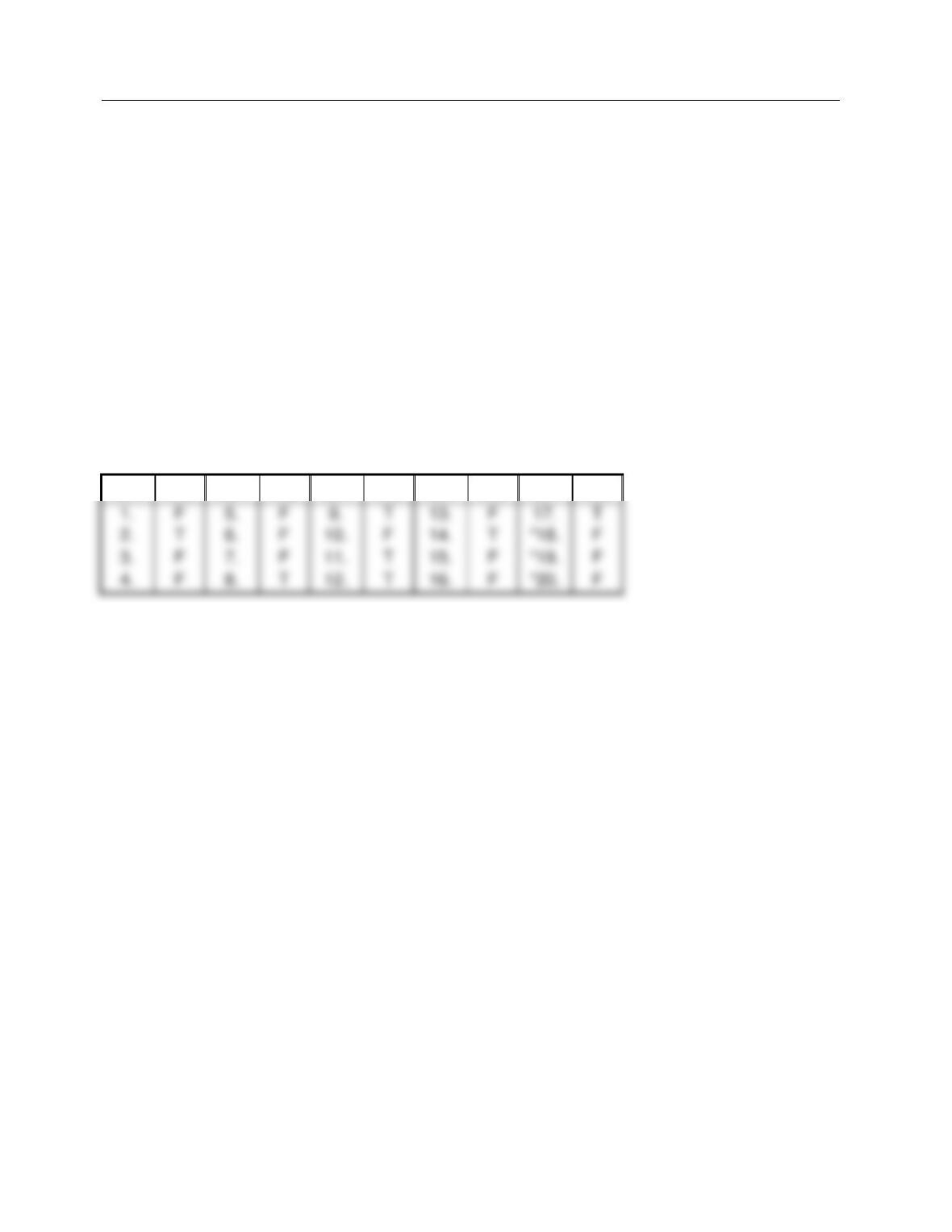
True / False Answers — Conceptual
Item
Ans.
Item
Ans.
Item
Ans.
Item
Ans.
Item
Ans.
MULTIPLE CHOICE—Conceptual
21. Factors that shape an accounting information system include the
a. nature of the business.
b. size of the firm.
c. volume of data to be handled.
d. All of these answer choices are correct.
22. The process of transferring figures from the book of original entry to the ledger accounts is
called
a. adjusting.
b. balancing.
c. ledgering.
d. posting.
23. Debit always means
a. the right side of an account.
b. an increase.
c. a decrease.
d. None of these answer choices are correct.
24. An accounting record into which the essential facts and figures in connection with all
transactions are first recorded is called the
a. ledger.

The Accounting Information System
3 – 9
b. account.
c. trial balance.
d. None of these answer choices are correct.

Test Bank for Intermediate Accounting, Fifteenth Edition
3 – 10
25. A trial balance
a. proves that debits and credits are equal in the ledger.
b. supplies a listing of open accounts and their balances that are used in preparing
financial statements.
c. is normally prepared three times in the accounting cycle.
d. All of these answer choices are correct.
26. Which of the following is a real (permanent) account?
a. Goodwill
b. Service Revenue
c. Accounts Receivable
d. Both Goodwill and Accounts Receivable
27. Which of the following is a nominal (temporary) account?
a. Unearned Service Revenue
b. Salaries and Wages Expense
c. Inventory
d. Retained Earnings
28. Nominal accounts are also called
a. temporary accounts.
b. permanent accounts.
c. real accounts.
d. None of these answer choices are correct.
29. The double-entry accounting system means
a. Each transaction is recorded with two journal entries.
b. Each item is recorded in a journal entry, then in a general ledger account.
c. The dual effect of each transaction is recorded with a debit and a credit.
d. None of these answer choices are correct.
30. When a corporation pays a note payable and interest,
a. the account notes payable will be increased.
b. the account interest expense will be decreased.
c. they will debit notes payable and interest expense.
d. they will debit cash.
31. Stockholders’ equity is not affected by all
a. cash receipts.
b. dividends.
c. revenues.
d. expenses.
32. The debit and credit analysis of a transaction normally takes place
a. before an entry is recorded in a journal.
b. when the entry is posted to the ledger.
c. when the trial balance is prepared.
d. at the end of the accounting cycle.

The Accounting Information System
3 – 11
33. The accounting equation must remain in balance
a. throughout each step in the accounting cycle.
b. only when journal entries are recorded.
c. only at the time the trial balance is prepared.
d. only when formal financial statements are prepared.
34. The difference between the accounting process and the accounting cycle is
a. the accounting process results in the preparation of financial statements, whereas the
accounting cycle is concerned with recording business transactions.
b. the accounting cycle represents the steps taken to accomplish the accounting
process.
c. the accounting process represents the steps taken to accomplish the accounting
cycle.
d. merely semantic, because both concepts refer to the same thing.
35. An optional step in the accounting cycle is the preparation of
a. adjusting entries.
b. closing entries.
c. a statement of cash flows.
d. a post-closing trial balance.
36. Which of the following criteria must be met before an event or item should be recorded for
accounting purposes?
a. The event or item can be measured objectively in financial terms.
b. The event or item is relevant and reliable.
c. The event or item is an element.
d. All of these must be met.
37. Which of the following is a recordable event or item?
a. Changes in managerial policy
b. The value of human resources
c. Changes in personnel
d. None of these answer choices are correct.
38. Which of the following is not an internal event?
a. Depreciation
b. Using raw materials in the production process
c. Dividend declaration and subsequent payment
d. All of these are internal transactions.
39. External events do not include
a. interaction between an entity and its environment.
b. a change in the price of a good or service that an entity buys or sells.
c. improvement in technology by a competitor.
d. using buildings and machinery in operations.
40. A trial balance may prove that debits and credits are equal, but
a. an amount could be entered in the wrong account.
b. a transaction could have been entered twice.
c. a transaction could have been omitted.
d. All of these answer choices are correct.

Test Bank for Intermediate Accounting, Fifteenth Edition
3 – 12
41. A general journal
a. chronologically lists transactions and other events, expressed in terms of debits and
credits.
b. contains one record for each of the asset, liability, stockholders’ equity, revenue, and
expense accounts.
c. lists all the increases and decreases in each account in one place.
d. contains only adjusting entries.
42. A journal entry to record the sale of inventory on account will include a
a. debit to Inventory.
b. debit to Accounts Receivable.
c. debit to Sales Revenue.
d. credit to Cost of Goods Sold.
43. A journal entry to record a payment on account will include a
a. debit to Accounts Receivable.
b. credit to Accounts Receivable.
c. debit to Accounts Payable.
d. credit to Accounts Payable.
44. A journal entry to record a receipt of rent in advance will include a
a. debit to Rent Revenue.
b. credit to Rent Revenue.
c. credit to Cash.
d. credit to Unearned Revenue.
45. Which of the following errors will cause an imbalance in the trial balance?
a. Omission of a transaction in the journal.
b. Posting an entire journal entry twice to the ledger.
c. Posting a credit of $720 to Accounts Payable as a credit of $720 to Accounts
Receivable.
d. Listing the balance of an account with a debit balance in the credit column of the trial
balance.
S46. Which of the following is not a principal purpose of an unadjusted trial balance?
a. It proves that debits and credits of equal amounts are in the ledger.
b. It is the basis for any adjustments to the account balances.
c. It supplies a listing of open accounts and their balances.
d. It proves that debits and credits were properly entered in the ledger accounts.
S47. An adjusting entry should never include
a. a debit to an expense account and a credit to a liability account.
b. a debit to an expense account and a credit to a revenue account.
c. a debit to a liability account and a credit to revenue account.
d. a debit to a revenue account and a credit to a liability account.
48. Which of the following is an example of an accrued expense?
a. Office supplies purchased at the beginning of the year and debited to an expense
account.
b. Property taxes incurred during the year, to be paid in the first quarter of the
subsequent year.
c. Depreciation expense
d. Rent recognized during the period, to be received at the end of the year

The Accounting Information System
3 – 13
P49. Which of the following statements is true about the accrual basis of accounting?
a. The timing of cash receipts and disbursements is emphasized.
b. A minimal amount of record keeping is required in accrual basis accounting compared
to cash basis.
c. This method is used less frequently by businesses than the cash method of
accounting.
d. Revenues are recognized in the period the performance obligation is satisfied,
regardless of the time period the cash is received.
P50. An adjusting entry to record an accrued expense involves a debit to a(an)
a. expense account and a credit to a prepaid account.
b. expense account and a credit to Cash.
c. expense account and a credit to a liability account.
d. liability account and a credit to an expense account.
P51. The failure to properly record an adjusting entry to accrue an expense will result in an
a. understatement of expenses and an understatement of liabilities.
b. understatement of expenses and an overstatement of liabilities.
c. understatement of expenses and an overstatement of assets.
d. overstatement of expenses and an understatement of assets.
P52. Which of the following properly describes a deferral?
a. Cash is received after revenue is recognized.
b. Cash is received before revenue is recognized.
c. Cash is paid after expense is incurred.
d. Cash is paid in the same time period that an expense is incurred.
P53. The failure to properly record an adjusting entry to accrue a revenue item will result in an
a. understatement of revenues and an understatement of liabilities.
b. overstatement of revenues and an overstatement of liabilities.
c. overstatement of revenues and an overstatement of assets.
d. understatement of revenues and an understatement of assets.
P54. The omission of the adjusting entry to record depreciation expense will result in an
a. overstatement of assets and an overstatement of owners’ equity.
b. understatement of assets and an understatement of owner’s equity.
c. overstatement of assets and an overstatement of liabilities.
d. overstatement of liabilities and an understatement of owners’ equity.
55. Adjustments are often prepared
a. after the balance sheet date, but dated as of the balance sheet date.
b. after the balance sheet date, and dated after the balance sheet date.
c. before the balance sheet date, and dated before the balance sheet date.
d. before the balance sheet date, and dated after the balance sheet date.
56. At the time a company prepays a cost
a. it debits an asset account to show the service or benefit it will receive in the future.
b. it debits an expense account to match the expense against revenues recognized.
c. its credits a liability account to show the obligation to pay for the service in the future.
d. it credits an asset account and debits an expense account.

Test Bank for Intermediate Accounting, Fifteenth Edition
3 – 14
57. How do these prepaid expenses expire?
Rent Supplies
a. With the passage of time Through use and consumption
b. With the passage of time With the passage of time
c. Through use and consumption Through use and consumption
d. Through use and consumption With the passage of time
58. Recording the adjusting entry for depreciation has the same effect as recording the
adjusting entry for
a. an unearned revenue.
b. a prepaid expense.
c. an accrued revenue.
d. an accrued expense.
59. Unearned revenue on the books of one company is likely to be
a. a prepaid expense on the books of the company that made the advance payment.
b. an unearned revenue on the books of the company that made the advance payment.
c. an accrued expense on the books of the company that made the advance payment.
d. an accrued revenue on the books of the company that made the advance payment.
60. To compute interest expense on a note for an adjusting entry, the formula is (principal ×
annual rate × a fraction). The numerator and denominator of the fraction are:
Numerator Denominator
a. Length of time note has been outstanding 12 months
b. Total length of note 12 months
c. Length of time until note matures Total length of note
d. Length of time note has been outstanding Total length of note
61. Adjusting entries are necessary to
1. obtain a proper matching of revenue and expense.
2. achieve an accurate statement of assets and equities.
3. adjust assets and liabilities to their fair market value.
a. 1
b. 2
c. 3
d. 1 and 2
62. Why are certain costs of doing business capitalized when incurred and then depreciated
or amortized over subsequent accounting cycles?
a. To reduce the federal income tax liability
b. To aid management in cash-flow analysis
c. To match the costs of production with revenues as recognized
d. To adhere to the accounting constraint of conservatism
63. When an expense is paid in cash before it is used, it is called a(n)
a. prepaid expense.
b. accrued expense.
c. estimated expense.
d. cash expense.

The Accounting Information System
3 – 15
64. When revenue or expense has been recognized or incurred but not yet collected or paid, it
is normally called a(n) ____________ revenue or expense.
a. deferred
b. adjusted
c. estimated
d. None of these answer choices are correct.
65. When a revenue is collected and recorded in advance, it is normally accounted for as a(n)
___________ revenue.
a. accrued
b. prepaid
c. unearned
d. cash
66. An accrued expense can best be described as an amount
a. paid and currently matched with earnings.
b. paid and not currently matched with earnings.
c. not paid and not currently matched with earnings.
d. not paid and currently matched with earnings.
67. During an accounting period, if an expense has been incurred and consumed but not yet
paid for or recorded, then the end–of-period adjusting entry would involve
a. a liability account and an asset account.
b. an asset or contra asset account and an expense account.
c. a liability account and an expense account.
d. a receivable account and a revenue account.
68. Which of the following must be considered in estimating depreciation on an asset for an
accounting period?
a. The original cost of the asset
b. Its useful life
c. The decline of its fair value
d. Both the original cost of the asset and its useful life.
69. Which of the following would not be a correct form for an adjusting entry?
a. A debit to a revenue and a credit to a liability
b. A debit to an expense and a credit to a liability
c. A debit to a liability and a credit to a revenue
d. A debit to an asset and a credit to a liability
70. Year-end net assets would be overstated and current expenses would be understated as
a result of failure to record which of the following adjusting entries?
a. Expiration of prepaid insurance
b. Depreciation of fixed assets
c. Use of supplies
d. All of these answer choices are correct.
71. A prepaid expense can best be described as an amount
a. paid and currently matched with revenues.
b. paid and not currently matched with revenues.
c. not paid and currently matched with revenues.
d. not paid and not currently matched with revenues.

Test Bank for Intermediate Accounting, Fifteenth Edition
3 – 16
72. An accrued revenue can best be described as an amount
a. collected and currently matched with expenses.
b. collected and not currently matched with expenses.
c. not collected and currently matched with expenses.
d. not collected and not currently matched with expenses.
73. An unearned revenue can best be described as an amount
a. collected and currently matched with expenses.
b. collected and not currently matched with expenses.
c. not collected and currently matched with expenses.
d. not collected and not currently matched with expenses.
74. An adjusted trial balance
a. is prepared after the financial statements are completed.
b. proves the equality of the debit balances and credit balances of ledger accounts after
all adjustments have been made.
c. is a required financial statement under generally accepted accounting principles.
d. cannot be used to prepare financial statements.
75. Which type of account is always debited during the closing process?
a. Dividends
b. Expense
c. Revenue
d. Retained earnings
S76. Which of the following statements best describes the purpose of closing entries?
a. To faciliate posting and taking a trial balance.
b. To determine the amount of net income or net loss for the following period.
c. To reduce the balances of revenue and expense accounts to zero so that they may be
used to accumulate the revenues and expenses of the next period.
d. To complete the record of various transactions that were started in a prior period.
P77. If ending accounts receivable exceeds the beginning accounts receivable
a. cash collections during the period exceed the amount of revenue recognized.
b. net income for the period is less than the amount of cash-basis income.
c. no cash was collected during the period.
d. cash collections during the year are less than the amount of revenue recognized.
*78. Under the cash-basis of accounting, revenues are recorded
a. when they are recognized and realized.
b. when they are recognized and realizable.
c. when they are recognized.
d. when they are realized.
*79. When converting from cash-basis to accrual-basis accounting, which of the following
adjustments should be made to cash receipts from customers to determine accrual-basis
service revenue?
a. Subtract ending accounts receivable.
b. Subtract beginning unearned service revenue.
c. Add ending accounts receivable.
d. Add cash sales.

The Accounting Information System
3 – 17
*80. When converting from cash-basis to accrual-basis accounting, which of the following
adjustments should be made to cash paid for operating expenses to determine accrual-
basis operating expenses?
a. Add beginning accrued liabilities.
b. Subtract beginning prepaid expense.
c. Subtract ending prepaid expense.
d. Subtract interest expense.
*81. Reversing entries are
1. normally prepared for prepaid, accrued, and estimated items.
2. necessary to achieve a proper matching of revenue and expense.
3. useful in simplifying the recording of transactions in the next accounting
period.
a. 1
b. 2
c. 3
d. 1 and 2
*82. Adjusting entries that should be reversed include those for prepaid or unearned items that
a. create an asset or a liability account.
b. were originally entered in a revenue or expense account.
c. were originally entered in an asset or liability account.
d. create an asset or a liability account and were originally entered in a revenue or
expense account.
*83. Adjusting entries that should be reversed include
a. all accrued revenues.
b. all accrued expenses.
c. those that debit an asset or credit a liability.
d. All of these answer choices are correct.
S*84. A reversing entry should never be made for an adjusting entry that
a. accrues unrecorded revenue.
b. adjusts expired costs from an asset account to an expense account.
c. accrues unrecorded expenses.
d. adjusts unexpired costs from an expense account to an asset account.
S*85. The worksheet for Sharko Co. consisted of five pairs of debit and credit columns. The
dollar amount of one item appeared in both the credit column of the income statement
section and the debit column of the balance sheet section. That item is
a. net income for the period.
b. beginning inventory.
c. cost of goods sold.
d. net loss for the period.
Test Bank for Intermediate Accounting, Fifteenth Edition
3 – 18
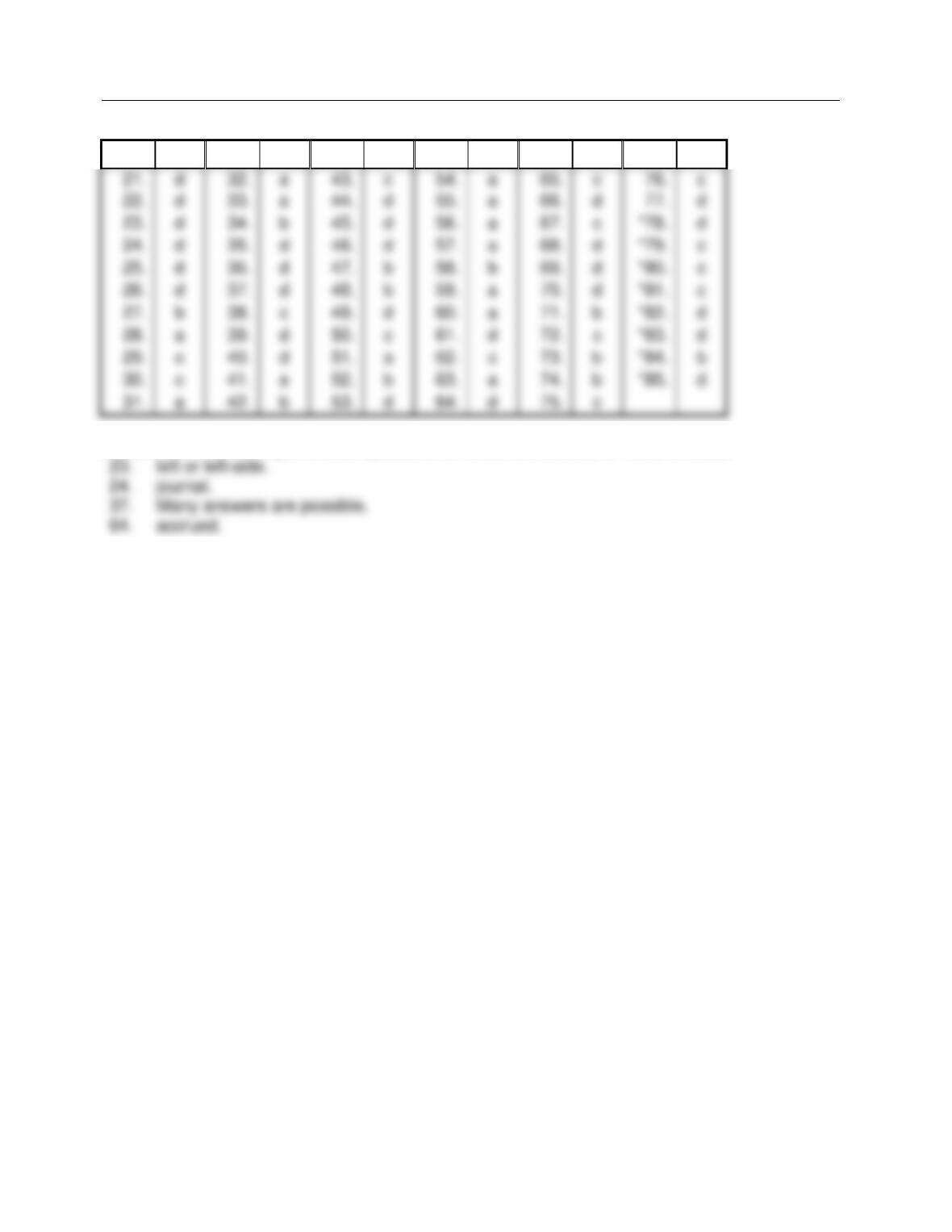
Multiple Choice Answers—Conceptual
Item
Ans.
Item
Ans.
Item
Ans.
Item
Ans.
Item
Ans.
Item
Ans.
Solutions to those Multiple Choice questions for which the answer is “none of these.”
MULTIPLE CHOICE—Computational
86. Maso Company recorded journal entries for the issuance of common stock for $160,000,
the payment of $52,000 on accounts payable, and the payment of salaries expense of
$84,000. What net effect do these entries have on owners’ equity?
a. Increase of $160,000.
b. Increase of $108,000.
c. Increase of $76,000.
d. Increase of $24,000.
87. Mune Company recorded journal entries for the declaration of $150,000 of dividends, the
$96,000 increase in accounts receivable for services rendered, and the purchase of
equipment for $63,000. What net effect do these entries have on owners’ equity?
a. Decrease of $213,000.
b. Decrease of $117,000.
c. Decrease of $54,000.
d. Increase of $33,000.
88. Pappy Corporation received cash of $24,000 on September 1, 2014 for one year’s rent in
advance and recorded the transaction with a credit to Unearned Rent Revenue. The
December 31, 2014 adjusting entry is
a. debit Rent Revenue and credit Unearned Rent Revenue, $8,000.
b. debit Rent Revenue and credit Unearned Rent Revenue, $16,000.
c. debit Unearned Rent Revenue and credit Rent Revenue, $8,000.
d. debit Cash and credit Unearned Rent Revenue, $16,000.

The Accounting Information System
3 – 19
89. Panda Corporation paid cash of $60,000 on June 1, 2014 for one year’s rent in advance
and recorded the transaction with a debit to Prepaid Rent. The December 31, 2014
adjusting entry is
a. debit Prepaid Rent and credit Rent Expense, $25,000.
b. debit Prepaid Rent and credit Rent Expense, $35,000.
c. debit Rent Expense and credit Prepaid Rent, $35,000.
d. debit Prepaid Rent and credit Cash, $25,000.
90. Tate Company purchased equipment on November 1, 2014 and gave a 3-month, 9% note
with a face value of $60,000. The December 31, 2014 adjusting entry is
a. debit Interest Expense and credit Interest Payable, $5,400.
b. debit Interest Expense and credit Interest Payable, $1,350.
c. debit Interest Expense and credit Cash, $900.
d. debit Interest Expense and credit Interest Payable, $900.
91. Brown Company’s account balances at December 31, 2014 for Accounts Receivable and
the related Allowance for Doubtful Accounts are $920,000 debit and $1,400 credit,
respectively. From an aging of accounts receivable, it is estimated that $23,000 of the
December 31 receivables will be uncollectible. The necessary adjusting entry would
include a credit to the allowance account for
a. $23,000.
b. $24,400.
c. $21,600.
d. $1,400.
92. Chen Company’s account balances at December 31, 2014 for Accounts Receivable and
the Allowance for Doubtful Accounts are $480,000 debit and $900 credit. Sales during
2014 were $1,650,000. It is estimated that 1% of sales will be uncollectible. The adjusting
entry would include a credit to the allowance account for
a. $17,400.
b. $16,500.
c. $15,600.
d. $4,800.
93. Starr Corporation loaned $450,000 to another corporation on December 1, 2014 and
received a 3-month, 8% interest-bearing note with a face value of $450,000. What
adjusting entry should Starr make on December 31, 2014?
a. Debit Interest Receivable and credit Interest Revenue, $9,000.
b. Debit Cash and credit Interest Revenue, $3,000.
c. Debit Interest Receivable and credit Interest Revenue, $3,000.
d. Debit Cash and credit Interest Receivable, $9,000.
94. A company receives interest on a $70,000, 8%, 5-year note receivable each April 1. At
December 31, 2014, the following adjusting entry was made to accrue interest receivable:
Interest Receivable …………………………………………………….. 4,200
Interest Revenue …………………………..………………… 4,200

Test Bank for Intermediate Accounting, Fifteenth Edition
3 – 20
Assuming that the company does not use reversing entries, what entry should be made
on April 1, 2015 when the annual interest payment is received?
a. Cash ……………………………………………………………………….. 1,400
Interest Revenue …………………………………………….. 1,400
b. Cash ……………………………………………………………………….. 4,200
Interest Receivable …………………………………………. 4,200
c. Cash ……………………………………………………………………….. 5,600
Interest Receivable …………………………………………. 4,200
Interest Revenue …………………………………………….. 1,400
d. Cash ……………………………………………………………………….. 5,600
Interest Revenue …………………………………………….. 5,600
*95. A company receives interest on a $70,000, 8%, 5-year note receivable each April 1. At
December 31, 2014, the following adjusting entry was made to accrue interest receivable:
Interest Receivable ……………………………………………………. 4,200
Interest Revenue …………………………………………….. 4,200
Assuming that the company does use reversing entries, what entry should be made on
April 1, 2015 when the annual interest payment is received?
a. Cash ……………………………………………………………………….. 1,400
Interest Revenue …………………………………………….. 1,400
b. Cash ……………………………………………………………………….. 4,200
Interest Receivable …………………………………………. 4,200
c. Cash ………………………………………………………………………. 5,600
Interest Receivable …………………………………………. 4,200
Interest Revenue …………………………………………….. 1,400
d. Cash ……………………………………………………………………….. 5,600
Interest Revenue …………………………………………….. 5,600
96. Murphy Company sublet a portion of its warehouse for five years at an annual rental of
$60,000, beginning on May 1, 2014. The tenant, Sheri Charter, paid one year’s rent in
advance, which Murphy recorded as a credit to Unearned Rent Revenue. Murphy reports
on a calendar-year basis. The adjustment on December 31, 2014 for Murphy should be
a. No entry
b. Unearned Rent Revenue ……………………………………………. 20,000
Rent Revenue ………………………………………………… 20,000
c. Rent Revenue …………………………………………………………… 20,000
Unearned Rent Revenue …………………………………. 20,000
d. Unearned Rent Revenue ……………………………………………. 40,000
Revenue Revenue …………………………………………… 40,000
97. During the first year of Wilkinson Co.’s operations, all purchases were recorded as assets.
Supplies in the amount of $25,800 were purchased. Actual year-end supplies amounted to
$5,600. The adjusting entry for store supplies will
a. increase net income by $20,200.
b. increase expenses by $20,200.
c. decrease supplies by $5,600.
d. debit Accounts Payable for $5,600.

The Accounting Information System
3 – 21
98. Big-Mouth Frog Corporation had revenues of $300,000, expenses of $200,000, and
dividends of $45,000. When Income Summary is closed to Retained Earnings, the amount
of the debit or credit to Retained Earnings is a
a. debit of $55,000.
b. debit of $100,000.
c. credit of $55,000.
d. credit of $100,000.
*99. The income statement of Dolan Corporation for 2014 included the following items:
Interest revenue $121,000
Salaries and wages expense 180,000
Insurance expense 18,200
The following balances have been excerpted from Dolan Corporation’s balance sheets:
December 31, 2014 December 31, 2013
Interest receivable $18,200 $15,000
Salaries and wages payable 17,800 8,400
Prepaid insurance 2,200 3,000
The cash received for interest during 2014 was
a. $102,800.
b. $117,800.
c. $121,000.
d. $124,200.
*100. The income statement of Dolan Corporation for 2014 included the following items:
Interest revenue $121,000
Salaries and wages expense 180,000
Insurance expense 18,200
The following balances have been excerpted from Dolan Corporation’s balance sheets:
December 31, 2014 December 31, 2013
Interest receivable $18,200 $15,000
Salaries and wages payable 17,800 8,400
Prepaid insurance 2,200 3,000
The cash paid for salaries and wages during 2014 was
a. $189,400.
b. $170,600.
c. $171,600.
d. $197,800.
*101. The income statement of Dolan Corporation for 2014 included the following items:
Interest revenue $121,000
Salaries and wages expense 180,000
Insurance expense 18,200

Test Bank for Intermediate Accounting, Fifteenth Edition
3 – 22
The following balances have been excerpted from Dolan Corporation’s balance sheets:
December 31, 2014 December 31, 2013
Interest receivable $18,200 $15,000
Salaries and wages payable 17,800 8,400
Prepaid insurance 2,200 3,000
The cash paid for insurance premiums during 2014 was
a. $16,000.
b. $15,200.
c. $19,000.
d. $17,400.
*102. Olsen Company paid or collected during 2014 the following items:
Insurance premiums paid $ 25,800
Interest collected 62,800
Salaries paid 260,400
The following balances have been excerpted from Olsen’s balance sheets:
December 31, 2014 December 31, 2013
Prepaid insurance $ 2,400 $ 3,000
Interest receivable 7,400 5,800
Salaries and wages payable 24,600 21,200
The insurance expense on the income statement for 2014 was
a. $20,400.
b. $25,200.
c. $26,400.
d. $31,200.
*103. Olsen Company paid or collected during 2014 the following items:
Insurance premiums paid $ 25,800
Interest collected 62,800
Salaries paid 260,400
The following balances have been excerpted from Olsen’s balance sheets:
December 31, 2014 December 31, 2013
Prepaid insurance $ 2,400 $ 3,000
Interest receivable 7,400 5,800
Salaries and wages payable 24,600 21,200
The interest revenue on the income statement for 2014 was
a. $49,600.
b. $61,200.
c. $64,400.
d. $76,000.

The Accounting Information System
3 – 23
*104. Olsen Company paid or collected during 2014 the following items:
Insurance premiums paid $ 25,800
Interest collected 62,800
Salaries and wages paid 260,400
The following balances have been excerpted from Olsen’s balance sheets:
December 31, 2014 December 31, 2013
Prepaid insurance $ 2,400 $ 3,000
Interest receivable 7,400 5,800
Salaries and wages payable 24,600 21,200
Salaries and wages expense on the income statement for 2014 was
a. $214,600.
b. $257,000.
c. $263,800.
d. $306,200.
*105. The Supplies account had a balance at the beginning of year 3 of $8,000 (before the
reversing entry). Payments for purchases of supplies during year 3 amounted to $50,000
and were recorded as expense. A physical count at the end of year 3 revealed supplies
costing $11,500 were on hand. Reversing entries are used by this company. The required
adjusting entry at the end of year 3 will include a debit to:
a. Supplies Expense for $3,500.
b. Supplies for $3,500.
c. Supplies Expense for $46,500.
d. Supplies for $11,500.
*106. At the end of 2014, Drew Company made four adjusting entries for the following items:
1. Depreciation expense, $25,000.
2. Expired insurance, $2,200 (originally recorded as prepaid insurance.)
3. Interest payable, $6,000.
4. Rent receivable, $10,000.
In the normal situation, to facilitate subsequent entries, the adjusting entry or entries that
may be reversed is (are)
a. Entry No. 3 only.
b. Entry No. 4 only.
c. Entry No. 3 and No. 4.
d. Entry No. 2, No. 3 and No. 4.
*107. Garcia Corporation received cash of $36,000 on August 1, 2014 for one year’s rent in
advance and recorded the transaction with a credit to Rent Revenue. The December 31,
2014 adjusting entry is
a. debit Rent Revenue and credit Unearned Rent Revenue, $15,000.
b. debit Rent Revenue and credit Unearned Rent Revenue, $21,000.
c. debit Unearned Rent Revenue and credit Rent Revenue, $15,000.
d. debit Cash and credit Unearned Rent Revenue, $21,000.
Test Bank for Intermediate Accounting, Fifteenth Edition
3 – 24
*108. Lopez Company received $14,400 on April 1, 2014 for one year’s rent in advance and
recorded the transaction with a credit to a nominal account. The December 31, 2014
adjusting entry is
a. debit Rent Revenue and credit Unearned Rent Revenue, $3,600.
b. debit Rent Revenue and credit Unearned Rent Revenue, $10,800.
c. debit Unearned Rent Revenue and credit Rent Revenue, $3,600.
d. debit Unearned Rent Revenue and credit Rent Revenue, $10,800.
*109. Gibson Company paid $12,000 on June 1, 2014 for a two-year insurance policy and
recorded the entire amount as Insurance Expense. The December 31, 2014 adjusting
entry is
a. debit Insurance Expense and credit Prepaid Insurance, $3,500.
b. debit Insurance Expense and credit Prepaid Insurance, $8,500.
c. debit Prepaid Insurance and credit Insurance Expense, $3,500
d. debit Prepaid Insurance and credit Insurance Expense, $8,500.
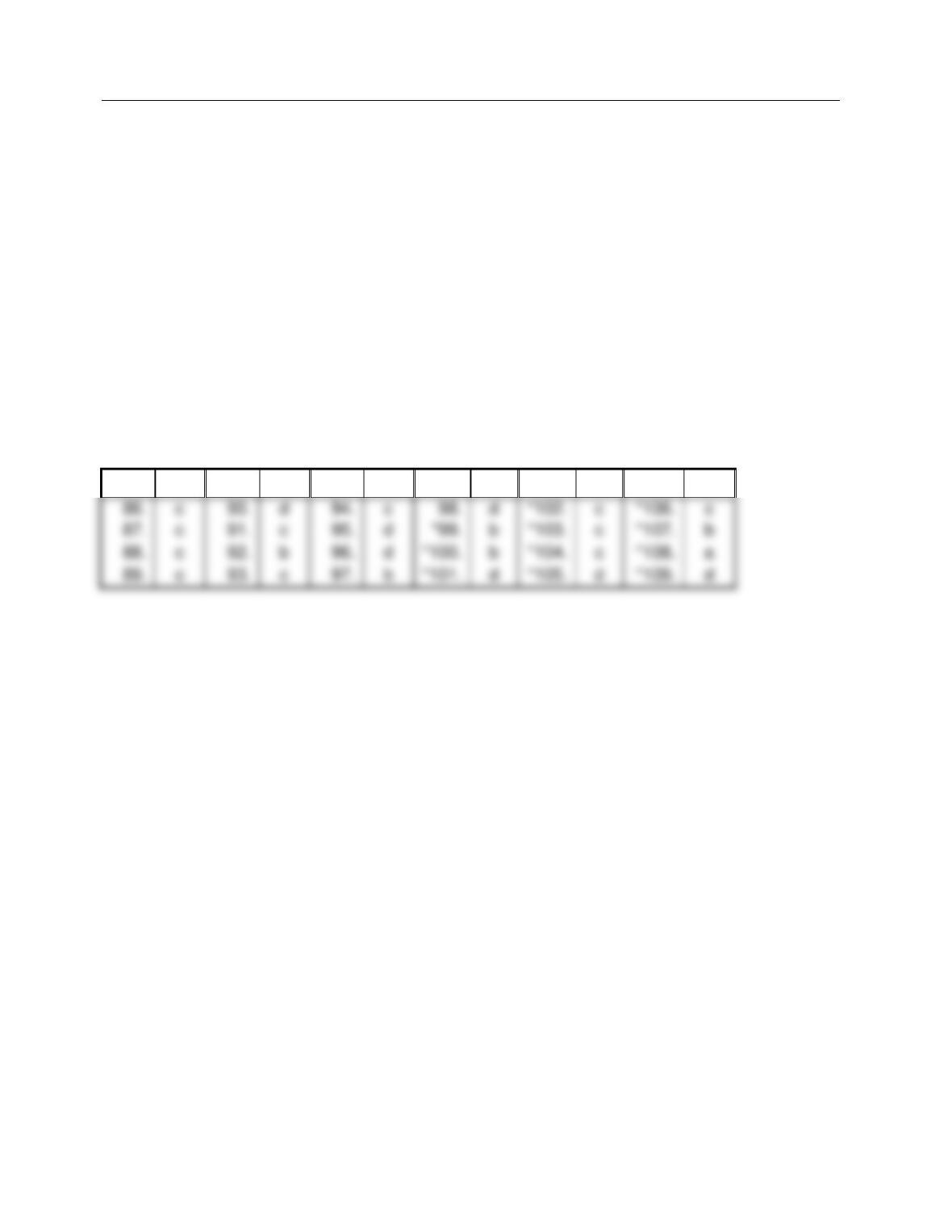
Multiple Choice Answers—Computational
Item
Ans.
Item
Ans.
Item
Ans.
Item
Ans
Item
Ans
Item
Ans.
MULTIPLE CHOICE—CPA Adapted
110. On September 1, 2014, Lowe Co. issued a note payable to National Bank in the amount
of $900,000, bearing interest at 9%, and payable in three equal annual principal payments
of $300,000. On this date, the bank’s prime rate was 8%. The first payment for interest
and principal was made on September 1, 2015. At December 31, 2015, Lowe should
record accrued interest payable of
a. $27,000.
b. $24,000.
c. $18,000.
d. $16,000.
111. Eaton Co. sells major household appliance service contracts for cash. The service
contracts are for a one-year, two-year, or three-year period. Cash receipts from contracts
are credited to Unearned Service Revenue. This account had a balance of $3,800,000 at
December 31, 2014 before year-end adjustment. Service contract costs are charged as
incurred to the Service Contract Expense account, which had a balance of $900,000 at
December 31, 2014.
Service contracts still outstanding at December 31, 2014 expire as follows:
During 2015 $960,000
During 2016 1,140,000
During 2017 700,000

The Accounting Information System
3 – 25
What amount should be reported as Unearned Service Revenue in Eaton’s December 31,
2014 balance sheet?
a. $2,900,000.
b. $2,800,000.
c. $1,900,000.
d. $1,000,000.
112. In November and December 2014, Lane Co., a newly organized magazine publisher,
received $60,000 for 1,000 three-year subscriptions at $20 per year, starting with the
January 2015 issue. Lane included the entire $60,000 in its 2014 income tax return. What
amount should Lane report in its 2014 income statement for subscriptions revenue?
a. $0.
b. $3,333.
c. $20,000.
d. $60,000.
113. On June 1, 2014, Nott Corp. loaned Horn $800,000 on a 12% note, payable in five annual
installments of $160,000 beginning January 2, 2015. In connection with this loan, Horn
was required to deposit $5,000 in a noninterest-bearing escrow account. The amount held
in escrow is to be returned to Horn after all principal and interest payments have been
made. Interest on the note is payable on the first day of each month beginning July 1,
2014. Horn made timely payments through November 1, 2014. On January 2, 2015, Nott
received payment of the first principal installment plus all interest due. At December 31,
2014, Nott’s interest receivable on the loan to Horn should be
a. $0.
b. $8,000.
c. $16,000.
d. $24,000.
114. Included in Allen Corp.’s balance sheet at June 30, 2013 is a 10%, $3,000,000 note
payable. The note is dated October 1, 2013 and is payable in three equal annual
payments of $1,500,000 plus interest. The first interest and principal payment was made
on October 1, 2014. In Allen’s June 30, 2015 balance sheet, what amount should be
reported as accrued interest payable for this note?
a. $337,500.
b. $225,000.
c. $112,500.
d. $75,000.
115. Colaw Co. pays all salaried employees on a biweekly basis. Overtime pay, however, is
paid in the next biweekly period. Colaw accrues salaries expense only at its December 31
year end. Data relating to salaries earned in December 2014 are as follows:
Last payroll was paid on 12/26/14, for the 2-week period ended 12/26/14.
Overtime pay earned in the 2-week period ended 12/26/14 was $20,000.
Remaining work days in 2014 were December 29, 30, 31, on which days there was no
overtime.
The recurring biweekly salaries total $360,000.

Test Bank for Intermediate Accounting, Fifteenth Edition
3 – 26
Assuming a five-day workweek, Colaw should record a liability at December 31, 2014 for
accrued salaries of
a. $108,000.
b. $128,000.
c. $216,000.
d. $236,000.
116. Tolan Corp.‘s trademark was licensed to Eddy Co. for royalties of 15% of sales of the
trademarked items. Royalties are payable semiannually on March 15 for sales in July
through December of the prior year, and on September 15 for sales in January through
June of the same year. Tolan received the following royalties from Eddy:
March 15 September 15
2013 $5,000 $7,500
2014 6,000 9,500
Eddy estimated that sales of the trademarked items would total $30,000 for July through
December 2014. In Tolan’s 2014 income statement, the royalty revenue should be
a. $14,000.
b. $15,500.
c. $20,000.
d. $20,500.
117. At December 31, 2014, Sue’s Boutique had 1,000 gift certificates outstanding, which had
been sold to customers during 2014 for $60 each. Sue’s operates on a gross profit of 60%
of its sales. What amount of revenue pertaining to the 1,000 outstanding gift certificates
should be deferred at December 31, 2014?
a. $0.
b. $24,000.
c. $36,000.
d. $60,000.
*118. Compared to the accrual basis of accounting, the cash basis of accounting overstates
income by the net increase during the accounting period of the
Accounts Receivable Accrued Expenses Payable
a. No No
b. No Yes
c. Yes No
d. Yes Yes
*119. Gregg Corp. reported revenue of $1,450,000 in its accrual basis income statement for the
year ended June 30, 2015. Additional information was as follows:
Accounts receivable June 30, 2014 $400,000
Accounts receivable June 30, 2015 530,000
Uncollectible accounts written off during the fiscal year 15,000
Under the cash basis, Gregg should report revenue of
a. $1,035,000.
b. $1,050,000.
c. $1,305,000.
d. $1,335,000.

The Accounting Information System
3 – 27
*120. Jim Yount, M.D., keeps his accounting records on the cash basis. During 2015, Dr. Yount
collected $350,000 from his patients. At December 31, 2014, Dr. Yount had accounts
receivable of $40,000. At December 31, 2015, Dr. Yount had accounts receivable of
$70,000 and unearned revenue of $10,000. On the accrual basis, how much was Dr.
Yount’s patient service revenue for 2015?
a. $310,000.
b. $370,000.
c. $380,000.
d. $390,000.
*121. The following information is available for Ace Company for 2014:
Disbursements for purchases $1,360,000
Increase in trade accounts payable 100,000
Decrease in merchandise inventory 40,000
Cost of goods sold for 2014 was
a. $1,500,000.
b. $1,420,000.
c. $1,300,000.
d. $1,220,000.
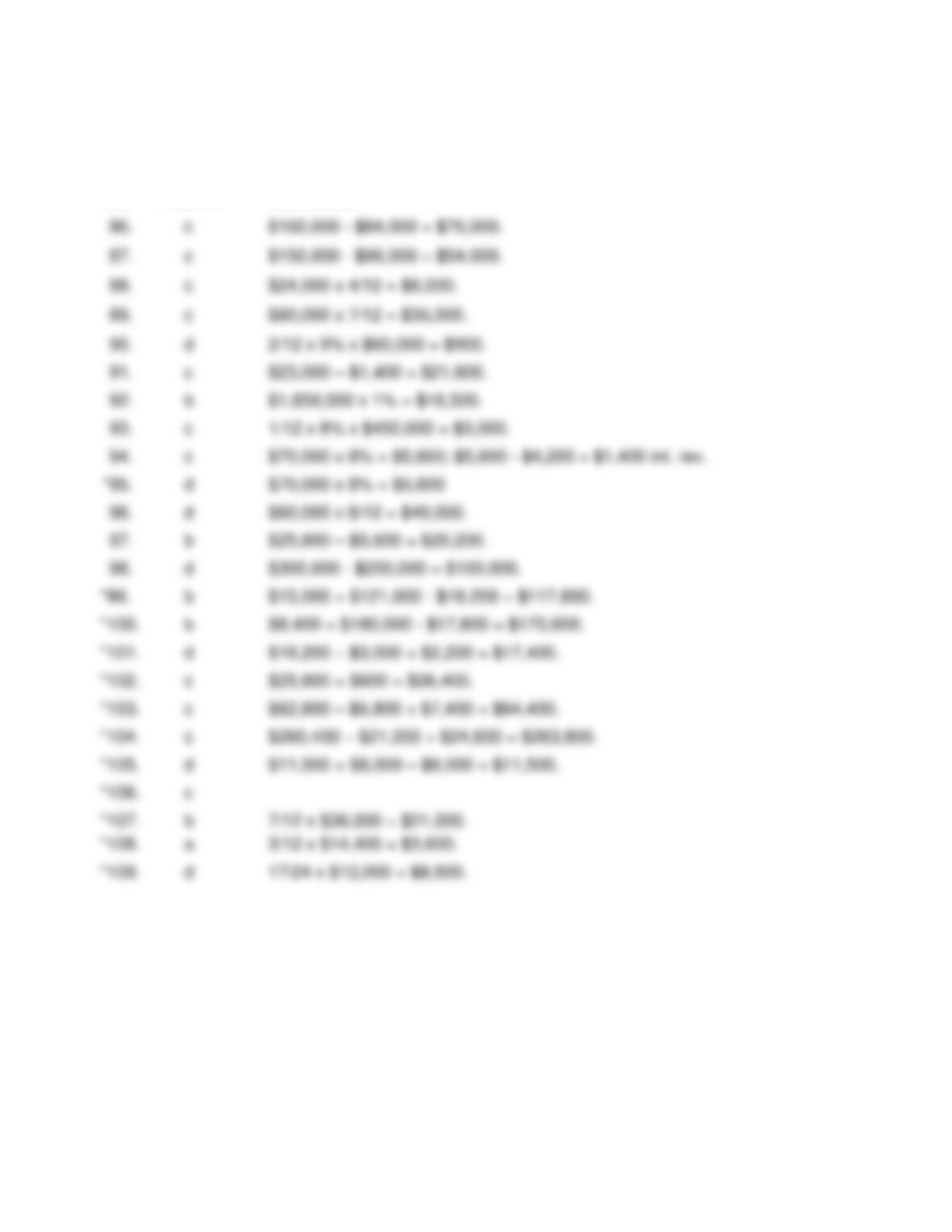
Multiple Choice Answers—CPA Adapted
Item
Ans.
Item
Ans.
Item
Ans.
Item
Ans.
Item
Ans
Item
Ans.
Test Bank for Intermediate Accounting, Fifteenth Edition
3 – 28
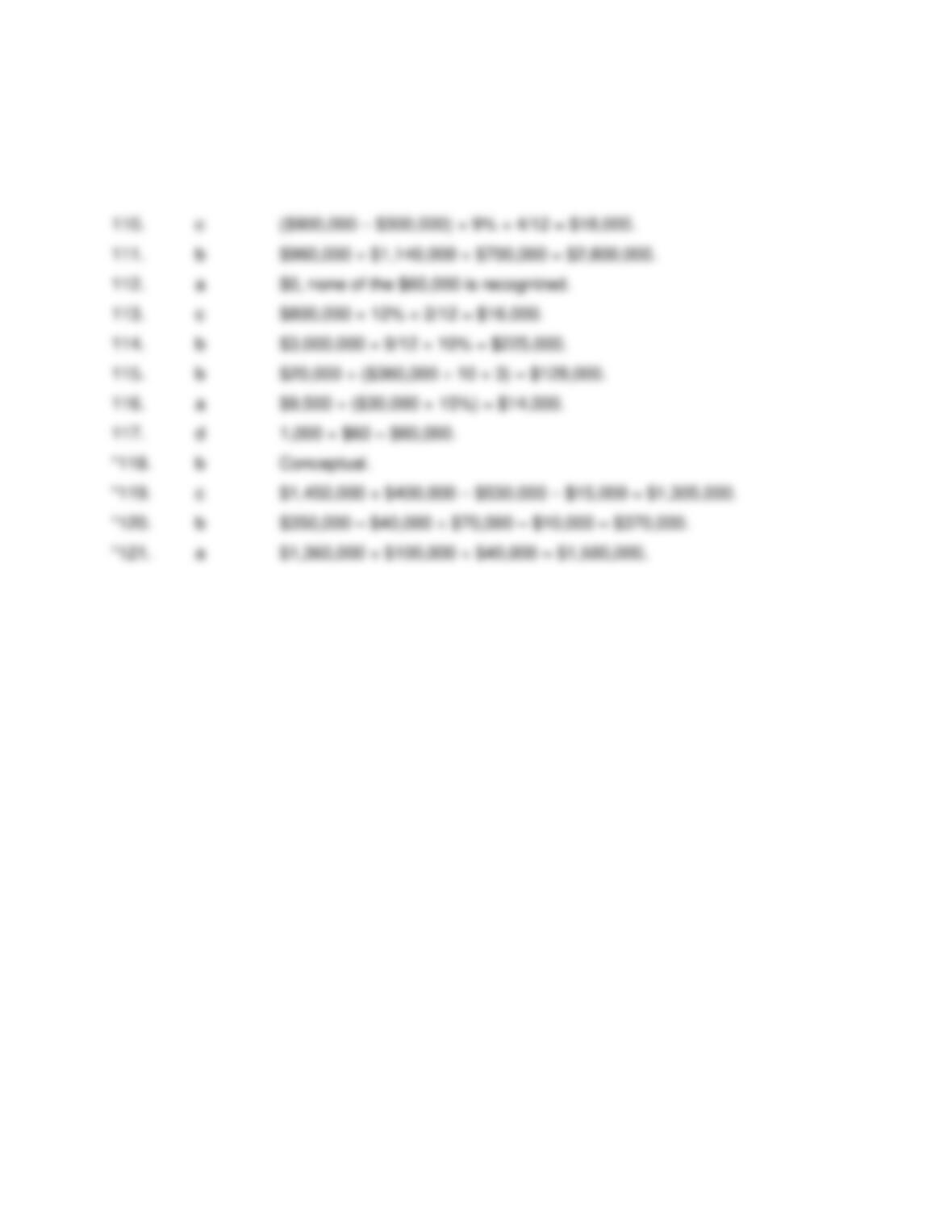
DERIVATIONS — Computational
No. Answer Derivation
The Accounting Information System
3 – 29
DERIVATIONS — CPA Adapted
No. Answer Derivation
BRIEF EXERCISES
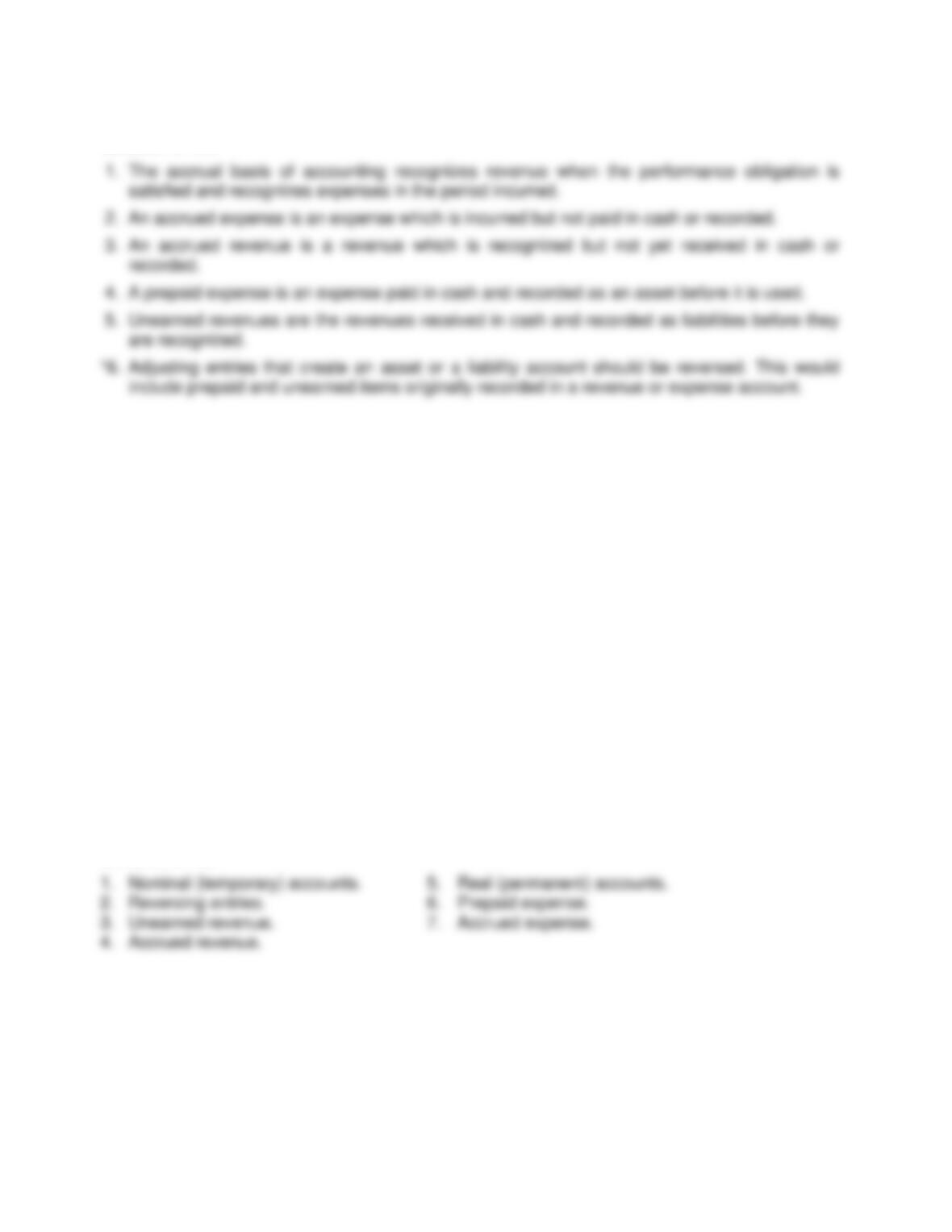
BE. 3–122—Definitions.
Provide clear, concise answers for the following.
1. What is the accrual-basis of accounting?
2. What is an accrued expense?
3. What is accrued revenue?
4. What is a prepaid expense?
5. What is unearned revenue?
*6. State the rule that indicates which adjusting entries for prepaid and unearned items should be
reversed.
Test Bank for Intermediate Accounting, Fifteenth Edition
3 – 30
Solution 3-122
BE. 3–123—Terminology.
In the space provided at the right, write the word or phrase that is defined or indicated.
1. Revenue and expense accounts. 1. _______________________________________
2. An optional step in the accounting 2. _______________________________________
cycle.
3. A revenue collected, but not recognized.3. _______________________________________
4. A revenue recognized, but not collected.4. _______________________________________
5. Asset, liability, and equity accounts. 5. _______________________________________
6. An expense paid, but not incurred. 6. _______________________________________
7. An expense incurred, but not paid. 7. _______________________________________
Solution 3-123
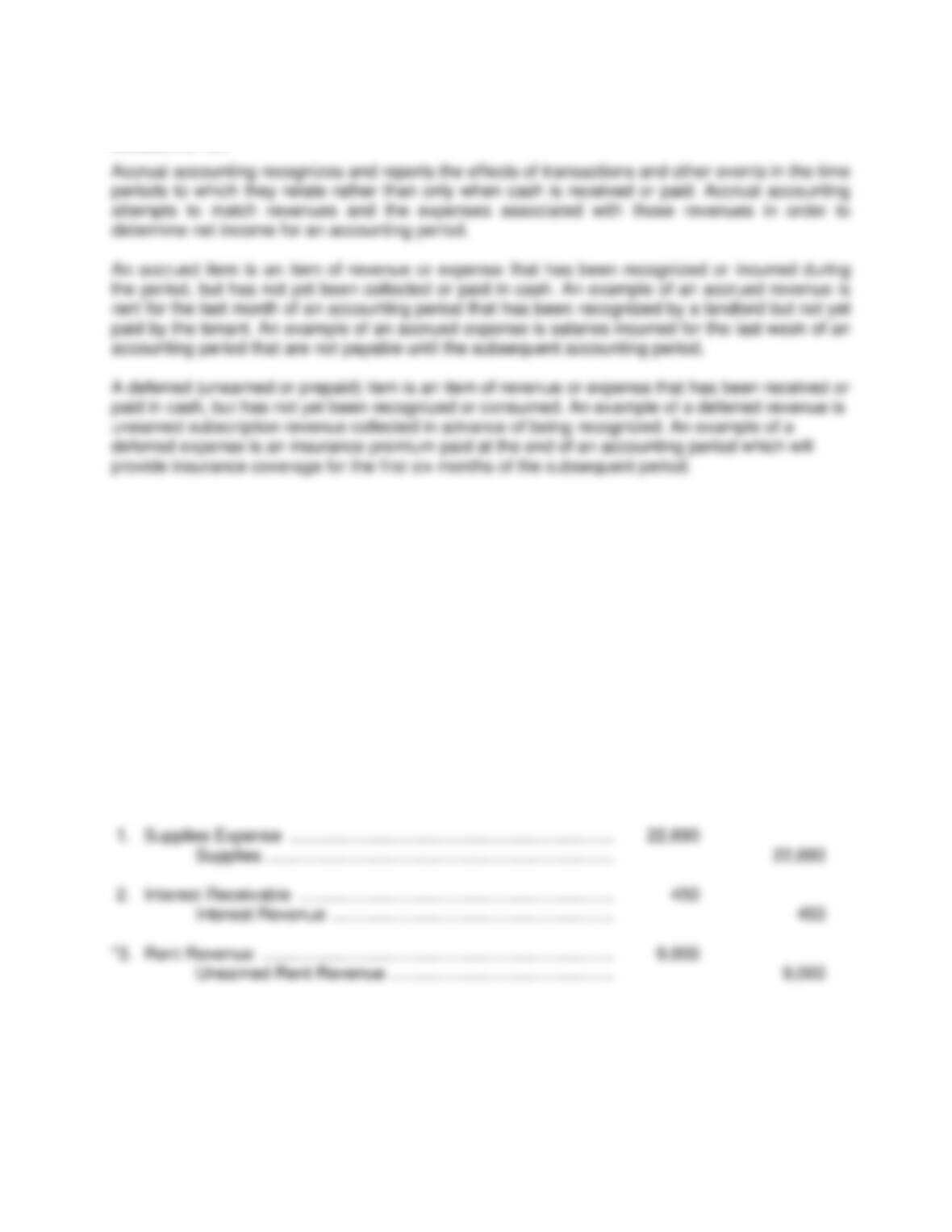
BE. 3–124—Accrued items and deferred (unearned or prepaid) items.
Generally accepted accounting principles require the use of accruals and deferrals in the
determination of income. How is income determined under the accrual-basis of accounting?
Include in your answer what constitutes an accrued item and a deferred (prepaid) item, and give
appropriate examples of each.
The Accounting Information System
3 – 31
Solution 3-124
EXERCISES
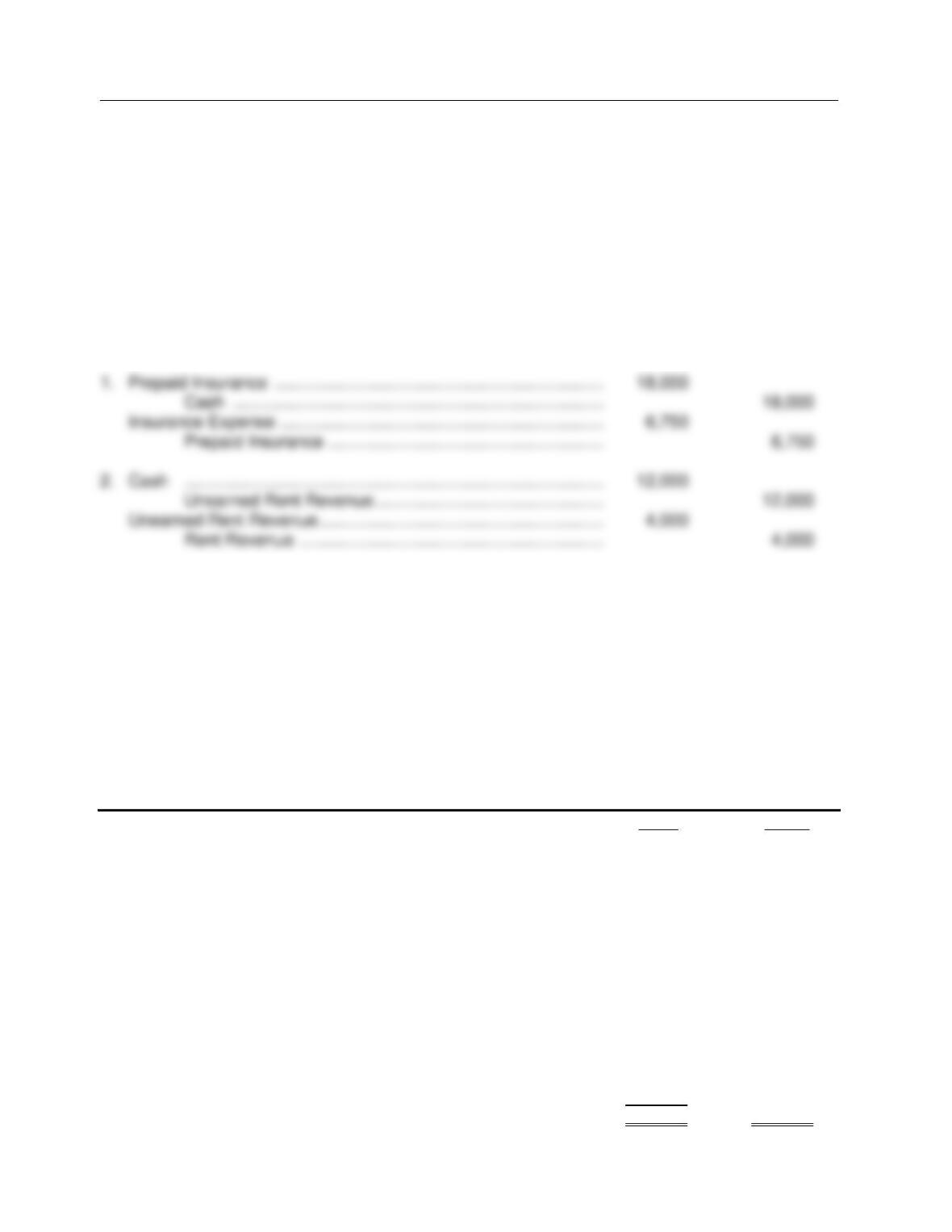
Ex. 3-125—Adjusting entries.
Present, in journal form, the adjustments that would be made on July 31, 2015, the end of the
fiscal year, for each of the following.
1. The supplies inventory on August 1, 2014 was $9,350. Supplies costing $22,150 were
acquired during the year and charged to the supplies inventory. A count on July 31, 2015
indicated supplies on hand of $8,810.
2. On April 30, a ten-month, 6% note for $30,000 was received from a customer.
*3. On May 1, $12,000 was collected as rent for one year and a nominal account was credited.
Solution 3-125
Test Bank for Intermediate Accounting, Fifteenth Edition
3 – 32
Ex. 3-126—Adjusting entries.
Reed Co. wishes to enter receipts and payments in such a manner that adjustments at the end of
the period will not require reversing entries at the beginning of the next period. Record the
following transactions in the indicated manner and give the adjusting entry on December 31,
2014. (Two entries for each part.)
1. An insurance policy for two years was acquired on April 1, 2014 for $18,000.
2. Rent of $12,000 for six months for a portion of the building was received on November 1,
2014.
Solution 3-126
Ex. 3-127
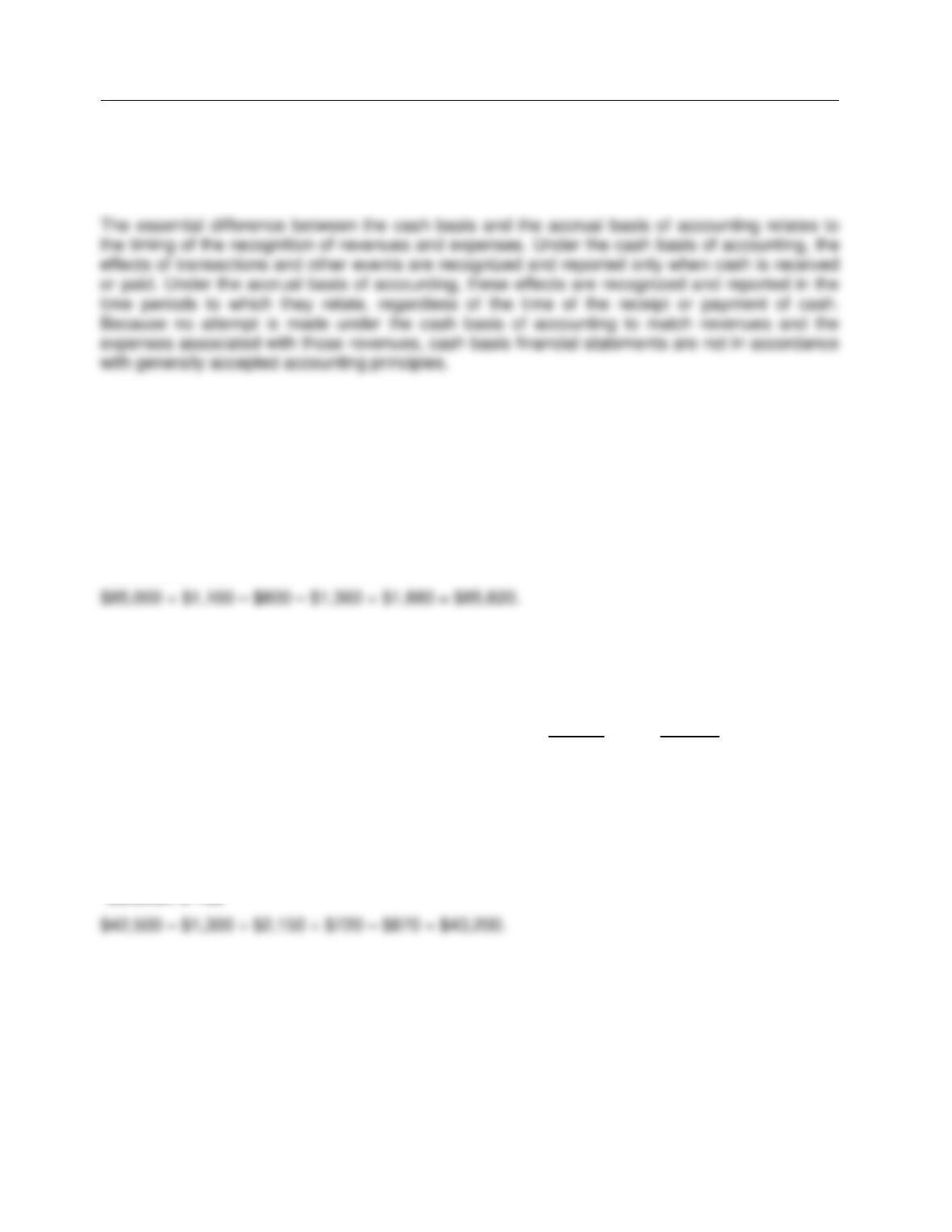
The adjusted trial balance of Ryan Financial Planners appears below. Using the information from
the adjusted trial balance, you are to prepare for the month ending December 31:
1. an income statement.
2. a retained earnings statement.
3. a balance sheet.
RYAN FINANCIAL PLANNERS
Adjusted Trial Balance
December 31, 2014
Debit Credit
Cash …………………………………………………………………………………… $ 2,900
Accounts Receivable ……………………………………………………………… 2,200
Supplies ……………………………………………………………………………….. 1,800
Equipment ……………………………………………………………………………. 16,000
Accumulated Depreciation—Equipment ……………………………………. $ 4,000
Accounts Payable ………………………………………………………………….. 3,300
Unearned Service Revenue ……………………………………………………. 5,000
Common Stock ……………………………………………………………………… 10,000
Retained Earnings …………………………………………………………………. 4,400
Dividends ……………………………………………………………………………… 2,000
Service Revenue …………………………………………………………………… 4,200
Supplies Expense ………………………………………………………………….. 600
Depreciation Expense ……………………………………………………………. 2,500
Rent Expense ……………………………………………………………………….. 2,900 ______
$30,900 $30,900
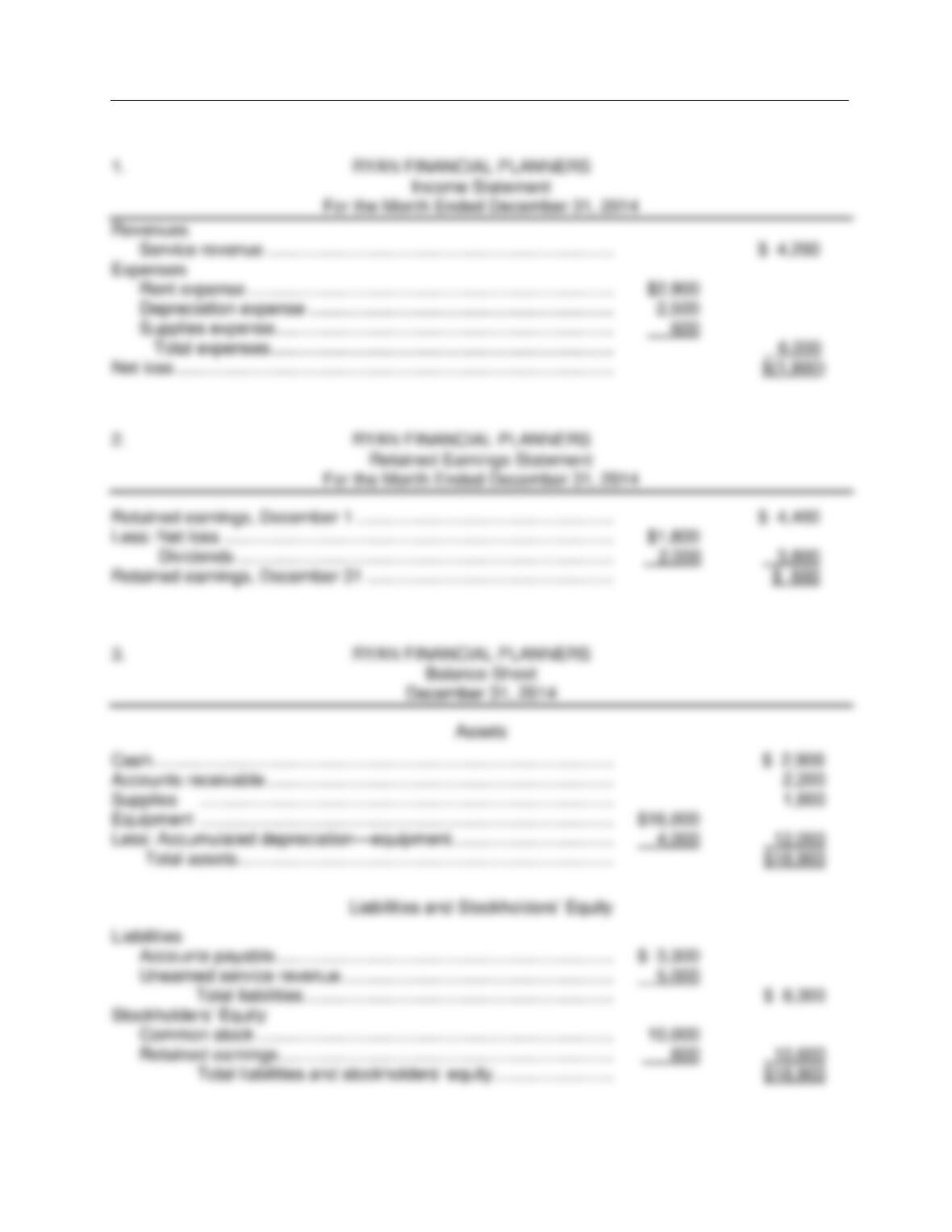
The Accounting Information System
3 – 33
Solution 3-127 (20 min)
Test Bank for Intermediate Accounting, Fifteenth Edition
3 – 34
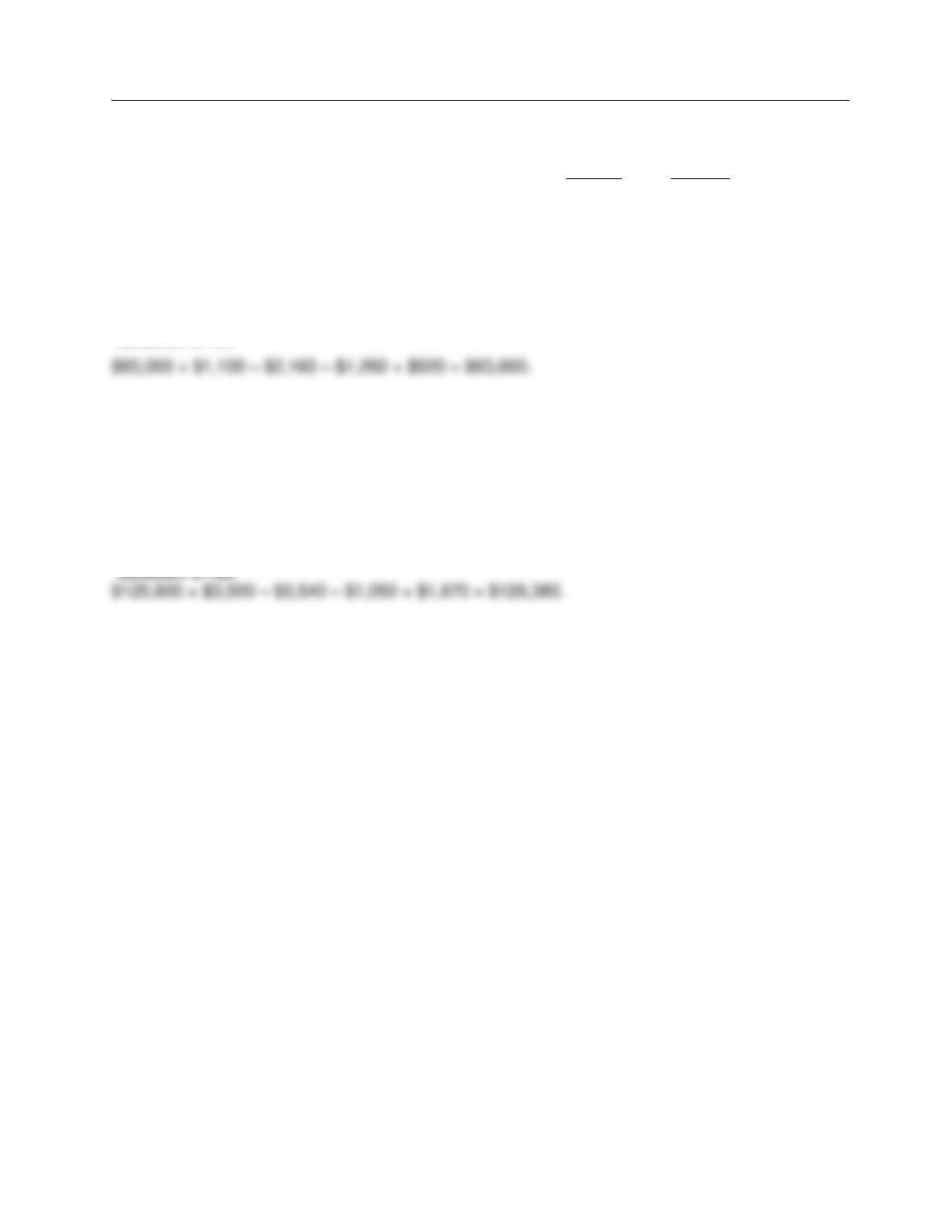
*Ex. 3-128—Cash basis vs. accrual basis of accounting.
Contrast the cash basis of accounting with the accrual basis of accounting.
*Solution 3-128
*Ex. 3-129—Accrual basis.
Sales salaries paid during 2014 were $85,000. Advances to salesmen were $1,100 on January 1,
2014, and $800 on December 31, 2014. Sales salaries accrued were $1,360 on January 1, 2014,
and $1,880 on December 31, 2014. Show the computation of sales salaries on an accrual basis
for 2014.
*Solution 3-129
*Ex. 3-130—Accrual basis.
The records for Todd Inc. showed the following for 2014:
Jan. 1 Dec. 31
Accrued expenses $1,300 $2,150
Prepaid expenses 720 870
Cash paid during the year for expenses, $42,500
Show the computation of the amount of expense that should be reported on the income
statement.
*Solution 3-130
The Accounting Information System
3 – 35
*Ex. 3-131—Accrual basis.
The records for Kiley Company showed the following for 2014:
Jan. 1 Dec. 31
Unearned revenue $1,100 $2,160
Accrued revenue 1,260 920
Cash collected during the year for revenue, $65,000
Show the computation of the amount of revenue that should be reported on the income
statement.
*Solution 3-131
*Ex. 3-132—Cash basis.
Revenue on the income statement was $125,800. Accounts receivable were $3,500 on January 1
and $3,540 on December 31. Unearned revenue was $1,050 on January 1 and $1,670 on
December 31.
Show the computation of revenue for the year on a cash basis.
PROBLEMS
Pr. 3-133—Adjusting entries and account classification.
Selected amounts from Trent Company‘s trial balance of 12/31/14 appear below:
1. Accounts Payable $ 160,000
2. Accounts Receivable 150,000
3. Accumulated Depreciation—Equipment 200,000
4. Allowance for Doubtful Accounts 20,000
5. Bonds Payable 500,000
6. Cash 150,000
7. Common Stock 60,000
8. Equipment 960,000
9. Prepaid Insurance 30,000
10. Interest Expense 10,000
11. Inventory 300,000
12. Notes Payable (due 6/1/15) 200,000
13. Prepaid Rent 210,000
14. Retained Earnings 818,000
15. Salaries and Wages Expense 328,000
(All of the above accounts have their standard or normal debit or credit balance.)
Test Bank for Intermediate Accounting, Fifteenth Edition
3 – 36
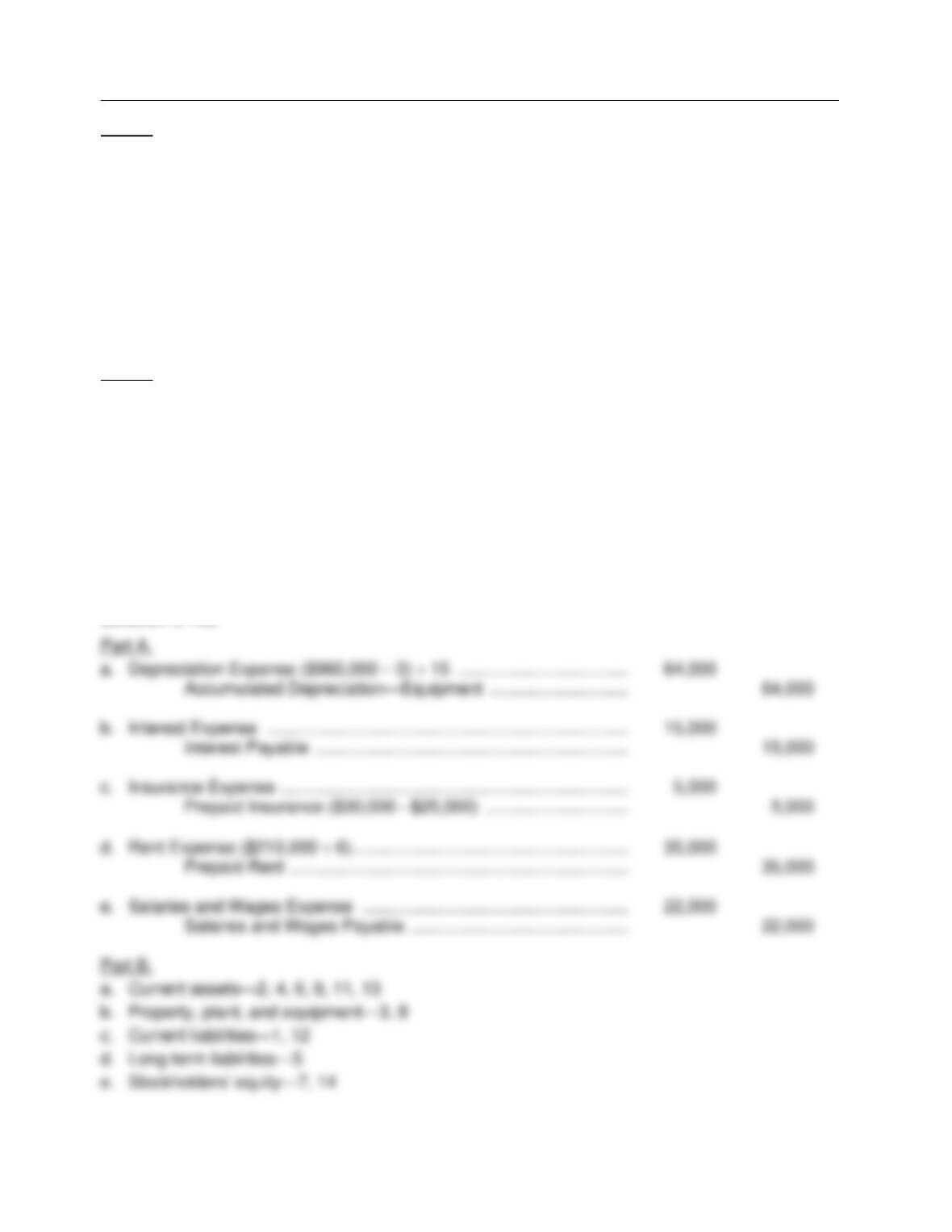
Part A. Prepare adjusting journal entries at year end, December 31, 2014, based on the
following supplemental information.
a. The equipment has a useful life of 15 years with no salvage value. (Straight-line method being
used.)
b. Interest accrued on the bonds payable is $15,000 as of 12/31/14.
c. Prepaid insurance at 12/31/14 is $25,000.
d. The rent payment of $180,000 covered the six months from November 30, 2014 through May
31, 2015.
e. Salaries and wages earned but unpaid at 12/31/14, $22,000.
Part B. Indicate the proper balance sheet classification of each of the 15 numbered accounts
in the 12/31/14 trial balance before adjustments by placing appropriate numbers after
each of the following classifications. If the account title would appear on the income
statement, do not put the number in any of the classifications.
a. Current assets
b. Property, plant, and equipment
c. Current liabilities
d. Long-term liabilities
e. Stockholders’ equity
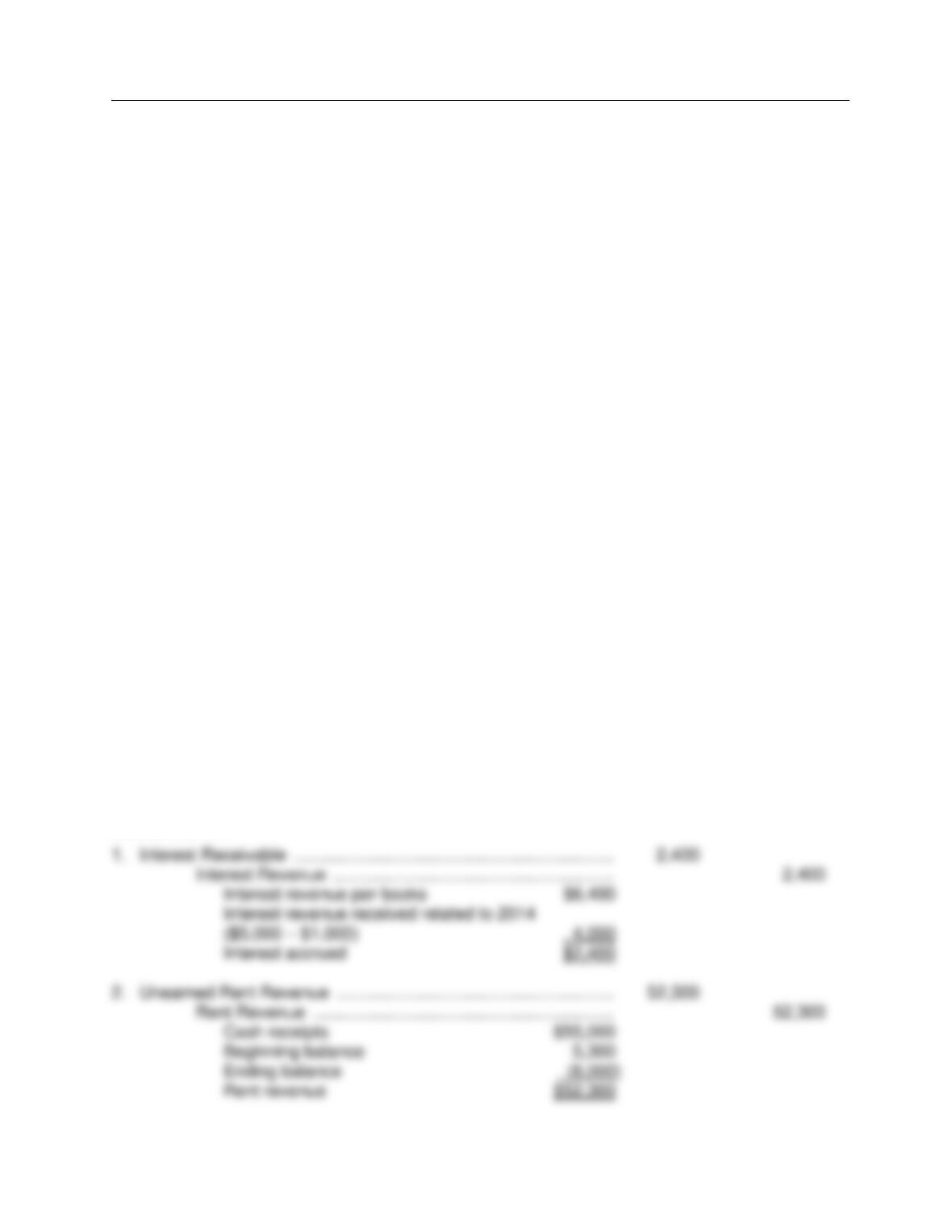
Solution 3-133
The Accounting Information System
3 – 37
Pr. 3-134—Adjusting entries.
Data relating to the balances of various accounts affected by adjusting or closing entries appear
below. (The entries which caused the changes in the balances are not given.) You are asked to
supply the missing journal entries which would logically account for the changes in the account
balances.
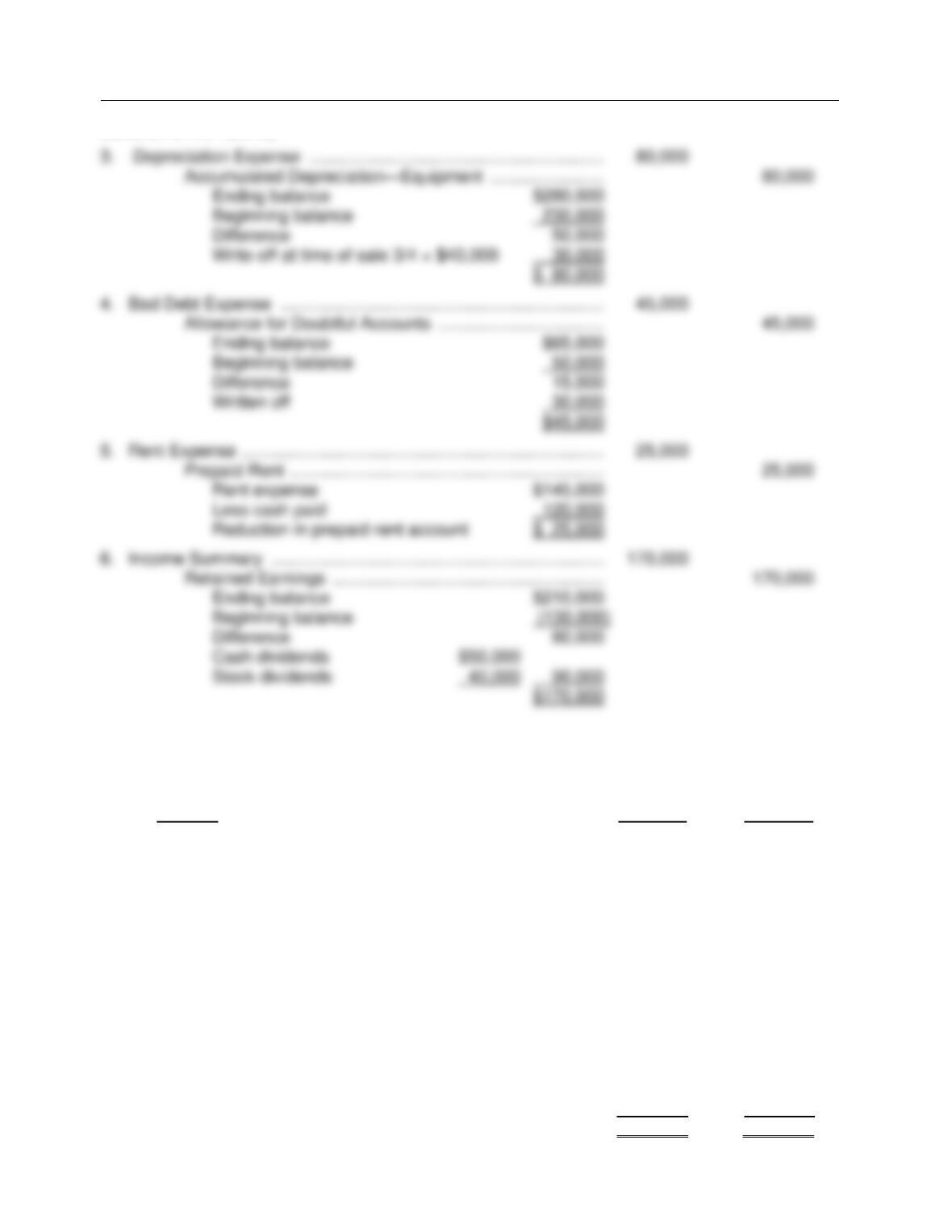
1. Interest receivable at 1/1/14 was $1,000. During 2014 cash received from debtors for interest
on outstanding notes receivable amounted to $5,000. The 2014 income statement showed
interest revenue in the amount of $6,400. You are to provide the missing adjusting entry that
must have been made, assuming reversing entries are not made.
2. Unearned rent at 1/1/14 was $5,300 and at 12/31/14 was $8,000. The records indicate cash
receipts from rental sources during 2014 amounted to $55,000, all of which was credited to
the Unearned Rent Revenue account. You are to prepare the missing adjusting entry.
3. Accumulated depreciation—equipment at 1/1/14 was $230,000. At 12/31/14 the balance of
the account was $280,000. During 2014, one piece of equipment was sold. The equipment
had an original cost of $40,000 and was 3/4 depreciated when sold. You are to prepare the
missing adjusting entry.
4. Allowance for doubtful accounts on 1/1/14 was $50,000. The balance in the allowance
account on 12/31/14 after making the annual adjusting entry was $65,000 and during 2014
bad debts written off amounted to $30,000. You are to provide the missing adjusting entry.
5. Prepaid rent at 1/1/14 was $29,000. During 2014 rent payments of $120,000 were made and
charged to “rent expense.” The 2014 income statement shows as a general expense the item
“rent expense” in the amount of $145,000. You are to prepare the missing adjusting entry that
must have been made, assuming reversing entries are not made.
6. Retained earnings at 1/1/14 was $130,000 and at 12/31/14 it was $210,000. During 2014,
cash dividends of $50,000 were paid and a stock dividend of $40,000 was issued. Both
dividends were properly charged to retained earnings. You are to provide the missing closing
entry.
Solution 3-134
Test Bank for Intermediate Accounting, Fifteenth Edition
3 – 38
Solution 3-134 (cont.)
Pr. 3-135—Adjusting and closing entries.
The following trial balance was taken from the books of Fisk Corporation on December 31, 2014.
Account Debit Credit
Cash $ 9,000
Accounts Receivable 40,000
Notes Receivable 10,000
Allowance for Doubtful Accounts $ 1,800
Inventory 44,000
Prepaid Insurance 4,800
Equipment 110,000
Accumulated Depreciation—Equip. 15,000
Accounts Payable 10,800
Common Stock 44,000
Retained Earnings 55,000
Sales Revenue 280,000
Cost of Goods Sold 126,000
Salaries and Wages Expense 50,000
Rent Expense 12,800
Totals $406,600 $406,600
The Accounting Information System
3 – 39
Pr. 3-135 (cont.)
At year end, the following items have not yet been recorded.
a. Insurance expired during the year, $2,000.
b. Estimated bad debts, 1% of gross sales.
c. Depreciation on equipment, 10% per year on original cost.
d. Interest at 5% is receivable on the note for one full year.
*e. Rent paid in advance at December 31, $5,400 (originally charged to expense).
f. Accrued salaries and wages at December 31, $5,800.
Instructions
(a) Prepare the necessary adjusting entries.
(b) Prepare the necessary closing entries.
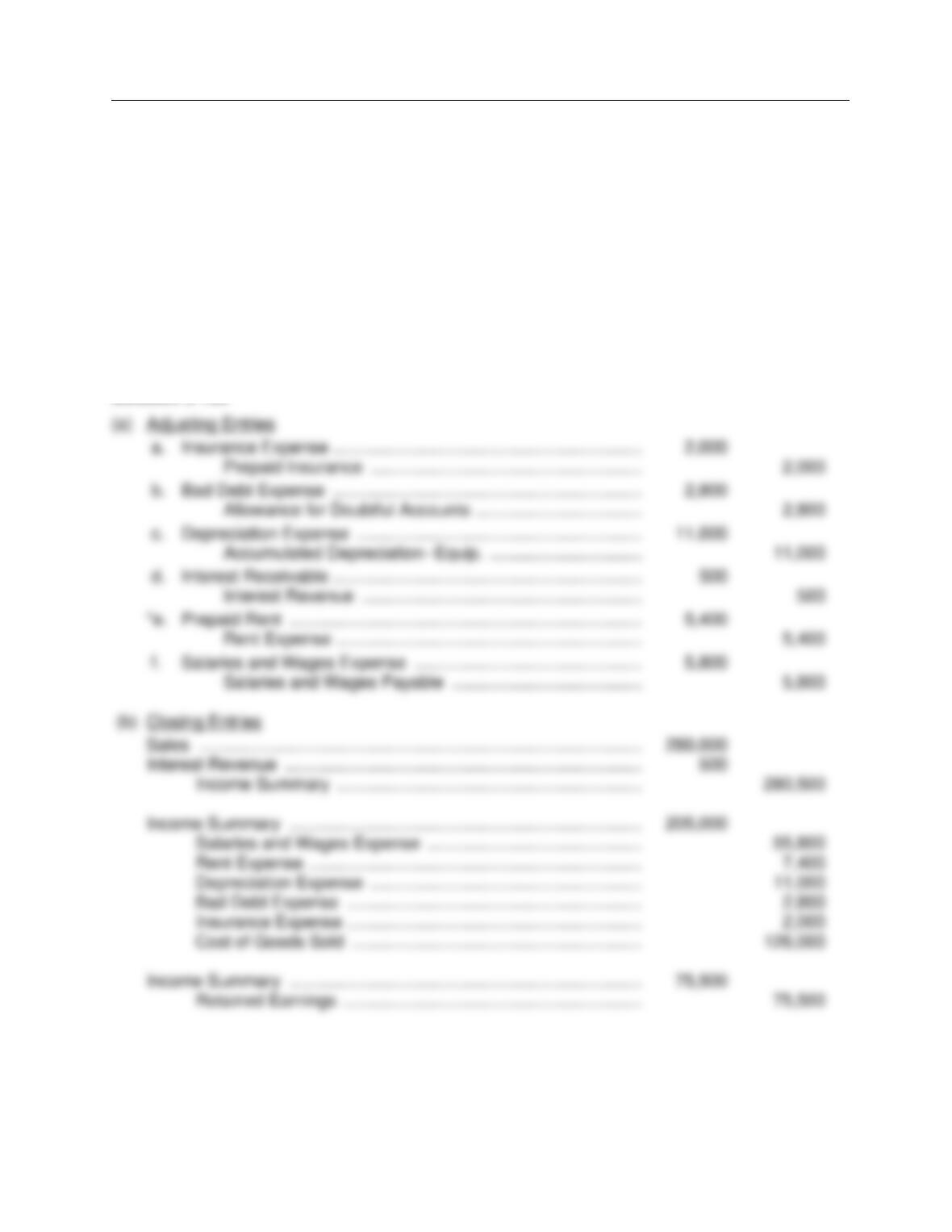
Solution 3-135
Test Bank for Intermediate Accounting, Fifteenth Edition
3 – 40
*Pr. 3-136—Cash to accrual accounting.
The following information is available for Renn Corporation’s first year of operations:
Payment for merchandise purchases $335,000
Ending merchandise inventory 135,000
Accounts payable (balance at end of year) 60,000
Collections from customers 280,000
The balance in accounts payable relates only to merchandise purchases. All merchandise items
were marked to sell at 35% above cost. What should be the ending balance in accounts
receivable, assuming all accounts are deemed collectible?
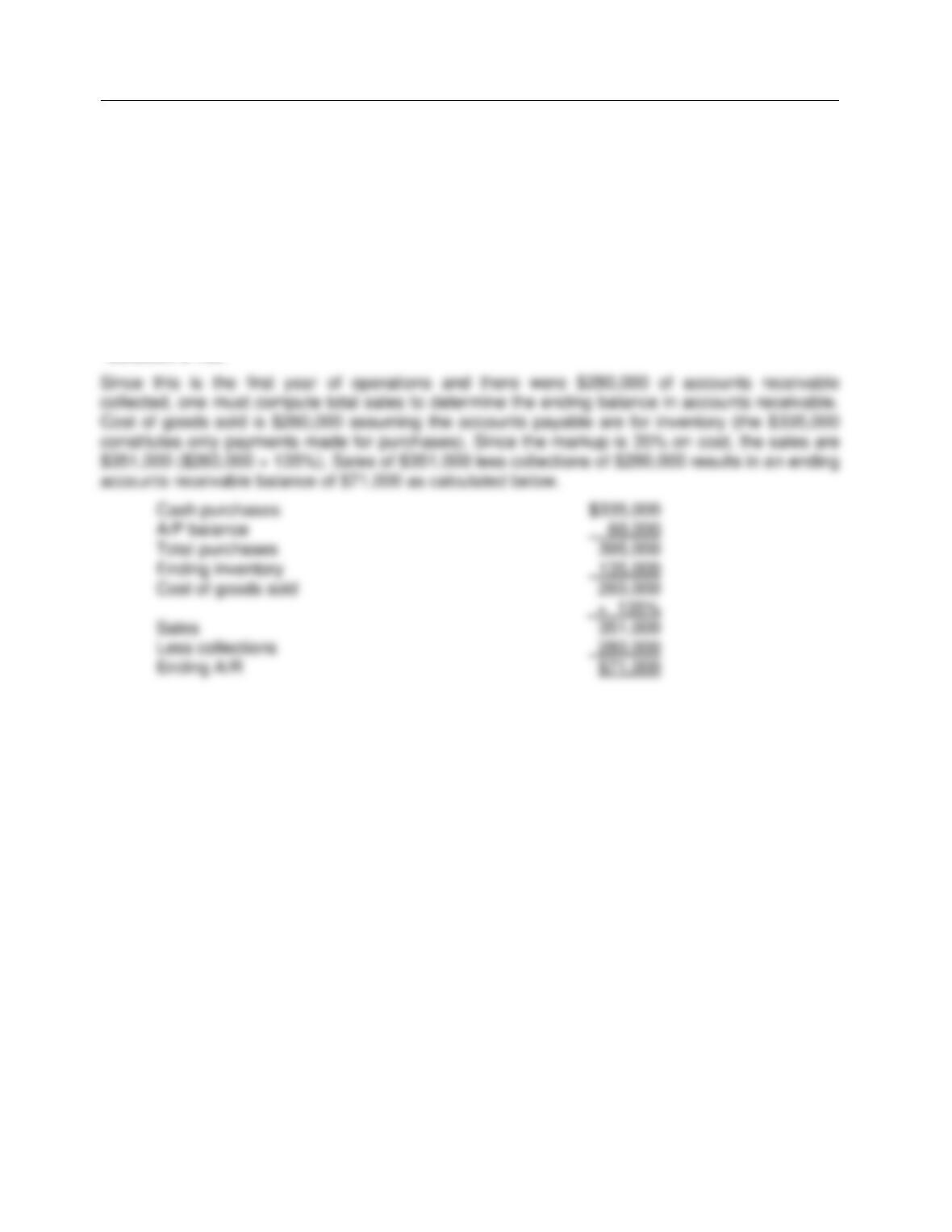
*Solution 3-136
*Pr. 3-137—Accrual accounting.
Yates Company’s records provide the following information concerning certain account balances
and changes in these account balances during the current year. Transaction information is
missing from each item below.
Instructions
Prepare the entry to record the missing information for each account. (Consider each inde–
pendently.)
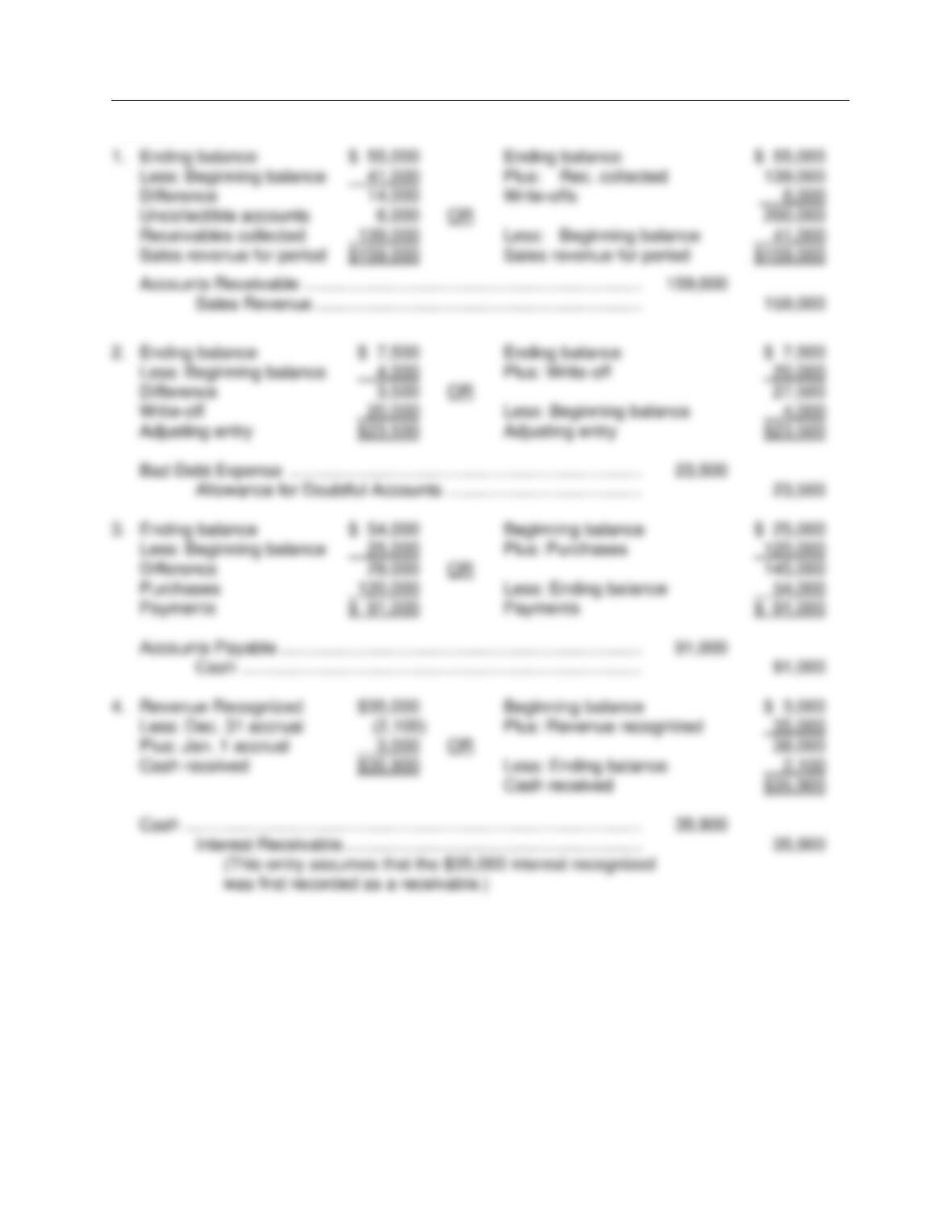
1. Accounts Receivable: Jan. 1, balance $41,000, Dec. 31, balance $55,000, uncollectible
accounts written off during the year, $6,000; accounts receivable collected during the year,
$139,000. Prepare the entry to record sales revenue.
2. Allowance for Doubtful Accounts: Jan. 1, balance $4,000, Dec. 31, balance $7,500,
uncollectible accounts written off during the year, $20,000. Prepare the entry to record bad
debt expense.
3. Accounts Payable: Jan. 1, balance $25,000, Dec. 31, balance $54,000, purchases on account
for the year, $120,000. Prepare the entry to record payments on account.
4. Interest Receivable: Jan. 1 accrued, $3,000, Dec. 31 accrued, $2,100, recognized for the
year, $35,000. Prepare the entry to record cash interest received.
The Accounting Information System
3 – 41
*Solution 3-137
Test Bank for Intermediate Accounting, Fifteenth Edition
3 – 42
*Pr. 3-138—Accrual basis.
Grier & Associates maintains its records on the cash basis. You have been engaged to convert its
cash basis income statement to the accrual basis. The cash basis income statement, along with
additional information, follows:
Grier & Associates
Income Statement (Cash Basis)
For the Year Ended December 31, 2014
Cash receipts from customers $450,000
Cash payments:
Salaries and wages $170,000
Income taxes 65,000
Insurance 40,000
Interest 25,000 300,000
Net income $150,000
Additional information:
Balances at 12/31
2014 2013
Accounts receivable $50,000 $30,000
Salaries and wages payable 10,000 20,000
Income taxes payable 24,000 19,000
Prepaid insurance 8,000 4,000
Accumulated depreciation 95,000 75,000
Interest payable 3,000 9,000
No plant assets were sold during 2014.
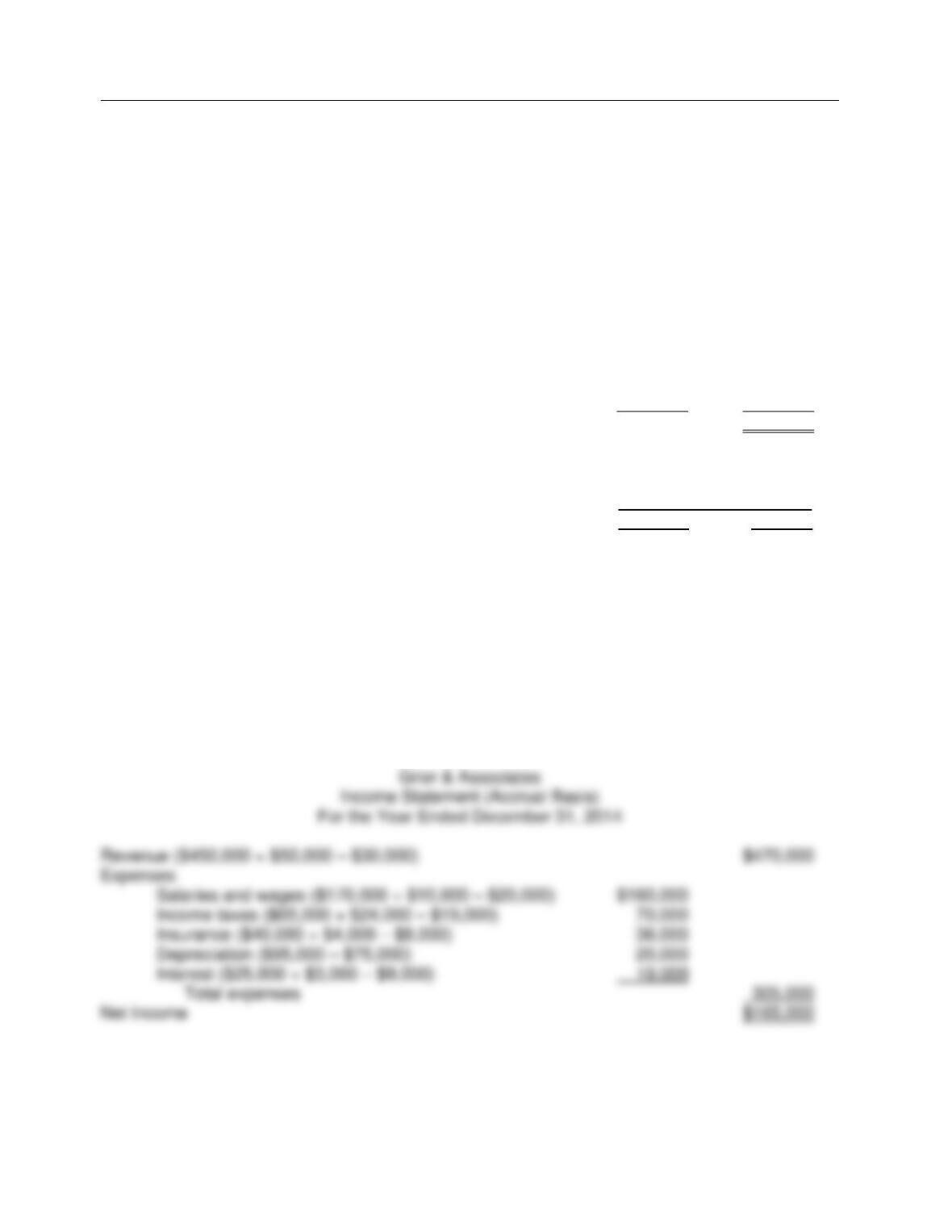
*Solution 3-138
Grier & Associates

The Accounting Information System
3 – 43
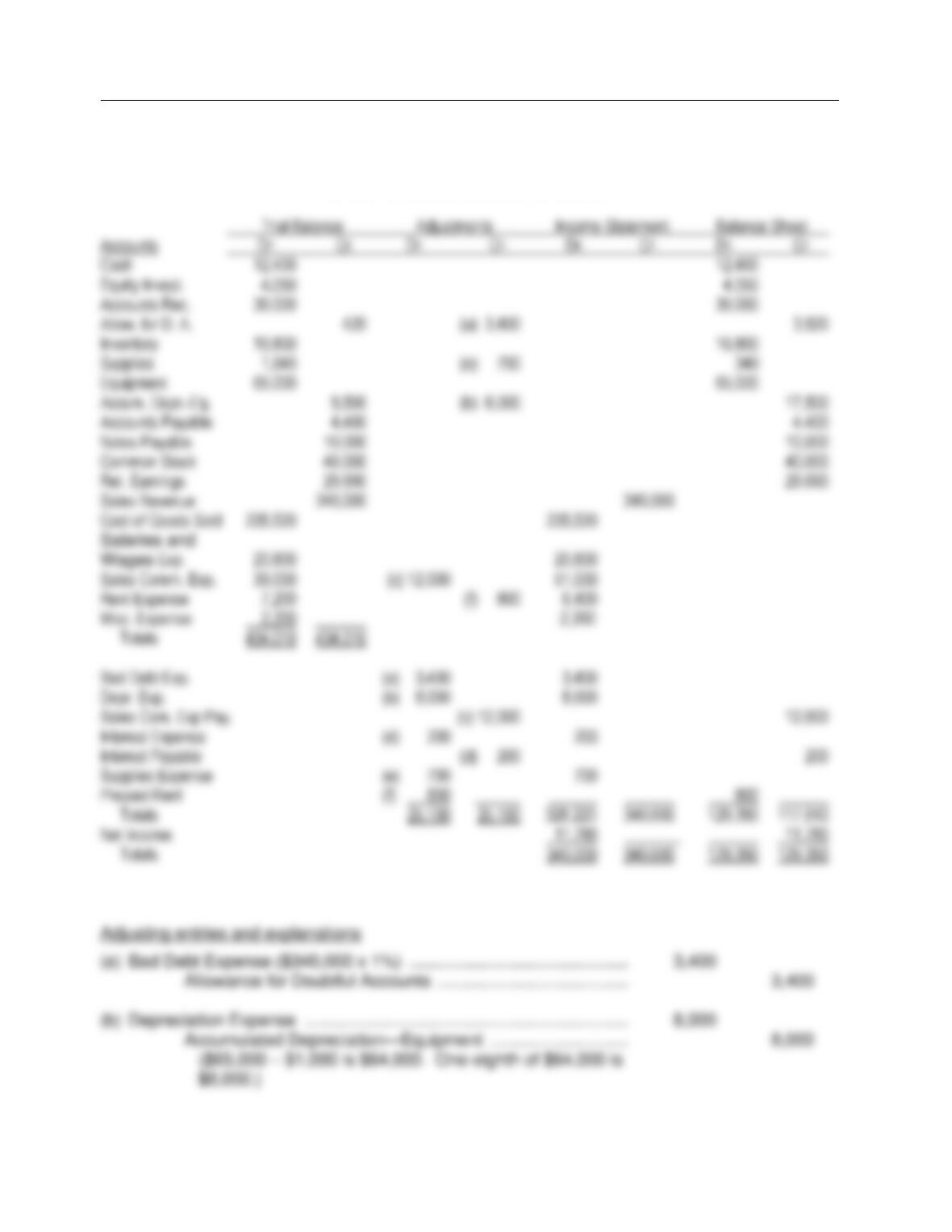
*Pr. 3-139—Eight-column work sheet.
The trial balance of Winsor Corporation is reproduced on the following page. The information
below is relevant to the preparation of adjusting entries needed to both properly match revenues
and expenses for the period and reflect the proper balances in the real and nominal accounts.
Instructions
As the accountant for Winsor Corporation, you are to prepare adjusting entries based on the
following data, entering the adjustments on the work sheet and completing the additional columns
with respect to the income statement and balance sheet. Carefully key your adjustments and
label all items. (Due to time constraints, an adjusted trial balance is not required.) Round all
computations to the nearest dollar.
(a) Winsor determined that one percent of sales will become uncollectible.
(b) Depreciation is computed using the straight-line method, with an eight-year life and $1,000
salvage value.
(c) Salesmen are paid commissions of 15% of sales. Commissions on sales for December have
not been paid.
(d) The note was issued on October 1, bearing interest at 8%, due Feb. 1, 2015.
(e) A physical inventory of supplies indicated $340 of supplies currently in stock.
(f) Provisions of a lease contract specify payments must be made one month in advance, with
monthly payments at $800/mo. This provision has been complied with as of Dec. 31, 2014.
Winsor Corporation
Work Sheet
For the Year Ended December 31, 2014
Trial Balance Adjustments Income Statement Balance Sheet
Accounts Dr. Cr. Dr. Cr. Dr. Cr. Dr. Cr.
Cash 12,400
Equity Invest. 4,050
Accounts Rec. 30,000
Allow. for D. A. 420
Inventory 16,800
Supplies 1,040
Equipment 65,000
Accum. Depr.-Equip. 9,500
Accounts Payable 4,400
Notes Payable 10,000
Common Stock 40,000
Ret. Earnings 29,690
Sales Revenue 340,000
Cost of Goods Sold 235,520
Salaries and
Wages Exp. 20,800
Sales Comm. Exp. 39,000
Rent Expense 7,200
Misc. Expense 2,200
Totals 434,010 434,010
Test Bank for Intermediate Accounting, Fifteenth Edition
3 – 44
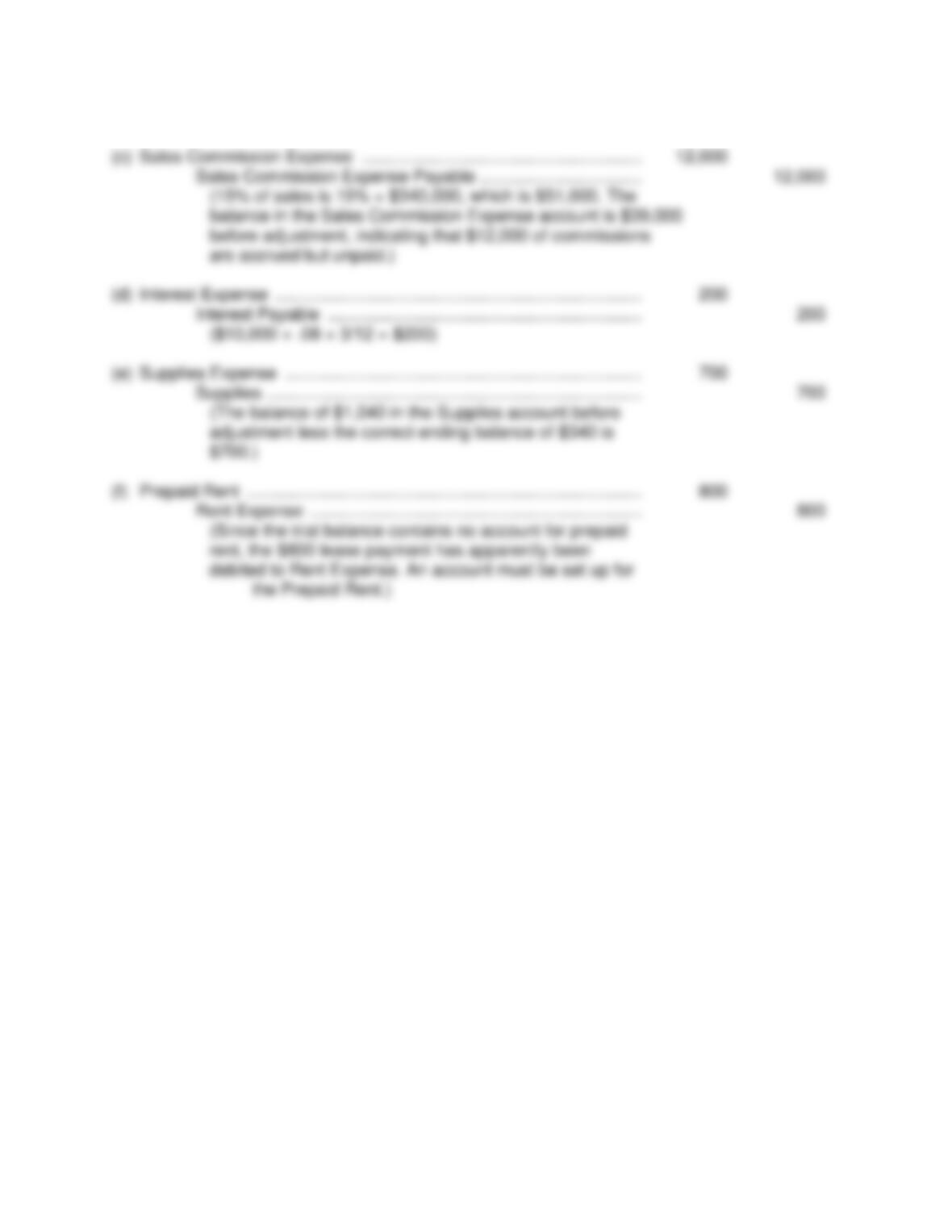
Solution 3-139 Winsor Corporation
Work Sheet
For the Year Ended December 31, 2014
The Accounting Information System
3 – 45
Solution 3-139 (cont.)

Test Bank for Intermediate Accounting, Fifteenth Edition
3 – 46
IFRS QUESTIONS
True / False
1. As rules for accounting for specific events sometimes differ across countries, the double-entry
accounting system is difficult to implement as the basis of worldwide accounting system.
2. IASB is working to establish high-quality auditing and assurance quality standards throughout
the world.
Multiple Choice:
3. Icon International, a software company, incorporated on January 1, 2013 is planning to
convert to IFRS. The company decided to present its first IFRS statements for the year ended
December 31, 2015. What is the transition date of Icon International?
a. January 1, 2013
b. January 1, 2015
c. December 31, 2015
d. December 31, 2013
4. Icon International, a software company, incorporated on January 1, 2013 is planning to
convert to IFRS. The company decided to present its first IFRS statements for the year ended
December 31, 2015. What is the reporting date of Icon International?
a. January 1, 2013
b. January 1, 2015
c. December 31, 2015
d. December 31, 2013
5. Which of the following is a reason for recasting prior financial statements based on IFRS?
a. To increase the market value of a company’s shares
b. To report a high income for attracting investors
c. To report a low taxable income reducing the tax liability
d. To provide financial statement users with comparable information
6. IFRS 1 requires information in a company’s first IFRS statement to:
a. be same as in GAAP statement.
b. be transparent.
c. be as lengthy as possible.
d. provide a suitable ending point.
7. Which of the following is the first step to be taken by a company deciding to convert to IFRS?
a. Preparing an opening balance sheet at the date of transition
b. Identifying the timing of first IFRS statement
c. Selecting accounting principles that comply with IFRS
d. Implementing accounting principles retrospectively
The Accounting Information System
3 – 47
Answers to Multiple Choice:
Short Answer:
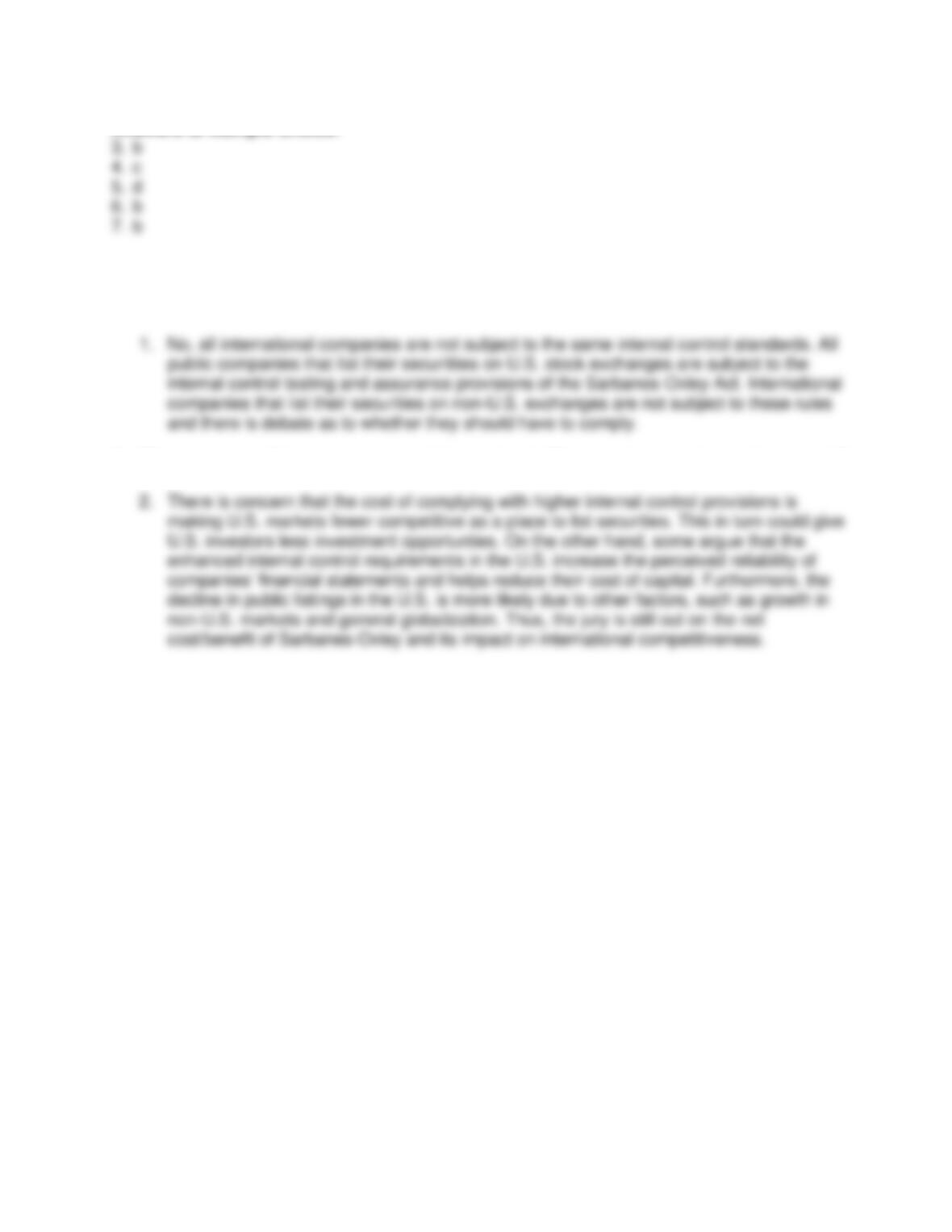
8. Are all international companies subject to the same internal control standards? Explain.
9. What are some of the consequences of international differences in internal control standards?