56.
The current ratio is used to help assess a company’s ability to pay its debts in the near
future.
57.
If a company has current assets of $15,000 and current liabilities of $9,500, its current
ratio is 1.6.
58.
Flo’s Flowers’ current ratio is 1.3. The industry average for the current ratio is 1.2. This
indicates that Flo’s can cover its short term liabilities with its short term assets.
59.
A benefit of using a work sheet is that it aids in the preparation of the financial
statements.
60.
The work sheet is a required report made available to external decision makers.
61.
On a work sheet, if the Debit total exceeds the Credit total of the Income Statement
columns, a net loss is indicated.
62.
If all columns of a completed work sheet balance, you can be sure that no errors were
made in its preparation.
63.
Normally closing entries are first entered in the general journal and then posted to the
work sheet.
64.
Adjusting entries are often entered in the work sheet before they are entered in the
general journal.
65.
On the work sheet, net income is entered in the Income Statement Credit column as well
as the Balance Sheet Credit column.
66.
An expense account is normally closed by debiting Income Summary and crediting the
expense account.
67.
After posting the entries to close all revenue and expense accounts, the Income Summary
account of Cleaver Auto Services has a $4,000 debit balance. This result implies that
Cleaver earned a net income of $4,000.
68.
When there is a net loss the Income Summary account would have a credit balance.
69.
The steps in the closing process are (1) close credit balances in revenue accounts to
Income Summary; (2) close debit balances in expense accounts to Income Summary; (3)
close Income Summary to Retained Earnings; (4) close Dividends to Retained Earnings.
70.
A post-closing trial balance is a list of permanent accounts and their balances from the
ledger after all closing entries are journalized and posted.
71.
The aim of a post-closing trial balance is to verify that (1) total debits equal total credits
for temporary accounts, and (2) all temporary accounts have zero balances.
72.
Reversing entries are optional.
Multiple Choice Questions
73.
Another name for a temporary account is a(n):
74.
Which of the following accounts is a permanent (real) account?
75.
When closing entries are made:
76.
Revenue, expense, and dividend accounts, which are closed at the end of each accounting
period, are:
77.
Assets, liabilities, and equity accounts are not closed; these accounts are called:
78.
Closing the temporary accounts at the end of each accounting period does all of the
following
except
:
79.
Journal entries recorded at the end of each accounting period to prepare the revenue,
expense, and dividend accounts for the upcoming period and to update the retained
earnings account for the events of the period just finished are referred to as:
80.
The closing process is necessary in order to:
81.
The recurring steps performed each reporting period in preparing financial statements,
starting with analyzing and recording transactions in the journal and continuing through
the post-closing trial balance, is referred to as the:
82.
Which of the following is the usual final step in the accounting cycle?
83.
A classified balance sheet:
84.
Two common subgroups for liabilities on a classified balance sheet are:
85.
Which of the following are classified as current assets?
86.
The current ratio:
87.
The Unadjusted Trial Balance columns of a company’s work sheet shows the Store
Supplies account with a balance of $750. The Adjustments columns shows a credit of
$425 for supplies used during the period. The amount shown as Store Supplies in the
Balance Sheet columns of the work sheet is:
88.
Accumulated Depreciation and Service Fees Earned would be sorted to which respective
columns in completing a work sheet?
89.
Which of the following statements is
incorrect
?
90.
A company shows a $600 balance in Prepaid Rent in the Unadjusted Trial Balance
columns of the work sheet. The Adjustments columns show expired rent of $200. This
adjusting entry results in:
91.
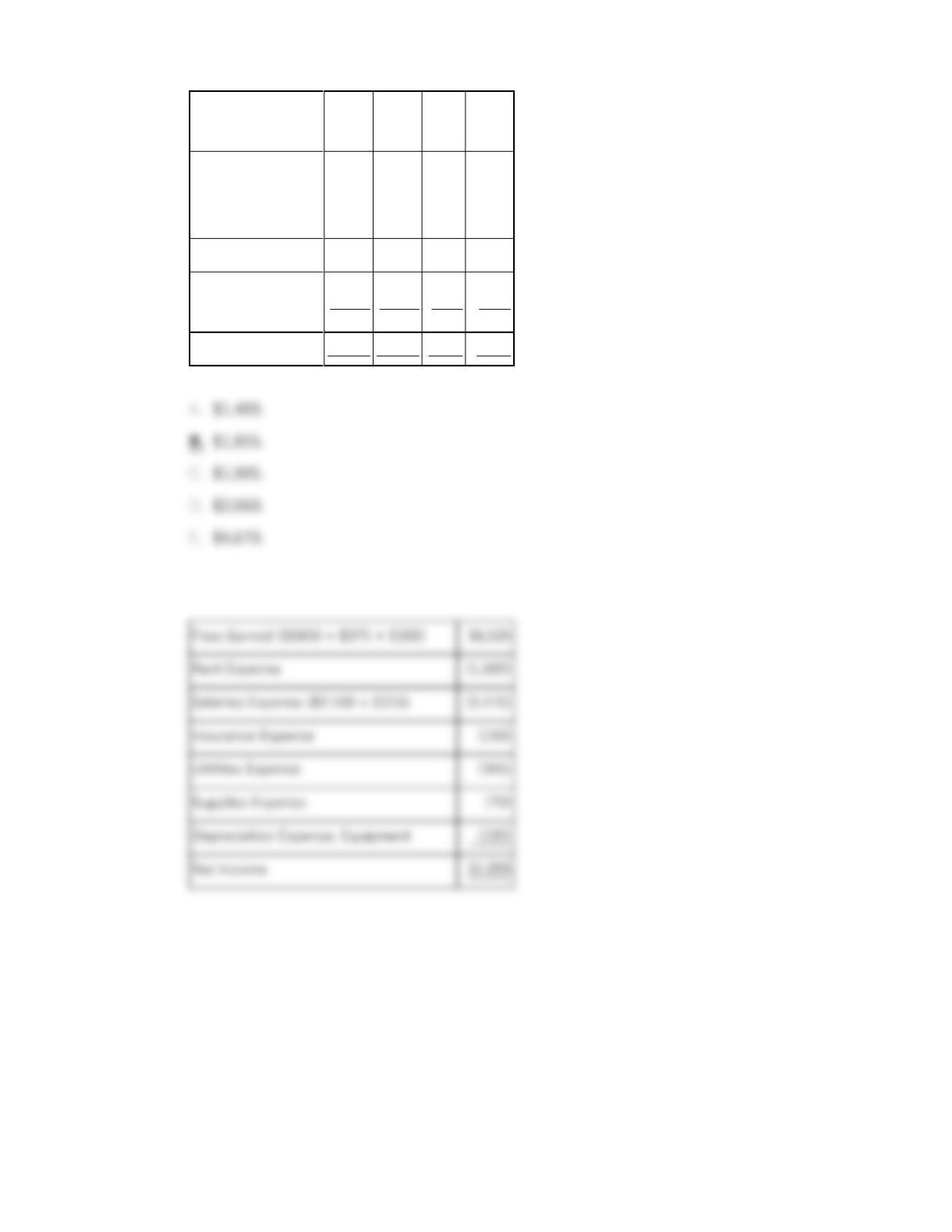
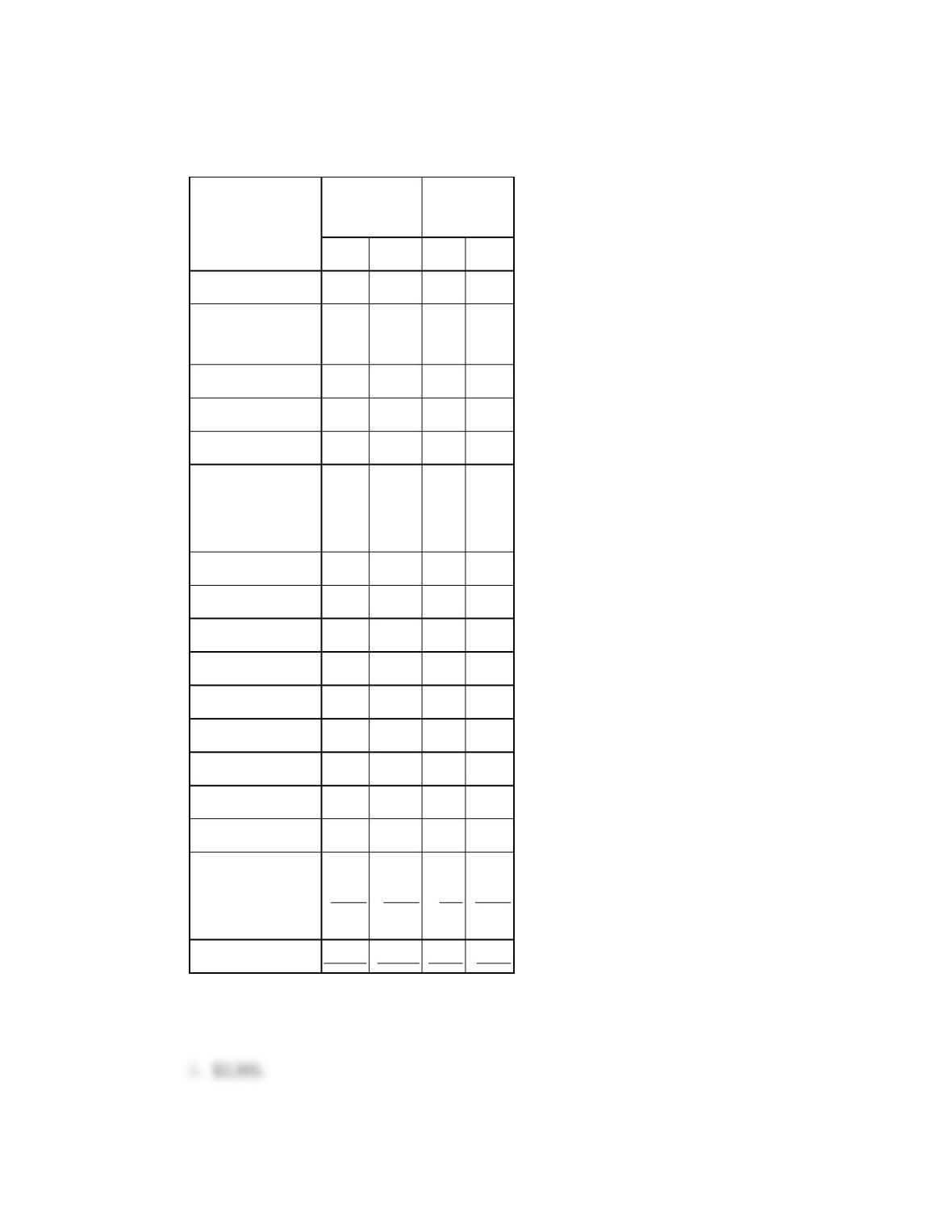
A company’s December 31 work sheet for the current period appears below. Based on the
information provided, what is net income for the current period?
Unadjusted
Trial Balance
Adjustments
Debit
Credit
Debit
Credit
Cash
975
Prepaid insurance
3,600
150
Supplies
180
70
Equipment
10,320
Accounts payable
1,140
Unearned fees
4,500
375
Common stock
9,180
Dividends
1,650
Fees earned
5,850
375
300
Rent expense
1,500
Salaries expense
2,100
315
Utilities expense
345
Insurance expense
150
Supplies expense
70
Depreciation
190
expense—
equipment
Accumulated
depreciation—
equipment
190
Salaries payable
315
Accounts
receivable
300
Total
20,670
20,670
1,400
1,400
Utilities Expense
Supplies Expense
92.
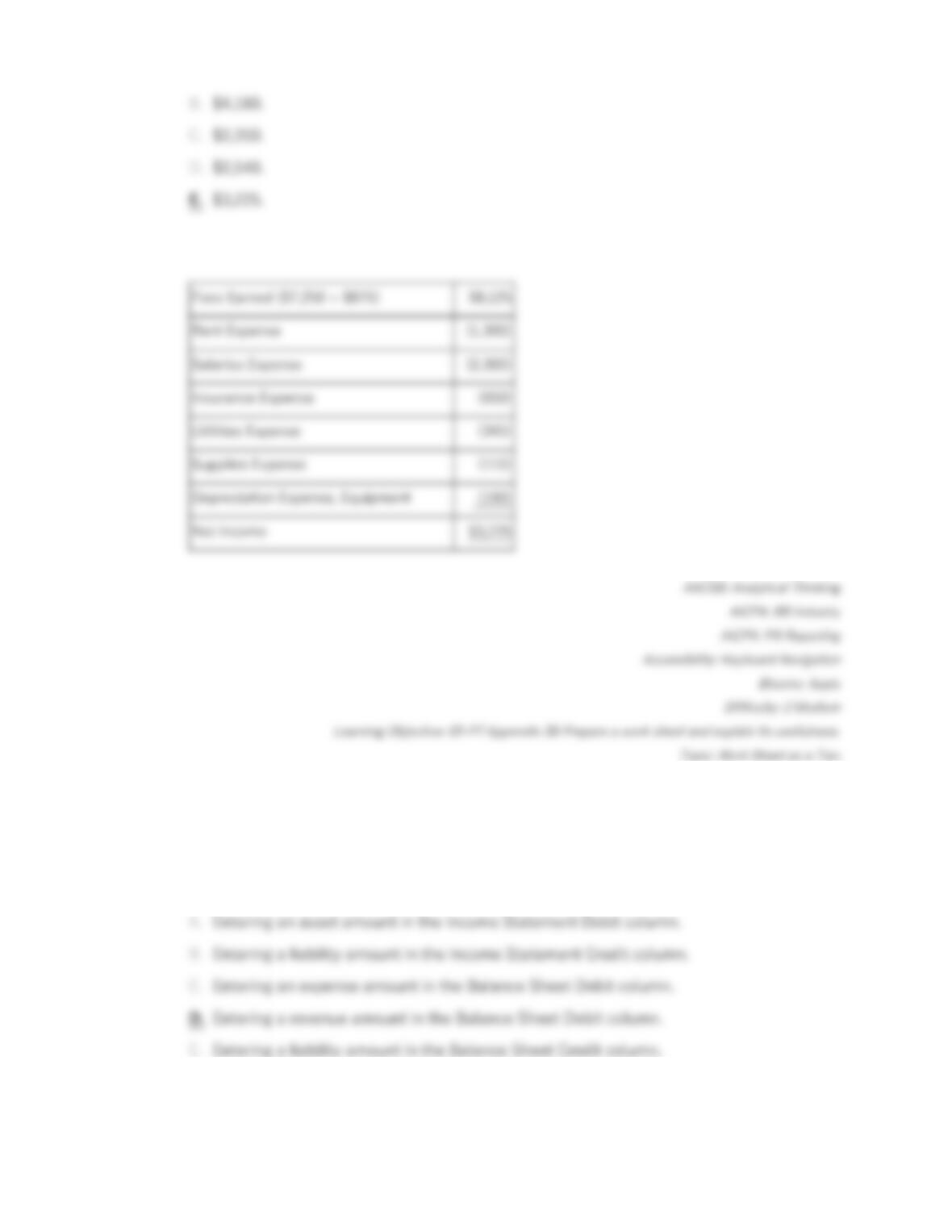
A company’s December 31 work sheet for the current period appears below. Based on the
information provided, what is net income for the current period?
Unadjusted
Trial Balance
Adjustments
Debit
Credit
Debit
Credit
Cash
1,975
Accounts
Receivable
1,000
875
Prepaid insurance
1,600
650
Supplies
330
115
Equipment
8,320
Accumulated
depreciation—
equipment
720
190
Accounts payable
1,140
Common stock
9,110
Dividends
1,050
Fees earned
7,250
875
Rent expense
1,300
Salaries expense
2,300
Utilities expense
345
Insurance expense
650
Supplies expense
115
Depreciation
expense—
equipment
190
Total
18,220
18,220
1,830
1,830
93.
Which of the following errors would cause the Balance Sheet columns of a work sheet to
be out of balance?