Chapter 03 – Measuring Business Income
TRUE/FALSE
1. Accounting periods of greater than a year are called interim periods.
2. If a company is not expected to survive, it is considered a going concern.
3. Expenses are often called the cost of doing business or expired costs.
4. When revenues exceed expenses, a net income occurs.
5. All increases to cash represent revenues.
6. Revenue is equal to the cash received by a company during an accounting period.
7. Not all decreases in stockholders’ equity are a result of expenses.
8. Instead of the word net income, accountants use net profit because the latter term can be defined more
precisely.
9. A company’s fiscal year need not correspond to the calendar year.
10. Accounting periods should be of unequal length to facilitate comparisons between periods.
11. The continuity assumption acknowledges that estimates of net income are still useful.
12. When preparing financial statements, the accountant assumes that the business will not continue to
operate indefinitely unless there is evidence to the contrary.
13. In applying the matching rule, expenses should be recognized in the same accounting period as the
revenues to which they are related. .
14. When there is a direct connection between revenues and costs, the costs are systematically allocated
among the periods benefited from the costs.
15. The intentional preparation of misleading financial statements is referred to as fraudulent financial
reporting.
16. Direct cause-and-effect relationships between revenues and expenses are often difficult to identify.
17. The manipulation of revenues and expenses to get a certain outcome is called earnings management.
18. All transactions can be easily assigned to specific accounting periods.
19. When a net loss has been suffered, Retained Earnings will contain a positive balance.
20. The matching rule is most closely related to the cash basis of accounting.
21. Net income is misleading when revenue is overstated or expenses are understated by significant
amounts.
22. When the estimates involved in earnings management begin moving outside a reasonable range, the
financial statements can become misleading.
23. One of the applications of accrual accounting is recognizing revenue at the appropriate time.
24. Accrual accounting is an application of continuity.
25. Revenue is produced when accounts receivable are collected.
26. Adjusting entries affect only the cash flows of the current period.
27. Revenue should be recognized, only when collectability is reasonably assured.
28. Revenue cannot be recognized when delivery of goods has occurred or services have been rendered.
29. Accrual accounting recognizes revenues and expenses at the point that cash changes hands.
30. A cash payment that reduces a liability does not result in an expense.
31. The cash basis of accounting results in a more accurate measurement of net income for the period than
does the accrual basis of accounting.
32. An accrual is the recognition of an expense that has arisen but has not yet been recorded.
33. Adjusting entries are useful in apportioning costs among two or more accounting periods.
34. An adjusting entry includes two balance sheet accounts or two income statement accounts.
35. Recording incurred but unpaid expenses is an example of an accrual.
36. A contra account is an account whose balance is added to an associated account in the financial
statements.
37. Expenses that have been paid for and recorded are called accrued expenses.
38. Revenue for which the service has been performed but no entry has been made in the accounting
records is called prepaid revenue.
39. A depreciable asset’s original cost can typically be obtained by referring to the balance sheet.
40. Accumulated depreciation is another term for depreciation expense.
41. Depreciation Expense–Equipment is an example of a contra account.
42. The carrying value of equipment is the difference between the original value of the equipment and its
accumulated depreciation.
43. When an asset’s depreciation is recorded, it’s carrying value increases.
44. The heading of an adjusted trial balance might contain the line “May 31, 2013”
45. The adjusted trial balance facilitates the preparation of the financial statements.
46. An adjusted trial balance is prepared after the adjusting entries are recorded.
47. An adjusted trial balance proves the balance of the ledger accounts after the adjusting entries have
been posted.
48. An adjusted trial balance will probably list fewer accounts than are listed in the trial balance.
49. The dollar amount of Cash on the trial balance and on the adjusted trial balance should be identical.
50. Financial statements cannot be prepared until the accounts have been adjusted.
51. In the accounting cycle, adjusting entries are prepared before closing entries.
52. Closing entries are journal entries made at the beginning of an accounting period.
53. Real account balances are reduced to zero by closing entries.
54. Closing entries deal primarily with the balances of real accounts.
55. The only accounts that are closed are temporary accounts.
56. Closing entries result in the transfer of net income or loss into the Retained Earnings account.
57. After all closing entries have been posted, the balance of the Income Summary account will equal net
income for the period.
58. Accounts Receivable is a real account.
59. Rent Expense is a permanent account.
60. Cash is a nominal account.
61. Supplies Expense is a permanent account.
62. A revenue account is closed with a credit to the revenue account and a debit to Income Summary.
63. Net income provides a good measure of a business’s debt-paying ability.
64. The Supplies Expense account on the income statement is related to the Supplies Payable account on
the balance sheet.
MULTIPLE CHOICE
1. The manipulation of revenues and expenses to achieve a specific outcome is called
a.
earnings management.
b.
continuity.
c.
going concern.
d.
revenue recognition.
2. A net loss results in a decrease in
a.
expenses.
b.
liabilities.
c.
stockholders’ equity.
d.
assets.
3. Net income results in a(n)
a.
increase in stockholders’ equity.
b.
increase in expenses.
c.
decrease in revenues.
d.
decrease in assets.
4. When expenses exceed revenues,
a.
a net income will result.
b.
a net loss occurs.
c.
stockholders’ equity increases.
d.
a liability is created.
5. The cost of doing business is also known as
a.
a liability.
b.
an expense.
c.
revenue.
d.
an asset.
6. The periodicity assumption recognizes that
a.
the company may continue indefinitely.
b.
all financial statements should cover a fiscal year.
c.
it is useful to estimate the business’s net income in terms of accounting periods.
d.
the value of an asset may vary from month to month.
7. Retailers often end their fiscal year
a.
in correspondence with their yearly cycle of business activity.
b.
during the peak of the busy season.
c.
at different times each year.
d.
on July 31.
8. In order to make comparison easier, financial statement time periods should
a.
end during the peak season.
b.
be of equal length.
c.
correspond to the calendar year.
d.
comply with income tax regulations.
9. The going concern assumption helps solve the
a.
matching rule issue.
b.
periodicity issue.
c.
recognition issue.
d.
continuity issue.
10. When a direct cause-and-effect relationship cannot be established between revenues and costs, the
costs are
a.
not expensed and remain as assets on the balance sheet.
b.
expensed among the accounting periods that benefit from the costs.
c.
expensed immediately in their entirety.
d.
expensed equally each year.
11. Making an assumption about periodicity attempts to solve which income measurement issue?
a.
Accounting period issue.
b.
Continuity issue.
c.
Matching issue.
d.
Recognition issue.
12. Revenues are increases in stockholders’ equity and result from
a.
selling goods.
b.
rendering services.
c.
both selling goods and rendering services.
d.
neither selling goods nor rendering services.
13. Which of the following actions can distort company records and result in fraudulent financial
reporting?
a.
Prepaying an expense and recording it as an asset
b.
Collecting revenue in advance of earning it
c.
Recording income that has not yet been earned
d.
Recording an expense that has been incurred but has not yet been paid
14. Which of the following transactions results in an increase in expenses?
a.
Cash payment on accounts payable
b.
Receive a bill for the usage of utilities
c.
Repayment of principal of bank loan
d.
Purchase of machinery on credit
15. Which of the following transactions results in an increase in revenues?
a.
Sale of a service on credit
b.
Receipt of cash from bank loan
c.
Sale of land at cost for cash
d.
Collection of cash on account
16. Which of the following transactions will not result in an increase in revenues?
a.
Sale of goods on credit
b.
Sale of services for cash
c.
Accumulation of interest in bank account
d.
Sale of stock to investors for cash
17. Expenses are incurred
a.
as a result of selling goods or rendering a service.
b.
in order to produce liabilities.
c.
only during the adjustment process.
d.
in order to produce assets.
18. A customer’s promise to pay for goods or services
a.
decreases the assets of the company..
b.
decreases the Cash account of the company.
c.
creates a liability for the company.
d.
increases the assets of the company.
19. The matching rule relates the least to
a.
systematic and rational allocation.
b.
the cash basis of accounting.
c.
revenues and expenses.
d.
cause-and-effect relationships.
20. The matching rule is applied
a.
because it is required by the Internal Revenue Code.
b.
by expensing certain items immediately and in their entirety.
c.
to help make the bookkeeper’s job easier.
d.
to help produce an accurate measurement of a company’s performance.
21. Which of the following is the most difficult to assign to specific time periods?
a.
The incurrence of wages expense
b.
The accrual of interest
c.
The use of equipment
d.
The expiration of insurance
22. The going concern assumption is not applied to
a.
companies that have sustained losses for the previous two years.
b.
companies about to file for bankruptcy.
c.
the partnership form of business.
d.
companies that have been in existence for less than a year.
23. Which of the following is not an application of accrual accounting?
a.
Recognizing revenues when earned and expenses when incurred
b.
Applying the matching rule
c.
Adjusting the accounts
d.
Recording on the basis of actual receipt and payment of cash
24. Which of the following conditions is not a requirement by the SEC for the recognition of revenue?
a.
Delivery has occurred or services have been rendered.
b.
Collectability is reasonably certain.
c.
A written agreement has been signed.
d.
The seller’s price to the buyer is fixed or determinable.
25. The four conditions that must exist, according to the SEC, before revenue should be recognized
include all of the following except
a.
there is a reasonable assurance the amount is collectible.
b.
a selling price has been determined.
c.
delivery will occur or services will be rendered within 30 days.
d.
persuasive evidence of an arrangement exists.
26. Which of the following is a condition required by the SEC for the recognition of revenue?
a.
Cash payment received
b.
Execution of a promissory note
c.
Price in excess of $500
d.
A product or service has been delivered
27. Which of the following transactions results in the recognition of an expense?
a.
Expiration of the usefulness of equipment during the accounting period
b.
Payment on an account payable
c.
Declaration and payment of a dividend
d.
Payment on the principal portion of a loan
28. When a credit sale takes place,
a.
a revenue account will decrease.
b.
an asset account will increase.
c.
one asset account will increase and another will decrease.
d.
assets will be unaffected.
29. Which of the following is not an application of accrual accounting?
a.
Recording advertising fees earned at the time the work is paid for
b.
Adjusting unearned advertising fees to the proper balance at the end of the month
c.
Recording advertising fees earned at the time service is performed
d.
Recording telephone expense in the accounting period covered by the monthly bill
30. Which of the following transactions is most likely not to result in an adjusting entry at the end of the
period?
a.
Performance of a service for which payment was received in advance
b.
Payment of this month’s rent
c.
Purchase of office equipment
d.
Purchase of a two-year insurance policy
31. Which of the following is an application of accrual accounting?
a.
Depreciating a building as quickly as allowed by income tax regulations
b.
Recording utilities expense in the accounting period when the bill is paid
c.
Expensing a machine in its entirety when purchased
d.
Recording revenue at the time services are rendered
32. An adjusting entry would not include which of the following accounts?
a.
Accounts Payable
b.
Unearned Revenue
c.
Accounts Receivable
d.
Cash
33. In accounting, depreciation refers to the
a.
allocation of asset cost.
b.
wearing away of an asset.
c.
decline in value of an asset.
d.
obsolescence of an asset.
34. Which of the following assets is not subject to depreciation?
a.
Vehicles
b.
Art equipment
c.
Land
d.
Machinery
35. Which of the following accounts is a contra account?
a.
Accumulated Depreciation–Machinery
b.
Accounts Payable
c.
Depreciation Expense–Machinery
d.
Unearned Fees
36. The carrying value of a depreciable asset equals
a.
original cost minus depreciation expense for the current period.
b.
original cost minus accumulated depreciation.
c.
the estimated cost to replace the asset.
d.
the estimated amount that the asset could be sold for.
37. Accumulated depreciation is classified as a(n)
a.
contra-expense account.
b.
expense account.
c.
contra-asset account.
d.
liability account.
38. Which of the following accounts need not be adjusted at year end?
a.
Prepaid Advertising
b.
Land
c.
Office Supplies
d.
Unearned Revenue
39. The recording of an expense could result in a corresponding increase in
a.
stockholders’ equity.
b.
revenue.
c.
a liability.
d.
an asset.
40. As the usefulness of a plant asset expires,
a.
an amount is transferred from one asset account to another.
b.
a related expense account is reduced.
c.
a liability is created.
d.
the cost of the asset is allocated to an expense account.
41. Machinery might be depreciated over 10 years because
a.
it will lose most of its market value in 10 years.
b.
it will be paid for in 10 years.
c.
it will help to generate revenue for the company over 10 years.
d.
income tax provisions require depreciation over 10 years.
42. Which of the following accounts is most likely to be adjusted at year end?
a.
Accounts Payable
b.
Land
c.
Supplies
d.
Common Stock
43. Which of the following accounts could increase as a result of adjusting entries?
a.
Prepaid Rent
b.
Accounts Receivable
c.
Unearned Revenues
d.
Machinery
44. Which of the following transactions will not result in the recognition of an expense?
a.
Interest accrued on a bank loan
b.
Declaration and payment of a dividend
c.
Use of machinery during the period
d.
Expiration of prepaid insurance
45. Which of the following accounts could decrease as a result of adjusting entries?
a.
Prepaid Insurance
b.
Accumulated Depreciation–Equipment
c.
Supplies Expense
d.
Revenue
46. Which of the following is an example of a deferral?
a.
Interest expense incurred but not yet paid
b.
A commission collected in advance
c.
Estimated income taxes for the year
d.
Medical fees earned but not yet collected
47. Which of the following is an example of an accrual?
a.
Bookkeeping fees collected but not yet earned
b.
Six months’ rent paid in advance
c.
Interest earned but not yet received
d.
Equipment purchased for use in the business
48. Which of the following is an example of an accrual?
a.
Debit Office Supplies Expense, credit Office Supplies
b.
Debit Wages Expense, credit Wages Payable
c.
Debit Rent Expense, credit Prepaid Rent
d.
Debit Unearned Revenue, credit Revenue from Services
49. Which of the following is an example of a deferral?
a.
Debit Interest Expense, credit Interest Payable
b.
Debit Accounts Receivable, credit Legal Fees Earned
c.
Debit Property Taxes Expense, credit Property Taxes Payable
d.
Debit Depreciation Expense–Truck, credit Accumulated Depreciation–Truck
50. An adjusting entry cannot include a debit to a(n)
a.
expense and a credit to an asset.
b.
expense and a credit to a liability.
c.
asset and a credit to a revenue.
d.
asset and a credit to a liability.
51. Which of the following is an example of a deferral?
a.
Income taxes recorded but not yet paid
b.
The purchase of a company vehicle
c.
Legal fees earned but not yet collected
d.
The accumulation of interest in a bank account
52. Which of the following is an example of an accrual?
a.
The purchase of office supplies
b.
Wages expense incurred but not yet paid
c.
Tuition revenue collected in advance
d.
Payment of two years’ insurance in advance
53. Which of the following situations is an example of an accrual?
a.
Recording supplies consumed
b.
Recording unrecorded, earned revenues
c.
Recording depreciation
d.
Recording the portion of prepaid rent that has expired
54. Which of the following pairs of accounts could not possibly appear in the same adjusting entry?
a.
Interest Income and Interest Payable
b.
Revenue from Services and Accounts Receivable
c.
Revenue from Services and Unearned Revenue
d.
Rent Expense and Rent Payable
55. The principal difference between depreciation expense and most other types of expenses is that
depreciation
a.
can be avoided if the asset is in as good of condition as when it was purchased.
b.
does not require an immediate cash outlay.
c.
is not deductible if it will cause a net loss.
d.
is subject to more precise measurement.
56. Which of the following accounts could not be credited in an adjusting entry?
a.
Equipment
b.
Prepaid Insurance
c.
Office Supplies
d.
Interest Receivable
57. Which of the following pairs of accounts could not be included in the same adjusting entry?
a.
Unearned Revenue and Revenue from Services
b.
Wages Expense and Wages Payable
c.
Interest Expense and Interest Receivable
d.
Rent Expense and Rent Payable
58. What is the adjustment entry for that portion of revenue received in advance which has now been
earned?
a.
Unearned Revenue – Debit; Cash – Credit.
b.
Unearned Revenue – Debit; Revenue from Services – Credit.
c.
Revenue from Services – Debit; Unearned Revenue – Credit.
d.
Cash – Debit; Unearned Revenue – Credit.
59. An adjusting entry made to record accrued interest on a note payable due next year consists of
a.
Cash – Debit; Interest Expense – Credit.
b.
Interest Receivable – Debit; Interest Income – Credit.
c.
Interest Payable – Debit; Interest Expense – Credit.
d.
Interest Expense – Debit; Interest Payable – Credit.
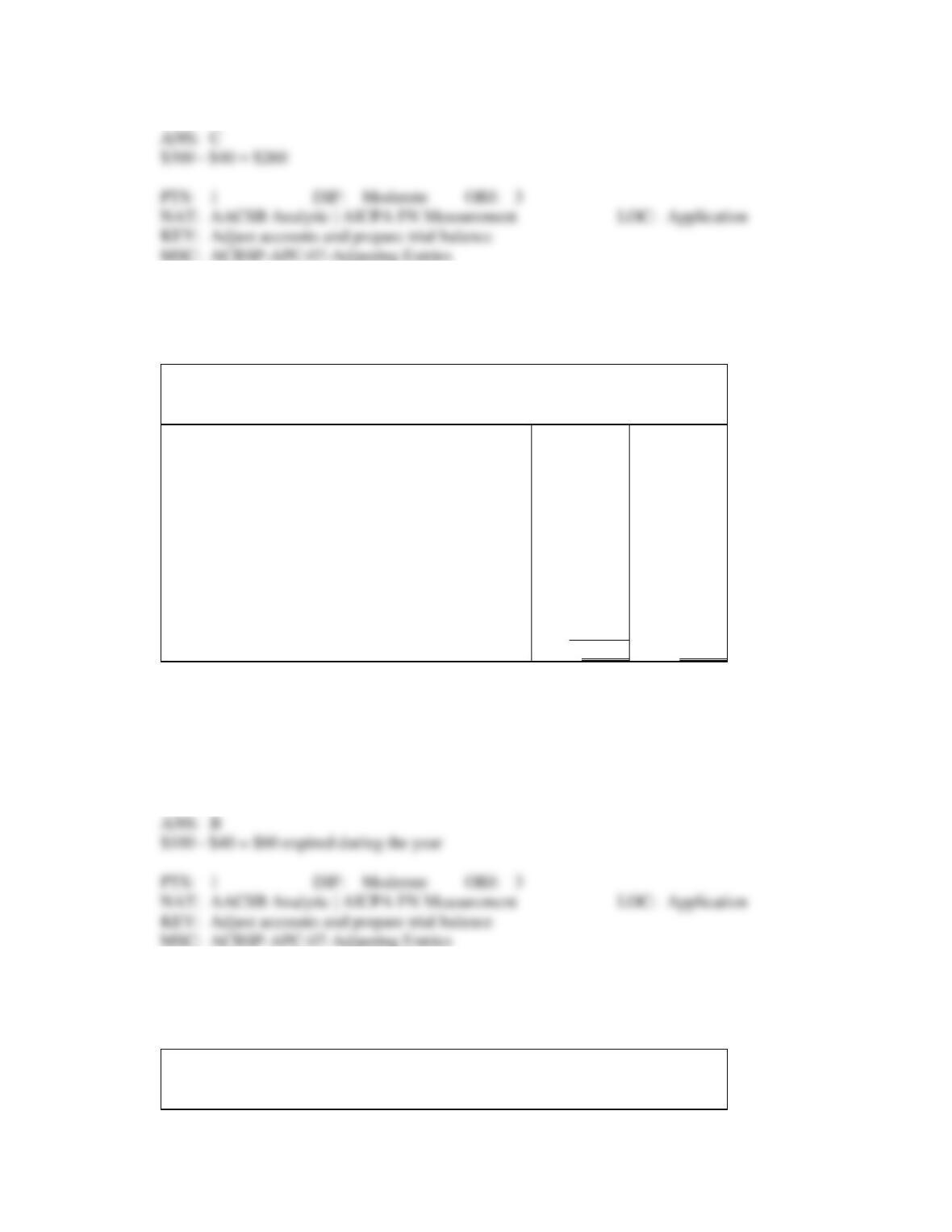
60. Use this information to answer the following question.
The trial balance for Barnstable Corporation appears as follows:
Barnstable Corporation
Trial Balance
December 31, 2013
Cash
$ 400
Accounts Receivable
1,000
Prepaid Insurance
100
Supplies
300
Office Equipment
800
Accumulated Depreciation–Office Equipment
$ 400
Accounts Payable
600
Common Stock
1,200
Service Revenue Earned
1,000
Salaries Expense
200
Rent Expense
400
______
$3,200
$3,200
If on December 31, 2013, supplies on hand were $40, the adjusting entry would contain a
a.
credit to Supplies for $40.
b.
credit to Supplies Expense for $260.
c.
debit to Supplies Expense for $260.
d.
debit to Supplies for $40.
61. Use this information to answer the following question.
The trial balance for Barnstable Corporation appears as follows:
Barnstable Corporation
Trial Balance
December 31, 2013
Cash
$ 400
Accounts Receivable
1,000
Prepaid Insurance
100
Supplies
300
Office Equipment
800
Accumulated Depreciation–Office Equipment
$ 400
Accounts Payable
600
Common Stock
1,200
Service Revenue Earned
1,000
Salaries Expense
200
Rent Expense
400
______
$3,200
$3,200
If on December 31, 2013, the insurance still unexpired amounted to $40, the adjusting entry would
contain a
a.
debit to Prepaid Insurance for $60.
b.
credit to Prepaid Insurance for $60.
c.
debit to Insurance Expense for $40.
d.
credit to Prepaid Insurance for $40.
62. Use this information to answer the following question.
The trial balance for Barnstable Corporation appears as follows:
Barnstable Corporation
Trial Balance
December 31, 2013