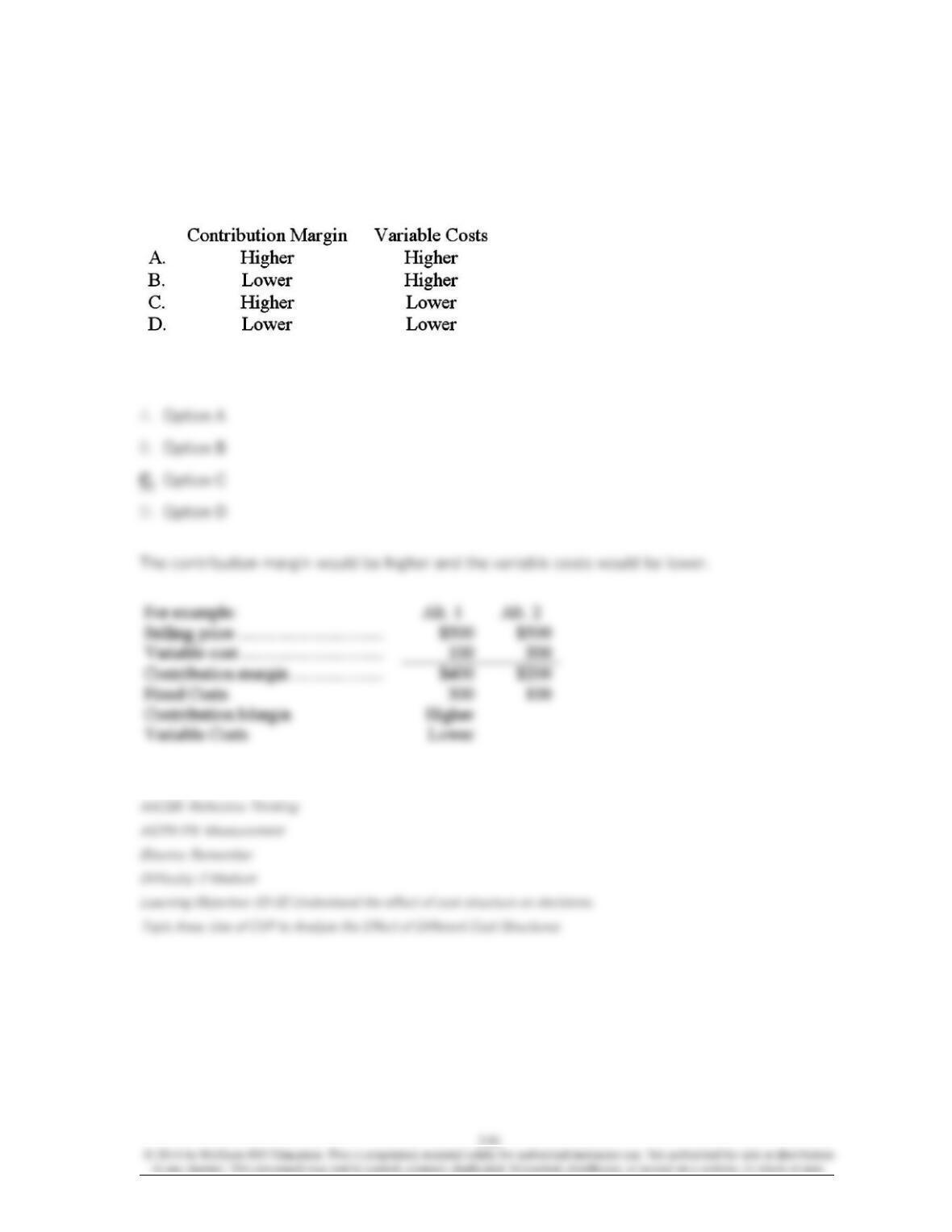
96. All other things the same, which of the following would be true of the contribution margin
and variable costs of a company with high fixed costs and low variable costs as compared to a
company with low fixed costs and high variable costs?
97. James Company has a margin of safety percentage of 20%. The break-even point is
$200,000 and the variable costs are 45% of sales. Given this information, the operating profit is:
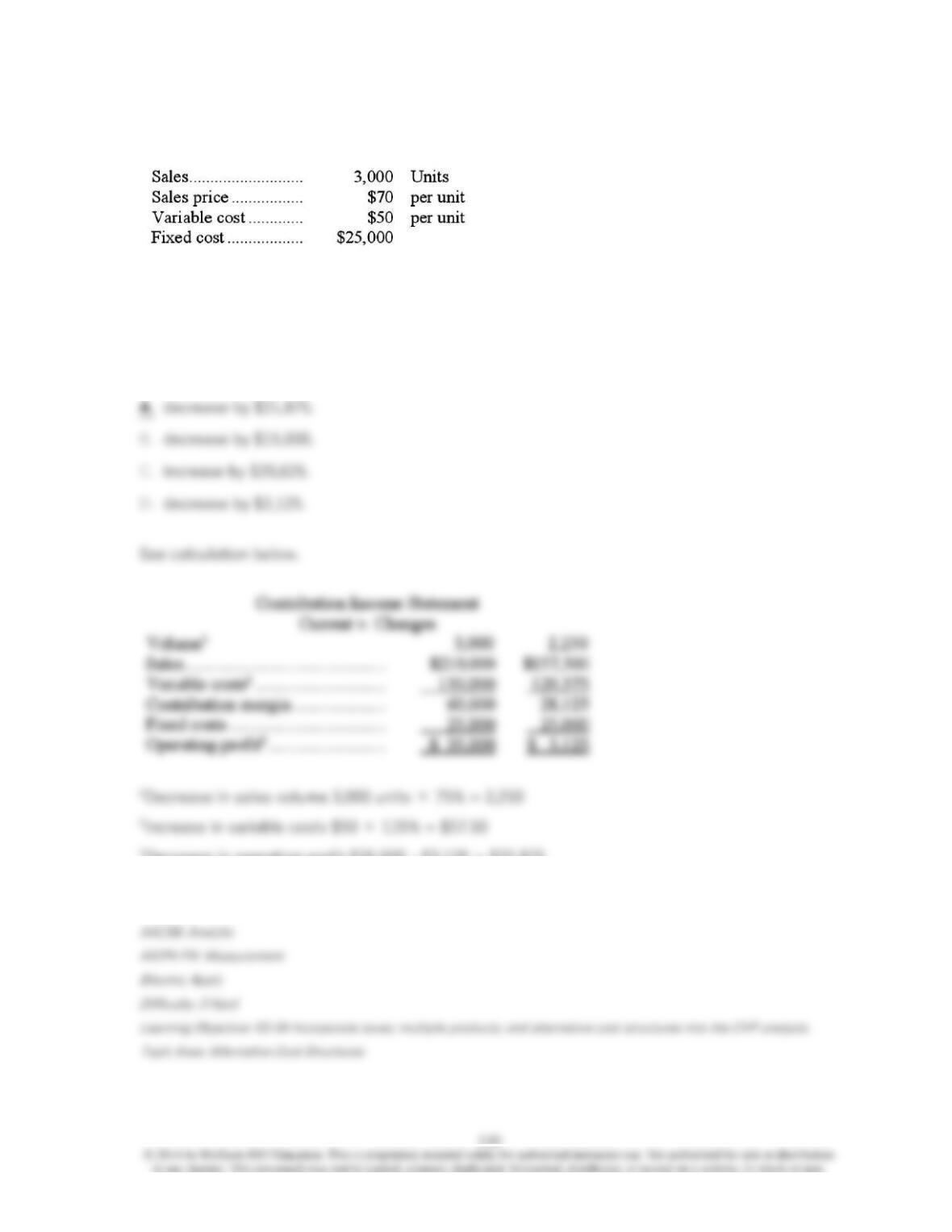
98. A company has provided the following data:
If the sales volume decreases by 25%, the variable cost per unit increases by 15%, and all other
factors remain the same, operating profit will:
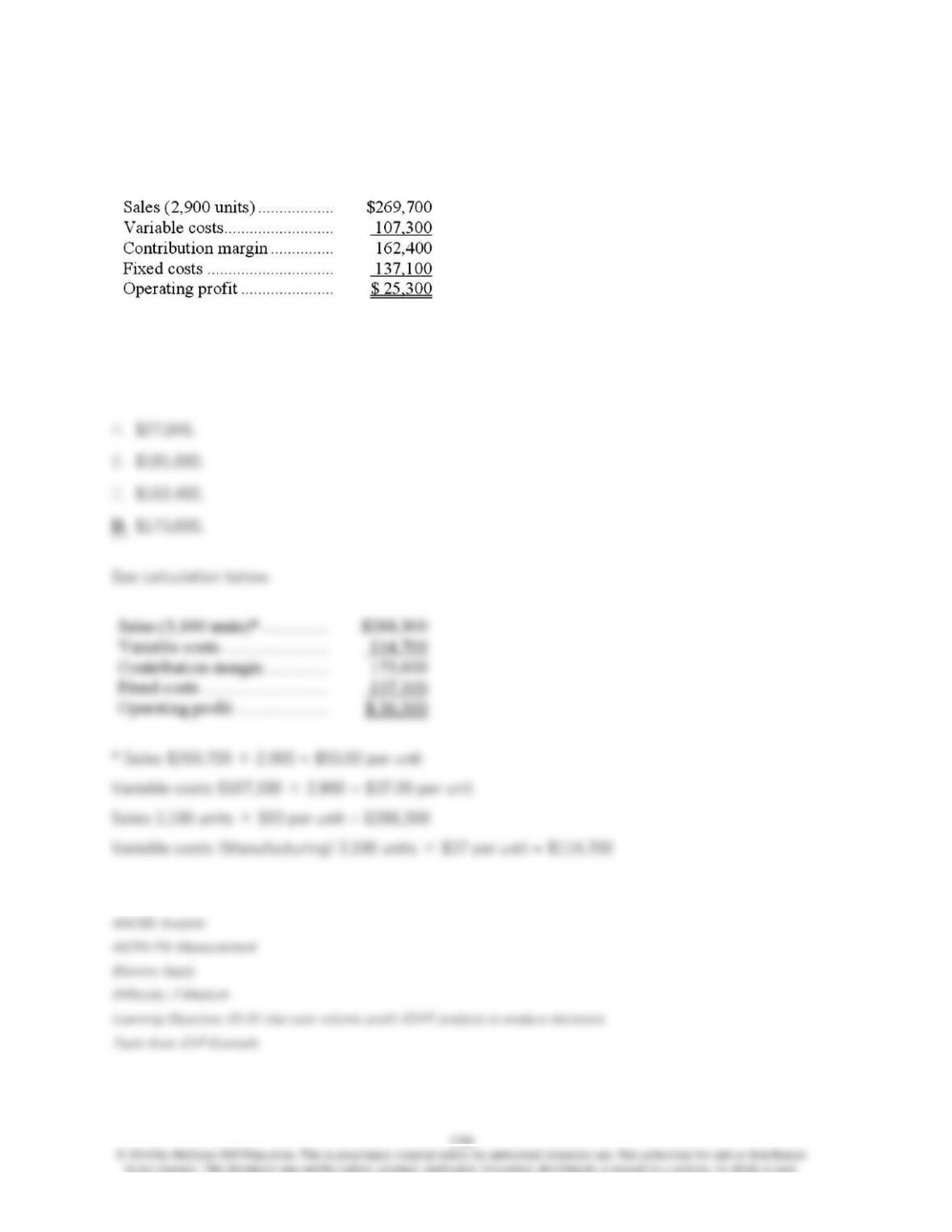
99. Mancuso Corporation has provided its contribution format income statement for January.
The company produces and sells a single product.
If the company sells 3,100 units, its total contribution margin should be closest to:
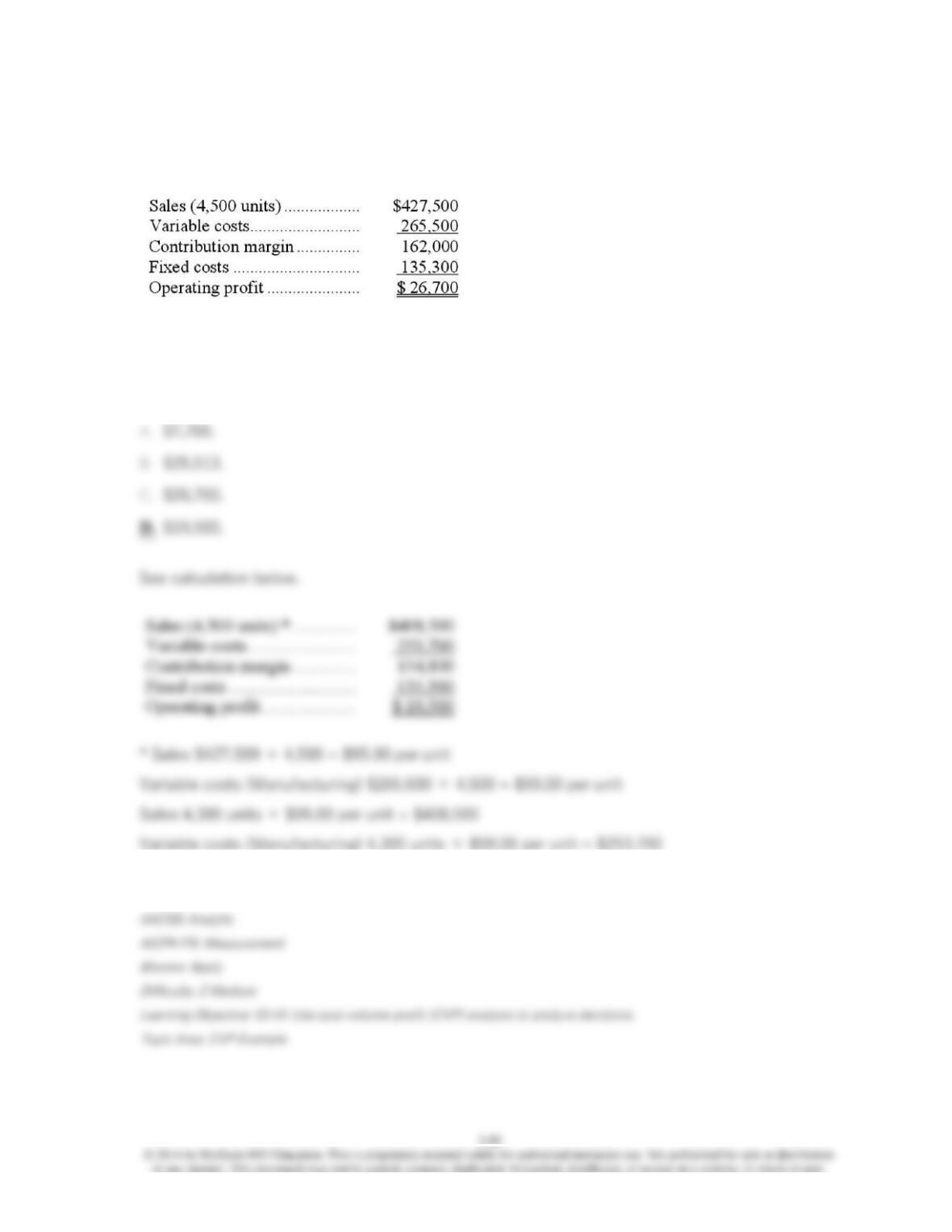
100. Gaudy Inc. produces and sells a single product. The company has provided its
contribution format income statement for May.
If the company sells 4,300 units, its operating profit should be closest to:
101. The contribution margin ratio is 25% for Grain Company and the break-even point in sales
is $200,000. If Grain Company’s target operating profit is $60,000, sales would have to be:
102. Rothe Company manufactures and sells a single product that it sells for $90 per unit and
has a contribution margin ratio of 35%. The company’s fixed costs are $46,800. If Rothe desires a
monthly target operating profit equal to 15% of sales, sales will have to be (rounded):
103. Street Company’s fixed costs total $150,000, its variable cost ratio is 60% and its variable
costs are $4.50 per unit. Based on this information, the break-even point in units is:
104. Turner Company’s contribution margin ratio is 15%. If the degree of operating leverage is
12 at the $150,000 sales level, operating profit at the $150,000 sales level must equal:
3-90
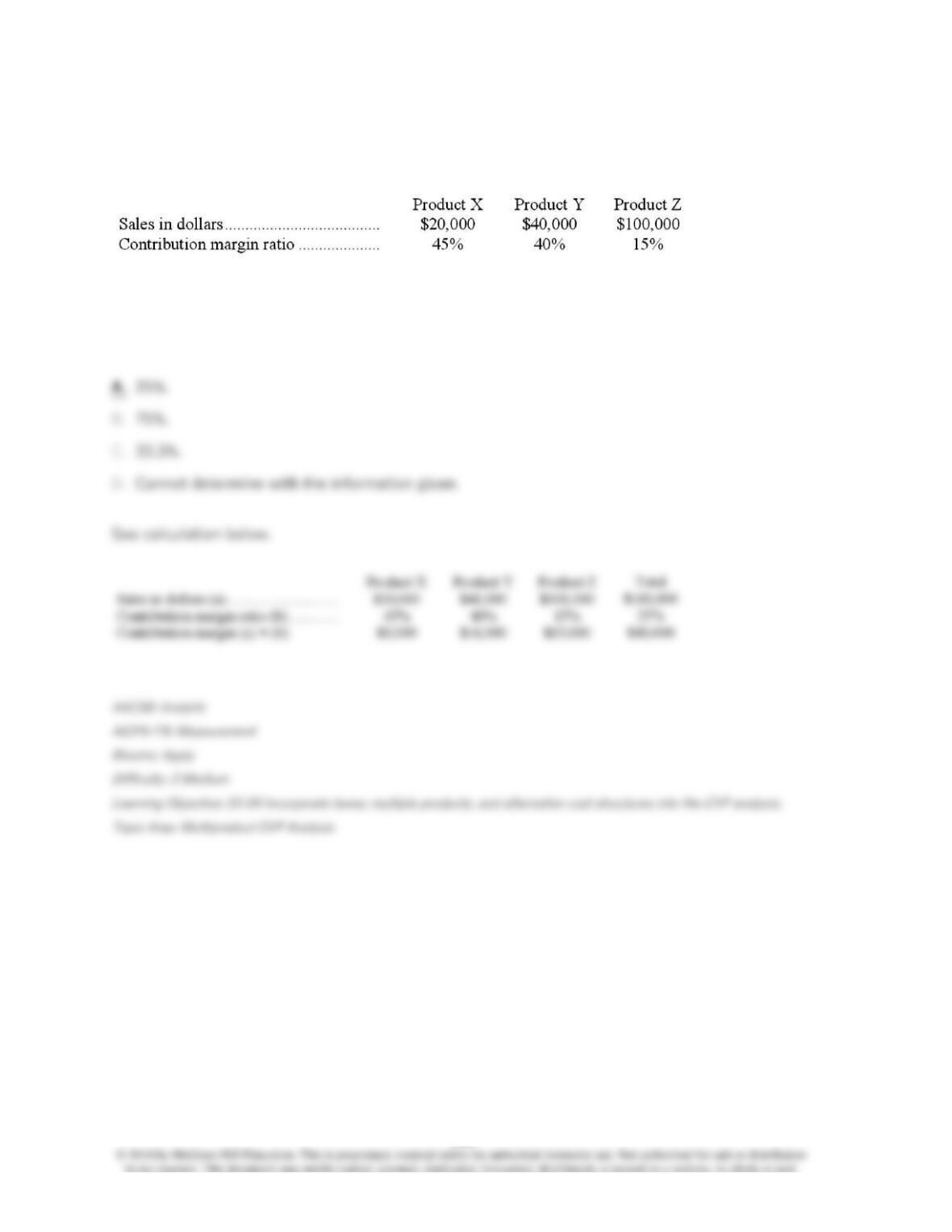
105. Darth Company sells three products. Sales and contribution margin ratios for the three
products follow:
Given these data, the contribution margin ratio for the company as a whole would be:
106. The Katie Corporation has budgeted fixed costs of $125,000 and an estimated selling
price of $16.50 per unit. The contribution margin ratio is 40% and the company plans to sell
25,000 units in 2013.
Required:
(a) Compute the break-even point in dollars.
(b) Compute the margin of safety for 2013.
(c) Compute the expected operating profit for 2013.
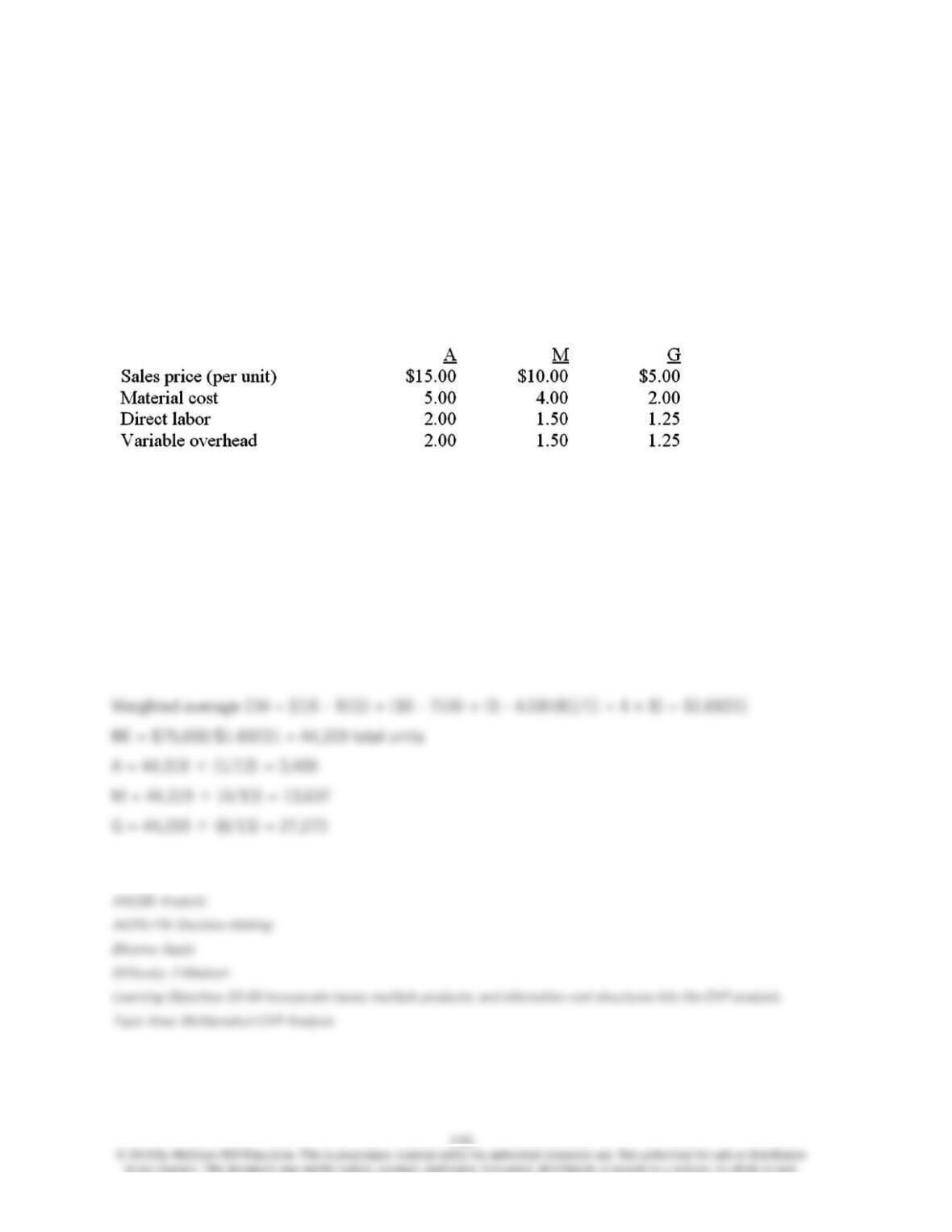
107. The president of AMG Enterprises is considering expanding sales by producing three
different versions of its product. Each will be targeted by the marketing department to different
income levels and, hence, will be produced from three different qualities of materials. After
reviewing the sales forecasts, the sales department feels that for every item of A sold, 4 of M can
be sold, and 8 of G can be sold.
The following information has been assembled by the sales department and the production
department.
The fixed costs associated with the manufacture of these three products are $75,000 per year.
Required:
Determine the number of units of each product that would be sold at the break-even point.
3-93
108. Stanley Clipper, now retired, owns the Campus Barber Shop. He employs five (5) barbers
and pays each a base rate of $500 per month. One of the barbers serves as the manager and
receives an extra $300 per month. In addition to the base rate, each barber also receives a
commission of $3 per haircut. A barber can do as many as 20 haircuts a day, but the average is
14 haircuts per day. The Campus Barber Shop is open 24 days a month. You can safely ignore
income taxes.
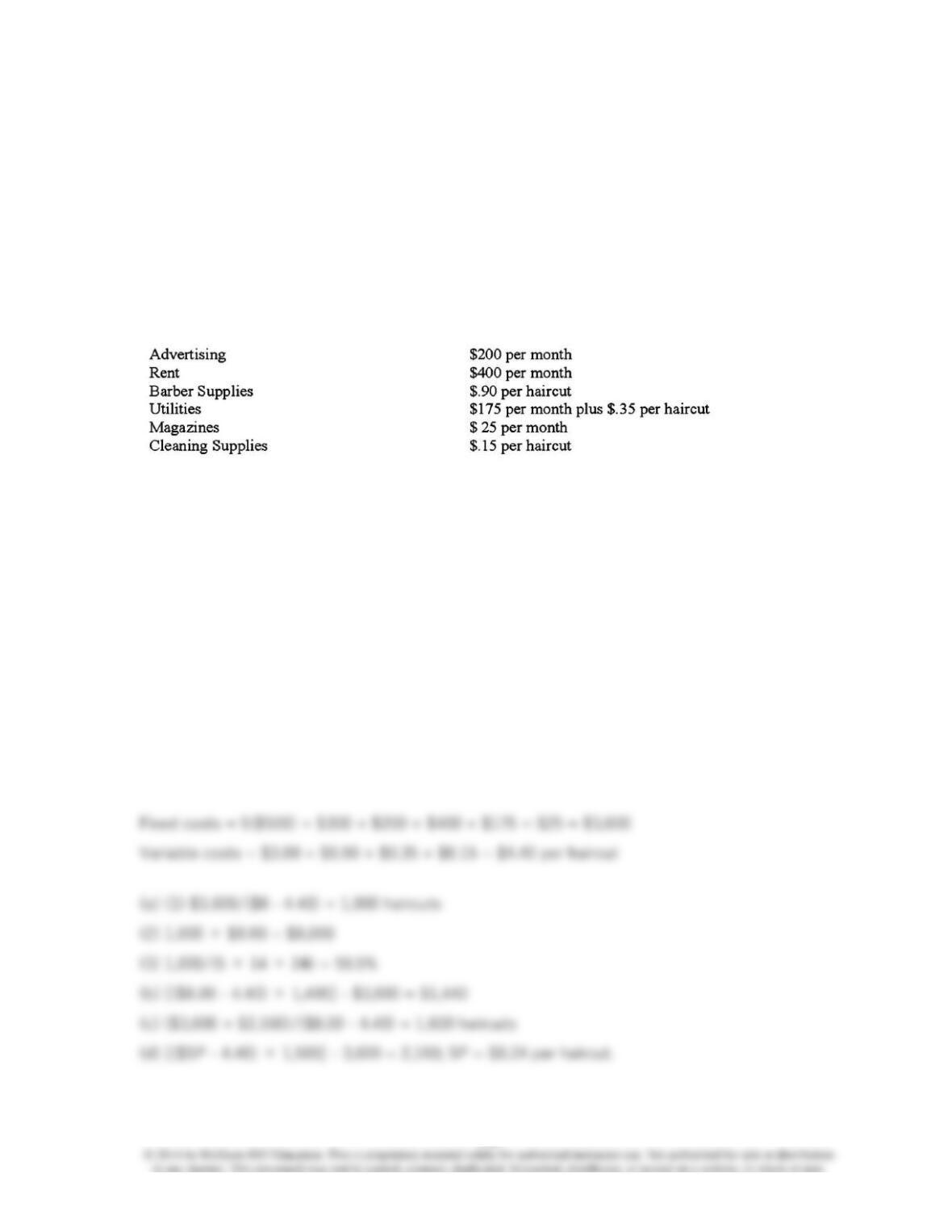
Other costs are incurred as follows:
Stanley currently charges $8 per haircut.
Required:
(a) Compute the break-even point in (1) number of haircuts, (2) total sales dollars, and (3) as a
percentage of capacity.
(b) In March, 1,400 haircuts were given. Compute the operating profits for the month.
(c) Stanley wants a $2,160 operating profits in April. Compute the number of haircuts that must
be given in order to achieve this goal.
(d) If 1,500 haircuts are given in April, compute the selling price that would have to be charged in
order to have $2,160 in operating profits.
3-94
109. Stanley Clipper, now retired, owns the Campus Barber Shop. He employs five (5) barbers
and pays each a base rate of $500 per month. One of the barbers serves as the manager and
receives an extra $300 per month. In addition to the base rate, each barber also receives a
commission of $3 per haircut. A barber can do as many as 20 haircuts a day, but the average is
14 haircuts per day. The Campus Barber Shop is a corporation with a 30% tax rate and is open 24
days a month.
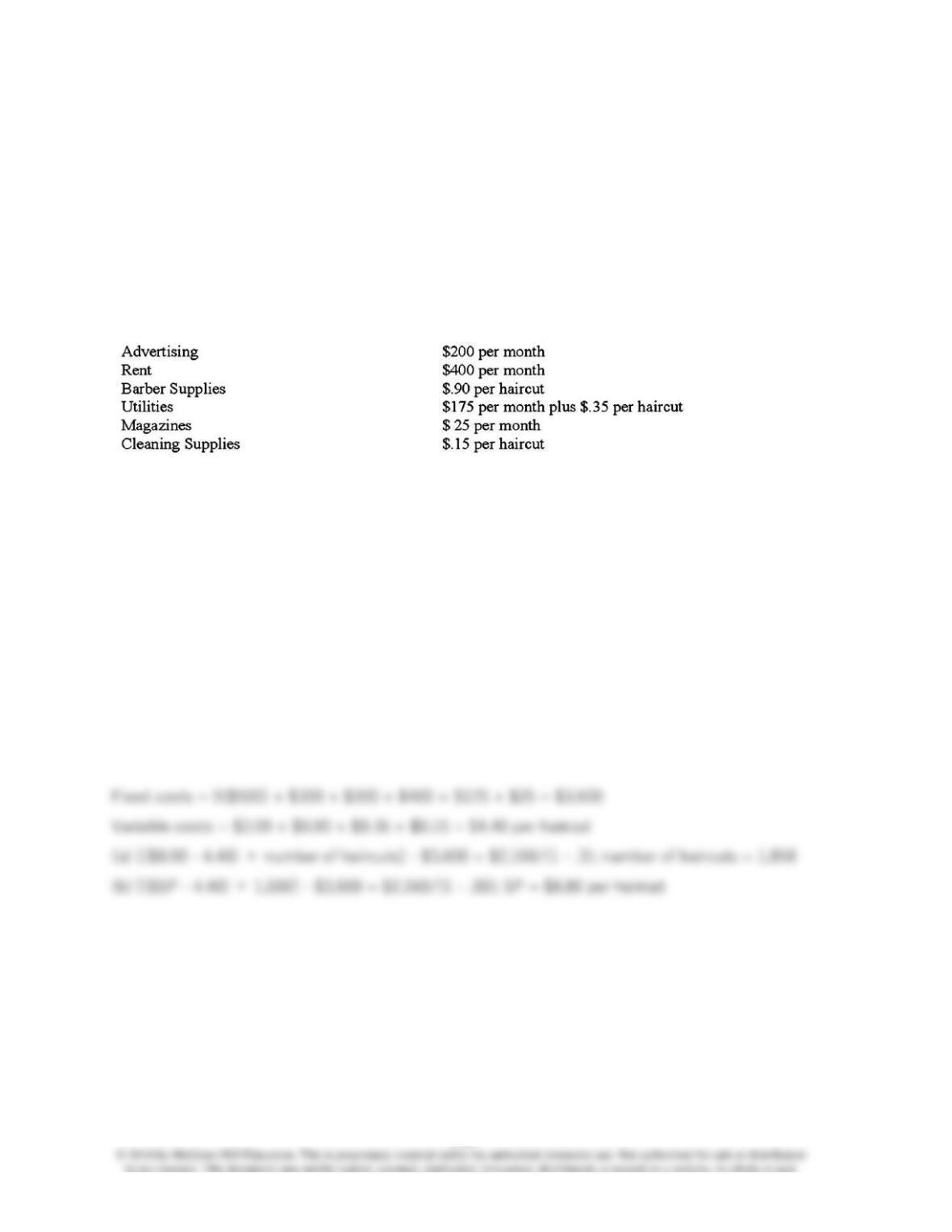
Other costs are incurred as follows:
Stanley currently charges $8 per haircut.
Required:
(a) Stanley wants to earn $2,160 in after-tax operating profits. Compute the number of haircuts
that must be given to reach this goal in July.
(b) In July, only 1,500 haircuts were given. Compute the price per haircut that Stanley should
have charged in July to earn $2,160 in after-tax operating profits.
110. You have been provided with the following information regarding the ALG Manufacturing
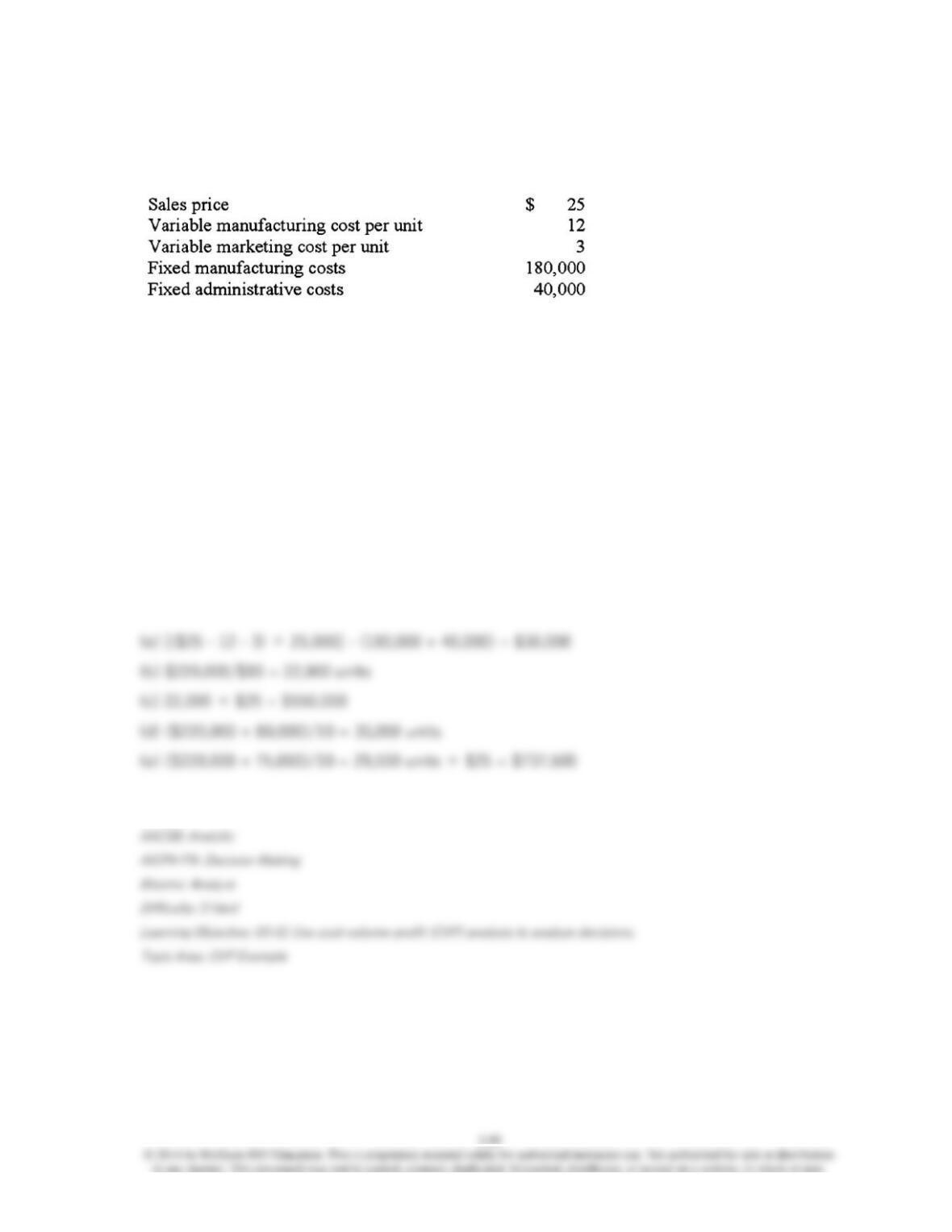
Company:
This information is based on forecasted sales of 25,000 units.
Required:
(a) What are the expected operating profits for the upcoming year?
(b) What is the break-even point in units?
(c) What is the break-even point in dollars?
(d) If $80,000 of operating profits is desired, how many units must be sold?
(e) How much in sales dollars is required to generate operating profits of $75,000?

3-96
111. Almo Company manufactures and sells adjustable canopies that attach to motor homes
and trailers. The market covers both new unit purchases as well as replacement canopies. Almo
developed its 2013 business plan based on the assumption that canopies would sell at a price of
$400 each. The variable costs for each canopy were projected to be $200, and the annual fixed
costs were budgeted at $100,000. The goal for Almo’s after-tax operating profits was $240,000;
the company’s effective tax rate is 40%
While Almo’s sales usually rise during the second quarter, the May financial statements reported
that sales were not meeting expectations. For the first five months of 2013, only 350 units had
been sold at the established price, with variable costs as planned. It was clear that the 2013
after-tax operating profit goal would not be reached unless some corrective actions were taken.
Almo’s president assigned a management committee to analyze the situation and develop several
alternative courses of action. The following mutually exclusive alternatives were presented to the
president:
(1) Reduce the sales price by $40. The sales department predicts that with the significantly
reduced price, 2,700 units can be sold during the remainder of 2013. Total fixed and variable unit
costs will stay as budgeted.
(2) Lower variable costs per unit by $25 through the use of less expensive materials and lightly
modified manufacturing techniques. The sales price will also be reduced by $30. These changes
will yield sales of 2,200 for the remainder of 2013.
(3) Cut fixed costs by $10,000 and lower the sales price by 5%. Variable costs per unit will be
unchanged. Sales of 2,000 units can be expected for the remainder of 2013.
Required:
(a) If no changes are made to the selling price or cost structure, determine the number of units
that Almo must sell in order to break even.
(b) If no changes are made to the selling price or cost structure, determine the number of units
that Almo must sell in order to achieve its after-tax operating profit objective.
(c) Determine which one of the alternatives Almo should select to achieve its after-tax operating
profit objective. Be sure to support your selection with appropriate computations.
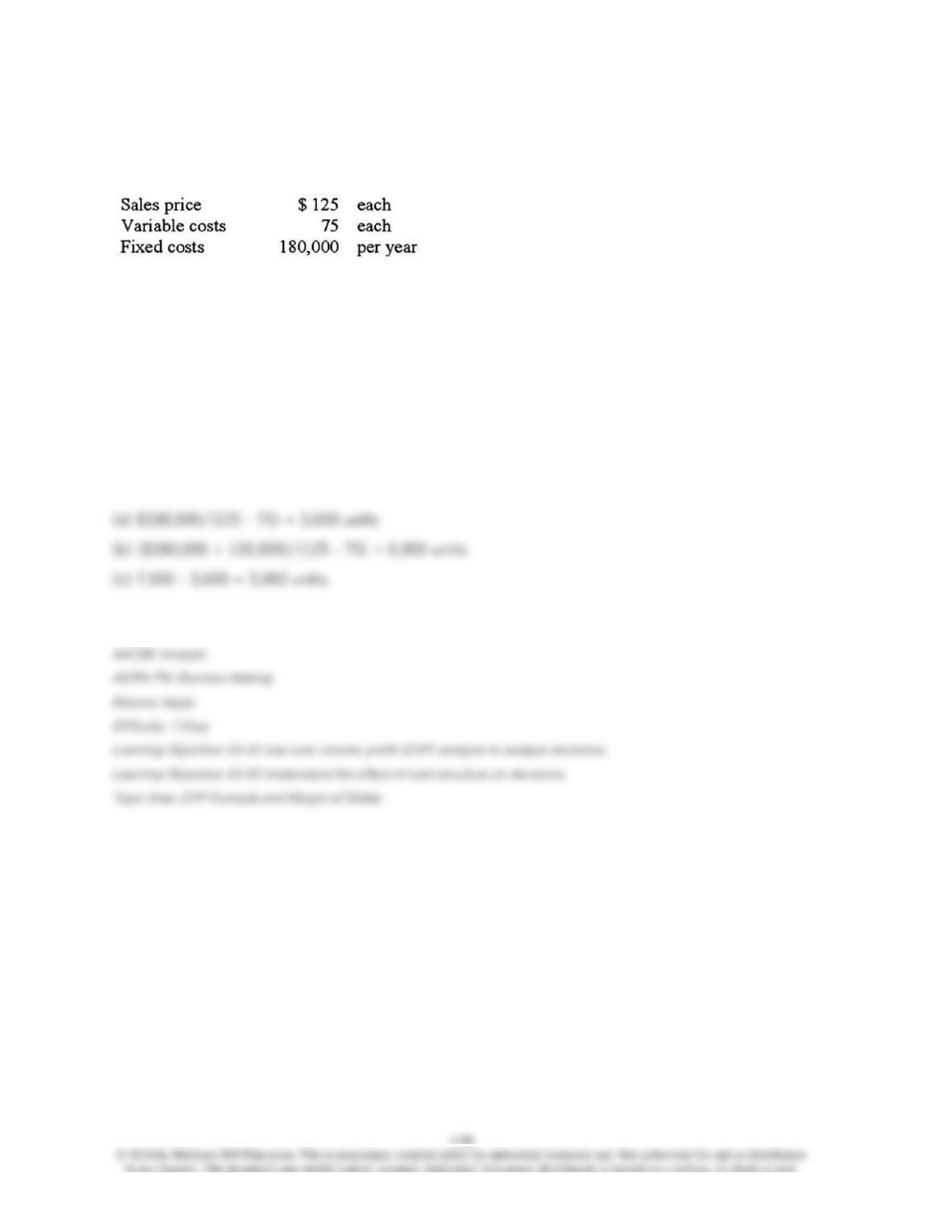
112. T-Tunes, Inc. is considering the introduction of a new music player with the following
price and cost characteristics:
Required:
(a) How many units must T-Tunes sell to break even?
(b) How many units must T-Tunes sell to make an operating profit of $120,000 for the year?
(c) If projected sales are 7,500 units, what is the margin of safety in units?
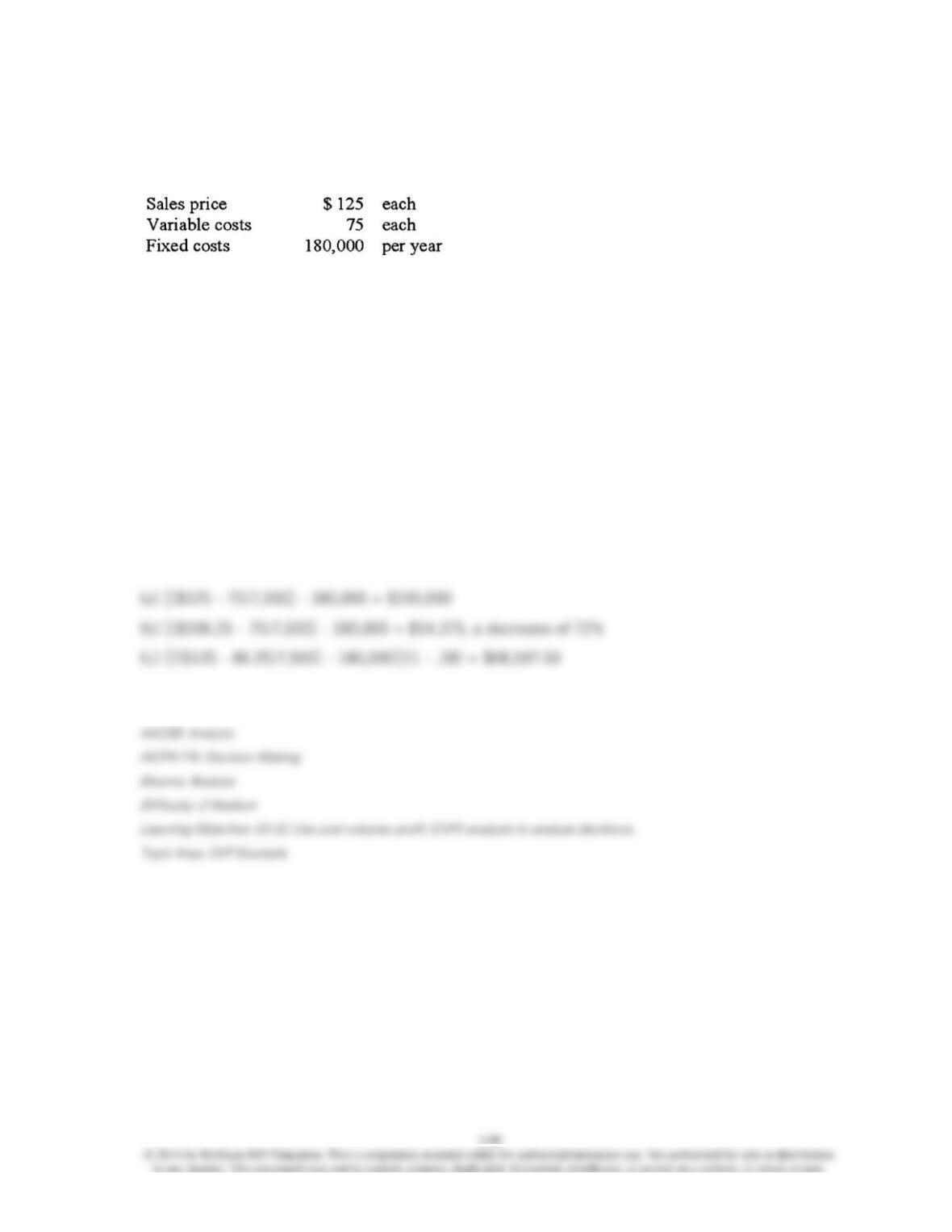
113. Zuma, Inc. is considering the introduction of a new music player with the following price
and cost characteristics:
Projected sales are 7,500 units per year.
Required (consider each question independent of each other):
(a) What will the operating profit be?
(b) What is the impact on operating profit if the selling price per unit decreases by 15%?
(c) What is the net income if variable costs per unit increase by 15% and Zuma has a 38% tax
rate?
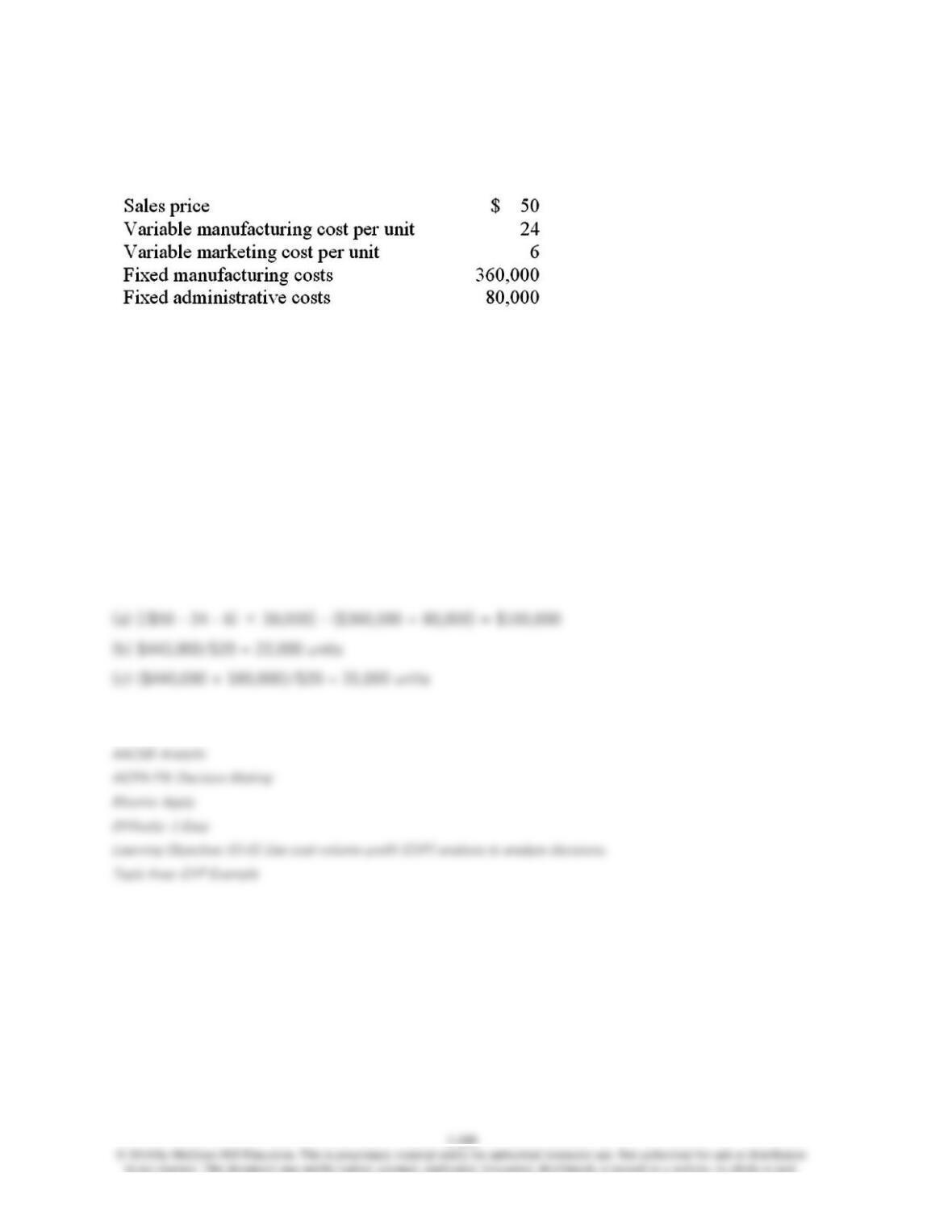
114. You have been provided with the following information regarding the VLCD
Manufacturing Company:
This information is based on forecasted sales of 30,000 units.
Required:
(a) What is the expected operating profit for the upcoming year?
(b) What is the break-even point in units?
(c) If $180,000 of operating profit is desired, how many units must be sold?