48) The following accounts and balances are taken from Brown Company‘s adjusted trial balance:
Accounts Payable
$10,000
Accounts Receivable
3,000
Accumulated Depreciation
1,400
Depreciation Expense
1,500
Dividends
2,400
Insurance Expense
2,300
Interest Revenue
1,240
Prepaid Insurance
2,320
Retained Earnings
10,500
Salary Expense
24,100
Service Revenue
37,800
After the closing entries are posted, what is the balance of Retained Earnings? Show your
computations.
Retained earnings, beginning balance
Add: Net income
Subtotal
Less: Dividends
Retained earnings, ending balance
Revenue:
Service revenue
Interest revenue
Less Expenses:
Depreciation
Insurance
Salary
Net income
6 Learning Objective 3-6
1) To analyze a company’s financial position, decision makers use data and ratios computed from
various items in the financial statements.
2) A current ratio of less than 1.0 means that current assets exceed current liabilities.
3) A low debt ratio is safer than a high debt ratio because a company with few liabilities has low
required debt payments.
4) The managers of a company are concerned about how certain transactions will affect ratios used in
loan agreements.
5) Generally to be considered sufficiently liquid, entities should have a sufficient excess of current
liabilities over current assets.
6) A loan agreement may require that a company’s current ratio not fall below a certain level and/or that
the company’s debt ratio may not rise above a threshold.
7) Net working capital:
A) represents the company’s ability to pay its long-term debts.
B) is computed by subtracting total current liabilities from total current assets.
C) should be a negative number to ensure the profitability of the company.
D) should be the same for all companies.
8) As a rule of thumb, a strong current ratio is:
A) 1.0.
B) .50.
C) 1.5.
D) none of the above.
9) A measure of a company’s ability to pay current liabilities with current assets is the:
A) liability ratio.
B) current ratio.
C) debt ratio.
D) asset ratio.
10) When analyzing a company’s current ratio:
A) the current ratio measures the company‘s ability to pay all liabilities with current assets.
B) most successful businesses operate with current ratios between 0.1 and 0.5.
C) a current ratio of less than 1.00 means that current liabilities exceed current assets.
D) the industry in which the company operates should not be considered.
11) When analyzing a company’s debt ratio:
A) the ratio measures a company’s ability to pay its total liabilities.
B) the ratio indicates the proportion of a company’s assets that are financed with stockholders’ equity.
C) a high debt ratio is better than a low debt ratio.
D) the norm for debt ratios ranges from 80% to 90%.
12) The debt ratio is computed by dividing:
A) total liabilities by total assets.
B) current liabilities by total assets.
C) total assets by total liabilities.
D) total assets by current liabilities.
13) Which of the following combinations of ratios is preferable?
A) a low current ratio and a high debt ratio
B) a high current ratio and a low debt ratio
C) a low current ratio and a low debt ratio
D) a high current ratio and a high debt ratio
14) To help keep debt ratios within normal limits, companies might adopt the following strategy:
A) decrease revenues.
B) sell stock.
C) choose to borrow more money.
D) increase costs.
15) A company has current assets of $76,000, long-term assets of $150,000, current liabilities of $43,000,
and long-term liabilities of $35,000. The current ratio is:
A) 0.79.
B) 3.40.
C) 1.77.
D) 2.17.
16) Brankov Company has current assets of $95,000 and current liabilities of $110,000. The company
decides to issue stock and receives cash of $100,000. After this transaction, the company’s current ratio
will be: (Round your final answer to two decimal places.)
A) 0.86.
B) 0.91.
C) 1.86.
D) 1.77.
17) At the beginning of the year, Butters Company’s balance sheet showed current assets of $35,000 and
current liabilities of $23,000. During the current year, Butters issued common stock for $4900 for cash
and purchased $2800 of inventory on account. After these transactions were recorded, Butter’s current
ratio was: (Round your final answer to two decimal places.)
A) 1.51.
B) 1.55.
C) 1.66.
D) 1.52.
18) A company has current assets of $85,000 and current liabilities of $35,000. A $5000 sale on account
was made. After this transaction, its current ratio will be: (Round your final answer to two decimal
places.)
A) 0.41.
B) 2.29.
C) 2.43.
D) 2.57.
19) Rosewood Company had current assets of $592, current liabilities of $453, total assets of $702, and
long-term liabilities of $200. What is Rosewood’s debt ratio? (Round your final answer to two decimal
places.)
A) 0.65
B) 1.31
C) 0.93
D) 0.28
20) Dooley Company had current assets of $1592, current liabilities of $1423, total assets of $1692, and
long-term liabilities of $1210. If Dooley acquires inventory by executing a six–month note for $1500,
what is the new current ratio? (Round your final answer to two decimal places.)
A) 1.12
B) 1.06
C) 0.95
D) 2.17
21) Flanders Company has total assets of $400,000 and total liabilities of $270,000. The company collects
an account receivable of $20,000. After this transaction, the company’s debt ratio will be: (Round your
final answer to two decimal places.)
A) 0.64.
B) 0.68.
C) 0.63.
D) 1.48.
22) A company’s current ratio is decreasing every year and currently stands at 1.00. This indicates:
A) an improving financial position.
B) an improving liquidity position.
C) a declining ability to pay current liabilities.
D) an increase in profitability.
23) A company’s debt ratio is increasing every year and currently stands at 90%. This indicates:
A) an improving financial position.
B) an increase in financial risk.
C) a greater ability to pay current and long-term liabilities.
D) a company that is going bankrupt.
24) Sendik’s Food Store has the following Adjusted Trial Balance as of March 31, 2017. Determine the
current ratio. Round your answer to two decimal places.
Account
Debit
Credit
Cash
$5,000
Short-Term Investments
5,500
Accounts Receivable
3,800
Inventory
3,000
Supplies
3,400
Land
28,000
Building
50,000
Accumulated Depreciation — Building
$10,000
Store Equipment
27,000
Accumulated Depreciation — Store Equipment
15,625
Accounts Payable
9,000
Notes Payable due in one year
4,500
Salaries Payable
1,000
Income Tax Payable
12,000
Common Stock
31,655
Retained Earnings
4,920
Revenue
63,000
Rent Expense
7,000
Salaries Expense
14,000
Depreciation Expense — Building
3,500
Depreciation Expense — Store Equipment
1,500
________
TOTALS
$151,700
$151,700
25) Lori’s Bath Supplies has the following Adjusted Trial Balance as of March 31, 2017. Determine the
debt ratio. Round your answer to four decimal places.
Account
Debit
Credit
Cash
$10,500
Accounts Receivable
3,800
Inventory
3,000
Store Supplies
1,900
Prepaid Insurance
1,500
Land
28,000
Building
50,000
Accumulated Depreciation—Building
$10,000
Store Equipment
27,000
Accumulated Depreciation—Store Equipment
15,625
Accounts Payable
9,000
Notes Payable due in one year
4,500
Salaries Payable
1,000
Income Tax Payable
12,000
Common Stock
31,655
Retained Earnings
4,920
Revenue
63,000
Rent Expense
7,000
Salaries Expense
14,000
Depreciation Expense—Building
3,500
Depreciation Expense—Store Equipment
1,500
________
TOTALS
$151,700
$151,700
26) List three groups of financial statement users and comment on how each group uses net working
capital and the current ratio for decision making.
27) Selected information for Greene, Inc., as of December 31, 2017, follows:
Total current
assets
$80,000
Total assets
$175,000
Total current
liabilities
$60,000
Total liabilities
$125,000
Compute (show all computations and round final answers to two decimal places):
a. Net working capital
b. Current ratio
c. Debt ratio
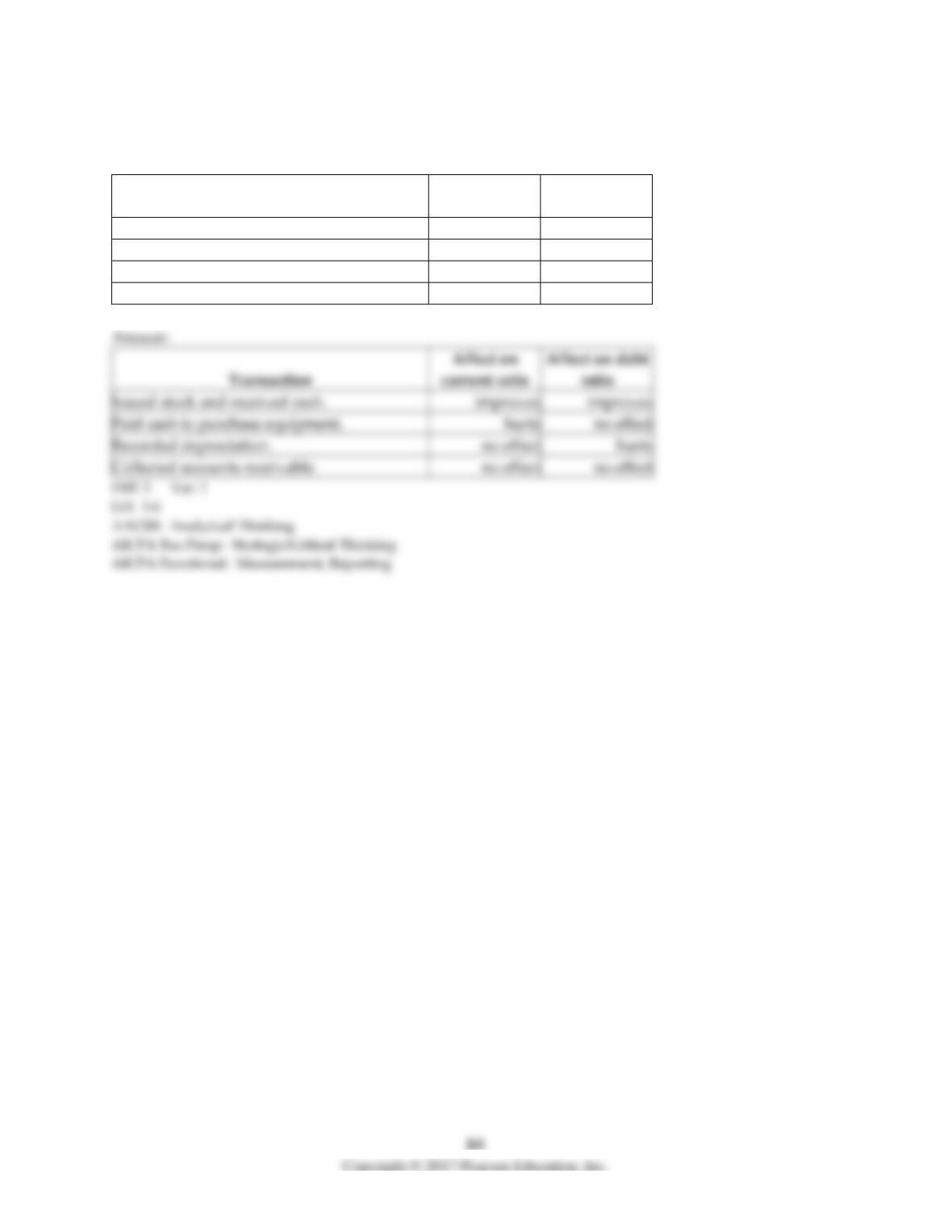
28) State whether each of the following transactions improves, hurts, or has no effect the current ratio
and debt ratio.
Transaction
Affect on
current ratio
Affect on debt
ratio
Issued stock and received cash.
Paid cash to purchase equipment.
Recorded depreciation.
Collected accounts receivable
Affect on
Affect on debt
Issued stock and received cash.
Paid cash to purchase equipment.
Recorded depreciation.
Collected accounts receivable