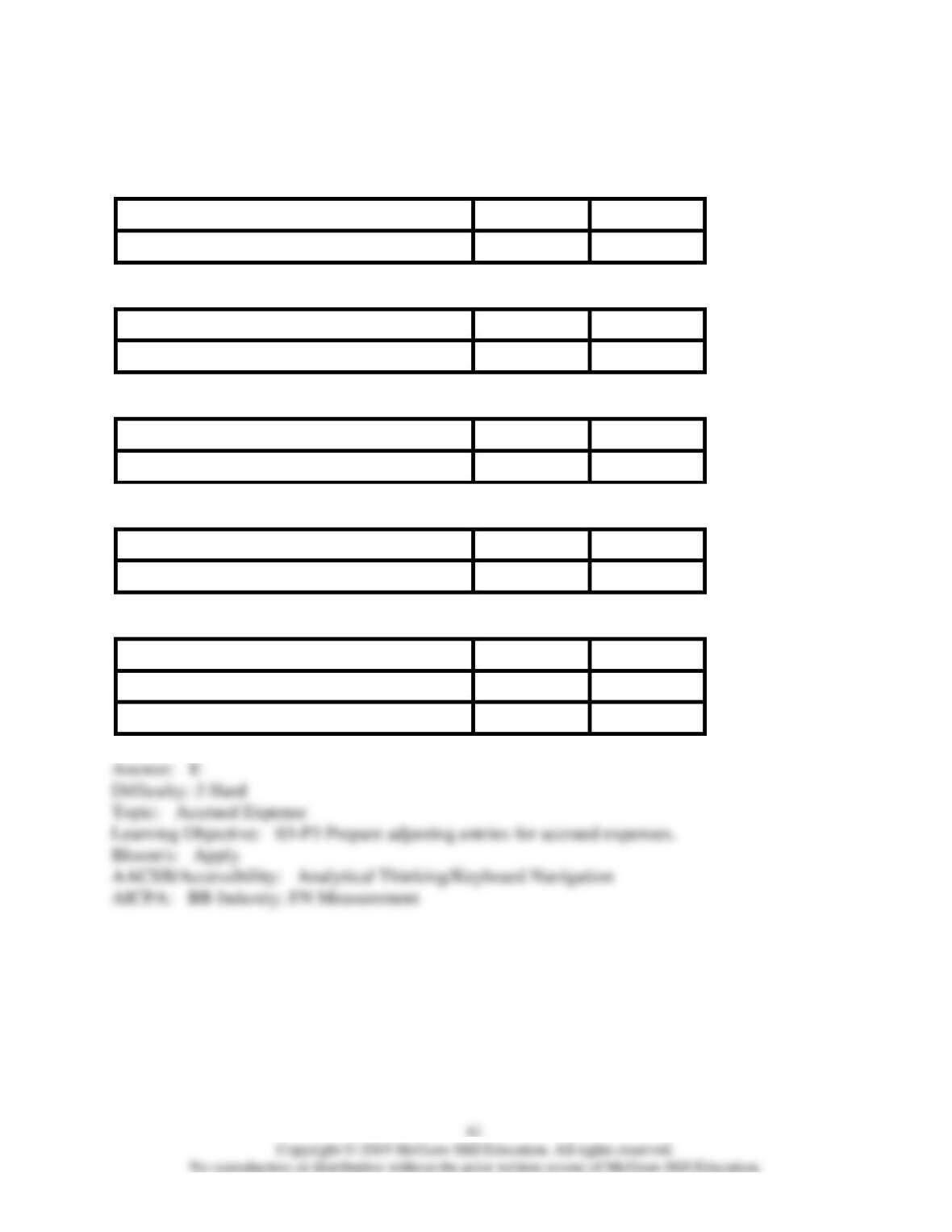
185) An adjusting entry was made on year-end December 31 to accrue salary expense of $1,200.
Assuming the company does not prepare reversing entries, which of the following entries would
be prepared to record the $3,000 payment of salaries in January of the following year?
A)
Salaries Expense
3,000
Cash
3,000
B)
Salaries Payable
3,000
Cash
3,000
C)
Salaries Payable
1,200
Cash
1,200
D)
Salaries Expense
1,200
Salaries Payable
1,200
E)
Salaries Payable
1,200
Salaries Expense
1,800
Cash
3,000
186) The difference between the cost of an asset and the accumulated depreciation for that asset
is called
A) Depreciation Expense.
B) Unearned Depreciation.
C) Prepaid Depreciation.
D) Depreciation Value.
E) Book Value.
187) A company purchased a new delivery van at a cost of $45,000 on July 1. The delivery van
is estimated to have a useful life of 6 years and a salvage value of $3,000. The company uses the
straight-line method of depreciation. How much depreciation expense will be recorded for the
van during the first year ended December 31?
A) $3,250.
B) $3,500.
C) $4,000.
D) $6,500.
E) $7,000.
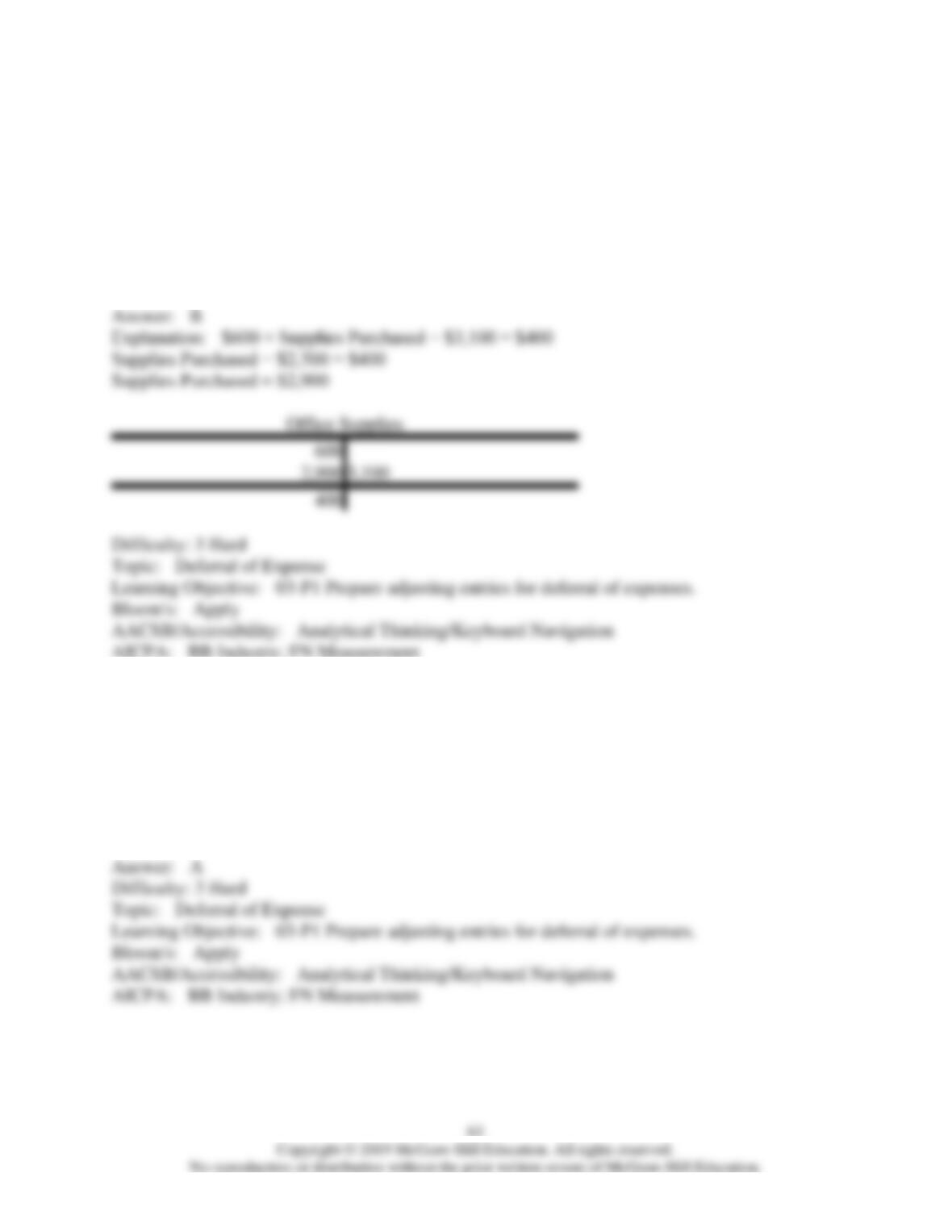
188) A company’s Office Supplies account shows a beginning balance of $600 and an ending
balance of $400. If office supplies expense for the year is $3,100, what amount of office supplies
was purchased during the period?
A) $2,700.
B) $2,900.
C) $3,300.
D) $3,500.
E) $3,700.
189) If a company records prepayment of expenses in an asset account, the adjusting entry when
all or part of the prepaid asset is used or expired would:
A) Result in a debit to an expense and a credit to an asset account.
B) Cause an adjustment to prior expense to be overstated and assets to be understated.
C) Cause an accrued liability account to exist.
D) Result in a debit to a liability and a credit to an asset account.
E) Decrease cash.
64
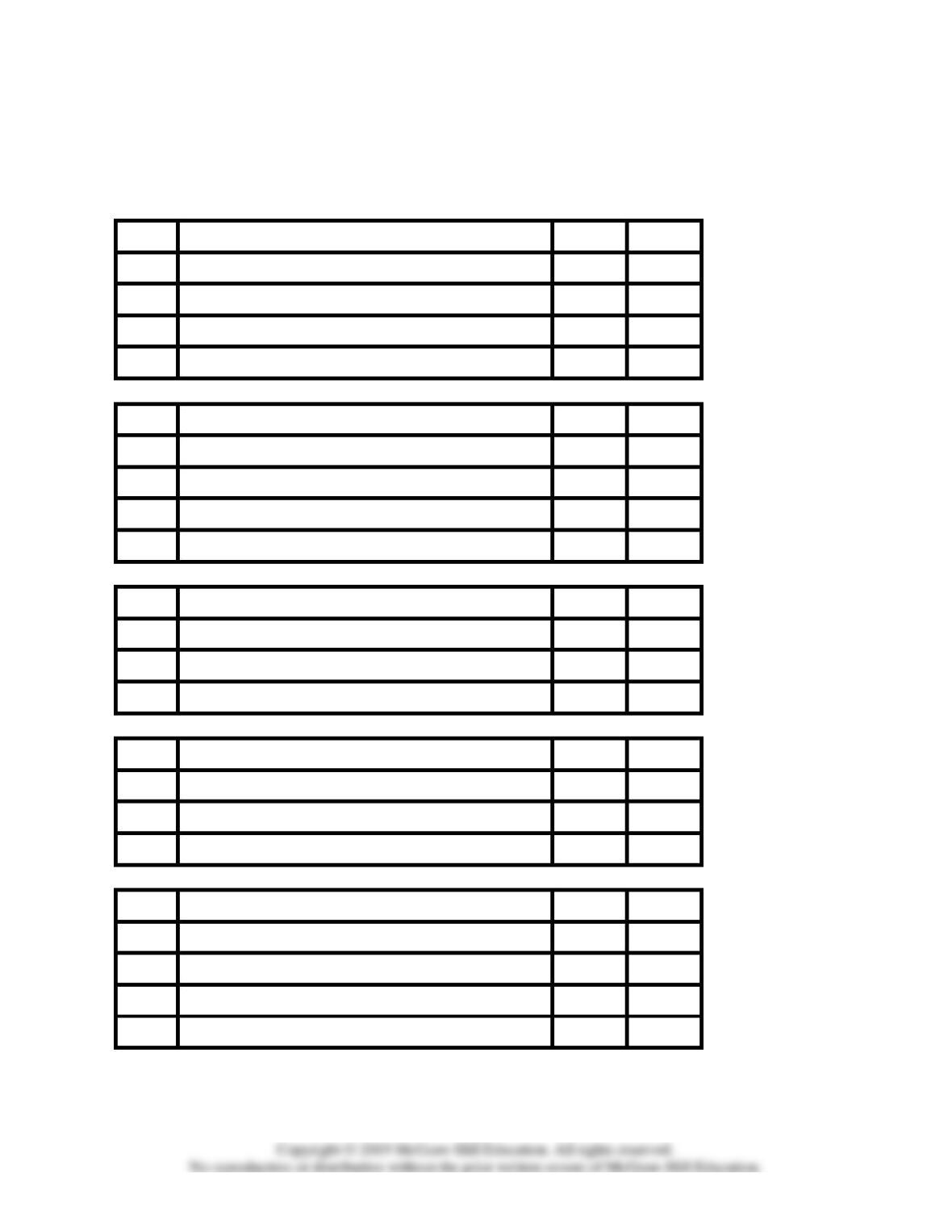
190) A company recorded 2 days of accrued salaries of $1,400 for its employees on January 31.
On February 9, it paid its employees $7,000 for these accrued salaries and for other salaries
earned through February 9. Assuming the company does not prepare reversing entries, the
January 31 and February 9 journal entries are:
A)
1/31
Salaries Expense
1,400
Salaries Payable
1,400
2/9
Salaries Payable
7,000
Salaries Expense
1,400
Cash
8,400
B)
1/31
Salaries Payable
1,400
Salaries Expense
1,400
2/9
Salaries Expense
5,600
Salaries Payable
1,400
Cash
7,000
C)
1/31
Salaries Expense
1,400
Cash
1,400
2/9
Salaries Expense
7,000
Cash
7,000
D)
1/31
Salaries Expense
1,400
Salaries Payable
1,400
2/9
Salaries Expense
7,000
Cash
7,000
E)
1/31
Salaries Expense
1,400
Salaries Payable
1,400
2/9
Salaries Expense
5,600
Salaries Payable
1,400
Cash
7,000
191) If accrued salaries were recorded on December 31 with a debit to Salaries Expense and a
credit to Salaries Payable, and no reversing entries were made on January 1, the entry to record
payment of these wages on the following January 5 would include:
A) A debit to Cash and a credit to Salaries Payable.
B) A debit to Cash and a credit to Prepaid Salaries.
C) A debit to Salaries Payable and a credit to Cash.
D) A debit to Salaries Payable and a credit to Salaries Expense.
E) No entry would be necessary on January 5.
192) On December 1, Orenthal Marketing Company received $3,600 from a customer for a 2-
month marketing plan to be completed January 31 of the following year. The cash receipt was
recorded as unearned fees. The adjusting entry for the year ended December 31 would include:
A) a debit to Earned Fees for $3,600.
B) a debit to Unearned Fees for $1,800.
C) a credit to Unearned Fees for $1,800.
D) a debit to Earned Fees for $1,800.
E) a credit to Earned Fees for $3,600.
193) Harrod Company paid $4,800 for a 4-month insurance premium in advance on November 1,
with coverage beginning on that date. The balance in the prepaid insurance account before
adjustment at the end of the year is $4,800 and no adjustments had been made previously. The
adjusting entry required on December 31 is:
A) Debit Insurance Expense, $2,400; credit Prepaid Insurance, $2,400.
B) Debit Prepaid Insurance, $2,400; credit Insurance Expense, $2,400.
C) Debit Insurance Expense, $1,200; credit Prepaid Insurance, $1,200.
D) Debit Prepaid Insurance, $1,200; credit Insurance Expense, $1,200.
E) Debit Cash, $4,800; Credit Prepaid Insurance, $4,800.
194) What is the proper adjusting entry at December 31, the end of the accounting period, if the
balance in the prepaid insurance account is $7,750 before adjustment, and the unexpired amount
per analysis of policies is $3,250?
A) Debit Insurance Expense, $3,250; credit Prepaid Insurance, $3,250.
B) Debit Insurance Expense, $4,500; credit Prepaid Insurance, $4,500.
C) Debit Prepaid Insurance, $4,500; credit Insurance Expense, $4,500.
D) Debit Insurance Expense, $7,750; credit Prepaid Insurance, $7,750.
E) Debit Cash, $7,750; Credit Prepaid Insurance, $7,750.
195) On April 1, Garcia Publishing Company received $1,548 from Otisco, Inc. for 36-month
subscriptions to several different magazines. The subscriptions started immediately. What is the
amount of revenue that should be recorded by Otisco Publishing Company for the first year of
the subscription assuming the company uses a calendar-year reporting period?
A) $0.
B) $516.
C) $387.
D) $129.
E) $430.
196) On April 1, Garcia Publishing Company received $1,548 from Otisco, Inc. for 36-month
subscriptions to several different magazines. The subscriptions started immediately. What is the
amount of revenue that should be recorded by Garcia Publishing Company for the second year of
the subscription assuming the company uses a calendar-year reporting period?
A) $0
B) $516.
C) $387.
D) $129.
E) $430.
197) On April 1, Garcia Publishing Company received $1,548 from Otisco, Inc. for 36-month
subscriptions to several different magazines. The company credited Unearned Fees for the
amount received and the subscriptions started immediately. Assuming adjustments are only made
at year-end, What is the adjusting entry that should be recorded by Garcia Publishing Company
on December 31 of the first year?
A) debit Unearned Fees, $1,548; credit Fees Earned, $1,548.
B) debit Unearned Fees, $516; credit Fees Earned, $516.
C) debit Unearned Fees, $1,161; credit Fees Earned, $1,161.
D) debit Unearned Fees, $129; credit Fees Earned, $129.
E) debit Unearned Fees, $387; credit Fees Earned, $387.
198) On April 1, Garcia Publishing Company received $1,548 from Otisco, Inc. for 36-month
subscriptions to several different magazines. The company credited Unearned Fees for the
amount received and the subscriptions started immediately. Assuming adjustments are only made
at year-end, What is the adjusting entry that should be recorded by Garcia Publishing Company
on December 31 of the second year?
A) debit Unearned Fees, $1,548; credit Fees Earned, $1,548.
B) debit Unearned Fees, $516; credit Fees Earned, $516.
C) debit Unearned Fees, $1,161; credit Fees Earned, $1,161.
D) debit Unearned Fees, $129; credit Fees Earned, $129.
E) debit Unearned Fees, $387; credit Fees Earned, $387.
199) On April 1, Otisco, Inc. paid Garcia Publishing Company $1,548 for 36-month
subscriptions to several different magazines. Otisco debited the prepayment to a Prepaid
Subscriptions account, and the subscriptions started immediately. What amount should appear in
the Prepaid Subscription account for Otisco, Inc. after adjustments on December 31 of the first
year assuming the company is using a calendar-year reporting period and no previous adjustment
has been made?
A) $1,548.
B) $387.
C) $516.
D) $1,161.
E) $0.
200) On April 1, Otisco, Inc. paid Garcia Publishing Company $1,548 for 36-month
subscriptions to several different magazines. Otisco debited the prepayment to a Prepaid
Subscriptions account, and the subscriptions started immediately. What amount should appear in
the Prepaid Subscription account for Otisco, Inc. after adjustments on December 31 of the
second year assuming the company is using a calendar-year reporting period and the previous
year adjustment had been made?
A) $1,548.
B) $387.
C) $516.
D) $645.
E) $0.
201) On April 1, Otisco, Inc. paid Garcia Publishing Company $1,548 for 36-month
subscriptions to several different magazines. Otisco debited the prepayment to a Prepaid
Subscriptions account, and the subscriptions started immediately. What adjusting entry should be
made by Otisco, Inc. for the adjustment on December 31 of the first year assuming the company
is using a calendar-year reporting period and no previous adjustments had been made?
A) Debit Subscription Expense $516 and credit Prepaid Subscriptions $516.
B) Debit Prepaid Subscriptions $516 and credit Subscription Expense $516.
C) Debit Subscription Expense $387 and credit Cash $387.
D) Debit Unearned Subscriptions $387 and credit Subscription Expense $387.
E) Debit Subscription Expense $387 and credit Prepaid Subscriptions $387.
202) A company made no adjusting entry for accrued and unpaid employee salaries of $9,000 on
December 31. Which of the following statements is true?
A) It will have no effect on income.
B) It will overstate assets and liabilities by $9,000.
C) It will understate current-year net income by $9,000.
D) It will understate assets by $9,000.
E) It will understate current-year expenses and overstate current-year net income by $9,000.
203) The correct adjusting entry for accrued and unpaid employee salaries of $9,000 on
December 31 is:
A) debit Salary Expense, $9,000; credit Cash, $9,000
B) debit Salary Expense, $9,000; credit Fees Earned, $9,000
C) debit Salary Expense, $9,000; credit Prepaid Salary, $9,000
D) debit Salary Expense, $9,000; credit Salaries Payable, $9,000
E) debit Salaries Payable, $9,000; credit Salary Expense $9,000
204) A company purchased new furniture at a cost of $14,000 on September 30. The furniture is
estimated to have a useful life of 8 years and a salvage value of $2,000. The company uses the
straight-line method of depreciation. How much depreciation expense will be recorded for the
furniture for the first year ended December 31?
A) $437.50
B) $375.00
C) $1,500.00
D) $500
E) $1,750
205) A company purchased new furniture at a cost of $14,000 on September 30. The furniture is
estimated to have a useful life of 8 years and a salvage value of $2,000. The company uses the
straight-line method of depreciation. What is the book value of the furniture on December 31 of
the first year?
A) $13,562.50
B) $12,250.00
C) $12,500.00
D) $13,500.00
E) $13,625.00
206) A company purchased new furniture at a cost of $16,000 on January 1. The furniture is
estimated to have a useful life of 6 years and a $1,000 salvage value. The company uses the
straight-line method of depreciation. What is the book value of the furniture on December 31 of
the first year?
A) $16,000
B) $15,000
C) $2,500
D) $13,500
E) $13,333
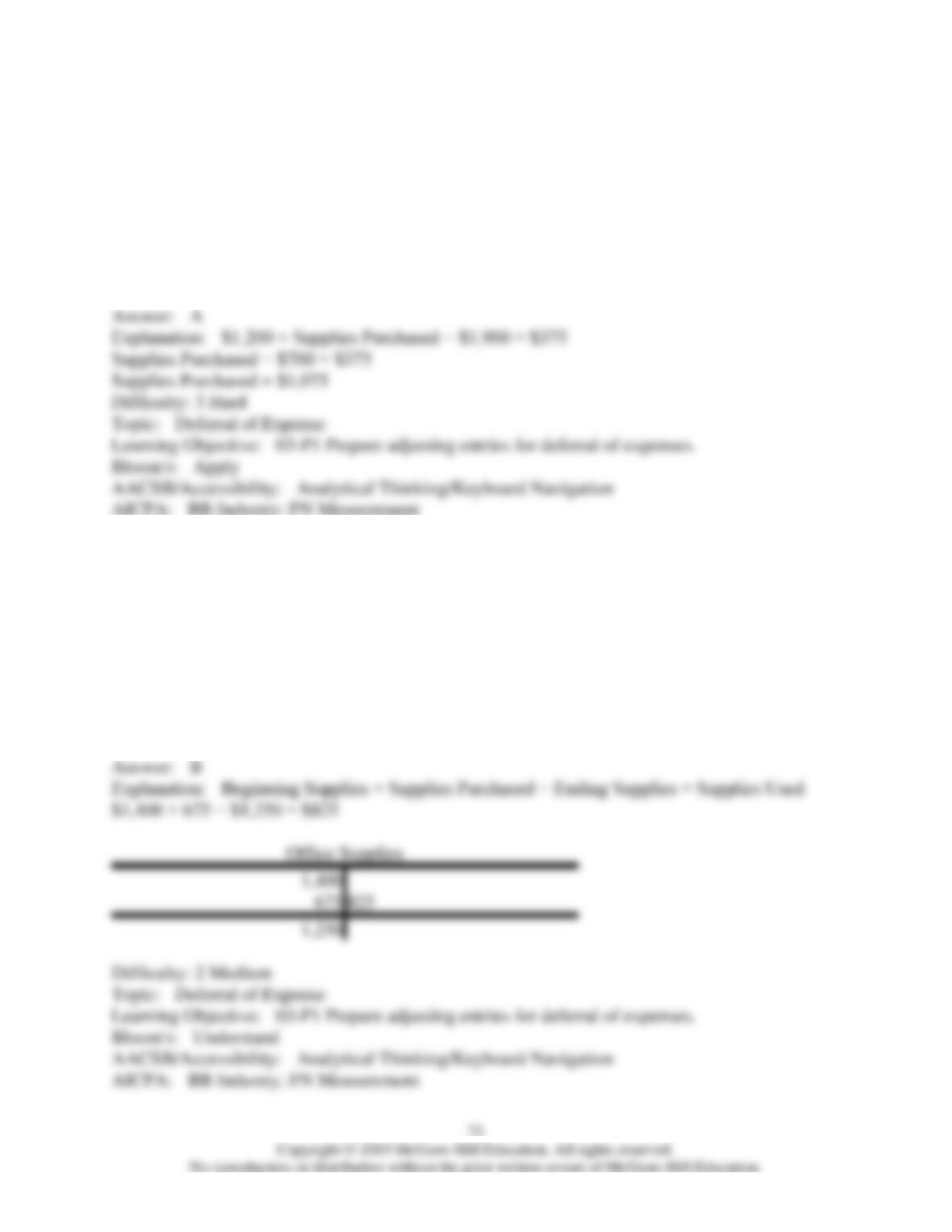
207) The balances in Labeille Accounting Services’ office supplies account on February 1 and
February 28 were $1,200 and $375, respectively. If the office supplies expense for the month is
$1,900, what amount of office supplies was purchased during February?
A) $1,075
B) $1,500
C) $1,525
D) $2,325
E) $3,100
208) If Bojana Tax Services’ office supplies account balance on March 1 was $1,400, the
company purchased $675 of supplies during the month, and a physical count of supplies on hand
at the end of March indicated $1,250 unused, what is the amount of the adjusting entry for office
supplies on March 31?
A) $675
B) $825
C) $1,250
D) $1,975
E) $525
209) A physical count of supplies on hand at the end of May for Masters, Inc. indicated $1,250
of supplies on hand. The general ledger balance before any adjustment is $2,100. What is the
adjusting entry for office supplies that should be recorded on May 31?
A) Debit Supplies Expense $1,250 and credit Supplies $1,250.
B) Debit Prepaid Supplies $850 and credit Supplies Expense $850.
C) Debit Supplies Expense $1,250 and credit Supplies $2,100.
D) Debit Supplies $1,250 and credit Cash $1,250.
E) Debit Supplies Expense $850 and credit Supplies $850.
210) Which of the following statements is incorrect?
A) An income statement reports revenues earned less expenses incurred.
B) An unadjusted trial balance shows the account balances after they have been revised to reflect
the effects of end-of-period adjustments.
C) Interim financial reports can be based on one-month or three-month accounting periods.
D) The fiscal year is any 12 consecutive months (or 52 weeks) used by a business as its annual
accounting period.
E) Property, plant, and equipment are referred to as plant assets.
211) A trial balance prepared after adjustments have been recorded is called a(n):
A) Balance sheet.
B) Adjusted trial balance.
C) Unadjusted trial balance.
D) Classified balance sheet.
E) Unclassified balance sheet.
212) A trial balance prepared before any adjustments have been recorded is:
A) An adjusted trial balance.
B) Used to prepare financial statements.
C) An unadjusted trial balance.
D) Correct with respect to proper balance sheet and income statement amounts.
E) Only prepared once a year.
213) The adjusted trial balance contains information pertaining to:
A) Asset accounts only.
B) Balance sheet accounts only.
C) Income statement accounts only.
D) All general ledger accounts.
E) Revenue accounts only.
214) Financial statements are typically prepared in the following order:
A) Balance sheet, statement of retained earnings, income statement.
B) Statement of retained earnings, balance sheet, income statement.
C) Income statement, balance sheet, statement of retained earnings.
D) Income statement, statement of retained earnings, balance sheet.
E) Balance sheet, income statement, statement of retained earnings.
215) A balance sheet that places the assets above the liabilities and equity is called a(n):
A) Report form balance sheet.
B) Account form balance sheet.
C) Classified balance sheet.
D) Unadjusted balance sheet.
E) Unclassified balance sheet.
216) A balance sheet that places the liabilities and equity to the right of the assets is a(n):
A) Account form balance sheet.
B) Report form balance sheet.
C) Interim balance sheet.
D) Classified balance sheet.
E) Unclassified balance sheet.
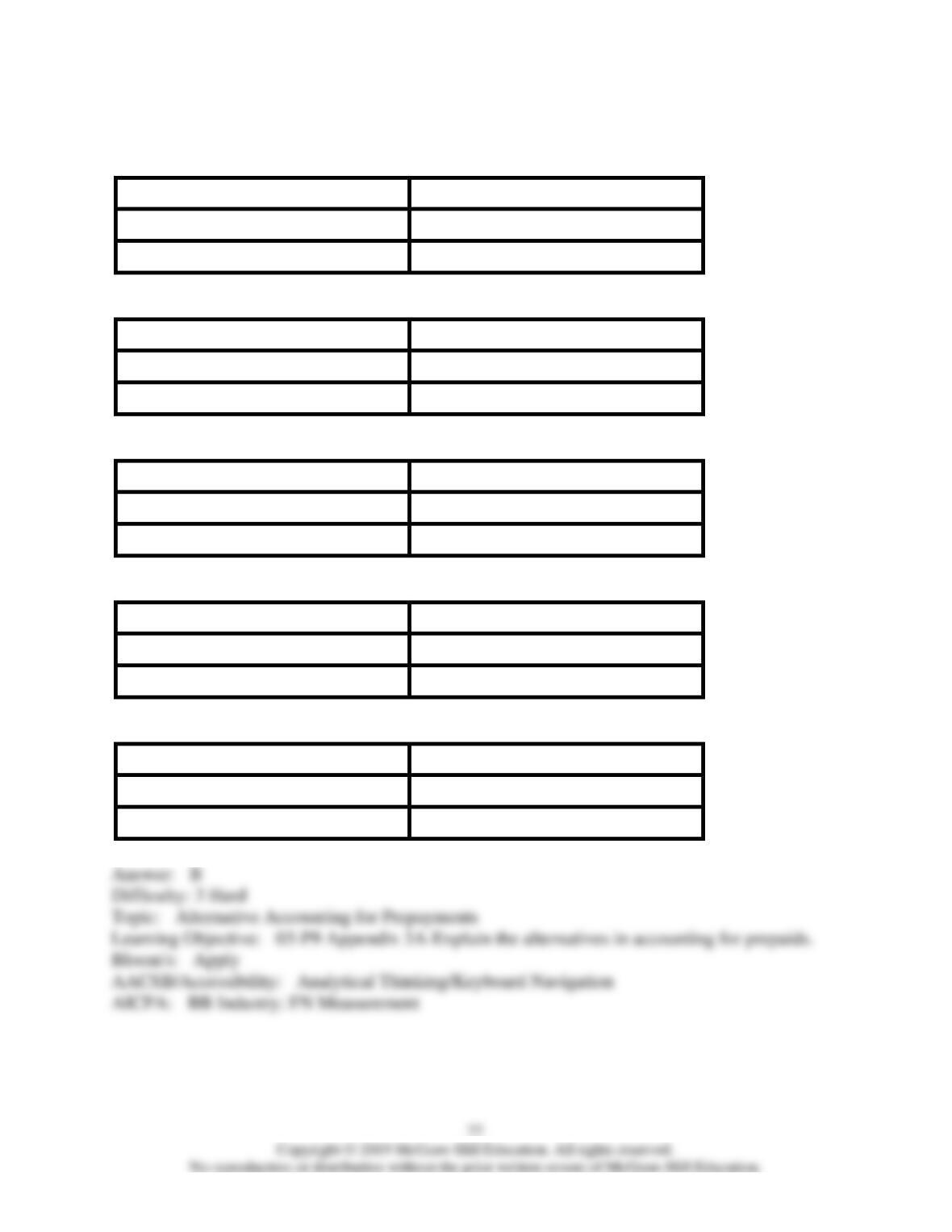
217) Under the alternative method for accounting for unearned revenue, which of the following
pairs of journal entry formats is correct?
A)
Initial Entry
Adjusting Entry
Cash
Unearned Consulting Revenue
Unearned Consulting Revenue
Consulting Revenue
B)
Initial Entry
Adjusting Entry
Cash
Consulting Revenue
Consulting Revenue
Unearned Revenue
C)
Initial Entry
Adjusting Entry
Cash
Unearned Revenue
Unearned Revenue
Cash
D)
Initial Entry
Adjusting Entry
Consulting Revenue
Unearned Revenue
Cash
Consulting Revenue
E)
Initial Entry
Adjusting Entry
Cash
Consulting Revenue
Unearned Revenue
Unearned Revenue
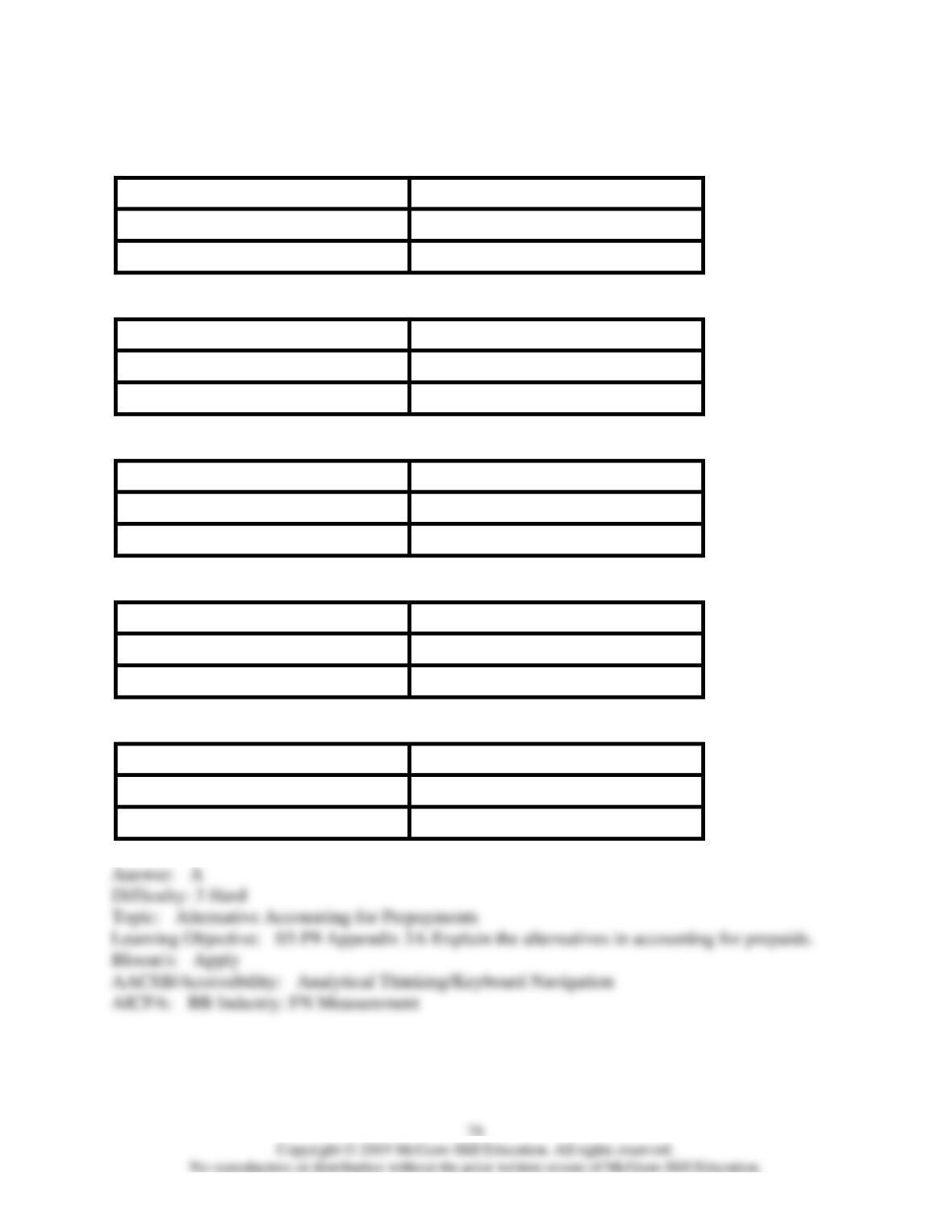
218) Under the alternative method for recording prepaid expenses, which is the correct set of
journal entries?
A)
Initial Entry
Adjusting Entry
Insurance Expense
Prepaid Insurance
Cash
Insurance Expense
B)
Initial Entry
Adjusting Entry
Cash
Prepaid Insurance
Insurance Expense
Insurance Expense
C)
Initial Entry
Adjusting Entry
Prepaid Insurance
Prepaid Insurance
Cash
Insurance Expense
D)
Initial Entry
Adjusting Entry
Prepaid Insurance
Insurance Expense
Cash
Prepaid Insurance
E)
Initial Entry
Adjusting Entry
Prepaid Insurance
Cash
Insurance Expense
Prepaid Insurance
219) An adjusting entry that increases a revenue and decreases a liability is known as a(n):
A) Accrued expense.
B) Deferred expense.
C) Deferred revenue.
D) Accrued revenue.
E) Depreciation.
220) On December 1, Milton Company borrowed $300,000, at 8% annual interest, from the
Tennessee National Bank. Interest is paid when the loan matures one year from the issue date.
What is the adjusting entry for accruing interest that Milton would need to make on December
31, the calendar year-end?
A) debit Interest Payable, $2,000; credit Interest Expense, $2,000.
B) debit Interest Expense, $2,000; credit Interest Payable, $2,000.
C) debit Interest Expense, $2,000; credit Cash, $2,000.
D) debit Interest Expense, $4,000; credit Interest Payable, $4,000.
E) debit Interest Expense, $24,000; credit Interest Payable, $24,000.
221) On September 1, Kennedy Company loaned $100,000, at 12% annual interest, to a
customer. Interest and principal will be collected when the loan matures one year from the issue
date. Assuming adjustments are only made at year-end, what is the adjusting entry for accruing
interest that Kennedy would need to make on December 31, the calendar year-end?
A) Debit Interest Expense, $12,000; credit Interest Payable, $12,000.
B) Debit Interest Expense, $4,000; credit Interest Payable, $4,000.
C) Debit Interest Receivable, $12,000; credit Cash, $12,000.
D) Debit Interest Receivable, $4,000; credit Interest Revenue, $4,000.
E) Debit Cash, $4,000; credit Interest Revenue, $4,000.
222) A roofing company collects fees when jobs are complete. The work for one customer,
whose job was bid at $3,000, has been completed as of December 31, but the customer has not
yet been billed. Assuming adjustments are only made at year-end, what is the adjusting entry the
company would need to make on December 31, the calendar year-end?
A) Debit Cash, $3,000; credit Roofing Fees Revenue, $3,000.
B) Debit Roofing Fees Revenue, $3,000; credit Accounts Receivable, $3,000.
C) Debit Accounts Receivable, $3,000; credit Roofing Fees Revenue, $3,000.
D) Debit Cash, $3,000; credit Accounts Receivable, $3,000.
E) No adjustment is required.