134. If the beginning balance of Retained Earnings equals $10,000, net income for the year
equals $6,000, and dividends for the year equal $2,000, then the ending balance of Retained
Earnings equals $18,000.
135. If the beginning balance of Retained Earnings equals $12,000, the ending balance of
Retained Earnings equals $15,000, and dividends for the year equal $1,000, then net income
for the year equals $4,000.
136. After closing entries are prepared, all asset and liability accounts have a balance of zero.
137. After closing entries are prepared, the balance of Retained Earnings is updated to reflect
the activity in the revenue, expense, and dividend accounts for the period.
138. The post-closing trial balance is a list of all accounts and their balances at a particular
date after the account balances have been updated for closing entries.
139. The post-closing trial balance does not include any assets or liabilities, because these
accounts all have zero balances after closing entries.
140. For each transaction below, calculate the amount of revenue to be recognized in the
current period using accrual-basis accounting:
(a) Performed $24,000 of services during the month and received full cash payment from
customers at the time of service.
(b) Performed $9,000 of services during the month and billed customers. Customers are
expected to pay next month.
(c) Received $12,000 cash from customers for services to be provided next month.
141. For each transaction below, calculate the amount of expense to be recognized in the
current period using accrual-basis accounting:
(a) Paid $3,500 on account for supplies purchased last period. All supplies were used last
month.
(b) Paid $5,000 cash for advertising in the current period.
(c) Employees worked in the current period but will not be paid until the following period,
$4,500.
142. A company receives $2,500 cash from customers for services to be provided next month.
Record the cash receipt using (a) accrual-basis accounting and (b) cash-basis accounting.
143. A company performs $2,800 of services during the month and bills customers. The
customers are expected to pay next month. Record the customer billing using (a) accrual-basis
accounting and (b) cash-basis accounting.
144. A company performs $4,200 of services during the month and receives full cash payment
from customers at the time of service. Record the cash receipt using (a) accrual-basis
accounting and (b) cash-basis accounting.
145. A company pays $1,700 cash to employees for work performed during the month.
Record the payment using (a) accrual-basis accounting and (b) cash-basis accounting.
146. A company receives a $700 utility bill for the current month but does not plan to pay the
bill until early next month. Record the receipt of the utility bill using (a) accrual-basis
accounting and (b) cash-basis accounting.
147. A company pays $1,200 on account for supplies purchased last month. All supplies were
used last month. Record the payment using (a) accrual-basis accounting and (b) cash-basis
accounting.
148. A company maintains its records using cash-basis accounting. During the year, the
company received cash from customers, $34,000, and paid cash for taxes, $24,000. At the
beginning of the year, customers owe the company $3,000. By the end of the year, customers
owe $5,000. At the beginning of the year, the company owes taxes of $4,000. At the end of
the year, the company owes taxes of $5,000. Determine cash-basis net income and accrual-
basis net income for the year.
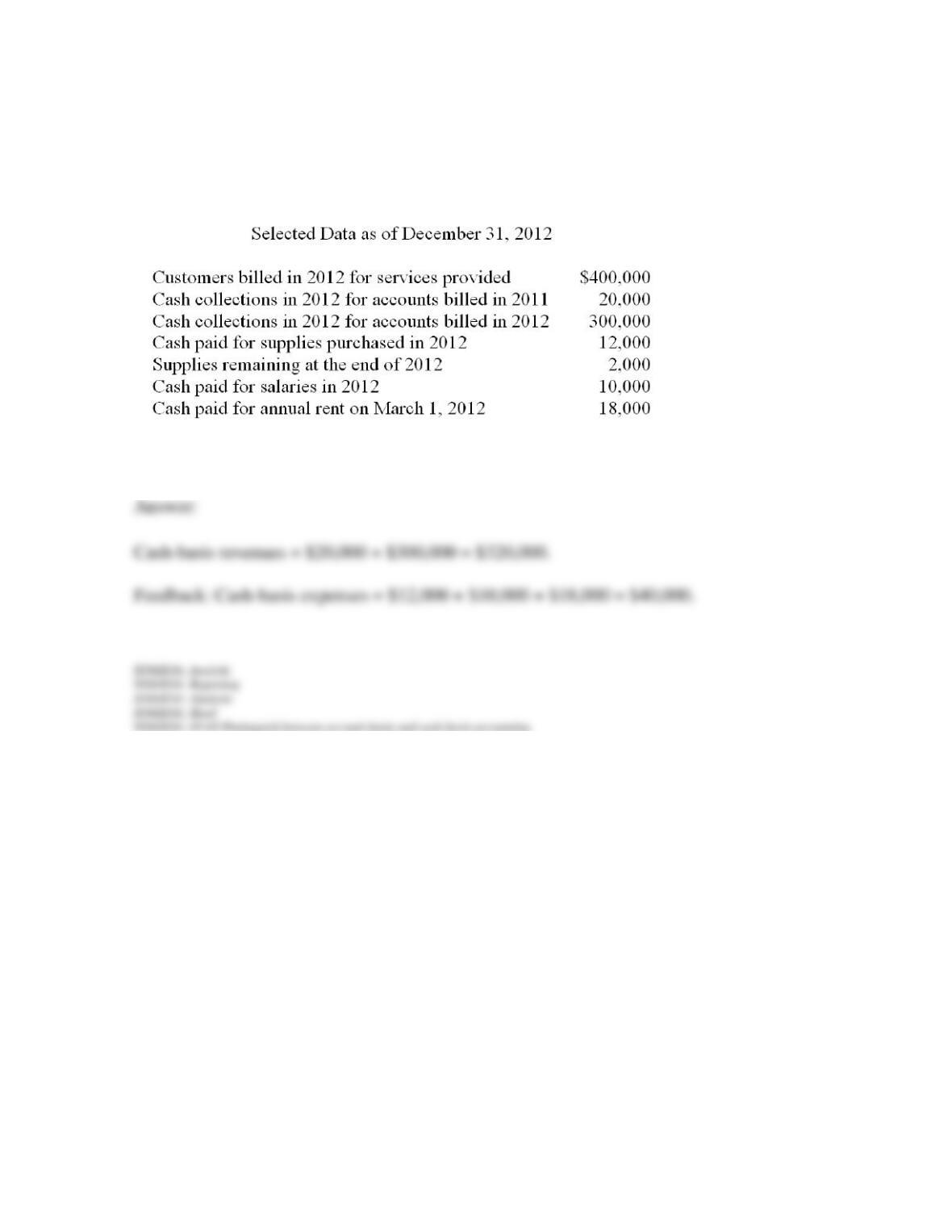
149. The following data are taken from the cash-basis accounting records of Myerson
Company for the year ended December 31, 2012:
Calculate the amount of revenues and expenses for 2012 under cash-basis accounting.
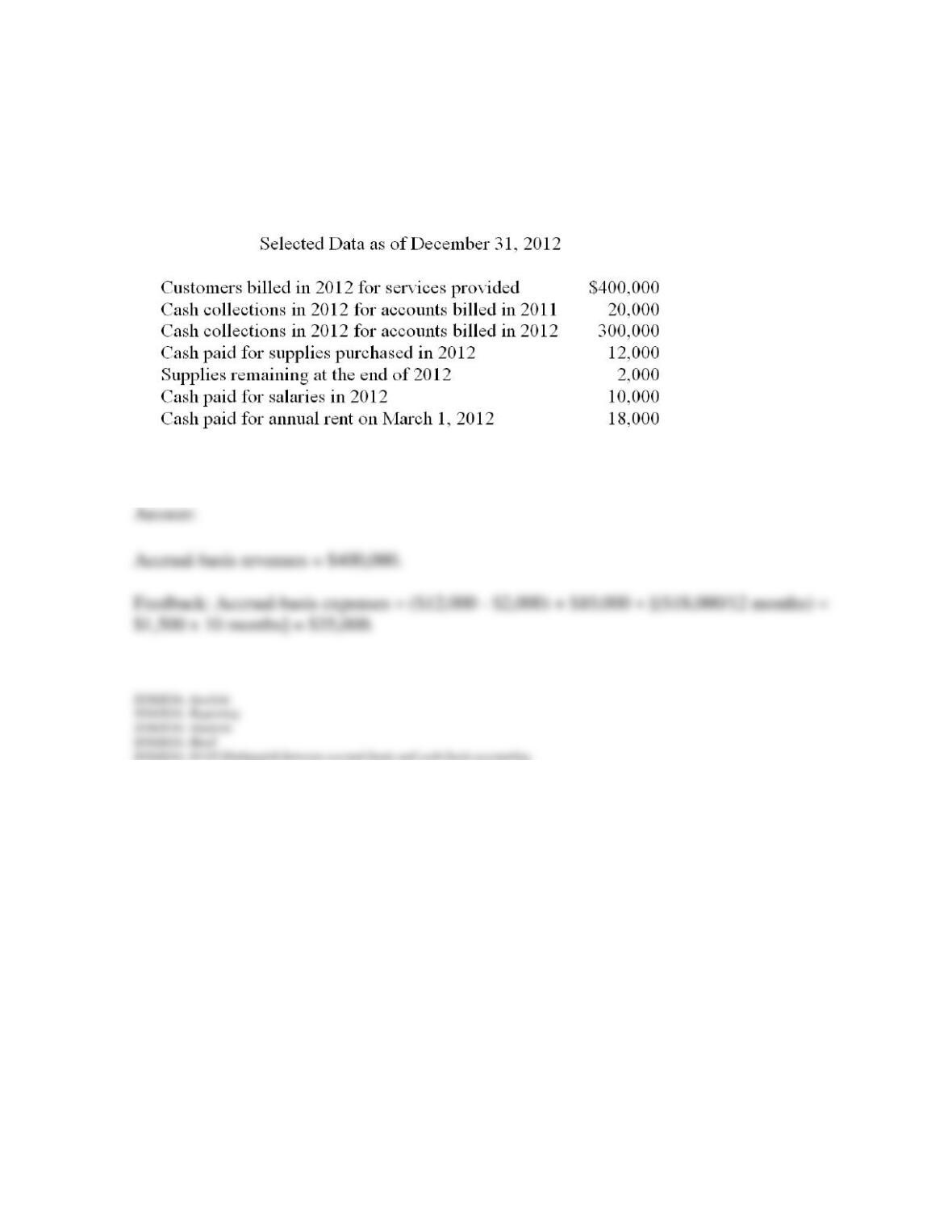
150. The following data are taken from the cash-basis accounting records of Myerson
Company for the year ended December 31, 2012:
Calculate the amount of revenues and expenses for 2012 under accrual-basis accounting.
151. At the beginning of the period, a company reports a balance in office supplies of $500.
During the period, the company purchases an additional $3,500 of office supplies for cash. By
the end of the period, only $700 of office supplies remains. Record the period-end adjusting
entry.
152. Suppose a company rents office space for one year, paying $12,000 ($1,000/month) in
advance on September 1. Record the adjusting entry on December 31.
153. A company purchases one year of flood insurance in advance on May 1, paying $24,000
($2,000/month). Record the adjusting entry on December 31.
154. A company purchases new equipment for $24,000 cash on August 1, 2012. At the time
of purchase, the equipment is expected to be used in operations for four years (48 months) and
have no resale or scrap value at the end. The company depreciates the equipment evenly over
the 48 months ($500/month). Record the adjusting entry for depreciation on December 31,
2012.
155. Suppose a customer rents a vehicle for four months from Rent-A-Car on October 1,
paying $4,000 ($1,000/month). Record Rent-A-Car’s adjusting entry on December 31.
156. A company pays its employees $5,600 every two weeks ($400/day). The current two-
week pay period ends on December 26, 2012, and employees are paid $5,600. The next two-
week pay period ends on January 9, 2013, and employees will be paid $5,600. Record the
adjusting entry on December 31, 2012.
157. A company borrows $20,000 with 8% interest on October 1, 2012. This amount plus
interest is due on September 30, 2013. Record the adjusting entry on December 31, 2012.
158. A company lends $30,000 with 10% interest on May 1, 2012. This amount plus interest
is due on April 30, 2013. Record the adjusting entry on December 31, 2012.
159. Prepare adjusting journal entries, as needed, for the following items.
(a) The Supplies account shows a balance of $500, but a count of supplies reveals only $200
on hand at year-end.
(b) The company initially records the payments of all insurance premiums as prepaid
insurance. The unadjusted trial balance at year-end shows a balance of $500 in Prepaid
Insurance. A review of insurance policies reveals that $100 of insurance is unexpired.
(c) Employees work Monday through Friday, and salaries of $2,500 per week are paid each
Friday. The company’s year-end falls on Tuesday.
(d) At year-end, the company received a utility bill for December’s electricity usage of $200
that will be paid in early January.
160. A company reports the following amounts: Assets = $6,000; Liabilities = $2,000;
Stockholders’ equity = $4,000; Dividends = $500; Revenues = $5,000; and Expenses =
$3,000. What amount is reported for net income?
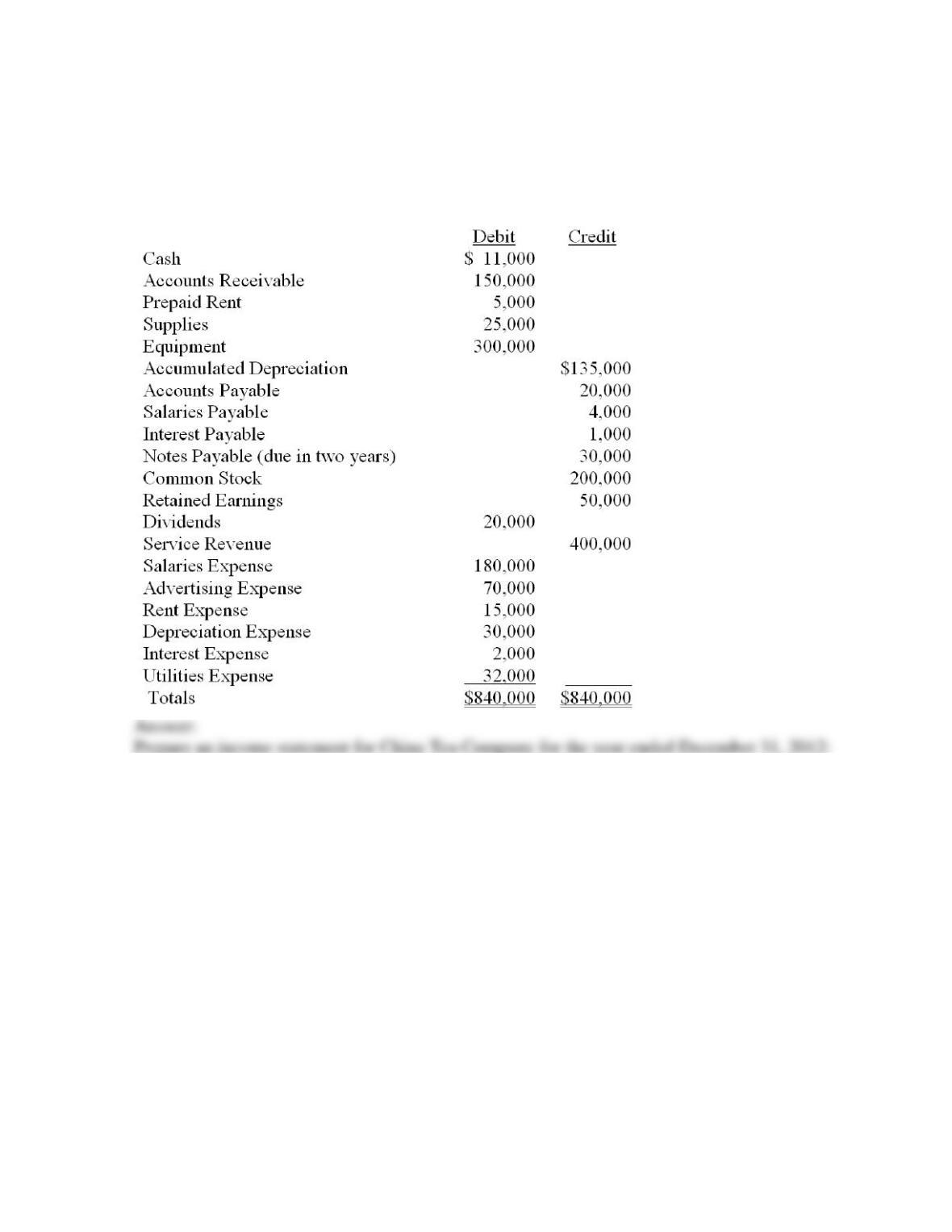
161. The adjusted trial balance for China Tea Company at December 31, 2012, is presented
below: