
Chapter 3 – Product Costing and Cost Accumulation in a Batch Production Environment
3-53
96. Darrin Products uses a job-costing system for its units, which pass from the Machining
Department, to the Assembly Department, to finished-goods inventory. The Machining
Department is heavily automated; in contrast, the Assembly Department performs a number
of manual-assembly activities. The company uses machine hours to apply manufacturing
overhead to products in the Machining Department, and direct labor cost to apply
manufacturing overhead to products in the Assembly Department.
The following information relates to the Machining Department for the year just ended:
Budgeted manufacturing overhead
$12,000,000
Actual manufacturing overhead
12,142,000
Budgeted machine hours
800,000
Actual machine hours
794,000
The Machining Department data that follow pertain to job no. 775, the only job in production
at year-end.
Direct materials
$125,000
Direct labor cost
61,800
Machine hours
550
Required:
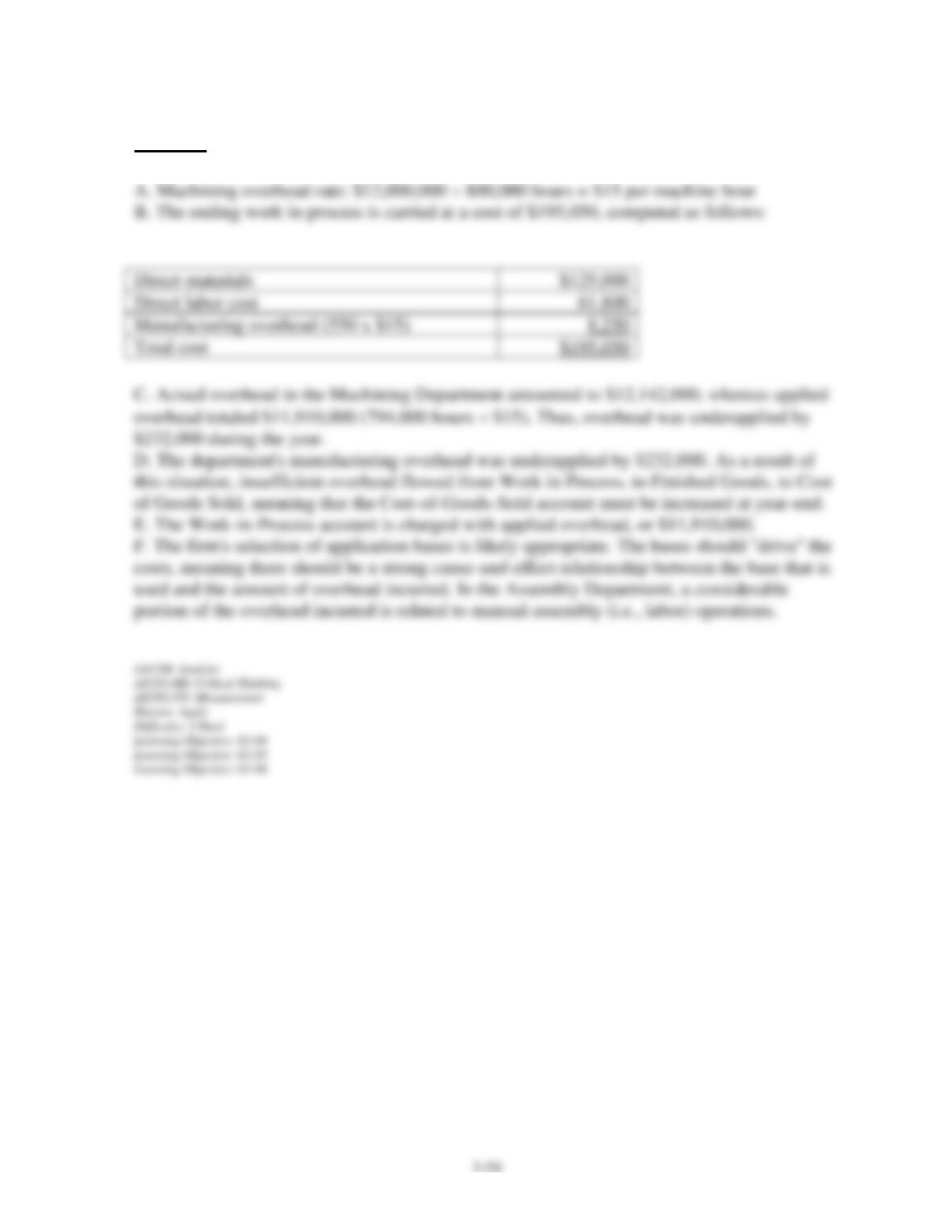
A. Assuming the use of normal costing, calculate the predetermined overhead rate that is used
in the Machining Department.
B. Compute the cost of the Machining Department’s year-end work-in-process inventory.
C. Determine the amount that overhead was under- or overapplied during the year in the
Machining Department. Indicate whether it is overapplied or underapplied.
D. If Darrin disposes of the Machining Department’s under- or overapplied overhead as an
adjustment to Cost of Goods Sold, would the company’s Cost-of-Goods-Sold account increase
or decrease? Explain.
E. How much overhead would have been charged to the Machining Department’s Work-in–
Process account during the year?
F. Comment on the appropriateness of direct labor cost to apply manufacturing overhead in
the Assembly Department.
Chapter 3 – Product Costing and Cost Accumulation in a Batch Production Environment
Solution:
97. Kwik Products uses a predetermined overhead application rate of $18 per labor hour. A
review of the company’s accounting records revealed budgeted manufacturing overhead for
the period of $621,000, applied manufacturing overhead of $590,400, and overapplied
overhead of $11,900.
Required:
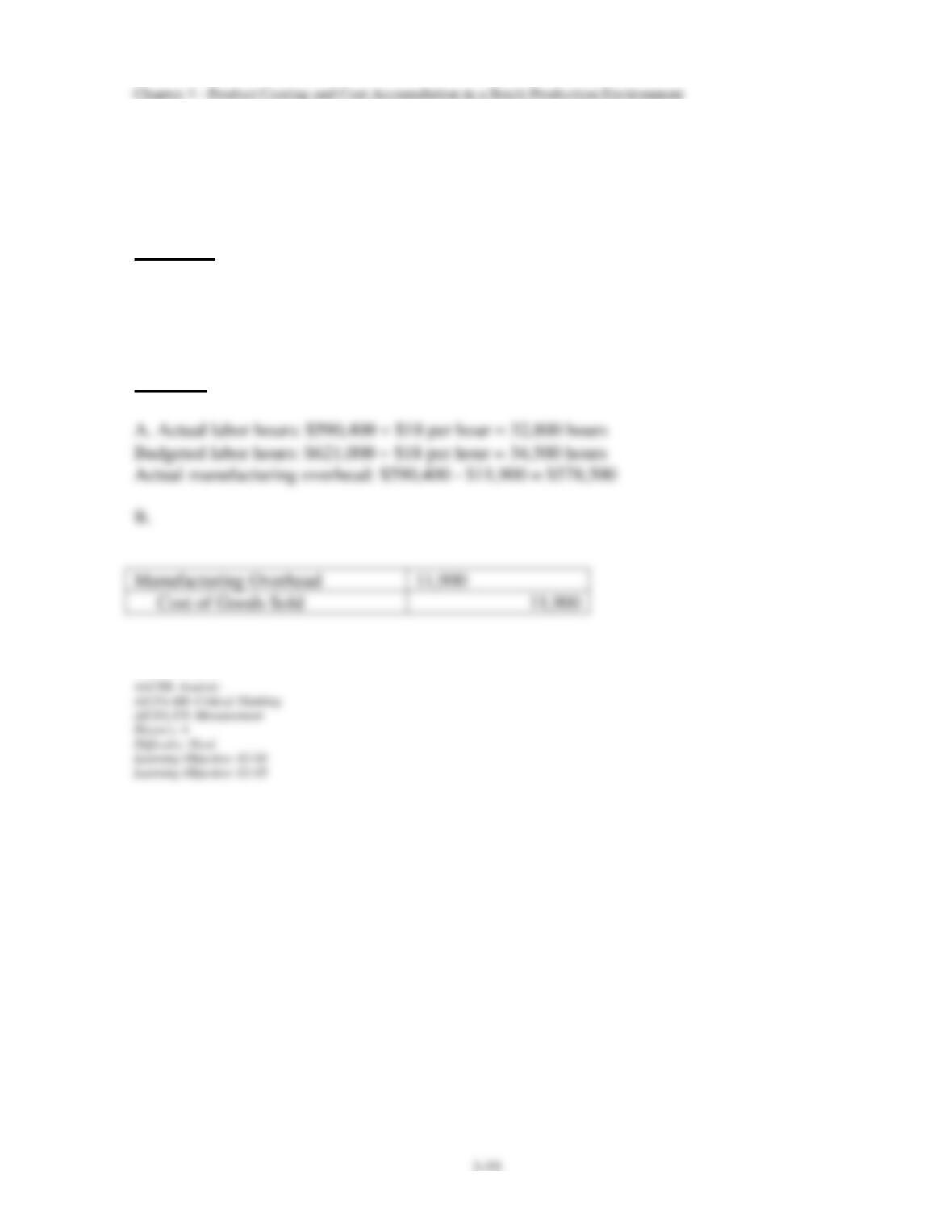
A. Determine Kwik’s actual labor hours, budgeted labor hours, and actual manufacturing
overhead.
B. Present the necessary year-end journal entry to handle the overapplied overhead, assuming
that the firm allocates over- or underapplied overhead to Cost of Goods Sold.
Solution:
98. A review of the records of Protix, Inc., a new company, disclosed the following year-end
information:
· Manufacturing Overhead account: Contained debits of $872,000, which included $20,000 of
sales commissions.
· Work-in-Process Inventory account: Contained charges for overhead of $875,000.
· Cost-of-Goods-Sold account: Contained a year-end debit balance of $3,680,000. This
amount was computed prior to any year-end adjustment for under- or overapplied overhead.
Pilgrim applies manufacturing overhead to production by using a predetermined rate of $20
per machine hour. Budgeted overhead for the period was anticipated to be $900,000.
Required:
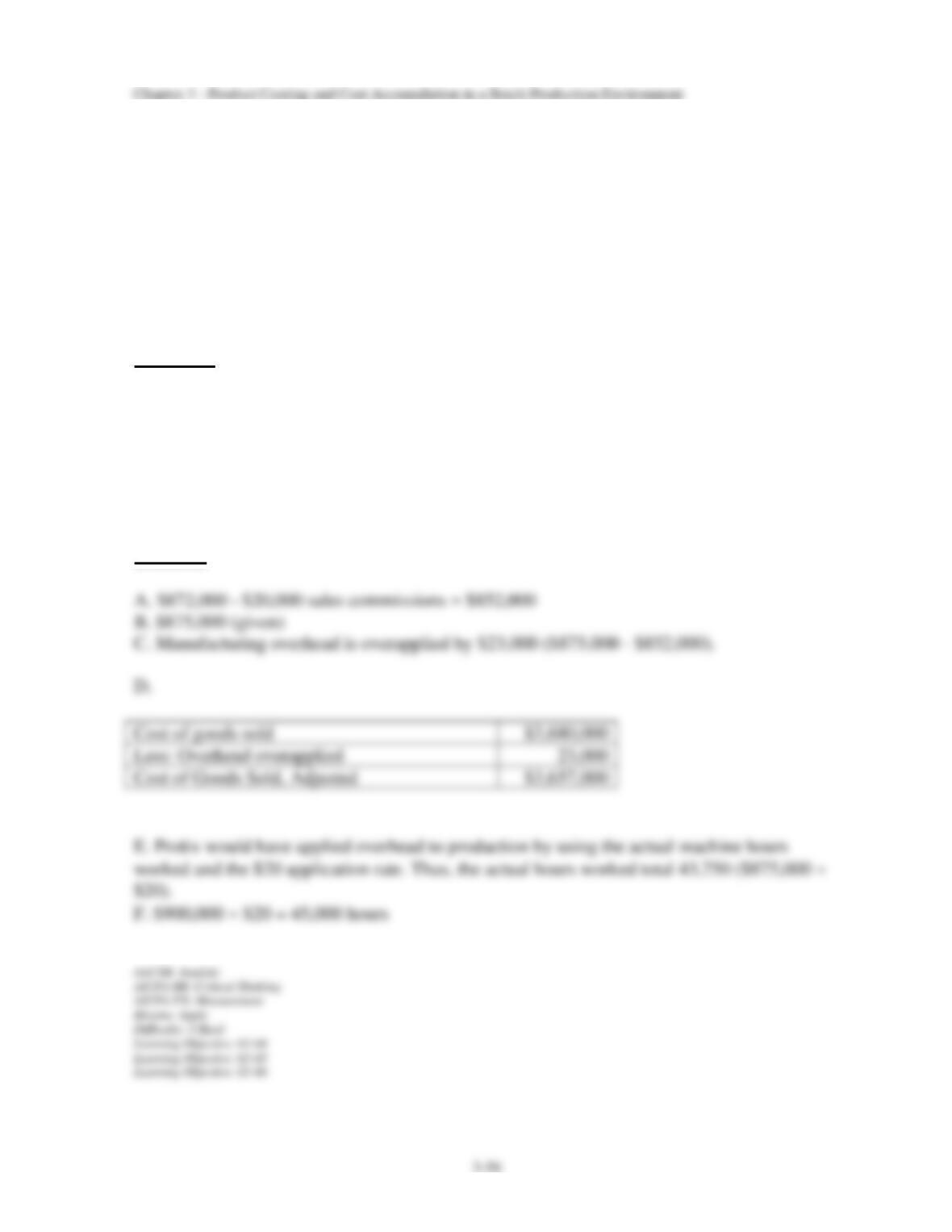
A. Determine the actual manufacturing overhead for the year.
B. Determine the amount of manufacturing overhead applied to production.
C. Is overhead under- or overapplied? By how much?
D. Compute the adjusted cost-of-goods-sold figure that should be disclosed on the company’s
income statement.
E. How many machine hours did Protix actually work during the year?
F. Compute budgeted machine hours for the year.
Solution:
3-57
99. Discuss the reason for (1) allocating overhead to the cost of production jobs, and (2)
applying overhead using a predetermined rate instead of an actual overhead rate.
Solution:
100. Caldon Products started and finished job no. C19 during June. The job required $15,000
of direct material and 75 hours of direct labor at $12 per hour. The predetermined overhead
rate is $16 per direct labor hour.
During June, direct materials requisitions for all jobs totaled $149,000; the total direct labor
hours and cost were 6,200 hours at $12 per hour; and the total cost of jobs completed was
$337,500. All of these figures include data that pertain to job no. C19.
Required:
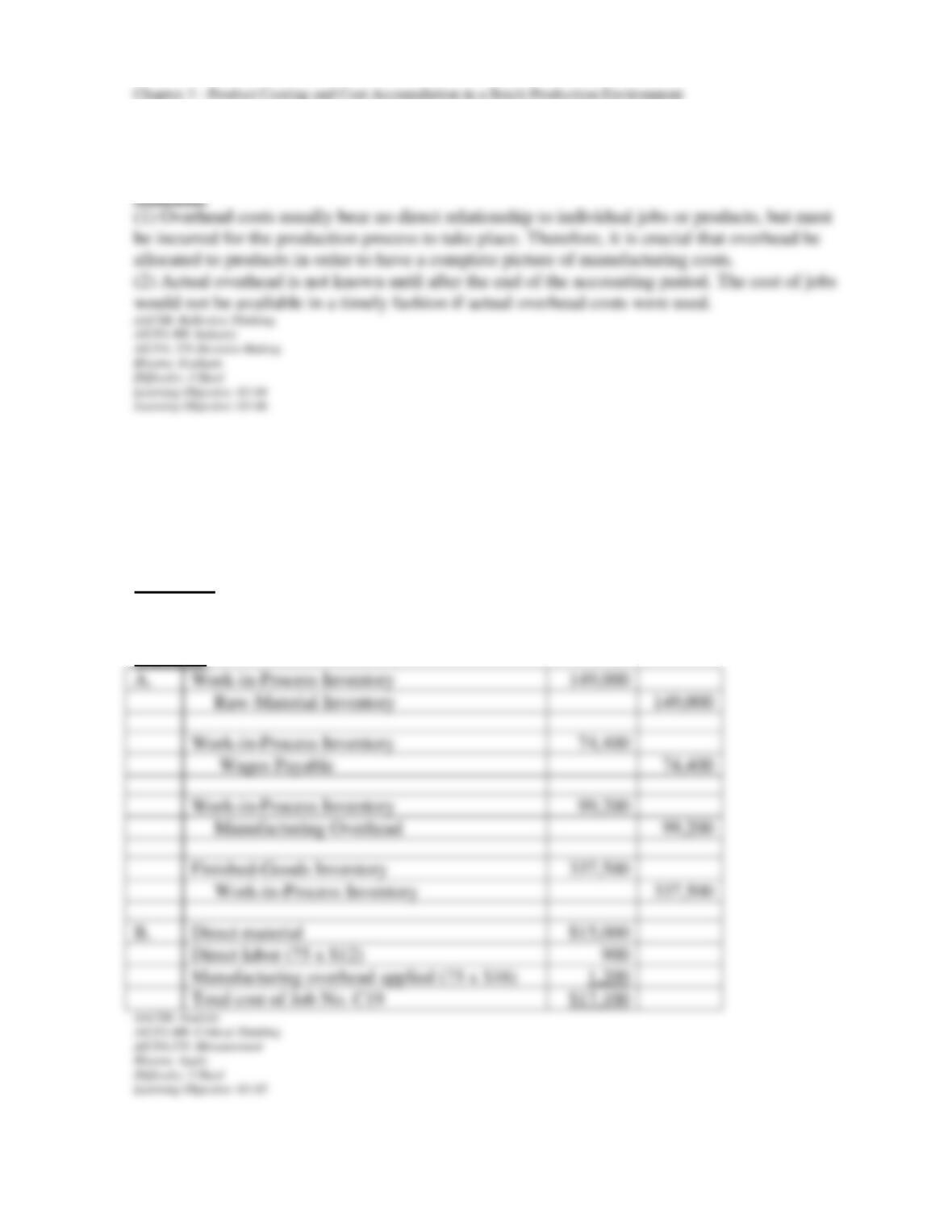
A. Prepare journal entries that summarize June’s total activity.
B. Determine the cost of job no. C19.
Solution:
101. Manufacturing overhead is applied to production.
A. Describe several situations that may give rise to underapplied overhead.
B. Assume that underapplied manufacturing overhead is treated as an adjustment to Cost of
Goods Sold. Explain why an underapplication of overhead increases Cost of Goods Sold.
Solution:
102. Layman, Inc., has just completed job nos. 78 and 79, which were similar in terms of
complexity, production processes, and units manufactured. Job no. 78 was manufactured by
Joe Bingham who earns $14 per hour, whereas job no. 79 was completed by Susan Fortner
who earns $20 per hour. If Joe and Susan are equally efficient, would the company be better
off using direct labor cost or direct labor hours as the cost driver in its predetermined oerhead
rate? Briefly explain.
Solution:
103. Briefly describe the stages used in the two-stage allocation process for assigning
overhead costs.
3-60
104. Farnham & Associates is a literary consulting firm in New York. The following costs
were incurred in a project to design a dust cover for a new novel:
Direct material
$29,000
Direct professional labor
42,000
The firm’s budget for the year included the following estimates:
Budgeted overhead
$800,000
Budgeted direct professional labor
640,000
Overhead is applied to contracts by using a predetermined overhead rate that is based on
direct professional labor cost. Actual professional labor during the year was $655,000 and
actual overhead was $793,000.
Required:
A. Determine the total cost to design the cover of the novel.
B. Calculate the under- or overapplied overhead for the year. Be sure to label your answer.
Direct professional labor
Applied overhead ($42,000 x 125%*)
Applied overhead ($655,000 x 125%)
Actual overhead
Overapplied overhead
3-61
105. Farmington and Associates designs relatively small sports stadiums and arenas at various
sites throughout the country. The firm’s accountant prepared the following budget for the
upcoming year:
Professional staff salaries
$3,000,000
Administrative support staff
800,000
Other operating costs
200,000
Eighty percent of professional staff salaries are directly traceable to client projects, a figure
that falls to 60% for the administrative support staff and other operating costs. Traceable costs
are charged directly to client projects; nontraceable costs, on the other hand, are treated as
firm overhead and charged to projects by using a predetermined overhead application rate.
Farmington had one project in process at year-end: an arena that was being designed for Toll
County. Costs directly chargeable to this project were:
Professional staff salaries
$90,000
Administrative support staff
17,300
Other operating costs
6,700
Required:
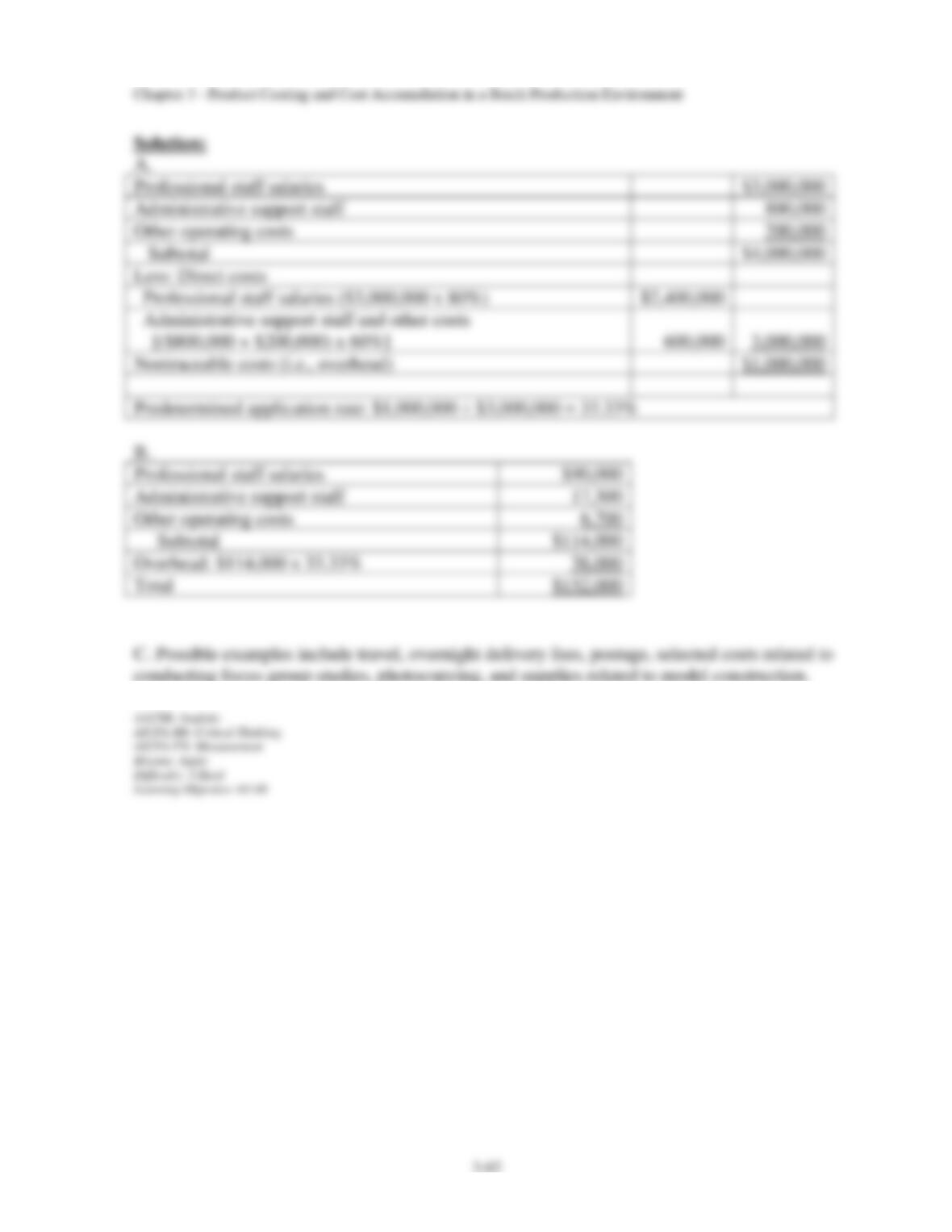
A. Determine Farmington’s overhead for the year and the firm’s predetermined overhead
application rate. The rate is based on costs directly chargeable to firm projects.
B. Compute the cost of the Toll County arena project as of year-end.
C. Present three examples of “other operating costs” that might be directly traceable to the
Toll County project.
3-63
106. Bonanza Enterprises provides consulting services and uses a job-order system to
accumulate the cost of client projects. Traceable costs are charged directly to individual
clients; in contrast, other costs incurred by Bonanza , but not identifiable with specific clients,
are charged to jobs by using a predetermined overhead application rate. Clients are billed for
directly chargeable costs, overhead, and a markup.
Bonanza anticipates the following costs for the upcoming year:
Cost
Percentage of Cost
Directly Traceable
to Clients
Professional staff salaries
$5,000,000
80 %
Administrative support staff
600,000
50
Travel
200,000
80
Other Operating costs
200,000
20
Total
$6,000,000
Bonanza’s partners desire to make a $480,000 profit for the firm and plan to add a percentage
markup on total cost to achieve that figure.
On May 14, Bonanza completed work on a project for Laramie Manufacturing. The following
costs were incurred: professional staff salaries, $68,000; administrative support staff, $8,900;
travel, $10,500; and other operating costs, $2,600.
Required:
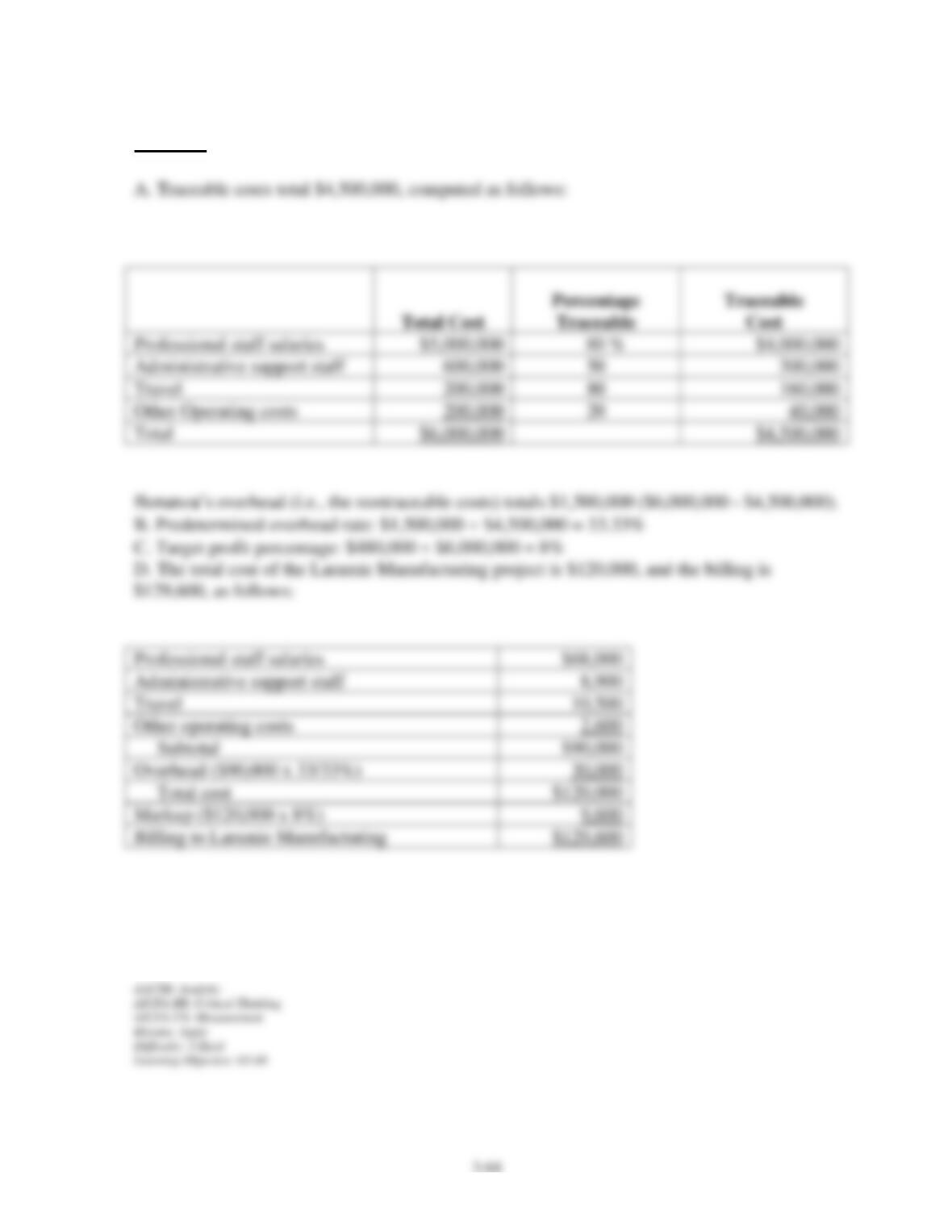
A. Determine Bonanza’s total traceable costs for the upcoming year and the firm’s total
anticipated overhead.
B. Calculate the predetermined overhead rate. The rate is based on total costs traceable to
client jobs.
C. What percentage of total cost will Bonanza add to each job to achieve its profit target?
D. Determine the total cost of the Laramie Manufacturing project. How much would Laramie
be billed for services performed?
Chapter 3 – Product Costing and Cost Accumulation in a Batch Production Environment
Solution: