Chapter 3 – Product Costing and Cost Accumulation in a Batch Production Environment
84. What is the overhead rate for staff accountants, if separate rates are used for partners and
staff accountants?
85. If overhead is applied on the Monoco engagement based on a single-cost driver basis,
what is the total cost of the engagement?
86. If overhead is applied on the Monoco engagement based on two separate cost drivers,
what is the cost of the engagement?
87. At the Bayshore Advertising Agency, partner and staff compensation cost is a key driver
of agency overhead. In light of this fact, which of the following is the correct expression to
determine the amount of overhead applied to a particular client job?
Chapter 3 – Product Costing and Cost Accumulation in a Batch Production Environment
Essay Questions
88. Troski Corporation sells a number of products to groups that provide educational
workshops and seminars. One of the products involves a combination leather case and note
pad. The company purchases the case and pad combination from a supplier and encloses a $3
pen that contains the educational groups’ name and logo.
Troski began to carry this product at the start of 20×3, acquiring 12,500 cases from Executive
Supply for $87,500 along with an identical number of pens from Accent Goods. During 20×3,
9,500 of the cases and pens were issued to Troski’s assembly operation where the pen is
added. Eighty percent of these cases were completed as of December 31, and a review of the
December 31 finished-goods inventory found 2,600 completed cases in the warehouse.
Conversations with salespeople revealed that 70 finished sets were used in various company
marketing activities throughout the year.
Required:
A. Determine the cost of the cases and pens that would appear in Troski’s raw materials, work
in process, and finished-goods inventory as of December 31.
B. Determine the cost of the cases and pens that would appear in the company’s cost of goods
sold for 20×3.
Solution:
89. The selected data that follow relate to the Underwood Furniture Company.
Direct material purchased on account
$160,000
Direct material used
79,000
Direct labor
170,000
Manufacturing overhead incurred
100,000
Manufacturing overhead applied
90,000
During the year, products costing $310,000 were completed, and products costing $316,000
were sold on account for $455,000.
Required:
Prepare journal entries to record the preceding transactions and events.
Solution:
Raw-Material Inventory
Accounts Payable
Raw-Material Inventory
Manufacturing Overhead
Miscellaneous Accounts
Manufacturing Overhead
Finished-Goods Inventory
Work-in-Process Inventory
Accounts Receivable
Sales Revenue
Cost of Goods Sold
Finished-Goods Inventory

3-45
90. Pincus Corporation, which uses a job-costing system, had two jobs in process at the start
of 20×1: job no. 59 ($95,000) and job no. 60 ($39,500). The following information is
available:
· The company applies manufacturing overhead on the basis of machine hours. Budgeted
overhead and machine activity for the year were anticipated to be $720,000 and 20,000 hours,
respectively.
· The company worked on three jobs during the first quarter. Direct materials used, direct
labor incurred, and machine hours consumed were:
Job No.
Direct Materials
Direct Labor
Machine Hours
59
$18,000
$45,000
900
60
—
25,000
600
61
37,000
35,000
1,200
· Manufacturing overhead during the first quarter included charges for depreciation ($20,000),
indirect labor ($50,000), indirect materials used ($4,000), and other factory costs ($108,700).
· Pincus completed job no. 59 and job no. 60. Job no. 59 was sold for cash, producing a gross
profit of $24,600 for the firm.
Required:
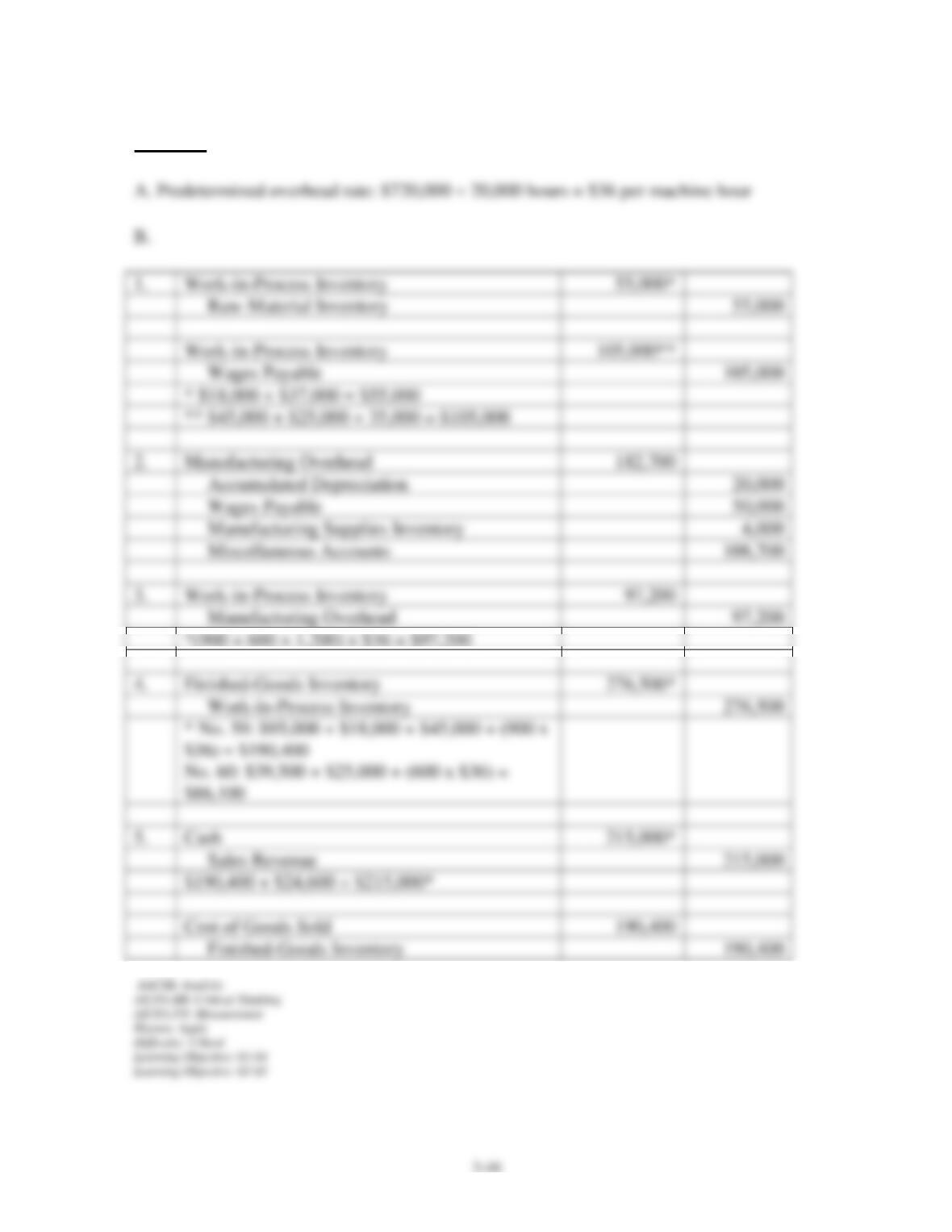
A. Determine the company’s predetermined overhead application rate.
B. Prepare journal entries as of March 31 to record the following. (Note: Use summary entries
where appropriate by combining individual job data.)
1. The issuance of direct material to production, and the direct labor incurred.
2. The manufacturing overhead incurred during the quarter.
3. The application of manufacturing overhead to production.
4. The completion of job no. 59 and no. 60.
5. The sale of job no. 59.
Chapter 3 – Product Costing and Cost Accumulation in a Batch Production Environment
Solution:
91. Bartlett Corporation, which began operations on January 1 of the current year, reported
the following information:
Estimated manufacturing overhead
$600,000
Actual manufacturing overhead
639,000
Estimated direct labor cost
480,000
Actual direct labor cost
500,000
Total debits in the Work-in-Process account
1,880,000
Total credits in the Finished-Goods account
920,000
Bartlett uses a normal cost system and applies manufacturing overhead to jobs on the basis of
direct labor cost. A 60% markup is added to the cost of completed production when finished
goods are sold. On December 31, job no. 18 was the only job that remained in production.
That job had direct-material and direct-labor charges of $16,500 and $36,000, respectively.
Required:
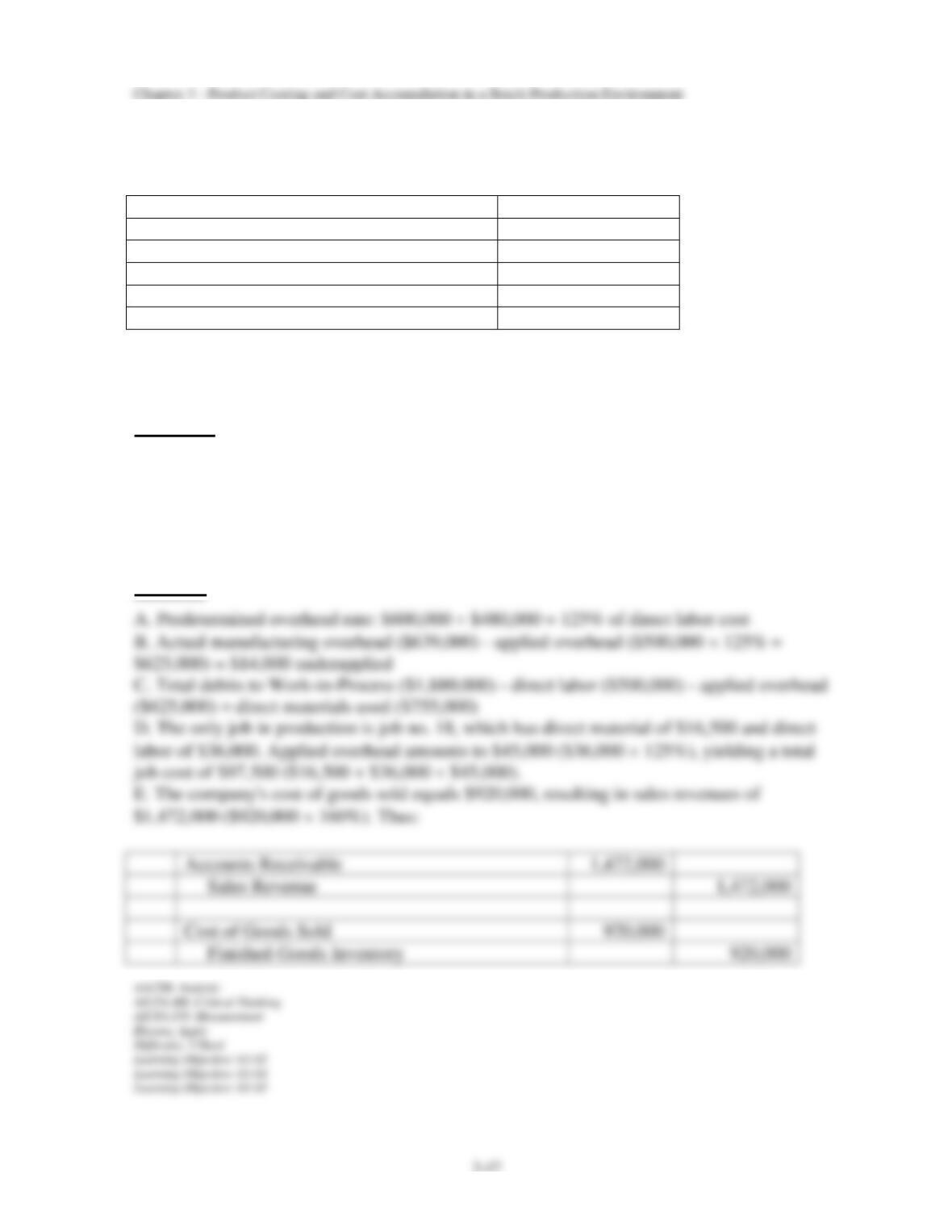
A. Determine the company’s predetermined overhead rate.
B. Determine the amount of under- or overapplied overhead. Be sure to label your answer.
C. Compute the amount of direct materials used in production.
D. Calculate the balance the company would report as ending work-in-process inventory.
E. Prepare the journal entry (ies) needed to record Bartlett’s sales, which are all made on
account.
Solution:
Accounts Receivable
Sales Revenue
Cost of Goods Sold
Finished-Goods Inventory
3-48
92. Describe the types of manufacturing environments that would best be suited for (1) job-
order costing and (2) process costing. Include two examples of manufacturers that would
likely use job-cost systems.
Solution:
93. Margin Call, Inc., which uses a job-costing system, is a labor-intensive firm, with many
skilled craftspeople on the payroll. Job no. 789 was the only job in process on January 1,
having costs of $22,500 as of that date. Direct materials used and direct labor incurred during
January were:
Job No.
Direct Materials
Direct Labor
789
$2,000
$6,000
790
9,000
10,000
791
14,000
8,000
Job no. 791 was the only job in production as of January 31.
Required:
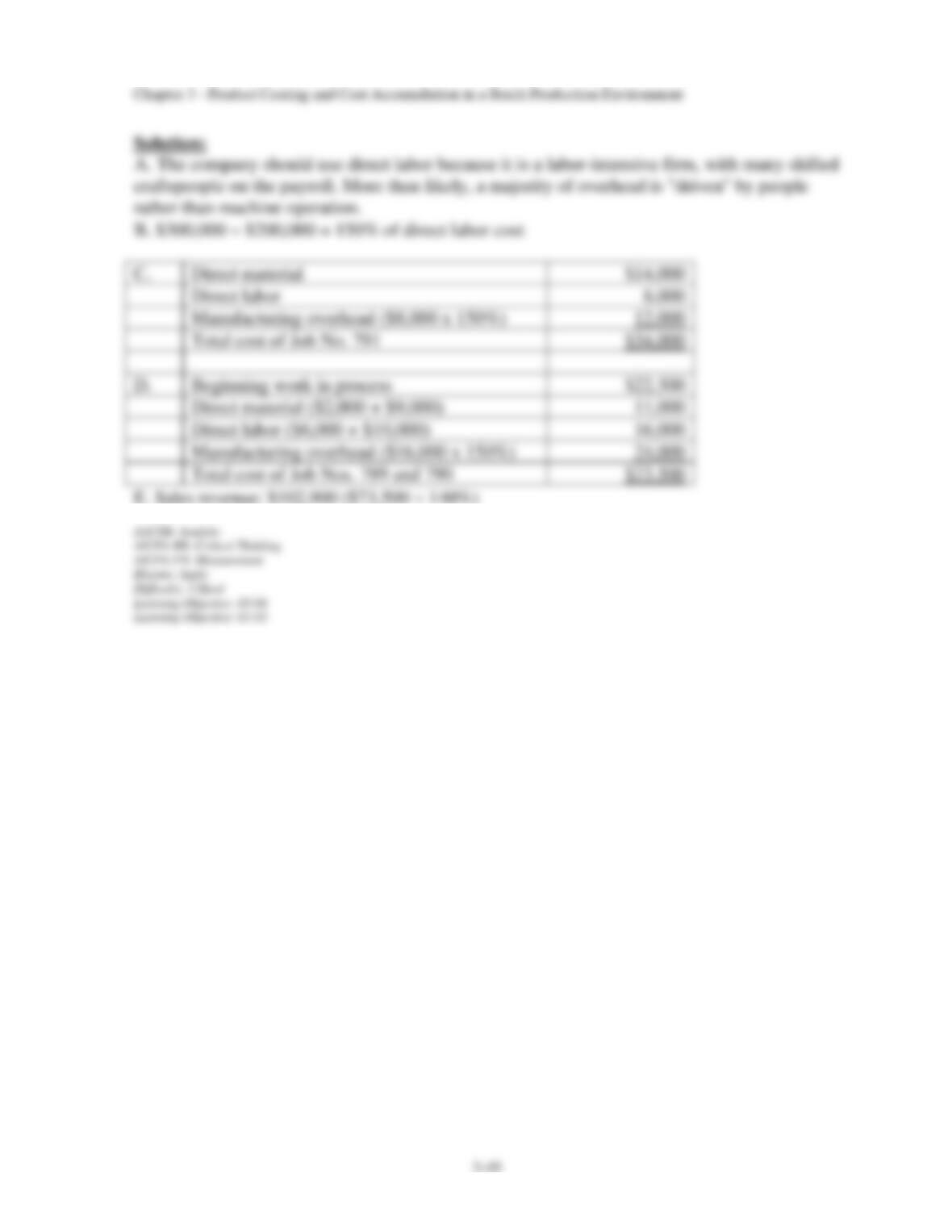
A. Should Margin Call use direct labor or machine hours as a cost driver. Why?
B. Assume that the company decided to use direct labor as its cost driver. If the budgeted
amounts of direct labor and manufacturing overhead are anticipated to be $200,000 and
$300,000, respectively, what is the firm’s predetermined overhead rate?
C. Compute the cost of work-in-process inventory as of January 31.
D. Compute the cost of jobs completed during January.
E. Suppose that the company sold all of its completed jobs, adding a 40% markup to cost.
How much would the firm report as sales revenue?

3-50
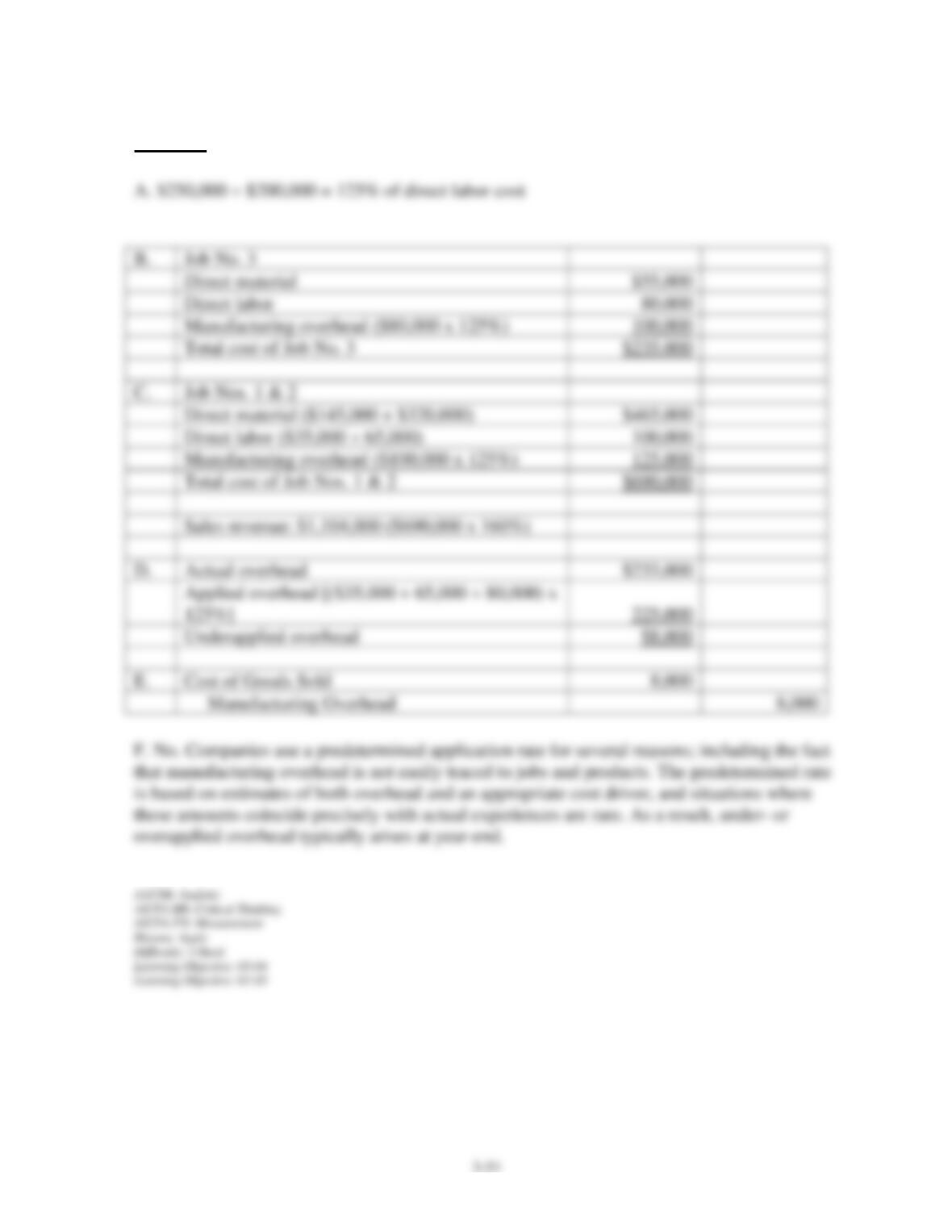
94. Garrison, Inc., which uses a job-costing system, began business on January 1, 20×3 and
applies manufacturing overhead on the basis of direct-labor cost. The following information
relates to 20×3:
· Budgeted direct labor and manufacturing overhead were anticipated to be $200,000 and
$250,000, respectively.
· Job nos. 1, 2, and 3 were begun during the year and had the following charges for direct
material and direct labor:
Job No.
Direct Materials
Direct Labor
1
$145,000
$35,000
2
320,000
65,000
3
55,000
80,000
· Job nos. 1 and 2 were completed and sold on account to customers at a profit of 60% of cost.
Job no. 3 remained in production.
· Actual manufacturing overhead by year-end totaled $233,000. Garrison adjusts all under-
and overapplied overhead to cost of goods sold.
Required:
A. Compute the company’s predetermined overhead application rate.
B. Compute Garrison’s ending work-in-process inventory.
C. Determine Garrison’s sales revenue.
D. Was manufacturing overhead under- or overapplied during 20×3? By how much?
E. Present the necessary journal entry to handle under- or overapplied manufacturing
overhead at year-end.
F. Does the presence of under- or overapplied overhead at year-end indicate that Garrison’s
accountants made a serious error? Briefly explain.
Chapter 3 – Product Costing and Cost Accumulation in a Batch Production Environment
Solution:
3-52
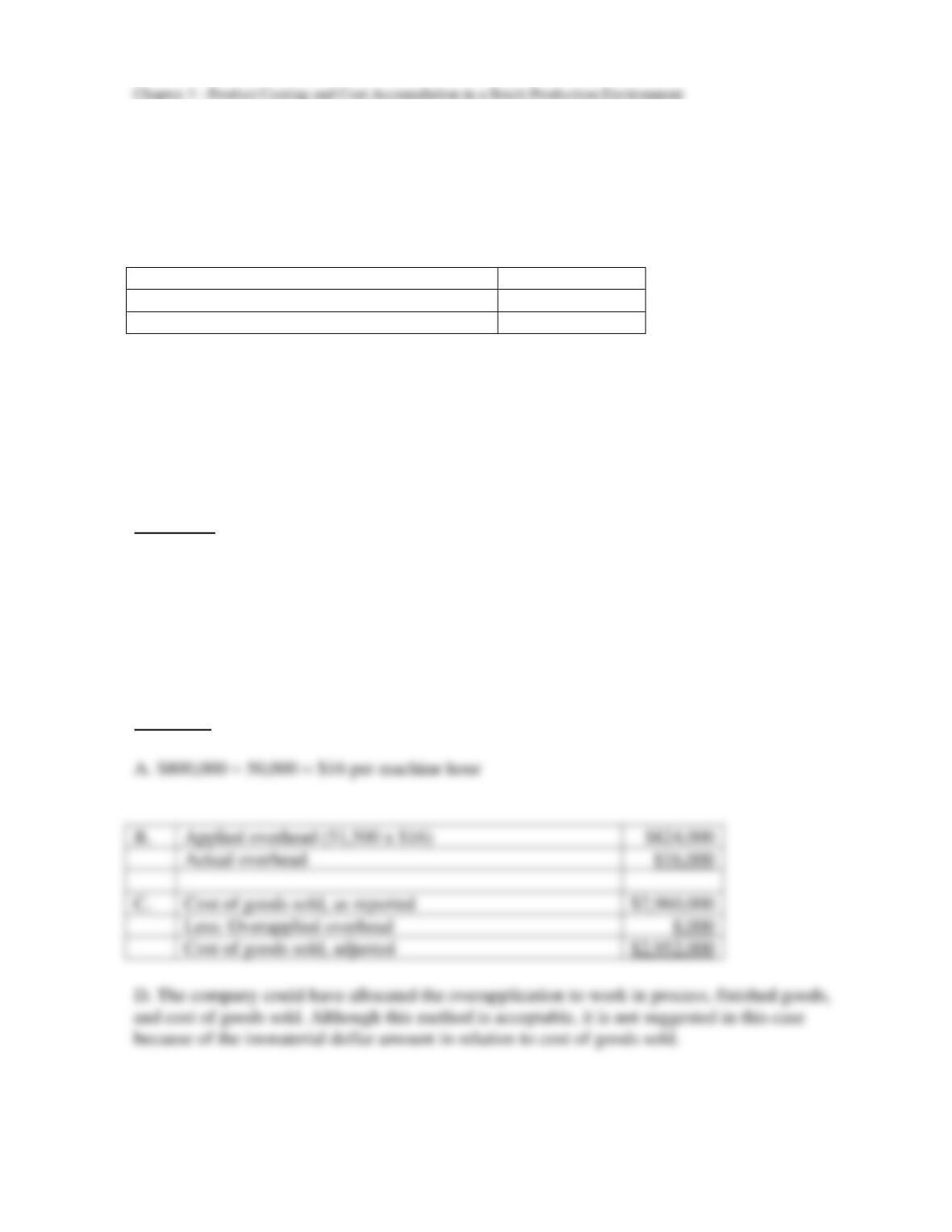
95. Altman Corporation uses a job-cost system and applies manufacturing overhead to
products on the basis of machine hours. The company’s accountant estimated that overhead
and machine hours would total $800,000 and 50,000, respectively, for 20×1. Actual costs
incurred follow.
Direct material used
$250,000
Direct labor
300,000
Manufacturing overhead
816,000
The manufacturing overhead figure presented above excludes $27,000 of sales commissions
incurred by the firm. An examination of job-cost records revealed that 18 jobs were sold
during the year at a total cost of $2,960,000. These goods were sold to customers for
$3,720,000. Actual machine hours worked totaled 51,500, and Altman adjusts under- or
overapplied overhead at year-end to Cost of Goods Sold.
Required:
A. Determine the company’s predetermined overhead application rate.
B. Determine the amount of under- or overapplied overhead at year-end. Be sure to indicate
whether overhead was under- or overapplied.
C. Compute the company’s adjusted cost of goods sold.
D. What alternative accounting treatment could the company have used at year-end to adjust
for under- or overapplied overhead? Is the alternative that you suggested appropriate in this
case? Why?
Solution:
Applied overhead (51,500 x $16)
Actual overhead
Less: Overapplied overhead
Cost of goods sold, adjusted
$2,952,000