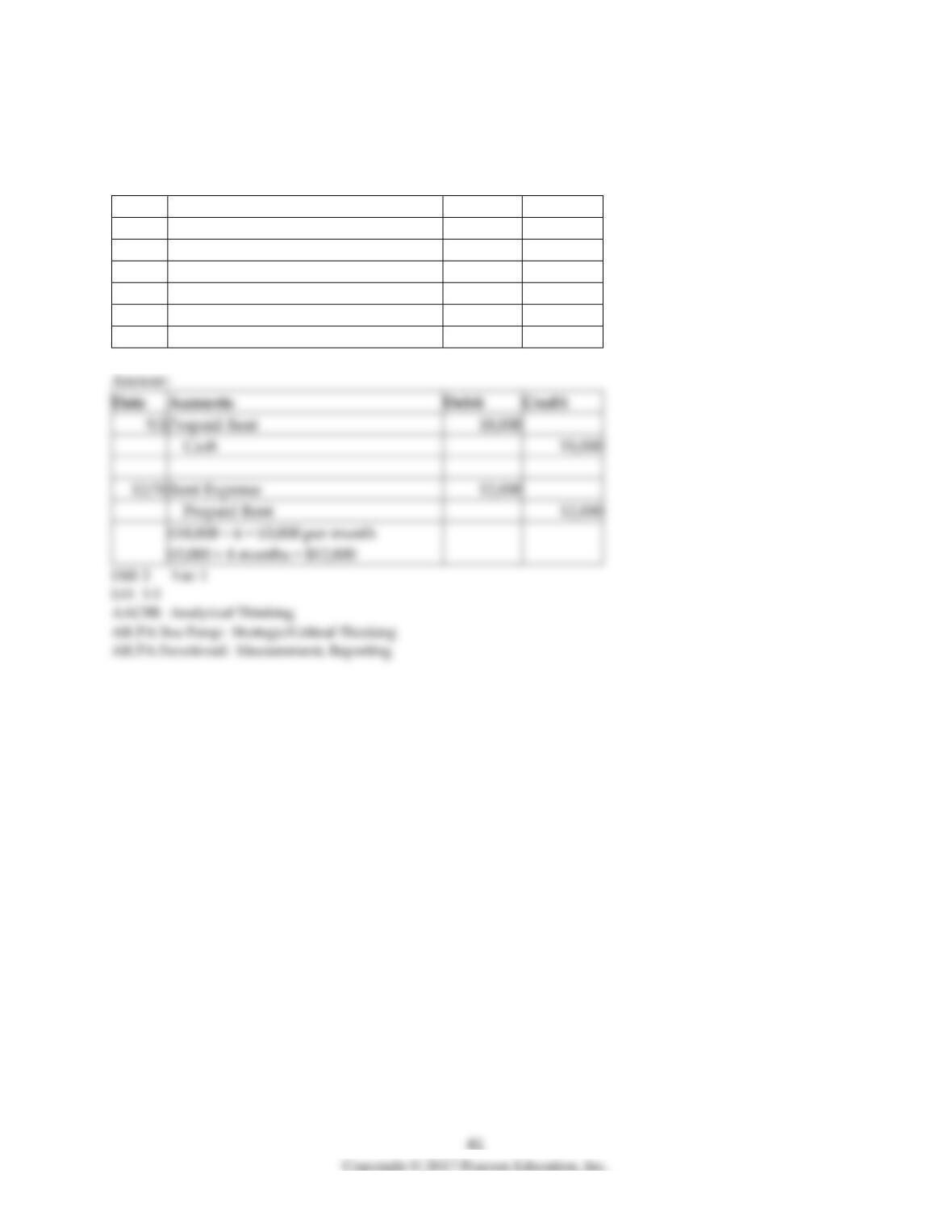
71) On September 1, Barnes Enterprises prepaid $18,000 for six months’ rent. The rental period begins
on September 1. Barnes adjusts the accounts only at December 31, the end of this fiscal year.
Prepare the journal entry for September 1 and the adjusting entry for December 31. Omit explanations.
Date
Accounts
Debit
Credit
Date
Accounts
Debit
Credit
Prepaid Rent
Rent Expense
$3,000 × 4 months = $12,000
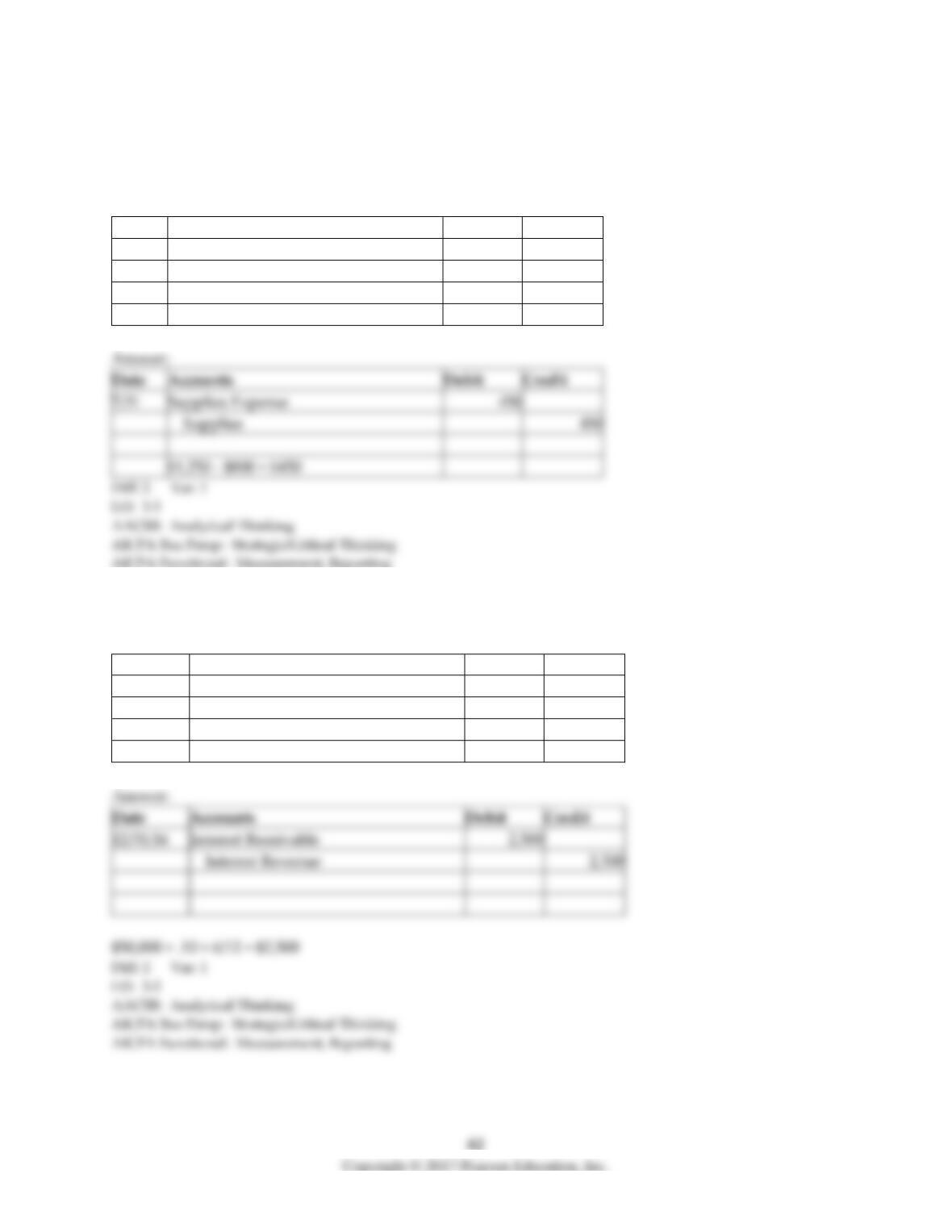
72) Fisher Accounting’s fiscal year ends on July 31. Accounts are adjusted only on the last day of the
fiscal year. On July 31, before adjusting journal entries were prepared, the balance of Supplies was
$1,250. A physical count revealed $800 of supplies on hand. Prepare the July 31 adjusting journal entry.
Omit explanations.
Date
Accounts
Debit
Credit
Date
Accounts
Debit
Credit
Supplies Expense
$1,250 – $800 = $450
73) Jackson Company holds a $50,000 note receivable dated July 1, 2016, with 10% interest. What
adjusting entry is needed on December 31, 2016?
Date
Accounts
Debit
Credit
Date
Accounts
Debit
Credit
12/31/16
Interest Receivable
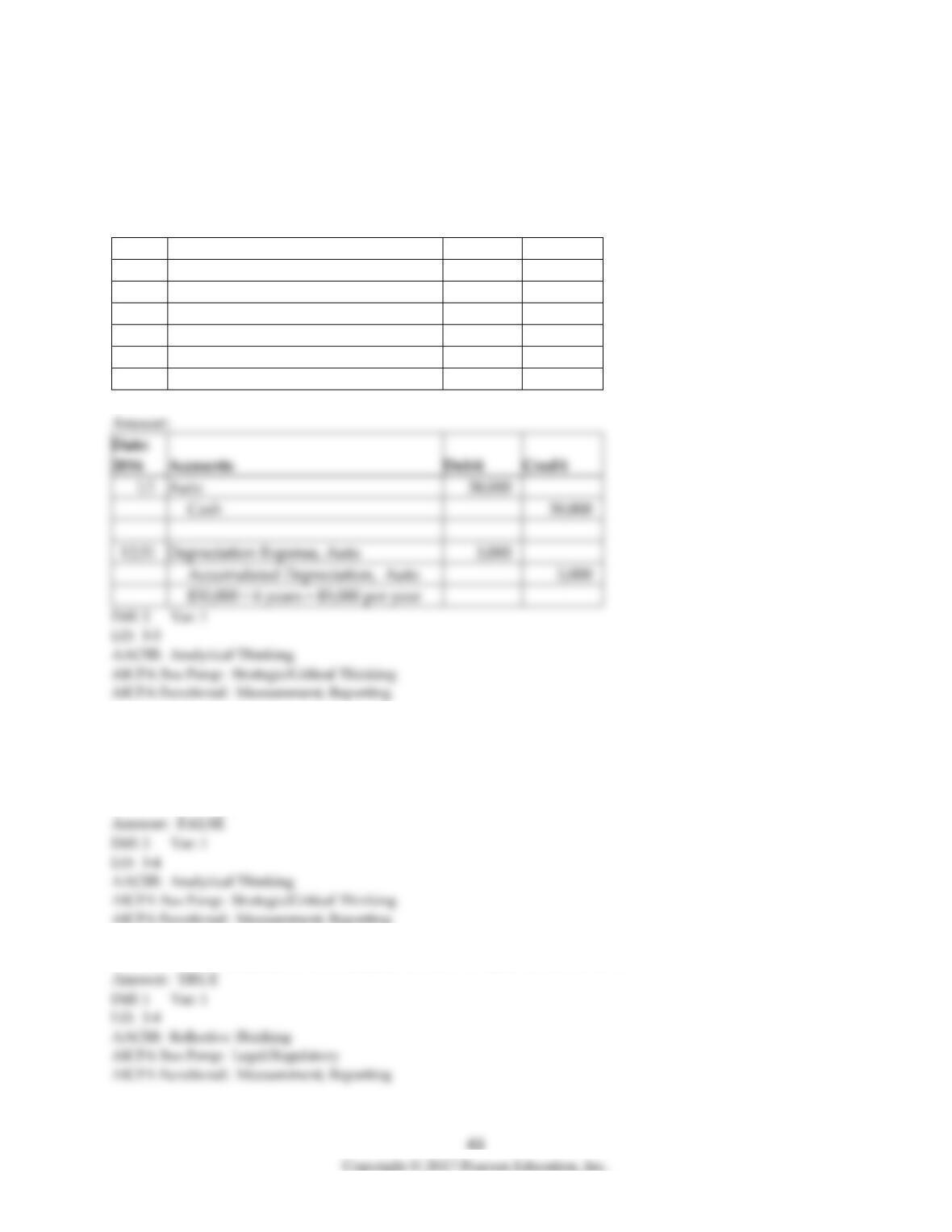
74) Barker Enterprises paid $30,000 cash for a new auto on January 1, 2016, the first day of its fiscal year.
The auto is expected to remain useful for six years. At the end of six years, the auto’s value is expected
to be zero. Accounts are adjusted only on the last day of the fiscal year.
Make the journal entries for January 1, 2016 and for December 31, 2016. Omit explanations.
Date
Accounts
Debit
Credit
Auto
Depreciation Expense, Auto
4 Learning Objective 3-4
1) The beginning balance of retained earnings appears on the balance sheet and the statement of
retained earnings.
2) The financial statements can be prepared from the adjusted trial balance.
3) In what order are the financial statements generally prepared?
A) balance sheet, income statement, and statement of retained earnings
B) income statement, statement of retained earnings, and balance sheet
C) income statement, balance sheet, and statement of retained earnings
D) statement of retained earnings, balance sheet, and income statement
4) The net income or loss is calculated on which financial statement?
A) statement of retained earnings
B) income statement
C) balance sheet
D) dividends statement
5) The beginning retained earnings balance is found on the:
A) statement of retained earnings.
B) income statement.
C) balance sheet.
D) both the statement of retained earnings and the balance sheet.
6) The financial statements are prepared from which columns of the trial balance worksheet?
A) unadjusted trial balance columns.
B) adjusted trial balance columns.
C) adjustment columns.
D) closing entries columns.
7) When preparing the balance sheet, the final balancing element of the balance sheet is:
A) Cash.
B) Net income.
C) Retained earnings.
D) Dividends.
8) The balance sheet reports:
A) assets, liabilities and stockholders’ equity.
B) the changes in retained earnings.
C) assets, liabilities, revenues and expenses.
D) revenues and expenses.
9) ________ will not be found on the statement of retained earnings.
A) Net income
B) Dividends
C) Stockholders’ equity
D) Net loss
10) When preparing the financial statements, why is the income statement prepared first?
A) The income statement is used to prepare the balance sheet.
B) The income statement is the easiest statement to prepare.
C) The income statement is the most important statement to investors and creditors.
D) Net income or net loss from the income statement is used for the statement of retained earnings.
11) When using the trial balance worksheet to prepare the statement of retained earnings, what
information is used from the trial balance worksheet?
A) net income or net loss
B) revenues and expenses
C) beginning balance of retained earnings and dividends
D) cash balance
12) The balance sheet reports the retained earnings balance at the end of a fiscal year. What is the source
of this ending balance of retained earnings?
A) Trial Balance Worksheet
B) Adjusted Trial Balance
C) Unadjusted Trial Balance
D) Statement of Retained Earnings
13) The statement of retained earnings reports a company’s net income or net loss for a period of time.
What is the source of the amount of net income or net loss?
A) Balance Sheet
B) Cash Dividend Statement
C) Trial Balance Worksheet
D) Income Statement
14) The statement of retained earnings reports the amount of dividends declared over a period of time.
What is the source of the amount of dividends declared?
A) Balance Sheet
B) Income Statement
C) Adjusted Trial Balance
D) Cash Dividend Statement
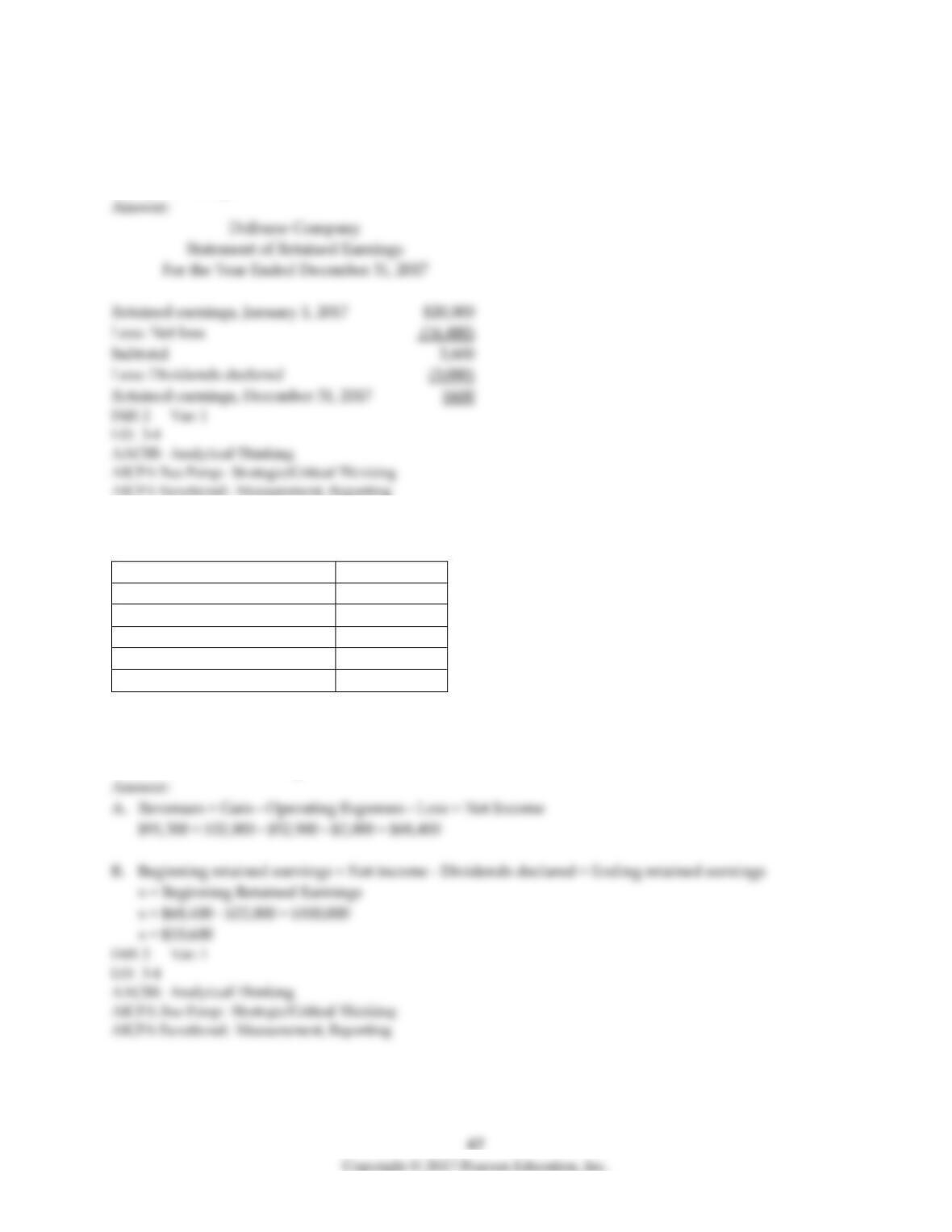
15) Dolhune Company has a balance of $20,000 in Retained Earnings as of January 1, 2017. For the year
ended December 31, 2017, Dolhune had a net loss of $16,400. $3,000 was declared and paid in dividends
for the year. Prepare the Statement of Retained Earnings for the year ended December 31, 2017. Include
a proper heading.
16) A company has the following information available for the year ending December 31, 2017:
Service Revenue
$91,300
Operating Expenses
$52,900
Gain on Sale of Land
$32,000
Loss on Sale of Equipment
($2,000)
Retained Earnings, 12/31/2017
$100,000
Dividends declared in 2017
$22,000
Required:
Calculate the company’s (A) net income or loss for the year ending December 31, 2017 and (B) the
balance in Retained earnings on 1/1/2017.
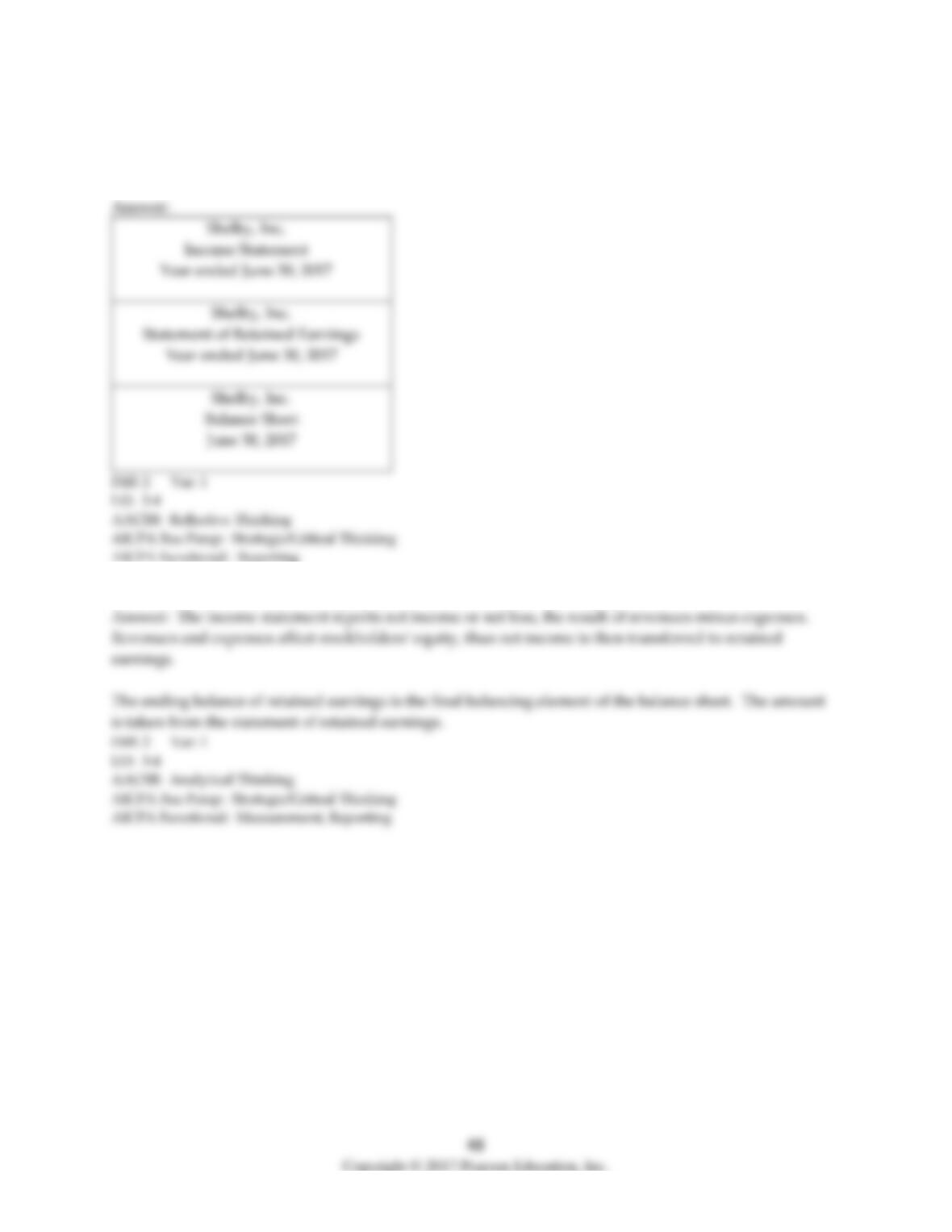
17) Shelby, Inc.’s fiscal year ended June 30, 2017 and the company is preparing annual financial
statements. List the financial statements in the order in which they are prepared. For each statement,
include a proper heading. Do not include the statement of cash flows.
18) Why is the income statement prepared first and the balance sheet prepared last?
5 Learning Objective 3-5
1) The books need to be closed in order to prepare the accounts for the next period’s transactions.
2) Temporary accounts are closed at the end of the accounting period.
3) During the closing process, each revenue account is credited for the amount of its balance.
4) The dividends account is a permanent account.
5) Liquidity measures how quickly an item can be converted into cash.
6) Inventory is more liquid than accounts receivable because the company must first sell the goods.
7) A classified balance sheet separates current assets from long-term assets and current liabilities from
long-term liabilities.
8) A multistep income statement reports a number of subtotals to highlight important relationships
between assets and liabilities.
9) Operating income reflects the earnings from the company‘s core business.
10) All companies must conform to either a pure single-step format or a pure multistep income
statement format.
11) Assume the balance in the Retained Earnings account at January 1, 2017 is zero, and no dividends
are declared in 2017. If a debit balance of $6000 exists in Retained Earnings after closing out revenues
and expenses at the end of 2017, this indicates:
A) that the company had net income of $6000.
B) an increase in cash of $6000.
C) the company had a net loss of $6000.
D) a decrease in cash of $6000.
12) All of the following accounts are closed EXCEPT for:
A) Cash.
B) Service Revenue.
C) Dividends.
D) Utilities Expense.
13) Closing entries:
A) are made at the beginning of each accounting period.
B) prepare the accounts for the next period’s transactions.
C) bring all account balances to zero.
D) are the same as adjusting entries.
14) After the closing entries are prepared and posted:
A) all asset accounts will have a zero balance.
B) the Retained Earnings account will have the correct ending balance.
C) the temporary accounts will have debit balances.
D) all liability accounts will have a zero balance.
15) Accounts that relate to a limited period of time are called:
A) asset and liability accounts.
B) permanent accounts.
C) real accounts.
D) temporary accounts.
16) Which of the following accounts are considered permanent accounts?
A) Inventory and Cost of Goods Sold
B) Land and Accounts Receivable
C) Accounts Payable and Service Revenue
D) Common Stock and Salary Expense
17) The entry to close expense account(s) includes a:
A) debit to the expense accounts.
B) credit to the expense accounts.
C) credit to Retained Earnings.
D) debit to the revenue accounts.
18) The entry to close Service Revenue includes a debit to:
A) Retained Earnings and a credit to Service Revenue.
B) Service Revenue and a credit to Retained Earnings.
C) Service Revenue and a credit to Stockholders’ Equity.
D) Service Revenue and a credit to Net Income.
19) The closing entry for the Salaries Expense account includes a debit to:
A) Salaries Expense and a credit to Retained Earnings.
B) Salaries Expense and a credit to Net Income.
C) Retained Earnings and a credit to Salaries Expense.
D) Net Income and a credit to Salaries Expense.
20) On a classified balance sheet:
A) Accounts Receivable is a current liability.
B) Salaries Payable is a long-term liability.
C) Notes Payable due in one year is a current liability.
D) Dividends is a current asset.
21) When preparing the financial statements for a company:
A) the report format of the income statement lists liabilities before assets.
B) the account format for the balance sheet lists the assets on the left and liabilities and stockholders’
equity on the right.
C) the multistep balance sheet lists assets in order of their liquidity.
D) the single-step income statement reports a number of subtotals.
22) Which of the following is CORRECT regarding liquidity?
A) Liquidity measures how quickly revenue can be earned.
B) Accounts receivable is the most liquid asset.
C) A balance sheet lists assets and liabilities in the order of relative liquidity.
D) Equipment is a highly liquid asset.
23) Which of the following lists the accounts in order of liquidity?
A) Cash, Inventory, Accounts Receivable, Furniture
B) Cash, Accounts Receivable, Inventory, Furniture
C) Furniture, Cash, Accounts Receivable, Inventory
D) Furniture, Cash, Inventory, Accounts Receivable
24) When classifying assets and liabilities:
A) assets are classified as liquid and non-liquid.
B) for most businesses the operating cycle is two years.
C) furniture and fixtures are long-term assets.
D) current liabilities include accounts receivable.
25) When preparing the financial statements of a company:
A) liabilities are not classified on the balance sheet.
B) current assets are the most liquid assets.
C) the balance sheet must be prepared using the account format.
D) the income statement can be prepared using the multistep or report format.
26) Kincaid Company’s Retained Earnings balance on January 1 was $7000. During the current year,
Kincaid earned $3500 in revenues and incurred $3900 in expenses. Kincaid declared and paid $2500 in
dividends, all in cash. After the closing entries are made, Kincaid’s Retained Earnings balance on
December 31 will be:
A) $6600.
B) $8000.
C) $7000.
D) $4100.
27) The following accounts and balances are taken from Evan Company’s adjusted trial balance:
Accounts Payable
$10,000
Accounts Receivable
3,000
Accumulated Depreciation
1,400
Depreciation Expense
1,500
Dividends
2,400
Insurance Expense
2,300
Interest Revenue
1,240
Prepaid Insurance
2,320
Retained Earnings
10,500
Salary Expense
24,100
Service Revenue
37,800
In the closing process, which accounts are credited?
A) Accounts Receivable, Prepaid Insurance, Salary Expense
B) Depreciation Expense, Dividends, Insurance Expense, Salary Expense
C) Depreciation Expense, Insurance Expense, Salary Expense, Prepaid Insurance
D) Interest Revenue, Service Revenue
28) The following accounts and balances are taken from Jenny Company’s adjusted trial balance:
Accounts Payable
$10,000
Accounts Receivable
3,000
Accumulated Depreciation
1,400
Depreciation Expense
1,500
Dividends
2,400
Insurance Expense
2,300
Interest Revenue
1,240
Prepaid Insurance
2,320
Retained Earnings
10,500
Salary Expense
24,100
Service Revenue
37,800
In the closing process, which accounts are debited?
A) Accounts Payable, Retained Earnings
B) Service Revenue, Interest Revenue
C) Depreciation Expense, Insurance Expense, Salary Expense
D) Depreciation Expense, Insurance Expense, Salary Expense, Dividends
29) The following accounts and balances are taken from Martin Company’s adjusted trial balance:
Accounts Payable
$10,000
Accounts Receivable
3,000
Accumulated Depreciation
1,400
Depreciation Expense
1,500
Dividends
2,400
Insurance Expense
2,300
Interest Revenue
1,240
Prepaid Insurance
2,320
Retained Earnings
10,500
Salary Expense
24,100
Service Revenue
37,800
In the closing process, which accounts are credited?
A) Accounts Payable, Prepaid Insurance
B) Service Revenue, Interest Revenue
C) Depreciation Expense, Insurance Expense, Salary Expense
D) Accumulated Depreciation, Insurance Expense, Salary Expense, Dividends
30) The following accounts and balances are taken from Moore Company’s adjusted trial balance:
Accounts Payable
$12,000
Accounts Receivable
2900
Accumulated Depreciation
1500
Depreciation Expense
1100
Dividends
2400
Insurance Expense
2600
Interest Revenue
1140
Prepaid Insurance
2020
Retained Earnings
10,600
Salary Expense
22,100
Service Revenue
37,800
What is the ending balance in Retained Earnings after the closing entries are completed?
A) $10,740
B) $13,140
C) $21,340
D) $38,940
31) The McCarthy Company has the following adjusted trial balance as of December 31, 2017:
Account
Debit
Credit
Cash
$800
Accounts Receivable
1000
Inventory
2200
Supplies
1800
Prepaid Rent
600
Land
6300
Building
39,500
Accumulated Depreciation
$8,500
Accounts Payable
7,500
Unearned Revenue
4,100
Notes Payable, due 2020
2,300
Common Stock
6,600
Retained Earnings
3,100
Service Revenue
33,000
Rent Expense
2,300
Supplies Expense
1,200
Salaries Expense
6,400
Depreciation Expense
1,400
Utilities Expense
1,600
Totals
$65,100
$65,100
What are total current assets at December 31, 2017?
A) $6400
B) $4600
C) $45,900
D) $4000
32) The Shepherd Company has the following information available at December 31, 2017:
Account
Debit
Credit
Cash
$1000
Accounts Receivable
1000
Inventory
1900
Supplies
2100
Prepaid Rent
500
Land
5800
Building
39,900
Accumulated Depreciation
$8,500
Accounts Payable
7,500
Unearned Revenue
4,100
Notes Payable, due 2020
2,300
Common Stock
6,600
Retained Earnings
3,100
Service Revenue
33,000
Rent Expense
2,300
Supplies Expense
1,200
Salaries Expense
6,400
Depreciation Expense
1,400
Utilities Expense
1,600
Totals
$65,100
$65,100
What are the total long-term assets at December 31, 2017?
A) $37,200
B) $39,900
C) $45,700
D) $49,600