Accounting Information Systems, 13e (Romney/Steinbart)
Chapter 3 Systems Documentation Techniques
3.1 Prepare and use data flow diagrams to understand, evaluate, and document information
systems.
1) Graphical representations of information are often supplemented by
A) narrative descriptions.
B) relevant e-mail communications.
C) logic charts.
D) oral descriptions from management.
2) All of the following are guidelines for preparing data flow diagrams except
A) show the most detail in the highest-level DFD.
B) include all storage files, even if they are only temporary.
C) uniquely name all data flows.
D) sequentially number process bubbles.
3) The Sarbanes-Oxley Act requires independent auditors to
A) create flowcharts to document business processes.
B) understand a client’s system of internal controls.
C) establish effective internal controls.
D) prepare and understand all types of system documentation.
4) The passage of the Sarbanes Oxley Act
A) made documentation skills even more important.
B) requires public companies to prepare an annual internal control report.
C) mandates that auditors must be able to prepare, evaluate and read documentation tools such as
flowcharts.
D) all of the above
5) Which of the following is not a true statement?
A) Documentation tools save an organization both time and money.
B) Documentation tools are used extensively in the systems development process.
C) Data flow diagrams and flowcharts are the two most frequently used systems development
documentation tools.
D) Data flow diagrams and flowcharts are difficult to prepare and revise using software
packages.
6) A data flow diagram
A) is a graphical description of the source and destination of data that shows how data flow
within an organization.
B) is a graphical description of the flow of documents and information between departments or
areas of responsibility.
C) is a graphical description of the relationship among the input, processing, and output in an
information system.
D) is a graphical description of the sequence of logical operations that a computer performs as it
executes a program.
7) In a DFD, a “data sink” is also known as a
A) data store.
B) transformation process.
C) data flow.
D) data destination.
8) In preparing a DFD, when data are transformed through a process, the symbol used should be
A) a circle.
B) an arrow.
C) a square.
D) two horizontal lines.
9) In general, a data destination will be shown by
A) an arrow pointing away.
B) an arrow pointing in.
C) arrows pointing both ways.
D) no arrows, only two horizontal lines.
10) In a data flow diagram of the customer payment process, “update receivables” will appear
above or in
A) a square.
B) a circle.
C) two horizontal lines.
D) none of the above
11) In a data flow diagram of the customer payment process, “Customer” will appear above or in
A) a square.
B) a circle.
C) two horizontal lines.
D) none of the above
12) In a data flow diagram of the customer payment process, “Customer payment” will appear
above or in
A) a square.
B) a circle.
C) two horizontal lines.
D) an arrow.
13) Most processes on a DFD can be identified by
A) data in-flows only.
B) data out-flows only.
C) data flows both into or out of a process.
D) always being followed by a data store.
14) More than one arrow is needed between symbols on a DFD if
A) data elements always flow together.
B) data elements flow at different times.
C) data elements flow to different locations.
D) there is no guideline on use of single or multiple arrows.
15) A DFD created at the highest-level or summary view is referred to as a
A) process diagram.
B) overview diagram.
C) content diagram.
D) context diagram.
16) In a payroll processing DFD, the “prepare reports” activity will be represented by ________,
the “employee payroll file” will be represented by ________, and the “management” will be
represented by ________.
A) a circle; two horizontal lines; a square
B) a circle; two horizontal lines; two horizontal lines
C) a rectangle; a square; a circle
D) a square; two horizontal lines; a circle

17) The American Bread Company is a small restaurant that collects, stores, prepares and
provides meals to customers in Miami, Florida. When food is received, it is recorded in a
database and a receiving ticket is provided to the vendor. When food is used, the database is
updated so that it always reflects the amount and type of food available to customers. In a data
flow diagram, which type of symbol would be used to represent vendors?
A)
B)
C)
D)
18) The American Bread Company is a small restaurant that collects, stores, prepares and
provides meals to customers in Miami, Florida. When food is received, it is recorded in a
database and a receiving ticket is provided to the vendor. When food is used, the database is
updated so that it always reflects the amount and type of food available to customers. In a data
flow diagram, which type of symbol would be used to represent the system processing food
received from the vendor?
A)
B)
C)
D)
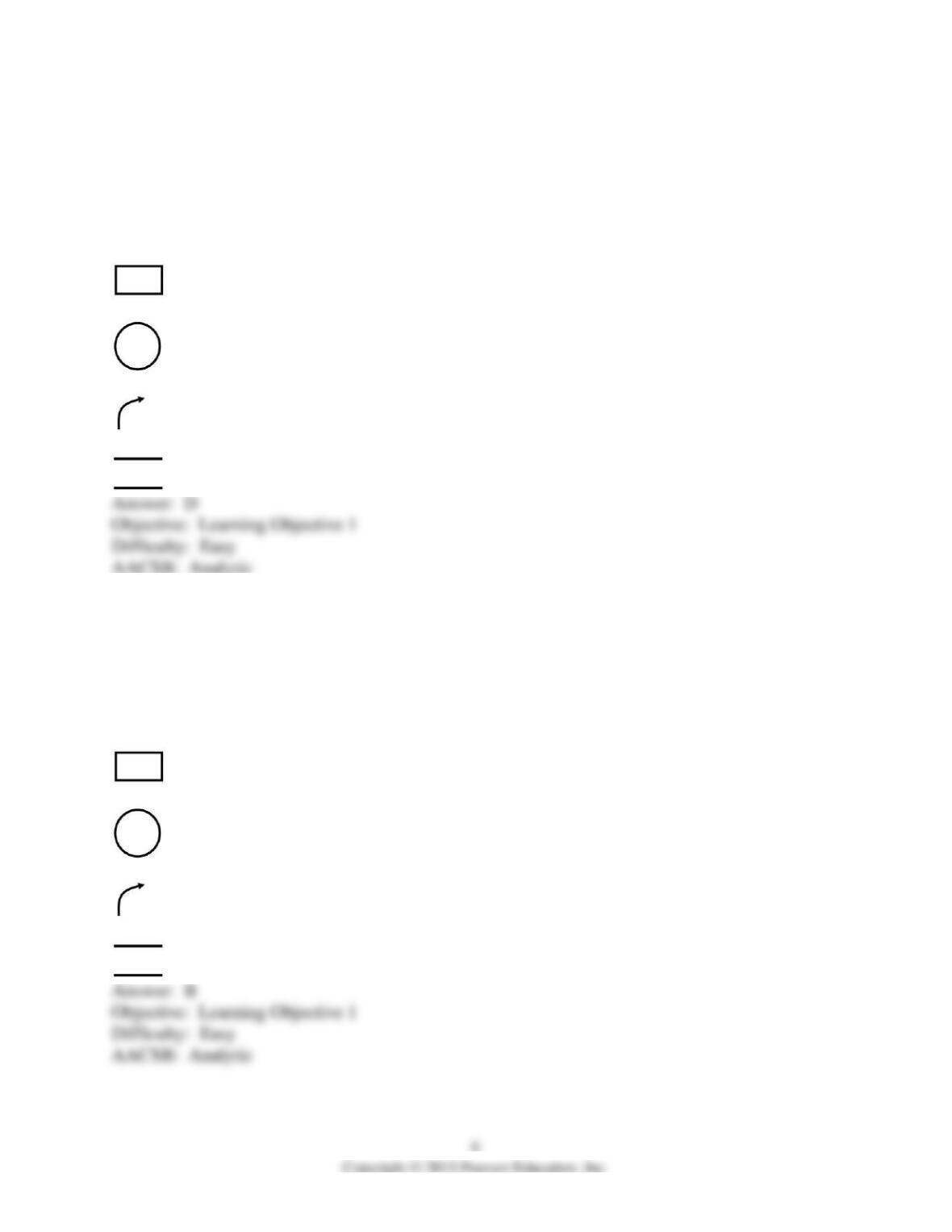
19) The American Bread Company is a small restaurant that collects, stores, prepares and
provides meals to customers in Miami, Florida. When food is received, it is recorded in a
database and a receiving ticket is provided to the vendor. When food is used, the database is
updated so that it always reflects the amount and type of food available to customers. In a data
flow diagram, which type of symbol would be used to represent the storage location of data in
the system?
A)
B)
C)
D)
20) The American Bread Company is a small restaurant that collects, stores, prepares and
provides meals to customers in Miami, Florida. When food is received, it is recorded in a
database and a receiving ticket is provided to the vendor. When food is used, the database is
updated so that it always reflects the amount and type of food available to customers. In a data
flow diagram, which type of symbol would be used to represent the process of updating the
company’s inventory records in the system?
A)
B)
C)
D)
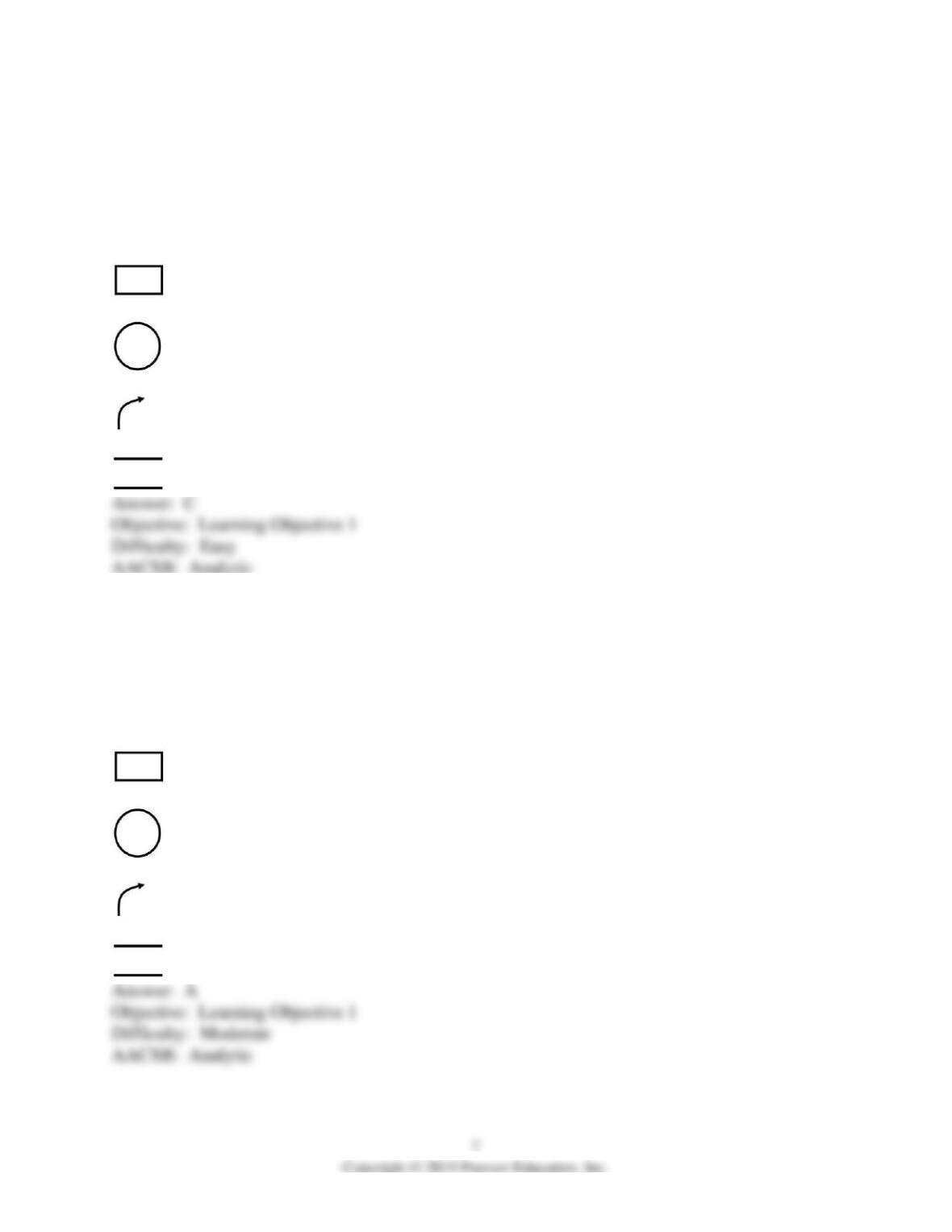
21) The American Bread Company is a small restaurant that collects, stores, prepares and
provides meals to customers in Miami, Florida. When food is received, it is recorded in a
database and a receiving ticket is provided to the vendor. When food is used, the database is
updated so that it always reflects the amount and type of food available to customers. In a data
flow diagram, which type of symbol would be used to represent the flow of data provided by the
vendors into the system?
A)
B)
C)
D)
22) Terrell and Monique Anderson run an antique store in their hometown of Dayton, Ohio. To
find items to sell in their shop, they travel around the United States and Europe buying unique
artifacts. Within an hour of making a purchase, they use their smartphone to take a picture of the
item and post a short tweet about the item on Twitter. Then, they ship the item back to Dayton
for sale in their shop. Which symbol should be used to represent Twitter in a context diagram of
this process?
A)
B)
C)
D)
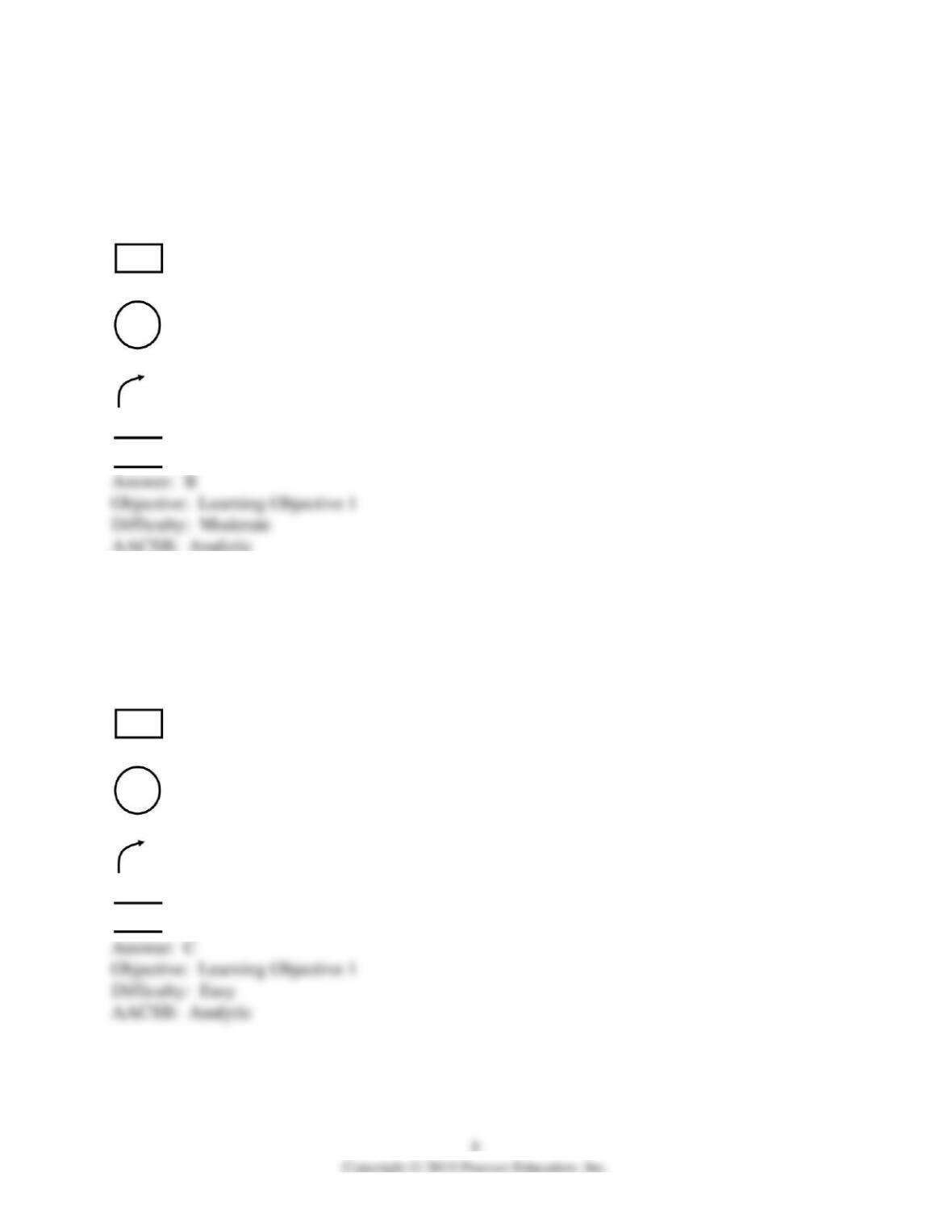
23) Terrell and Monique Anderson run an antique store in their hometown of Dayton, Ohio. To
find items to sell in their shop, they travel around the United States and Europe buying unique
artifacts. Within an hour of making a purchase, they use their smartphone to take a picture of the
item and post a short tweet about the item on Twitter. Which symbol should be used to represent
the preparation of data for their tweet in a context diagram of this process?
A)
B)
C)
D)
24) Terrell and Monique Anderson run an antique store in their hometown of Dayton, Ohio. To
find items to sell in their shop, they travel around the United States and Europe buying unique
artifacts. Within an hour of making a purchase, they use their smartphone to take a picture of the
item and post a short tweet about the item on Twitter. Which symbol should be used to represent
the transfer of data to Twitter in a context diagram of this process?
A)
B)
C)
D)
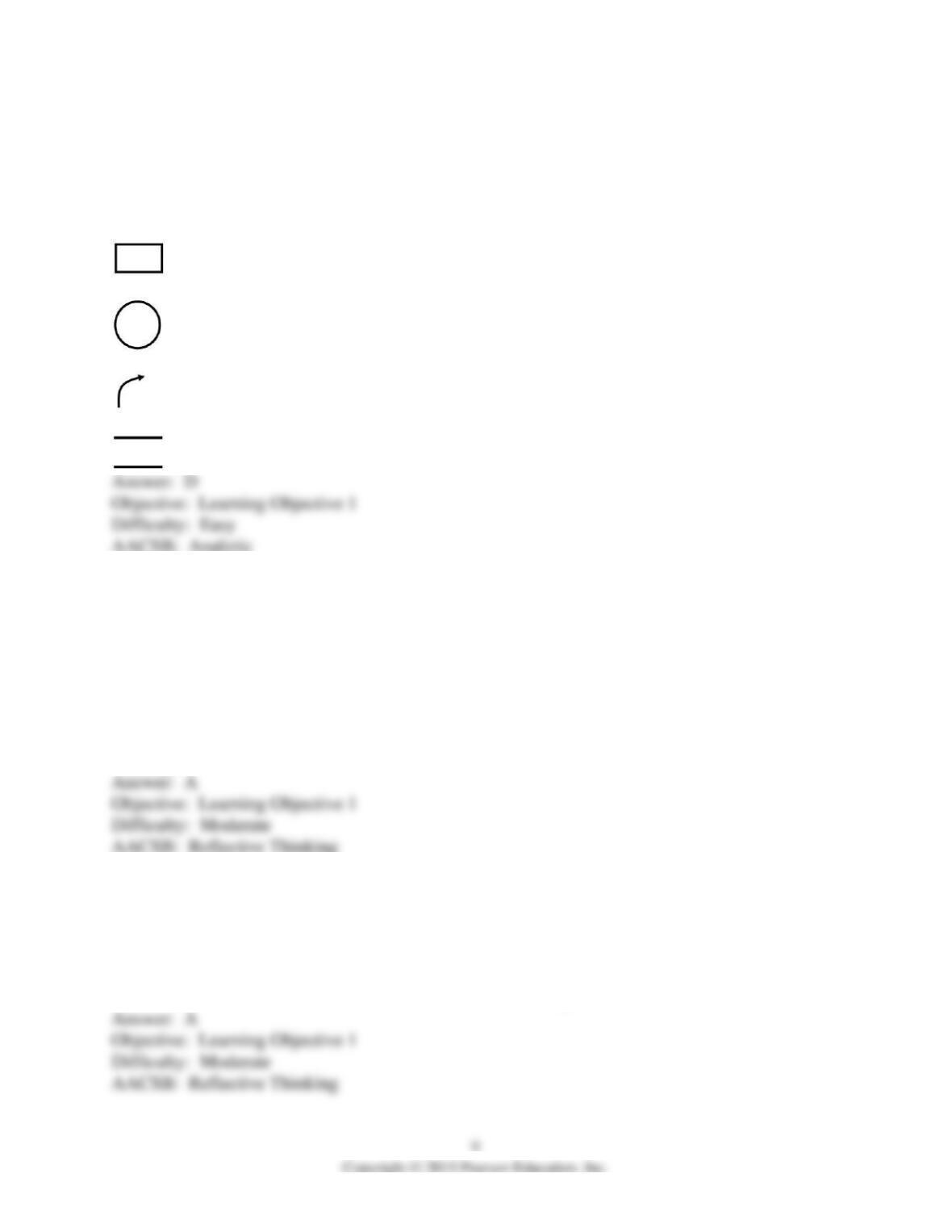
25) Terrell and Monique Anderson run an antique store in their hometown of Dayton, Ohio. To
find items to sell in their shop, they travel around the United States and Europe buying unique
artifacts. Within an hour of making a purchase, they use their smartphone to take a picture of the
item and post a short tweet about the item on Twitter. Which symbol should be used to represent
the remote server that stores the tweets (i.e., the Twitter posts) data?
A)
B)
C)
D)
26) Chas Mulligan has been hired by Yardley Security as an assistant to the internal auditor. He
has been asked to document the existing accounting information system, and focus on the
activities and flow of data between activities. He decides to begin with a summary description of
the sources and uses of data in the organization and how they are processed by the system. The
documentation tool that he should employ for this purpose is a
A) data flow diagram.
B) document flowchart.
C) system flowchart.
D) program flowchart.
27) A well-planned and drawn level 0 data flow diagram for the expenditure cycle would show
which of the following processes?
A) 1.0 Order Goods; 2.0 Receive and Store Goods; 3.0 Pay for Goods
B) 1.0 Order Goods; 1.1 Receive and Store Goods; 1.2 Pay for Goods
C) 0.1 Order Goods; 0.2 Receive and Store Goods; 0.3 Pay for Goods
D) 0.1 Order Goods; 0.12 Receive and Store Goods; 0.13 Pay for Goods
28) A well-planned and drawn context data flow diagram will include how many processes?
A) one
B) between 5 and 7
C) between 2 and 7, but no more than 7
D) as many as are needed to accurately depict the process being documented
29) Data flow diagrams depict
A) processes, but not who is performing the processes.
B) processes, but not the data that flows between processes.
C) who is performing processes, but not how they perform the process.
D) who is performing processes, but not the data that flows between processes.
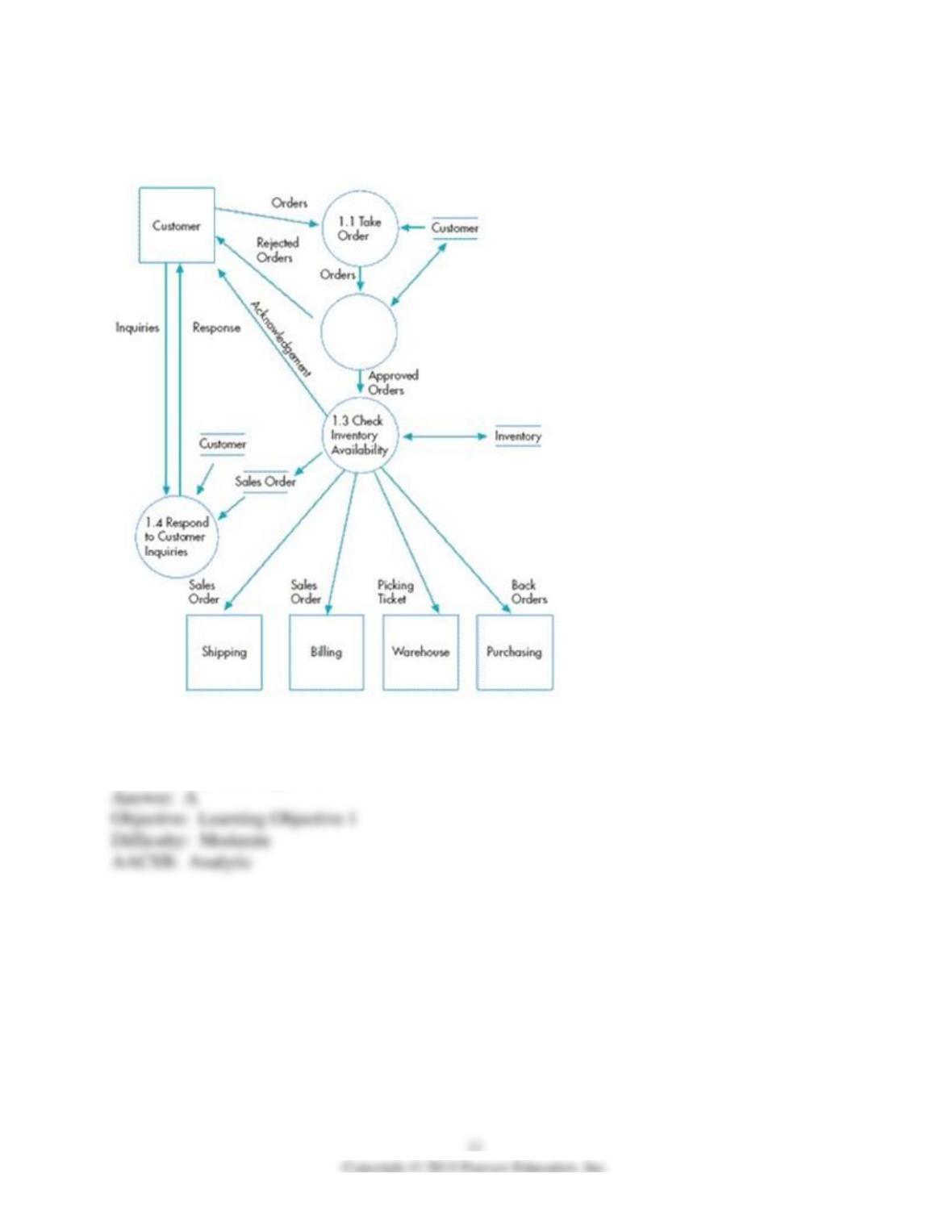
30) Which is the correct label for the blank transformation process circle in the data flow
diagram below?
A) 1.2 Check Credit
B) 1.2 Enter Order in Sales Journal
C) 1.2 Does Customer Have Credit?
D) 1.2 Salesperson Approves
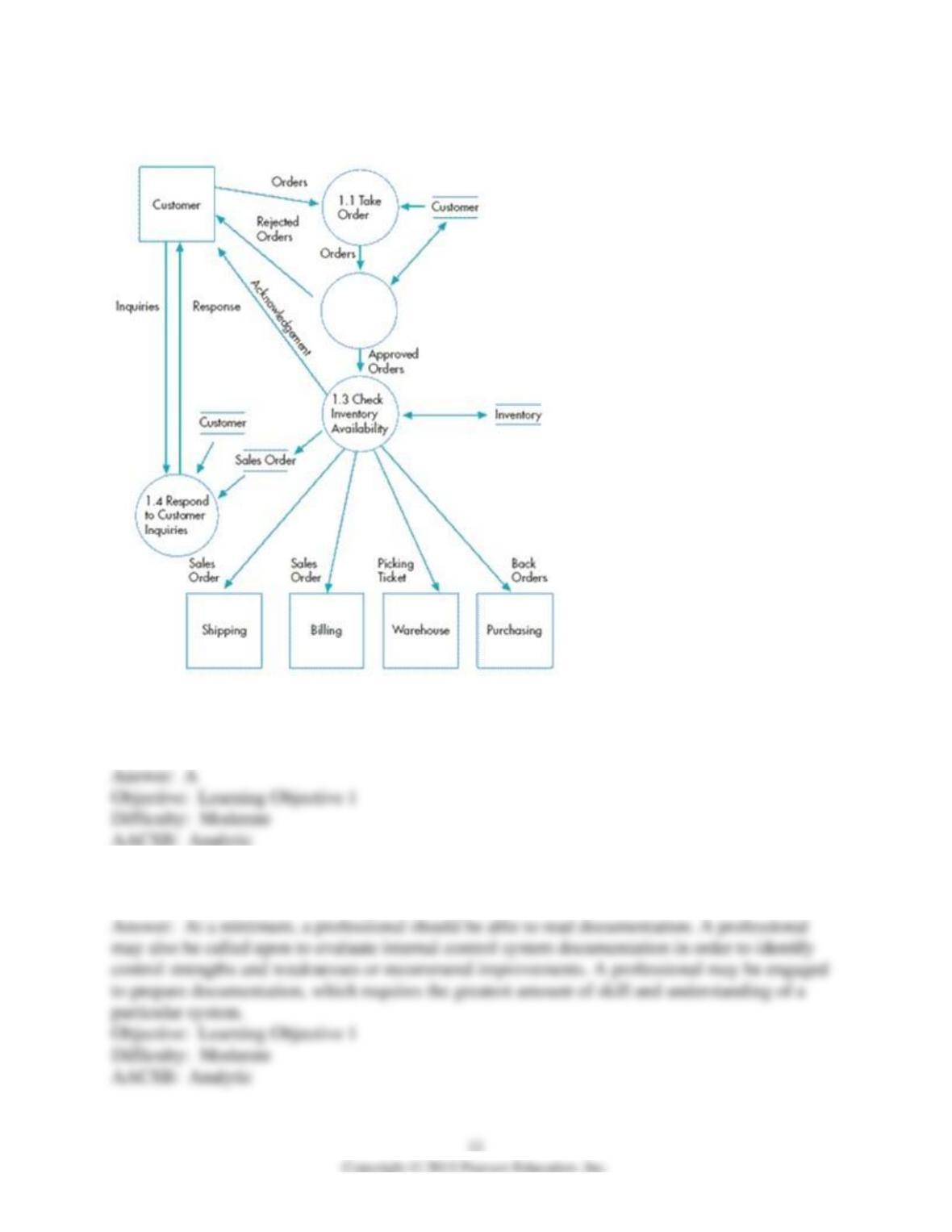
31) In the data flow diagram below, inventory is a
A) data store.
B) data source.
C) data flow.
D) data source and destination.
32) Discuss the ways in which information professionals interact with documentation tools and
the various levels of understanding necessary.
33) Explain two reasons why it is important to have a working knowledge of DFDs and
flowcharting.
34) What does the Sarbanes-Oxley Act require that is relevant to documentation tools?
35) Describe a situation in which data flow should be shown with two data flow lines instead of
one.
36) Describe the different levels of DFDs.
37) How is a DFD different from a flowchart?
38) Explain the relevance of the Sarbanes Oxley Act to the documentation tools presented in this
chapter.
39) Discuss the idea of a data flow.
40) What is the value of using a context diagram when working with DFDs?
41) Identify five important guidelines for drawing a DFD. Select one from your list and describe
why it could be the most important one to consider when preparing a DFD. Support your choice
with an example.
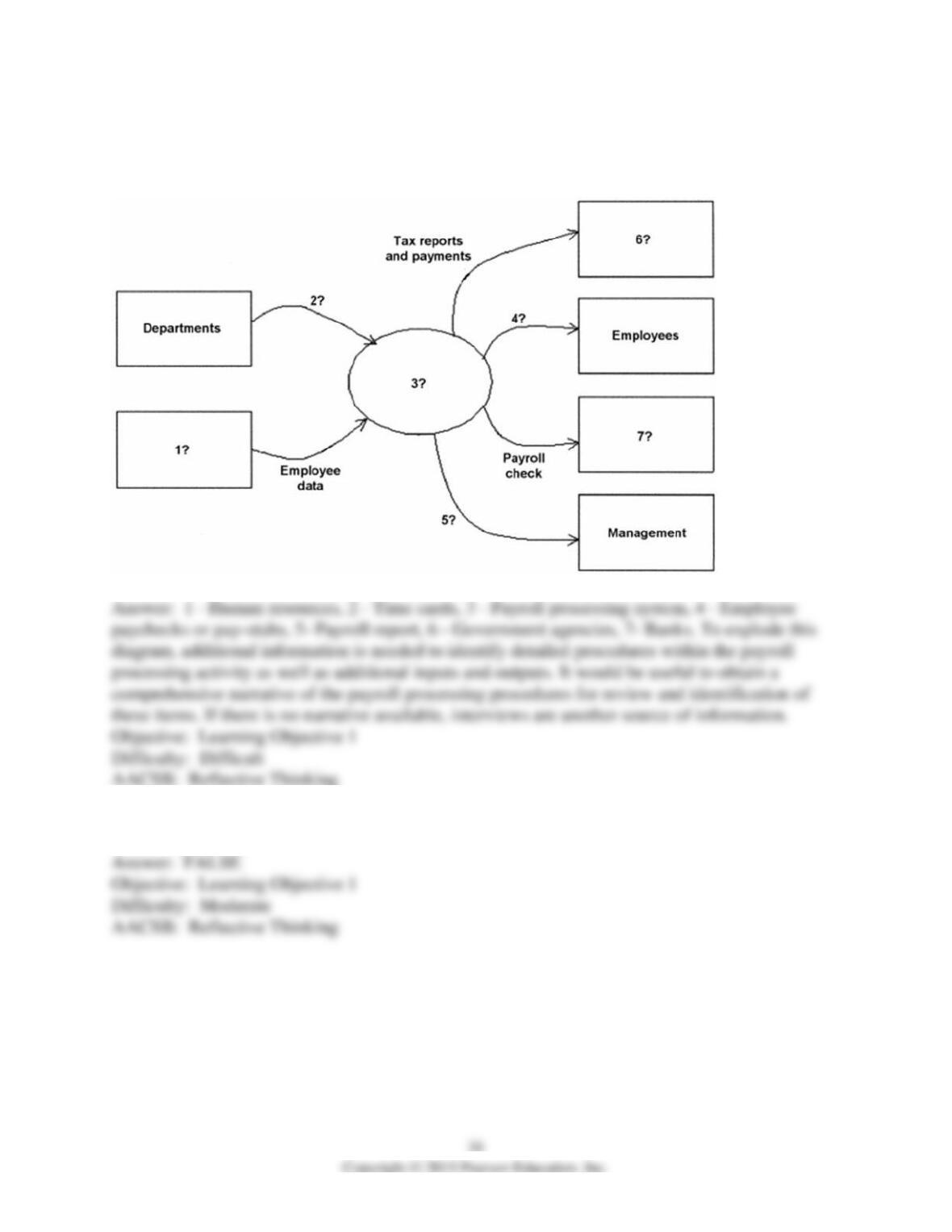
42) Following is a context diagram for a current Payroll Processing System. a) Identify the data
sources and destinations, data flows, and transformation process marked by question marks. b)
What would you need to do to explode this diagram?
43) True or False: The Sarbanes-Oxley Act requires auditors to create flowcharts to document
business processes.
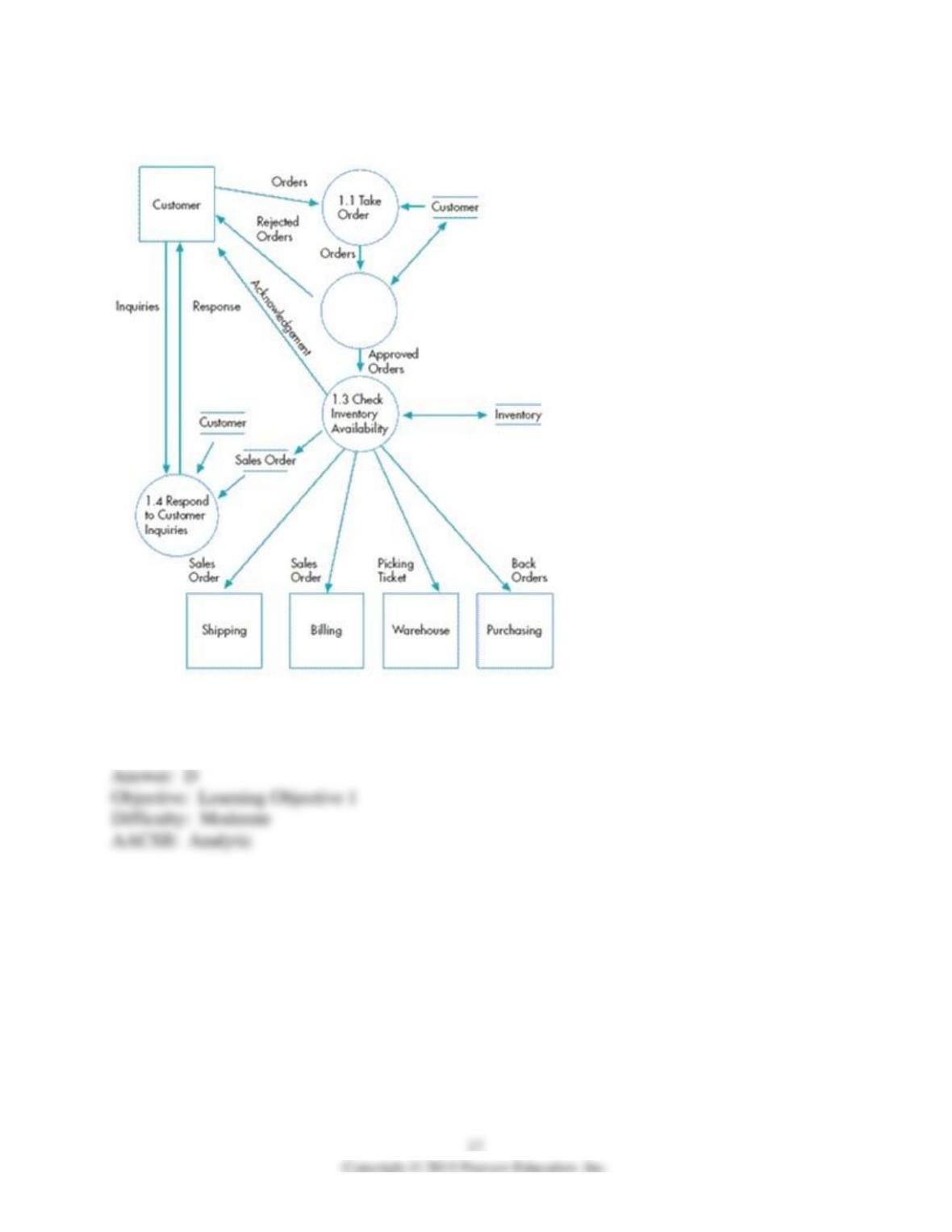
44) In the data flow diagram below, Shipping is a
A) data store.
B) data flow.
C) data source.
D) data destination.
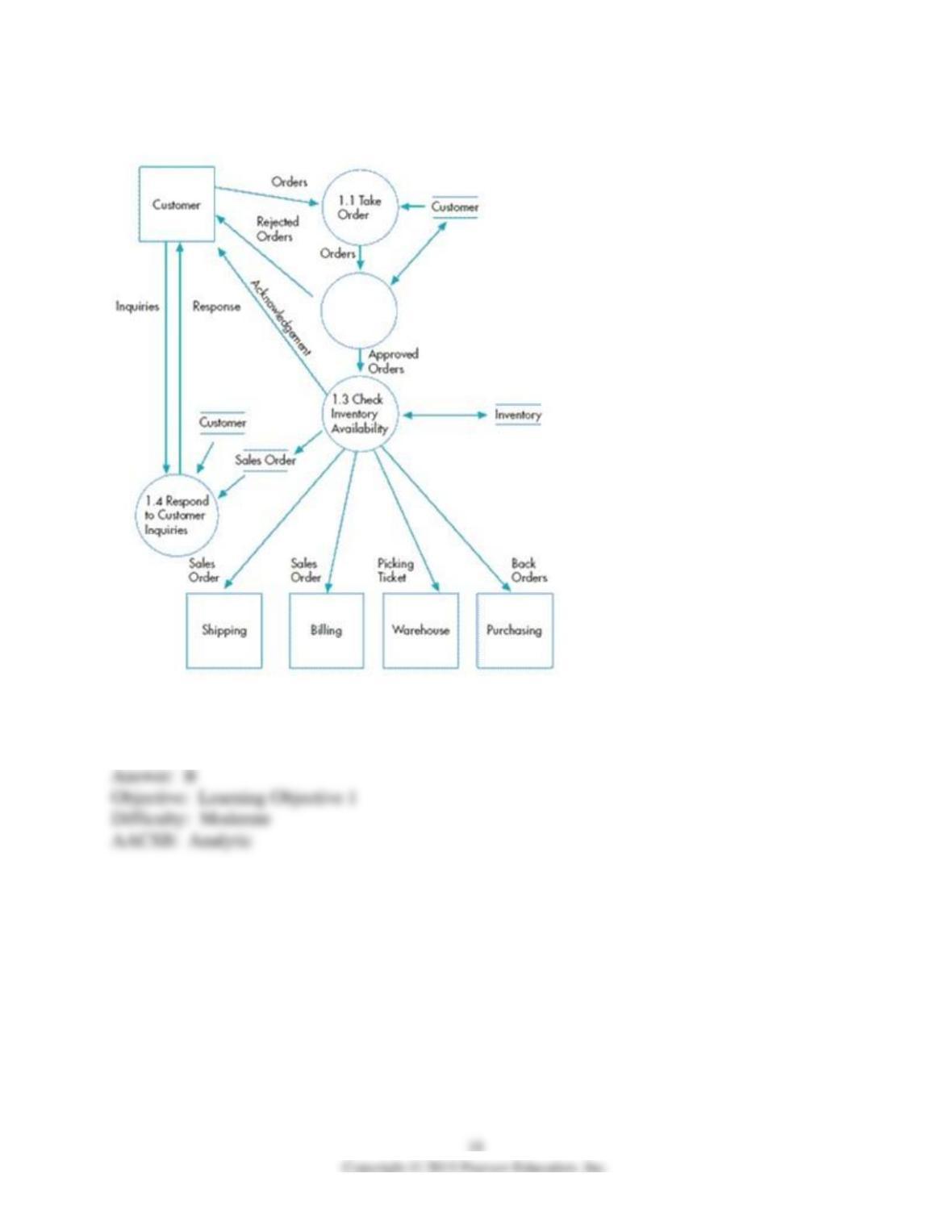
45) In the data flow diagram below, which process happens first?
A) Respond to customer inquiries
B) Take order
C) Check inventory availability
D) Approve order
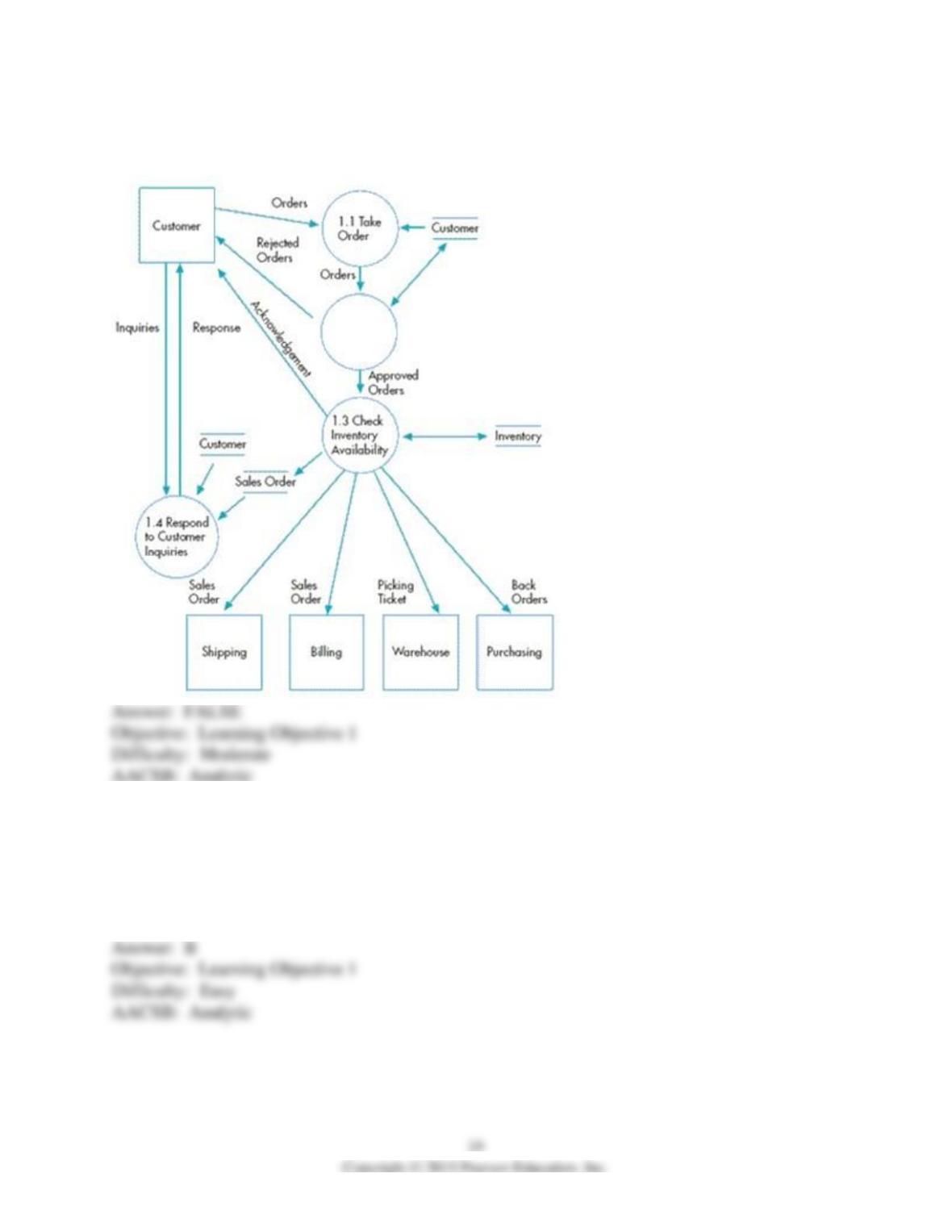
46) True or False: In the data flow diagram below, a customer order must be approved before
the company checks to make sure the inventory is available.
47) In a data flow diagram of the vendor payment process, what symbol would most
appropriately reflect an update of the payables account?
A) a square
B) a circle
C) two horizontal lines
D) none of the above
48) In a data flow diagram of the vendor payment process, “Vendor” will appear above or in
A) a square.
B) a circle.
C) two horizontal lines.
D) none of the above
49) In a data flow diagram, an inverted triangle represents
A) an internal control.
B) document filing.
C) on page connection.
D) document processing.
50) In a data flow diagram that depicts a company’s internal controls, where is each internal
control typically explained in detail?
A) in an annotation on the same page as the internal control
B) inside the symbol used to represent the internal control
C) on a table that accompanies the internal control data flow diagram
D) Internal controls are not typically explained in detail in an internal control data flow diagram.
51) Which documentation technique would not depict the type of storage medium used (such as
a flash drive or a hard drive) to physically store data?
A) system flowchart
B) data flow diagram
C) business process diagram
D) internal control flowchart