Financial Accounting, 11e (Harrison/Horngren/Thomas)
Chapter 3 Accrual Accounting & Income
1 Learning Objective 3-1
1) Under cash-basis accounting, stockholders’ equity is increased when company makes a sale, not
when the company collects the cash at a later date.
2) The journal entry to record a cash sale will be the same under the accrual and cash-basis of
accounting.
3) Under cash-basis accounting, no journal entry is recorded when a sale is made on account.
4) Generally Accepted Accounting Principles (GAAP) require the use of accrual accounting.
5) Accrual accounting records the impact of both cash and noncash business transactions as they occur.
6) Under cash-basis accounting, income statements and balance sheets may be misstated.
7) The basic defect of cash-basis accounting is that the cash basis ignores important information.
8) Cash-basis accounting is a more faithful representation of economic reality than accrual accounting.
9) The time-period concept ensures that the accounting information follows the framework of concepts
and principles.
10) The only way for a business to know for certain how well it performed is to shut down, sell the
assets, pay the liabilities, and return any leftover cash to the owners.
11) A doctor performed surgery in March and did not receive cash from the patient until July. Under
accrual accounting, the doctor recognizes revenue:
A) in March.
B) in July.
C) in either March or July.
D) at a time that cannot be determined from the facts.
12) A doctor performed surgery in April and did not receive cash payment from the patient until
August. Under cash-basis accounting, the doctor recognizes revenue:
A) in April.
B) in August.
C) in April or August.
D) at a time that cannot be determined from the facts.
13) Under accrual accounting, revenue is recorded:
A) when the cash is received, regardless of when the services are performed.
B) when the services are performed, regardless of when the cash is received.
C) at the end of every month.
D) only if the cash is received at the same time the services are performed.
14) Which of the following transactions would be recorded under accrual accounting but NOT under
cash-basis accounting?
A) collecting cash from customers
B) borrowing money from the bank
C) purchasing of inventory on account
D) issuing stock for cash
15) Which of the following is a CORRECT statement about the two bases of accounting?
A) Cash-basis accounting records revenues when they are earned.
B) Cash-basis accounting records expenses only at the end of the month.
C) GAAP requires accrual accounting.
D) Only the largest companies in the United States use accrual accounting.
16) The ________ basis of accounting records revenues ONLY when cash is received.
A) deferral
B) cash
C) accrual
D) hybrid
17) When cash-basis accounting is used, and services are provided on account:
A) only the income statement will be incorrect.
B) only the balance sheet will be incorrect.
C) both the income statement and the balance sheet will be incorrect.
D) either the income statement or the balance sheet will be incorrect.
18) An expense occurred in 2016, but it is not paid until 2017. Using accrual accounting, the expense
should appear on:
A) the 2016 income statement.
B) the 2017 income statement.
C) whichever income statement the business prefers.
D) both the 2016 and 2017 income statements.
19) An expense occurred in 2016, and it is not paid until 2017. Using cash-basis accounting, the expense
should appear on:
A) the 2016 income statement.
B) the 2017 income statement.
C) whichever income statement the business prefers.
D) both the 2016 and 2017 income statements.
20) Under accrual-basis accounting, if a company fails to record a sale on account:
A) revenue will be understated.
B) assets will be understated.
C) net income will still be correct.
D) A and B.
21) An interim period used for reporting purposes is generally:
A) more than one year, but less than the life of the company.
B) more than one year.
C) less than one year.
D) the same as the fiscal year.
22) The requirement to report accounting information at regular intervals is known as the:
A) interim reporting concept.
B) revenue principle.
C) time-period concept.
D) expense recognition principle.
23) Which of the following statements regarding the time-period concept is NOT correct?
A) Interim financial reports are rarely prepared.
B) Accountants prepare financial statements for specific periods of time.
C) The basic accounting period is one year.
D) Most large companies use a calendar year for financial reporting.
24) Wilde Company earned revenues of $150,000 in cash and $210,000 on account during 2016. Of the
$210,000 on account, $61,000 was collected in cash in 2016 and the rest in 2017. The company incurred
expenses of $135,000 in 2016 and made payments of $70,000 towards the expenses in 2016. What is net
income in 2016 under cash-basis accounting?
A) $140,000
B) $80,000
C) $141,000
D) $225,000
25) Winter Company earned revenues of $170,000 in cash and $230,000 on account during 2016. Of the
$230,000 on account, $66,000 was collected in cash in 2016 and the rest in 2017. The company incurred
expenses of $105,000 in 2016 and made payments of $80,000 towards the expenses in 2016. What is net
income in 2016 under accrual accounting?
A) $125,000
B) $295,000
C) $320,000
D) $400,000
26) Accrual accounting records all of the following transactions EXCEPT:
A) earning of unearned revenue received in advance.
B) expiration of prepaid insurance.
C) accrual of expenses incurred but not paid.
D) receipt of Award for Service to the Community of Naperville, Illinois.
27) Cash-basis accounting does NOT record:
A) receipt of cash from interest earned on note receivable.
B) payment of salaries to employees.
C) expiration of prepaid rent.
D) borrowing money from the local bank.
28) Cash-basis accounting does NOT record:
A) purchase of supplies with cash.
B) sale of common stock.
C) payment of note payable.
D) depreciation expense.
29) Under cash-basis accounting, cash receipts are treated as ________ and cash payments are treated as
________.
A) retained earnings; dividends
B) retained earnings; income
C) revenues; expenses
D) gains; losses
2 Learning Objective 3-2
1) The revenue principle determines when to record revenue and the amount of revenue to record.
2) The revenue principle states that revenue should be recorded in the same period as the cash is
received.
3) Under international financial reporting standards (IFRS), the retail industry recognizes revenue when
the cash is received.
4) The expense recognition principle states that expenses have future benefit to the company.
5) Expenses have a future benefit to the company.
6) The expense recognition principle recognizes expenses in the period they are paid.
7) The amount of revenue to record is the amount of cash or its equivalent that is transferred from the
customer to the seller.
8) Expenses are the costs of assets used up and liabilities created in earning revenue.
9) Since accrual accounting follows the revenue principle and the expense recognition principle, all
ethical challenges are avoided.
10) On December 15, 2017, a company receives an order from a customer for services to be performed
on December 28, 2017. Due to a backlog of orders, the company does not perform the services until
January 3, 2018. The customer pays for the services on January 6, 2018. The revenue principle requires
the revenue to be recorded by the company on:
A) December 15, 2017.
B) January 3, 2018.
C) December 28, 2017.
D) January 6, 2018.
11) On July 25, Henry Company’s accountant prepared a check for the August rent payment. Henry
Company mailed the check on July 27 to the landlord. The landlord received the check on July 31 and
cashed it on August 2. When should Henry Company record the rent expense associated with this
transaction? Henry Company uses accrual accounting.
A) July 25
B) July 27
C) August 31
D) August 2
12) The revenue principle deals with the following:
A) when to record revenue and where to record this revenue.
B) where to record revenue and the amount of revenue to record.
C) when to record revenue and the amount of revenue to record.
D) when to record revenue and when to record related expenses.
13) Under accrual accounting, the event that triggers revenue recognition for the sale of goods is the:
A) date a contract is signed.
B) date the customer pays for the goods.
C) date the customer orders the goods.
D) delivery of goods to customer.
14) To obtain a new customer, a business sells merchandise to the customer for $100. Normally, the
merchandise sells for $200. For this sale, the business should record revenue of:
A) $100.
B) $200.
C) either amount.
D) an average of the two amounts.
15) Which of the following is a TRUE statement regarding expenses?
A) Expenses represent future benefit to the company.
B) The expense recognition principle recognizes revenue in the same period in which the related
revenues are earned.
C) Expenses will never result in the creation of a liability account.
D) The critical event for recording salary expense is the payment of cash.
16) The revenue principle requires that a business record revenue when the business:
A) receives an order from a customer.
B) prepares the invoice for the customer.
C) delivers goods to or performs services for a customer.
D) receives payment from a customer.
17) On November 1, 2016, a company using accrual accounting, pays $720,000 for a television
advertising campaign. Commercials will run evenly over six months beginning on November 1, 2016.
How much Advertising Expense will be reported on an income statement prepared for the year ended
December 31, 2017?
A) $240,000
B) $360,000
C) $480,000
D) $720,000
18) A CPA prepares tax returns for clients and bills them after the work is completed. It usually takes
two weeks of work to prepare the tax returns. It takes 30 days on average to receive payment from the
clients. The CPA uses cash-basis accounting. The revenue should be recorded when the CPA:
A) starts working on the tax returns.
B) completes working on the tax returns.
C) bills the clients.
D) receives payments from the clients.
19) The expense recognition principle requires the recognition of expenses:
A) in the same period in which the related revenues are earned.
B) in the period they are paid.
C) in the period assets are created.
D) in the period in which future benefit for the company occurs.
20) The Financial Accounting Standards Board(FASB) and the International Accounting Standards
Board (IASB) are working together to develop similar standards. Which of the following statements is
FALSE?
A) The FASB and IASB have recently issued a joint new standard that provides a globally consistent,
converged, and simplified way to recognize revenue.
B) In the retail merchandising industry, the joint new revenue recognition standard has not
substantially changed the rules by which revenue is recognized.
C) In the retail merchandising industry, FASB and IASB have historically used different rules for
revenue recognition.
D) The joint new revenue recognition standard is based on the idea that all business transactions
involve contracts that exchange goods or services for cash or claims to receive cash.
21) According to the joint new standard for revenue recognition, issued by FASB and IASB, which item
below is NOT necessary?
A) Identify the contract with the customer.
B) Identify the separate performance obligations in the contract.
C) Allocate the transaction price to the separate performance obligations in the contract.
D) Recognize expenses as the entity satisfies the performance obligations.
22) Following the expense recognition principle, to recognize expenses along with the related revenues,
means to:
A) add expenses and revenues together to compute net income or net loss.
B) recognize the expense of a period against the cash revenues during the period.
C) abandon the matching principle.
D) subtract expenses from the related revenues to compute net income or net loss.
23) On June 1, 2017, Starbucks paid the rent of $114,000 for 40 of its stores in Washington and California.
The rent covers the period, June 1, 2017 through November 30, 2017. On June 1, Starbucks will record
________. On June 30, Starbucks will record ________.
A) Rent Expense of $114,000; nothing
B) nothing; Rent Expense of $114,000
C) nothing; Rent Expense of $19,000
D) Prepaid Rent of $114,000; Rent Expense of $19,000
24) On January 1, 2017, a customer places an order for a new customized vehicle. The contract price is
$45,000. The vehicle is delivered to the dealer and customer on April 1, 2017. What amount of revenue
does the dealer record on January 1, 2017 and April 1, 2017?
A) $45,000; $0
B) $22,500; $22,500
C) $15,000; $15,000
D) $0; $45,000
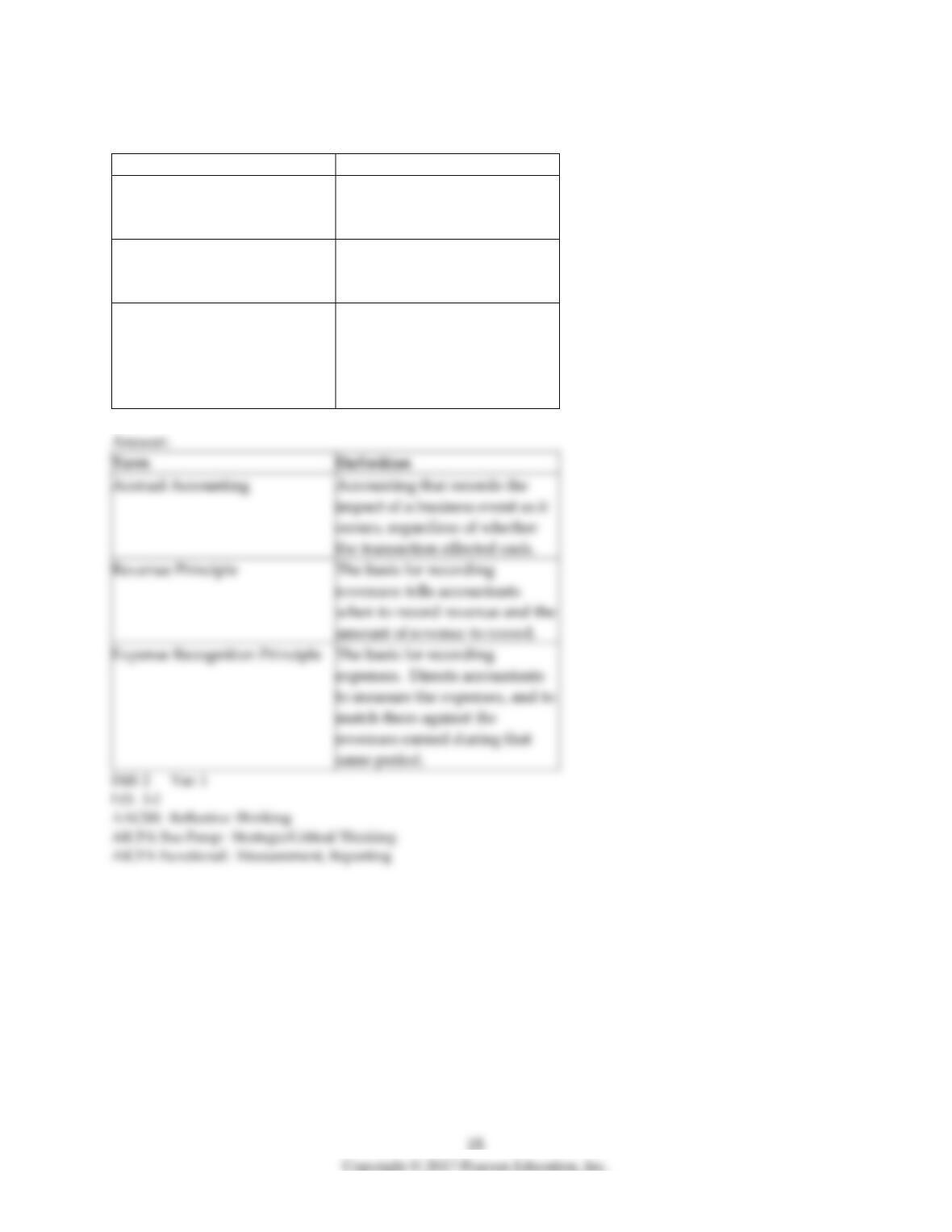
25) Define the following terms:
Term
Definition
Accrual Accounting
Revenue Principle
Expense Recognition Principle
Term
Definition
impact of a business event as it
occurs, regardless of whether
the transaction affected cash.
revenues: tells accountants
when to record revenue and the
amount of revenue to record.
revenues earned during that
same period.

16
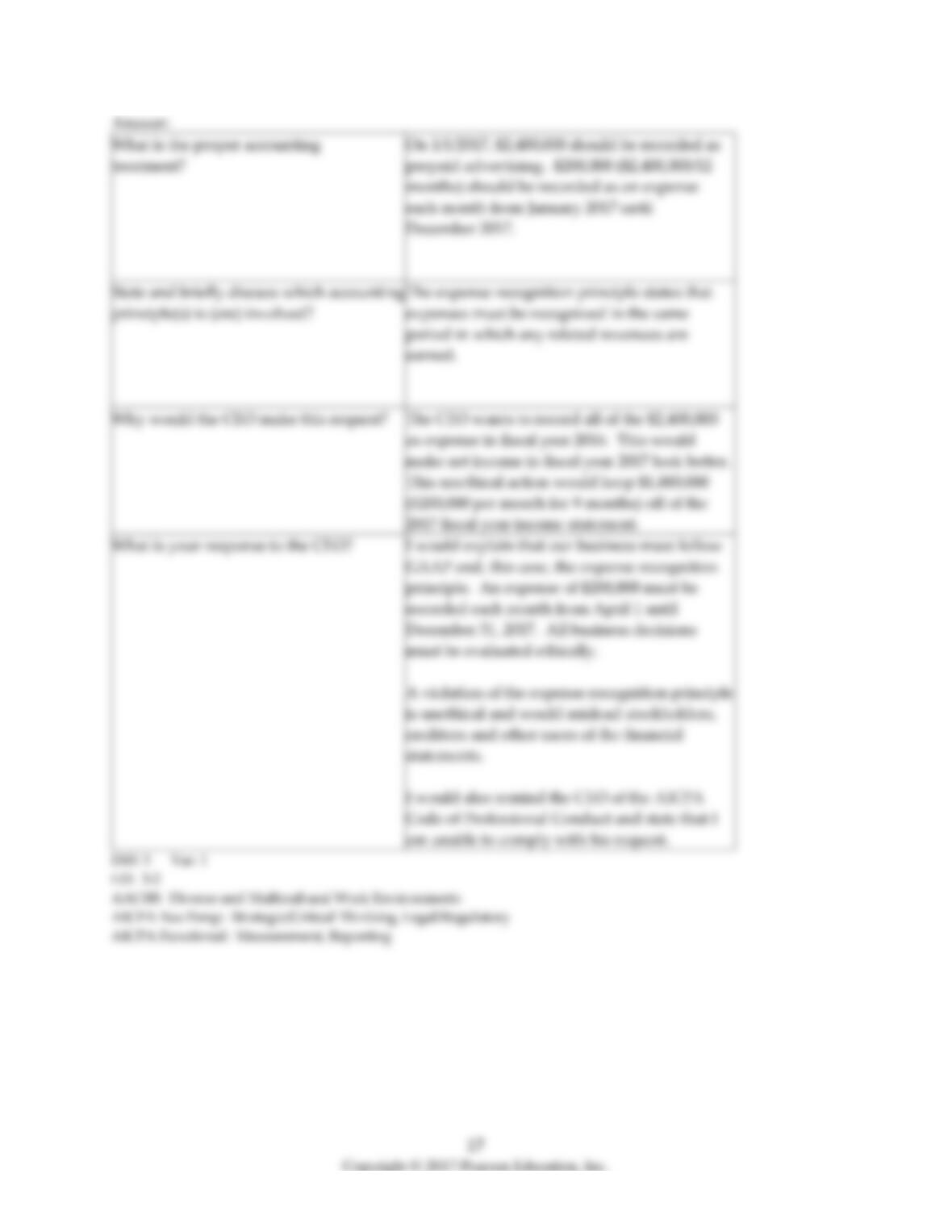
26) Fiscal year 2016 (April 1, 2016 – March 31, 2017) has been great for Murphy Incorporated. Net
income is higher than expected. Management believes that fiscal year 2017 will not be as profitable. On
December 31, 2106, Murphy signed a one year contract for monthly advertising for $2,400,000. The
advertising began on January 1, 2017. The CEO has asked the accountant to expense the $2,400,000
during fiscal year 2016.
You are the accountant. Comment on each of the following:
What is the proper accounting treatment?
State and briefly discuss which accounting
principle(s) is (are) involved?
Why would the CEO make this request?
What is your response to the CEO?
3 Learning Objective 3-3
1) In an unadjusted trial balance, the accounts are not yet ready for the preparation of the company’s
financial statements.
2) Prepaid Rent and Unearned Service Revenue are examples of accounts that do not need to be
adjusted at the end of the accounting period.
3) Some accounts do not need to be adjusted at the end of the period, since the day–to-day transactions
provide all the data for these accounts.
4) An accrual is an adjustment for the receipt of cash in advance of providing services.
5) Depreciation allocates the cost of land to expense over the useful life of the land.
6) An accrual adjustment is made for payment of an item in advance of use.
7) The accumulated depreciation account decreases over the life of the asset.
8) The amount of prepaid insurance that is used up during a period of time is recorded as Insurance
Expense.
9) If deferred revenue has been earned by the end of the current period but no adjustment is recorded,
net income for the current period will be understated.
10) The adjusted trial balance lists only the balance sheet accounts and their final balances in a single
place.
11) Unearned Service Revenue is a revenue account.
12) The adjusting entry, to recognize salaries that are owed to employees, increases net income and
increases liabilities.
13) Every adjusting entry must affect both the income statement and the balance sheet.
14) Income tax expense and the related income tax payable are typically accrued as the final adjusting
entry of the period.
15) One company’s prepaid expense is another company’s unearned revenue.
16) The following accounts are up–to-date and need no adjustment at the end of the period:
A) Cash, Common Stock and Prepaid Rent.
B) Prepaid Rent, Supplies and Unearned Rent Revenue.
C) Cash, Land and Common Stock.
D) Cash, Dividends and Unearned Rent Revenue.