Chapter 03 Activity-Based Costing Answer Key
True / False Questions
1.
Direct labor is an appropriate allocation base for overhead when overhead costs and direct
labor are highly correlated.
2.
Batch-level activities are performed each time a batch of goods is processed. The cost of
a batch-level activity is proportional to the number of units in the batch.
3.
Facility-level costs can be traced on a cause-and-effect basis to individual products.
4.
Activity-based costing involves a two-stage allocation process in which overhead costs are
first assigned to departments and then allocated to products using activity measures.
5.
In the second-stage allocation in activity-based costing, overhead costs are allocated from
activity cost pools to products.
6.
The challenge in designing an activity-based costing system is to identify a reasonably
small number of activities that explain the bulk of the variation in overhead costs.
7.
Managing and sustaining product diversity requires many more overhead resources such
as production schedulers and product design engineers. The costs of these resources
have no obvious connection with direct labor.
8.
Facility-level activities are activities that are carried out regardless of which products are
produced, how many batches are run, or how many units are made.
9.
Companies use three common approaches to assign overhead costs to products—
plantwide overhead rate, departmental overhead rates, and activity-based costing. The
most accurate of these three approaches is departmental overhead rates.
10.
An activity in activity-based costing is an event that causes the consumption of overhead
resources.
11.
When designing an activity-based costing system, accountants should be tasked with
identifying the activities they think are important and that consume most of the resources
in the organization.
12.
If a company has a great deal of product diversity, activity-based costing will generally
yield less accurate product costs than traditional methods based on direct labor or
machine hours.
13.
A plantwide predetermined overhead rate based on direct labor-hours results in high
overhead costs for products with a high direct labor-hour content and low overhead costs
for products with a low direct labor-hour content.
14.
In general, activities and costs should be combined in an activity-based costing system
only if they fall within the same level in the cost hierarchy.
15.
Activities consume resources. In activity-based costing an attempt is made to trace the
costs of those activities directly to the products that cause them.
16.
An activity measure in activity-based costing expresses how much of an activity is carried
out and it is used as the allocation base for assigning overhead costs to departments.
17.
An activity rated is computed for each activity cost pool—not for each product.
18.
The activity rates in activity-based costing are not intended to set targets for how quickly
a task should be completed.
19.
Activity rates in activity-based costing are computed by dividing costs from the first-stage
cost assignments by the activity measure for each activity cost pool.
20.
In activity-based costing, unit product costs computed for external financial reports
include direct materials costs.
21.
In activity-based costing, unit product costs computed for external financial reports
include direct materials, direct labor, and only a part of manufacturing overhead costs.
22.
When a company changes from a traditional costing system to an activity-based costing
system, the unit product costs of low-volume products typically change more than the unit
product costs of high-volume products.
23.
When a company changes from a traditional costing system to an activity-based costing
system, costs will ordinarily shift from low-volume products to high-volume products when
the activity-based costing system includes batch-level or product-level costs.
24.
When a company changes from a traditional cost system in which manufacturing overhead
is applied based on direct labor-hours to an activity-based costing system in which there
are batch-level and product-level costs, the unit product costs of high-volume products
typically increase whereas the unit product costs of low-volume products typically
decrease.
Multiple Choice Questions
25.
Which of the following would be classified as a product-level activity?
26.
Setting up a machine to change from producing one product to another is an example of
a:
27.
Would the following activities at a manufacturer of canned soup be best classified as unit-
level, batch-level, product-level, or facility-level activities?
Researching
new recipes
Shipping orders to
grocery stores
A)
Unit
Unit
B)
Batch
Batch
C)
Product
Unit
D)
Product
Batch
28.
Testing a prototype of a new product is an example of a:
29.
Material handling is an example of a:
30.
Assembling a product is an example of a:
31.
The plant manager’s work is an example of a:
32.
Which of the following would be classified as a product-level activity?
33.
In activity-based costing, the activity rate for an activity cost pool is computed by dividing
the total overhead cost in the activity cost pool by:
34.
In activity-based costing, unit product costs computed for external financial reports do
NOT include:
35.
When switching from a traditional costing system to an activity-based costing system that
contains some batch-level costs:
36.
All other things the same, the unit product costs of high volume products will decrease
and the unit product costs of low volume products will increase when switching from a
traditional costing system to an activity-based costing system if:

37.
Marchan, Inc., manufactures and sells two products: Product K1 and Product S6. Data
concerning the expected production of each product and the expected total direct labor-
hours (DLHs) required to produce that output appear below:
Expected Production
Direct Labor-Hours Per Unit
Total Direct
Labor-Hours
Product K1
500
8.0
4,000
Product S6
100
5.0
500
Total direct labor-hours
4,500
The company is considering adopting an activity-based costing system with the following
activity cost pools, activity measures, and expected activity:
Estimated
Expected Activity
Activity Cost
Pools
Activity
Measures
Overhead
Cost
Product
K1
Product
S6
Total
Labor-related
DLHs
$127,485
4,000
500
4,500
Production
orders
orders
27,820
400
600
1,000
General factory
MHs
452,868
4,000
3,800
7,800
$608,173
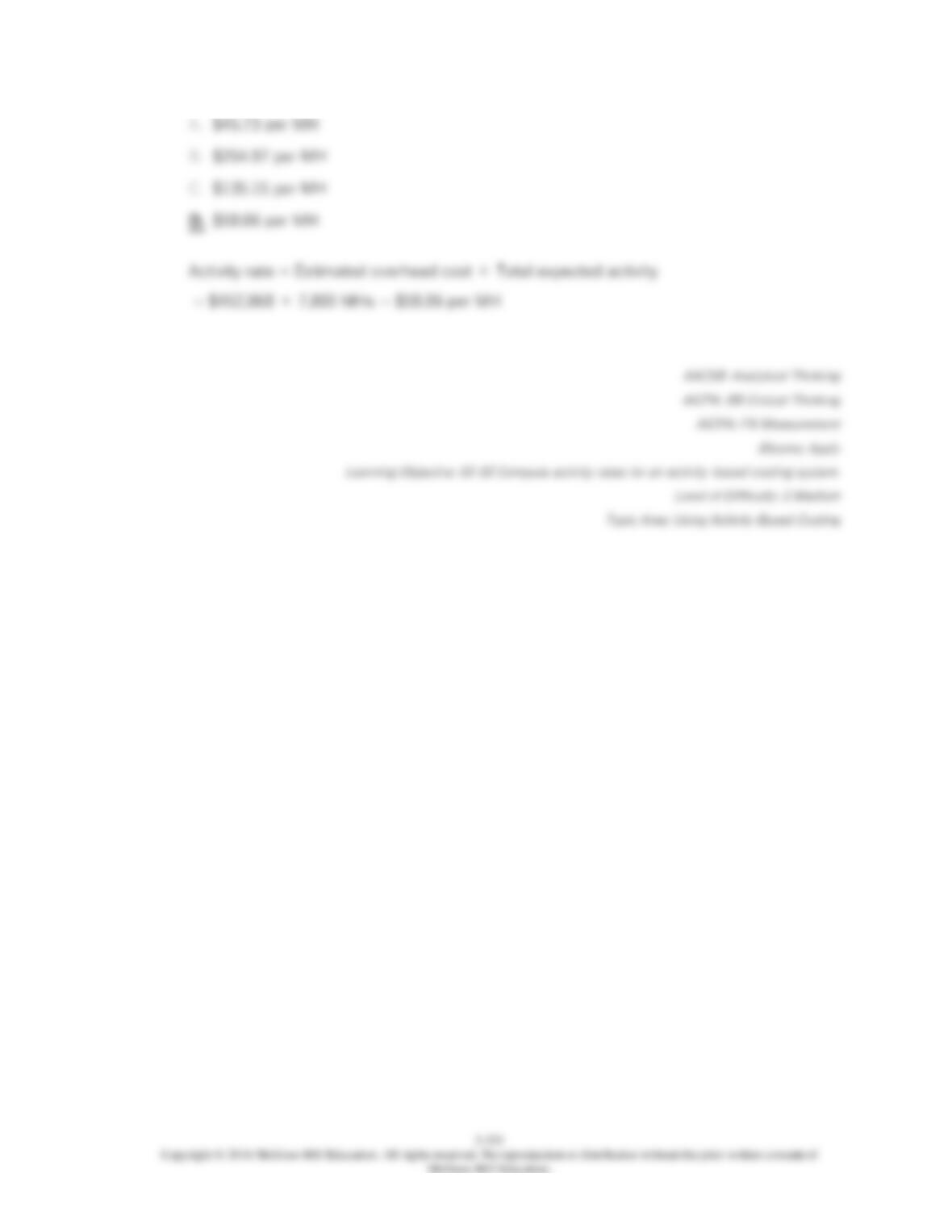
The activity rate for the General Factory activity cost pool under activity-based costing is
closest to:

38.
Pedrozo, Inc., manufactures and sells two products: Product R9 and Product O3. The
company is considering adopting an activity-based costing system with the following
activity cost pools, activity measures, and expected activity:
Estimated
Expected Activity
Activity
Cost
Pools
Activity
Measures
Overhead
Cost
Product
R9
Product
O3
Total
Labor-
related
DLHs
$197,540
4,000
10,000
14,000
Product
testing
tests
32,760
400
300
700
General
factory
MHs
567,758
3,300
3,400
6,700
$798,058
The activity rate for the Labor-Related activity cost pool under activity-based costing is
closest to: