1. Both total revenues (TR) and total costs (TC) are likely to be affected by changes in the
output.
2. Cost-volume-profit (CVP) analysis assumes that the production volume equals sales
volume so that any changes in unit prices can be ignored.
3. The total contribution margin is the unit contribution margin multiplied by the number of
units minus the fixed component of the total costs (TC).
4. Profit is the unit contribution margin multiplied by the number of units minus the fixed
component of the total costs (TC).
5. If the average selling price is $.60 per unit, the average variable cost is $.36 per unit, and
the total fixed costs are $1,500, then sales of 15,000 units will result in operating profits of
$3,600.
6. The average selling price is $.60 per unit, the average variable cost is $.36 per unit, and
the total fixed costs are $1,500. If operating profits of $900 are desired, a sales volume of 2,500
units is necessary.
7. The contribution margin ratio is the contribution margin per unit divided by the selling
price per unit.
8. If the fixed costs are $2,400, targeted operating profits is $1,200, selling price per unit is
$2, and the contribution margin ratio is 40%, then the required sales volume is 9,000 units.
9. The break-even point in sales dollars is fixed costs divided by the contribution margin
ratio.
10. An organization’s operating leverage is high when it has a low proportion of variable costs
in its total costs.
11. An increase in the selling price per unit will decrease an organization’s operating
leverage, assuming sales unit volume doesn’t change and there are no other changes in its cost
structure.
12. The break-even point for an organization with a low operating leverage will be relatively
higher than the break-even point for an organization with a high operating leverage.
13. An increase in an organization’s fixed costs will result in a lower margin of safety,
assuming all other costs and sales remain unchanged.
14. An increase in an organization’s tax rate will cause an increase in its break-even point.
15. Before-tax operating profits are equal to the after-tax operating profits divided by (1 – tax
rate).
16. If an organization’s fixed costs are $2,400, tax rate is 40%, and contribution margin is
$5,200, then its after-tax operating profits are $1,680.
17. If the fixed costs are $2,400, targeted before-tax operating profit is $1,200, tax rate is
25%, selling price per unit is $2, and contribution margin ratio is 40%, then the sales volume is
9,000 units.
18. Cost-volume-profit (CVP) analysis is more complicated for organizations with multiple
products because typically each product has a different contribution margin ratio.
19. The JK Manufacturing Company sells two products, J and K. J has a higher contribution
margin ratio than K. If the product mix shifts towards K, the company’s break-even point in total
units (i.e., J plus K) will increase.
20. In multi-product cost-volume-profit (CVP) analysis, the fixed product mix method and the
weighted-average contribution margin method yield different break-even points.
21. Cost-volume-profit (CVP) analysis is a simple but powerful tool to assist management
make operating decisions. Which of the following does not represent a potential use of CVP
analysis?
22. Which of the following would not cause the break-even point to change?
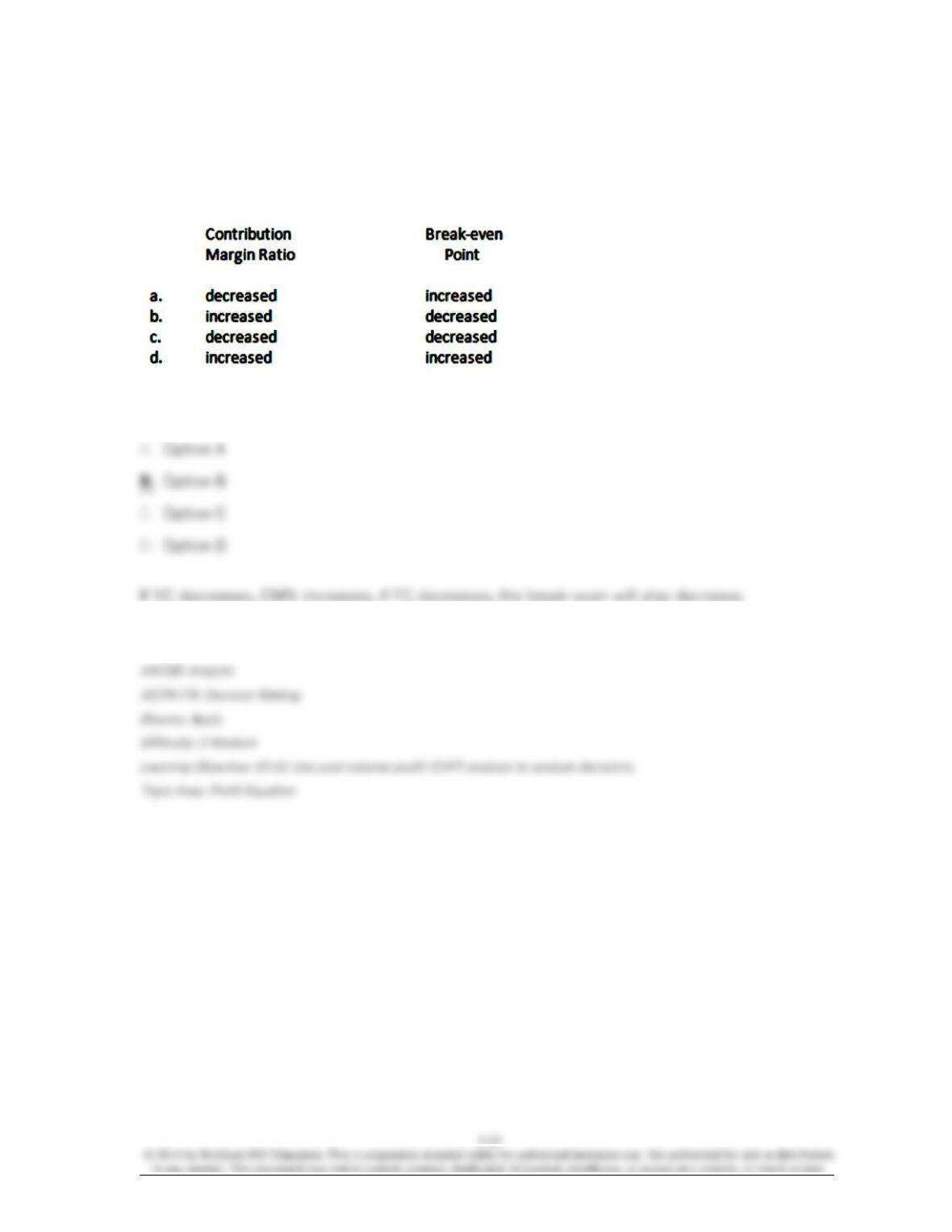
23. If the fixed costs for a product decrease and the variable costs (as a percentage of sales
dollars) decrease, what will be the effect on the contribution margin ratio and the break-even
point, respectively?
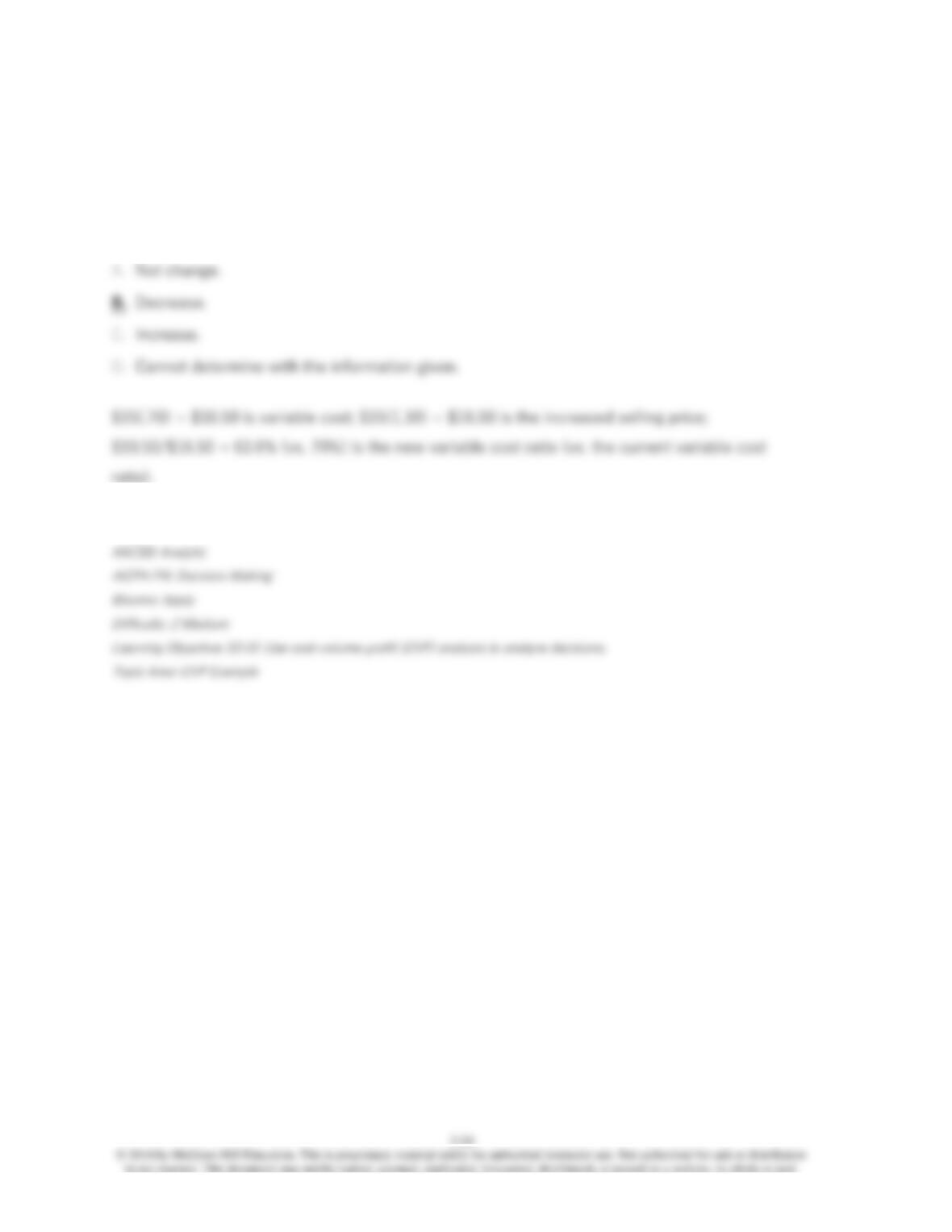
24. The Blue Company is currently selling its single product for $15. Variable costs are
estimated to remain at 70% of the current selling price and fixed costs are estimated to be $4,800
per month. If Blue increases its selling price by 10%, its variable cost ratio will:
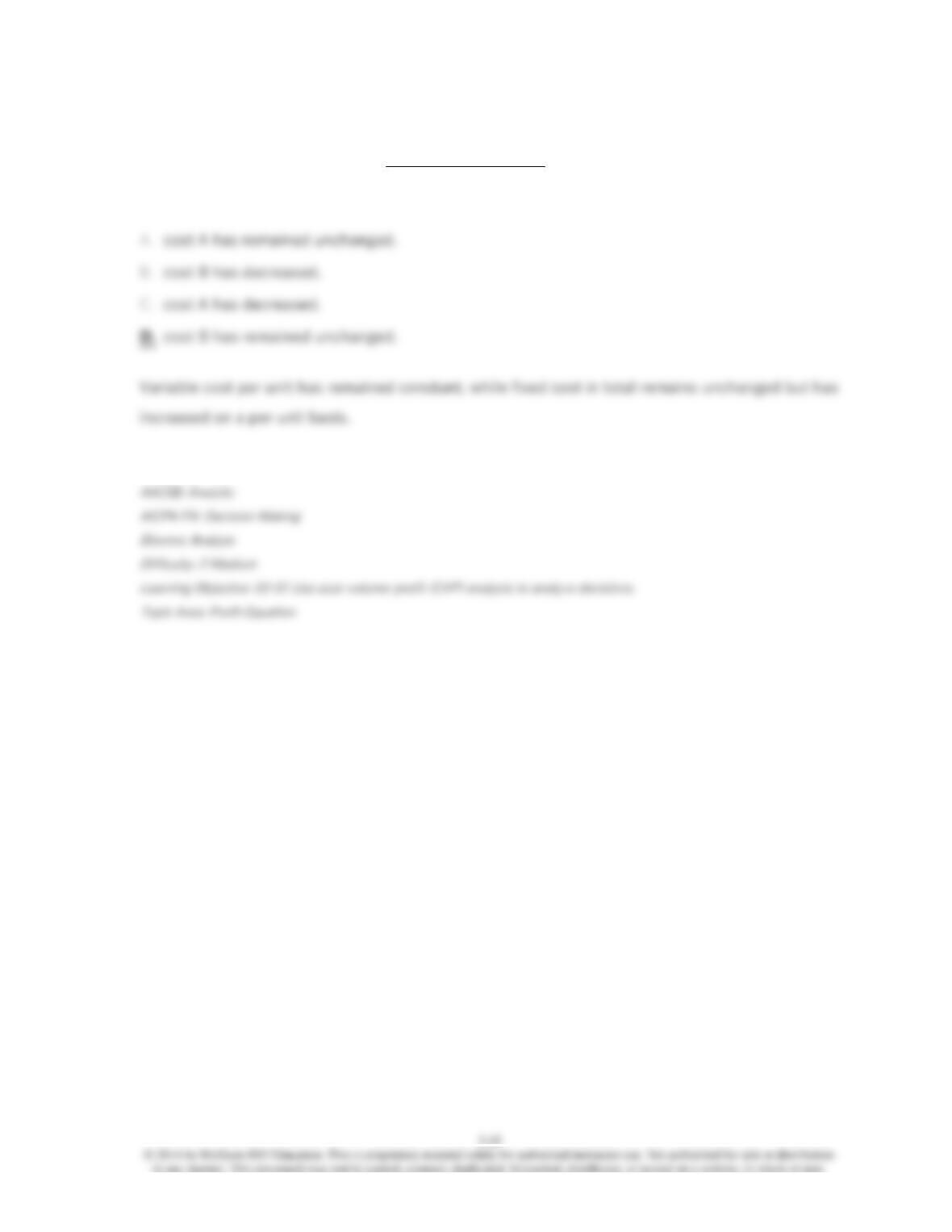
25. Cost A is a fixed cost, while B is a variable cost. During the current year, the volume of
output has decreased. In terms of cost per unit of output, we would expect that:
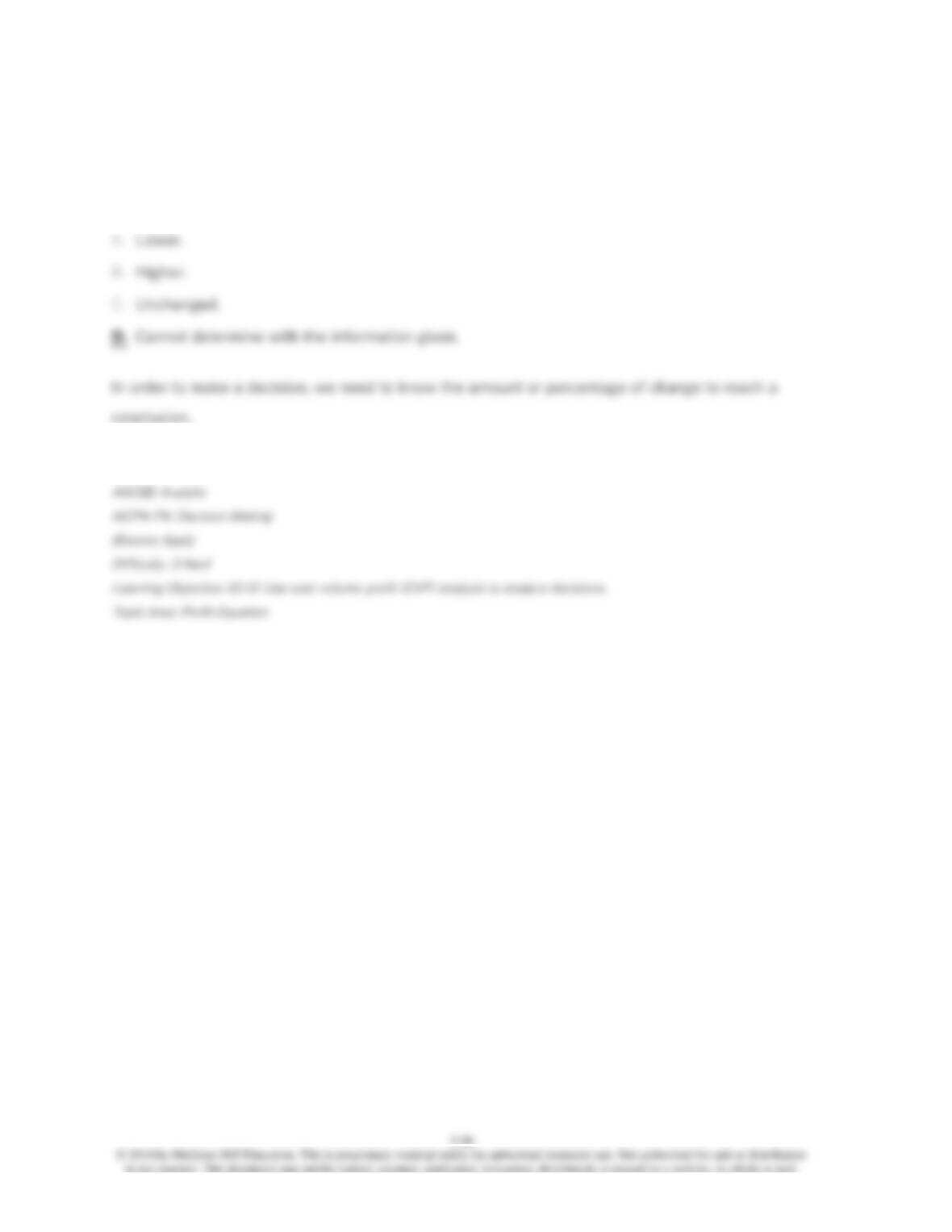
26. If both the variable cost per unit and the selling price per unit decrease, the new
contribution margin ratio in relation to the old contribution margin ratio will be:
27. A company’s break-even point will not be increased by:
28. Which of the following changes to a company’s contribution income statement will always
lower the break-even point (either in units or in dollars)?
29. Operating leverage refers to the extent to which an organization’s cost structure is made
up of:
30. A decrease in the margin of safety would be caused by a(n):