Accounting, 9e (Horngren)
Chapter 3 The Adjusting Process
Learning Objective 3-1
1) Accrual accounting records transactions ONLY when cash is received or paid.
2) The owner of Recipes.org purchases $2,000 of supplies on account. Under the accrual basis of accounting, no
entry is made until the $2,000 is paid.
3) In cash-basis accounting, revenue is recognized when cash is received and expenses are recognized when they are
paid.
4) Under accrual basis accounting, revenue is recorded ONLY when cash is received.
5) Under cash-basis accounting, revenue is recorded when it is earned, regardless of when cash is received.
6) Under accrual basis accounting, an expense is recorded ONLY when the cash is paid out.
7) Under cash-basis accounting, an expense is recorded ONLY when cash is paid out.
8) Generally accepted accounting principles require the use of accrual accounting.
9) If a company is using the accrual method of accounting, when is revenue recorded?
A) When cash is received, even though services may be rendered at a later date
B) When services are rendered, even though cash may be received at a later date
C) When cash is received, before the completion of the services
D) When cash is received, 30 days after the completion of the services
10) If a company is using the cash-basis method of accounting, when is revenue recorded?
A) When services are rendered, even though cash may be received at a later date
B) When cash is received, prior to the services being rendered
C) When cash is received, at a time after the services were rendered
D) When cash is received, either prior to the services being rendered or at a time after the services were rendered
11) Which of the following accounts does cash-basis accounting ignore?
A) Payables
B) Revenue
C) Cash
D) Expenses
12) Which of the following entries would be recorded ONLY if a company is using the accrual method of
accounting?
A)
Cash
1,000
Accounts receivable
1,000
B)
Salary expense
1,000
Cash
1,000
C)
Cash
1,000
Service revenue
1,000
D)
Supplies
1,000
Cash
1,000
13) Which of the following entries would be recorded if a company is using the cash-basis method of accounting?
A)
Cash
1,000
Accounts receivable
1,000
B)
Salary expense
1,000
Salary payable
1,000
C)
Prepaid rent
1,000
Cash
1,000
D)
Rent expense
1,000
Cash
1,000
14) Which of the following is TRUE?
A) Accrual accounting is required by generally accepted accounting principles.
B) Accrual accounting records expenses when incurred. Cash-basis accounting records expenses when cash is paid.
C) Accrual accounting records revenue when services are rendered. Cash–basis accounting records revenue when
cash is received.
D) All of the above are true.
15) Which of the following situations would result in an increase in income under the accrual method of accounting,
but would NOT result in an increase in income under the cash-basis method of accounting?
A) Purchase of supplies for cash
B) Performance of services on account
C) Use of supplies purchased earlier
D) Receipt of cash for services that were performed earlier on account
16) Which of the following accounts would be used under the accrual method of accounting, but NOT under the
cash-basis method of accounting.
A) Cash
B) Unearned revenue
C) Equipment
D) Salary expense
Learning Objective 3-2
1) The revenue principle is the basis for recording revenues―both when to record revenue and the amount of
revenue to record.
2) An example of an interim accounting period is one year.
3) Which of the following is NOT considered an interim accounting period?
A) Monthly
B) Quarterly
C) Annually
D) Semi-annually
4) Which of the following would be considered an interim accounting period?
A) One to two months
B) One to two quarters
C) One to two years
D) Either one month or one quarter
5) In accounting, the matching principle means to match which of the following?
A) Revenues to liabilities
B) Expenses to assets
C) Expenses to revenues
D) Expenses to liabilities
6) The matching principle means which of the following?
A) Revenues are subtracted from expenses.
B) Expenses are subtracted from revenues.
C) Assets are subtracted from liabilities.
D) Liabilities are subtracted from expenses.
7) The revenue principle guides accountants in which of the following ways?
A) Ensures that information is reported at regular intervals
B) Determines when to record expenses
C) Determines when to record revenue
D) Dictates that expenses be deducted from revenues
8) Ensuring that accounting information is updated each period is the purpose of the:
A) matching principle.
B) revenue principle.
C) time-period concept.
D) expense principle
9) Which of the following statements BEST mirrors the matching principle?
A) The principle that ensures that information is reported at regular intervals
B) The principle that only determines when to record revenues
C) The principle that determines when to record expenses
D) None of the above
10) Which of the following is the time-period concept?
A) The concept that ensures that information is reported at regular intervals
B) The concept that determines when to record revenues
C) The concept that determines when to record expenses
D) None of the above
11) Robert Rogers, CPA performed accounting services for a client in December. A bill was mailed to the client on
December 30. Roberts received a check in the mail on January 5. The revenue principle would require that which of
the following accounts appear on the balance sheet for December 31?
A) Prepaid expense
B) Accounts receivable
C) Unearned revenue
D) Accounts payable
12) Robert Rogers, CPA owns a computer used for the company’s business. The matching principle would require
that which of the following accounts appear on the income statement for the year ended December 31?
A) Depreciation expense
B) Service revenue
C) Accumulated depreciation
D) Equipment expense
13) Robert Rogers, CPA owns a computer used by the business. The matching principle would require that which of
the following accounts appear on the balance sheet for the year ended December 31?
A) Depreciation expense
B) Service revenue
C) Accumulated depreciation
D) Equipment expense
14) Employees of Robert Rogers, CPA worked during the last two weeks of December. They received their
paychecks on January 2. The matching principle would require that which of the following accounts appear on the
balance sheet for December 31?
A) Accounts payable
B) Salaries payable
C) Salary expense
D) Prepaid expense
15) Employees of Robert Rogers, CPA worked during the last two weeks of December. They received their
paychecks on January 2. The matching principle would require that which of the following accounts appear on the
income statement for the year ended December 31?
A) Salary expense
B) Prepaid expense
C) Salaries payable
D) Unearned revenue
16) Which of the following entries would be made as the result of the revenue principle?
A)
Service revenue
1,000
Service revenue
1,000
B)
Accounts receivable
1,000
Service revenue
1,000
C)
Salary expense
1,000
Accounts payable
1,000
D)
Depreciation expense
1,000
Accumulated depreciation
1,000
17) Which of the following entries would be made because of the matching principle?
A)
Salary expense
1,000
Accounts payable
1,000
B)
Cash
1,000
Salary expense
1,000
C)
Salary expense
1,000
Salary payable
1,000
D)
Cash
1,000
Unearned revenue
1,000
18) The purposes of the adjusting process are:
A) to adjust expenses and revenues to the proper accrual basis.
B) to adjust asset and liability balances to the proper accrual basis.
C) to adjust expenses and revenues as well as asset and liability balances to the proper accrual basis.
D) none of the above.
Learning Objective 3-3
1) How do the adjusting entries differ from other journal entries?
A) Adjusting entries always include debits or credits to at least one income statement account and at least one
balance sheet account.
B) Adjusting entries are made only at the end of the period.
C) Adjusting entries never affect cash.
D) All of the above are true.
10
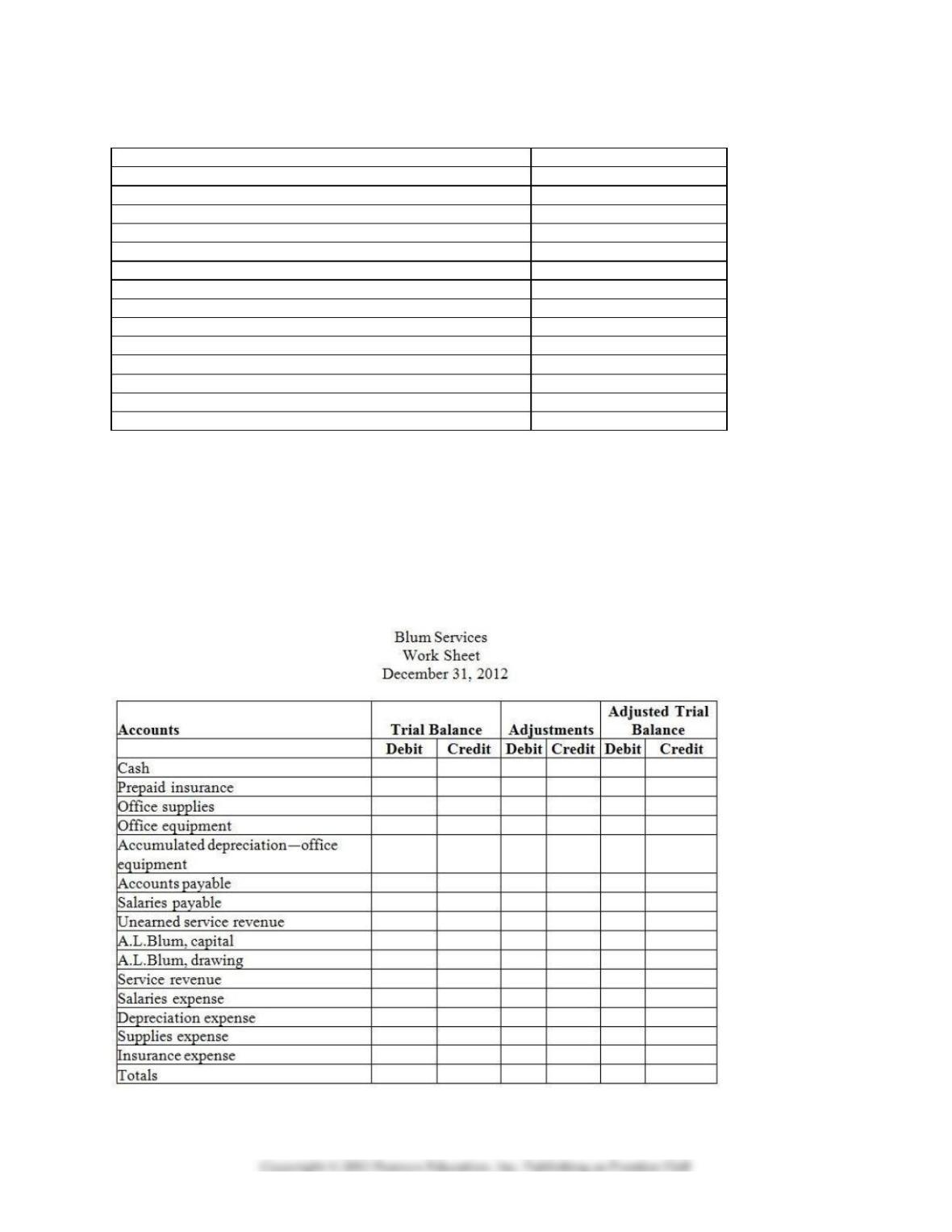
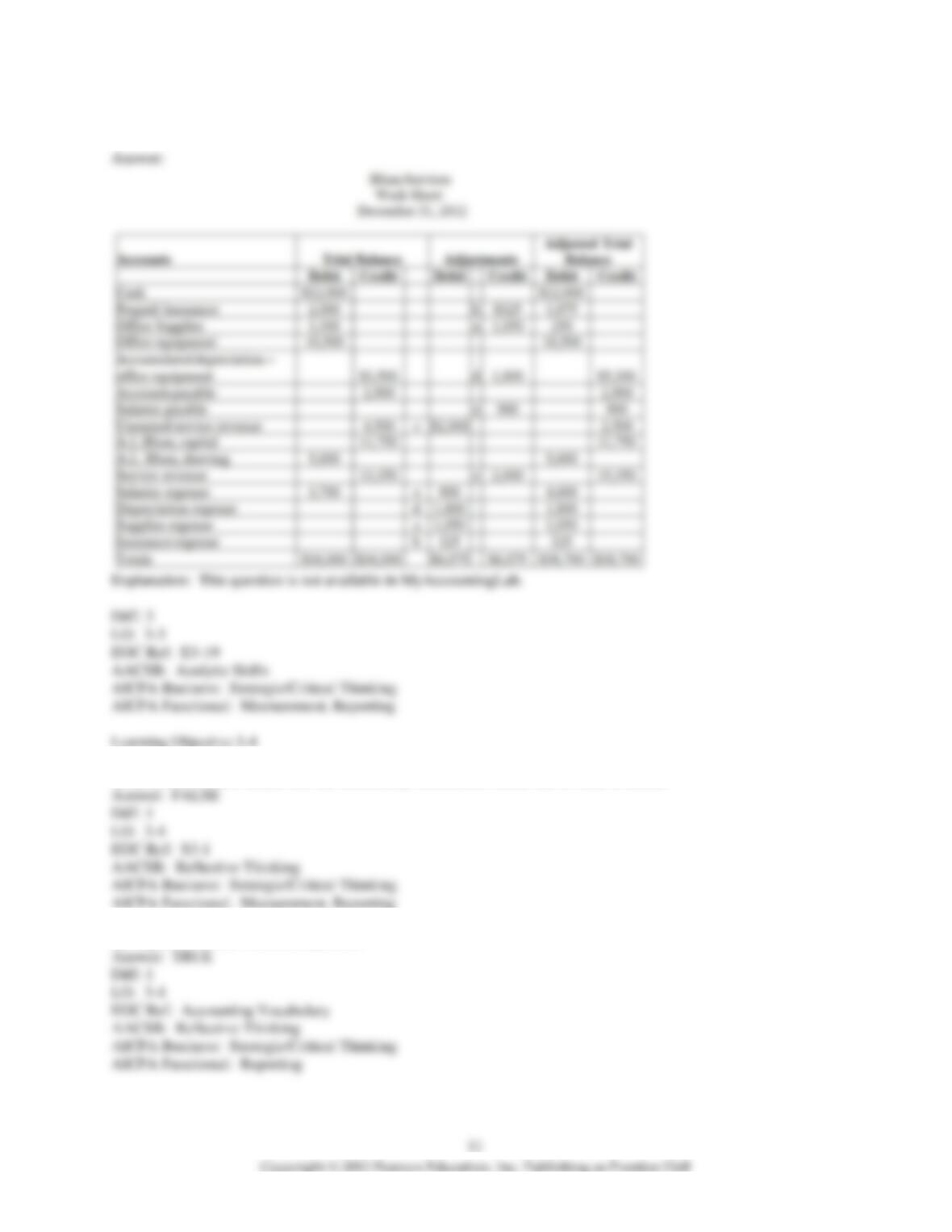
2) Blum Services has the following unadjusted balances at year-end.
Cash
$12,900
Prepaid insurance
2,000
Office supplies
1,300
Office equipment
10,500
Accumulated depreciation–office equipment
3,500
Accounts payable
2,900
Salaries payable
-0-
Unearned service revenue
4,500
A.L.Blum, capital
11,750
A.L.Blum, drawing
5,600
Service revenue
13,350
Salary expense
3,700
Depreciation expense
-0-
Supplies expense
-0-
Insurance expense
-0-
The following information is available to use in making adjusting entries.
a. Office supplies on hand at year-end: $250
b. Prepaid insurance expired during the year: $325
c. Unearned revenue remaining at year-end: $2,500
d. Depreciation expense for the year: $1,800
e. Accrued salaries at year-end: $900
Using the work sheet below, prepare the trial balance, the adjustments and the adjusted trial balance for Blum
Services.
1) To accrue revenue means that the cash receipt is recorded before the revenue is earned.
2) Prepaid insurance is an asset account.
3) Prepaid rent is an expense account.
4) A contra account has two characteristics: (1) a contra account is paired with a companion account, and (2) a
contra account’s normal balance is the same as that of the companion account.
5) In the case of a prepaid expense, the adjusting entry required at the end of a period consists of a debit to Prepaid
expense.
6) In the case of a prepaid expense, the adjusting entry required at the end of a period consists of a credit to Prepaid
expense.
7) In the case of Unearned revenue, the cash is received first, and the revenue is earned later.
8) In the case of Unearned revenue, the adjusting entry at the end of the period includes a debit to Service revenue.
9) In the case of Unearned revenue, the adjusting entry at the end of the period includes a credit to Service revenue.
10) Contra asset accounts like Accumulated depreciation have normal debit balances.
11) At January 1, Smith has a beginning balance in Prepaid insurance expense of $1,200. Smith pays insurance
premiums once a year, and his total premium is $4,800. As of the end of February, the balance in prepaid insurance
is $2,000.
12) At January 1, Smith has $1,200 of supplies on hand. During January, Smith purchases $3,000 worth of new
supplies. At the end of the month, a count reveals $500 worth of supplies remaining on the shelves. The adjustment
entry needed will include a debit to Supply expense of $3,700.
13) Smith owns manufacturing equipment that originally cost $12,600 and has an estimated useful life of 7 years.
Smith records depreciation monthly in the amount of $100.
14) At January 1, Smith has a beginning balance in Unearned revenue of $1,000. During January, he earns $800 of
that amount. He also collects $4,000 from a new customer for services to be rendered the following month. As of
the end of January, the Unearned revenue account had a balance of $4,800.
15) Smith borrows $10,000 on a one year Note payable that bears interest at 12% per year. He will repay the
principal and interest at the end of the one-year period. Smith makes accrual adjustments and each month, he
records interest expense of $1,200.
16) Smith signed a contract with a service provider for security services at a rate of $250 per month for the period of
January through June. He will pay the service provider the entire amount at the end of June. Smith makes adjusting
entries each month. During the month of February, Smith will record total security expense of $500.
17) Argyle Designs has a contract to design 20 new dresses for a customer, and will collect a total of $40,000 when
the design services are complete. They start on June 1. As of June 30, Argyle has finished 4 of the 20 designs.
They will make an adjusting entry at the end of June to accrue $10,000 of service revenue.
18) Unearned revenue would be classified as a(n) ________ account.
A) liability
B) asset
C) revenue
D) equity
19) Robert Rogers, CPA performed accounting services for a client in December. A bill was mailed to the client on
December 30. Roberts received a check in the mail on January 5. The revenue principle would require that which of
the following accounts appear on the income statement for the year ended December 31?
A) Service revenue
B) Unearned revenue
C) Accounts payable
D) Prepaid expense
20) Real Losers, a diet magazine, collected $360,000 in subscription revenue in May. Each subscriber will receive
an issue of the magazine for each of the next 12 months, beginning with the June issue. The company uses the
accrual method of accounting. By the end of December, how much Subscription revenue has been earned?
A) $120,000
B) $12,000
C) $360,000
D) $210,000
21) Real Losers, a diet magazine, collected $360,000 in subscription revenue in May. Each subscriber will receive
an issue of the magazine for each of the next 12 months, beginning with the June issue. The company uses the
accrual method of accounting. What is the balance in the Unearned revenue account at the end of December?
A) $150,000
B) $330,000
C) $360,000
D) $0
22) The table below represents Able Company’s supplies account. Please supply the missing amount.
Beginning supplies
2,000
Supplies purchased
?
Supplies expense
8,000
Ending supplies
3,000
A) $9,000
B) $5,000
C) $11,000
D) $13,000
23) The table below represents Able Company‘s supplies account. Please supply the missing amount.
Beginning supplies
?
Supplies purchased
7,000
Supplies expense
9,000
Ending supplies
4,000
A) $2,000
B) $15,000
C) $11,000
D) $6,000
24) The table below represents Able Company’s supplies account. Please supply the missing amount.
Beginning supplies
5,000
Supplies purchased
6,000
Supplies expense
8,000
Ending supplies
?
A) $9,000
B) $1,000
C) $3,000
D) $11,000
25) The table below represents Able Company’s supplies account. Please supply the missing amount.
Supplies, beginning balance
1,000
Supplies purchased during year
12,000
Supplies expense during the year
?
Supplies, ending balance
3,000
A) $9,000
B) $10,000
C) $6,000
D) $16,000
26) The entry to record depreciation includes a debit to which account?
A) Equipment
B) Cash
C) Accumulated depreciation
D) Depreciation expense
27) The entry to record depreciation includes a credit to which account?
A) Equipment
B) Cash
C) Accumulated depreciation
D) Depreciation expense
28) Which of the following accounts would NOT be included in the adjusting entries made at the end of an
accounting period?
A) Accounts receivable
B) Accounts payable
C) Cash
D) Prepaid insurance
29) Which of the following accounts would NOT be adjusted at the end of an accounting period?
A) Accounts receivable
B) Unearned revenue
C) Equipment
D) Prepaid insurance
30) Adjusting entries NEVER involve:
A) expenses.
B) cash.
C) liabilities.
D) revenues.
31) If an adjusting entry includes a debit to Rent expense, that would indicate that the payment of rent had been
previously recorded as a(n) ________ entry.
A) prepaid expense
B) depreciation
C) accrued expense
D) accrued revenue
32) An entry that reflects the using up of a portion of a fixed asset’s value would be a(n) ________ entry.
A) prepaid expense
B) accrued expense
C) accrued revenue
D) depreciation
33) Which of the following is a contra account?
A) Depreciation expense
B) Accumulated depreciation
C) Unearned revenue
D) Earned revenue
34) Accrued revenue is revenue that:
A) has been collected and earned.
B) the business has collected, but not yet earned.
C) the business has earned, but not collected.
D) will be collected and earned in the future.
35) Unearned revenue is revenue that:
A) will be collected and earned in the future.
B) the business has collected, but not yet earned.
C) has been collected and earned.
D) the business has earned, but not collected.
36) An adjusting entry that credits Salaries payable is an example of a(n):
A) accrued expense.
B) unearned revenue.
C) accrued revenue.
D) prepaid expense.
37) An adjusting entry that debits Accounts receivable is an example of a(n):
A) prepaid expense.
B) accrued revenue.
C) accrued expense.
D) unearned revenue.
38) At the end of the current year, the accountant for Navistar Graphics forgot to make an adjusting entry to accrue
Wages payable to the company’s employees for the last week in December. The wages will be paid to the employees
in January. Which of the following is one of the effects of this error?
A) Net income is overstated.
B) Liabilities are overstated.
C) Net income is understated.
D) Expenses are overstated.