
Name:
Class:
Date:
chapter 25
Indicate whether the statement is true or false.
1. In using the variable cost concept of applying the cost-plus approach to product pricing, fixed manufacturing costs and
fixed selling and administrative expenses must be covered by the markup.
a.
True
b.
False
2. Differential revenue is the amount of increase or decrease in revenue expected from a particular course of action as
compared with an alternative.
a.
True
b.
False
3. The theory of constraints is a manufacturing strategy that focuses on reducing the influence of bottlenecks on a process.
a.
True
b.
False
4. When a segment of a company is showing a net loss, it is always best to discontinue the segment in order not to
continue with losses.
a.
True
b.
False
Use this information for Hill Co. to answer the questions that follow.
Hill Co. can further process Product O to produce Product P. Product O is currently selling for $60 per pound and costs
$42 per pound to produce. Product P would sell for $82 per pound and would require an additional cost of $13 per pound
to produce.
5. The differential revenue of producing Product P over Product O is $82 per pound.
a.
True
b.
False
6. In using the product cost concept of applying the cost-plus approach to product pricing, selling expenses, administrative
expenses, and profit are covered in the markup.
a.
True
b.
False
7. Under the total cost concept, manufacturing cost plus desired profit is included in the total cost per unit.
a.
True
b.
False
8. A cost that will not be affected by later decisions is termed an opportunity cost.
a.
True
b.
False
9. Activity-based costing provides more accurate and useful cost data than traditional systems.
a.
True
b.
False

Name:
Class:
Date:
chapter 25
10. A bottleneck begins when demand for the company’s product exceeds the ability to produce the product.
a.
True
b.
False
11. Activity-based costing is determined by charging products for only the services (activities) they used during
production.
a.
True
b.
False
12. The total cost concept includes all manufacturing costs plus selling and administrative expenses in the cost amount to
which the markup is added to determine product price.
a.
True
b.
False
13. Make-or–buy options often arise when a manufacturer has excess productive capacity in the form of unused
equipment, space, and labor.
a.
True
b.
False
14. Discontinuing a segment or product may not be the best choice when the segment is contributing to fixed expenses.
a.
True
b.
False
15. The product cost concept includes all manufacturing costs in the cost amount to which the markup is added to
determine product price.
a.
True
b.
False
16. Since the costs of producing an intermediate product do not change regardless of whether the intermediate product is
sold or processed further, these costs are not considered in deciding whether to further process a product.
a.
True
b.
False
17. When a bottleneck occurs between two products, the company must determine the contribution margin for each
product and manufacture the product that has the highest contribution margin per bottleneck hour.
a.
True
b.
False
18. In deciding whether to accept business at a special price, the short-run price should be set high enough to cover all
variable costs and expenses.
a.
True
b.
False
19. If the total unit cost of manufacturing Product Y is currently $36 and the total unit cost after modifying the style is
estimated to be $48, the differential cost for this situation is $48.
a.
True

Name:
Class:
Date:
chapter 25
b.
False
20. In using the variable cost concept of applying the cost-plus approach to product pricing, fixed manufacturing costs and
both fixed and variable selling and administrative expenses must be covered by the markup.
a.
True
b.
False
Use this information for Hill Co. to answer the questions that follow.
Hill Co. can further process Product O to produce Product P. Product O is currently selling for $60 per pound and costs
$42 per pound to produce. Product P would sell for $82 per pound and would require an additional cost of $13 per pound
to produce.
21. The differential cost of producing Product P over Product O is $13 per pound.
a.
True
b.
False
22. Differential revenue is the amount of income that would result from the best available alternative proposed use of
cash.
a.
True
b.
False
23. The costs of initially producing an intermediate product should be considered in deciding whether to further process a
product, even though the costs will not change, regardless of the decision.
a.
True
b.
False
24. Cost-plus methods determine the normal selling price by estimating a cost amount per unit and adding a markup.
a.
True
b.
False
Use this information for Hill Co. to answer the questions that follow.
Hill Co. can further process Product O to produce Product P. Product O is currently selling for $60 per pound and costs
$42 per pound to produce. Product P would sell for $82 per pound and would require an additional cost of $13 per pound
to produce.
25. The differential revenue of producing Product P over Product O is $22 per pound.
a.
True
b.
False
26. If the total unit cost of manufacturing Product Y is currently $36 and the total unit cost after modifying the style is
estimated to be $48, the differential cost for this situation is $12.
a.
True
b.
False
27. Differential analysis can be used if management is considering making a part that is currently being purchased but not

Name:
Class:
Date:
chapter 25
if considering purchasing a part that is currently being made.
a.
True
b.
False
28. A bottleneck happens when a key piece of manufacturing machinery can produce 1,000 units per hour and demand for
the product supports a production rate of 1,200 units per hour.
a.
True
b.
False
29. Manufacturers must conform to the Robinson-Patman Act, which prohibits price discrimination within the United
States unless differences in prices can be justified by different costs of serving different customers.
a.
True
b.
False
30. When estimated costs are used in applying the cost-plus approach to product pricing, the estimates should be based on
ideal levels of performance.
a.
True
b.
False
31. The amount of revenue that is foregone from an alternative use of cash is called opportunity cost.
a.
True
b.
False
Use this information for Hill Co. to answer the questions that follow.
Hill Co. can further process Product O to produce Product P. Product O is currently selling for $60 per pound and costs
$42 per pound to produce. Product P would sell for $82 per pound and would require an additional cost of $13 per pound
to produce.
32. The differential cost of producing Product P over Product O is $55 per pound.
a.
True
b.
False
33. The desired selling price for a product will be the same under both variable and total cost concepts.
a.
True
b.
False
34. Opportunity cost is the amount of increase or decrease in cost that would result from the best available alternative to
the proposed use of cash or its equivalent.
a.
True
b.
False
35. Differential analysis only considers the short-term (1-year) effects of discontinuing a product.
a.
True
b.
False
36. The product cost concept includes all manufacturing costs plus selling and administrative expenses in the cost amount

Name:
Class:
Date:
chapter 25
to which the markup is added to determine product price.
a.
True
b.
False
37. A practical approach that is frequently used by managers when setting normal long-run prices is the cost-plus
approach.
a.
True
b.
False
38. The lowest contribution margin per scarce resource is the most profitable.
a.
True
b.
False
39. In addition to the differential costs in an equipment replacement decision, the remaining useful life of the old
equipment and the estimated life of the new equipment are important considerations.
a.
True
b.
False
40. A cost that will not be affected by later decisions is termed a sunk cost.
a.
True
b.
False
41. In using the total cost concept of applying the cost-plus approach to product pricing, selling expenses, administrative
expenses, and profit are covered in the markup.
a.
True
b.
False
42. When using differential analysis to make a decision regarding the acceptance of an order at a special price, both fixed
and variable costs are included in the analysis.
a.
True
b.
False
43. When estimated costs are used in applying the cost-plus approach to product pricing, the estimates should be based on
normal levels of performance.
a.
True
b.
False
44. Differential analysis can aid management in making decisions on a variety of alternatives, including whether to
discontinue an unprofitable segment and whether to replace usable plant assets.
a.
True
b.
False
45. Under the variable cost concept, only variable costs are included in the cost amount per unit to which the markup is
added.
a.
True
b.
False

Name:
Class:
Date:
chapter 25
Indicate the answer choice that best completes the statement or answers the question.
Use this information for Mallard Corporation to answer the questions that follow.
Mallard Corporation uses the product cost concept of product pricing. The cost information for the production and sale of
45,000 units of its sole product follows. Mallard desires a profit equal to a 12% rate of return on invested assets of
$800,000.
Fixed factory overhead cost
$82,000
Fixed selling and administrative costs
45,000
Variable direct materials cost per unit
5.50
Variable direct labor cost per unit
7.65
Variable factory overhead cost per unit
2.25
Variable selling and administrative cost per unit
0.90
46. The unit selling price for the company’s product is
a.
$19.35
b.
$15.75
c.
$22.05
d.
$21.25
Use this information for Widgeon Co. to answer the questions that follow.
Widgeon Co. manufactures three products: Bales, Tales, and Wales. Their selling prices are $55, $78, and $32,
respectively. The variable costs for each product are $20, $50, and $15, respectively. Each product must go through the
same processing in a machine that is limited to 2,000 hours per month. Bales take 5 hours to process; Tales, 7 hours; and
Wales, 1 hour.
47. Assume that Widgeon produced enough of the product with the highest contribution margin per unit to use 1,000
hours of machine time. Product demand does not warrant any more production of that product. What is the maximum
additional contribution margin that can be realized by utilizing the remaining 1,000 hours on the product with the second
highest contribution margin per hour?
a.
$35,000
b.
$7,000
c.
$4,000
d.
$28,000
48. What cost concept used in applying the cost-plus approach to product pricing covers selling expenses, administrative
expenses, and desired profit in the markup?
a.
total cost concept
b.
product cost concept
c.
variable cost concept
d.
sunk cost concept
Use this information for Stryker Industries to answer the questions that follow.
Stryker Industries received an offer from an exporter for 15,000 units of product at $17.50 per unit. The acceptance of the
offer will not affect normal production or domestic sales prices. The following data are available:
Name:
Class:
Date:
chapter 25
Domestic unit sales price
$20
Unit manufacturing costs:
Variable
11
Fixed
1
49. What is the differential revenue from the acceptance of the offer?
a.
$300,000
b.
$262,500
c.
$52,500
d.
$250,000
50. Nighthawk Inc. is considering selling an old machine with a book value of $22,500 and an estimated remaining life of
3 years. The old machine can be sold for $6,250. A new machine with a purchase price of $68,750 is being considered as
a replacement. It will have a useful life of 3 years and no residual value. It is estimated that the annual variable
manufacturing costs will be reduced from $43,750 to $20,000 if the new machine is purchased. The differential effect on
profit for the entire 3 years for the new machine is a(n)
a.
$8,750 increase
b.
$31,250 decrease
c.
$8,750 decrease
d.
$2,925 decrease
51. What pricing concept is used if all costs are considered and a fair markup is added to determine the selling price?
a.
total cost concept
b.
demand-based concept
c.
variable cost concept
d.
fixed cost concept
52. When using the total cost concept of applying the cost-plus approach to product pricing, what is included in the
markup?
a.
total selling and administrative expenses plus desired profit
b.
total fixed manufacturing costs, total fixed selling and administrative expenses, and desired profit
c.
total costs plus desired profit
d.
desired profit
Use this information for Miramar Industries to answer the questions that follow.
Miramar Industries manufactures two products: A and B. The manufacturing operation involves three overhead
activities—production setup, materials handling, and general factory activities. Miramar uses activity-based costing to
allocate overhead to products. An activity analysis of the overhead revealed the following estimated costs and activity
bases for these activities:
Activity
Cost
Activity Base
Production setup
$250,000
Number of setups
Materials handling
150,000
Number of parts
General overhead
80,000
Number of direct labor hours
Each product’s total activity in each of the three areas is as follows:
Name:
Class:
Date:
chapter 25
Product A
Product B
Number of setups
100
300
Number of parts
40,000
20,000
Number of direct labor hours
8,000
12,000
53. What is the activity rate for production setup?
a.
$2,500 per setup
b.
$833 per setup
c.
$625 per setup
d.
$400 per setup
54. Contractors who sell to government agencies would be most likely to use which of the following cost concepts in
pricing their products?
a.
variable cost concept
b.
product cost concept
c.
total cost concept
d.
fixed cost concept
Use this information for Widgeon Co. to answer the questions that follow.
Widgeon Co. manufactures three products: Bales, Tales, and Wales. Their selling prices are $55, $78, and $32,
respectively. The variable costs for each product are $20, $50, and $15, respectively. Each product must go through the
same processing in a machine that is limited to 2,000 hours per month. Bales take 5 hours to process; Tales, 7 hours; and
Wales, 1 hour.
55. Which product has the highest contribution margin per machine hour?
a.
Bales
b.
Tales
c.
Wales
d.
Bales and Tales have the same contribution margin per machine hour.
Use this information for Flyer Company to answer the questions that follow.
Flyer Company sells a product in a competitive marketplace. Market analysis indicates that its product would probably
sell at $48 per unit. Flyer’s management desires a 12.5% profit margin on sales. Its current full cost for the product is $44
per unit.
56. What is the target cost of the company’s product?
a.
$44
b.
$42
c.
$43
d.
$40
57. All of the following should be considered in a make-or–buy decision except
a.
cost savings
b.
quality issues with the supplier

Name:
Class:
Date:
chapter 25
c.
future growth in the plant and other production opportunities
d.
whether the supplier will make a profit that would no longer belong to the business
58. Sage Company is operating at 90% of capacity and is currently purchasing a part used in its manufacturing operations
for $15 per unit. The unit cost for the business to make the part is $20 including fixed costs and $11 excluding fixed costs.
If 30,000 units of the part are normally purchased during the year but could be manufactured using unused capacity, what
would be the amount of differential cost increase or decrease from making the part rather than purchasing it?
a.
$150,000 cost increase
b.
$120,000 cost decrease
c.
$150,000 cost increase
d.
$120,000 cost increase
59. Piper Corp. is operating at 70% of capacity and is currently purchasing a part used in its manufacturing operations for
$24 per unit. The unit cost for the business to make the part is $36 including fixed costs and $26 excluding fixed costs. If
15,000 units of the part are normally purchased during the year but could be manufactured using unused capacity, what
would be the amount of differential cost increase or decrease from making the part rather than purchasing it?
a.
$30,000 cost decrease
b.
$180,000 cost increase
c.
$30,000 cost increase
d.
$180,000 cost decrease
60. Sparrow Co. is currently operating at 80% of capacity and is currently purchasing a part used in its manufacturing
operations for $8.00 a unit. The unit cost for Sparrow Co. to make the part is $9.00, which includes $0.60 of fixed costs. If
4,000 units of the part are normally purchased each year but could be manufactured using unused capacity, what would be
the amount of differential cost increase or decrease for making the part rather than purchasing it?
a.
$12,000 decrease
b.
$4,000 increase
c.
$20,000 decrease
d.
$1,600 increase
Use this information for Stryker Industries to answer the questions that follow.
Stryker Industries received an offer from an exporter for 15,000 units of product at $17.50 per unit. The acceptance of the
offer will not affect normal production or domestic sales prices. The following data are available:
Domestic unit sales price
$20
Unit manufacturing costs:
Variable
11
Fixed
1
61. What is the amount of differential profit or loss from the acceptance of the offer?
a.
$97,500 profit
b.
$94,500 loss
c.
$37,500 profit
d.
$37,500 loss
Use this information for Miramar Industries to answer the questions that follow.
Name:
Class:
Date:
chapter 25
Miramar Industries manufactures two products: A and B. The manufacturing operation involves three overhead
activities—production setup, materials handling, and general factory activities. Miramar uses activity-based costing to
allocate overhead to products. An activity analysis of the overhead revealed the following estimated costs and activity
bases for these activities:
Activity
Cost
Activity Base
Production setup
$250,000
Number of setups
Materials handling
150,000
Number of parts
General overhead
80,000
Number of direct labor hours
Each product’s total activity in each of the three areas is as follows:
Product A
Product B
Number of setups
100
300
Number of parts
40,000
20,000
Number of direct labor hours
8,000
12,000
62. What is the activity rate for materials handling?
a.
$1.50 per part
b.
$3.75 per part
c.
$7.50 per part
d.
$2.50 per part
63. The condensed income statement of Hayden Corp. for the past year is as follows:
Product
T
U
Sales
$680,000
$320,000
Cost of goods sold:
Variable costs
$540,000
$220,000
Fixed costs
145,000
40,000
Total cost of goods sold
$685,000
$260,000
Income (loss) from operations
$ (5,000)
$ 60,000
Management is considering the discontinuance of the manufacture and sale of Product T at the beginning of the current
year. The discontinuance would have no effect on the total fixed costs and expenses or on the sales of Product U. What is
the amount of change in income for the current year that will result from the discontinuance of Product T?
a.
$140,000 increase
b.
$5,000 increase
c.
$5,000 decrease
d.
$140,000 decrease
64. A cost that will not be affected by later decisions is termed a
a.
period cost
b.
differential cost
c.
sunk cost
d.
replacement cost
Use this information for Falcon Co. to answer the questions that follow.

Name:
Class:
Date:
chapter 25
Falcon Co. produces a single product. Its normal selling price is $30 per unit. The variable costs are $19 per unit. Fixed
costs are $25,000 for a normal production run of 5,000 units per month. Falcon received a request for a special order that
would not interfere with normal sales. The order was for 1,500 units with a special price of $20 per unit. Falcon has the
capacity to handle the special order, and for this order, a variable selling cost of $1 per unit would be eliminated.
65. If the order is accepted, what would be the impact on profit?
a.
decrease of $750
b.
decrease of $4,500
c.
increase of $3,000
d.
increase of $1,500
Use this information for Widgeon Co. to answer the questions that follow.
Widgeon Co. manufactures three products: Bales, Tales, and Wales. Their selling prices are $55, $78, and $32,
respectively. The variable costs for each product are $20, $50, and $15, respectively. Each product must go through the
same processing in a machine that is limited to 2,000 hours per month. Bales take 5 hours to process; Tales, 7 hours; and
Wales, 1 hour.
66. What is the contribution margin per machine hour for Wales?
a.
$35
b.
$28
c.
$17
d.
$7
67. Yasmin Co. can further process Product B to produce Product C. Product B is currently selling for $30 per pound and
costs $28 per pound to produce. Product C would sell for $55 per pound and would require an additional cost of $31 per
pound to produce. What is the differential cost of producing Product C?
a.
$30 per pound
b.
$31 per pound
c.
$28 per pound
d.
$55 per pound
68. Discontinuing a product or segment is a huge decision that must be carefully analyzed. Which of the following would
be a valid reason not to discontinue an operation?
a.
Losses are minimal.
b.
Variable costs are less than revenues.
c.
Variable costs are more than revenues.
d.
Allocated fixed costs are more than revenues.
Use this information for Carmen Co. to answer the questions that follow.
Carmen Co. can further process Product J to produce Product D. Product J is currently selling for $20.00 per pound and
costs $15.75 per pound to produce. Product D would sell for $38.00 per pound and would require an additional cost of
$8.55 per pound to produce.
69. What is the differential revenue of producing Product D?
a.
$6.75 per pound
Name:
Class:
Date:
chapter 25
b.
$22.25 per pound
c.
$18.00 per pound
d.
$6.25 per pound
Use this information for Dotterel Corporation to answer the questions that follow.
Dotterel Corporation uses the variable cost concept of product pricing. The cost information for the production and sale of
35,000 units of its sole product follows. Dotterel desires a profit equal to an 11.2% rate of return on invested assets of
$350,000.
Fixed factory overhead cost
$105,000
Fixed selling and administrative costs
35,000
Variable direct materials cost per unit
4.34
Variable direct labor cost per unit
5.18
Variable factory overhead cost per unit
0.98
Variable selling and administrative cost per unit
0.70
70. The unit selling price for the company’s product is
a.
$16.32
b.
$13.44
c.
$12.10
d.
$13.72
Use this information for Miramar Industries to answer the questions that follow.
Miramar Industries manufactures two products: A and B. The manufacturing operation involves three overhead
activities—production setup, materials handling, and general factory activities. Miramar uses activity-based costing to
allocate overhead to products. An activity analysis of the overhead revealed the following estimated costs and activity
bases for these activities:
Activity
Cost
Activity Base
Production setup
$250,000
Number of setups
Materials handling
150,000
Number of parts
General overhead
80,000
Number of direct labor hours
Each product’s total activity in each of the three areas is as follows:
Product A
Product B
Number of setups
100
300
Number of parts
40,000
20,000
Number of direct labor hours
8,000
12,000
71. What is the overhead allocated to Product B using activity-based costing?
a.
$135,000
b.
$175,000
c.
$292,500
d.
$285,500
72. Peyton Company manufactures Phone X and Phone Y. Peyton can sell all it can make of either. Based on the

Name:
Class:
Date:
chapter 25
following data, assuming the number of hours is a constraint, which statement is true?
X
Y
Sales price
$48
$44
Variable cost
38
28
Time needed to process
5 hours
8 hours
a.
X is more profitable than Y in using bottleneck resources.
b.
Y is more profitable than X in using bottleneck resources.
c.
Neither X nor Y is profitable in using bottleneck resources.
d.
X and Y are equally profitable in using bottleneck resources.
73. Delaney Company is considering replacing equipment that originally cost $600,000 and that has $420,000
accumulated depreciation to date. A new machine will cost $790,000, and the old equipment can be sold for $8,000. What
is the sunk cost in this situation?
a.
$172,000
b.
$180,000
c.
$188,000
d.
$290,000
Use this information for Magpie Corporation to answer the questions that follow.
Magpie Corporation uses the total cost concept of product pricing. The cost information for the production and sale of
60,000 units of its sole product follows. Magpie desires a profit equal to a 25% rate of return on invested assets of
$700,000.
Fixed factory overhead cost
$38,700
Fixed selling and administrative costs
7,500
Variable direct materials cost per unit
4.60
Variable direct labor cost per unit
1.88
Variable factory overhead cost per unit
1.13
Variable selling and administrative cost per unit
4.50
74. The markup percentage on the total cost of the company’s product is
a.
21.0%
b.
22.6%
c.
15.8%
d.
24.0%
Use this information for Dotterel Corporation to answer the questions that follow.
Dotterel Corporation uses the variable cost concept of product pricing. The cost information for the production and sale of
35,000 units of its sole product follows. Dotterel desires a profit equal to an 11.2% rate of return on invested assets of
$350,000.
Fixed factory overhead cost
$105,000
Fixed selling and administrative costs
35,000
Variable direct materials cost per unit
4.34
Variable direct labor cost per unit
5.18

Name:
Class:
Date:
chapter 25
Variable factory overhead cost per unit
0.98
Variable selling and administrative cost per unit
0.70
75. The dollar amount of the desired profit from the production and sale of the company’s product is
a.
$89,600
b.
$39,200
c.
$70,000
d.
$84,000
76. Delaney Company is considering replacing equipment that originally cost $600,000 and that has $420,000
accumulated depreciation to date. A new machine will cost $790,000. What is the sunk cost in this situation?
a.
$370,000
b.
$790,000
c.
$180,000
d.
$190,000
77. The amount of increase or decrease in cost that is expected from a particular course of action as compared with an
alternative is
a.
period cost
b.
product cost
c.
differential cost
d.
discretionary cost
78. Which of the following reasons could cause a company to reject an offer to accept business at a special price?
a.
The additional sales will not conflict with regular sales.
b.
The additional sales will increase differential profit.
c.
The additional sales will not increase fixed expenses.
d.
The additional sales will increase fixed expenses.
79. Rowan Quinn Company manufactures kitchen appliances. Currently, it is manufacturing one of its components at a
variable cost of $40 and fixed costs of $15 per unit. An outside provider of this component has offered to sell Rowan
Quinn the component for $45. Determine the best plan and compute the savings assuming fixed costs are unaffected by
the decision.
a.
$5 savings per unit if manufactured
b.
$5 savings per unit if purchased
c.
$10 savings per unit if manufactured
d.
$15 savings per unit if purchased
Use this information for Widgeon Co. to answer the questions that follow.
Widgeon Co. manufactures three products: Bales, Tales, and Wales. Their selling prices are $55, $78, and $32,
respectively. The variable costs for each product are $20, $50, and $15, respectively. Each product must go through the
same processing in a machine that is limited to 2,000 hours per month. Bales take 5 hours to process; Tales, 7 hours; and
Wales, 1 hour.
80. What is the contribution margin per machine hour for Tales?

Name:
Class:
Date:
chapter 25
a.
$4
b.
$7
c.
$28
d.
$35
81. Which equation better describes target costing?
a.
Selling Price – Desired Profit = Target Costs
b.
Selling Price + Profit = Target Costs
c.
Target Variable Costs + Contribution Margin = Selling Price
d.
Selling Price = Profit – Target Variable Costs
82. The target cost approach assumes that
a.
markup is added to total cost
b.
the selling price is set by the marketplace
c.
markup is added to variable cost
d.
markup is added to product cost
83. When using the product cost concept of applying the cost-plus approach to product pricing, what is included in the
markup?
a.
desired profit
b.
total fixed manufacturing costs, total fixed selling and administrative expenses, and desired profit
c.
total costs plus desired profit
d.
total selling and administrative expenses plus desired profit
Use this information for Stryker Industries to answer the questions that follow.
Stryker Industries received an offer from an exporter for 15,000 units of product at $17.50 per unit. The acceptance of the
offer will not affect normal production or domestic sales prices. The following data are available:
Domestic unit sales price
$20
Unit manufacturing costs:
Variable
11
Fixed
1
84. What is the differential cost from the acceptance of the offer?
a.
$200,000
b.
$262,500
c.
$85,500
d.
$165,000
85. Starling Co. is considering selling a machine with a book value of $12,500 and estimated remaining life of 5 years.
The old machine can be sold for $1,500. A new high-speed machine can be purchased at a cost of $25,000. It will have a
useful life of 5 years and no residual value. It is estimated that the annual variable manufacturing costs will be reduced
from $26,000 to $23,500 if the new machine is purchased. The differential effect on profit for the new machine for the
entire 5 years is a(n)
a.
decrease of $11,000

Name:
Class:
Date:
chapter 25
b.
decrease of $15,000
c.
increase of $11,000
d.
increase of $15,000
86. Target costing is arrived at by taking the
a.
selling price minus desired profit
b.
selling price and adding desired profit
c.
selling price and subtracting the budget standard cost
d.
budget standard cost and reducing it by 10%
87. The amount of revenue that is foregone from an alternative use of cash is called
a.
differential profit
b.
sunk cost
c.
differential revenue
d.
opportunity cost
Use this information for Flyer Company to answer the questions that follow.
Flyer Company sells a product in a competitive marketplace. Market analysis indicates that its product would probably
sell at $48 per unit. Flyer’s management desires a 12.5% profit margin on sales. Its current full cost for the product is $44
per unit.
88. In order to meet the new target cost, how much will Flyer have to cut costs per unit, if any?
a.
$1
b.
$3
c.
$2
d.
$0
89. What pricing concept considers the price that other providers charge for the same product?
a.
demand-based concept
b.
total cost concept
c.
cost-plus concept
d.
competition-based concept
Use this information for Dotterel Corporation to answer the questions that follow.
Dotterel Corporation uses the variable cost concept of product pricing. The cost information for the production and sale of
35,000 units of its sole product follows. Dotterel desires a profit equal to an 11.2% rate of return on invested assets of
$350,000.
Fixed factory overhead cost
$105,000
Fixed selling and administrative costs
35,000
Variable direct materials cost per unit
4.34
Variable direct labor cost per unit
5.18
Variable factory overhead cost per unit
0.98
Variable selling and administrative cost per unit
0.70

Name:
Class:
Date:
chapter 25
90. The markup percentage for the sale of the company’s product is
a.
14%
b.
5.6%
c.
45.71%
d.
11.2%
91. What cost concept used in applying the cost-plus approach to product pricing includes only desired profit in the
markup?
a.
product cost concept
b.
variable cost concept
c.
sunk cost concept
d.
total cost concept
92. Swan Company produces a product at a total cost of $43 per unit. Of this amount, $8 per unit is selling and
administrative costs. The total variable cost is $30 per unit, and the desired profit is $20 per unit. Determine the markup
percentage on product cost.
a.
80%
b.
46.5%
c.
70%
d.
110%
93. What cost concept used in applying the cost-plus approach to product pricing includes only total manufacturing costs
in the cost amount to which the markup is added?
a.
variable cost concept
b.
total cost concept
c.
product cost concept
d.
opportunity cost concept
Use this information for Dotterel Corporation to answer the questions that follow.
Dotterel Corporation uses the variable cost concept of product pricing. The cost information for the production and sale of
35,000 units of its sole product follows. Dotterel desires a profit equal to an 11.2% rate of return on invested assets of
$350,000.
Fixed factory overhead cost
$105,000
Fixed selling and administrative costs
35,000
Variable direct materials cost per unit
4.34
Variable direct labor cost per unit
5.18
Variable factory overhead cost per unit
0.98
Variable selling and administrative cost per unit
0.70
94. The variable cost per unit for the production and sale of the company’s product is
a.
$14.00
b.
$12.60
c.
$9.80
d.
$11.20
Name:
Class:
Date:
chapter 25
95. A practical approach that is frequently used by managers when setting normal long-run prices is
a.
the cost-plus approach
b.
the economic theory approach
c.
the price graph approach
d.
price skimming
Use this information for Magpie Corporation to answer the questions that follow.
Magpie Corporation uses the total cost concept of product pricing. The cost information for the production and sale of
60,000 units of its sole product follows. Magpie desires a profit equal to a 25% rate of return on invested assets of
$700,000.
Fixed factory overhead cost
$38,700
Fixed selling and administrative costs
7,500
Variable direct materials cost per unit
4.60
Variable direct labor cost per unit
1.88
Variable factory overhead cost per unit
1.13
Variable selling and administrative cost per unit
4.50
96. The dollar amount of the desired profit from the production and sale of the company’s product is
a.
$175,000
b.
$67,200
c.
$73,500
d.
$96,000
Use this information for Miramar Industries to answer the questions that follow.
Miramar Industries manufactures two products: A and B. The manufacturing operation involves three overhead
activities—production setup, materials handling, and general factory activities. Miramar uses activity-based costing to
allocate overhead to products. An activity analysis of the overhead revealed the following estimated costs and activity
bases for these activities:
Activity
Cost
Activity Base
Production setup
$250,000
Number of setups
Materials handling
150,000
Number of parts
General overhead
80,000
Number of direct labor hours
Each product’s total activity in each of the three areas is as follows:
Product A
Product B
Number of setups
100
300
Number of parts
40,000
20,000
Number of direct labor hours
8,000
12,000
97. What is the total overhead allocated to Product A using activity-based costing?
a.
$194,500
b.
$162,500
c.
$32,000
d.
$224,000
Name:
Class:
Date:
chapter 25
98. The condensed income statement of Fletcher Inc. for the past year is as follows:
Product
F
G
H
Total
Sales
$300,000
$210,000
$340,000
$850,000
Cost of goods sold:
Variable costs
$180,000
$180,000
$220,000
$590,000
Fixed costs
50,000
50,000
40,000
140,000
Total cost of goods sold
$230,000
$230,000
$260,000
$730,000
Income (loss) from operations
$ 70,000
$(20,000)
$ 80,000
$120,000
Management is considering the discontinuance of the manufacture and sale of Product G at the beginning of the current
year. The discontinuance would have no effect on the total fixed costs and expenses or on the sales of Product F and
Product H. What is the amount of change in income for the current year that will result from the discontinuance of
Product G?
a.
$20,000 increase
b.
$30,000 increase
c.
$20,000 decrease
d.
$30,000 decrease
Use this information for Falcon Co. to answer the questions that follow.
Falcon Co. produces a single product. Its normal selling price is $30 per unit. The variable costs are $19 per unit. Fixed
costs are $25,000 for a normal production run of 5,000 units per month. Falcon received a request for a special order that
would not interfere with normal sales. The order was for 1,500 units with a special price of $20 per unit. Falcon has the
capacity to handle the special order, and for this order, a variable selling cost of $1 per unit would be eliminated.
99. Should the special order be accepted?
a.
The answer cannot be determined from the data given.
b.
yes
c.
no
d.
There would be no difference in accepting or rejecting the special order.
Use this information for Mallard Corporation to answer the questions that follow.
Mallard Corporation uses the product cost concept of product pricing. The cost information for the production and sale of
45,000 units of its sole product follows. Mallard desires a profit equal to a 12% rate of return on invested assets of
$800,000.
Fixed factory overhead cost
$82,000
Fixed selling and administrative costs
45,000
Variable direct materials cost per unit
5.50
Variable direct labor cost per unit
7.65
Variable factory overhead cost per unit
2.25
Variable selling and administrative cost per unit
0.90
100. The dollar amount of the desired profit from the production and sale of the company’s product is
a.
$105,840
b.
$225,000

Name:
Class:
Date:
chapter 25
c.
$96,000
d.
$220,500
101. Mighty Safe Fire Alarm is currently buying 50,000 motherboards from MotherBoard, Inc. at a price of $65.00 per
board. Mighty Safe is considering making its own motherboards. The costs to make the motherboards are as follows:
direct materials, $32.00 per unit; direct labor, $10.00 per unit; and variable factory overhead, $16.00 per unit. Fixed costs
for the plant would increase by $75,000. Which option should be selected and why?
a.
buy, $75,000 more in profits
b.
make, $275,000 increase in profits
c.
buy, $275,000 more in profits
d.
make, $350,000 increase in profits
Use this information for Rylan Corporation to answer the questions that follow.
Rylan Corporation received an offer from an exporter for 25,000 units of product at $16 per unit. The acceptance of the
offer will not affect normal production or domestic sales prices. The following data are available:
Domestic unit sales price
$22
Unit manufacturing costs:
Variable
11
Fixed
6
102. What is the amount of the differential profit or loss from the acceptance of the offer?
a.
$125,000 loss
b.
$25,000 profit
c.
$125,000 profit
d.
$25,000 loss
103. Jarrett Company is considering a cash outlay of $300,000 for the purchase of land, which it could lease out for
$36,000 per year. If alternative investments that yield a 9% return are available, the opportunity cost of the purchase of the
land is
a.
$27,000
b.
$36,000
c.
$9,000
d.
$72,000
104. Which of the following would be considered a sunk cost?
a.
purchase price of new equipment
b.
equipment rental for the production area
c.
net book value of equipment that has no market value
d.
warehouse lease expense
105. Farris Company is considering a cash outlay of $500,000 for the purchase of land, which it could lease out for
$40,000 per year. If alternative investments that yield a 15% return are available, the opportunity cost of the purchase of
the land is
a.
$75,000
b.
$40,000

Name:
Class:
Date:
chapter 25
c.
$44,000
d.
$7,500
Use this information for Swan Company to answer the questions that follow.
Swan Company produces a product at a total cost of $43 per unit. Of this amount, $8 per unit is selling and administrative
costs. The total variable cost is $30 per unit, and the desired profit is $20 per unit.
106. Determine the markup percentage using the total cost concept.
a.
100%
b.
110%
c.
80%
d.
46.5%
107. Heston and Burton, CPAs, currently work a 5-day week. They estimate that net income for the firm would increase
by $75,000 annually if they worked an additional day each month. The cost associated with the decision to continue the
practice of a 5-day workweek is an example of a(n)
a.
differential revenue
b.
sunk cost
c.
differential profit
d.
opportunity cost
108. Using the variable cost concept, determine the markup per unit for 30,000 units using the following data:
Variable cost per unit $15
Total fixed costs $90,000
Desired profit $150,000
Round to the nearest dollar.
a.
$10
b.
$15
c.
$8
d.
$23
Use this information for Magpie Corporation to answer the questions that follow.
Magpie Corporation uses the total cost concept of product pricing. The cost information for the production and sale of
60,000 units of its sole product follows. Magpie desires a profit equal to a 25% rate of return on invested assets of
$700,000.
Fixed factory overhead cost
$38,700
Fixed selling and administrative costs
7,500
Variable direct materials cost per unit
4.60
Variable direct labor cost per unit
1.88
Variable factory overhead cost per unit
1.13
Variable selling and administrative cost per unit
4.50
109. The cost per unit for the production and sale of the company’s product is
a.
$12.11

Name:
Class:
Date:
chapter 25
b.
$12.88
c.
$15.00
d.
$13.50
Use this information for Swan Company to answer the questions that follow.
Swan Company produces a product at a total cost of $43 per unit. Of this amount, $8 per unit is selling and administrative
costs. The total variable cost is $30 per unit, and the desired profit is $20 per unit.
110. Determine the markup percentage using the variable cost concept.
a.
100%
b.
110%
c.
80%
d.
46.5%
Use this information for Widgeon Co. to answer the questions that follow.
Widgeon Co. manufactures three products: Bales, Tales, and Wales. Their selling prices are $55, $78, and $32,
respectively. The variable costs for each product are $20, $50, and $15, respectively. Each product must go through the
same processing in a machine that is limited to 2,000 hours per month. Bales take 5 hours to process; Tales, 7 hours; and
Wales, 1 hour.
111. Assuming that Widgeon Co. can sell all of the products it can make, what is the maximum contribution margin it can
earn per month?
a.
$49,000
b.
$70,000
c.
$56,000
d.
$34,000
Use this information for Flyer Company to answer the questions that follow.
Flyer Company sells a product in a competitive marketplace. Market analysis indicates that its product would probably
sell at $48 per unit. Flyer’s management desires a 12.5% profit margin on sales. Its current full cost for the product is $44
per unit.
112. What is the desired profit per unit?
a.
$6
b.
$8
c.
$5
d.
$4
113. Jacoby Company received an offer from an exporter for 30,000 units of product at $15 per unit. The acceptance of
the offer will not affect normal production or domestic sales prices. The following data are available:
Domestic unit sales price
$21
Unit manufacturing costs:
Variable
12
Fixed
5
Name:
Class:
Date:
chapter 25
What is the differential revenue from the acceptance of the offer?
a.
$450,000
b.
$630,000
c.
$510,000
d.
$120,000
114. Lara Technologies is considering a cash outlay of $250,000 for the purchase of land, which it could lease out for
$35,000 per year. If alternative investments that yield a 12% return are available, the opportunity cost of the purchase of
the land is
a.
$35,000
b.
$30,000
c.
$250,000
d.
$4,200
115. Which of the following is not a cost concept commonly used in applying the cost-plus approach to product pricing?
a.
total cost concept
b.
product cost concept
c.
variable cost concept
d.
fixed cost concept
116. When using the variable cost concept of applying the cost-plus approach to product pricing, what is included in the
markup?
a.
total costs plus desired profit
b.
desired profit
c.
total selling and administrative expenses plus desired profit
d.
total fixed manufacturing costs, total fixed selling and administrative expenses, and desired profit
Use this information for Miramar Industries to answer the questions that follow.
Miramar Industries manufactures two products: A and B. The manufacturing operation involves three overhead
activities—production setup, materials handling, and general factory activities. Miramar uses activity-based costing to
allocate overhead to products. An activity analysis of the overhead revealed the following estimated costs and activity
bases for these activities:
Activity
Cost
Activity Base
Production setup
$250,000
Number of setups
Materials handling
150,000
Number of parts
General overhead
80,000
Number of direct labor hours
Each product’s total activity in each of the three areas is as follows:
Product A
Product B
Number of setups
100
300
Number of parts
40,000
20,000
Number of direct labor hours
8,000
12,000
117. What is the activity rate for general overhead?

Name:
Class:
Date:
chapter 25
a.
$4.00 per direct labor hour
b.
$60.00 per direct labor hour
c.
$6.67 per direct labor hour
d.
$10.00 per direct labor hour
118. Using the variable cost concept, determine the selling price per unit for 30,000 units using the following data:
Variable cost per unit $15
Total fixed costs $90,000
Desired profit $150,000
Round to the nearest dollar.
a.
$10
b.
$15
c.
$8
d.
$23
119. Keating Co. is considering selling equipment with a cost of $50,000 and accumulated depreciation of $40,000.
Keating Co. can sell the equipment through a broker for $25,000, less a 5% broker commission. Alternatively, Gunner Co.
has offered to lease the equipment for 5 years for a total of $48,750. Keating will incur repair, insurance, and property tax
expenses estimated at $8,000 over the 5-year period. At lease-end, the equipment is expected to have no residual value.
The differential profit from the lease alternative is
a.
$17,000
b.
$7,000
c.
$27,000
d.
$14,500
120. Grace Co. can further process Product B to produce Product C. Product B is currently selling for $60 per pound and
costs $38 per pound to produce. Product C would sell for $95 per pound and would require an additional cost of $13 per
pound to produce. What is the differential revenue of producing and selling Product C?
a.
$35 per pound
b.
$38 per pound
c.
$95 per pound
d.
$60 per pound
121. Relevant revenues and costs refer to
a.
activities that occurred in the past
b.
monies already earned and/or spent
c.
last year’s income
d.
differences between the alternatives being considered
Use this information for Mallard Corporation to answer the questions that follow.
Mallard Corporation uses the product cost concept of product pricing. The cost information for the production and sale of
45,000 units of its sole product follows. Mallard desires a profit equal to a 12% rate of return on invested assets of
$800,000.
Fixed factory overhead cost
$82,000

Name:
Class:
Date:
chapter 25
Fixed selling and administrative costs
45,000
Variable direct materials cost per unit
5.50
Variable direct labor cost per unit
7.65
Variable factory overhead cost per unit
2.25
Variable selling and administrative cost per unit
0.90
122. The markup percentage on product cost for the company’s product is
a.
23.4%
b.
10.98%
c.
26.1%
d.
18%
123. The cost per unit for the production of the company’s product is
a.
$13.15
b.
$17.22
c.
$15.40
d.
$15.75
Use this information for Magpie Corporation to answer the questions that follow.
Magpie Corporation uses the total cost concept of product pricing. The cost information for the production and sale of
60,000 units of its sole product follows. Magpie desires a profit equal to a 25% rate of return on invested assets of
$700,000.
Fixed factory overhead cost
$38,700
Fixed selling and administrative costs
7,500
Variable direct materials cost per unit
4.60
Variable direct labor cost per unit
1.88
Variable factory overhead cost per unit
1.13
Variable selling and administrative cost per unit
4.50
124. The unit selling price for the company’s product is
a.
$15.00
b.
$13.82
c.
$15.79
d.
$14.76
Use this information for Rylan Corporation to answer the questions that follow.
Rylan Corporation received an offer from an exporter for 25,000 units of product at $16 per unit. The acceptance of the
offer will not affect normal production or domestic sales prices. The following data are available:
Domestic unit sales price
$22
Unit manufacturing costs:
Variable
11
Fixed
6
125. What is the differential cost from the acceptance of the offer?

Name:
Class:
Date:
chapter 25
a.
$150,000
b.
$275,000
c.
$550,000
d.
$125,000
Use this information for Flyer Company to answer the questions that follow.
Flyer Company sells a product in a competitive marketplace. Market analysis indicates that its product would probably
sell at $48 per unit. Flyer’s management desires a 12.5% profit margin on sales. Its current full cost for the product is $44
per unit.
126. If the company cannot cut costs any lower than they already are, what would the profit margin on sales be to meet the
market selling price?
a.
9.3%
b.
7.3%
c.
10.3%
d.
8.3%
Use this information for Carmen Co. to answer the questions that follow.
Carmen Co. can further process Product J to produce Product D. Product J is currently selling for $20.00 per pound and
costs $15.75 per pound to produce. Product D would sell for $38.00 per pound and would require an additional cost of
$8.55 per pound to produce.
127. What is the differential cost of producing Product D?
a.
$6.50 per pound
b.
$8.55 per pound
c.
$17.00 per pound
d.
$5.25 per pound
Use this information for Widgeon Co. to answer the questions that follow.
Widgeon Co. manufactures three products: Bales, Tales, and Wales. Their selling prices are $55, $78, and $32,
respectively. The variable costs for each product are $20, $50, and $15, respectively. Each product must go through the
same processing in a machine that is limited to 2,000 hours per month. Bales take 5 hours to process; Tales, 7 hours; and
Wales, 1 hour.
128. What is the contribution margin per machine hour for Bales?
a.
$5
b.
$7
c.
$35
d.
$28
129. The amount of increase or decrease in revenue that is expected from a particular course of action as compared with
an alternative is
a.
manufacturing margin
b.
contribution margin

Name:
Class:
Date:
chapter 25
c.
differential cost
d.
differential revenue
Match each of the following phrases with the term (a–e) it best describes.
a.
Demand-based concept
b.
Competition-based concept
c.
Product cost concept
d.
Target costing
e.
Production bottleneck
130. Also known as a constraint
131. Combines market-based pricing with a cost-reduction emphasis
132. Only includes the costs of manufacturing in product cost per unit
133. Sets the price according to competitors
134. Sets the price according to demand
Match each of the following phrases with the term (a–e) it best describes.
a.
Engineering change order
b.
Total cost concept
c.
Variable cost concept
d.
Normal selling price
e.
Setup
135. A document that initiates a product or process change
136. Includes manufacturing costs plus selling and administrative expenses
137. Changing tooling when preparing for a new product
138. Target selling price to be achieved in the long term
139. Variable manufacturing costs plus variable selling and administrative costs are included in cost per unit
Match each of the following phrases with the term (a–e) it best describes.
a.
Opportunity cost
b.
Sunk cost
c.
Theory of constraints
d.
Differential analysis
e.
Product cost distortion
140. Possible result of using an inappropriate overhead allocation method

Name:
Class:
Date:
chapter 25
141. Revenue forgone from an alternative use of an asset
142. Manufacturing strategy that focuses on reducing bottlenecks
143. Not relevant to future decisions
144. Evaluation of how profit will change based on an alternative course of action
145. Moon Company uses the variable cost concept of applying the cost-plus approach to product pricing. The costs and
expenses of producing and selling 75,000 units of Product T are as follows:
Variable costs:
Direct materials
$ 7.00
Direct labor
3.50
Factory overhead
1.50
Selling and administrative expenses
3.00
Total
$15.00
Fixed costs:
Factory overhead
$45,000
Selling and administrative expenses
20,000
Moon desires a profit equal to an18% rate of return on invested assets of $1,440,000.
a.
Determine the amount of desired profit from the production and sale of Product T.
b.
Determine the total variable costs for the production and sale of 75,000 units of Product T.
c.
Determine the markup percentage for Product T.
d.
Determine the unit selling price of Product T.
Round the markup percentage to one decimal place, and other intermediate computations and final answer to two decimal
places.
146. Snipe Company has been purchasing a component, Part Q, for $19.20 per unit. Snipe is currently operating at 70% of
capacity, and no significant increase in production is anticipated in the near future. The cost of manufacturing a unit of
Part Q is estimated as follows:
Direct materials
$11.50
Direct labor
4.50
Variable factory overhead
1.12
Fixed factory overhead
3.15
Total
$20.27
Prepare a differential analysis report, dated March 12 of the current year, on the decision to make or buy Part Q.
147. An unfinished desk is produced for $36.00 and sold for $65.00. A finished desk can be sold for $75.00. The
additional processing cost to complete the finished desk is $5.95. Provide a differential analysis for further processing.
148. The Eastwood Cake Factory sells chocolate cakes, birthday decorated cakes, and specialty cakes. The factory is
experiencing a bottleneck and is trying to determine which cake is more profitable. Even though the company may have to
limit the orders that it takes, Eastwood is concerned about customer service and satisfaction.
Chocolate
Birthday Cake
Specialty Cake
Name:
Class:
Date:
chapter 25
Cake
Sales price
$20.00
$45.00
$60.00
Variable cost per cake
$5.00
$12.00
$20.00
Hours needed to bake, frost,
and decorate
1 hour
2.5 hours
2 hours
a. Compute the contribution margin per hour per cake.
b. Determine which cakes the company should try to sell more of first, second, and then last.
149. Due to Medicare reimbursement cuts, Loving Home Care is considering shutting down its Certified Nursing
Assistant (CNA) Division. Fixed costs will have to be transferred to the Nursing Division if the CNA Division is
discontinued. Based on the following income statement make a recommendation to the president regarding this decision.
Loving Home Care
Condensed Income Statement
For the Year Ended December 31
Nursing
CNA
Total
Sales
$3,500,000
$1,000,000
$4,500,000
Cost of goods sold:
Variable costs
$2,000,000
$ 700,000
$2,700,000
Fixed costs
400,000
400,000
800,000
Total cost of goods sold
$2,400,000
$1,100,000
$3,500,000
Income (loss) from operations
$1,100,000
$ (100,000)
$1,000,000
150. MZE Manufacturing Company has a normal plant capacity of 37,500 units per month. Because of an extra-large
quantity of inventory on hand, it expects to produce only 30,000 units in May. Monthly fixed costs and expenses are
$112,500 ($3 per unit at normal plant capacity), and variable costs and expenses are $8.25 per unit. The present selling
price is $13.50 per unit. The company has an opportunity to sell 7,500 additional units at $9.90 per unit to an exporter
who plans to market the product under its own brand name in a foreign market. The additional business is therefore not
expected to affect the regular selling price or quantity of sales of MZE Manufacturing Company.
Prepare a differential analysis report, dated April 21 of the current year, on the proposal to sell at the special price.
151. Product J is one of the many products manufactured and sold by Oceanside Company. An income statement by
product line for the past year indicated a net loss for Product J of $12,250. This net loss resulted from sales of $260,000,
cost of goods sold of $186,500, and operating expenses of $85,750. It is estimated that 30% of the cost of goods sold
represents fixed factory overhead costs and that 40% of the operating expenses is fixed. If Product J is retained, the
revenue, costs, and expenses are not expected to change significantly from those of the current year. Because of the large
number of products manufactured, the total fixed costs and expenses are not expected to decline significantly if Product J
is discontinued.
Prepare a differential analysis report, dated February 8 of the current year, on the proposal to discontinue Product J.
152. Gull Corp. is considering selling its old popcorn machine and replacing it with a newer one. The old machine has a
book value of $5,000, and its remaining useful life is 5 years. Annual costs are $4,000. A high school is willing to buy it
for $2,000. New equipment would cost $18,000 with annual operating costs of $1,500. The new machine has an estimated
useful life of 5 years. Should the machine be replaced?
153. Goshawks Co. produces an automotive product and incurs total manufacturing costs of $2,600,000 in the production
of 80,000 units. The company desires to earn a profit equal to a 12% rate of return on assets of $960,000. Total selling and
administrative expenses are $105,000.
Name:
Class:
Date:
chapter 25
a.
Determine the markup percentage, using the product cost concept.
b.
Compute the selling price per unit of the automotive product.
Round the markup percentage to one decimal place, and other intermediate computations and final answer to two decimal
places.
154. Diamond Boot Factory normally sells its specialty boots for $375 a pair. An offer to buy 100 boots for $275 per pair
was made by an organization hosting a national event in Norfolk. The variable cost per boot is $250 and special stitching
will add another $20 per pair to the cost. Determine the differential profit or loss per pair of boots from selling to the
organization.
155. Mallory Company produces and sells Product X at a total cost of $35 per unit, of which $28 is product cost and $7 is
selling and administrative expenses. In addition, the total cost of $35 is made up of $24 variable cost and $11 fixed cost.
The desired profit is $8 per unit. Determine the markup percentage on product cost.
156. Piper Rose Boutique has been approached by the community college to make special polo shirts for the faculty and
staff. The college is willing to buy 4,000 polos with its own design for $6.00 each. The company normally sells its shirts
for $12.00 each. The company has enough excess capacity to make this order. A breakdown of costs is as follows:
Direct materials
$2.00
Direct labor
0.50
Variable costs
1.50
Fixed costs
_2.50
Total cost per unit
$6.50
Should Piper Rose Boutique accept the special order made by the college?
157. Jay Company uses the total cost concept of applying the cost-plus approach to product pricing. The costs and
expenses of producing and selling 38,400 units of Product F are as follows:
Variable costs:
Direct materials
$ 4.70
Direct labor
2.50
Factory overhead
1.90
Selling and administrative expenses
2.60
Total
$11.70
Fixed costs:
Factory overhead
$80,000
Selling and administrative expenses
14,000
Jay desires a profit equal to a 14% rate of return on invested assets of $640,000.
a.
Determine the amount of desired profit from the production and sale of Product F.
b.
Determine the total costs and the cost per unit for the production and sale of 38,400 units of
Product F.
c.
Determine the markup percentage for Product F.
d.
Determine the selling price of Product F.
158. Ptarmigan Company produces two products. Product A has a contribution margin of $20 and requires 4 machine
hours. Product B has a contribution margin of $18 and requires 3 machine hours. Determine the most profitable product
assuming the machine hours are the constraint.
159. Yakking Co. manufactures mobile cellular equipment and develops a price for the product by using the variable cost

Name:
Class:
Date:
chapter 25
concept. Yakking incurs variable costs of $1,900,000 in the production of 100,000 units while fixed costs total $50,000.
The company employs $4,725,000 of assets and wishes to earn a profit equal to a 10% rate of return on assets.
a.
Compute a markup percentage based on variable cost.
b.
Determine a selling price.
Round the markup percentage to one decimal place, and other intermediate computations and final answer to two decimal
places.
160. Hummingbird Company uses the product cost concept of applying the cost-plus approach to product pricing. The
costs and expenses of producing 25,000 units of Product K are as follows:
Variable costs:
Direct materials
$2.50
Direct labor
4.25
Factory overhead
1.25
Selling and administrative expenses
0.50
Total
$8.50
Fixed costs:
Factory overhead
$25,000
Selling and administrative expenses
17,000
Hummingbird desires a profit equal to a 5% rate of return on invested assets of $642,500.
a.
Determine the amount of desired profit from the production and sale of Product K.
b.
Determine the total manufacturing costs and the cost amount per unit for the
production of 25,000 units of Product K.
c.
Determine the markup percentage for Product K.
d.
Determine the selling price of Product K.
Round the markup percentage to one decimal place, and other intermediate computations and final answer to two decimal
places.
161. Airflow Company sells a product in a competitive marketplace. Market analysis indicates that the product would
probably sell at $28.00 per unit. Airflow management desires a profit equal to a 20% rate of return on invested assets of
$1,400,000. Airflow anticipates selling 50,000 units. The current full cost per unit for the product is $25.00 per unit.
a. What is the amount of profit per unit?
b. What is the target cost per unit if Airflow meets the market dictated price and management’s desired profit?
162. An employee of Morgan Corporation has found some partially completed units of Model X in a dusty corner of the
warehouse. A job ticket attached to the units indicates that a total of $750 in manufacturing costs have been used to bring
the materials to this point in the manufacturing process. The units can be sold in their current condition for $275 to a scrap
metal dealer. If Morgan spends $250 to complete the units, they could be sold for $600.
a. What should Morgan do? Why?
b. Identify the sunk cost, if any.
163. The Porter Beverage Factory owns a building for its operations. Porter uses only half of the building and is
considering two options for the unused space. The Popcorn Store would like to purchase the half of the building that is not
being used for $550,000. A 5% commission would have to be paid at the time of purchase. Salty Snacks would like to
lease half of the building for the next 5 years at $100,000 each year. Porter would have to continue paying $15,000 of
property taxes each year and $2,000 of yearly insurance on the property, according to the proposed lease agreement.
Name:
Class:
Date:
chapter 25
Determine the differential profit or loss from the lease alternative.
164. Using the variable cost concept, determine the selling price per unit for 30,000 units using the following data:
variable cost per unit, $15.00; total fixed costs, $90,000; and desired profit, $150,000. Round the markup percentage to
one decimal place and markup to nearest dollar.
165. Lockrite Security Company manufacturers home alarms. Currently, it is manufacturing one of its components at a
total cost of $45, which includes fixed costs of $15 per unit. An outside provider of this component has offered to sell
Lockrite the component for $40. Provide a differential analysis of the outside purchase proposal.
166. Turtle Company has total estimated factory overhead for the year of $1,200,000, divided into four activities:
fabrication, $600,000; assembly, $240,000; setup, $200,000; and materials handling, $160,000. Turtle manufactures two
products, Boogie Boards and Surf Boards. The activity-base usage quantities for each product by each activity are as
follows:
Fabrication
Assembly
Setup
Materials Handling
Boogie
Boards
10,000 dlh
30,000 dlh
60 setups
100 moves
Surf Boards
30,000
10,000
440
700
Total
40,000 dlh
40,000 dlh
500 setups
800 moves
Each product is budgeted for 10,000 units of production for the year. Determine (a) the activity rates for each activity and
(b) the factory overhead cost per unit for each product using activity-based costing.
167. A commercial oven with a book value of $67,000 has an estimated remaining 5-year life. A proposal is offered to sell
the oven for $8,500 and replace it with a new oven costing $110,000. The new machine has a 5-year life with no residual
value. Annual maintenance costs for the old machine were $54,000. The new machine would reduce annual maintenance
costs by $23,000. Provide a differential analysis on the proposal to replace the commercial oven.
168. Canine Company has total estimated factory overhead for the year of $2,400,000, divided into four activities:
fabrication, $1,200,000; assembly, $480,000; setup, $400,000; and materials handling, $320,000. Canine manufactures
two products, Standard Crates and Deluxe Crates. The activity-base usage quantities for each product by each activity are
as follows:
Fabrication
Assembly
Setup
Materials
Handling
Standard
20,000 dlh
60,000 dlh
120 setups
200 moves
Deluxe
60,000
20,000
880
1,400
80,000 dlh
80,000 dlh
1,000 setups
1,600 moves
Each product is budgeted for 20,000 units of production for the year.
Determine (a) the activity rates for each activity and (b) the factory overhead cost per unit for each product using activity-
based costing.
169. Olsen Company produces two products. Product A has a contribution margin of $30 and requires 10 machine hours.
Product B has a contribution margin of $24 and requires 4 machine hours. Determine the most profitable product
assuming the machine hours are the constraint.
170. Hadley Company is considering selling equipment that is no longer needed for operations. The equipment originally
cost $600,000 and accumulated depreciation to date totals $460,000. An offer has been received to lease the machine for

Name:
Class:
Date:
chapter 25
its remaining useful life for a total of $290,000, after which the equipment will have no salvage value. The repair,
insurance, and property tax expenses that would be incurred by Hadley on the machine during the period of the lease are
estimated at $75,800. Alternatively, the equipment can be sold through a broker for $230,000 less a 10% commission.
Prepare a differential analysis report, dated June 15, on whether the equipment should be leased or sold.
171. Finch, Inc., has bought a new server and must decide what to do with the old one. The cost of the old server was
originally $60,000, and it has been depreciated $45,000. The company has received two offers. One offer was made to
purchase the equipment outright for $18,500, less a 5% sales commission. The other offer was to lease the equipment for
$7,000 for the next 5 years, but the company will be required to provide maintenance and insurance totaling $3,000 per
year. What offer should Finch, Inc., accept?
172. Crane Company’s Division B recorded sales of $360,000, variable cost of goods sold of $315,000, variable selling
expenses of $13,000, and fixed costs of $61,000; creating an operating loss of $29,000. Determine the differential profit or
loss from the sales of Division B. Should this division be discontinued?
173. Sierra Company produces its product at a total cost of $89 per unit. Of this amount, $14 per unit is selling and
administrative costs. The total variable cost is $58 per unit and the desired profit is $28 per unit.
Determine the markup percentage using the (a) total cost, (b) product cost, and (c) variable cost concepts.
174. Sensational Soft Drinks makes three products: iced tea, soda, and lemonade. The following data are available:
Iced Tea
Soda
Lemonade
Sales price per unit
$0.90
$0.60
$0.50
Variable cost per unit
0.30
0.15
0.10
Contribution margin per unit
$0.60
$0.45
$0.40
Sensational is experiencing a bottleneck in one of its processes that affects each product as follows:
Iced Tea
Soda
Lemonade
Bottleneck process hours per unit
3
3
4
a.
Using a theory of constraints (TOC) approach, rank the products in terms of profitability.
b.
What price for lemonade would equate its profitability (contribution margin per bottleneck
hour) to that of soda?
175. Jamison Company produces and sells Product X at a total cost of $25 per unit, of which $15 is product cost and $10
is selling and administrative expenses. In addition, the total cost of $25 is made up of $14 variable cost and $11 fixed
cost. The desired profit is $5 per unit. Determine the markup percentage using the total cost concept.
176. Lark Art Company sells unfinished wooden decorations at a price of $15. The current profit margin is $5 per
decoration. The company is considering taking individual orders and customizing them for customers. To finish the
decoration, the company would have to pay additional labor of $3 per unit, additional materials costing an average of $4
per unit, and fixed costs would increase by $1,500. If the company estimates that it can sell 600 units for $25 per unit each
month, should it start taking the orders?
177. Falcon Inc. manufactures Product B, incurring variable costs of $15.00 per unit and fixed costs of $70,000. Falcon
desires a profit equal to a 12% rate of return on assets, $785,000 of assets are devoted to producing Product B, and
100,000 units are expected to be produced and sold.
a.
Compute the markup percentage, using the total cost concept.
b.
Compute the selling price of Product B.

Name:
Class:
Date:
chapter 25
Round intermediate computations and final answer to two decimal places.
Name:
Class:
Date:
chapter 25
Answer Key
Name:
Class:
Date:
chapter 25
Name:
Class:
Date:
chapter 25
Name:
Class:
Date:
chapter 25
Name:
Class:
Date:
chapter 25
Name:
Class:
Date:
chapter 25
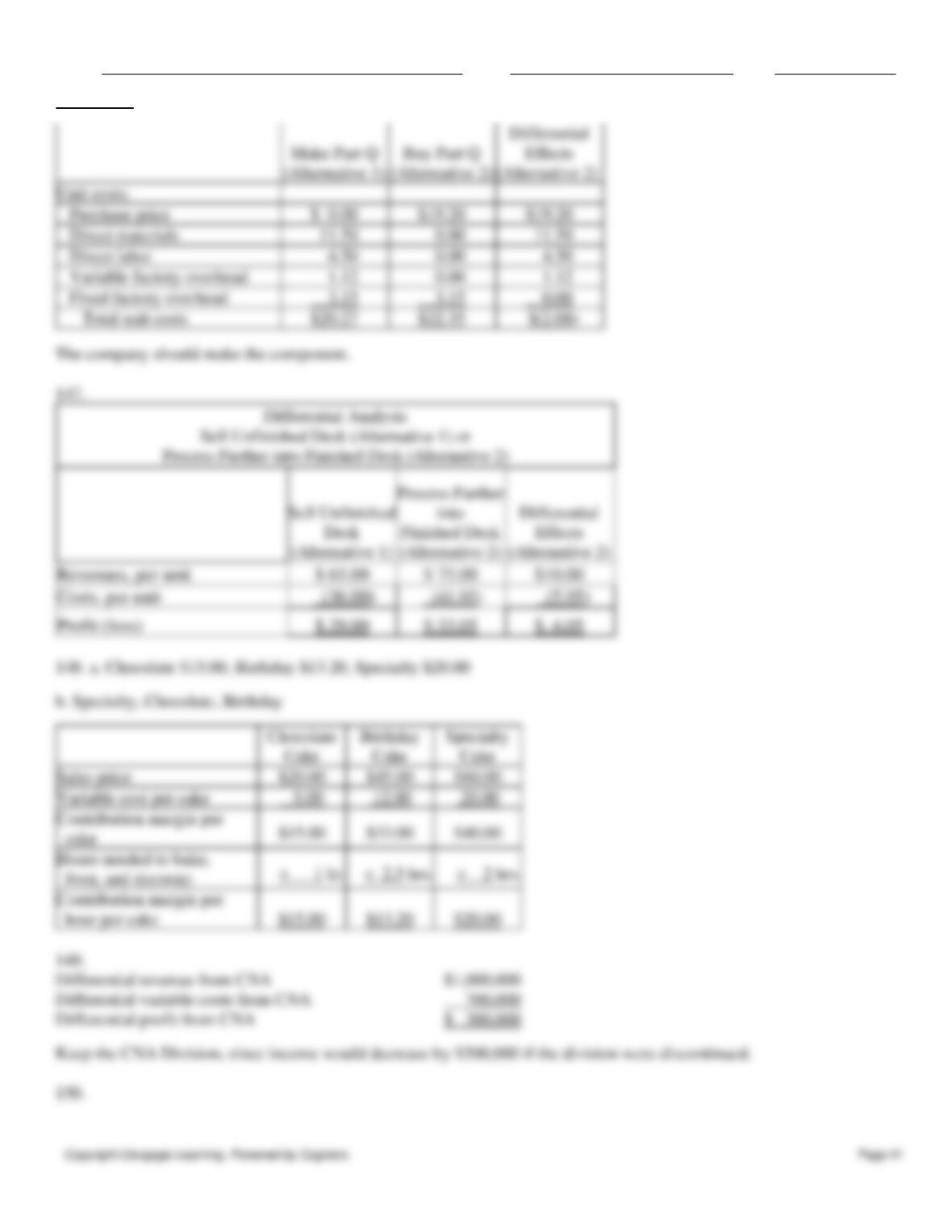
Name:
Class:
Date:
chapter 25
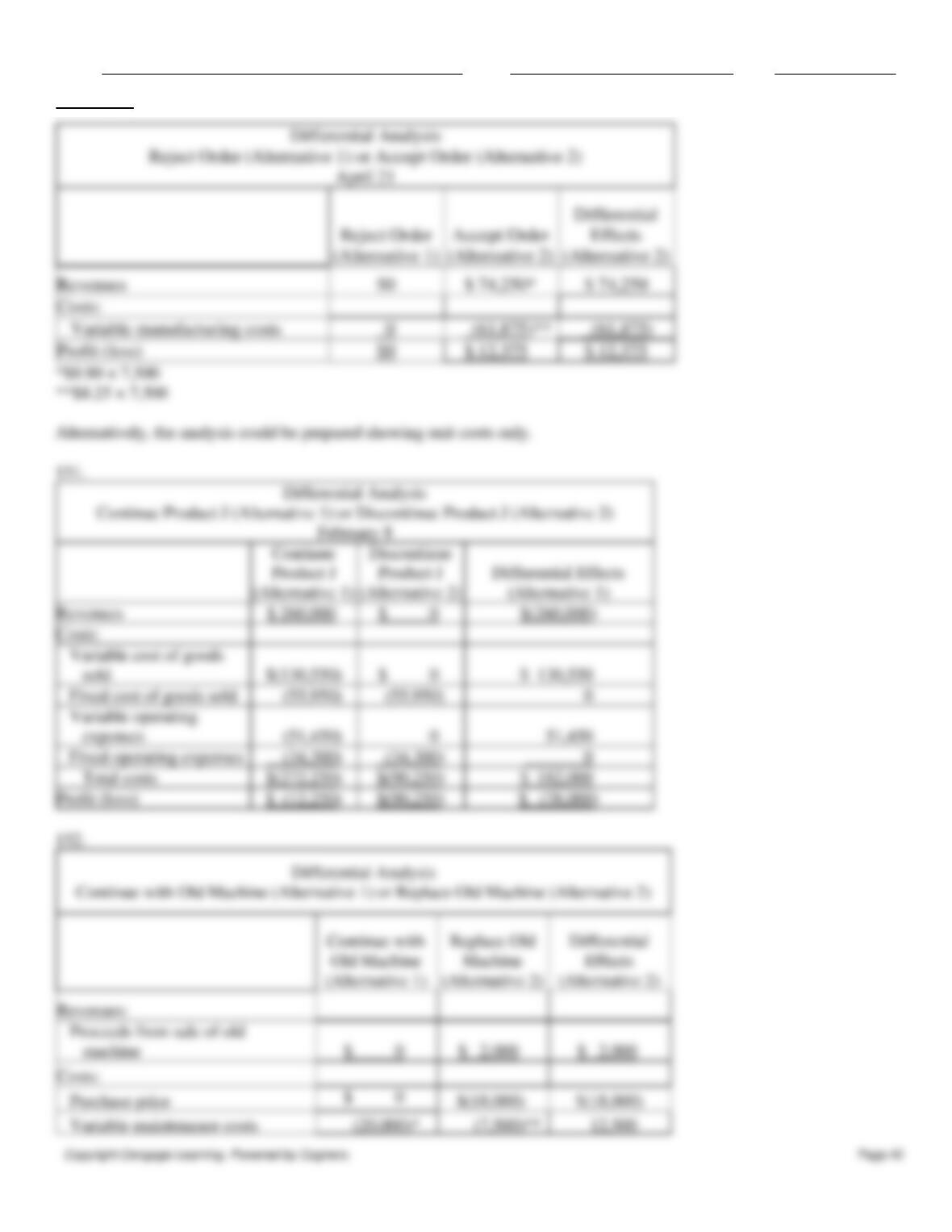
Name:
Class:
Date:
chapter 25
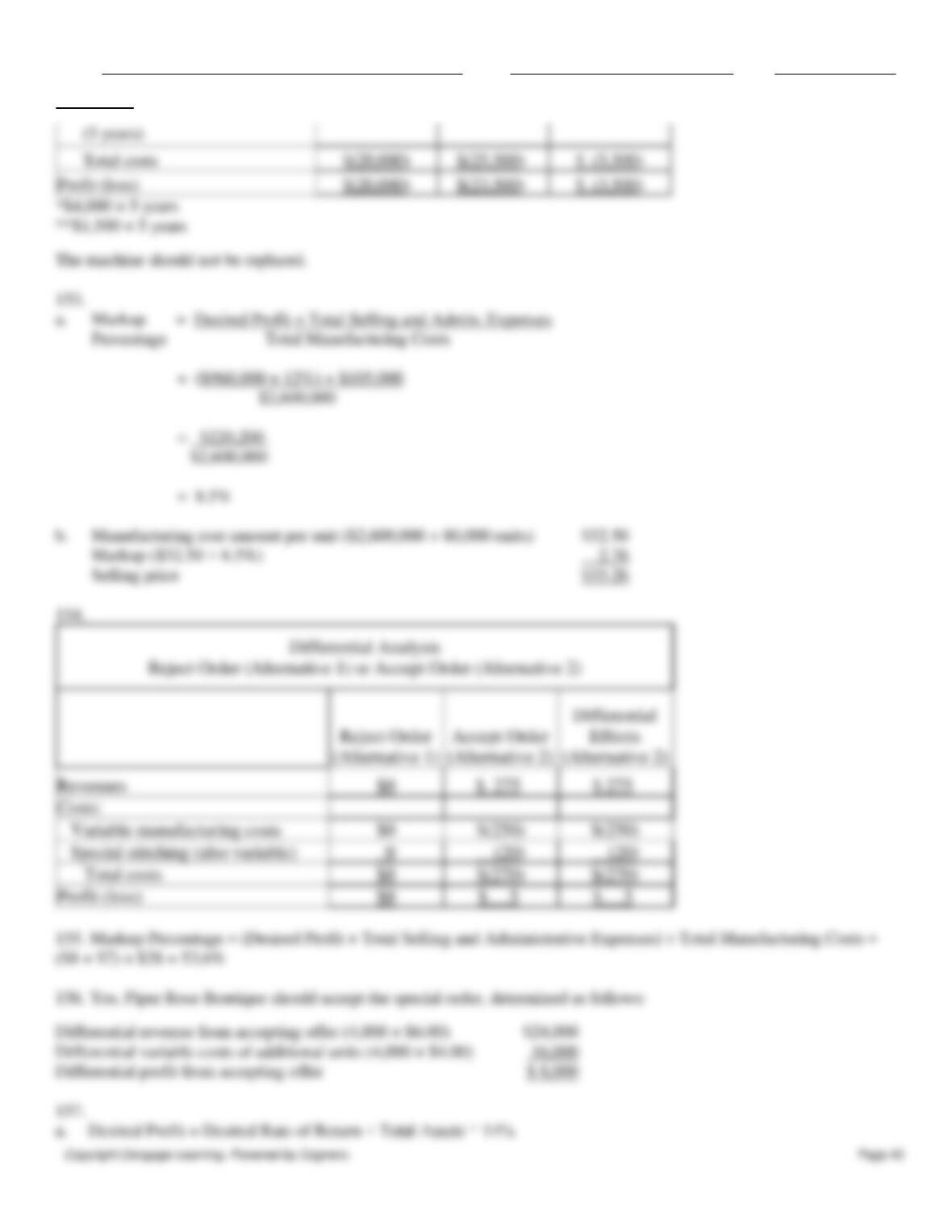
Name:
Class:
Date:
chapter 25
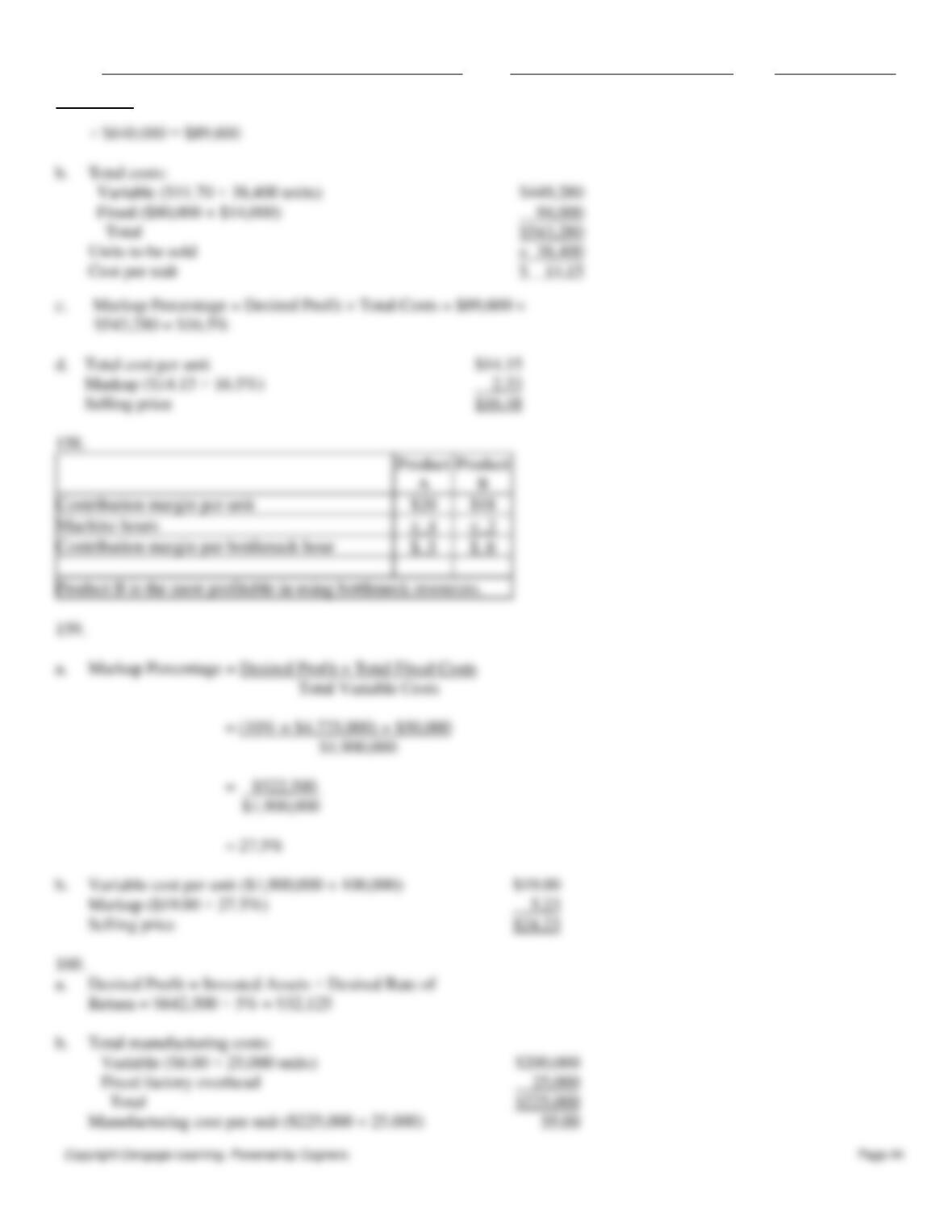
Name:
Class:
Date:
chapter 25
Name:
Class:
Date:
chapter 25
Name:
Class:
Date:
chapter 25
Name:
Class:
Date:
chapter 25
Name:
Class:
Date:
chapter 25
Name:
Class:
Date:
chapter 25
Name:
Class:
Date:
chapter 25