ANSWERS TO CASE STUDIES AND EXAMINATION QUESTIONS
Millichamp and Taylor, Auditing, 10th edition
© Cengage Learning 2012
146
a) Stock is correctly valued at lower of cost and net realisable value.
However the labour hour rate method may not accord with paragraph 20
of SSAP 9 if output in 2X10 is not a normal level of activity. Auditors will
have to validate this by analytical review. Old stock valued at £1 may be
an overly conservative policy. If these will be sold eventually at
reasonable prices then a true and fair view is not given because net
realisable value means just that – however the company may have a
better idea of old music CD’s value than the auditors.
b) This is a difficult area. New bands are notoriously unsuccessful – only a
few give a real return on initial investment. Prudence dictates that this
type of expenditure be treated as research expenditure and written off as
incurred. The treatment is therefore correct
c) Straight line is usually OK as computerised equipment may become
obsolete very quickly. This is a matter of fact for determination by the
directors.
d) The freehold property should be depreciated in accordance with FRS 15.
Land should be dealt with separately from buildings. Economic life should
be considered on its merits. Impairment should be considered.
(a) – (g)
a) The view given by the directors’ must be consistent with the view
shown by the accounts. For example the company has written off its
old stock of CD’s which may contradict this statement. E-musica is a
small niche label – whatever the directors’ think and the auditors will
have to come to a view on whether they consider the statements
ANSWERS TO CASE STUDIES AND EXAMINATION QUESTIONS
Millichamp and Taylor, Auditing, 10th edition
© Cengage Learning 2012
147
justified. As long as they are not actively misleading shareholders can
come to their own decisions on the status of dance music
b) Stocks should follow the disclosure requirements of SSAP 9.It must
describe the classification of stock – in this case musical equipment
and music CD’s
c) This income should be shown net of expenses associated with it. It
may not be material.
d) E-musica is clearly not going to be able to recover the bulk of the debt.
Angela cannot reveal the liquidation until this becomes public
knowledge as she is bound by the confidentiality aspect of her ethical
code. Depending upon how material this is – and it is probably
extremely material- a provision will have to be made for the amount
outstanding at the year end. Angela will have to wait until the
liquidation notice is published – which is never unduly delayed – before
insisting on the provision
e) This could be classed as a contingent asset but such actions may take
a long time to be resolved and the outcome is uncertain. No disclosure
should be made and the expense written off
f) Clearly this matter must be cleared up. All directors’ remuneration is
material and the CA 2006 is very insistent on full disclosure. It is
automatically material. There may be a non executive director who
does not receive a fee, in which case they should be included at zero
remuneration
g) If the directors’ report is correct the dividend payment needs
investigation. If the dividend is correct then the shareholding is
incorrectly reported in the Directors’ Report. The list of shareholders in
the statutory records should be definitive and this should accord with
the Register of Directors’ Interests and the accounts
Examination questions
Octavia
(This is an abbreviated answer)
AThat
xWork has been performed in accordance with the audit plan
ANSWERS TO CASE STUDIES AND EXAMINATION QUESTIONS
Millichamp and Taylor, Auditing, 10th edition
© Cengage Learning 2012
148
xWork has been performed in accordance with professional
standards and regulatory and legal requirements
xMaintain quality control
xSignificant matters have been raised for further consideration
xAppropriate consultations taken place/resulting conclusions
documented and implemented
xSee if there is a need to revise the nature, timing and extent of
work performed
xThe work performed supports the conclusions reached/Work
performed is appropriately documented/correct audit opinion
xThe evidence obtained is sufficient and appropriate to support the
auditors report
xThe objectives of the engagement procedures have been achieved
xTraining and coaching
xSenior staff have more experience
xCorrection of errors
B
xReview management accounts/assess profitability post year
end/any new customers
xIs gross margin is improving due to business shift
xReview correspondence with liquidator/Assess likelihood of
recoverability of debt and /or product
xReview contract with alternative customer for sale of returned
product
xReview post y/e period for recoverability of debt/return of product
xReview post y/e for sale to alternative customer
xReview forecasts for at least 12 months from the statement of
financial position date
Ensure assumptions are reasonable
Perform sensitivity analysis
Compare actual with first few months of forecast period
xReview correspondence from ex-employee who is making the claim
xReview legal correspondence in connection with the claim
xObtain written representations from management on ability to
continue as going concern/legal action
xInspect correspondence from bank to monitor relationship
xEnsure bank loan repayments being made on time/bank covenants
not breached
xReview company’s insurance policy to see if covered for industrial
injury
xReview board minutes
C
ANSWERS TO CASE STUDIES AND EXAMINATION QUESTIONS
Millichamp and Taylor, Auditing, 10th edition
© Cengage Learning 2012
149
xThe outcome of the legal action is at least one year away/Case has
not yet come to court/Octavia’s exemplary record/Insurance cover
xThe matter constitutes an inherent uncertainty
xProvision does not need to be made but full disclosure should be
given in the accounts
xAudit report:
If auditor satisfied that directors’ disclosures are
sufficiently detailed no qualification will be required but
consider an emphasis of matter paragraph drawing
attention to the uncertainty
If disclosure unclear or inadequate -qualify report
Except for – Disagreement as to extent of disclosure of
material fact
auditors’ report
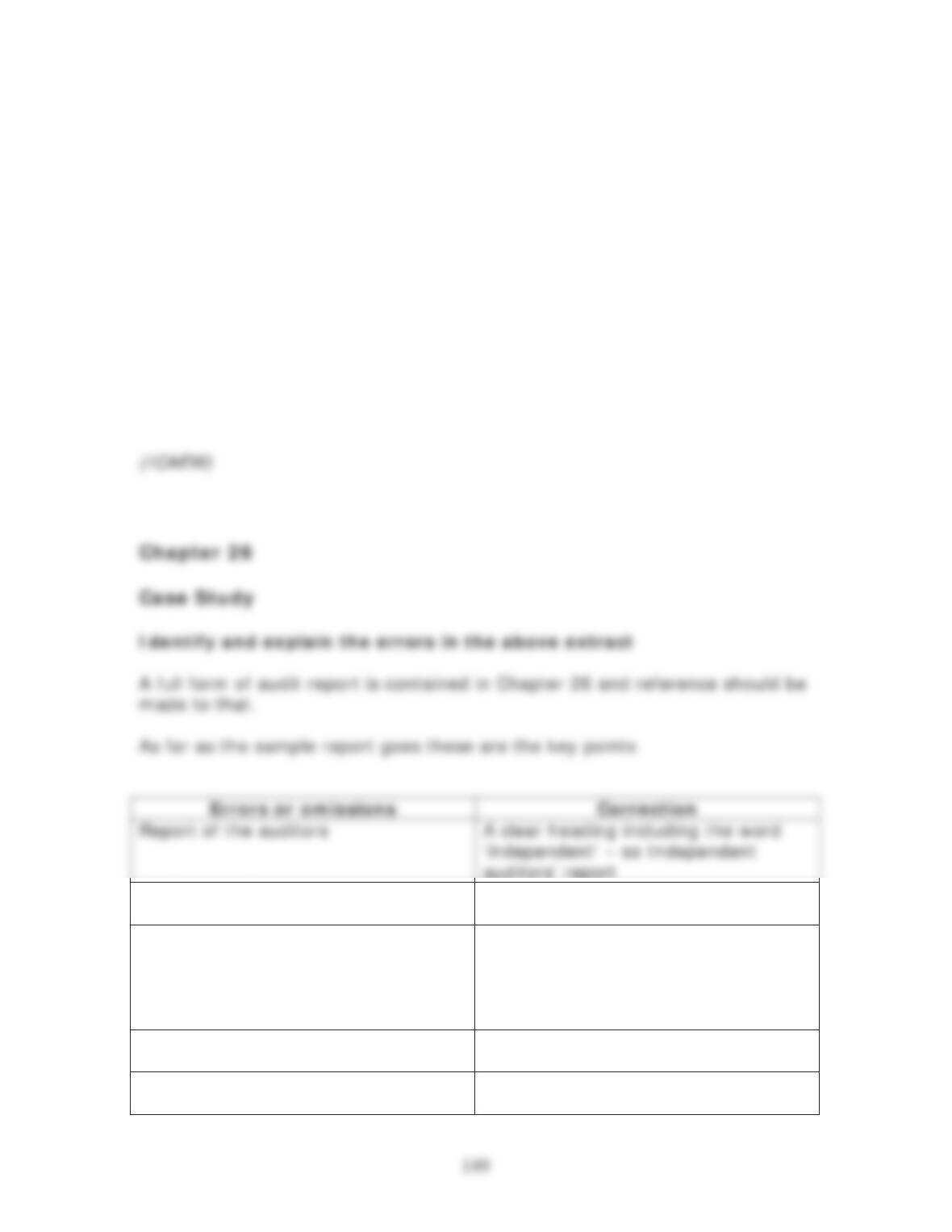
To Gofaster Motors Ltd The auditors report to the
shareholders
No mention of what is comprised in
the financial statements What the auditors have audited
should be spelled out – so the
Income Account, Statement of
Financial Position, notes, cash flow
statement etc
No mention of the basis of
preparation of the accounts Mention the accounting policies
No mention of directors’
responsibilities State directors’ responsibilities in
connection with preparation of the
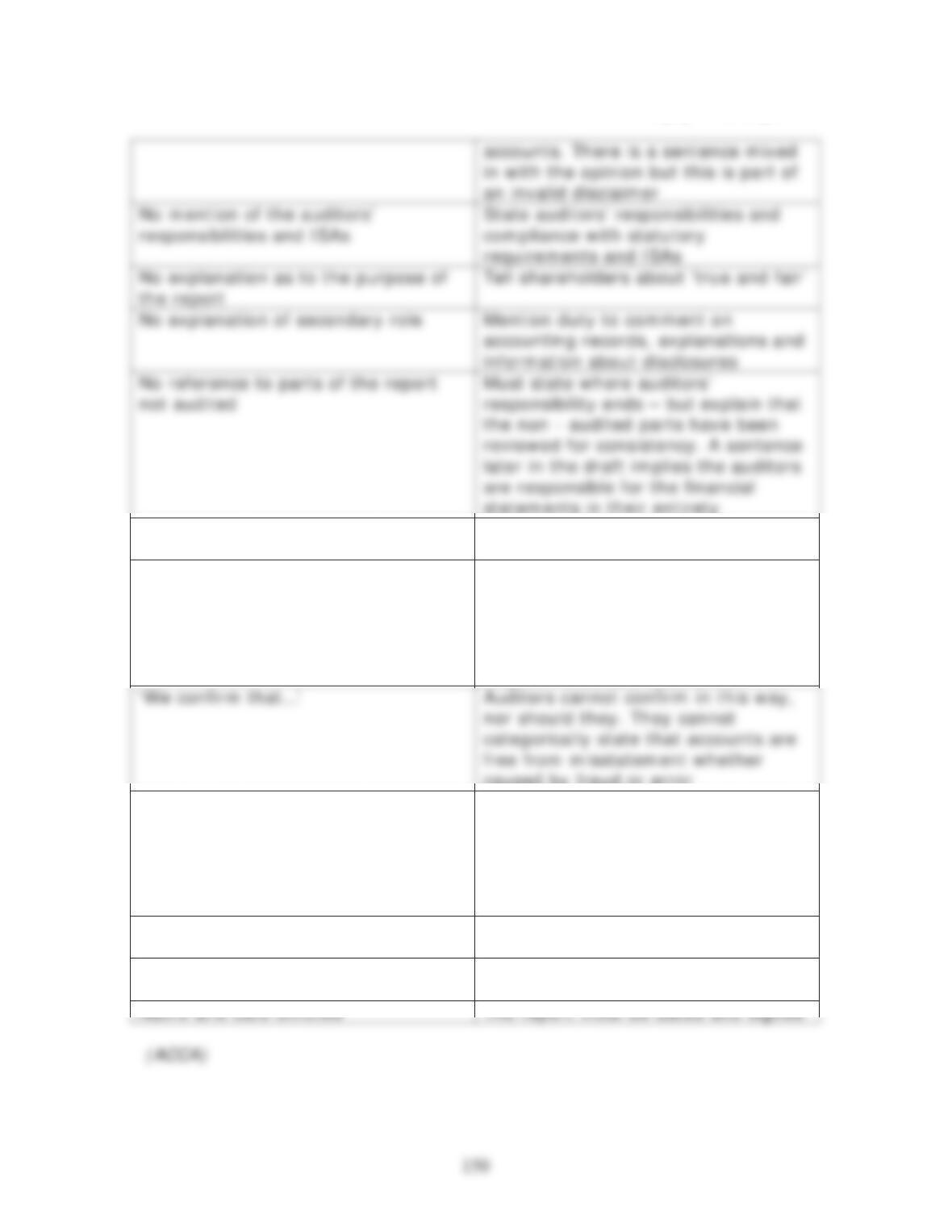
ANSWERS TO CASE STUDIES AND EXAMINATION QUESTIONS
Millichamp and Taylor, Auditing, 10th edition
© Cengage Learning 2012
150
statements in their entirety
Incorrect reference to standards Should set out which standards are
being used i.e. ISAs
‘given the time available for the
audit’ Sadly it is not possible to create such
a limitation on the auditors’ capacity
to carry out the audit.
Have to replace with mention of
sufficient appropriate evidence so as
to give reasonable assurance
caused by fraud or error
‘no liability for errors can be accepted
by the auditor …’ If only this were possible! Auditors
cannot disclaim a statutory duty in
this way. They can (but possibly
shouldn’t) disclaim the applicability of
their report to anyone other than the
persons to whom it is addressed
No proper opinion True and fair and mention of
Companies Act compliance
No mention of the Directors Report Comment re consistency of
information
Name and date omitted The report must be dated and signed
(ACCA)
ANSWERS TO CASE STUDIES AND EXAMINATION QUESTIONS
Millichamp and Taylor, Auditing, 10th edition
© Cengage Learning 2012
151
Conclusion
Qualified audit report.
Reasons
xLimitation on the scope of the auditor’s work – evidence reasonably
expected to be available is not available.
xIt is material in the context of total assets – 20.3% of total assets
and 80% of profit before tax.
Effect
xDescription of the limitation on the scope in the basis of opinion
section of the report.
xThe opinion should be qualified (except for) if considered material
without being pervasive.
xDisclaimer of opinion should be given if the matter is considered
material and pervasive.
xThere should also be a reference to the auditor’s inability to
determine whether proper accounting records had been maintained
and that all information necessary for the audit had not been
received in respect of lack of inventory records,
Reasons
Disagreement over the accounting treatment of the repairs and maintenance
costs, not material as it is only 2% of profit before tax and 0.25% of total
assets.
Effect
ANSWERS TO CASE STUDIES AND EXAMINATION QUESTIONS
Millichamp and Taylor, Auditing, 10th edition
© Cengage Learning 2012
152
xNo grounds for qualification as the situation is not a limitation of
scope or a disagreement.
xSignificant uncertainty, resolution of which is dependent on future
events and which may affect the financial statements. It is also
explained in note to the financial statements.
xEmphasis of matter paragraph following the opinion section.
xDraw the user’s attention to the note in the financial statements,
explain the issue giving rise to the uncertainty and contain a
specific statement “without qualifying our opinion”
xHowever, if the note to the financial statements is not adequate,
the opinion should be qualified on the grounds of disagreement
Audit quality depends, inter alia, on the quality of the people. Smaller firms
may lack resources and specialist (audit) expertise. In particular, small firms
may not be able to offer the same reward structures to attract and retain
staff as larger firms.
Also, whereas larger firms can afford to recruit staff in sufficient numbers to
allow for subsequent leavers and provide for their training needs, smaller
firms may not be able to offer the same training opportunities. Prospective
trainees may perceive a smaller firm’s client base to be less attractive than
that of a larger firm (e.g. in terms of the on-the-job training which it offers).
Smaller practices may have less scope to provide staff with internal and on-
the-job training and costs of external training may be costly in comparison
and also fail to provide the ‘hands-on’ experience necessary for professional
development.
ANSWERS TO CASE STUDIES AND EXAMINATION QUESTIONS
Millichamp and Taylor, Auditing, 10th edition
© Cengage Learning 2012
153
The cost of access to external specialists may be prohibitive for smaller firms.
Audit committees play an oversight role which contributes to quality control
in larger firms (e.g. on matters of client acceptance/retention, independence
issues, etc). When the client base is largely of owner-managed businesses,
as for many smaller audit firms, there are no non-executive directors to
support the auditor when difficult issues arise.
Quality control requires leadership within the firm. In a larger firm one senior
partner may have responsibility for establishing quality control policies and
procedures and another, responsibility for monitoring work performed.
Splitting these roles may not be practical for a smaller firm (and impossible
for sole practitioners).
Small firms operate in a highly competitive environment for audit work and
are often busy with non-audit work and under-resourced. Technical updating
on audit matters may not be as regular as desirable and audit practice may
become inefficient.
Smaller firms may draw, judiciously, on the expertise of suitably qualified
external consultants (e.g. on technical matters).
Small firms and sole practitioners have the same access to a wide range of
technical and ethical advisory services provided by ACCA (and other
professional bodies) and should take advantage of these.
Small firms may work together as a consortium to share training
opportunities and sometimes staff. For example, an association of small firms
may adopt the same methodology and meet annually (say) for technical
updates.
(b) Lammergeier Group – auditor’s report
ŶThe report is confused. It is clearly headed ‘Qualified opinion arising from
disagreement …’ yet the reasons for departure (from IAS 7) are ‘sound and
acceptable’. The heading is a statement of disagreement, the latter a
statement of concurrence. If the auditor concurs with a departure the opinion
should not be qualified.
ŶWhat is ‘IAS 7’? This should be stated in full, i.e. ‘International Accounting
Standard 7 Cash Flow Statements’.
ANSWERS TO CASE STUDIES AND EXAMINATION QUESTIONS
Millichamp and Taylor, Auditing, 10th edition
© Cengage Learning 2012
154
ŶIt might be simpler/clearer to head the opinion paragraph ‘Qualified opinion
arising from omission of cash flow statement’.
ŶThe auditors should not be expressing an opinion of Lammergeier’s
management in their report. Management’s ‘justification’ should be set out in
a note to the financial statements (e.g. in the accounting policies section).
The auditor’s report should clearly state that there is non-compliance with
IAS 7. For example, ‘As explained in note … the financial statements do not
contain a cash flow statement as required by IAS 7 [written out in full]’.
ŶThe grounds for non-compliance is ‘the complexity involved’. This does not
seem likely. IAS 7 offers no exemption on these (or any other) grounds.
ŶThe fact that the audit opinion was similarly qualified in the prior year
shows that the matter has not been resolved even after a year.
ŶIt is possible that, having qualified on the prior year, it was an ‘easy option’
to qualify again in the same terms rather than draft a more appropriate
opinion for the consecutive year.
ŶThe 2X10 opinion makes no reference to the fact that the matter is ‘not
new’ and that the opinion was similarly qualified in the prior year.