142) A company is considering a proposal to invest $40,000 in a project that would provide the
following net cash flows:
Year 1 ……………………………………….. $ 6,500
Year 2 …………………………………………. 12,700
Year 3 …………………………………………. 15,000
Year 4 …………………………………………. 12,800
Compute the project’s payback period.
143) A company produces two boat models, Flyer and Skimmer. Both products are being
considered for major investment projects next year. Relevant data follow:
Flyer Skimmer
New investment $424,000 $380,000
Expected net cash flows:
Year 1 150,000 130,000
Year 2 160,000 130,000
Year 3 170,000 130,000
Required:
Use the payback period to evaluate these two investment projects.
144) A company is evaluating the purchase of a machine for $750,000 with a six-year useful life
and no salvage value. The company uses straight-line depreciation and it assumes that the annual
net cash flow from using the machine will be received uniformly throughout each year. In
calculating the accounting rate of return, what is the company’s average investment?
145) A company purchases a machine for $800,000. The machine has an expected life of 9 years
and no salvage value. The company anticipates a yearly after-tax net income of $60,000 to be
received uniformly throughout each year. What is the accounting rate of return?
146) A company is considering two projects, Project A and Project B. The following information
is available for each project:
Project A Project B
Investment $500,000 $2,000,000
Net present value of cash flows $600,000 $800,000
Calculate the profitability index for each project. Based on the profitability index, which project,
if any, should the company pursue and why?
78
147) A company is considering the purchase of new equipment for $42,000. The projected
annual cash inflow is $18,000. The machine has a useful life of 3 years and no salvage value.
Management of the company requires a 12% return on investment. The present value of an
annuity of $1 for various periods follows:
Period
Present value of an annuity of 1 at 12%
1
0.8929
2
1.6901
3
2.4018
What is the net present value of this machine assuming all cash flows occur at year-end?

79
148) A company is trying to decide which of two new product lines to introduce in the coming
year. The company requires a 12% return on investment. The predicted revenue and cost data for
each product line follows:
Product A
Product B
Unit sales
25,000
20,000
Unit sales price
$ 30
$ 30
Direct materials
$15,000
$8,000
Direct labor
$120,000
$80,000
Other cash operating expenses
$30,000
$25,000
New equipment costs
$2,500,000
$1,500,000
Estimated useful life (no salvage)
5 years
5 years
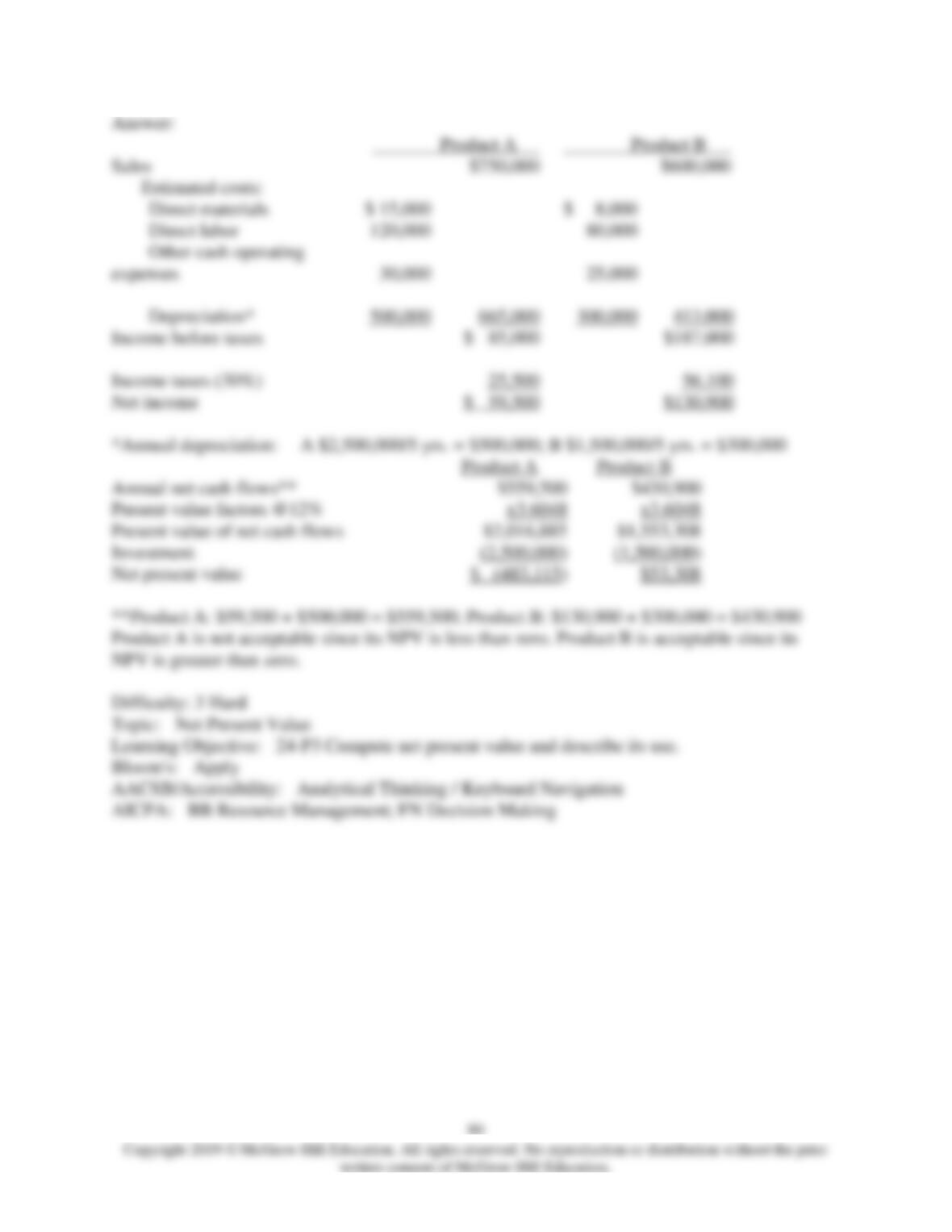
The company has a 30% tax rate and it uses the straight-line depreciation method. The present
value of an annuity of 1 for 5 years at 12% is 3.6048. Compute the net present value for each
piece of equipment under each of the two product lines. Which, if either of these two investments
is acceptable?
149) A company is considering two alternative investment opportunities, each of which requires
an initial cash outlay of $110,000. The expected net cash flows from the two projects follow:
Project A Project Z
Year 1 ……………… $ 30,000 $ 44,000
Year 2 ……………… 44,000 70,000
Year 3……………… 70,000 30,000
Totals ……………… $144,000 $144,000
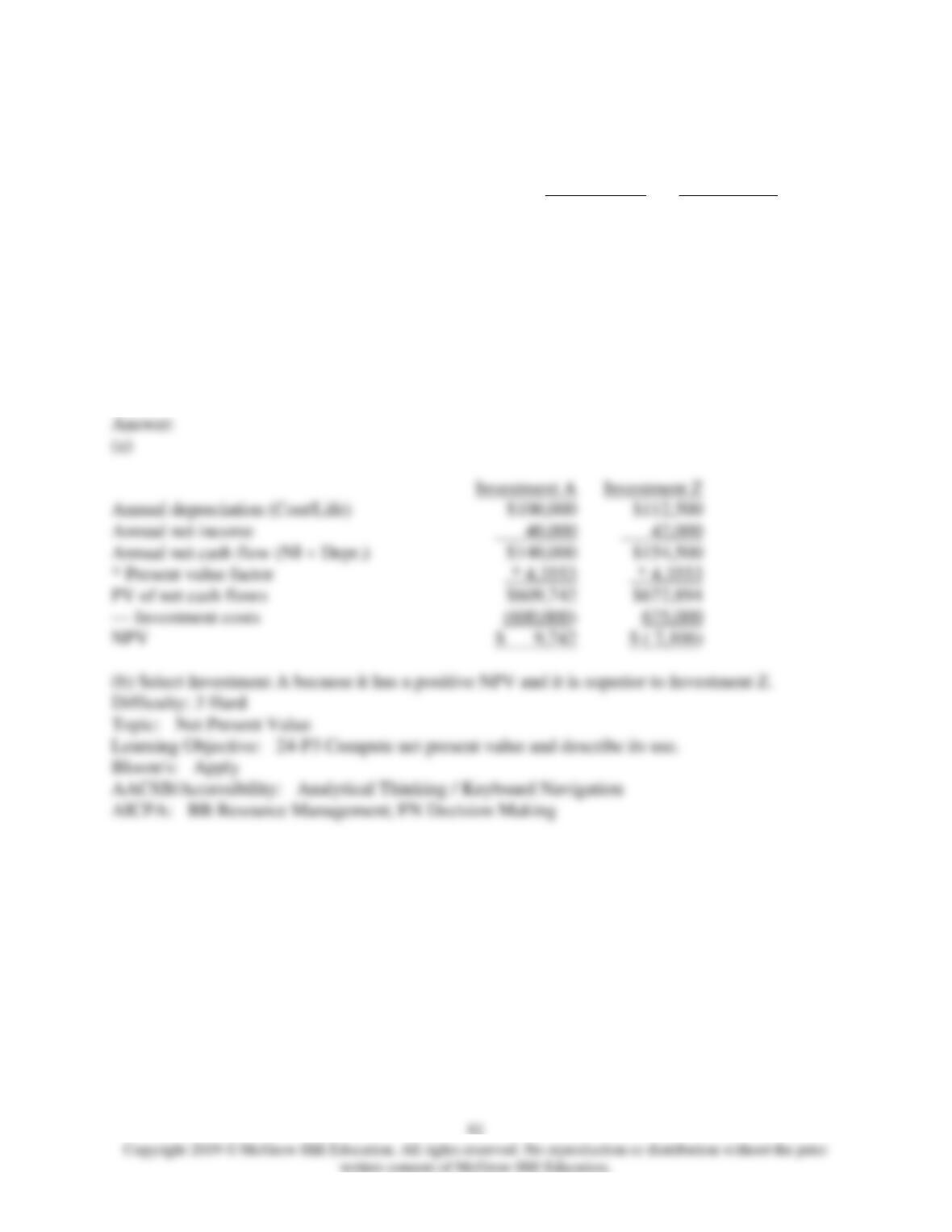
Based on a comparison of their net present values, and assuming the same discount rate of 12%
is required for both projects, which project is the better investment? Use the table values below
to compute the net present value of each project’s cash flows.
Periods Present value of 1 at 12%
1………………. 0.8929
2………………. 0.7972
3………………. 0.7118
150) A company has a decision to make between two investment alternatives. The company
requires a 10% return on investment. Predicted data is provided below:
Investment A Investment Z
Projected after-tax net income ………………………………… $ 40,000 $ 42,000
Investment costs ……………………………………………………. $600,000 $675,000
Estimated life ………………………………………………………. 6 years 6 years
The present value of an annuity for 6 years at 10% is 4.3553. This company uses straight-line
depreciation.
Required:
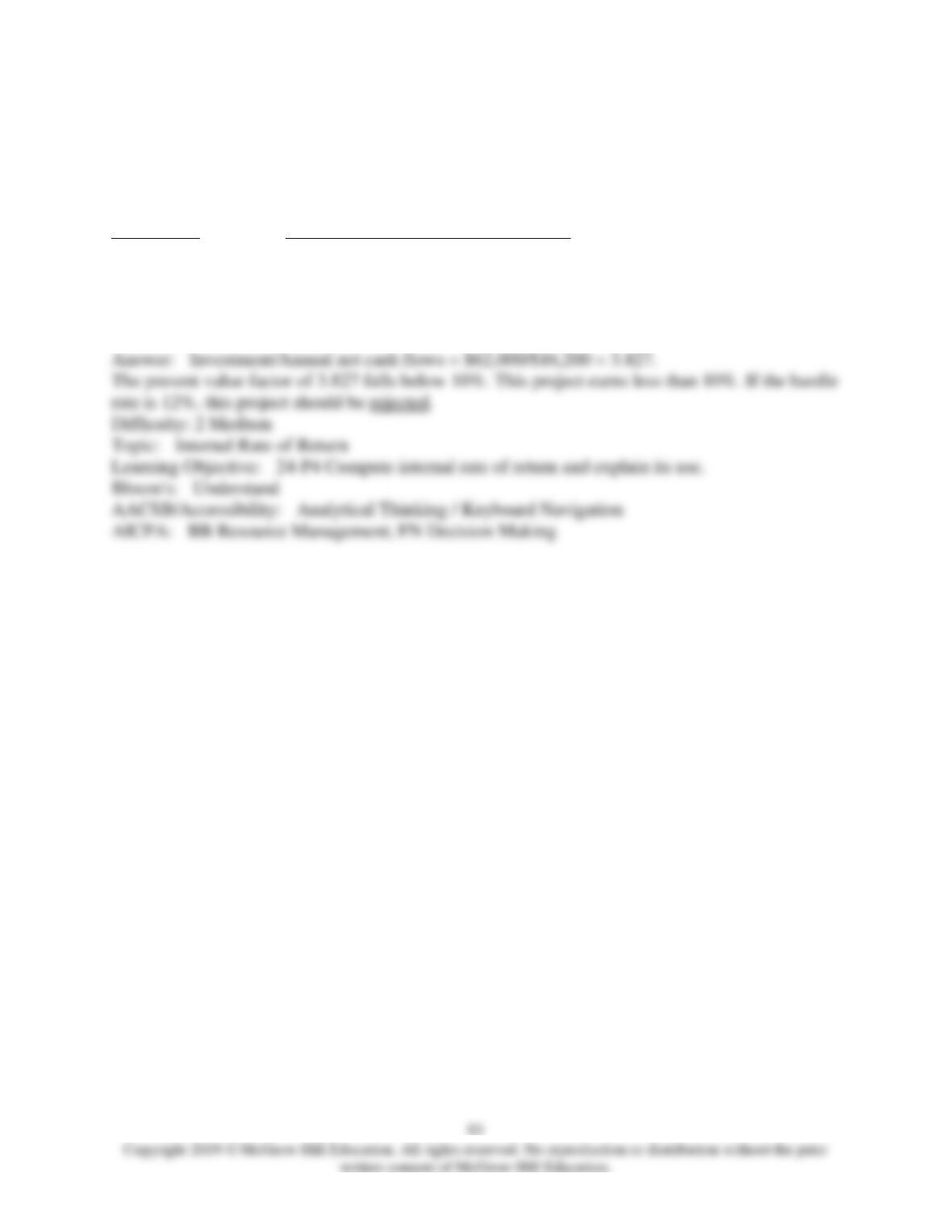
(a) Calculate the net present value for each investment.
(b) Which investment should this company select? Explain.
151) A company is considering a 5-year project. It plans to invest $62,000 now and it forecasts
cash flows for each year of $16,200. The company requires a hurdle rate of 12%. Calculate the
internal rate of return to determine whether it should accept this project. Selected factors for a
present value of an annuity of 1 for five years are shown below:
Interest rate
Present value of an annuity of 1 factor
10%
3.7908
12%
3.6048
14%
3.4331
152) Dracor Company is considering the purchase of equipment that would allow the company
to add a new product to its line. The equipment is expected to cost $280,000 with a 7-year life,
no salvage value, and will be depreciated using straight-line depreciation. The expected annual
income related to this equipment follows. Compute the (a) payback period and (b) accounting
rate of return for this equipment.
Sales
$900,000
Costs:
Manufacturing
$545,000
Depreciation on machine
40,000
Selling and administrative expenses
249,000
(834,000)
Income before taxes
66,000
Income tax (30%)
( 19,800)
Net income
$ 46,200
153) Trevoline Company is deciding between two projects. Each project requires an initial
investment of $350,000. The projected net cash flows for the two projects are listed below. The
revenue is to be received at the end of each year. Trevoline requires a 10% return on its
investments. The present value of an annuity of 1 and present value of an annuity factors for
10% are presented below. Use net present value to determine which project should be pursued
and explain why.
Project A
Project B
Present Value
Present Value of an
Periods
Cash Flows
Cash Flows
of 1 at 10%
Annuity of 1 at 10%
1
$50,000
$160,000
0.9091
0.9091
2
$200,000
$175,000
0.8264
1.7355
3
$250,000
$175,000
0.7513
2.4869
Year 1
Year 2
Year 3
Total
Amount invested
Net present value
154) ________ is the process of analyzing alternative long-term investments and deciding which
assets to acquire or sell.
155) The minimum acceptable rate of return on an investment, often the company’s cost of
capital, is called the ________.
156) A capital budgeting method that considers how quickly a project recovers costs is known as
________. An enhancement to this method that also considers the time value of money is
called ________.
157) In evaluating capital budgeting alternatives, there are two primary methods that do not
consider the time value of money. These methods are ________ and ________. There are
also two primary methods that consider the time value of money; these are ________ and
________.
158) The ________ is computed by dividing a project’s annual after-tax net income by the annual
average amount invested.
159) The ________ is computed by discounting the future net cash flows from the investment at
the project’s required rate of return and then subtracting the initial amount invested.
160) The net present value decision rule requires that when an asset’s expected cash flows are
discounted at the required rate and yield a positive net present value, the project should be
________.
161) The ________ is the rate that yields a net present value of zero for an investment.