Test Bank for Intermediate Accounting, Seventeenth Edition
24 – 34
Solution 24-87 (cont.)
(c) The prediction models are probably unsuccessful because accountants have not treated the
problem of seasonality correctly in their interim reports. The problem with the conventional
approach is that fixed nonmanufacturing costs are not charged in proportion to sales.
Rather, these costs are charged as incurred, or spread evenly over the four quarters. As a
result, it is extremely difficult to make accurate predictions because some artificial concepts
are used for matching purposes.
Ex. 24-88—Inventory and cost of goods sold at interim dates.
Discuss how inventory and cost of goods sold may be afforded special accounting treatment at
interim dates.
Ex. 24-89—Forecasts.
Recent proposals by investors and others have suggested that corporations include financial
forecasts in their annual reports. It further has been suggested that the CPA attest to those
forecasts.
Instructions
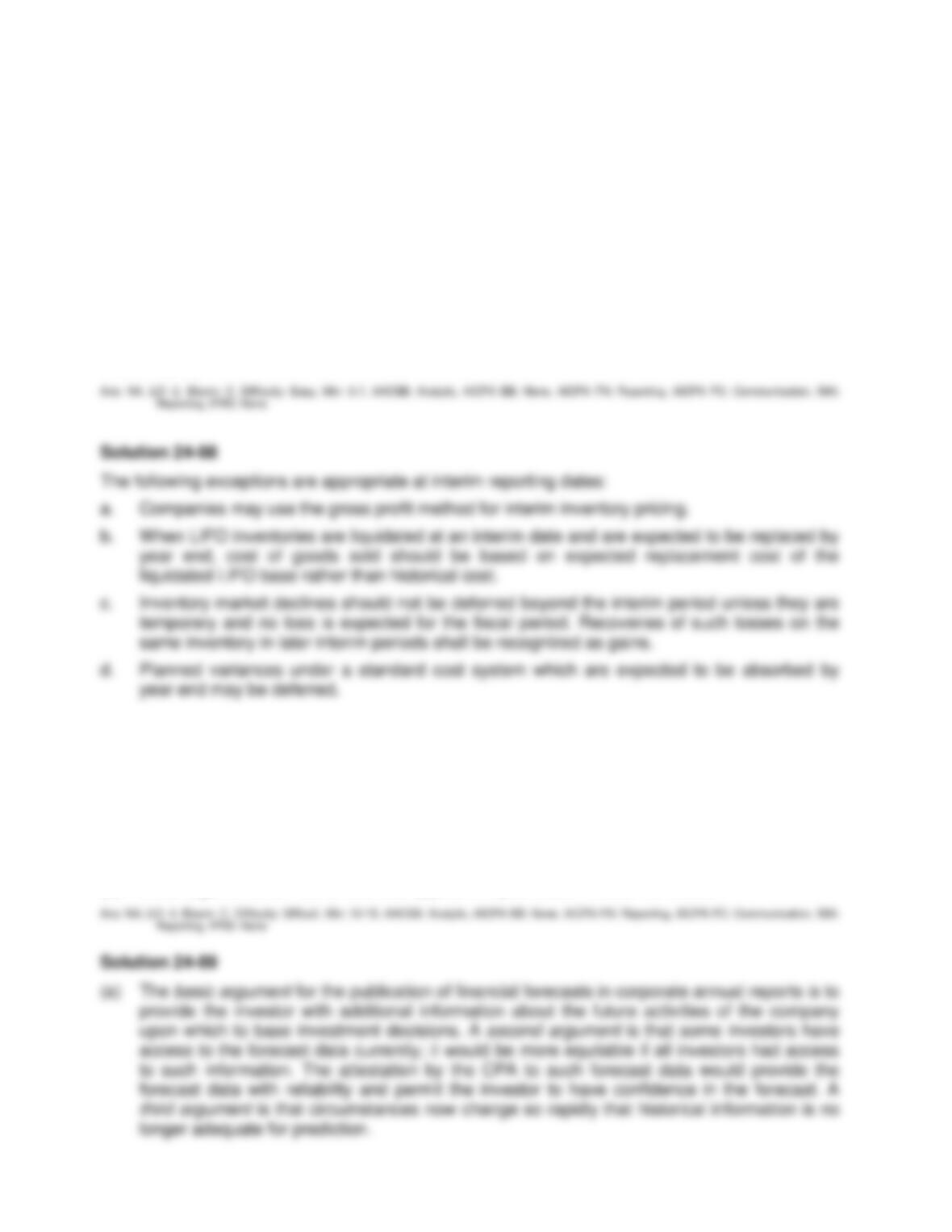
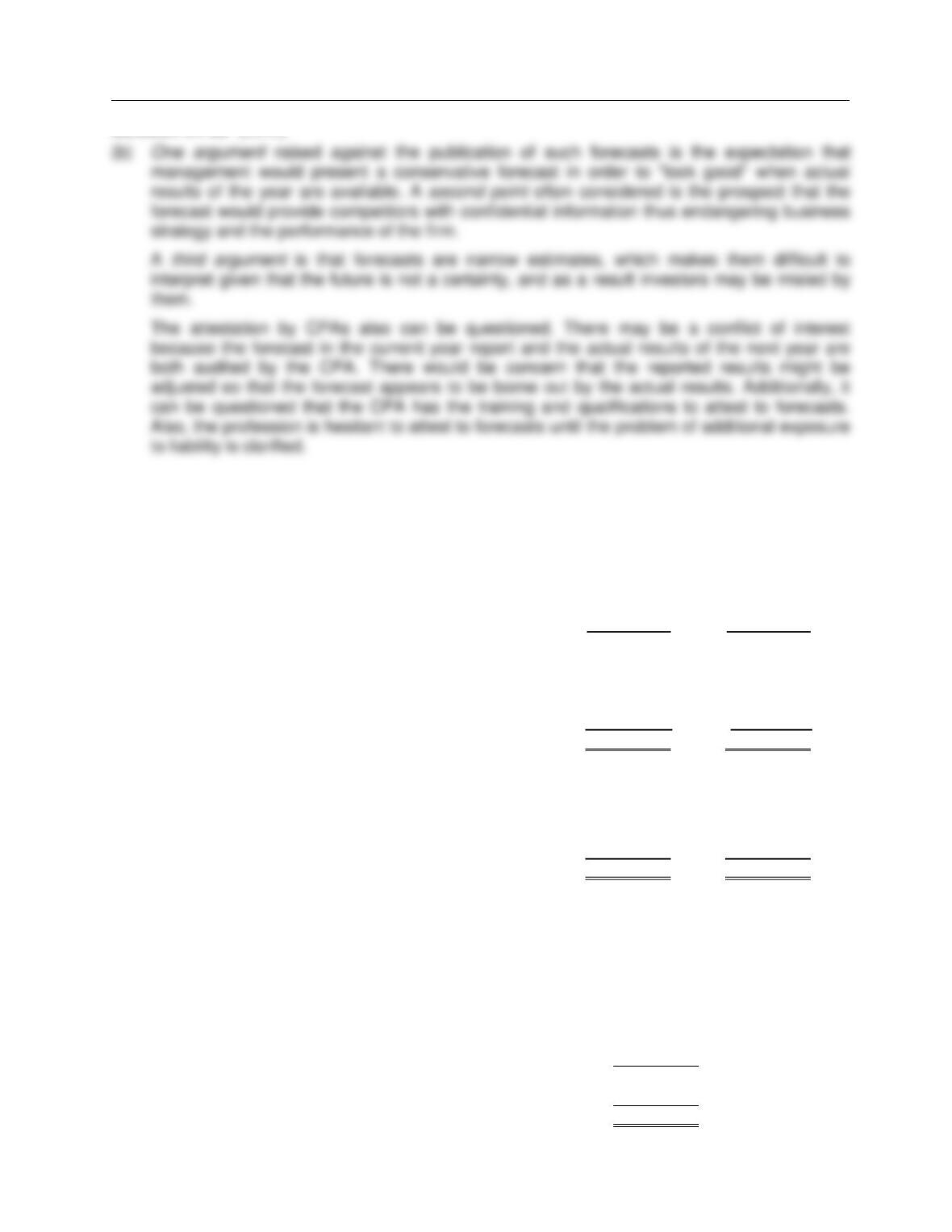
(a) What arguments are advanced to support the publication of such forecasts?
(b) What arguments are advanced that oppose the publication of such forecasts?
Full Disclosure in Financial Reporting
24 – 35
Solution 24-89 (cont.)
*Ex. 24-90—Financial statement analysis.
The condensed financial statements of Marks Company for the years 2020–2021 are presented
below:
Marks Company
Comparative Balance Sheets
As of December 31, 2020 and 2021
2021 2020
Cash $ 630,000 $ 180,000
Accounts receivable (net) 540,000 450,000
Inventories 570,000 510,000
Plant and equipment 2,700,000 1,608,000
Accumulated depreciation (390,000) (228,000)
$4,050,000 $2,520,000
Accounts payable $ 510,000 $ 240,000
Dividends payable -0- 60,000
Bonds payable 600,000 -0-
Common stock ($10 par) 2,280,000 1,800,000
Retained earnings 660,000 420,000
$4,050,000 $2,520,000
Additional data:
Market value of stock at 12/31/21 is $80 per share.
Marks sold 48,000 shares of common stock at par on July 1, 2021.
Marks Company
Condensed Income Statement
For the Year Ended December 31, 2021
Sales revenue $3,600,000
Cost of goods sold 2,475,000
Gross profit 1,125,000
Administrative and selling expenses 750,000
Net income $ 375,000
Test Bank for Intermediate Accounting, Seventeenth Edition
24 – 36
*Ex. 24-90 (cont.)
Instructions
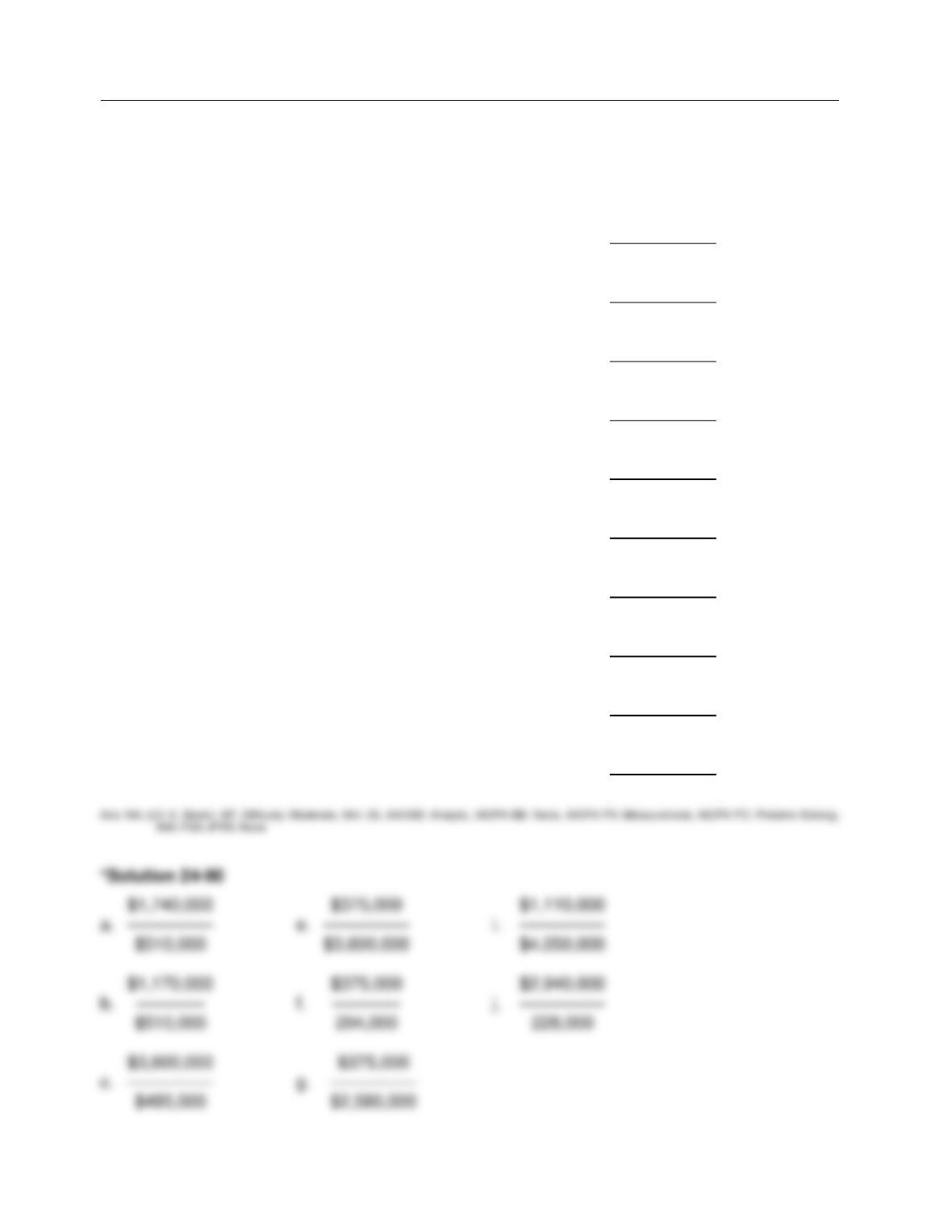
Compute the following financial ratios by placing the proper amounts in the parentheses provided
for numerators and denominators.
a. Current ratio at 12/31/21 ( )
( )
b. Acid test ratio at 12/31/21 ( )
( )
c. Accounts receivable turnover in 2021 ( )
( )
d. Inventory turnover in 2021 ( )
( )
e. Profit margin on sales in 2021 ( )
( )
f. Earnings per share in 2021 ( )
( )
g. Return on common stock holders’ equity in 2021 ( )
( )
h. Price earnings ratio at 12/31/21 ( )
( )
i. Debt to total assets at 12/31/21 ( )
( )
j. Book value per share at 12/31/21 ( )
( )
Full Disclosure in Financial Reporting
24 – 37
Solution 24-90 (cont.)
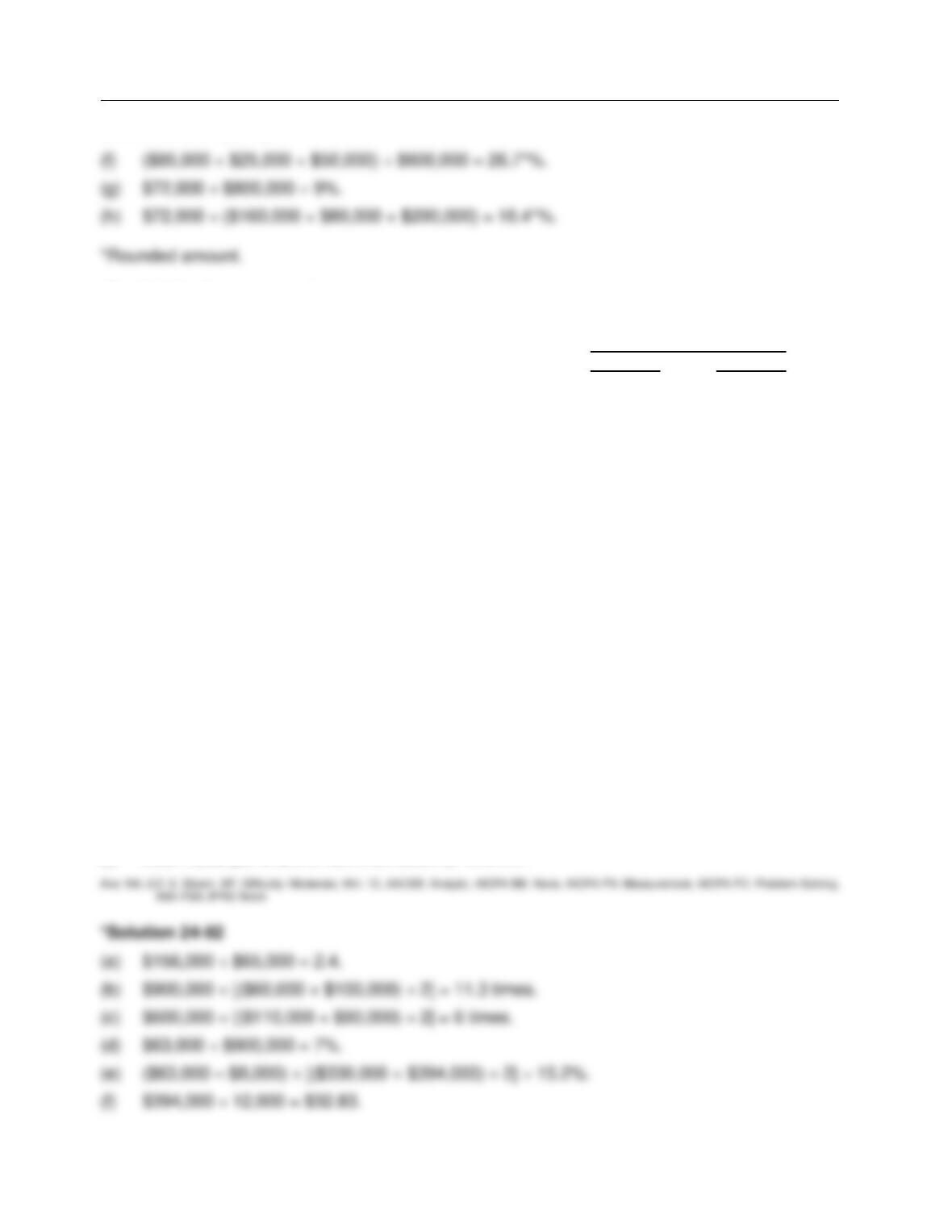
*Ex. 24-91—Selected financial ratios.
The following information pertains to Wamser Company:
Cash $ 40,000
Accounts receivable 100,000
Inventory 80,000
Plant assets (net) 380,000
Total assets $600,000
Accounts payable $ 85,000
Accrued taxes and expenses payable 25,000
Long-term debt 50,000
Common stock ($10 par) 160,000
Paid-in capital in excess of par 80,000
Retained earnings 200,000
Total equities $600,000
Net sales (all on credit) $800,000
Cost of goods sold 600,000
Net income 72,000
Instructions
Compute the following: (It is not necessary to use averages for any balance sheet figures
involved.)
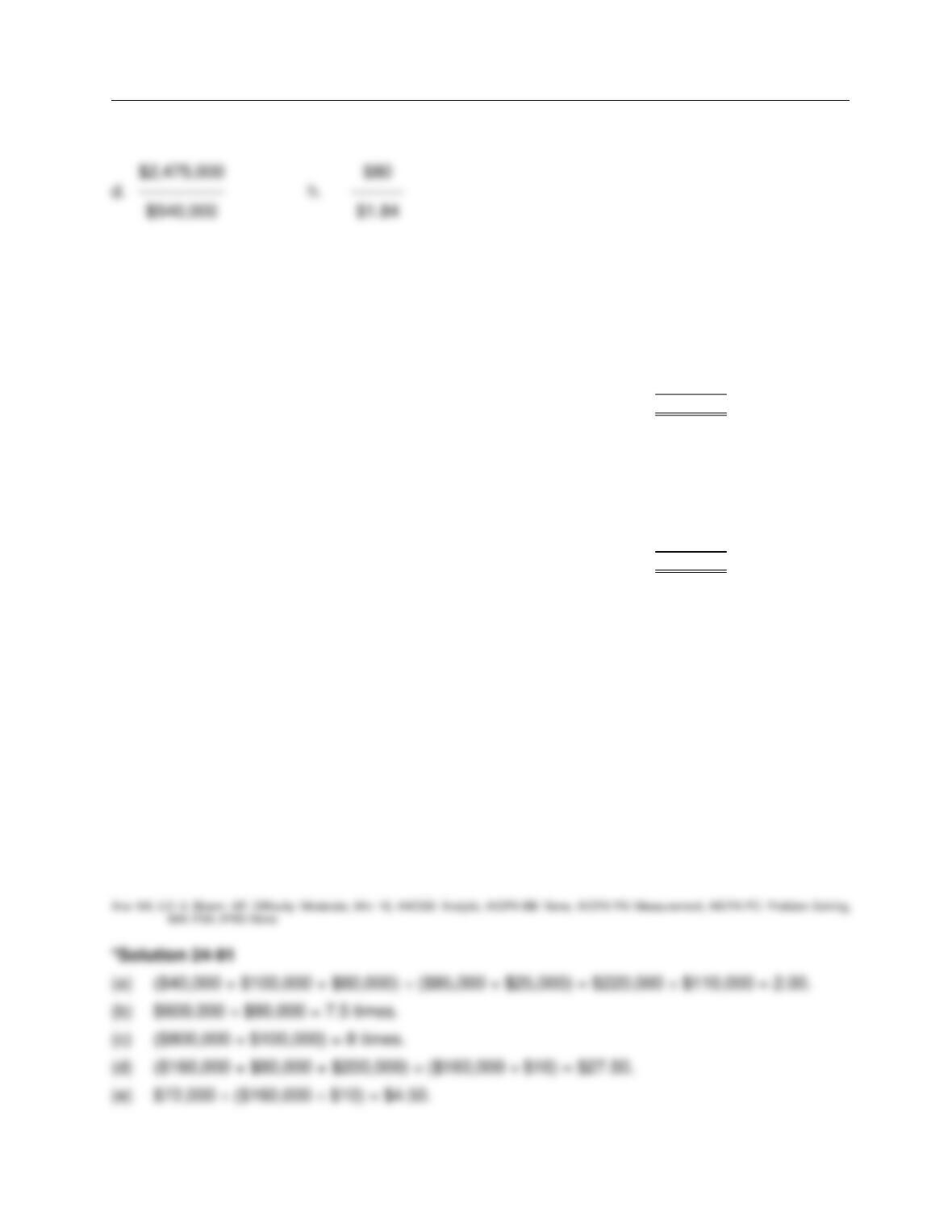
(a) Current ratio
(b) Inventory turnover
(c) Accounts receivable turnover
(d) Book value per share
(e) Earnings per share
(f) Debt to total assets
(g) Profit margin on sales
(h) Return on common stockholders’ equity
Test Bank for Intermediate Accounting, Seventeenth Edition
24 – 38
Solution 24-91 (cont.)
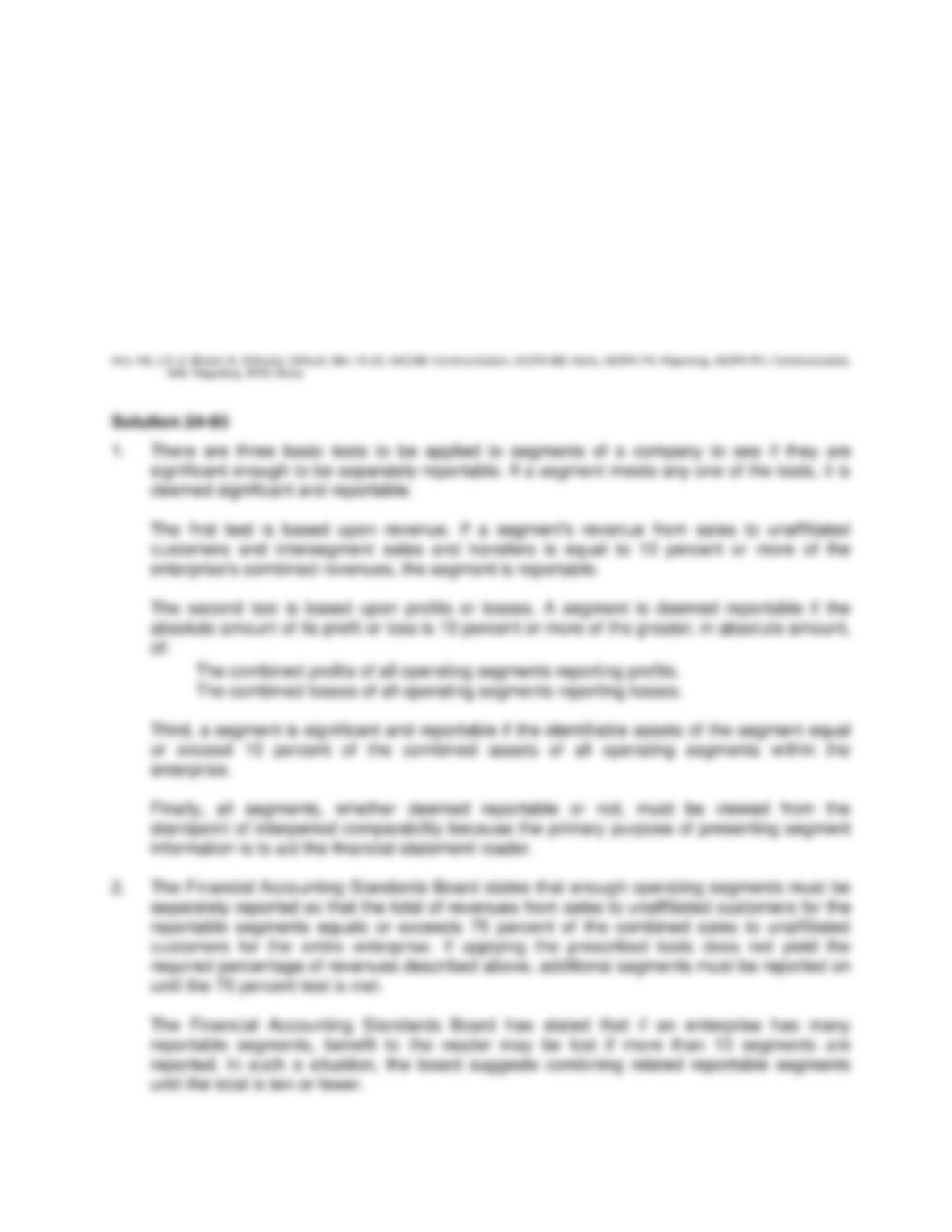
*Ex. 24-92—Computation of selected ratios.
The following data is given:
December 31,
2021 2020
Cash $ 56,000 $ 50,000
Accounts receivable (net) 100,000 60,000
Inventories 90,000 110,000
Plant assets (net) 383,000 325,000
Accounts payable 55,000 40,000
Salaries and wages payable 10,000 5,000
Bonds payable 70,000 70,000
8% Preferred stock, $40 par 100,000 100,000
Common stock, $10 par 120,000 90,000
Paid-in capital in excess of par 80,000 65,000
Retained earnings 194,000 175,000
Net credit sales 900,000
Cost of goods sold 600,000
Net income 63,000
Instructions
Compute the following ratios:
(a) Acid-test ratio at 12/31/21
(b) Accounts receivable turnover in 2021
(c) Inventory turnover in 2021
(d) Profit margin on sales in 2021
(e) Return on common stockholders’ equity in 2021
(f) Book value per share of common stock at 12/31/21
Full Disclosure in Financial Reporting
24 – 39
PROBLEMS
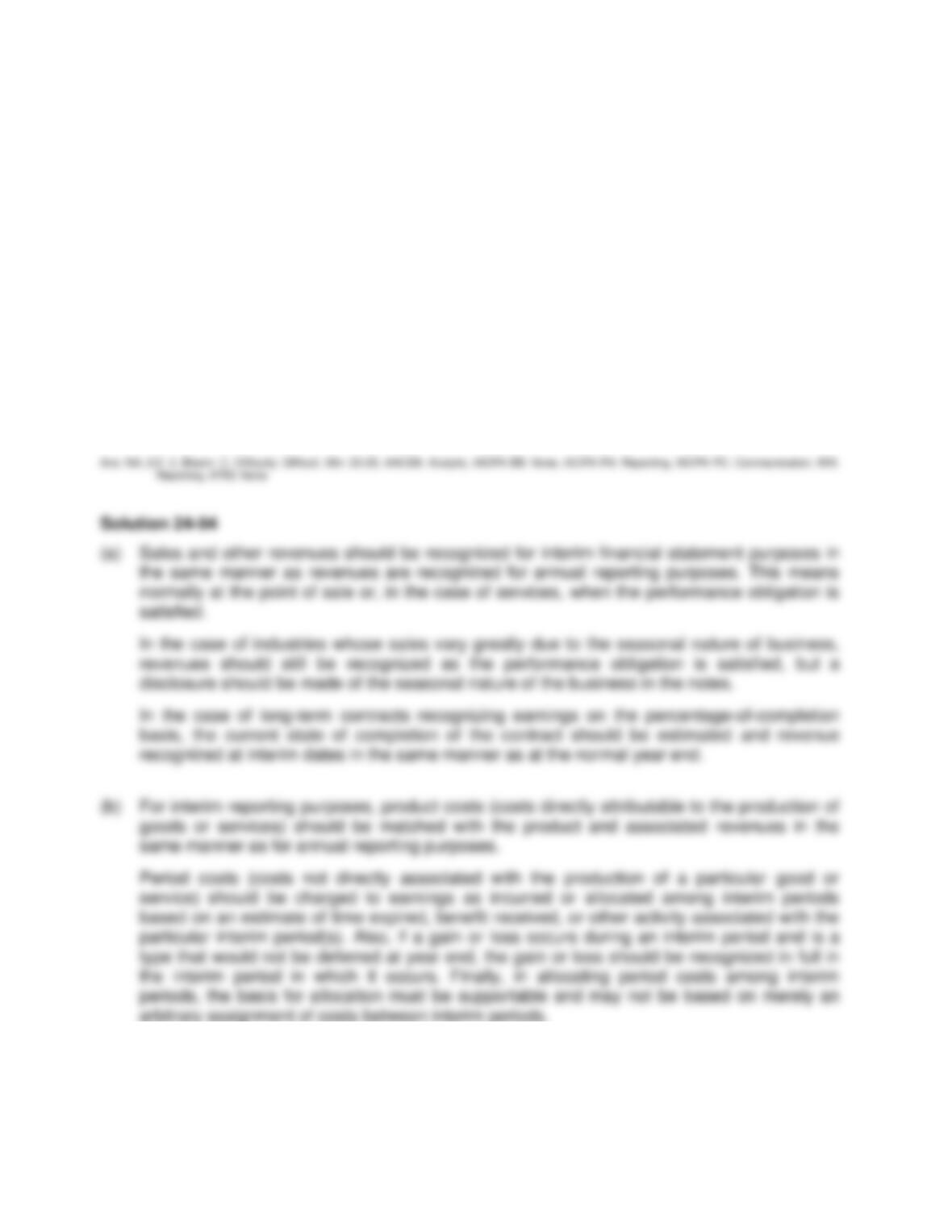
Pr. 24-93—Segment reporting.
A central issue in reporting on operating segments of a business enterprise is the determination
of which segments are reportable.
Instructions
1. What are the tests to determine whether or not an operating segment is reportable?
2. What is the test to determine if enough operating segments have been separately reported
upon, and what is the guideline on the maximum number of operating segments to be shown?
Test Bank for Intermediate Accounting, Seventeenth Edition
24 – 40
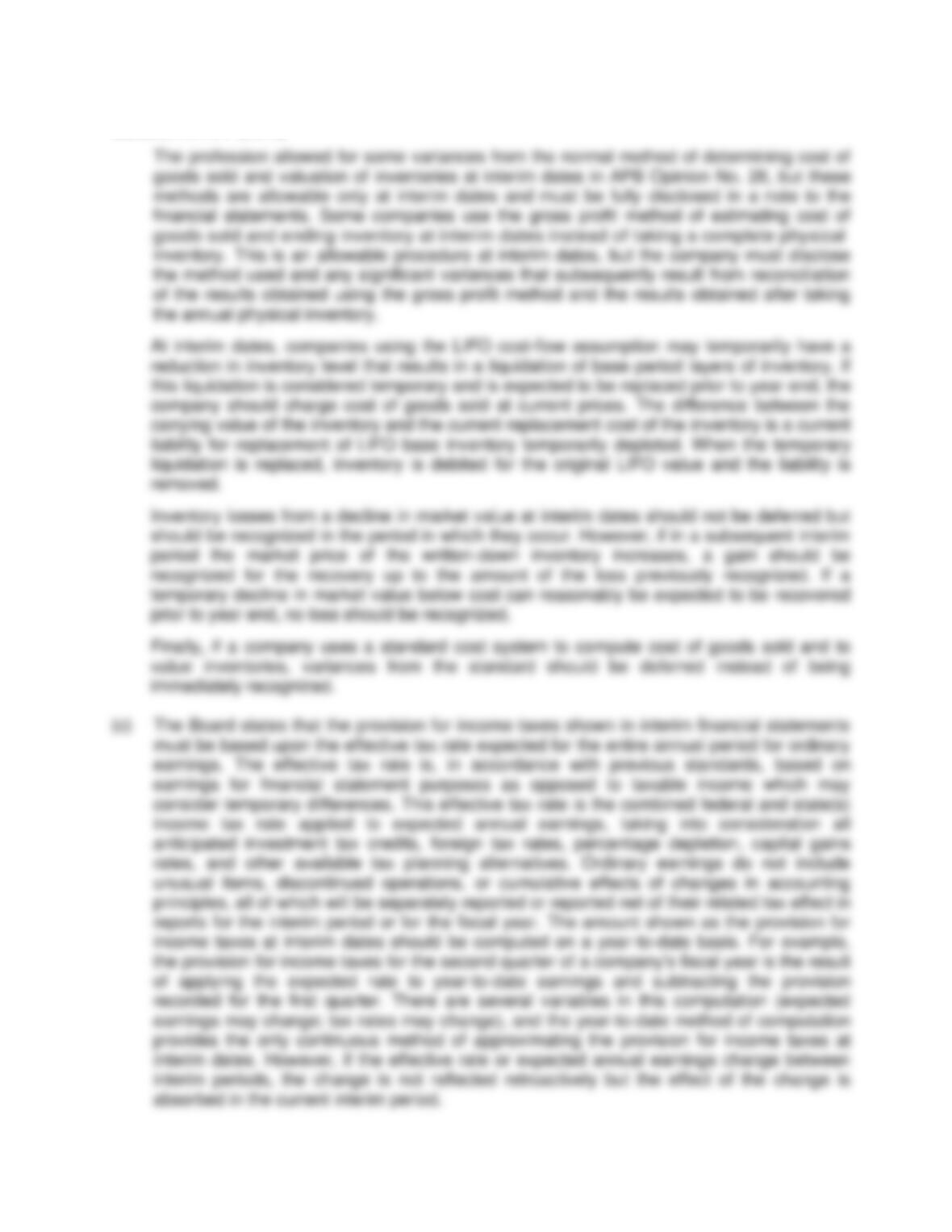
Pr. 24-94—Interim reporting.
Interim financial reporting has become an important topic in accounting. There has been
considerable discussion as to the proper method of reflecting results of operations at interim
dates. Accordingly, Accounting Standards clarify some aspects of interim financial reporting.
Instructions
(a) Discuss generally how revenue should be recognized at interim dates and specifically how
revenue should be recognized for industries subject to large seasonal fluctuations in
revenue and for long-term contracts using the percentage–of-completion method at annual
reporting dates.
(b) Discuss generally how product and period costs should be recognized at interim dates. Also
discuss how inventory and cost of goods sold may be afforded special accounting treatment
at interim dates.
(c) Discuss how the provision for income taxes is computed and reflected in interim financial
statements.
Full Disclosure in Financial Reporting
24 – 41
Solution 24-94 (cont.)
Test Bank for Intermediate Accounting, Seventeenth Edition
24 – 42
IFRS QUESTIONS
True/False
1. Due to the broader range of options available under GAAP compared to IFRS, note
disclosures are generally more expansive under GAAP than under IFRS.
2. IFRS requires companies to prepare interim reports on a quarterly basis.
3. IFRS requires segment reporting, and uses the management approach to identify reportable
segments.
4. IFRS requires companies to disclose transactions with related parties, including the name of
the related party and any doubtful amounts related to outstanding balances for the related
party.
5. Neither GAAP nor IFRS requires interim reports.
Answers to True/False:
Multiple Choice
6. If Benjamin Company and Iris, Inc. are similar companies in every regard, except
Benjamin Company uses IFRS while Iris, Inc. uses GAAP, which of the following is
true?
a. Iris, Inc. is required to issue interim statements every 6 months.
b. Benjamin Company need not recognize post-balance sheet events.
c. Benjamin Company is not required by IFRS to issue interim statements.
d. All of these choices are true.

Full Disclosure in Financial Reporting
24 – 43
7. Benjamin Company uses IFRS, while Iris, Inc. uses GAAP, for their external
financial reporting. On January 16, 2021, both companies settled lawsuits relating to
industrial accidents that occurred in 2019. Benjamin Company paid $550,000 and Iris, Inc.
paid $230,000. Assuming that no accrual had been previously made, what amount of loss
should be reported on the income statement for the year ended December 31, 2021 for
each company?
Benjamin Company Iris, Inc.
a. $-0- $-0-
b. $550,000 $230,000
c. $-0- $230,000
d. $550,000 $-0-
8. IFRS requires which of the following disclosures regarding related parties?
I. The name of the related party.
II. The amount and terms of the outstanding balance.
III. Doubtful amounts related to the outstanding balance.
a. I, II, and III.
b. I and II.
c. I and III.
d. II and III.
9. Nicole, Inc. uses IFRS for its external financial reporting. During 2020, an employee of
the company was injured in the factory. Discussions with corporate attorneys resulted in a
determination that the company would be required to pay between $1,500,000 and
$3,000,000 to settle the injury claim. Nicole, Inc. accrued a contingent liability on
December 31, 2020 for $1,500,000. On February 4, 2021, Nicole, Inc. settled the lawsuit
for $3,300,000. What amount of loss should be reported on the income statement for the
year ended December 31, 2021 for Nicole, Inc. related to this lawsuit?
a. $3,300,000
b. $1,800,000
c. $1,500,000
d. $300,000.
10. Identifiable assets for the 4 industry segments of Brittle Company are as follows:
Candy $120,000
Stix $240,000
Chips $980,000
Gum $ 45,000
Brittle Company uses IFRS for its external financial reporting. Using only the identifiable
assets test, which of the segments are reportable?
a. Under IFRS, all four segments must be reported.
b. Candy, Stix, and Chips only.
c. Chips only.
d. Stix and Chips only.

Test Bank for Intermediate Accounting, Seventeenth Edition
24 – 44
11. Operating profits and losses for the 4 industry segments of Brittle Company are as
follows:
Candy ($590,000)
Stix $ 20,000
Chips $ 85,000
Gum $ 9,000
Brittle Company uses IFRS for its external financial reporting. Using only the operating
profits (loss) test, which of the segments are reportable?
a. Under IFRS, all four segments must be reported.
b. Stix, Chips, and Gum only.
c. Candy and Chips only.
d. Candy only.
12. Which of the following is true regarding IFRS and GAAP?
a. Due to the broader range of options available under GAAP compared to IFRS, note
disclosures are generally more expansive under GAAP than under IFRS.
b. IFRS requires companies to prepare interim reports on a quarterly basis.
c. IFRS requires segment reporting, and uses the management approach to identify
reportable segments.
d. GAAP requires companies to disclose transactions with related parties, including the
name of the related party and any doubtful amounts related to outstanding balances
for the related party.

Full Disclosure in Financial Reporting
24 – 45
Answers to Multiple Choice:
Short Answer Solution
13. Bill Novak is working on an audit of an IFRS client. In his review of the client’s interim reports, he
notes that the reports are prepared on a discrete basis. That is, each interim report is viewed as a
distinct period. Is this acceptable under IFRS? If so, explain how that treatment could affect
comparisons to a GAAP company?