24) Advertising expense totaled $60,000. If indirect advertising costs are allocated based on gross sales per
department, what amount would be allocated to the watches department if $5,000 of advertising is
indirect?
Gross Sales: jewelry, $80,000; glassware, $30,000; watches, $20,000. (Round any percentages two decimal
places, X.XX%, and round your final answer to the nearest dollar.)
A) $5,000
B) $769
C) $9,231
D) $6,667
25) Carla’s building expenses, which are indirect, are based on each department’s square footage.
Department A occupies 35,000 square feet. Department B occupies 10,000 square feet, and Department C
occupies 55,000 square feet. If the building expenses total $230,000, how much is allocated to Department
B? (Round your answer to the nearest dollar.)
A) $35,385
B) $23,000
C) $51,111
D) $76,667
26) The Popper’s candy department experienced the following revenue and expenses during October:
Sales $13,500
Cost of Goods Sold 7,600
Direct Operating Expenses 1,000
Indirect Operating Expenses 400
The candy departmental net income is:
A) $12,100.
B) $4,900.
C) $4,500.
D) $12,500.
27) If gross sales for the tools department are $450,000 and gross sales for the appliances department are
$270,000, what is the fraction used to apportion the indirect advertising for the appliances department if it
is based on gross sales?
A) 3/11
B) 5/8
C) 3/8
D) 3/5
28) Julia Company allocates its indirect advertising expenses based on each department’s gross sales. If
the men’s apparel department has gross sales of $200,000 out of a total of $1,800,000 in gross sales, what
percentage would Julia use to allocate its indirect advertising expenses?
A) 1/9
B) 1/10
C) 1/11
D) 8/9
29) The photography department in a department store experienced the following revenue and expenses
during October:
Sales $6,600
Cost of Goods Sold 2,000
Direct Operating Expenses 200
Indirect Operating Expenses 700
The photography departmental net income is:
A) $6,600.
B) $4,600.
C) $3,700.
D) $4,400.
30) Calculate the costume jewelry department net income (loss) given the following:
Sales $1,500
Cost of Goods Sold 300
Direct Operating Expenses 250
Indirect Operating Expenses 800
A) $1,200
B) $950
C) $150
D) ($1,200)
31) Departmental accounting requires:
A) measuring departmental gross profit.
B) allocating direct costs to departments.
C) allocating indirect costs to departments.
D) Both A and C are correct.
32) Which of the following expenses is the most difficult to allocate to departments?
A) Cost of goods sold
B) Use of common supplies by everyone
C) Salaries and wages
D) Merchandise purchases
33) Which allocation base is best used to allocate building depreciation?
A) Square feet of space used
B) Number of employees
C) Hours used
D) Electric usage
34) Which allocation base is best used to allocate advertising expense by selling department?
A) Square feet of spaced used
B) Gross sales of each department as a percent of total gross sales
C) An even split among all selling departments
D) Some other method not listed
35) Indirect expenses are normally:
A) subjective and approximate.
B) assigned by arbitrary methods.
C) assigned precisely by accepted methods.
D) assigned to the accounting department.
36) Of two departments, the men’s department has 10,000 square feet and the women’s department has
24,000 square feet. Depreciation is divided by square footage. If total depreciation is $70,000, the total
amount allocated to the men’s department would be approximately $56,000.
37) Sports apparel department’s gross profit is $300,000; clothing department gross profit is $300,000;
indirect advertising expense is $6,000. Indirect expense charged to the clothing apparel department based
on gross profit would be $3,000.
38) A direct expense should be traceable to a respective department.
39) Direct expenses, such as salaries, can be traced to a particular department.
40) A building’s depreciation would be considered an indirect expense.
41) A common way to apportion janitorial expense is to base it on number of employees.
42) Indirect expenses cannot be allocated to departments based on the cost of goods sold in each
department.
43) Indirect expenses are subjective in nature and may only be allocated by cost of goods sold.
44) Indirect expenses are the same across departments and industries.
Below is a list of expenses; you are to identify each as either [1] a direct expense or [2] an indirect expense.
45) Electricity for the stove in a restaurant. ________
46) Paint for the restaurant dining room. ________
47) Rent paid for the building of department store. ________
48) Wages paid to the restaurant wait staff. ________
49) Electricity for the general lighting in a department store. ________
50) Paint used by painting department. ________
51) General employee insurance. ________
52) Rent paid for the freezers in the frozen foods department of a food store. ________
53) Insurance paid on employees working in high risk areas of a machine shop. ________
54) Wages paid to the manager of an automobile repair shop. ________
55) Athletics For All is trying to allocate its building’s depreciation based on floor space. Determine the
amount that should be assigned to the golf department and to the basketball department.
Golf Basketball Total
Floor Space 110,000 140,000 250,000
Depreciation Exp $40,000
56) You have been hired by Jones to allocate his utilities to each department based on space (in square
footage).
Complete the assignment.
Shoe Dept. Jewelry Dept. Clothing Dept. Total
Space (square feet) 32,000 8,000 40,000 80,000
Utilities Cost $60,000
57) The following information is available for Charter Company:
Item Department 1 Department 2 Total
Equipment value $500,000 $250,000 $750,000
Square footage 25,000 sq.ft. 35,000 sq.ft. 60,000 sq.ft
Sales $1,250,000 $725,000 $1,975,000
Complete the following chart to determine the total cost for each department, using the most appropriate
method to apportion the indirect costs.
Cost Department 1 Department 2 Total
Depreciation $120,000
Utilities $45,000
Sales Commissions $59,250
Rent $150,000
TOTALS $374,250
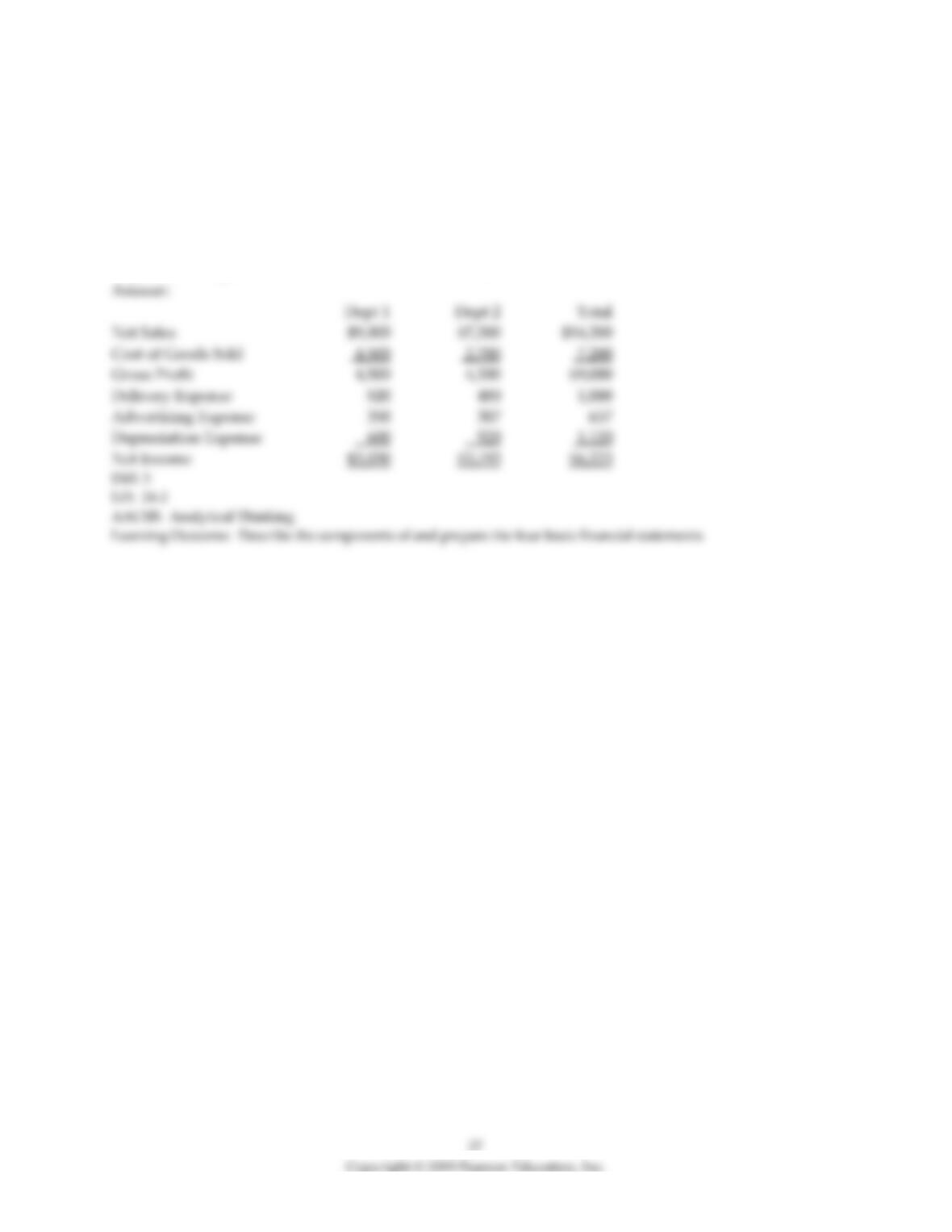
58) From the following, calculate income by departments.
Dept. 1 Dept. 2
Net Sales $9,000 $7,200
Cost of Goods Sold 4,500 2,700
Delivery Expense 520 480
Advertising Expense 350 307
Depreciation Expense 600 520
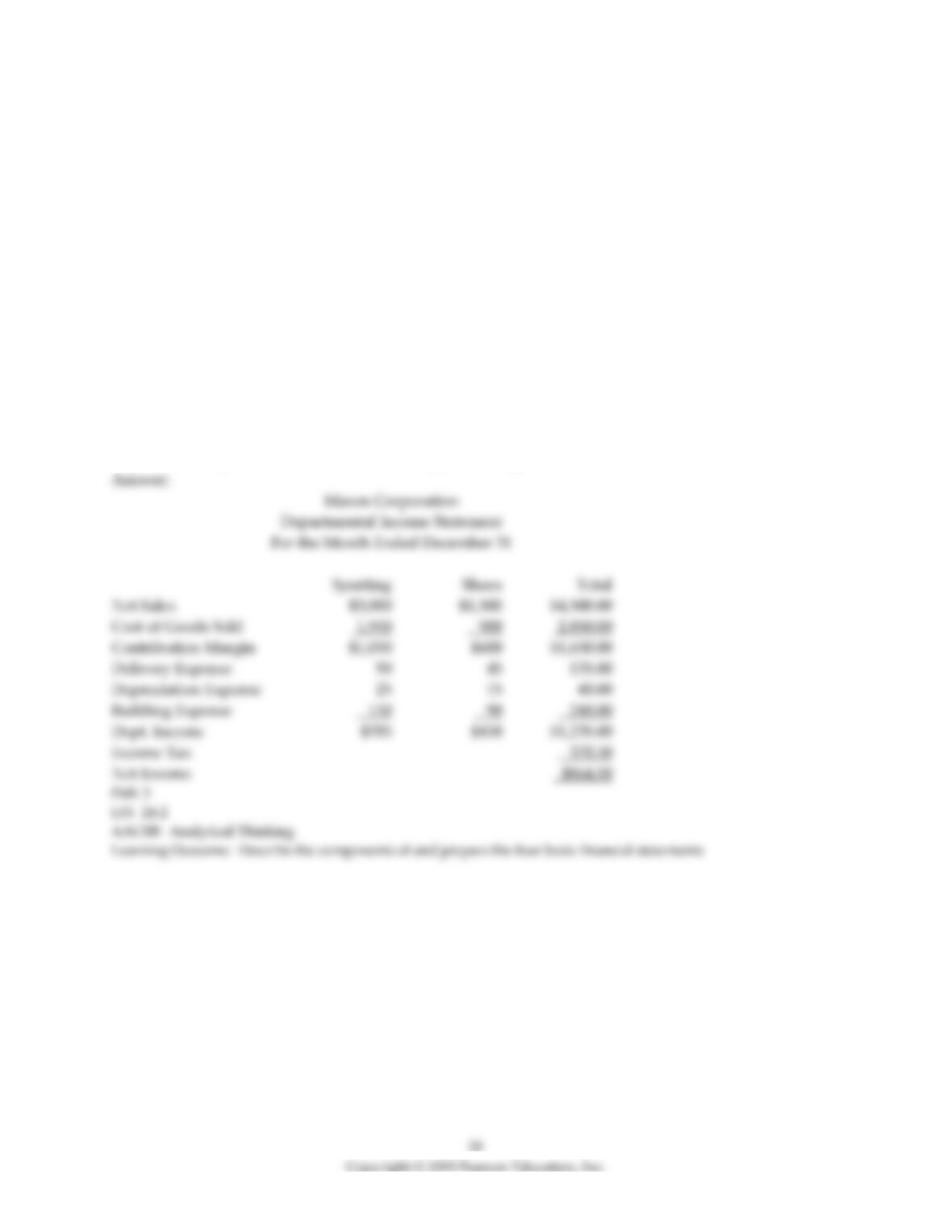
59) From the following partial data, prepare a departmental income statement showing income before tax
along with net income for Mason Corporation for the month ended December 31.
Net Sales-Sporting Goods $3,000
Net Sales-Shoes 1,500
Cost of Goods Sold-Sporting Goods 1,950
Cost of Goods Sold-Shoes 900
Income Tax Rate is 30%
Sporting Goods Dept.-5,000 square feet
Shoe Dept.-3,000 square feet
The following items are indirect expenses and should be allocated:
Basis of Appropriation
Building Expense $240 Square Footage
Delivery Expense $135 Net Sales
Depreciation Expense $40 Square Footage
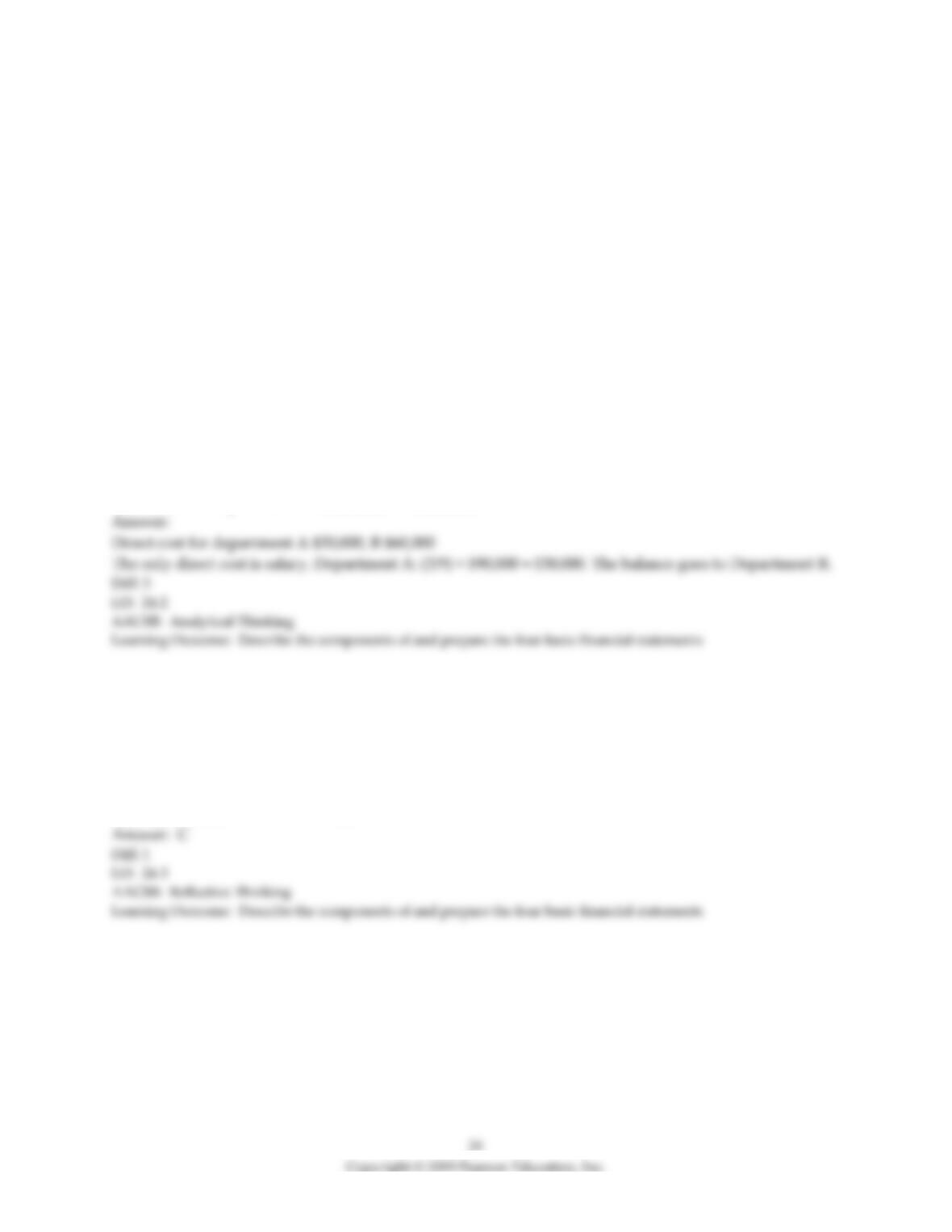
60) Below is a list of expenses (direct and indirect). You are to determine the total direct cost for
departments A and B.
Salary Expense $90,000
Depreciation Expense –
Office Equipment 4,000
Depreciation Expense –
Building 24,000
Heating Expense 1,800
Lighting Expense 2,400
Cleaning & Maintenance Expense 900
Department [A] [B]
Cost of Goods Sold $100,000 $300,000
Employees 3 6
Value of Equipment in each area $8,000 $12,000
Square footage of use 200 sq. ft. 400 sq. ft.
Direct cost for department A $ ________ B $ ________
24.3 Learning Objective 24-3
1) When preparing an income statement showing departmental contribution margin:
A) indirect expenses are combined with direct expenses.
B) indirect departmental expenses are added to contribution margin.
C) direct expenses are subtracted from gross profit of a department.
D) None of these answers is correct.
2) Compute the contribution margin for the video department, when gross profit is $990,000, direct
expenses $290,000, and indirect expenses are $120,000.
A) $1,110,000
B) $700,000
C) $580,000
D) $870,000
3) The CPC department of Alex shows gross sales of $735,000 for computer supplies and $935,000 for
office supplies. The cost of the computer supplies was $534,000 and the cost of the office supplies was
$491,400. Direct expenses were $75,700 for the company and indirect expenses were $75,200. What was
the contribution margin for the company?
A) $644,600
B) $1,594,300
C) $1,670,000
D) $568,900
4) A line on the income statement that indicates what a department has left after covering cost of goods
and sold and direct expenses is:
A) the gross margin.
B) the net income.
C) the contribution margin.
D) None of these answers is correct.
5) What is the purpose for determining contribution margin?
A) To show the contribution by department toward covering indirect costs
B) To help determine whether or not to eliminate a department
C) To show the effect on net income for each department
D) All of these answers are correct.
6) Supporters of the contribution margin approach believe that:
A) indirect expenses should be departmentalized.
B) indirect expenses should not be used for evaluating departmental performance.
C) indirect expenses are proportionally charged to each department.
D) direct expenses should not be used in evaluating departmental performance.
7) The cosmetic department experienced the following revenue and expenses during December:
Sales $83,000
Cost of Goods Sold 30,000
Direct Operating Expenses 5,000
Indirect Operating Expenses 3,000
The cosmetic department’s contribution margin is:
A) $53,000.
B) $45,000.
C) $75,000.
D) $48,000.
8) On a departmental income statement, contribution margin minus total indirect expenses equals:
A) departmental contribution margin.
B) net income.
C) income before taxes.
D) net sales.
9) On a departmental income statement, sales less cost of goods sold and direct expenses equals:
A) gross margin.
B) income before taxes.
C) indirect expenses.
D) departmental contribution margin.
10) The photography department in a department store experienced the following revenue and expenses
during October:
Sales $23,200
Cost of Goods Sold 8,200
Direct Operating Expenses 2,800
Indirect Operating Expenses 1,100
The photography department’s contribution margin is:
A) $15,000.
B) $20,400.
C) $12,200.
D) $13,900.
11) When a department showing a loss is eliminated, other departments will always achieve a greater
contribution margin.
12) Direct expenses and indirect expenses are separated in determining contribution margin.
13) Direct expenses are assigned to departments based on the actual expenses incurred.
14) Eliminating one department may increase the sales of another department.
15) Department contribution margin equals gross profit on sales minus direct departmental expenses.
16) Departmental income statements would be a useful to tool for management to determine the viability
of a department.
17) A department should not be eliminated just because it becomes unprofitable.
18) A net income would occur if the contribution margin is greater than indirect expenses.
19) Trends in the industry, such as advancements in technology, should not be a consideration in
determining whether or not a department is eliminated.
20) The availability of suppliers and a firm’s potential capacity is a consideration before a department is
added.
21) Why would it be advisable for a company to keep separate accounting records for various
departments?
22) Prepare an income statement showing departmental contribution margin based on the following:
Dept. X Dept. Y Rent Expense
Space (square feet) 17,500 35,000
Net Sales $70,000 $50,000
Cost of Goods Sold 19,000 20,000
Rent Expense (allocated based on square feet) $3,000
23) Buckeye Golf is considering dropping the clothing department because it is not generating a profit as
disclosed by the following data:
Sales $2,000
Cost of Goods Sold 900
Gross Profit $1,100
Direct Expenses 600
Contribution Margin 500
Indirect Expenses 600
Net Loss $(100)
Note: None of the indirect expenses can be avoided by dropping the department.
Should Buckeye drop the department? Show your computations.
24) Given the following, calculate contribution margin and net income:
Indirect
DVD CD Expense
Net Sales $12,000 $6,000
Cost of Goods Sold 7,000 2,500
Operating Expenses (Indirect) $5,000