122) Nestor Company is considering the purchase of an asset for $100,000. It is expected to
produce the following net cash flows. The cash flows occur evenly throughout each year.
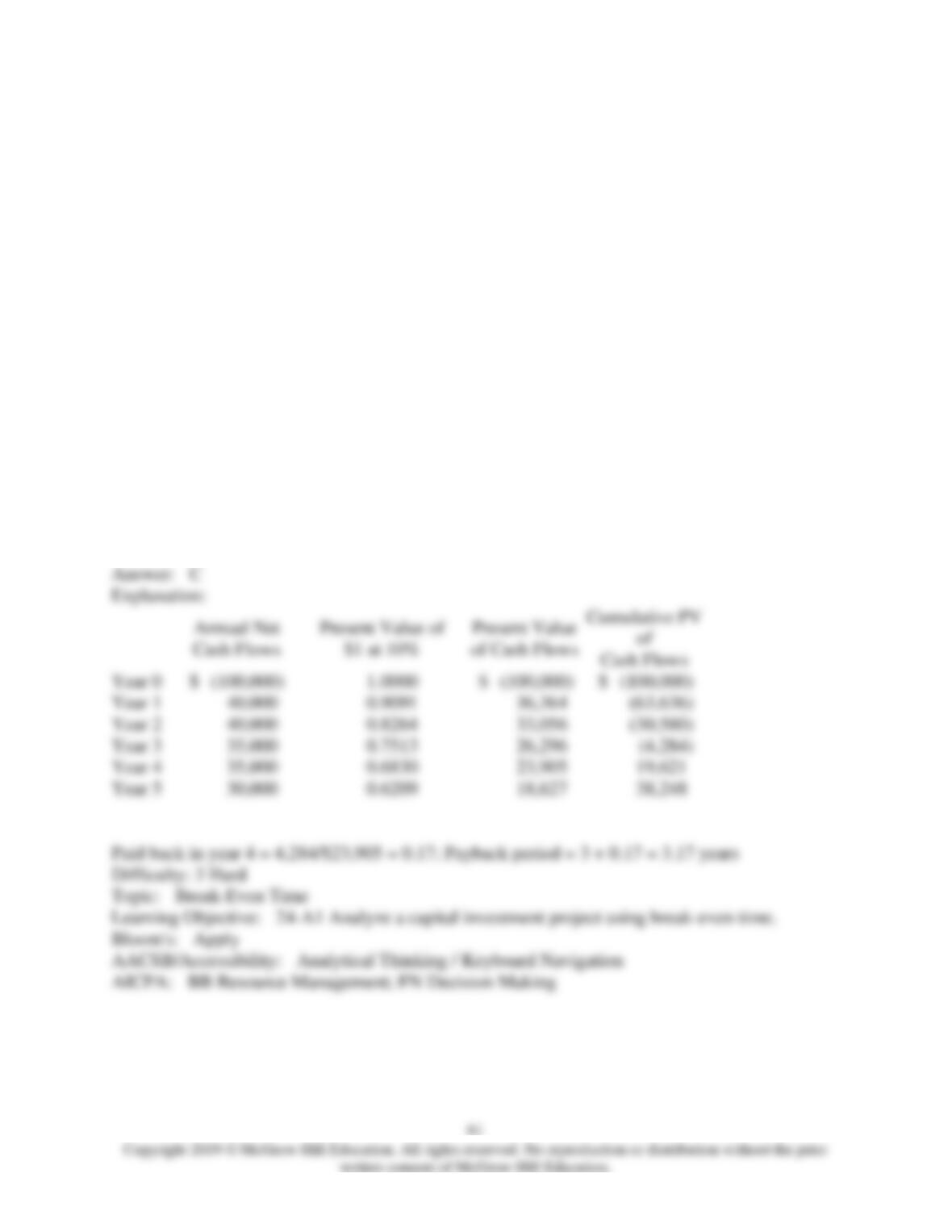
Compute the break-even time (BET) period for this investment.
Annual Net
Cash Flows
Present Value
of $1 at 10%
Year 0
1.0000
Year 1
$
40,000
0.9091
Year 2
$
40,000
0.8264
Year 3
$
35,000
0.7513
Year 4
$
35,000
0.6830
Year 5
$
30,000
0.6209
A) 2.85 years.
B) 2.57 years.
C) 3.17 years.
D) 2.98 years.
E) 3.62 years.
Year 0
(100,000
)
1.0000
(100,000
)
$
(100,000
)
Year 1
0.9091
)
Year 2
0.8264
)
Year 3
0.7513
)
Year 4
0.6830
Year 5
0.6209
123) A postaudit is:
A) An evaluation of the effectiveness of the budgeting committee.
B) An analysis of the capital budgeting method used.
C) An evaluation of a project’s actual results versus its projected results.
D) A review by outside auditors to assess efficiency.
E) An analysis of risk changes over the life of an investment.
124) The process of analyzing alternative long-term investments and deciding which assets to
acquire or sell is known as:
A) Planning and control.
B) Capital budgeting.
C) Variance analysis.
D) Master budgeting.
E) Managerial accounting.
125) Capital budgeting decisions are risky because all of the following are true except:
A) The outcome is uncertain.
B) Large amounts of money are usually involved.
C) The investment involves a long-term commitment.
D) The decision could be difficult or impossible to reverse.
E) They rarely produce net cash flows.
126) Presented below are terms preceded by letters a through g and followed by a list of
definitions 1 through 7. Match the letter of the term with the definition. Use the space provided
preceding each definition.
(a) Internal rate of return
(b) Hurdle rate
(c) Accounting rate of return
(d) Net cash flow
(e) Capital budgeting
(f) Payback period
(g) Net present value
______ (1) Equals the discount rate that results in a net present value of zero.
______ (2) Cash inflows minus cash outflows for the period.
______ (3) The required rate of return.
______ (4) The time expected to pass before the net cash flows from an investment equals its
initial cost.
______ (5) Annual after-tax net income divided by annual average investment.
______ (6) A process of analyzing alternative long-term investments and deciding which
assets to acquire or sell.
______ (7) Initial cost of an investment subtracted from discounted future cash flows from the
investment.
127) Presented below are terms preceded by letters a through f and followed by a list of
definitions 1 through 6. Match the letter of the terms with the definitions. Use the space provided
preceding each definition.
(a) Postaudit
(b) Capital rationing
(c) Profitability index
(d) Net present value
(e) Cost of capital
(f) Annuity
______ (1) Used to compare projects when a company cannot fund all positive net present
value projects calculated by dividing present value of net cash flows by the initial investment.
______ (2) A series of cash flows of equal dollar amount over equal time periods.
______ (3) An estimate of an asset’s value to the company; computed by discounting the future
net cash flows using the company’s required rate of return and then subtracting the initial amount
invested.
______ (4) An evaluation of a project’s actual results versus its projected results.
______ (5) An average of the rate the company must pay to its lenders and investors.
______ (6) Finance constraints that limit a company from accepting all positive net present
value investments.
128) What is capital budgeting? Why are capital budgeting decisions often difficult and risky?
129) Briefly describe the time value of money. Why is the time value of money important in
capital budgeting?
130) In using a capital budgeting method that takes the time value of money into consideration,
management must consider a hurdle rate in making its decisions. What is a hurdle rate? What
factors does management have to consider in selecting a hurdle rate?
131) How does the calculation of break-even time (BET) differ from the calculation of payback
period (PBP)?
132) Briefly describe both the payback period method and the net present value method of
comparing investment alternatives.
133) When making capital budgeting decisions, companies usually prefer shorter payback
periods. Explain why shorter payback periods are desirable.
134) What is one advantage and one disadvantage of using the accounting rate of return to
evaluate investment alternatives?
135) You have evaluated three projects of similar investment amount and risk using the net
present value (NPV) method. How would you decide which one of the projects to select?
136) When the amount invested differs substantially across projects, NPV is of limited value for
comparison purposes. You have evaluated three projects of substantially different investment
amounts using the net present value (NPV) method. How would you decide which one of the
projects to select?
70
137) Identify at least three reasons for managers to favor the internal rate of return (IRR) over
other capital budgeting approaches.

138) For each of the capital budgeting methods listed below, place an X in the correct column,
indicating the measurement basis of each, the ability to make comparison among projects, and
whether each method reflects or ignores the time value of money.
Measurement
Basis
Comparison among
projects
Time value
of money
Cash
flows
Accrual
income
Allows
comparison
Difficult
to
compare
Reflects
time value
of money
Ignores
time value
of money
Payback period
Accounting rate
of return
Net present value
Internal rate of
return

139) Nebraska Co. is reviewing a capital investment of $100,000. This project’s projected cash
flows over a five-year period are estimated at $35,000 each year.
Required:
(a) Calculate the payback period.
(b) Calculate the break-even time. Assume a 12% hurdle rate and use the table below:
Present Value
Periods of 1 at 12%
1…… 0.8929
2…… 0.7972
3…… 0.7118
4…… 0.6355
5…… 0.5674
(c) Using the results in (a) and (b), make a recommendation for the project.
73
140) A company is considering purchasing a machine for $85,000. The machine is expected to
generate a net after-tax income of $11,250 per year. Depreciation expense would be $8,500.
What is the payback period for this machine?
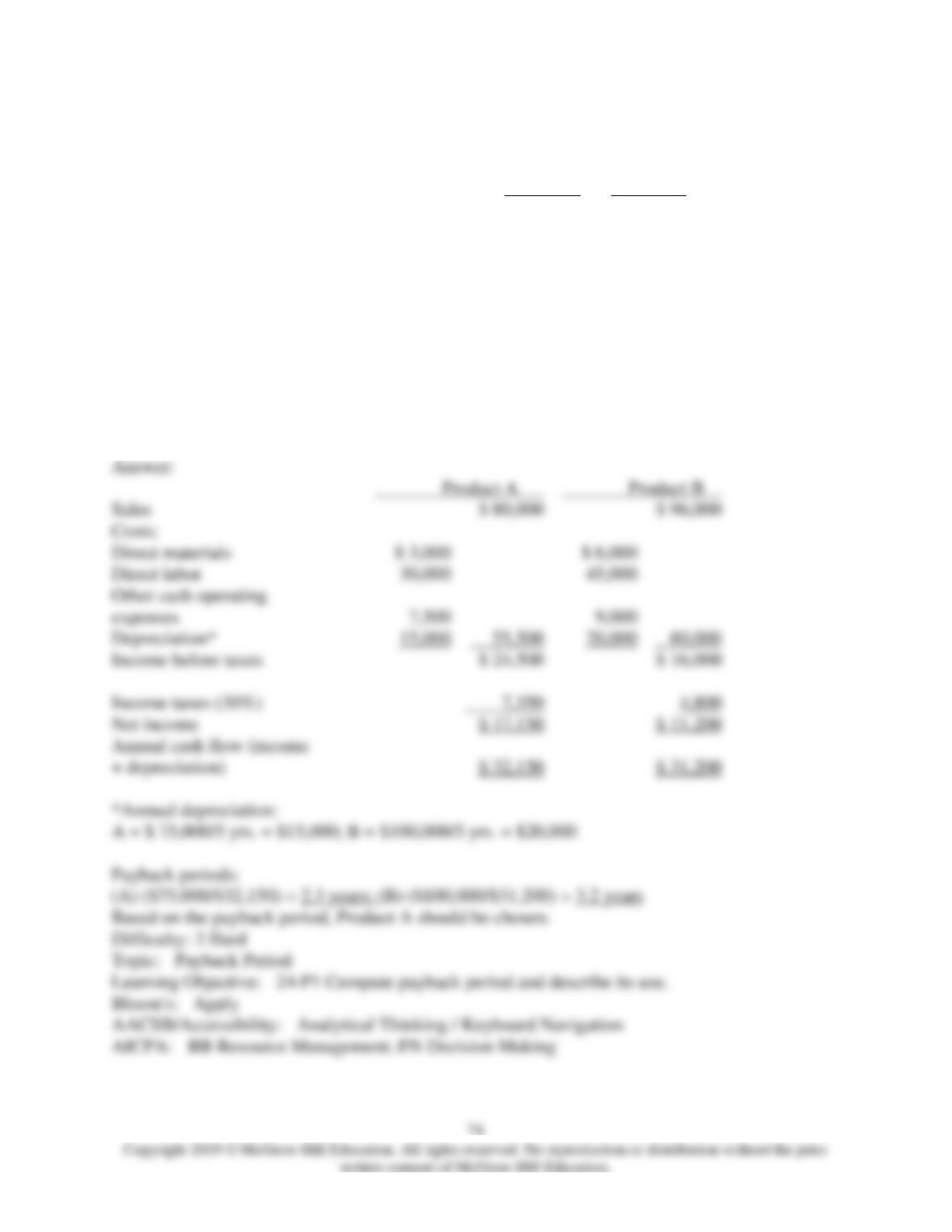
141) A company is trying to decide which of two new product lines to introduce in the coming
year. The predicted revenue and cost data for each product line follows:
Product A
Product B
Sales
$80,000
$96,000
Direct materials
3,000
6,000
Direct labor
30,000
45,000
Other cash operating expenses
7,500
9,000
New equipment costs
75,000
100,000
Estimated useful life (no salvage)
5 years
5 years
The company has a 30% tax rate, it uses the straight-line depreciation method, and it predicts that
cash flows will be spread evenly throughout each year. Calculate each product’s payback period.
If the company requires a payback period of three years or less, which, if either, product should
be chosen?
Sales
Costs:
Direct materials
$ 3,000
Direct labor
expenses
9,000
Depreciation*
Income before taxes
Income taxes (30%)
Net income
+ depreciation)