
Name:
Class:
Date:
chapter 24
Indicate whether the statement is true or false.
1. One of the advantages of decentralization is that delegating authority to managers closest to the operation always results
in better decisions.
a.
True
b.
False
2. The negotiated price approach allows the managers of decentralized units to agree among themselves on a transfer
price.
a.
True
b.
False
3. Service department allocations are similar to the expenses of a profit center that purchased services from a source
outside the company.
a.
True
b.
False
4. A decentralized business organization is one in which all major planning and operating decisions are made by top
management.
a.
True
b.
False
5. The manager of a profit center does not make decisions concerning the fixed assets invested in the center.
a.
True
b.
False
6. Property tax expense for a department store’s store equipment is an example of a direct expense.
a.
True
b.
False
7. A manager in a cost center also has responsibility and authority over the revenues.
a.
True
b.
False
8. The profit center income statement should include only revenues and expenses that are controlled by the manager.
a.
True
b.
False
9. Controllable expenses are those that can be influenced by the decisions of the profit center management.
a.
True
b.
False
10. The process of measuring and reporting operating data by responsibility centers is termed responsibility accounting.
a.
True
b.
False

Name:
Class:
Date:
chapter 24
11. If income from operations for a division is $120,000, sales are $975,000, and invested assets are $750,000, the
investment turnover is 1.3.
a.
True
b.
False
12. A responsibility center in which the authority over and responsibility for costs and revenues is vested in the
department manager is termed a profit center.
a.
True
b.
False
13. Developing and retaining quality managers are advantages of decentralization.
a.
True
b.
False
14. Responsibility accounting reports for profit centers are normally in the form of income statements.
a.
True
b.
False
15. The profit center income statement should include only controllable revenues and expenses.
a.
True
b.
False
16. If the profit margin for a division is 11% and the investment turnover is 1.5, the return on investment is 7.3%.
a.
True
b.
False
17. A responsibility center in which the department manager has responsibility for and authority over costs, revenues, and
assets invested in the department is termed a cost center.
a.
True
b.
False
18. The ratio of income from operations to sales is termed the profit margin component of the return on investment.
a.
True
b.
False
19. The three common types of responsibility centers are referred to as cost centers, profit centers, and investment centers.
a.
True
b.
False
20. If divisional income from operations is $100,000, invested assets are $850,000, and the minimum acceptable return on
invested assets is 8%, the residual income is $68,000.
a.
True
b.
False
21. A disadvantage to using the residual income performance measure is that it encourages managers to spend only the
minimum acceptable return on assets set by upper management.

Name:
Class:
Date:
chapter 24
a.
True
b.
False
22. Operating expenses incurred for the entire business as a unit that are not subject to the control of individual
department managers are called indirect expenses.
a.
True
b.
False
23. Sales commission expense for a department store is an example of a direct operating expense.
a.
True
b.
False
24. The major advantage of the return on investment over income from operations as a divisional performance measure is
that divisional investment is directly considered and thus comparability of divisions is facilitated.
a.
True
b.
False
25. The plant managers in a cost center can be held responsible for major differences between budgeted and actual costs in
their plants.
a.
True
b.
False
26. Operating expenses directly traceable to or incurred for the sole benefit of a specific department and usually subject to
the control of the department manager are termed direct operating expenses.
a.
True
b.
False
27. If income from operations for a division is $6,000, invested assets are $25,000, and sales are $30,000, the investment
turnover is 1.2.
a.
True
b.
False
28. The rates at which centralized services are allocated to each division are called service department allocation rates.
a.
True
b.
False
29. The minimum acceptable divisional income from operations is set by top management by establishing a maximum
return considered acceptable for invested assets.
a.
True
b.
False
30. The objective of transfer pricing is to encourage each division manager to transfer goods and services between
divisions if overall company income can be increased by doing so.
a.
True
b.
False
31. The DuPont formula uses both financial and nonfinancial information to measure the performance of a business.

Name:
Class:
Date:
chapter 24
41. Investment turnover (as used in determining the return on investment) focuses on the rate of profit earned on each
a.
True
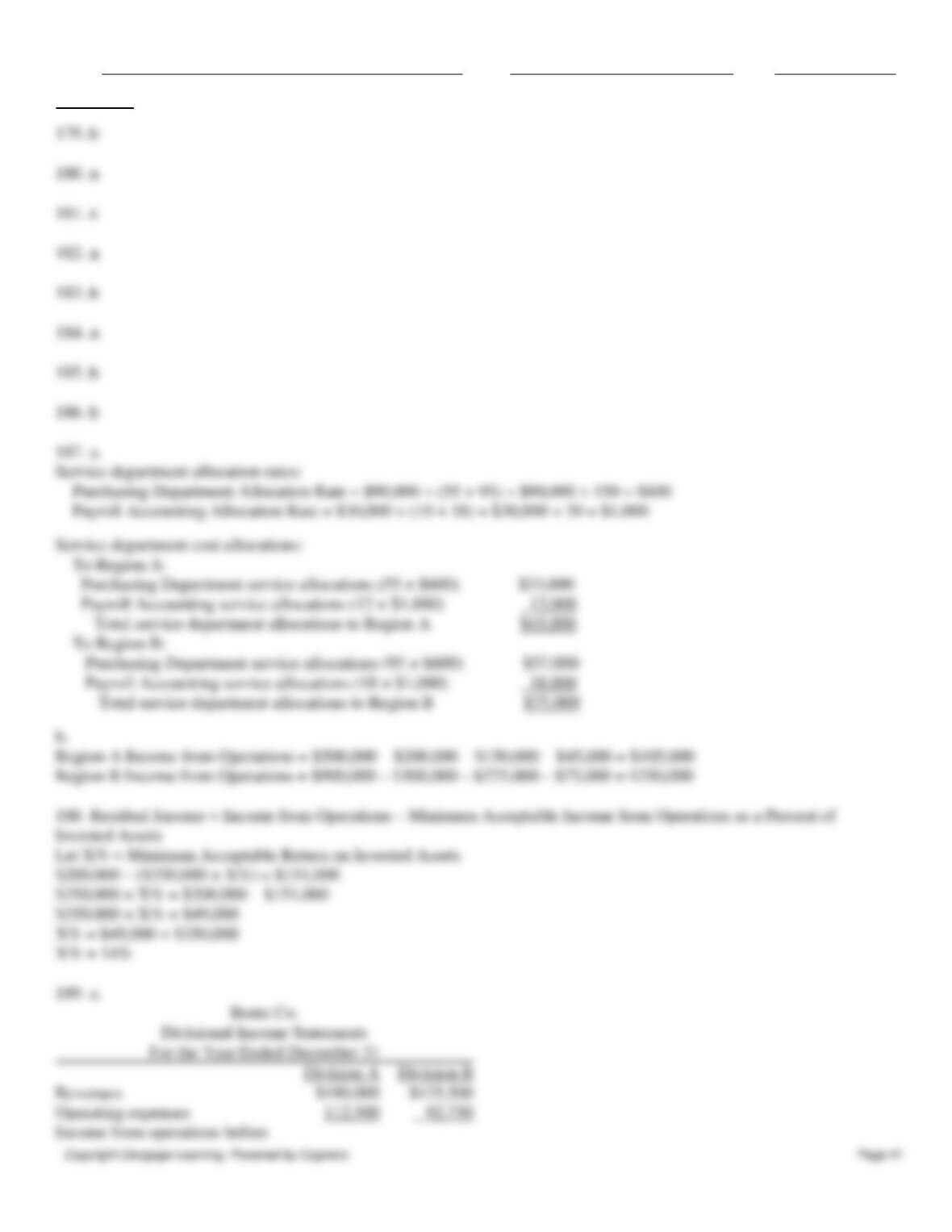
b.
False
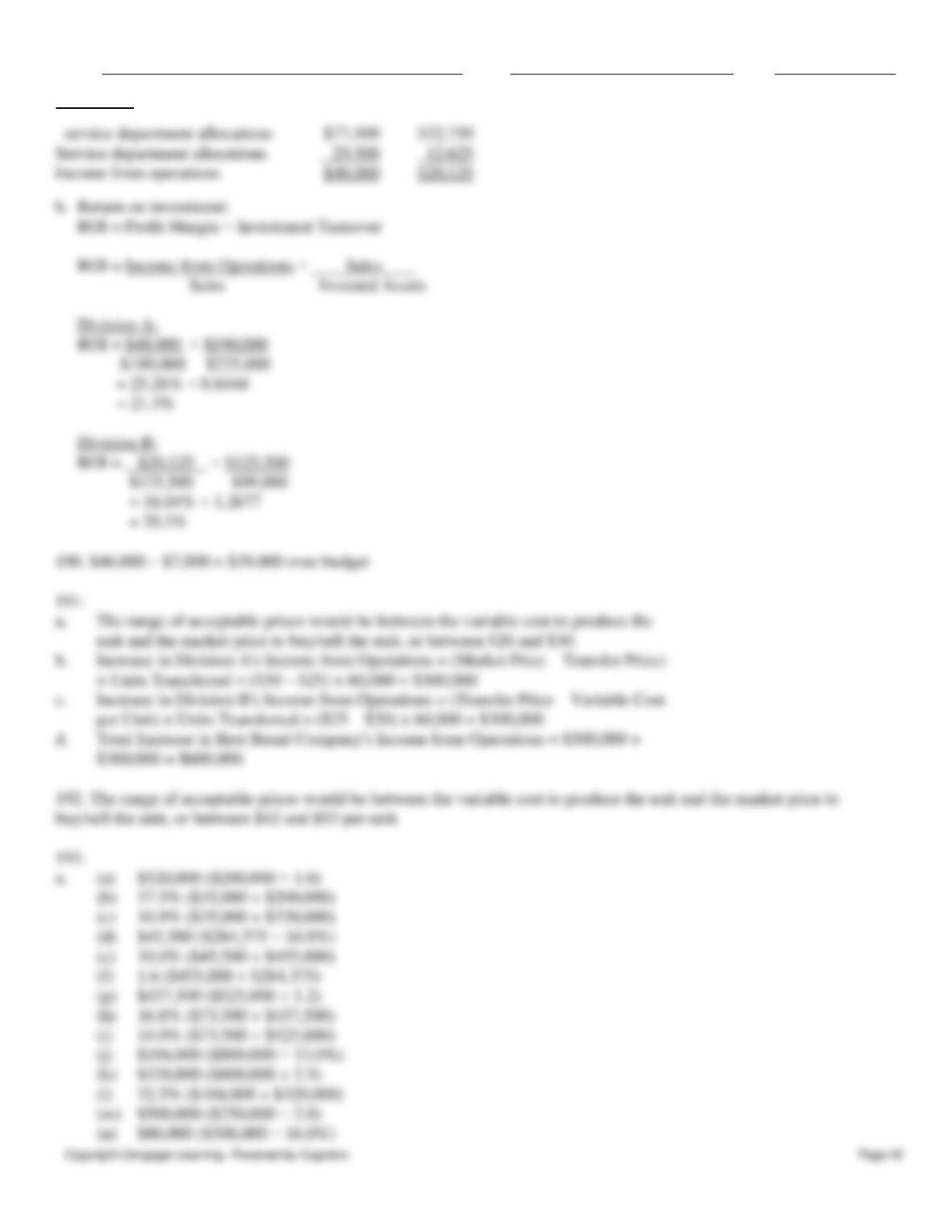
32. Office salaries expense for a department store is an indirect expense.
a.
True
b.
False
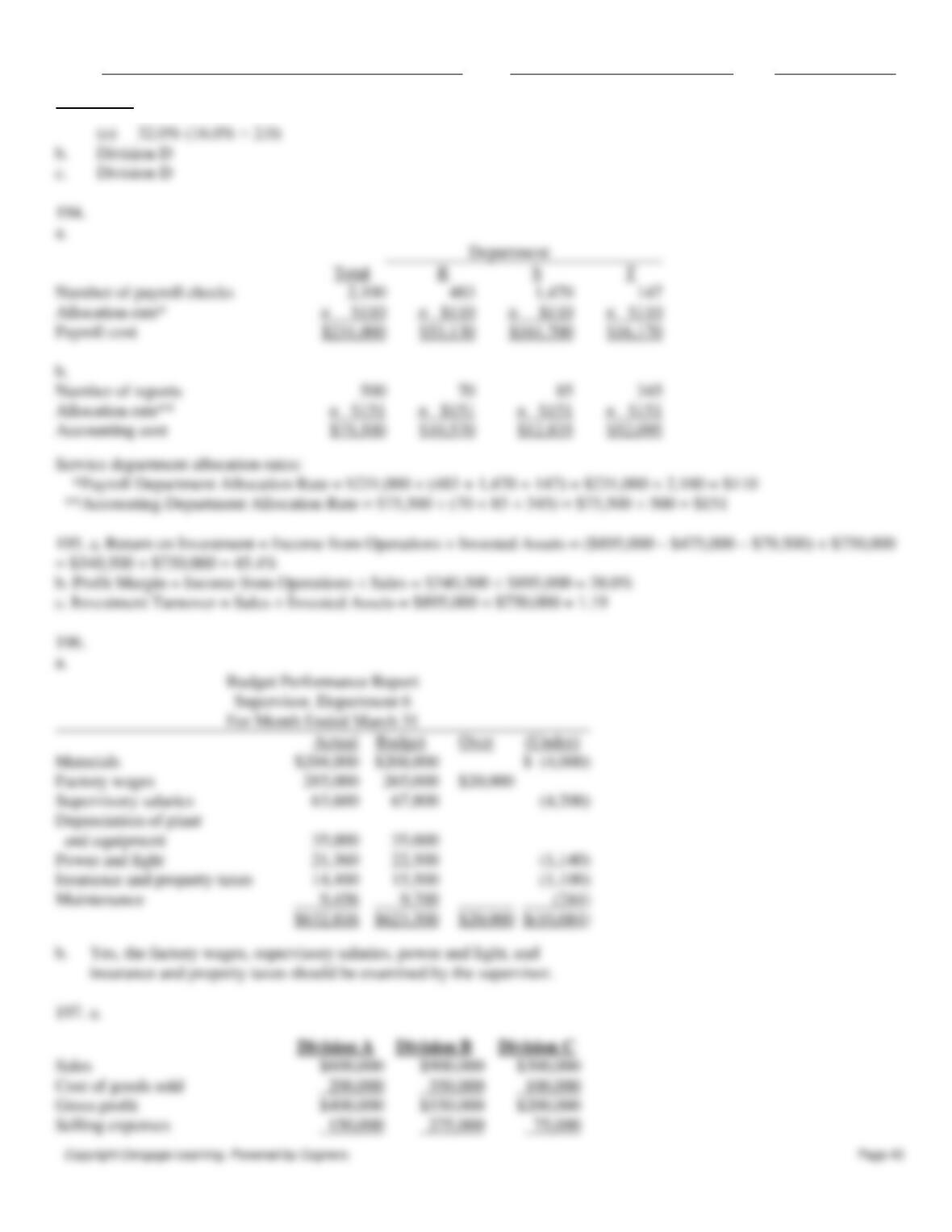
33. It is beneficial for divisions in a company to negotiate a transfer price when the supplying division has unused
capacity in its plant.
a.
True
b.
False
34. The minimum acceptable divisional income from operations is set by top management by establishing a minimum
return considered acceptable for invested assets.
a.
True
b.
False
35. In return on investment analysis, the investment turnover component focuses on efficiency in the use of assets and
indicates the rate at which sales are being generated for each dollar of invested assets.
a.
True
b.
False
36. Transfer prices may be used when decentralized units are organized as cost, profit, or investment centers.
a.
True
b.
False
37. If income from operations for a division is $6,000, invested assets are $25,000, and sales are $30,000, the profit
margin is 20%.
a.
True
b.
False
38. The major shortcoming of income from operations as an investment center performance measure is that it ignores the
amount of revenues earned by the center.
a.
True
b.
False
39. The DuPont formula uses only financial information to measure the performance of a business.
a.
True
b.
False
40. The major advantage of residual income as a performance measure is that it gives consideration to not only a
minimum acceptable return on investment but also the total magnitude of income from operations earned by each
division.
a.
True
b.
False

Name:
Class:
Date:
chapter 24
sales dollar.
a.
True
b.
False
42. Separation of businesses into more manageable operating units is termed decentralization.
a.
True
b.
False
43. If the profit margin for a division is 8% and the investment turnover is 1.2, the return on investment is 9.6%.
a.
True
b.
False
44. The return on investment may be computed by multiplying investment turnover by the profit margin.
a.
True
b.
False
45. The primary accounting tool for controlling and reporting for cost centers is a budget performance report.
a.
True
b.
False
46. The amount of detail presented in a budget performance report for a cost center depends on the level of management
to which the report is directed.
a.
True
b.
False
47. Three measures of investment center performance are income from operations, return on investment, and residual
income.
a.
True
b.
False
48. The ratio of sales to invested assets is termed the investment turnover component of the return on investment.
a.
True
b.
False
49. Under the negotiated price approach, the transfer price is the price at which the product or service transferred could be
sold to outside buyers.
a.
True
b.
False
50. Budget performance reports prepared for the vice president of production would generally contain less detail than
reports prepared for the various plant managers.
a.
True
b.
False
51. The underlying principle of allocating direct operating expenses to departments is to assign to each department an
amount of expense proportional to the revenues of that department.

Name:
Class:
Date:
chapter 24
a.
True
b.
False
52. The cost price approach to transfer pricing is most often used between responsibility centers organized as cost centers
that are not concerned with the revenue.
a.
True
b.
False
53. If Division Q’s yearly income from operations is $30,000 on invested assets of $200,000, the return on investment is
15%.
a.
True
b.
False
54. Responsibility accounting reports that are given to lower-level managers are usually very detailed; in turn, higher-
level managers will be given a summary report.
a.
True
b.
False
55. The excess of divisional income from operations over a minimum acceptable income from operations is termed the
residual income.
a.
True
b.
False
56. The primary disadvantage of decentralized operations is that decisions made by one manager may affect other
managers in such a way that the profitability of the entire company may suffer.
a.
True
b.
False
57. If income from operations for a division is $30,000, sales are $263,750, and invested assets are $187,500, the
investment turnover is 1.3.
a.
True
b.
False
58. If income from operations for a division is $6,000, invested assets are $25,000, and sales are $30,000, the investment
turnover is 5.
a.
True
b.
False
59. If income from operations for a division is $5,000, invested assets are $25,000, and sales are $30,000, the profit
margin is 20%.
a.
True
b.
False
60. Depreciation expense on store equipment for a department store is an indirect expense.
a.
True
b.
False

Name:
Class:
Date:
chapter 24
61. Under the cost price approach, the transfer price is the price at which the product or service transferred could be sold
to outside buyers.
a.
True
b.
False
62. By using the return on investment as a divisional performance measure, divisional managers will always be motivated
to invest in proposals that will increase the overall return for the company.
a.
True
b.
False
63. In an investment center, the manager has the responsibility and the authority to make decisions that affect not only
costs and revenues, but also the plant assets invested in the center.
a.
True
b.
False
64. The balanced scorecard is a set of financial and nonfinancial measures that reflect the performance of a business.
a.
True
b.
False
65. The profit margin component of return on investment analysis focuses on profitability by indicating the rate of profit
earned on each sales dollar.
a.
True
b.
False
66. Purchase requisitions for Purchasing and the number of payroll checks for Payroll Accounting are examples of cost
drivers.
a.
True
b.
False
67. If divisional income from operations is $75,000, invested assets are $737,500, and the minimum acceptable return on
invested assets is 6%, the residual income is $36,750.
a.
True
b.
False
68. A centralized business organization is one in which all major planning and operating decisions are made by top
management.
a.
True
b.
False
69. The manager of the Furniture Department of a leading retailer does not control the salaries of departmental personnel.
a.
True
b.
False
70. The ratio of sales to invested assets is termed the return on investment.
a.
True
b.
False
Name:
Class:
Date:
chapter 24
Indicate the answer choice that best completes the statement or answers the question.
71. A manager is responsible for costs but not revenues in a(n)
a.
profit center
b.
investment center
c.
volume center
d.
cost center
Use this information for Mason Division to answer the questions that follow.
Mason Division had $650,000 in invested assets, sales of $700,000, income from operations of $99,000, and a minimum
acceptable return of 15%.
72. The profit margin for Mason Division is
a.
7.1%
b.
20%
c.
15.2%
d.
14.1%
73. In an investment center, the manager has the responsibility for and the authority to make decisions that affect
a.
the assets invested in the center, but not costs and revenues
b.
costs and assets invested in the center, but not revenues
c.
both costs and revenues for the department or division
d.
costs, revenues, and assets invested in the center
74. In evaluating the profit center manager, the income from operations should be compared
a.
across profit centers
b.
to historical performance or budget
c.
to the competitor’s net income
d.
to the total company earnings per share
Use this information for ABC Corporation to answer the questions that follow.
ABC Corporation has three service departments with the following costs and cost drivers:
Service Department
Cost
Cost Driver
Graphics Production
$200,000
Number of copies made
Accounting
500,000
Number of invoices
processed
Personnel
400,000
Number of employees
ABC has three operating divisions, Micro, Macro and Super. Their revenue, cost, and activity information is as follows:
Micro
Macro
Super
Revenues
$700,000
$850,000
$650,000
Direct operating expenses
$50,000
$70,000
$100,000
Number of copies made
20,000
30,000
50,000
Number of invoices processed
700
800
500

Name:
Class:
Date:
chapter 24
Number of employees
130
145
125
75. What will the income of the Super Division be after all service department allocations?
a.
$300,000
b.
$325,000
c.
$550,000
d.
$200,000
76. The costs of services allocated to a profit center on the basis of its use of those services are
a.
operating expenses
b.
noncontrollable allocations
c.
service department allocations
d.
activity allocations
77. In a profit center, the manager has responsibility and authority for making decisions that affect
a.
long-term liabilities
b.
assets
c.
investments
d.
costs
78. Which of the following expenses incurred by a department store is an indirect expense?
a.
insurance on merchandise inventory
b.
sales salaries
c.
depreciation on store equipment
d.
salary of vice president of finance
Use this information for Chicks Division to answer the questions that follow.
Chicks Division had $1,100,000 in invested assets, sales of $1,210,000, income from operations of $302,500, and a
minimum acceptable return of 15%.
79. The profit margin for Chicks Division is
a.
25%
b.
22%
c.
15%
d.
27.5%
80. The Central Division of Nebraska Company has a return on investment of 28% and a profit margin of 14%. What is
the investment turnover?
a.
0.2
b.
2.0
c.
5.0
d.
0.5
81. A responsibility center in which the department manager is responsible for costs, revenues, and assets for a department
Name:
Class:
Date:
chapter 24
is called a(n)
a.
cost center
b.
profit center
c.
operating center
d.
investment center
82. Blaser Division had $275,000 in invested assets, sales of $330,000, income from operations of $33,000, and a
minimum acceptable return of 7.5%. The return on investment for Blaser Division is
a.
8.3%
b.
10%
c.
12%
d.
7.5%
83. Marshall Division had $220,000 in invested assets, sales of $242,000, income from operations of $66,000, and a
minimum acceptable return of 3%. The return on investment for Marshall Division is
a.
9.1%
b.
30%
c.
3.0%
d.
27.3%
Use this information for Square Yard Products Inc. to answer the questions that follow.
Materials used by Square Yard Products Inc. in producing Division 3′s product are currently purchased from outside
suppliers at a cost of $5.00 per unit. However, the same materials are available with Division 6. Division 6 has unused
capacity and can produce the materials needed by Division 3 at a variable cost of $3.00 per unit. A transfer price of $3.20
per unit is established, and 40,000 units of material are transferred, with no reduction in Division 6’s current sales.
84. How much will Division 6’s income from operations increase?
a.
$8,000
b.
$15,000
c.
$80,000
d.
$150,000
Use this information for ABC Corporation to answer the questions that follow.
ABC Corporation has three service departments with the following costs and cost drivers:
Service Department
Cost
Cost Driver
Graphics Production
$200,000
Number of copies made
Accounting
500,000
Number of invoices
processed
Personnel
400,000
Number of employees
ABC has three operating divisions, Micro, Macro and Super. Their revenue, cost, and activity information is as follows:
Micro
Macro
Super
Revenues
$700,000
$850,000
$650,000
Direct operating expenses
$50,000
$70,000
$100,000

Name:
Class:
Date:
chapter 24
Number of copies made
20,000
30,000
50,000
Number of invoices processed
700
800
500
Number of employees
130
145
125
85. What are the total service department allocations to the Micro Division?
a.
$200,000
b.
$145,000
c.
$60,000
d.
$345,000
86. What will the income of the Macro Division be after all service department allocations?
a.
$780,000
b.
$375,000
c.
$575,000
d.
$435,000
Use this information for Jefferson Company to answer the questions that follow.
Materials used by Jefferson Company in producing Division C’s product are currently purchased from outside suppliers at
a cost of $10.00 per unit. However, the same materials are available with Division A. Division A has unused capacity and
can produce the materials needed by Division C at a variable cost of $8.50 per unit. A transfer price of $9.50 per unit is
negotiated and 25,000 units of material are transferred, with no reduction in Division A’s current sales.
87. How much will Jefferson Company‘s total income from operations increase?
a.
$37,500
b.
$100,000
c.
$62,500
d.
$150,000
Use this information for Saunders Company to answer the questions that follow.
Division D of Saunders Company has sales of $350,000, cost of goods sold of $120,000, operating expenses of $58,000,
and invested assets of $150,000.
88. What is the profit margin for Division D?
a.
42.9%
b.
83.4%
c.
49.1%
d.
65.7%
Use this information for International Boot Division to answer the questions that follow.
International Boot Division has income from operations of $80,000, invested assets of $500,000, and sales of $1,525,000.
89. What is the investment turnover for International Boot Division?
a.
16.0
b.
3.05

Name:
Class:
Date:
chapter 24
c.
0.33
d.
27.5
90. Operating expenses directly traceable to or incurred for the sole benefit of a specific department and usually subject to
the control of the department manager are
a.
miscellaneous administrative expenses
b.
direct operating expenses
c.
indirect expenses
d.
fixed expenses
Use this information for Clydesdale Division to answer the questions that follow.
Clydesdale Division has sales of $4,500,000. It also has invested assets of $2,000,000 and operating expenses of
$3,600,000. The company has established a minimum acceptable return of 7%.
91. What is Clydesdale Division’s residual income?
a.
$252,000
b.
$900,000
c.
$1,400,000
d.
$760,000
92. The balanced scorecard measures four areas of financial and nonfinancial performance of a business. Identify one of
the following that is not included as a performance measurement.
a.
internal processes
b.
financial
c.
innovation and learning
d.
decentralization
93. The profit margin for the Central Division of a company is 20%, and the investment turnover is 2.8. What is the return
on investment for the Central Division?
a.
20%
b.
7.1%
c.
14%
d.
56%
94. For higher levels of management, responsibility accounting reports
a.
are more detailed than for lower levels of management
b.
are more summarized than for lower levels of management
c.
contain about the same level of detail as reports for lower levels of management
d.
are rarely provided or reviewed
Use this information for ABC Corporation to answer the questions that follow.
ABC Corporation has three service departments with the following costs and cost drivers:
Service Department
Cost
Cost Driver
Graphics Production
$200,000
Number of copies made
Name:
Class:
Date:
chapter 24
Accounting
500,000
Number of invoices
processed
Personnel
400,000
Number of employees
ABC has three operating divisions, Micro, Macro and Super. Their revenue, cost, and activity information is as follows:
Micro
Macro
Super
Revenues
$700,000
$850,000
$650,000
Direct operating expenses
$50,000
$70,000
$100,000
Number of copies made
20,000
30,000
50,000
Number of invoices processed
700
800
500
Number of employees
130
145
125
95. What are the total service department allocations to the Super Division?
a.
$350,000
b.
$100,000
c.
$125,000
d.
$550,000
96. Which of the following represents the profit margin factor as used in determining the return on investment by the
DuPont formula?
a.
Sales ÷ Income from Operations
b.
Income from Operations ÷ Sales
c.
Invested Assets ÷ Sales
d.
Sales ÷ Invested Assets
97. Income from operations for Division H is $220,000, and income from operations before service department allocations
is $975,000. As a result,
a.
total operating expenses are $565,000
b.
total manufacturing expenses are $565,000
c.
direct materials, direct labor, and factory overhead total $565,000
d.
total service department allocations are $755,000
98. The investment turnover is the ratio of
a.
income from operations to sales
b.
income from operations to invested assets
c.
assets to liabilities
d.
sales to invested assets
Use this information for Chacha Company to answer the questions that follow.
Division A of Chacha Company has sales of $140,000, cost of goods sold of $83,000, operating expenses of $43,000, and
invested assets of $150,000.
99. What is the investment turnover for Division A?
a.
0.93
b.
9.3

Name:
Class:
Date:
chapter 24
c.
1.07
d.
10.7
Use this information for Mason Division to answer the questions that follow.
Mason Division had $650,000 in invested assets, sales of $700,000, income from operations of $99,000, and a minimum
acceptable return of 15%.
100. The residual income for Mason Division is
a.
$0
b.
$84,150
c.
$(6,000)
d.
$1,500
101. Assume that divisional income from operations amounts to $215,000, and top management has established 15% as
the minimum acceptable return on divisional assets totaling $1,000,000. The residual income for the division is
a.
$65,000
b.
$215,000
c.
$635,000
d.
$150,000
102. Which of the following is not a measure that management can use in evaluating and controlling investment center
performance?
a.
return on investment
b.
negotiated price
c.
residual income
d.
income from operations
103. The ratio of income from operations to sales, which is also a factor in the DuPont formula for determining the return
on investment, is called
a.
profit margin
b.
indirect expenses
c.
investment turnover
d.
cost
104. Which of the following is a measure of a cost center manager’s performance?
a.
budget performance report
b.
return and residual income measures
c.
divisional income statements
d.
balance sheet
Use this information for Clydesdale Division to answer the questions that follow.
Clydesdale Division has sales of $4,500,000. It also has invested assets of $2,000,000 and operating expenses of
$3,600,000. The company has established a minimum acceptable return of 7%.
105. What is Clydesdale Division’s investment turnover?

Name:
Class:
Date:
chapter 24
a.
1.80
b.
2.25
c.
1.25
d.
1.4
106. The following data are taken from the management accounting reports of Dulcimer Co.:
Division A
Division B
Division C
Income from operations
$1,900,000
$1,450,000
$1,450,000
Total service department allocations
1,700,000
1,050,000
1,100,000
If an incentive bonus is paid to the manager who achieved the highest income from operations before service department
allocations, it follows that
a.
Division A’s manager is given the bonus
b.
Division B’s manager is given the bonus
c.
Division C’s manager is given the bonus
d.
Division B’s and Division C’s managers divide the bonus
107. Businesses that are separated into two or more manageable units in which managers have authority and responsibility
for operations are said to be
a.
decentralized
b.
consolidated
c.
diversified
d.
centralized
108. Which of the following would be most effective in a small owner–manager operated business?
a.
profit centers
b.
centralization
c.
investment centers
d.
cost centers
109. Which of the following is not a disadvantage of a decentralized operation?
a.
competition among managers
b.
duplication of operations
c.
price cutting by departments that are competing in the same product market
d.
top management freed from everyday tasks to do strategic planning
Use this information for ABC Corporation to answer the questions that follow.
ABC Corporation has three service departments with the following costs and cost drivers:
Service Department
Cost
Cost Driver
Graphics Production
$200,000
Number of copies made
Accounting
500,000
Number of invoices
processed
Personnel
400,000
Number of employees
Name:
Class:
Date:
chapter 24
ABC has three operating divisions, Micro, Macro and Super. Their revenue, cost, and activity information is as follows:
Micro
Macro
Super
Revenues
$700,000
$850,000
$650,000
Direct operating expenses
$50,000
$70,000
$100,000
Number of copies made
20,000
30,000
50,000
Number of invoices processed
700
800
500
Number of employees
130
145
125
110. What will the income of the Micro Division be after all service department allocations?
a.
$305,000
b.
$650,000
c.
$345,000
d.
$610,000
111. Managers of what type of decentralized units have authority and responsibility for revenues, costs, and assets
invested in the unit?
a.
profit center
b.
investment center
c.
production center
d.
cost center
112. The profit margin for Division C is 6%, and the investment turnover is 1.2. What is the return on investment for
Division C?
a.
20%
b.
6.7%
c.
7.3%
d.
7.2%
113. Income from operations of the Pierce Automobile Division is $2,225,000. If income from operations before service
department allocations is $3,250,000,
a.
operating expenses are $1,025,000
b.
total service department allocations are $1,025,000
c.
noncontrollable allocations are $1,025,000
d.
direct manufacturing allocations are $1,025,000
114. Which of the following is a measure of a manager’s performance working in an investment center?
a.
return on investment
b.
residual income
c.
divisional income statements
d.
All of these choices
115. What additional information is needed to compute the return on investment if income from operations is known?
a.
invested assets
b.
residual income

Name:
Class:
Date:
chapter 24
c.
direct expenses
d.
sales
116. The approach that requires the transfer price to be less than the market price but greater than the supplying division’s
variable costs per unit is called the
a.
cost price approach
b.
negotiated cost approach
c.
standard cost approach
d.
market price approach
117. Which transfer price approach is used when the transfer price is set at the amount sold to outside buyers?
a.
market price
b.
cost price
c.
negotiated price
d.
variable price
118. In a cost center, the manager has responsibility and authority for making decisions that affect
a.
revenues
b.
invested assets
c.
both costs and revenues
d.
costs
119. The excess of divisional income from operations over a minimum acceptable income from operations is
a.
profit margin
b.
residual income
c.
return on investment
d.
gross profit
120. Which of the following represents the investment turnover factor as used in determining the return on investment by
the DuPont formula?
a.
Invested Assets ÷ Sales
b.
Income from Operations ÷ Invested Assets
c.
Income from Operations ÷ Sales
d.
Sales ÷ Invested Assets
121. The profit margin is the ratio of
a.
income from operations to sales
b.
income from operations to invested assets
c.
assets to liabilities
d.
sales to invested assets
Use this information for Square Yard Products Inc. to answer the questions that follow.
Materials used by Square Yard Products Inc. in producing Division 3′s product are currently purchased from outside
suppliers at a cost of $5.00 per unit. However, the same materials are available with Division 6. Division 6 has unused

Name:
Class:
Date:
chapter 24
capacity and can produce the materials needed by Division 3 at a variable cost of $3.00 per unit. A transfer price of $3.20
per unit is established, and 40,000 units of material are transferred, with no reduction in Division 6’s current sales.
122. How much will Square Yard Products Inc.’s total income from operations increase?
a.
$32,000
b.
$112,000
c.
$80,000
d.
$150,000
123. Which of the following is not one of the common types of responsibility centers?
a.
cost center
b.
profit center
c.
investment center
d.
revenue center
Use this information for Clydesdale Division to answer the questions that follow.
Clydesdale Division has sales of $4,500,000. It also has invested assets of $2,000,000 and operating expenses of
$3,600,000. The company has established a minimum acceptable return of 7%.
124. What is Clydesdale Division’s profit margin?
a.
20%
b.
80%
c.
44.4%
d.
18%
125. In a profit center, the department manager has responsibility for and the authority to make decisions that affect
a.
not only costs and revenues, but also assets invested in the center
b.
the assets invested in the center, but not costs and revenues
c.
both costs and revenues for the department or division
d.
costs and assets invested in the center, but not revenues
126. Which of the following is not a commonly used approach to setting transfer prices?
a.
market price approach
b.
revenue price approach
c.
negotiated price approach
d.
cost price approach
127. Which of the following is the best example of a decentralized operation?
a.
One owner who prepares, plans, and makes decisions for the entire company.
b.
Each unit is responsible for its own operations and decision making.
c.
In a major company, operating decisions are made by top management.
d.
None of these choices
128. The formula for the return on investment is
a.
Invested Assets ÷ Income from Operations
Name:
Class:
Date:
chapter 24
b.
Sales ÷ Invested Assets
c.
Income from Operations ÷ Sales
d.
Income from Operations ÷ Invested Assets
Use this information for International Boot Division to answer the questions that follow.
International Boot Division has income from operations of $80,000, invested assets of $500,000, and sales of $1,525,000.
129. What is the profit margin?
a.
33.3%
b.
5.2%
c.
16.0%
d.
19.1%
130. Determining the transfer price as the price at which the product or service transferred could be sold to outside buyers
is known as the
a.
cost price approach
b.
negotiated price approach
c.
revenue price approach
d.
market price approach
Use this information for ABC Corporation to answer the questions that follow.
ABC Corporation has three service departments with the following costs and cost drivers:
Service Department
Cost
Cost Driver
Graphics Production
$200,000
Number of copies made
Accounting
500,000
Number of invoices
processed
Personnel
400,000
Number of employees
ABC has three operating divisions, Micro, Macro and Super. Their revenue, cost, and activity information is as follows:
Micro
Macro
Super
Revenues
$700,000
$850,000
$650,000
Direct operating expenses
$50,000
$70,000
$100,000
Number of copies made
20,000
30,000
50,000
Number of invoices processed
700
800
500
Number of employees
130
145
125
131. What is the service department allocation rate for the Accounting Department?
a.
$714 per invoice processed
b.
$250 per invoice processed
c.
$625 per invoice processed
d.
$0.004 per invoice processed
132. The Southern Division of Knucklehead Company has a return on investment of 15% and an investment turnover of
1.2. What is the profit margin?

Name:
Class:
Date:
chapter 24
a.
1.5%
b.
12.5%
c.
0.67%
d.
6.67%
133. Which of the following is a disadvantage of decentralization?
a.
Decisions made by one manager may negatively affect the profitability of the entire company.
b.
Decentralization helps retain quality managers.
c.
Managers closest to the operations make decisions.
d.
Managers are able to acquire expertise in their areas of responsibility.
134. Some organizations use internal centralized service departments to provide services to other divisions or departments
within an organization. Which of the following would probably not lend itself as a service department?
a.
Inventory Control
b.
Payroll Accounting
c.
Information and Computer Systems
d.
Human Resources
Use this information for Saunders Company to answer the questions that follow.
Division D of Saunders Company has sales of $350,000, cost of goods sold of $120,000, operating expenses of $58,000,
and invested assets of $150,000.
135. What is the return on investment for Division D?
a.
153.3%
b.
114.7%
c.
87.2%
d.
233%
136. Which of the following expenses incurred by the Sporting Goods Department of a department store is a direct
expense?
a.
depreciation expense—office equipment
b.
insurance on inventory of sporting goods
c.
uncollectible accounts expense
d.
office salaries
137. Most manufacturing plants are considered cost centers because they have control over
a.
sales and costs
b.
fixed assets and costs
c.
costs only
d.
fixed assets and sales
Use this information for ABC Corporation to answer the questions that follow.
ABC Corporation has three service departments with the following costs and cost drivers:
Name:
Class:
Date:
chapter 24
Service Department
Cost
Cost Driver
Graphics Production
$200,000
Number of copies made
Accounting
500,000
Number of invoices
processed
Personnel
400,000
Number of employees
ABC has three operating divisions, Micro, Macro and Super. Their revenue, cost, and activity information is as follows:
Micro
Macro
Super
Revenues
$700,000
$850,000
$650,000
Direct operating expenses
$50,000
$70,000
$100,000
Number of copies made
20,000
30,000
50,000
Number of invoices processed
700
800
500
Number of employees
130
145
125
138. What is the service department allocation rate for the Graphics Production Department?
a.
$2 per copy
b.
$10 per copy
c.
$6.66 per copy
d.
$0.50 per copy
139. Which of the following is a measure of a manager’s performance working in a profit center?
a.
a balance sheet
b.
the return on investment and residual income measures
c.
a budget performance report
d.
the divisional income statements
140. Nelson Company’s Radio Division currently is purchasing transistors from Charlotte Co. for $3.50 each. The total
number of transistors needed is 8,000 per month. Nelson Company’s Electronics Division can produce the transistors for a
cost of $4.00 each, and it has plenty of capacity to manufacture the units. The $4.00 is made up of $3.25 in variable costs
and $0.75 in allocated fixed costs. What should be the range of a possible transfer price?
a.
$3.26 to $3.49
b.
$3.51 to $3.99
c.
$3.26 to $3.99
d.
$3.25 to $3.50
141. Responsibility accounting reports for profit centers will include
a.
costs only
b.
revenues only
c.
expenses and fixed assets
d.
revenues, expenses, and income or loss from operations
142. To determine income from operations, total service department allocations are
a.
added to income from operations before service department allocations
b.
subtracted from operating expenses
c.
subtracted from income from operations before service department allocations

Name:
Class:
Date:
chapter 24
d.
subtracted from gross profit
143. The balanced scorecard measures
a.
only financial information
b.
only nonfinancial information
c.
both financial and nonfinancial information
d.
external and internal information
Use this information for Chicks Division to answer the questions that follow.
Chicks Division had $1,100,000 in invested assets, sales of $1,210,000, income from operations of $302,500, and a
minimum acceptable return of 15%.
144. The investment turnover for Chicks Division is
a.
1.3
b.
1.5
c.
1.0
d.
1.1
145. The best measure of managerial efficiency in the use of invested assets is
a.
return on stockholders’ equity
b.
investment turnover
c.
income from operations
d.
inventory turnover
146. Assume that Division Blue has achieved a yearly income from operations of $110,000 using $900,000 of invested
assets. If management has set a minimum acceptable return of 11%, the residual income is
a.
$99,000
b.
$691,000
c.
$209,000
d.
$11,000
Use this information for Chicks Division to answer the questions that follow.
Chicks Division had $1,100,000 in invested assets, sales of $1,210,000, income from operations of $302,500, and a
minimum acceptable return of 15%.
147. The residual income for Chicks Division is
a.
$165,000
b.
$302,500
c.
$137,500
d.
$191,500
Use this information for Chacha Company to answer the questions that follow.
Division A of Chacha Company has sales of $140,000, cost of goods sold of $83,000, operating expenses of $43,000, and

Name:
Class:
Date:
chapter 24
invested assets of $150,000.
148. What is the return on investment for Division A?
a.
9.3%
b.
99.3%
c.
74.6%
d.
4.6%
Use this information for Jefferson Company to answer the questions that follow.
Materials used by Jefferson Company in producing Division C’s product are currently purchased from outside suppliers at
a cost of $10.00 per unit. However, the same materials are available with Division A. Division A has unused capacity and
can produce the materials needed by Division C at a variable cost of $8.50 per unit. A transfer price of $9.50 per unit is
negotiated and 25,000 units of material are transferred, with no reduction in Division A’s current sales.
149. How much will Division A’s income from operations increase?
a.
$0
b.
$75,000
c.
$25,000
d.
$50,000
Use this information for Clydesdale Division to answer the questions that follow.
Clydesdale Division has sales of $4,500,000. It also has invested assets of $2,000,000 and operating expenses of
$3,600,000. The company has established a minimum acceptable return of 7%.
150. What is Clydesdale Division’s return on investment?
a.
56%
b.
20%
c.
45%
d.
25%
Use this information for Jefferson Company to answer the questions that follow.
Materials used by Jefferson Company in producing Division C’s product are currently purchased from outside suppliers at
a cost of $10.00 per unit. However, the same materials are available with Division A. Division A has unused capacity and
can produce the materials needed by Division C at a variable cost of $8.50 per unit. A transfer price of $9.50 per unit is
negotiated and 25,000 units of material are transferred, with no reduction in Division A’s current sales.
151. How much will Division C’s income from operations increase?
a.
$0
b.
$75,000
c.
$12,500
d.
$50,000
152. Tom’s Tool Division is an investment center and is responsible for all of its net income and the use of its assets. This
year, the invested assets totaled $475,000, and income from operations was $275,000. What is the return on investment?
a.
57.9%

Name:
Class:
Date:
chapter 24
b.
172.3%
c.
5.0%
d.
115.0%
153. Which of the following would not be considered an internal centralized service department?
a.
Payroll Accounting Department
b.
Manufacturing Department
c.
Information Systems Department
d.
Purchasing Department
Use this information for Mason Division to answer the questions that follow.
Mason Division had $650,000 in invested assets, sales of $700,000, income from operations of $99,000, and a minimum
acceptable return of 15%.
154. The investment turnover for Mason Division is
a.
1.08
b.
0.93
c.
6.57
d.
7.07
155. The term used to describe expenses that are incurred by a specific department is
a.
indirect expenses
b.
margin expenses
c.
departmental expenses
d.
direct expenses
Use this information for Chacha Company to answer the questions that follow.
Division A of Chacha Company has sales of $140,000, cost of goods sold of $83,000, operating expenses of $43,000, and
invested assets of $150,000.
156. What is the profit margin for Division A?
a.
11.1%
b.
10.0%
c.
9.0%
d.
0.90%
157. Division L is a profit center that does not sell a product. Income from operations for Division L is $250,000, total
service department allocations are $400,000, and operating expenses are $2,750,000. What are the revenues for Division
L?
a.
$650,000
b.
$3,000,000
c.
$3,400,000
d.
$2,750,000
158. Two divisions of Oregano Company (Divisions TX and OY) have the same profit margins. Division TX’s investment

Name:
Class:
Date:
chapter 24
turnover is larger than that of Division OY (1.2 to 1.0). Income from operations for Division TX is $55,000, and income
from operations for Division OY is $43,000. Division TX has a higher return on investment than Division OY by
a.
using income from operations as a performance measure
b.
comparing the profit margins
c.
applying a negotiated price measure
d.
using its assets more efficiently in generating sales
159. The ratio of sales to invested assets, which is also a factor in the DuPont formula for determining the return on
investment, is called
a.
profit margin
b.
indirect margin
c.
investment turnover
d.
cost ratio
Use this information for Square Yard Products Inc. to answer the questions that follow.
Materials used by Square Yard Products Inc. in producing Division 3′s product are currently purchased from outside
suppliers at a cost of $5.00 per unit. However, the same materials are available with Division 6. Division 6 has unused
capacity and can produce the materials needed by Division 3 at a variable cost of $3.00 per unit. A transfer price of $3.20
per unit is established, and 40,000 units of material are transferred, with no reduction in Division 6’s current sales.
160. How much will Division 3’s income from operations increase?
a.
$150,000
b.
$50,000
c.
$32,000
d.
$72,000
161. Investment centers differ from profit centers in that they
a.
are responsible for net income only
b.
are responsible for asset investments
c.
have less responsibilities than cost centers and profit centers
d.
are only responsible for revenues
162. All of the following are advantages of decentralization except
a.
managers make better decisions when closer to the operations of the company
b.
expertise in all areas of the business is difficult; decentralization makes it better to delegate certain
responsibilities
c.
each decentralized operation purchases its own assets and pays for operating costs
d.
decentralized managers can respond quickly to customer needs
Use this information for ABC Corporation to answer the questions that follow.
ABC Corporation has three service departments with the following costs and cost drivers:
Service Department
Cost
Cost Driver
Graphics Production
$200,000
Number of copies made
Accounting
500,000
Number of invoices
Name:
Class:
Date:
chapter 24
processed
Personnel
400,000
Number of employees
ABC has three operating divisions, Micro, Macro and Super. Their revenue, cost, and activity information is as follows:
Micro
Macro
Super
Revenues
$700,000
$850,000
$650,000
Direct operating expenses
$50,000
$70,000
$100,000
Number of copies made
20,000
30,000
50,000
Number of invoices processed
700
800
500
Number of employees
130
145
125
163. What are the total service department allocations to the Macro Division?
a.
$405,000
b.
$175,000
c.
$130,000
d.
$305,000
164. A responsibility center in which the department manager has responsibility for and authority over costs and revenues
is called a(n)
a.
profit center
b.
investment center
c.
volume center
d.
cost center
165. Heart Company has two divisions. Division A is interested in purchasing 10,000 units from Division B. Capacity is
available for Division B to produce these units. The per-unit market price is $30 per unit, with a variable cost of $25. The
manager of Division A has offered to purchase the units at $22 per unit. In an effort to make this transfer price beneficial
for the company as a whole, what range of prices should be used during negotiations between the two divisions?
a.
$22 to $30
b.
$22 to $25
c.
over $30
d.
$25 to $30
166. The transfer price approach that uses a variety of cost concepts is the
a.
negotiated price approach
b.
standard cost approach
c.
cost price approach
d.
market price approach
167. Division A reported income from operations of $975,000 and total service department allocations of $675,000. As a
result,
a.
net income was $300,000
b.
the gross profit was $300,000
c.
income from operations before service department allocations was $1,650,000
d.
consolidated net income was $300,000
Name:
Class:
Date:
chapter 24
168. The Central Division of Chemical Company has a return on investment of 22% and an investment turnover of 1.4.
What is the profit margin?
a.
20%
b.
15.7%
c.
14%
d.
6.36%
Use this information for ABC Corporation to answer the questions that follow.
ABC Corporation has three service departments with the following costs and cost drivers:
Service Department
Cost
Cost Driver
Graphics Production
$200,000
Number of copies made
Accounting
500,000
Number of invoices
processed
Personnel
400,000
Number of employees
ABC has three operating divisions, Micro, Macro and Super. Their revenue, cost, and activity information is as follows:
Micro
Macro
Super
Revenues
$700,000
$850,000
$650,000
Direct operating expenses
$50,000
$70,000
$100,000
Number of copies made
20,000
30,000
50,000
Number of invoices processed
700
800
500
Number of employees
130
145
125
169. What is the service department allocation rate for the Personnel Department?
a.
$2,758 per employee
b.
$3,200 per employee
c.
$3,077 per employee
d.
$1,000 per employee
Match each of the following cost drivers with the department (a–h) for which it would most likely be used to allocate
service department costs.
a.
Purchasing
b.
Payroll Accounting
c.
Human Resources
d.
Maintenance
e.
Information and Computer Systems
f.
Marketing
g.
Research and Development
h.
Transportation
170. Number of work orders

Name:
Class:
Date:
chapter 24
171. Number of employees
172. Number of payroll checks
173. Number of purchase requisitions
174. Number of advertising campaigns
175. Number of miles
176. Number of computers in department
Match each of the following definitions with the term (a–e) it defines.
a.
Controllable revenues
b.
Profit margin
c.
Investment turnover
d.
Return on investment
e.
Residual income
177. The excess of income from operations over a minimum acceptable income from operations
178. The ratio of income from operations to invested assets
179. The ratio of income from operations to sales
180. The revenues earned by a profit center
181. The ratio of sales to invested assets
Match each of the following phrases as describing (a) an advantage, (b) a disadvantage, or (c) neither of
decentralization.
a.
Advantage of decentralization
b.
Disadvantage of decentralization
c.
Neither an advantage nor a disadvantage
182. Responsibilities delegated to unit managers
183. Internal price wars
184. Operational issues made by managers closest to the operations
185. Separate office staff
186. Separate sales forces
187. The following data pertain to Ace Guitar Company for the current year:
Region A
Region B
Name:
Class:
Date:
chapter 24
Sales
$500,000
$900,000
Cost of goods sold
$200,000
$300,000
Selling expenses
$150,000
$275,000
Purchase requisitions issued
55
95
Number of employees
12
18
Service department costs:
Purchasing
$90,000
Payroll Accounting
30,000
a. Allocate Purchasing Department costs according to the number of purchase requisitions issued for a division, and
Payroll Accounting Department costs according to the number of employees in a division.
b. Determine the divisional income from operations for Regions A and B.
188. Paduka Industries has several divisions. The Eastern Division has $350,000 of invested assets, income from
operations of $200,000, and residual income of $151,000. Determine the minimum acceptable return on divisional assets.
189. Bentz Co. has two divisions, A and B. Invested assets and condensed income statement data for each division for the
year ended December 31 are as follows:
Division A
Division B
Revenues
$190,000
$125,500
Operating expenses
112,500
92,750
Service department allocations
29,500
12,625
Invested assets
225,000
99,000
a.
Prepare condensed income statements for the past year for each division.
b.
Using the DuPont formula, determine the profit margin, investment turnover,
and return on investment for each division. Round the profit margin percentage
to two decimal places and investment turnover to four decimal places.
190. Xang Company’s costs were over budget by $46,000. Xang Company is divided into two regions. The first region’s
costs were over budget by $7,000. Determine the amount that the second region’s costs were over or under budget.
191. Materials used by Best Bread Company in producing Division A’s product are currently purchased from outside
suppliers at a cost of $30 per unit. However, the same materials are available from Division B. Division B has unused
capacity and can produce the materials needed by Division A at a variable cost of $20 per unit.
a.
If the negotiated price approach is used, what would be the range of acceptable transfer
prices?
b.
Assuming a transfer price of $25 per unit is established and 60,000 units of material are
transferred, with no reductions in Division B’s current sales, how much would the income
from operations of Division A increase?
c.
Assuming a transfer price of $25 per unit is established and 60,000 units of material are
transferred, with no reductions in Division B’s current sales, how much would the income
from operations of Division B increase?
d.
If a transfer price of $25 per unit is established and 60,000 units of material are transferred,
with no reductions in Division B’s current sales, how much would Best Bread Company’s
total income from operations increase?
192. The materials used by Holly Company’s Division A are currently purchased from an outside supplier. Division B is
able to supply Division A with 20,000 units at a variable cost of $42 per unit. The normal price for which Division B

Name:
Class:
Date:
chapter 24
normally sells its units is $53 per unit. What is the range of transfer prices within which the two division managers should
negotiate?
193. Data for Divisions A, B, C, D, and E are as follows:
Div.
Sales
Income from
Operations
Inv.
Assets
Return
on Invest.
Profit
Margin
Invest.
Turnover
A
(a)
$35,000
$200,000
(b)
(c)
1.6
B
$455,000
(d)
$284,375
16.0%
(e)
(f)
C
$525,000
$73,500
(g)
(h)
(i)
1.2
D
$800,000
(j)
(k)
(l)
13.0%
2.5
E
(m)
(n)
$250,000
(o)
16.0%
2.0
a.
Determine the missing items, identifying each by letter (a–o).
Round percentage and turnover values to one decimal place.
b.
Which division is most profitable in terms of income from operations?
c.
Which division is most profitable in terms of return on investment?
194. A department store apportions payroll costs on the basis of the number of payroll checks issued. Accounting costs are
apportioned on the basis of the number of reports. The payroll costs for the year were $231,000, and the accounting costs
for the year totaled $75,500. The departments and the number of payroll checks and accounting reports for each are as
follows:
Number of
Payroll Checks
Number
of Reports
Department R
483
70
Department S
1,470
85
Department T
147
345
Determine the amount of (a) payroll cost and (b) accounting cost to be allocated to each department.
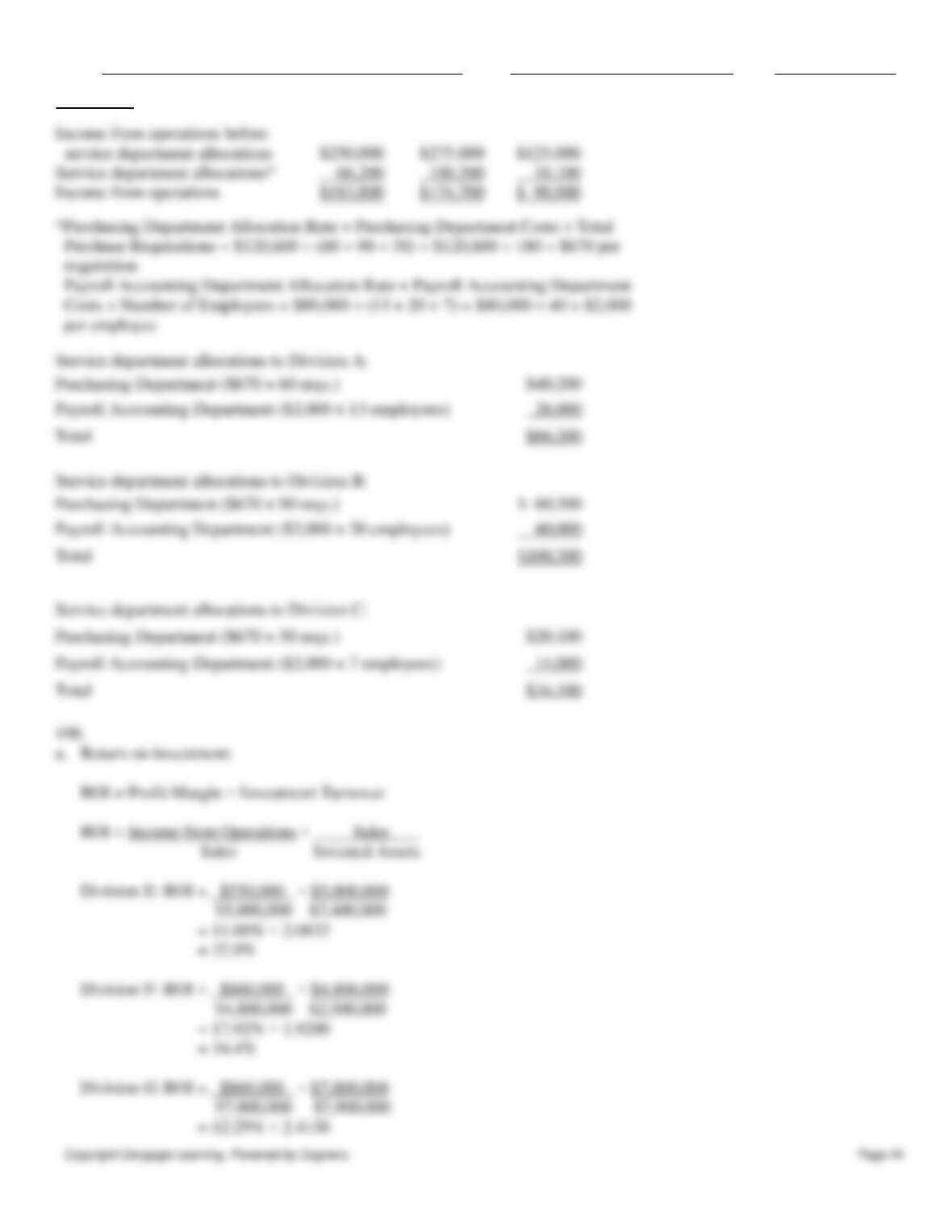
195. Division G of Elephant Preservation Inc. has sales of $895,000, cost of goods sold of $475,000, operating expenses
of $79,500, and invested assets of $750,000.
Determine:
a. The return on investment for Division G
b. The profit margin for Division G
c. The investment turnover for Division G
196. The budget for Department 6 of Cardinal Company for the current month ending March 31 is as follows:
Materials
$208,000
Factory wages
265,000
Supervisory salaries
67,800
Depreciation of plant and equipment
35,000
Power and light
22,500
Insurance and property taxes
15,500
Maintenance
9,700
During March, the costs incurred in Department 6 of Cardinal Company were materials, $204,000; factory wages,
$285,000; supervisory salaries, $63,600; depreciation of plant and equipment, $35,000; power and light, $21,360;
insurance and property taxes, $14,400; maintenance, $9,456.
a.
Prepare a budget performance report for the supervisor of Department 6 of Cardinal
Name:
Class:
Date:
chapter 24
Company for the month of March.
b.
Are there any significant variances (5% or greater) of the budgeted amounts that should be
examined by the supervisor? If so, which areas need further investigation?
197. The following data pertain to the divisions of Coffee & Cocoa Company:
Division A
Division B
Division C
Sales
$600,000
$900,000
$300,000
Cost of goods sold
$200,000
$350,000
$100,000
Selling expenses
$150,000
$275,000
$75,000
Purchase requisitions issued
60
90
30
Number of employees
13
20
7
Service department costs:
Purchasing
$120,600
Payroll Accounting
80,000
Determine the divisional income from operations for the three divisions. Allocate the Purchasing Department costs based
on the number of purchase requisitions issued for each division, and the Payroll Accounting Department costs based on
the number of employees in each division.
198. The sales, income from operations, and invested assets for each division of Grosbeak Company are as follows:
Sales
Income from
Operations
Invested
Assets
Division E
$5,000,000
$550,000
$2,400,000
Division F
4,800,000
860,000
2,500,000
Division G
7,000,000
860,000
2,900,000
a.
Using the DuPont formula, determine the profit margin, investment turnover,
and return on investment for each division. Round profit margin percentage to
two decimal places, investment turnover to four decimal places, and return on
investment to one decimal place.
b.
Which division is the most profitable per dollar invested?
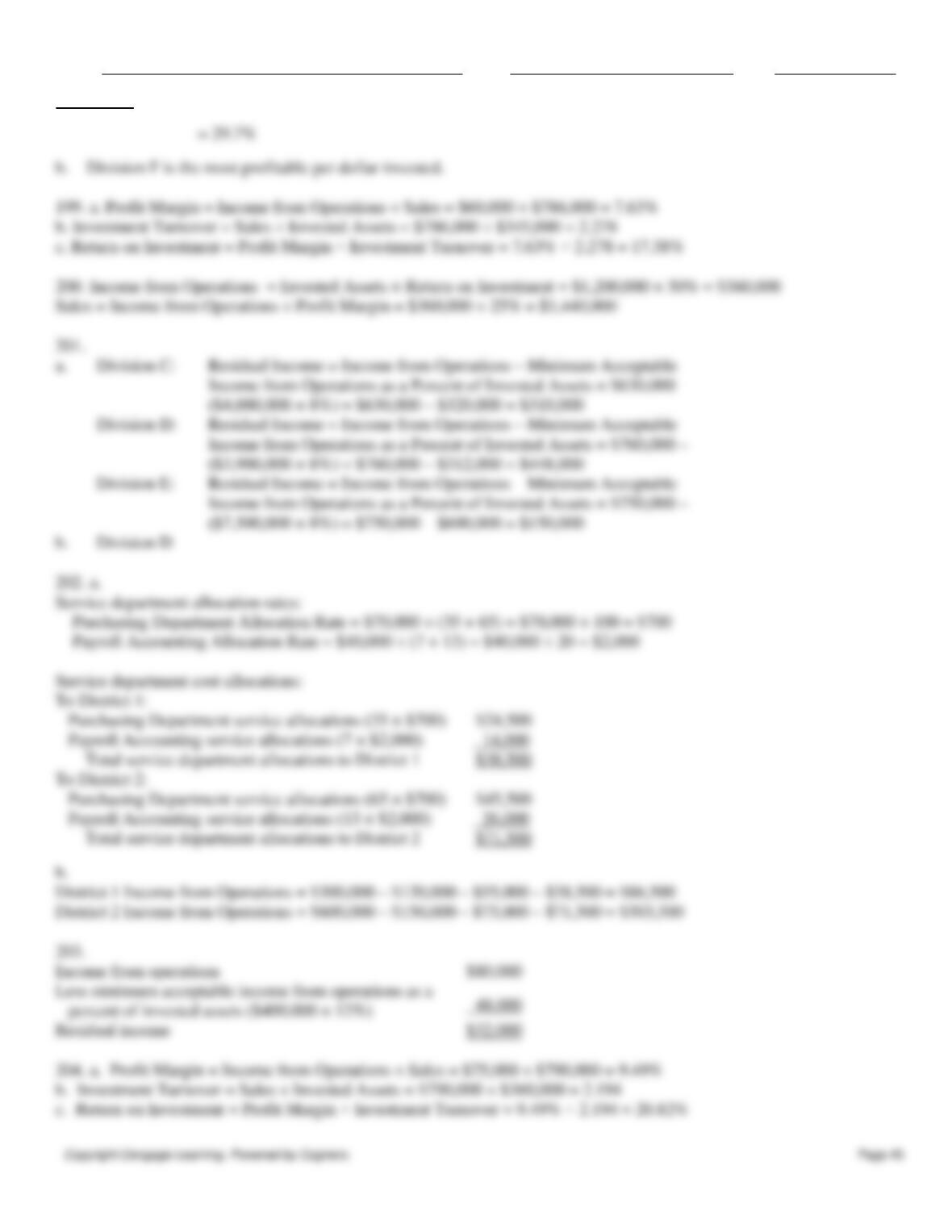
199. The Bottlebrush Division has income from operations of $60,000, invested assets of $345,000, and sales of
$786,000. Use the DuPont formula to compute the return on investment, and show (a) the profit margin, (b) the
investment turnover, and (c) the return on investment. Round the profit margin percentage to two decimal places, the
investment turnover to three decimal places, and the return on investment to two decimal places.
200. The Creative Division of Barry Company reported the following results for December:
Invested assets $1,200,000
Profit margin 25%
Return on investment 30%
Based on this information, what were sales?
201. The sales, income from operations, and invested assets for each division of Wren Company are as follows:
Sales
Income from
Operations
Invested
Assets
Division C
$5,000,000
$630,000
$4,000,000
Name:
Class:
Date:
chapter 24
Division D
6,800,000
760,000
3,900,000
Division E
3,750,000
750,000
7,500,000
Management has established a minimum acceptable return for invested assets of 8%.
a.
Determine the residual income for each division.
b.
Based on residual income, which of the divisions is the most profitable?
202. The following data pertain to Terrace Industries for the current year:
District 1
District 2
Sales
$300,000
$600,000
Cost of goods sold
$120,000
$150,000
Selling expenses
$55,000
$75,000
Purchase requisitions issued
35
65
Number of employees
7
13
Service department costs:
Purchasing
$70,000
Payroll Accounting
40,000
a. Allocate Purchasing Department costs according to the number of purchase requisitions issued for a division, and
Payroll Accounting Department costs according to the number of employees in a division.
b. Determine the divisional income from operations for Districts 1 and 2.
203. Magnolia Company’s Division A has income from operations of $80,000 and assets of $400,000. The minimum
acceptable return on assets is 12%. What is the residual income for the division?
204. Ralston Division has income from operations of $75,000, invested assets of $360,000, and sales of $790,000.
Use the DuPont formula to compute the return on investment, and show (a) the profit margin, (b) the investment turnover,
and (c) return on investment. Round the profit margin percentage to two decimal places and the investment turnover to
three decimal places.
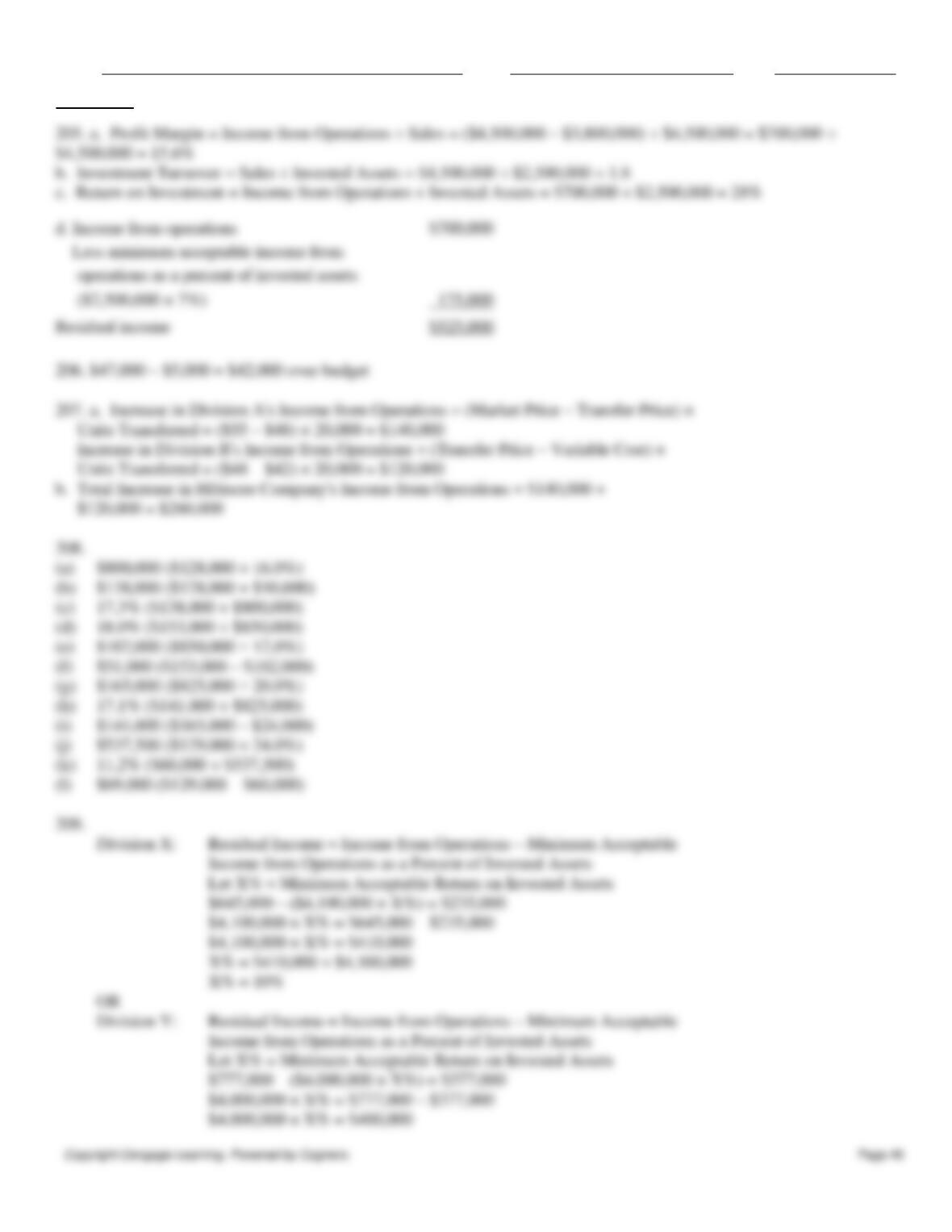
205. Miller’s Quarter Horse Division has sales of $4,500,000. It also has invested assets of $2,500,000 and operating
expenses of $3,800,000. The company has established a minimum acceptable return of 7%. If needed, round to one
decimal place.
a. What is the division’s profit margin?
b. What is the investment turnover?
c. What is the return on investment?
d. What is the residual income?
206. Piano Company’s costs were over budget by $47,000. Piano Company is divided into two regions. The first region’s
costs were over budget by $5,000. Determine the amount that the second region’s costs were over or under budget.
207. The materials used by Hibiscus Company’s Division A are currently purchased from an outside supplier at $55 per
unit. Division B is able to supply Division A with 20,000 units at a variable cost of $42 per unit. The two divisions have
recently negotiated a transfer price of $48 per unit for the 20,000 units. (a) By how much will each division’s income
increase as a result of this transfer? (b) What is the total increase in income for Hibiscus Company?
208. Several items are missing from the following table of return on investment and residual income. Determine the
missing items, identifying each item by the appropriate letter (a–l). Round percentage values to one decimal place.

Name:
Class:
Date:
chapter 24
Division
Invested
Assets
Income
from
Oper.
Return
on Invest.
Min.
Return
Min. Amt.
of Income
from
Oper.
Residual
Income
East
(a)
(b)
(c)
16.0%
$128,000
$10,000
West
$850,000
$153,000
(d)
12.0%
(e)
(f)
North
$825,000
(g)
20.0%
(h)
(i)
$24,000
South
(j)
$129,000
24.0%
(k)
$60,000
(l)
209. The sales, income from operations, invested assets, and residual income for each division of Marcus Company are as
follows:
Sales
Income
from
Operations
Invested
Assets
Residual
Income
Division X
$5,000,000
$645,000
$4,100,000
$235,000
Division Y
6,800,000
777,000
4,000,000
377,000
Division Z
3,750,000
760,000
7,600,000
0
Determine the minimum acceptable return for invested assets
210. Materials used by Layton Company’s Division 1 are currently purchased from an outside supplier at $58 per unit.
Division 2 is able to supply Division 1 with 20,000 units at a variable cost of $46 per unit. The two divisions have recently
negotiated a transfer price of $50 per unit for the 20,000 units.
a. By how much will each division’s income increase as a result of this transfer?
b. What is the total increase in income for Layton?
Name:
Class:
Date:
chapter 24
Answer Key

Name:
Class:
Date:
chapter 24
Name:
Class:
Date:
chapter 24
Name:
Class:
Date:
chapter 24
Name:
Class:
Date:
chapter 24
Name:
Class:
Date:
chapter 24
Name:
Class:
Date:
chapter 24
Name:
Class:
Date:
chapter 24
Name:
Class:
Date:
chapter 24
Name:
Class:
Date:
chapter 24
Name:
Class:
Date:
chapter 24
Name:
Class:
Date:
chapter 24
Name:
Class:
Date:
chapter 24
Name:
Class:
Date:
chapter 24