70) Which methods of evaluating a capital investment project use cash flows as a measurement
basis?
A) Net present value, accounting rate of return, and internal rate of return.
B) Internal rate of return, payback period, and accounting rate of return.
C) Accounting rate of return, net present value, and payback period.
D) Payback period, internal rate of return, and net present value.
E) Net present value, payback period, accounting rate of return, and internal rate of return.
71) The internal rate of return method is not subject to the limitations of the net present value
method when comparing projects with different amounts invested because:
A) The internal rate of return is expressed as a percent rather than the absolute dollar value of
present value.
B) The internal rate of return is expressed as an absolute dollar value rather than the percent of
net present value.
C) The internal rate of return reflects the time value of money rather than the absolute dollar
value of present value.
D) The internal rate of return is expressed as an absolute dollar value rather than the time value
of money used in net present value.
E) The internal rate of return is expressed as a percent rather than the accrual income method
used in net present value.
72) A project requires a $30,000 investment and is expected to generate end-of-period annual
cash inflows as follows:
Year 1 Year 2 Year 3 Total
$12,000 $8,000 $10,000 $30,000
Assuming a discount rate of 10%, what is the net present value of this investment? Selected
present value factors for a single sum are shown in the table below:
i = 10% i = 10% i = 10%
n = 1 n = 2 n = 3
0.9091 0.8264 0.7513
A) $0.00
B) $21,000.00
C) ($7,461.00)
D) $25,033.32
E) ($4,966.60)
73) A project requires a $28,000 investment and is expected to generate end-of-period annual
cash inflows as follows:
Year 1 Year 2 Year 3
$12,000 $13,000 $12,000
Assuming a discount rate of 10%, what is the net present value of this investment? Selected
present value factors for a single sum are shown in the table below.
i = 10% i = 10% i = 10%
n = 1 n = 2 n = 3
0.9091 0.8264 0.7513
A) $0.00
B) $2,668.00
C) ($7,461.00)
D) $30,668.00
E) ($4,966.68)
74) A project requires a $28,500 investment and is expected to generate end-of-period annual
cash inflows of $12,000 for each of three years. Assuming a discount rate of 10%, what is the net
present value of this investment? Selected present value factors for a single sum are shown in the
table below:
i = 10% i = 10% i = 10%
n = 1 n = 2 n = 3
0.9091 0.8264 0.7513
A) $0.00
B) $2,668.00
C) ($7,461.00)
D) $1,341.60
E) $29,841.60
75) Restating future cash flows in terms of present values and then determining the payback
period using these present values is known as:
A) Break-even time (BET)
B) Internal rate of return method.
C) Accounting rate of return method.
D) Net present value method.
E) Present value method.
76) If Management was not concerned with the time value of money, from which two capital
budgeting methods should they choose?
A) IRR or Payback.
B) ARR or Payback.
C) BET or IRR.
D) BET or NPV.
E) NPV or Payback.
77) The calculation of the payback period for an investment when net cash flow is uneven is:
A) Determining when the cumulative total of net cash flows reaches zero.
B) Determining when net income equals the cost of the investment.
C) Determining which depreciation method will shorten the period.
D) Determining the net present value for each cash flow.
E) Determining the applicable hurdle rate.
78) Coffer Co. is analyzing two potential investments.
Project X Project Y
Cost of machine $ 77,000 $ 55,000
Net cash flow:
Year 1 28,000 2,000
Year 2 28,000 25,000
Year 3 28,000 25,000
Year 4 0 20,000
If the company is using the payback period method and it requires a payback of three years or
less, which project(s) should be selected?
A) Project Y.
B) Project X.
C) Both X and Y are acceptable projects.
D) Neither X nor Y is an acceptable project.
E) Project Y because it has a lower initial investment.
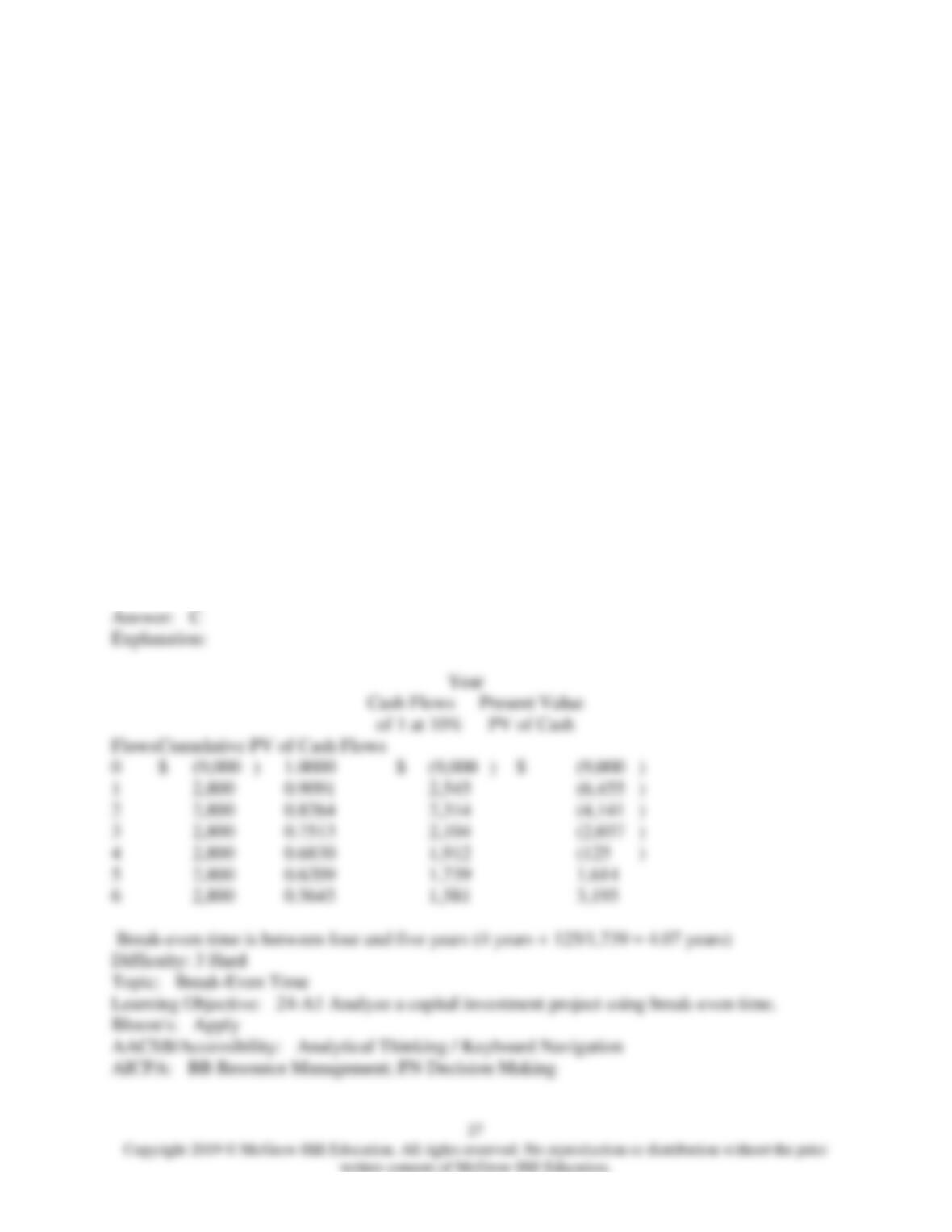
79) A company wishes to buy new equipment for $9,000. The equipment is expected to generate
an additional $2,800 in cash inflows for six years. All cash flows occur at year-end. A bank will
make a $9,000 loan to the company at a 10% interest rate so that the company can purchase the
equipment. Use the table below to determine break-even time for this equipment:
Year Present Value
of 1 at 10%
0 1.0000
1 0.9091
2 0.8264
3 0.7513
4 0.6830
5 0.6209
6 0.5645
A) Break-even time is between two and three years.
B) Break-even time is between three and four years.
C) Break-even time is between four and five years.
D) Break-even time is between five and six years.
E) This project will never break-even.

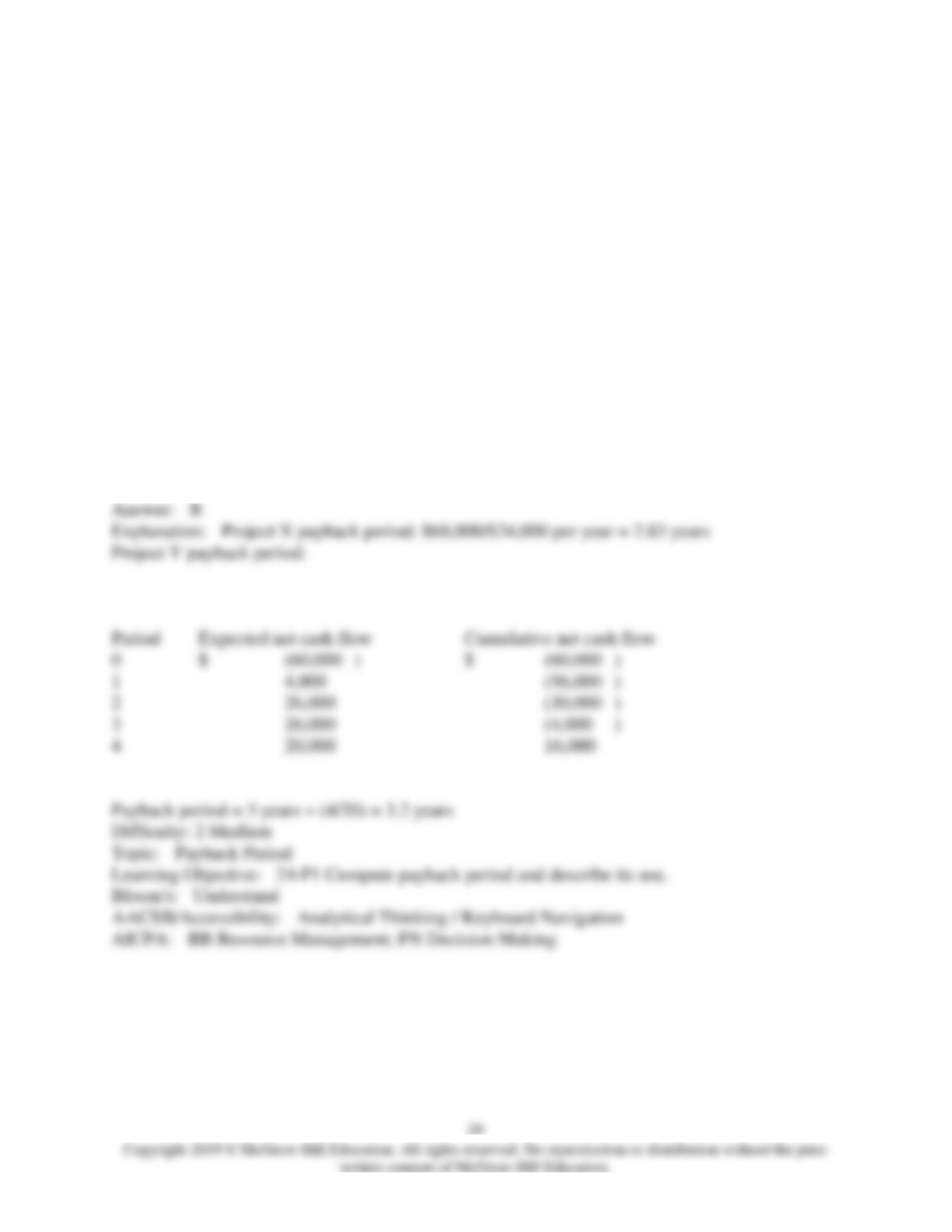
80) Porter Co. is analyzing two potential investments.
Project X Project Y
Cost of machine $ 68,000 $ 60,000
Net cash flow:
Year 1 24,000 4,000
Year 2 24,000 26,000
Year 3 24,000 26,000
Year 4 0 20,000
If the company is using the payback period method and it requires a payback of three years or
less, which project(s) should be selected?
A) Project Y.
B) Project X.
C) Both X and Y are acceptable projects.
D) Neither X nor Y is an acceptable project.
E) Project Y because it has a lower initial investment.
81) Porter Co. is analyzing two potential investments.
Project X Project Y
Cost of machine $ 68,000 $ 60,000
Net cash flow:
Year 1 24,000 4,000
Year 2 24,000 26,000
Year 3 24,000 26,000
Year 4 0 20,000
The payback period in years for Project X is:
A) 2.00.
B) 3.83.
C) 3.50.
D) 2.83.
E) 4.00.
82) The expected amount of time to recover the initial amount of an investment is called the:
A) Amortization period.
B) Payback period.
C) Interest period.
D) Budgeting period.
E) Discounted cash flow period.
83) A company is considering purchasing a machine for $21,000. The machine will generate an
after-tax net income of $2,000 per year. Annual depreciation expense would be $1,500. What is
the payback period for the new machine?
A) 4 years.
B) 6 years.
C) 10.5 years.
D) 14 years.
E) 42 years.
84) A company is considering purchasing a machine for $21,000. The machine will generate an
after-tax net income of $2,000 per year. Annual depreciation expense would be $1,500. The
machine has no salvage value. What is the accounting rate of return?
A) 19%
B) 33%
C) 17%
D) 10%
E) 25%
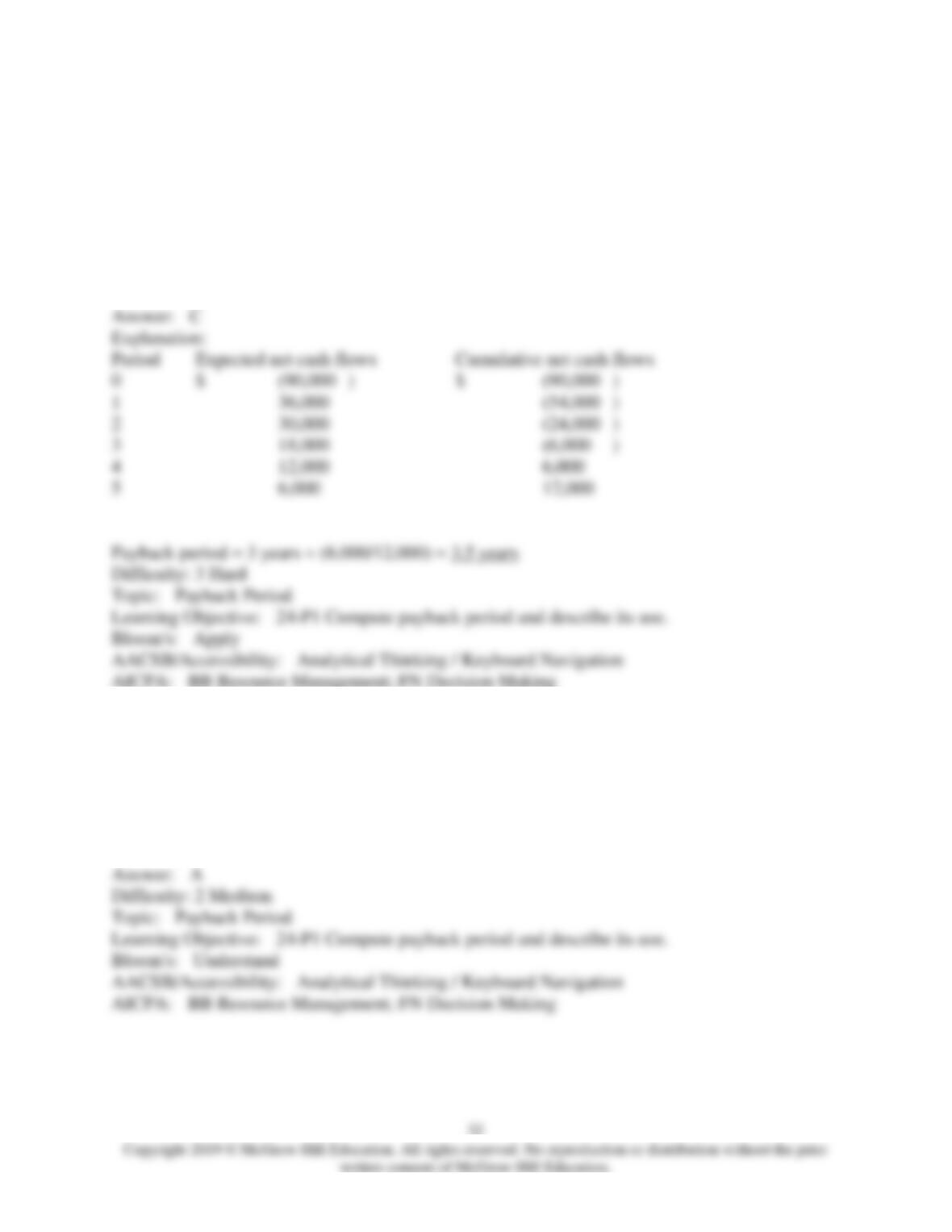
85) A company is considering the purchase of a new piece of equipment for $90,000. Predicted
annual cash inflows from this investment are $36,000 (year 1), $30,000 (year 2), $18,000 (year
3), $12,000 (year 4) and $6,000 (year 5). The payback period is:
A) 4.50 years.
B) 4.25 years.
C) 3.50 years.
D) 3.00 years.
E) 2.50 years.
86) A disadvantage of using the payback period to compare investment alternatives is that:
A) It ignores cash flows beyond the payback period.
B) It includes the time value of money.
C) It cannot be used when cash flows are not uniform.
D) It cannot be used if a company records depreciation.
E) It cannot be used to compare investments with different initial investments.
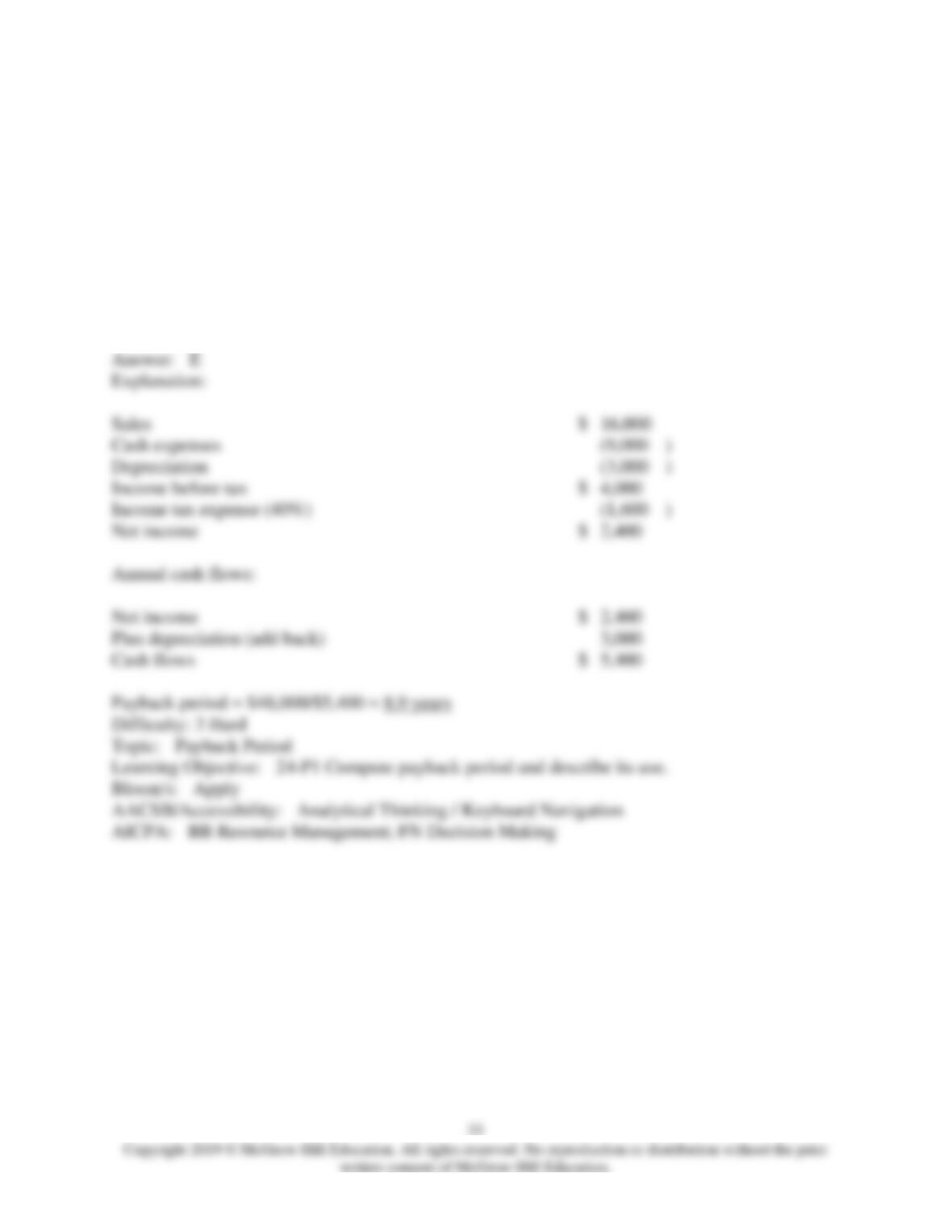
87) A company is considering the purchase of a new machine for $48,000. Management predicts
that the machine can produce sales of $16,000 each year for the next 10 years. Expenses are
expected to include direct materials, direct labor, and factory overhead totaling $12,000 per year
including depreciation of $3,000 per year. Income tax expense is $1,600 per year based on a tax
rate of 40%. What is the payback period for the new machine?
A) 20.0 years.
B) 6.0 years.
C) 7.5 years.
D) 12.0 years.
E) 8.9 years.
88) A company is considering the purchase of a new machine for $48,000. Management predicts
that the machine can produce sales of $16,000 each year for the next 10 years. Expenses are
expected to include direct materials, direct labor, and factory overhead totaling $8,000 per year
plus straight-line depreciation of $4,000 per year. The company’s after-tax net income, based on
a tax rate of 40%, is $2,400. What is the approximate accounting rate of return for the machine?
A) 13%.
B) 17%.
C) 8%.
D) 27%.
E) 10%.
89) A company is planning to purchase a machine that will cost $24,000 with a six-year life and
no salvage value. The company expects to sell the machine’s output of 3,000 units evenly
throughout each year. A projected income statement for each year of the asset’s life appears
below. What is the payback period for this machine?
Sales $ 90,000
Costs:
Manufacturing $ 52,000
Depreciation on machine 4,000
Selling and administrative expenses 30,000 ( 86,000 )
Income before taxes $ 4,000
Income tax (50%) (2,000 )
Net income $ 2,000
A) 24 years.
B) 12 years.
C) 6 years.
D) 4 years.
E) 1 year.
90) A company is planning to purchase a machine that will cost $24,000 with a six-year life and
no salvage value. The company uses straight-line depreciation. The company expects to sell the
machine’s output of 3,000 units evenly throughout each year. A projected income statement for
each year of the asset’s life appears below. What is the accounting rate of return for this
machine?
Sales $ 90,000
Costs:
Manufacturing $ 52,000
Depreciation on machine 4,000
Selling and administrative expenses 30,000 ( 86,000 )
Income before taxes $ 4,000
Income tax (50%) (2,000 )
Net income $ 2,000
A) 33.3%.
B) 16.7%.
C) 50.0%.
D) 8.3%.
E) 4%.
91) After-tax net income divided by the average amount invested in a project, is the:
A) Net present value rate.
B) Payback rate.
C) Accounting rate of return.
D) Earnings from investment.
E) Profit rate.
92) A company buys a machine for $60,000 that has an expected life of 9 years and no salvage
value. The company uses straight-line depreciation. The company anticipates a yearly net income
of $2,850 after taxes of 30%, with the cash flows to be received evenly throughout each year.
What is the accounting rate of return?
A) 2.85%.
B) 4.75%.
C) 6.65%.
D) 9.50%.
E) 42.75%.
93) A company buys a machine for $76,000 that has an expected life of 6 years and no salvage
value. The company uses straight-line depreciation. The company anticipates a yearly after tax
net income of $1,805. What is the accounting rate of return?
A) 2.85%.
B) 4.75%.
C) 6.65%.
D) 9.50%.
E) 42.75%.
94) Carmel Corporation is considering the purchase of a machine costing $36,000 with a 6-year
useful life and no salvage value. Carmel uses straight-line depreciation and assumes that the
annual cash inflow from the machine will be received uniformly throughout each year. In
calculating the accounting rate of return, what is Carmel’s average investment?
A) $6,000.
B) $7,000.
C) $18,000.
D) $21,000.
E) $36,000.
95) Watson Corporation is considering buying a machine for $25,000. Its estimated useful life is
5 years, with no salvage value. Watson anticipates annual net income after taxes of $1,500 from
the new machine. What is the accounting rate of return assuming that Watson uses straight-line
depreciation and that income is earned uniformly throughout each year?
A) 6.0%.
B) 8.0%.
C) 8.5%.
D) 10.0%.
E) 12.0%.
96) The accounting rate of return is calculated as:
A) The annual after-tax income divided by the total investment.
B) The annual after-tax income divided by the annual average investment.
C) The annual cash flows divided by the annual average investment.
D) The annual cash flows divided by the total investment.
E) The annual average investment divided by the after-tax income.
97) The following relates to a proposed equipment purchase:
Cost $ 144,000
Salvage value $ 4,000
Estimated useful life 4 years
Annual net cash flows $ 46,100
Depreciation method Straight-line
Assuming that net cash flows are received evenly throughout the year, the accounting rate of
return is (ignore income taxes):
A) 62.3%.
B) 32.0%.
C) 15.0%.
D) 7.7%.
E) 5.0%.
98) The following relates to a proposed equipment purchase:
Cost $ 144,000
Salvage value $ 4,000
Estimated useful life 4 years
Annual net cash flows $ 46,100
Depreciation method Straight-line
The annual average investment amount used to calculate the accounting rate of return is:
A) $72,000
B) $70,000
C) $37,000
D) $74,000
E) $48,950