135) Spilker Linens Store has three departments: Bath, Kitchen, and Bedding. The most recent
income statement, showing the total operating profit and departmental results is shown below:
Total
Bath
Kitchen
Bedding
Sales
$2,100,000
$1,000,000
$600,000
$500,000
Cost of goods sold
(1,260,000)
(500,000)
(400,000)
(360,000)
Gross profit
840,000
500,000
200,000
140,000
Direct expenses
(420,000)
(200,000)
(100,000)
(120,000)
Allocated expenses
(350,000)
(100,000)
(75,000)
(175,000)
Net income (loss)
$ 70,000
$ 200,000
$ 25,000
$(155,000)
Based on this income statement, management is planning on eliminating the Bedding
department, as it is generating a net loss. If the Bedding department is eliminated, the Kitchen
department will expand to fill the space, but sales will not change in total, nor will direct
expenses. None of Bedding’s allocated expenses will be avoided, but they will be reallocated to
Bath and Kitchen. Bath will be allocated $100,000 additional expenses, and Kitchen will be
allocated $75,000 additional expenses. Prepare a new income statement for Spilker Linens
Store, showing the results if the Bedding Department is eliminated and indicate whether
eliminating the department is advisable.
136) Luxury Linens has three departments: Bath, Kitchen, and Bedding. The most recent income
statement, showing the total operating profit and departmental results is shown below:
Total
Bath
Kitchen
Bedding
Sales
$2,100,000
$1,000,000
$500,000
$600,000
Cost of goods sold
(1,260,000)
(500,000)
(360,000)
(400,000)
Gross profit
840,000
500,000
140,000
200,000
Direct expenses
(420,000)
(200,000)
(120,000)
(100,000)
Allocated expenses
(325,000)
(100,000)
(150,000)
(75,000)
Net income (loss)
$ 95,000
$ 200,000
$(130,000)
$25,000
Based on this income statement, management is considering eliminating the Kitchen department.
If the Kitchen department is eliminated, the other departments will expand to fill the space but
sales are not expected to change. Twenty percent of Kitchen’s allocated expenses will be avoided
due to restructuring and the remainder reallocated equally to Bath and Bedding. Show an
analysis indicating whether the Kitchen department should be eliminated.
Sales lost
Avoidable costs: Cost of goods sold
Effect on net income

95
137) Generalware, Inc. sells a single product and reports the following results from sales of
100,000 units:
Sales ($45 unit) …………..…………….… $4,500,000
Less costs and expenses:
Direct materials ($16/unit)………….… $1,600,000
Direct labor ($9/unit)…………….….… 900,000
Variable overhead ($3/unit)…….…….. 300,000
Fixed overhead ($8.10/unit)……………. 810,000
Variable administrative ($4.50/unit)…. 450,000
Fixed administrative ($4/unit)………… 400,000
Total costs and expenses……………… $(4,460,000)
Operating income………………………… $ 40,000
A foreign buyer wants to purchase 15,000 units. However, they are willing to pay only $36 per
unit for this one-time order. They also agree to pay all freight costs. To fill the order,
Generalware will incur normal production costs. Total fixed overhead will have to be increased
by $60,000 to pay for equipment rentals and insurance. No additional administrative costs
(variable or fixed) will be incurred in association with this special order.
Required:
(1) Should Generalware accept the order if it does not affect regular sales? Explain.
(2) Assume that Generalware can accept the special order only by giving up 5,000 units of its
normal sales. Should the company accept the special order under these circumstances?
97
138) A company is planning to introduce a new portable computer to its existing product line.
Management must decide whether to make the computer case or buy it from an outside supplier.
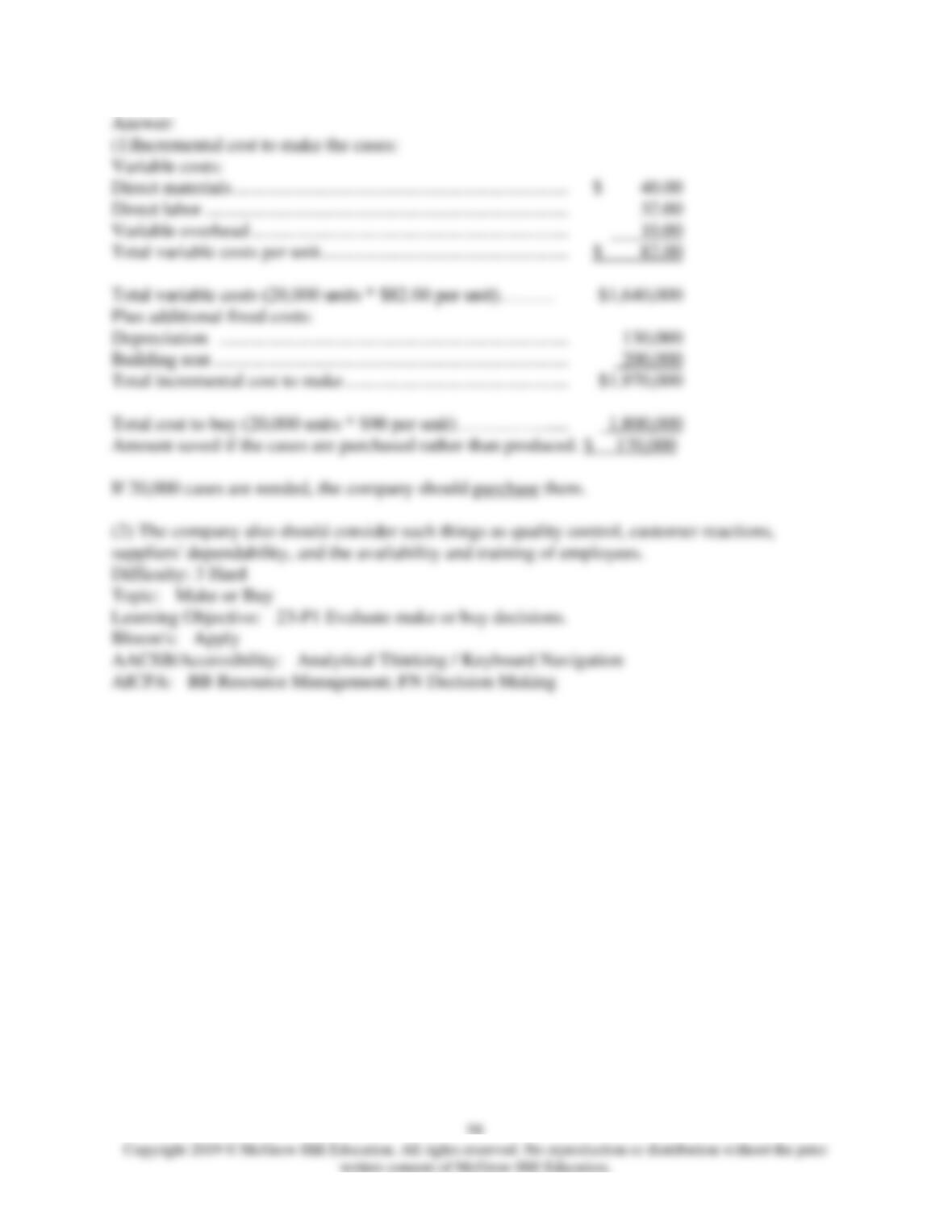
The lowest outside price is $90. If the case is produced internally, the company will have to
purchase new equipment that will yield annual depreciation of $130,000. The company will also
need to rent a new production facility at $200,000 a year. At 20,000 cases per year, a preliminary
analysis of production costs shows the following:
Per case
Direct materials ………………………………………………… $ 40.00
Direct labor ……………………………………………………….. 32.00
Variable overhead ………………………………………………. 10.00
Equipment depreciation ………………………………………. 6.50
Building rental ………………………………………………….. 10.00
Allocated fixed overhead …………………………………….. 7.50
Total cost …………………………………………………………… $106.00
Required:
(1) Determine whether the company should make the cases or buy them from the outside
supplier.
(2) What other factors, besides cost, should the company consider?
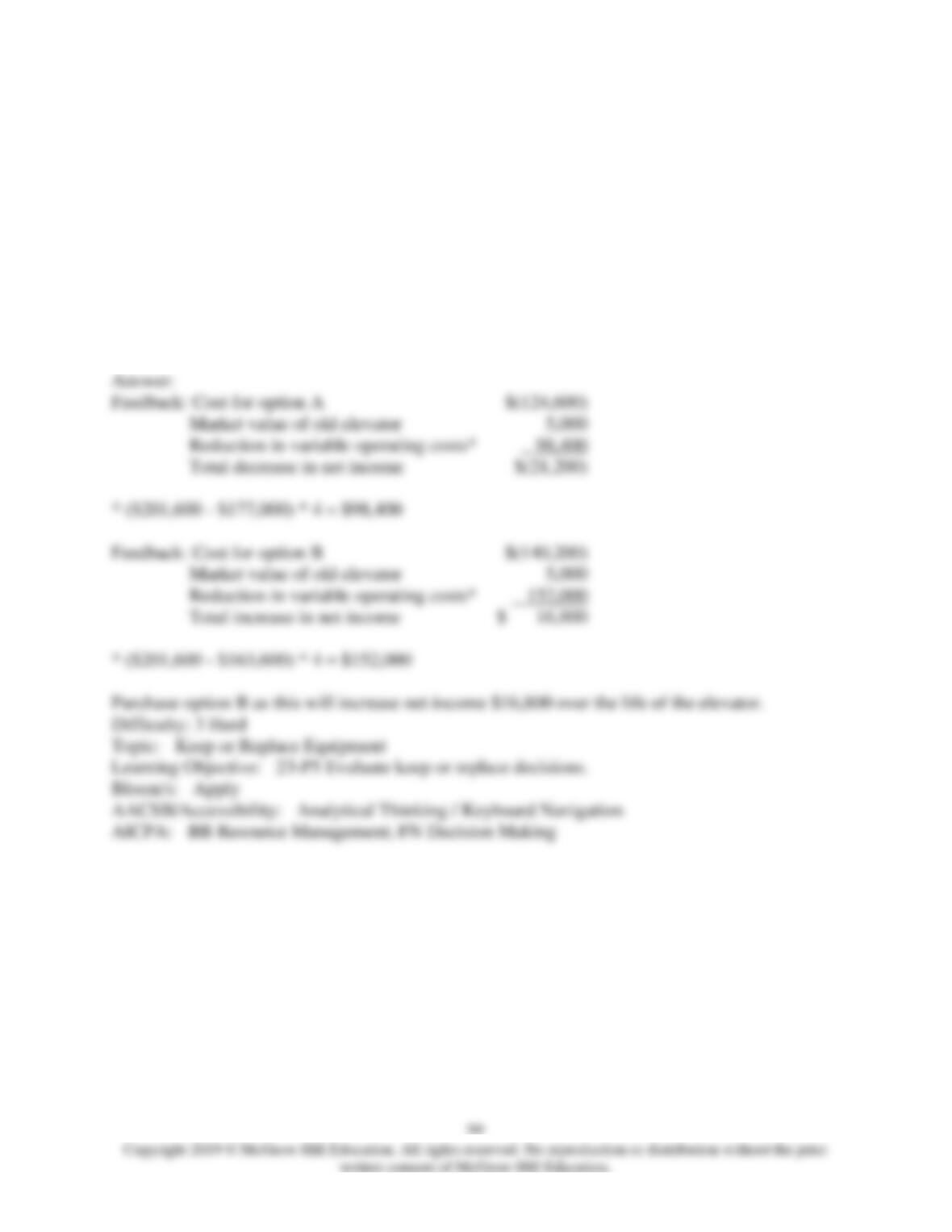
139) Leopal Company is considering replacing a freight elevator. The current freight elevator
has a book value of $37,500 and a remaining useful life of four years, at which time its salvage
value will be zero. The current market value of the freight elevator is $5,000. Variable
operating costs per year are $201,600 per year. Leopal has identified the following two possible
replacement options. Prepare an analysis of the alternatives and whether either option should be
used to replace the current elevator.
Option A
Option B
Cost
$124,600
$140,200
Variable operating costs per year
$177,000
$163,600
100
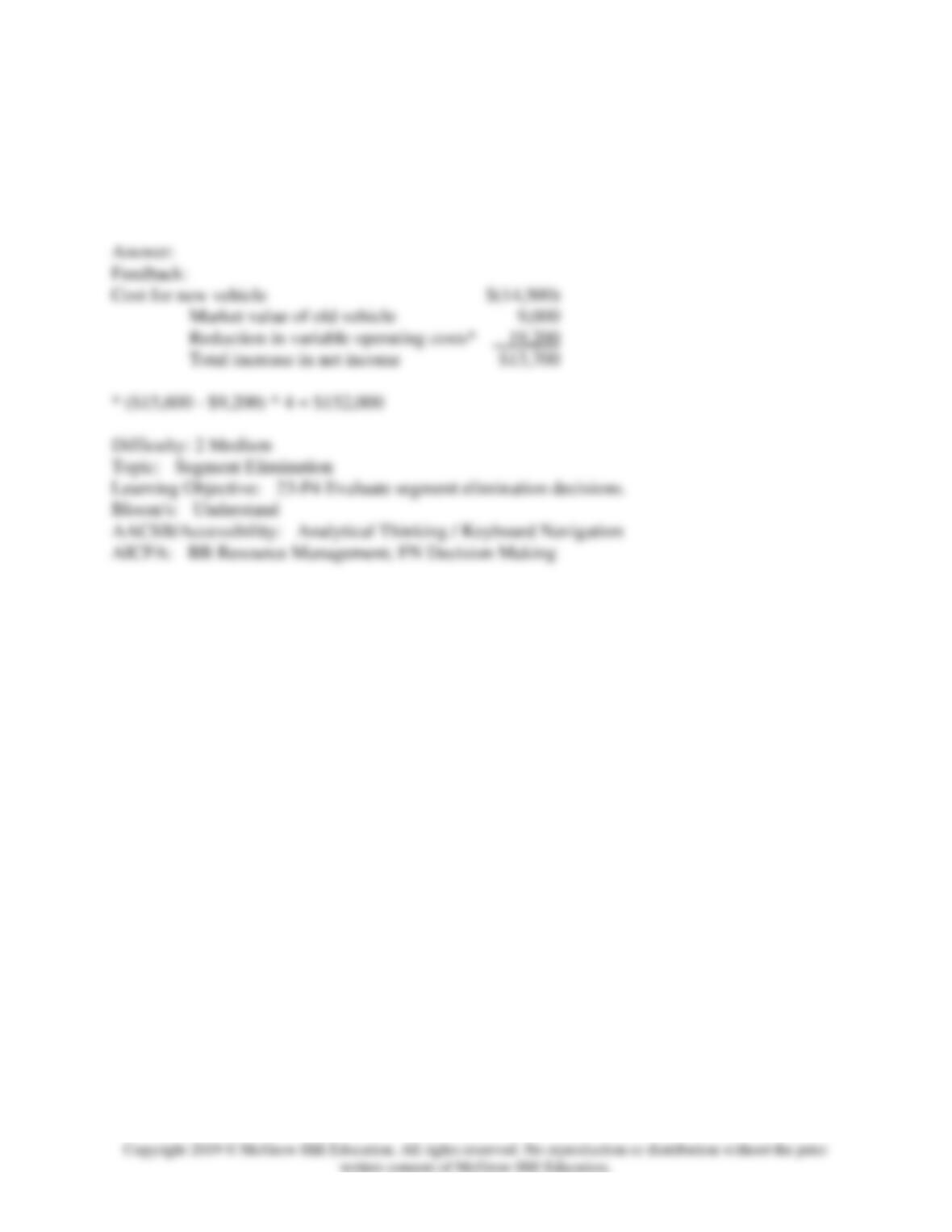
140) Chipper Company is considering replacing a delivery vehicle. The current vehicle has a
book value of $14,500 and a remaining useful life of three years, at which time its salvage value
will be zero. The current market value of the vehicle is $9,000. Variable operating costs per
year are $15,600 per year. The new vehicle has a cost of $32,500. Operating costs for the new
vehicle are $9,200 per year.
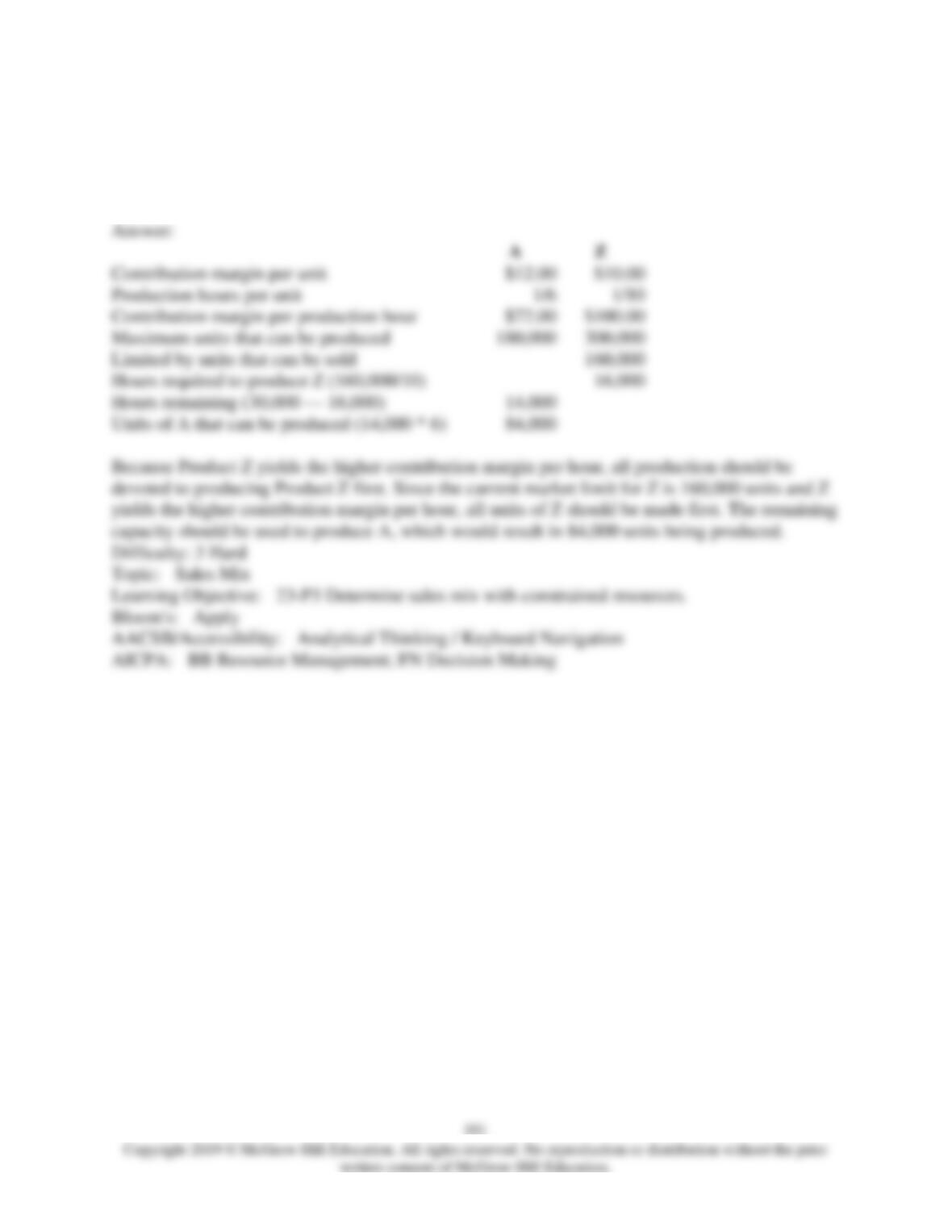
141) Mays Company can sell all of product A that it produces but only 160,000 units of product
Z. The company has limited production capacity. It can produce 6 units of A per hour or 10
units of Z per hour, and it has 30,000 production hours available. Contribution margin per unit is
$12 for A and $10 for Z. What is the most profitable sales mix for this company?
142) Marshall Company currently manufactures one of its parts at a cost of $3.25 per unit. This
cost is based on a normal production rate of 50,000 units. Variable costs are $2.10 per unit, fixed
costs related to making this part are $40,000 per year, and allocated fixed costs are $45,000 per
year. Allocated fixed costs are unavoidable whether the company makes or buys the part.
Marshall is considering buying the part from a supplier for a quoted price of $2.80 per unit
guaranteed for a three-year period. Should the company continue to manufacture the part, or
should it buy the part from the outside supplier? Support your answer with analyses.
143) Relevant costs are also known as ________.
144) A(n) ________ requires a future outlay of cash and is relevant for current and future
decision making.
145) A(n) ________ is the potential benefit lost by taking a specific action when two or more
alternative choices are available.
146) A(n) ________ arises from a past decision and cannot be avoided or changed; it is
irrelevant to future decisions.
147) ________ revenues are the additional revenue generated by selecting a certain course of
action over another..
148) The process of buying goods or services from an external supplier is called ________.
149) A ________ is the combination of products sold by a company.
150) In this chapter, you examined several short-term managerial decision tasks. Identify (list)
any three of these types of decision tasks:
________; ________; ________