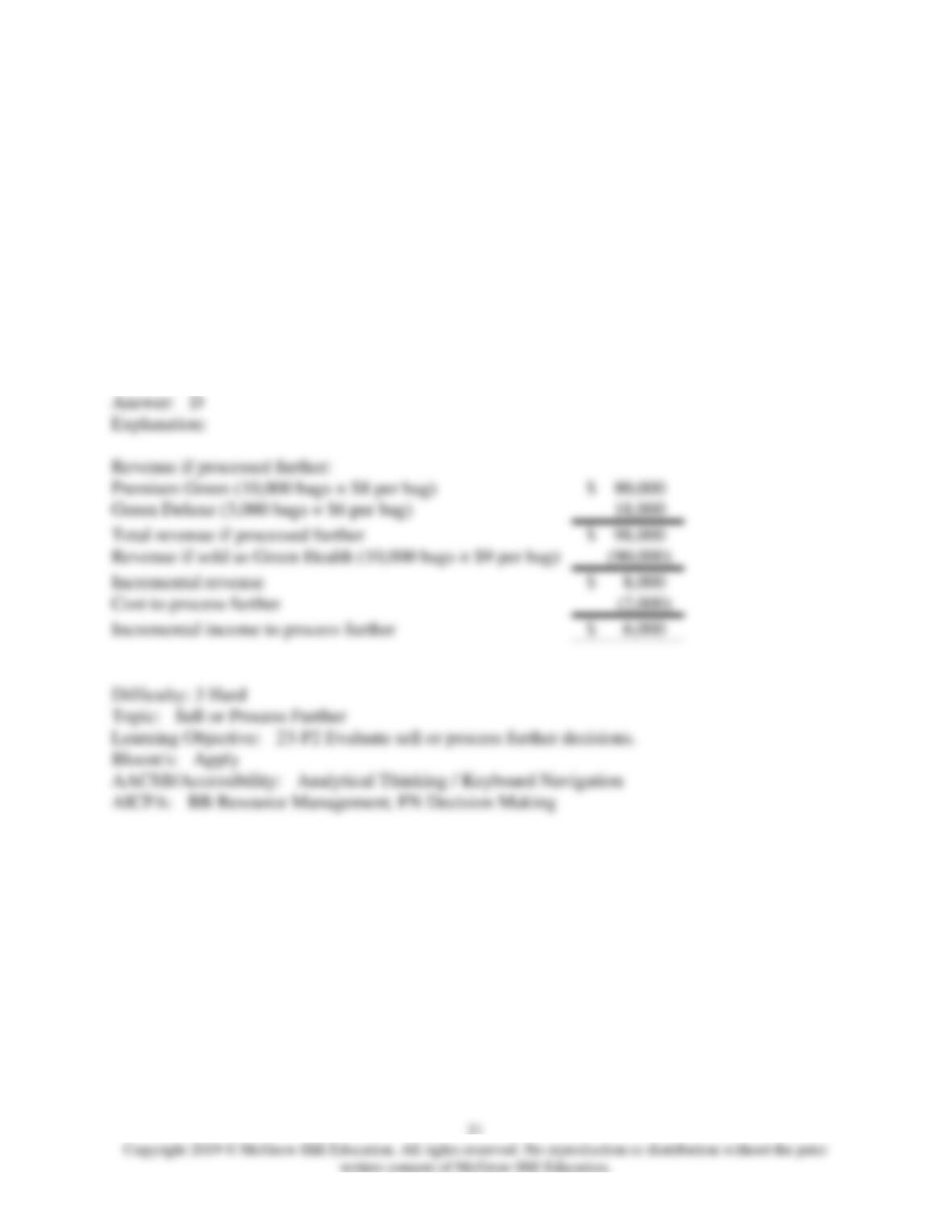
54) Maxim manufactures a hamster food product called Green Health. Maxim currently has
10,000 bags of Green Health on hand. The variable production costs per bag are $1.80 and total
fixed costs are $10,000. The hamster food can be sold as it is for $9.00 per bag or be processed
further into Premium Green and Green Deluxe at an additional $2,000 cost. The additional
processing will yield 10,000 bags of Premium Green and 3,000 bags of Green Deluxe, which can
be sold for $8 and $6 per bag, respectively. The net advantage (incremental income) of
processing Green Health further into Premium Green and Green Deluxe would be:
A) $98,000.
B) $96,000.
C) $8,000.
D) $6,000.
E) $2,000.
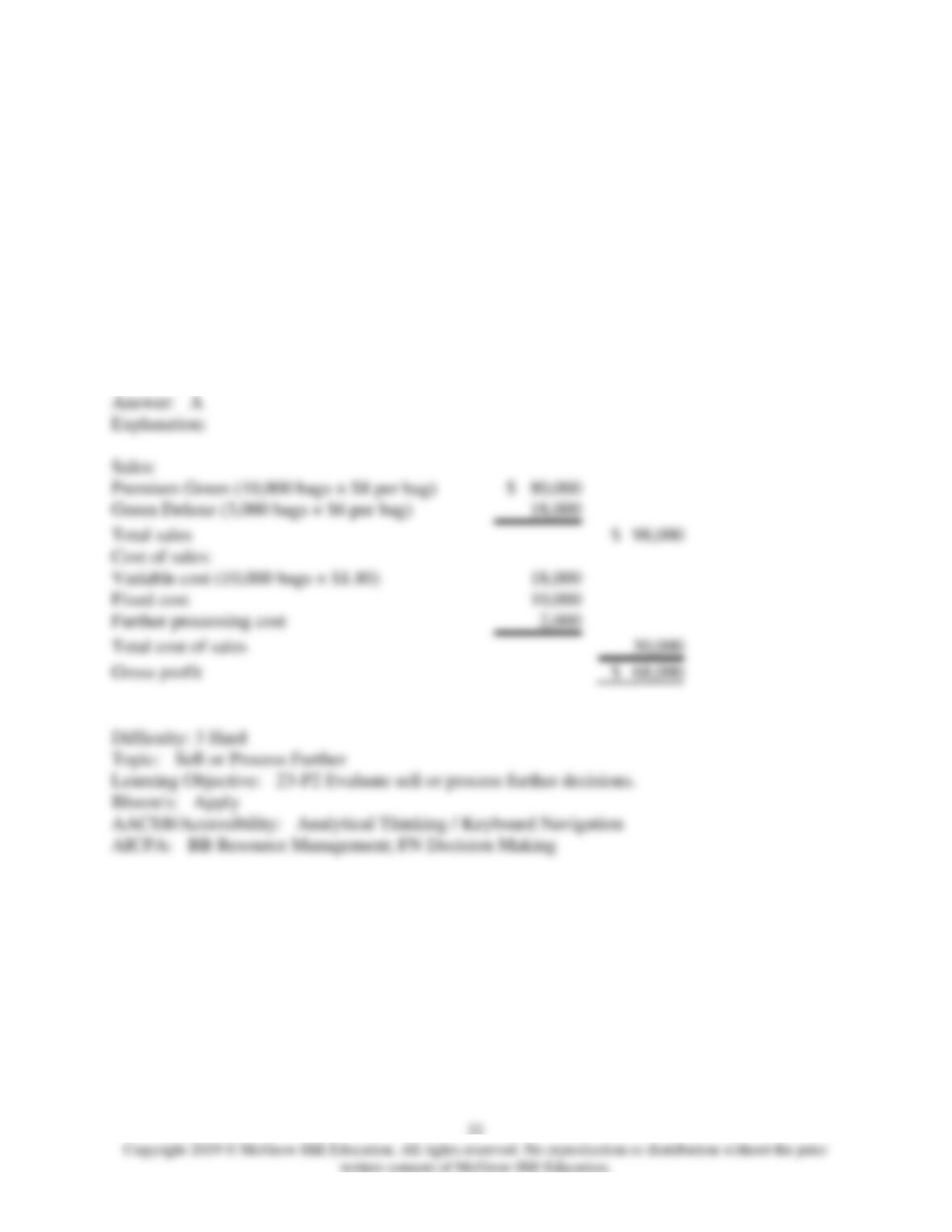
55) Maxim manufactures a cat food product called Green Health. Maxim currently has 10,000
bags of Green Health on hand. The variable production costs per bag are $1.80 and total fixed
costs are $10,000. The cat food can be sold as it is for $9.00 per bag or be processed further into
Premium Green and Green Deluxe at an additional $2,000 cost. The additional processing will
yield 10,000 bags of Premium Green and 3,000 bags of Green Deluxe, which can be sold for $8
and $6 per bag, respectively. If Green Health is processed further into Premium Green and Green
Deluxe, the total gross profit would be:
A) $68,000.
B) $78,000.
C) $96,000.
D) $98,000.
E) $100,000.
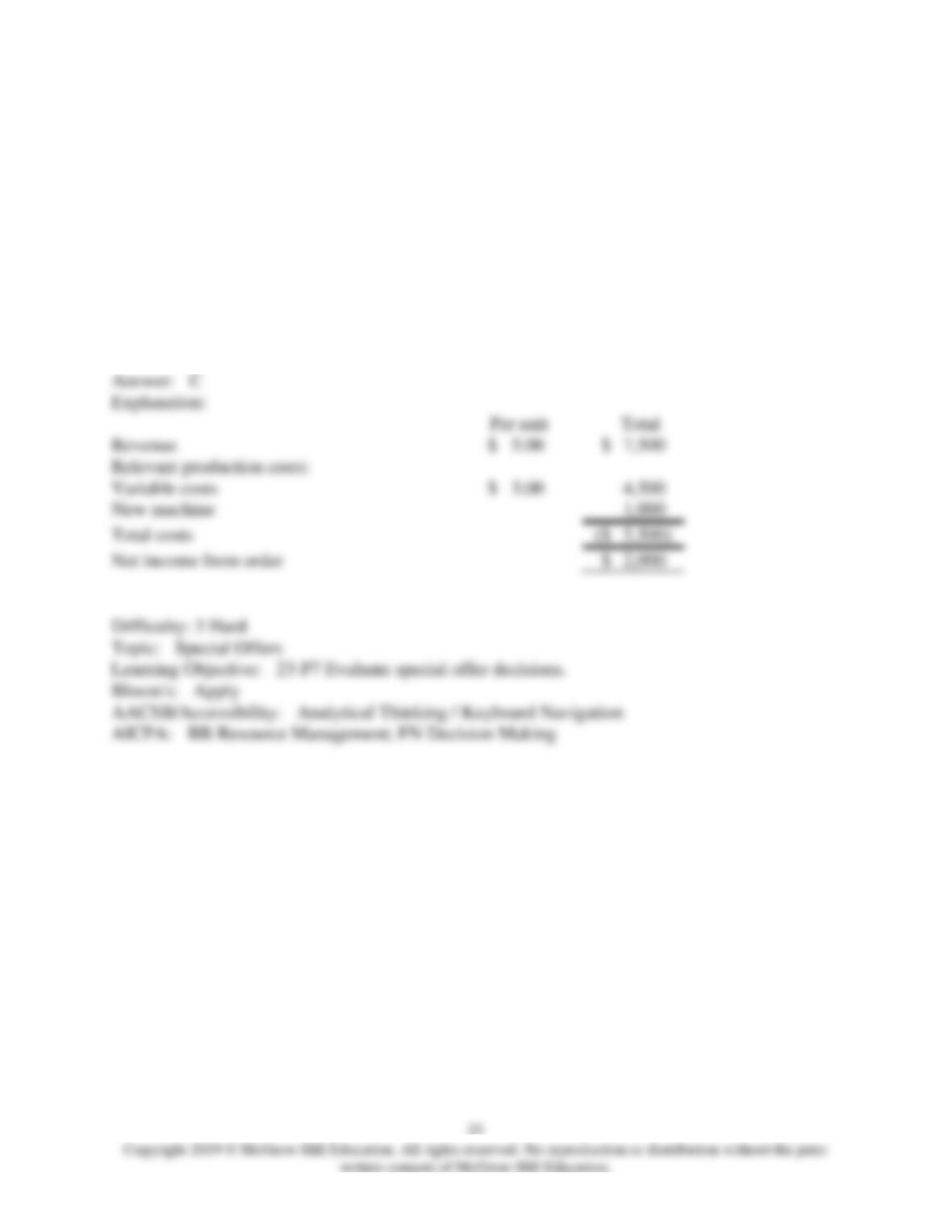
56) Minor Electric has received a special one-time order for 1,500 light fixtures (units) at $5 per
unit. Minor currently produces and sells 7,500 units at $6.00 each. This level represents 75% of
its capacity. Production costs for these units are $4.50 per unit, which includes $3.00 variable
cost and $1.50 fixed cost. To produce the special order, a new machine needs to be purchased at
a cost of $1,000 with a zero salvage value. Management expects no other changes in costs as a
result of the additional production. Should the company accept the special order?
A) No, because additional production would exceed capacity.
B) No, because incremental costs exceed incremental revenue.
C) Yes, because incremental revenue exceeds incremental costs.
D) Yes, because incremental costs exceed incremental revenues.
E) No, because the incremental revenue is too low.
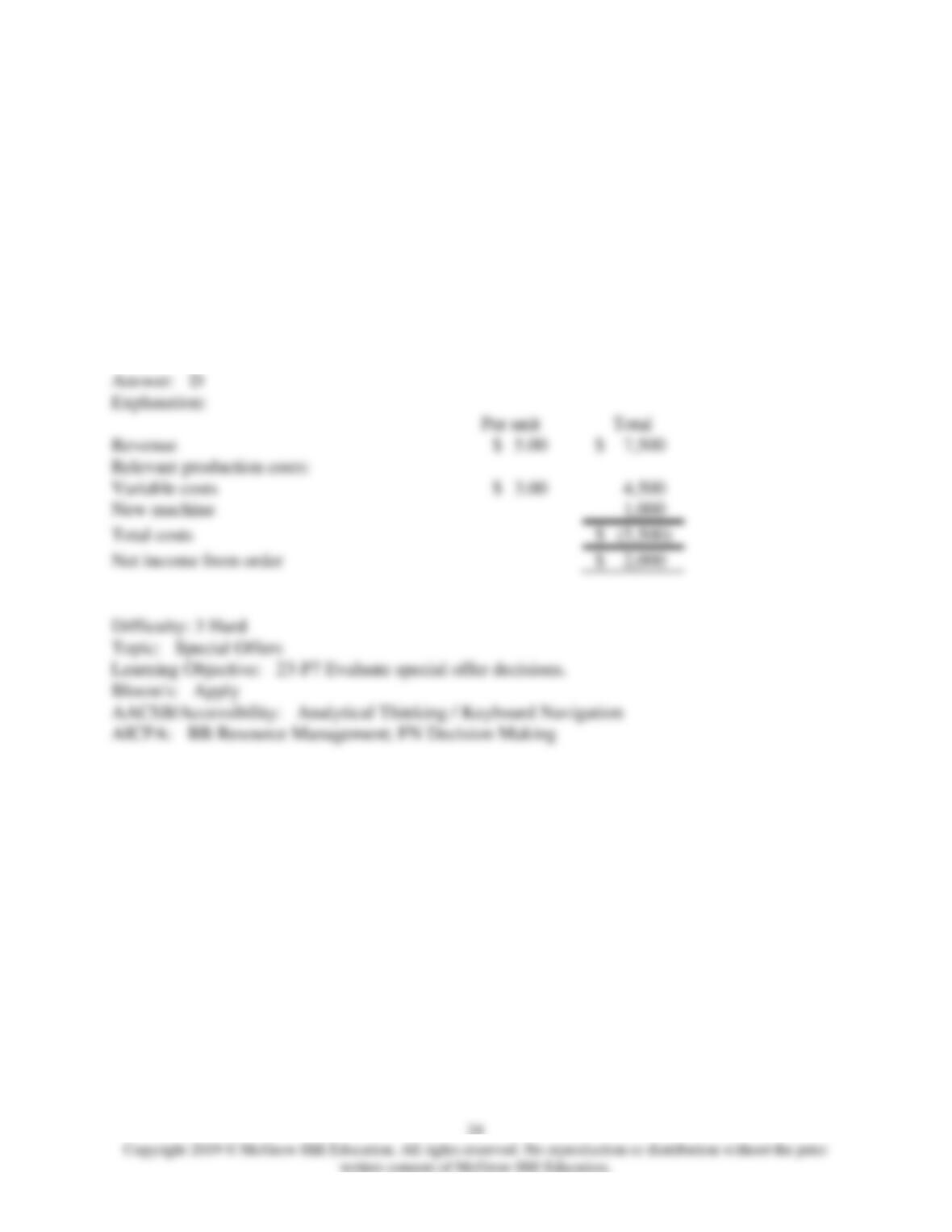
57) Minor Electric has received a special one-time order for 1,500 light fixtures (units) at $5 per
unit. Minor currently produces and sells 7,500 units at $6.00 each. This level represents 75% of
its capacity. Production costs for these units are $4.50 per unit, which includes $3.00 variable
cost and $1.50 fixed cost. To produce the special order, a new machine needs to be purchased at
a cost of $1,000 with a zero salvage value. Management expects no other changes in costs as a
result of the additional production. Should the company accept the special order?
A) No, because net income would decrease by $1,500.
B) No, because net income would decrease by $2,000.
C) Yes, because net income would increase by $7,500.
D) Yes, because net income would increase by $2,000.
E) No, because net income would decrease by $5,500.
58) Bluebird Mfg. has received a special one-time order for 15,000 bird feeders at $3 per unit.
Bluebird currently produces and sells 75,000 units at $7.00 each. This level represents 80% of its
capacity. These bird feeders would be marketed under the wholesaler’s name and would not
affect Bluebird’s sales through its normal channels. Production costs for these units are $3.50 per
unit, which includes $2.25 variable cost and $1.25 fixed cost. If Bluebird accepts this additional
business, the incremental revenue will be:
A) $45,000.
B) $11,250.
C) $33,750.
D) $7,500.
E) $26,250.
59) Bluebird Mfg. has received a special one-time order for 15,000 bird feeders at $3 per unit.
Bluebird currently produces and sells 75,000 units at $7.00 each. This level represents 80% of its
capacity. These bird feeders would be marketed under the wholesaler’s name and would not
affect Bluebird’s sales through its normal channels. Production costs for these units are $3.50 per
unit, which includes $2.25 variable cost and $1.25 fixed cost. If Bluebird accepts this additional
business, the incremental cost will be:
A) $45,000.
B) $11,250.
C) $38,750.
D) $7,500.
E) $33,750.
60) Minor Electric has received a special one-time order for 1,500 light fixtures (units) at $5 per
unit. Minor currently produces and sells 7,500 units at $6.00 each. This level represents 75% of
its capacity. Production costs for these units are $4.50 per unit, which includes $3.00 variable
cost and $1.50 fixed cost. To produce the special order, a new machine needs to be purchased at
a cost of $1,000 with a zero salvage value. Management expects no other changes in costs as a
result of the additional production. If Minor wishes to earn $1,250 on the special order, the size
of the order would need to be:
A) 4,500 units.
B) 2,250 units.
C) 1,125 units.
D) 625 units.
E) 300 units.
61) Bluebird Mfg. has received a special one-time order for 15,000 bird feeders at $3 per unit.
Bluebird currently produces and sells 75,000 units at $7.00 each. This level represents 80% of its
capacity. These bird feeders would be marketed under the wholesaler’s name and would not
affect Bluebird’s sales through its normal channels. Production costs for these units are $3.50 per
unit, which includes $2.25 variable cost and $1.25 fixed cost. If Bluebird accepts this additional
business, the effect on net income will be:
A) $45,000 increase.
B) $11,250 increase.
C) $33,750 increase.
D) $7,500 decrease.
E) $33,750 decrease.
62) Bannister Co. is thinking about having one of its products manufactured by a subcontractor.
Currently, the cost of manufacturing 1,000 units is:
Direct material
$
45,000
Direct labor
30,000
Factory overhead (30% is variable)
98,000
If Bannister can buy 1,000 units from an outside supplier for $100,000, it should:
A) Make the product because current factory overhead is less than $100,000.
B) Make the product because the cost of direct material plus direct labor of manufacturing is less
than $100,000.
C) Buy the product because the total incremental costs of manufacturing are greater than
$100,000.
D) Buy the product because total fixed and variable manufacturing costs are greater than
$100,000.
E) Make the product because factory overhead is a sunk cost.
Incremental cost to manufacture:
Direct materials
$
Direct labor
Variable overhead ($98,000 * 30%)
Total incremental cost to manufacture
$
104,400
63) Frederick Co. is thinking about having one of its products manufactured by an outside
supplier.
Currently, the cost of manufacturing 5,000 units is:
Direct material
$
62,000
Direct labor
47,000
Variable factory overhead
38,000
Factory overhead
52,000
If Frederick can buy 5,000 units from an outside supplier for $130,000, it should:
A) Make the product because current factory overhead is less than $130,000.
B) Make the product because the cost of direct material plus direct labor of manufacturing is less
than $130,000.
C) Make the product because factory overhead is a sunk cost.
D) Buy the product because total fixed and variable manufacturing costs are greater than
$130,000.
E) Buy the product because the total incremental costs of manufacturing are greater than
$130,000.
Incremental cost to manufacture:
Direct materials
$
Direct labor
Variable overhead
Total incremental cost to manufacture
$
147,000
64) A company has the choice of either selling 1,000 unfinished units as is or completing them.
The company could sell the unfinished units as is for $4.00 per unit. Alternatively, it could
complete the units with incremental costs of $1.00 per unit for direct materials, $2.00 per unit
for direct labor, and $1.50 per unit for overhead, and then sell the finished units for $8.00 each.
What should the company do?
A) Sell the units as is.
B) Finish the units.
C) It does not matter because both alternatives have the same result.
D) Neither sell nor finish because both alternatives produce a loss. Instead, the company should
store the units permanently.
E) Donate the units.
65) A company has the choice of either selling 1,000 unfinished units as is or completing them.
The company could sell the unfinished units as is for $4.00 per unit. Alternatively, it could
complete the units with incremental costs of $1.00 per unit for direct materials, $2.00 per unit for
direct labor, and $1.50 per unit for overhead, and then sell the completed units for $8.00 each. If
the company completes the units, what is the impact on income?
A) Income will increase by $4,000.
B) Income will increase by $500.
C) Income will decrease by $4,500.
D) Income will decrease by $500.
E) Income will increase by $8,000.
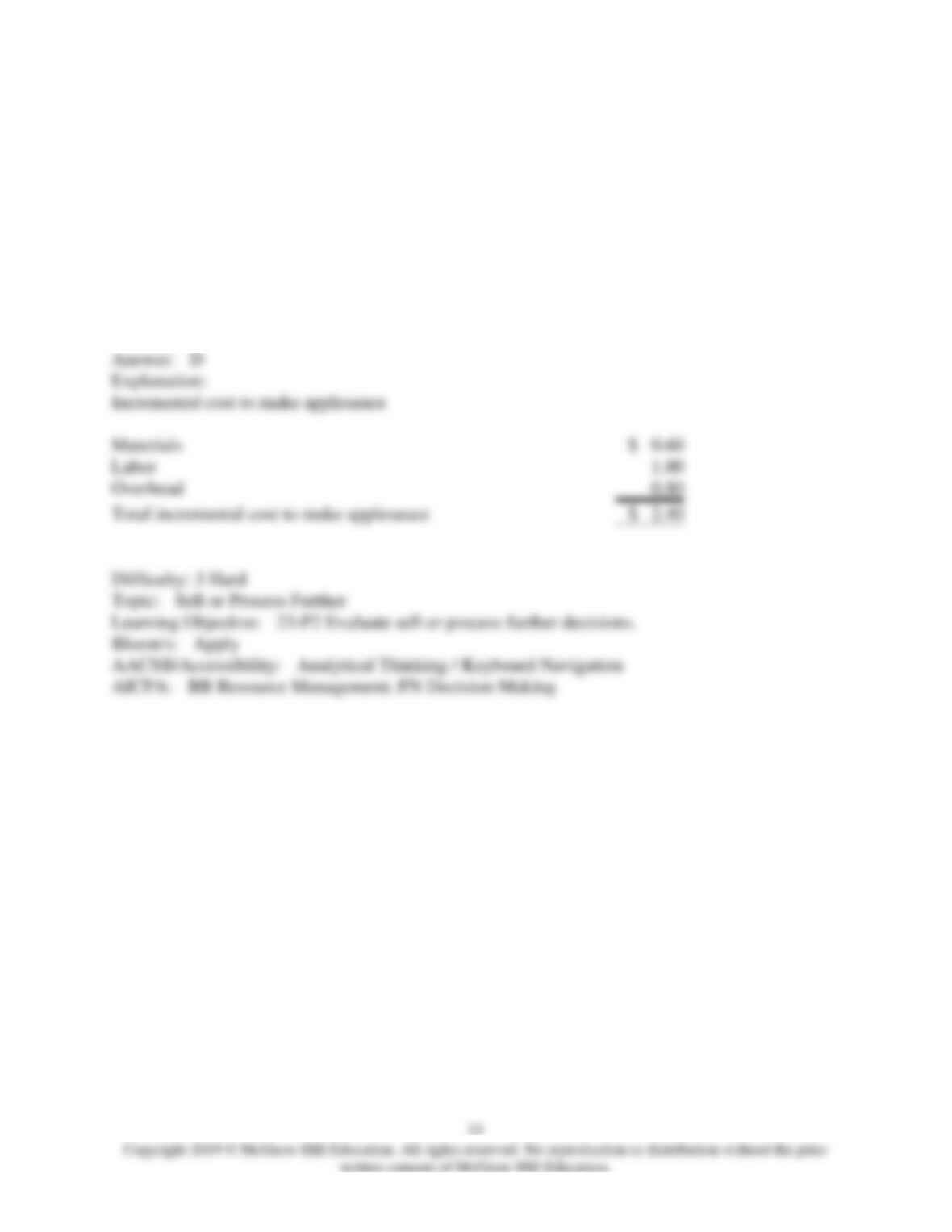
66) A company has the choice of either selling 600 apples or processing them into applesauce.
The company could sell the apples as is for $2.00 per unit. Alternatively, each apple could be
made into one unit of applesauce with incremental costs of $0.60 per unit for direct materials,
$1.00 per unit for direct labor, and $0.80 per unit for overhead, and then sold for $5.00 each.
What is the amount of incremental revenue from processing the apples into applesauce?
A) $3.00 per unit.
B) $5.00 per unit.
C) $7.00 per unit.
D) $2.40 per unit.
E) $0.60 per unit.
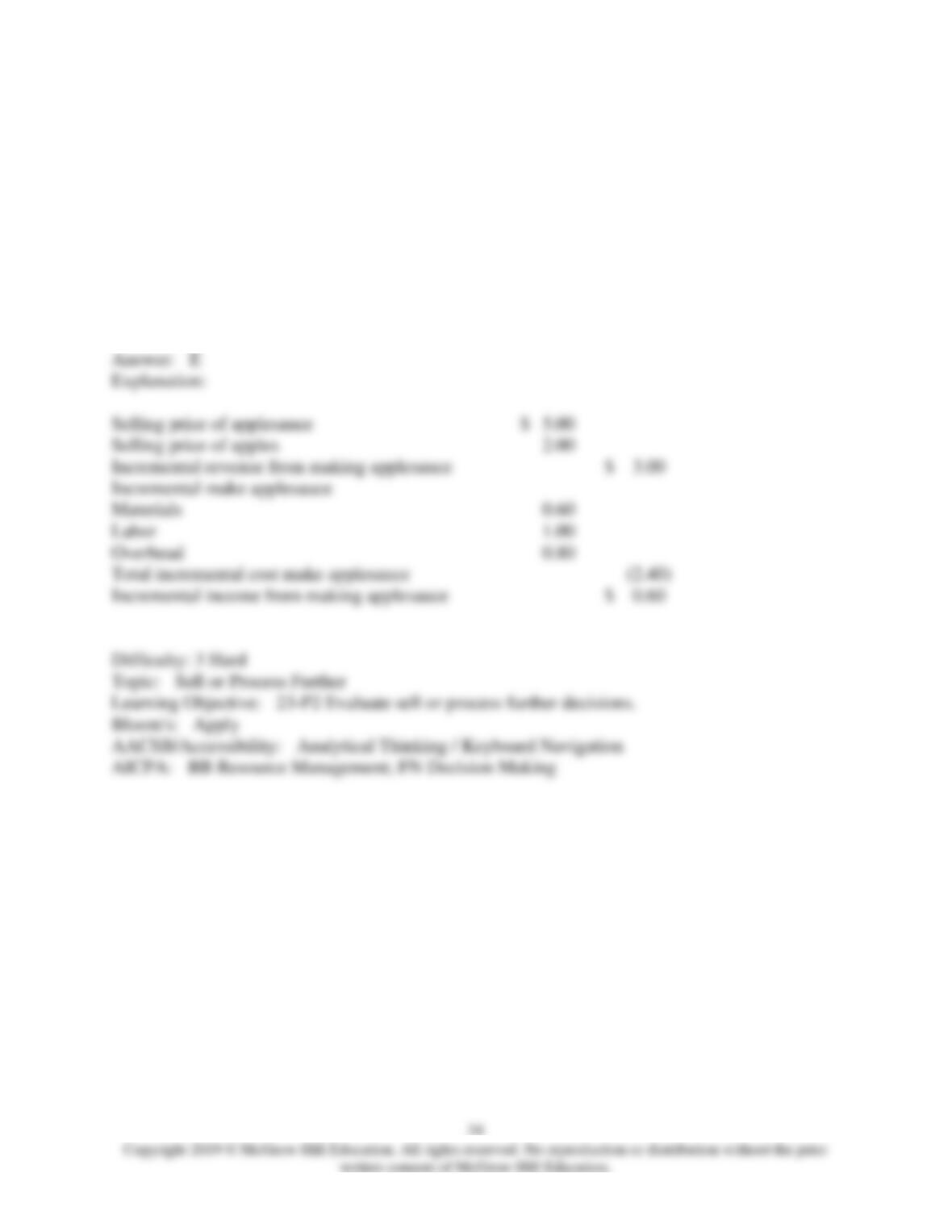
67) A company has the choice of either selling 600 apples or processing them into applesauce.
The company could sell the apples as they are for $2.00 per unit. Alternatively, each apple could
be made into one unit of applesauce with incremental costs of $0.60 per unit for direct materials,
$1.00 per unit for direct labor, and $0.80 per unit for overhead, and then sold for $5.00 each.
What is the amount of incremental cost from processing the apples into applesauce?
A) $3.00 per unit.
B) $5.00 per unit.
C) $7.00 per unit.
D) $2.40 per unit.
E) $0.60 per unit.
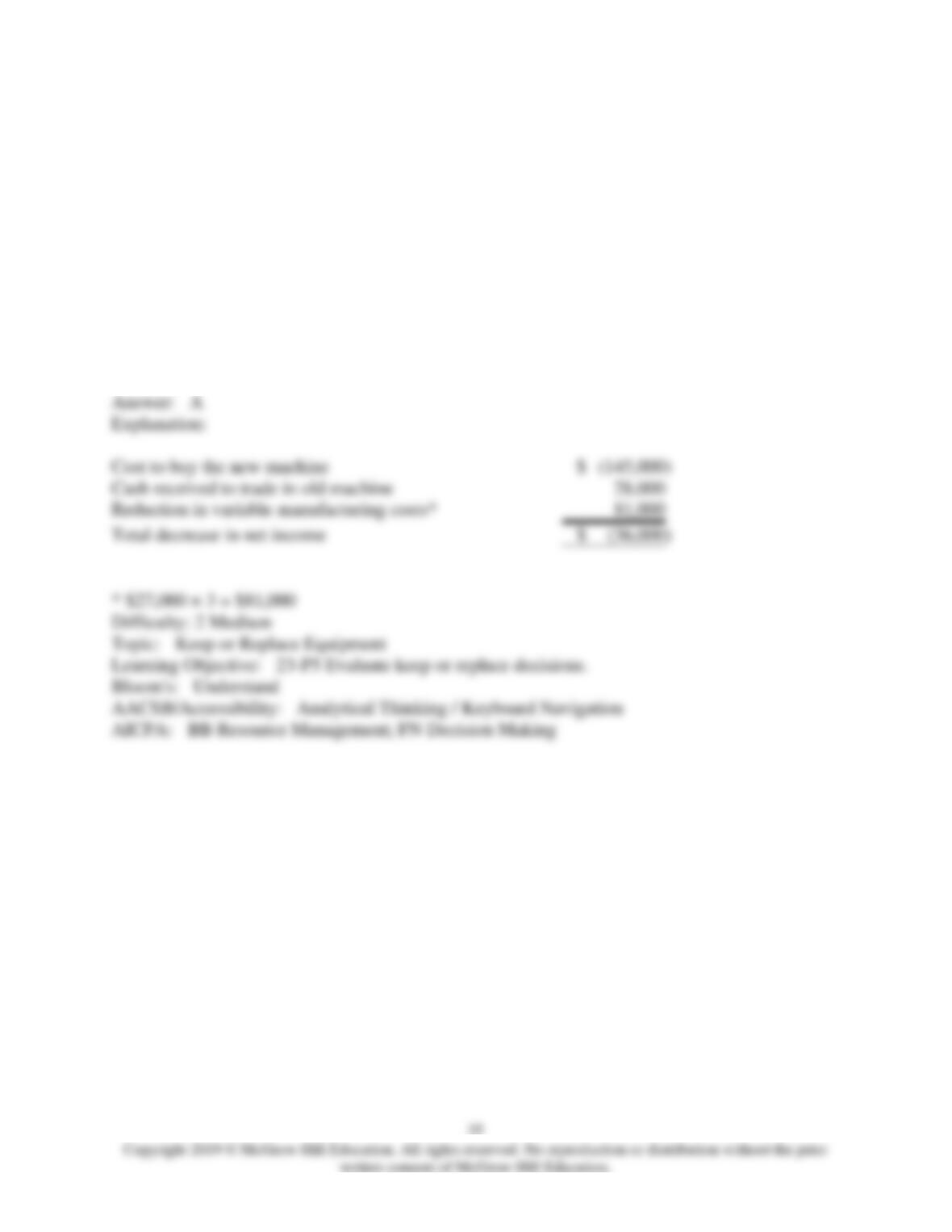
68) A company has the choice of either selling 600 apples or processing them into applesauce.
The company could sell the apples as they are for $2.00 per unit. Alternatively, each apple could
be made into one unit of applesauce with incremental costs of $0.60 per unit for direct materials,
$1.00 per unit for direct labor, and $0.80 per unit for overhead, and then sold for $5.00 each.
What is the amount of incremental income (loss) from processing the apples into applesauce?
A) $3.00 per unit.
B) $(3.00) per unit.
C) $7.00 per unit.
D) $(0.60) per unit.
E) $0.60 per unit.
69) Riener Hospital has an x-ray machine with a book value of $60,000 and a remaining useful
life of three years. At the end of the three years the equipment will have a zero salvage value.
The market value of the equipment is currently $32,000. Riener can purchase a new machine for
$145,000 and receive $28,000 in return for trading in its old machine. The new machine will
reduce variable manufacturing costs by $27,000 per year over the three-year life of the new
machine. The total increase or decrease in net income by replacing the current machine with the
new machine (ignoring the time value of money) is:
A) $22,000 decrease
B) $76,000 increase
C) $18,000 decrease
D) $52,000 increase
E) $22,000 increase
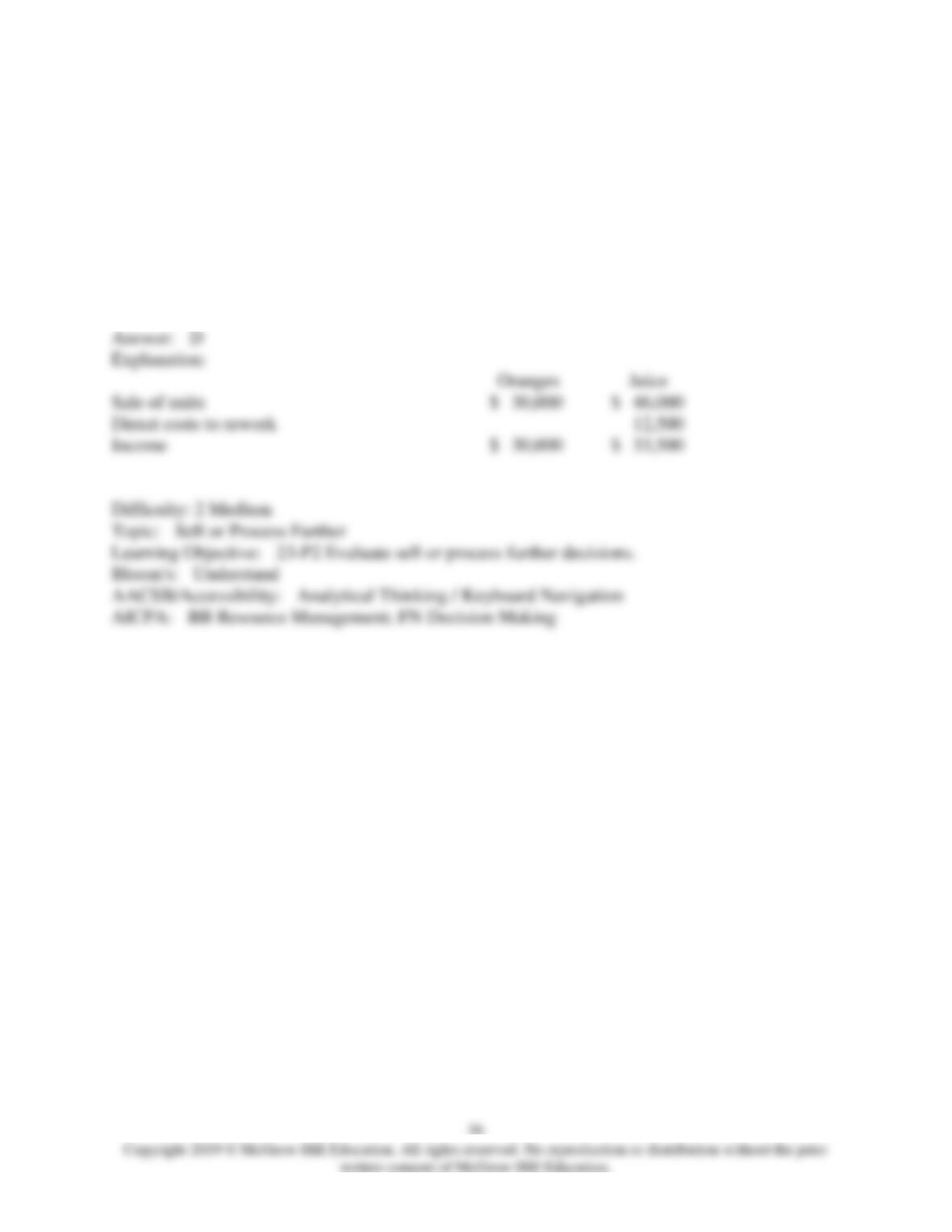
70) Ahngram Corp. has 1,000 carton of oranges that cost $10 per carton in direct costs and
$16.50 per carton in indirect costs and sold for $30 per carton. The oranges can be processed
further into orange juice at an additional cost of $12.50 and sold at a price of $46.
The incremental income (loss) from processing the oranges into orange juice would be:
A) $30,500.
B) $22,500.
C) ($30,500).
D) $33,500.
E) $23,500.
71) Benjamin Company had the following results of operations for the past year:
Sales (16,000 units at $10)
$
160,000
Direct materials and direct labor
$
96,000
Overhead (20% variable)
16,000
Selling and administrative expenses (all fixed)
32,000
(144,000
)
Operating income
$
16,000
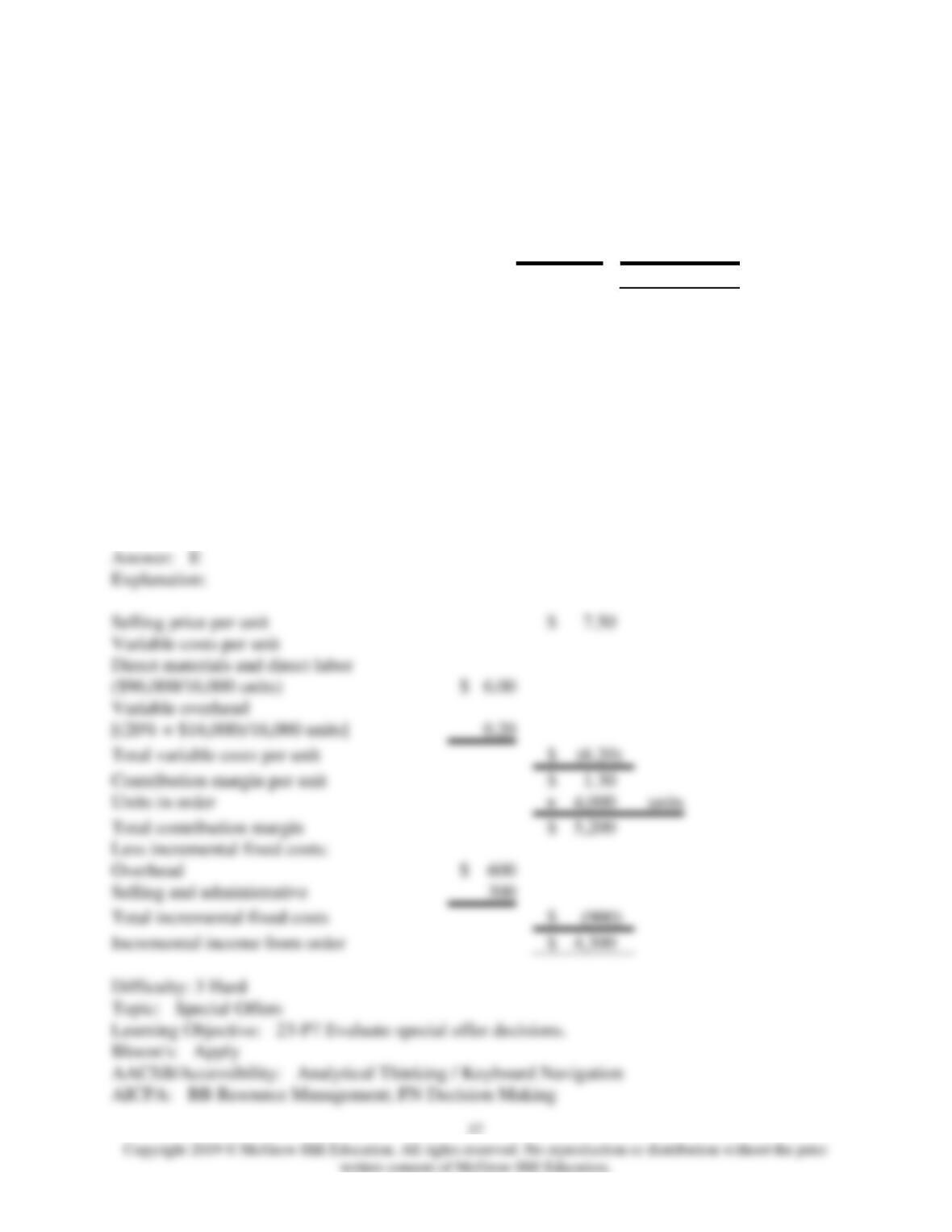
A foreign company (whose sales will not affect Benjamin’s market) offers to buy 4,000 units at
$7.50 per unit. In addition to variable manufacturing costs, selling these units would increase
fixed overhead by $600 and selling and administrative costs by $300. Assuming Benjamin has
excess capacity and accepts the offer, its profits will:
A) Increase by $30,000.
B) Increase by $6,000.
C) Decrease by $6,000.
D) Increase by $5,200.
E) Increase by $4,300.
Selling price per unit
$
Variable costs per unit
($96,000/16,000 units)
$
6.00
[(20% × $16,000)/16,000 units]
0.20
Total variable costs per unit
$
)
Contribution margin per unit
$
Units in order
×
4,000
units
Total contribution margin
$
5,200
Less incremental fixed costs:
Overhead
$
600
Selling and administrative
300
Total incremental fixed costs
$
)
Incremental income from order
$
4,300
72) Benjamin Company had the following results of operations for the past year:
Sales (16,000 units at $10)
$
160,000
Direct materials and direct labor
$
96,000
Overhead (20% variable)
16,000
Selling and administrative expenses (all fixed)
32,000
(144,000
)
Operating income
$
16,000
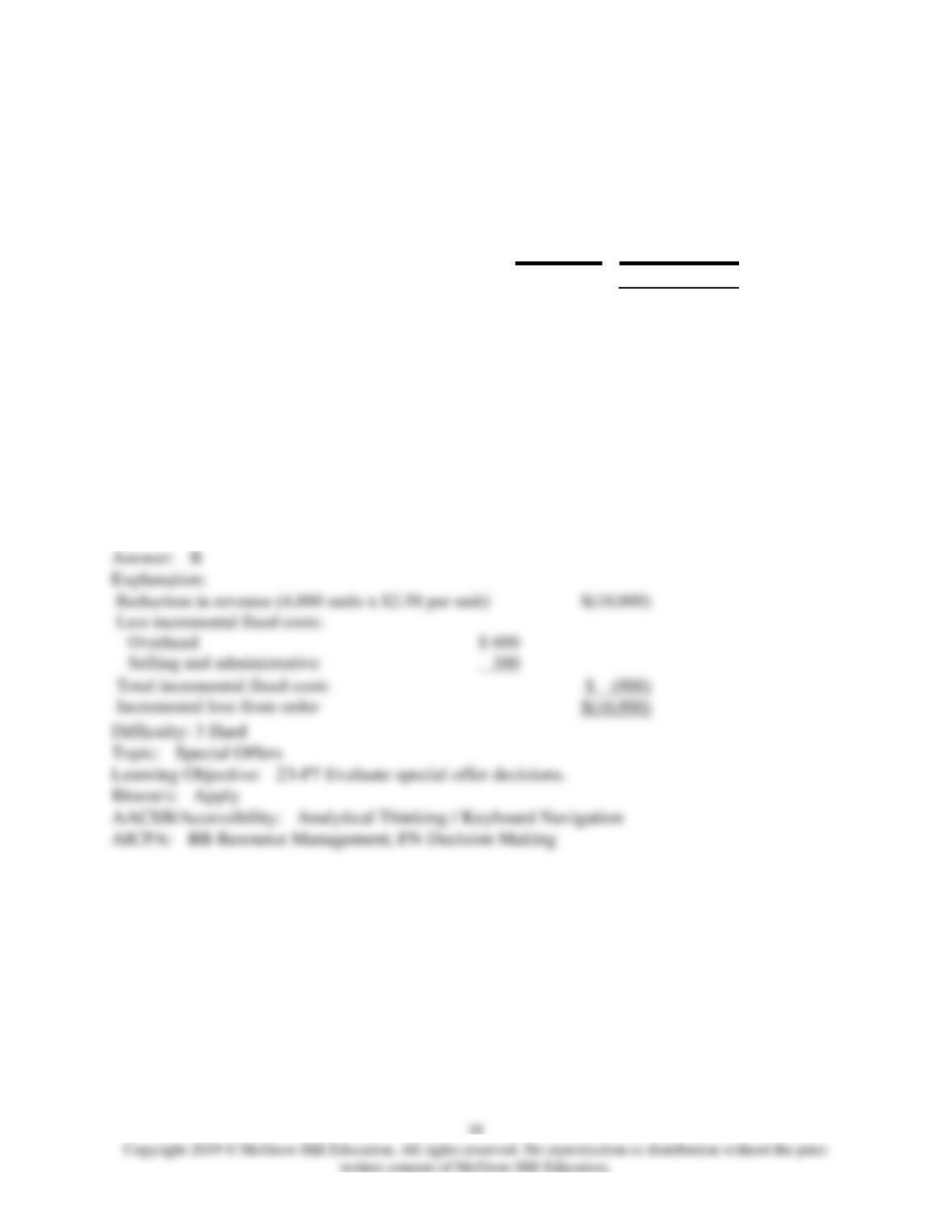
A foreign company offers to buy 4,000 units at $7.50 per unit. In addition to variable
manufacturing costs, selling these units would increase fixed overhead by $600 and selling and
administrative costs by $300. Assuming Benjamin’s productive capacity is 16,000 units per year
and it accepts the offer, its profits will:
A) Decrease by $10,000.
B) Decrease by $10,900.
C) Decrease by $6,000.
D) Increase by $9,100.
E) Increase by $4,300.
73) Lattimer Company had the following results of operations for the past year:
Sales (15,000 units at $12)
$
180,000
Variable manufacturing costs
$
97,500
Fixed manufacturing costs
21,000
Selling and administrative expenses (all fixed)
36,000
(154,500
)
Operating income
$
25,500
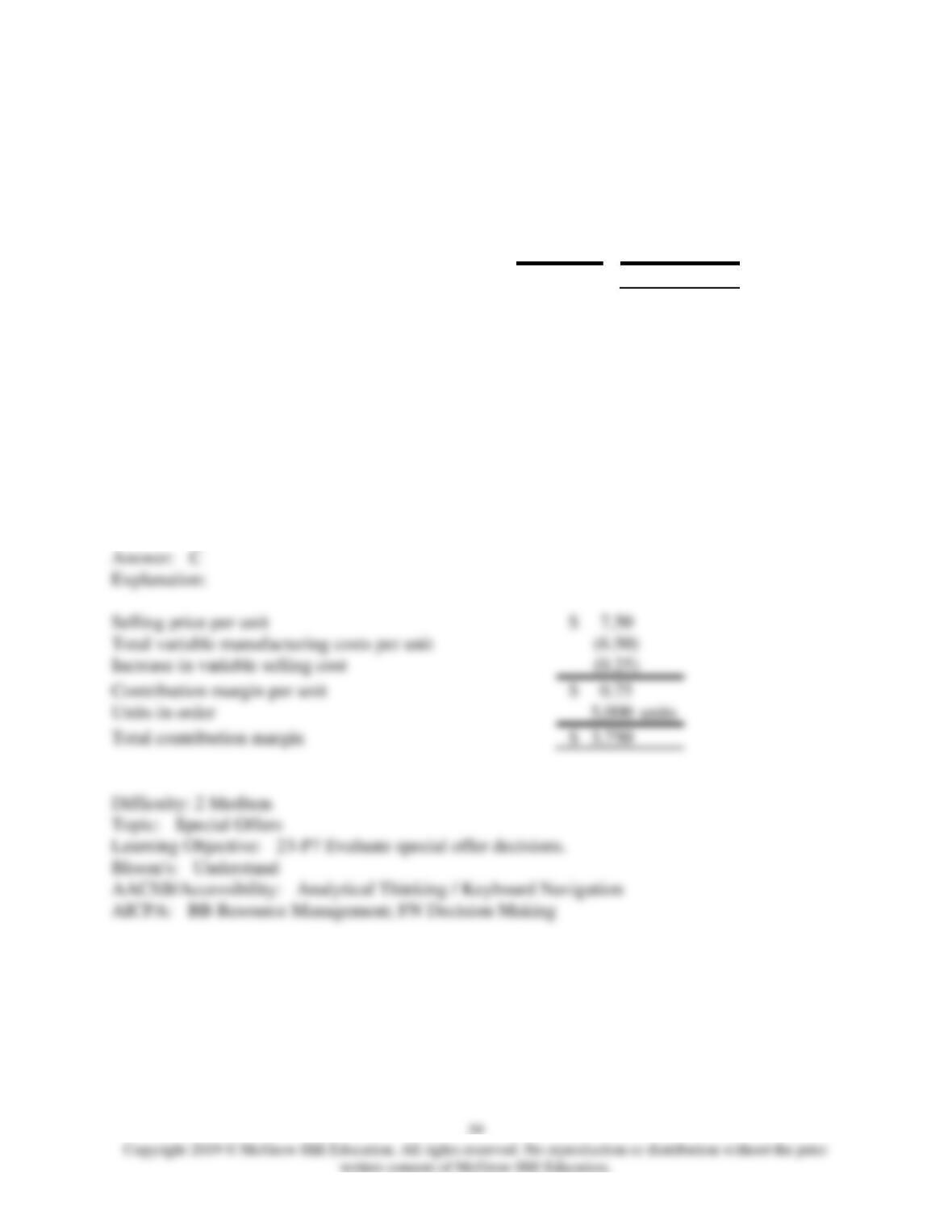
A foreign company offers to buy 5,000 units at $7.50 per unit. In addition to existing costs,
selling these units would add a $0.25 selling cost for export fees. Lattimer’s annual production
capacity is 25,000 units. If Lattimer accepts this additional business, the special order will yield
a:
A) $2,000 loss.
B) $8,250 loss.
C) $3,750 profit.
D) $3,250 loss.
E) $5,000 profit.
Selling price per unit
$
Total variable manufacturing costs per unit
)
Increase in variable selling cost
)
Contribution margin per unit
$
Units in order
5,000
units
Total contribution margin
$
3,750
74) Markson Company had the following results of operations for the past year:
Sales (8,000 units at $20)
$
160,000
Variable manufacturing costs
$
86,000
Fixed manufacturing costs
15,000
Variable administrative expenses
12,000
Fixed selling and administrative expenses
20,000
(133,000
)
Operating income
$
27,000
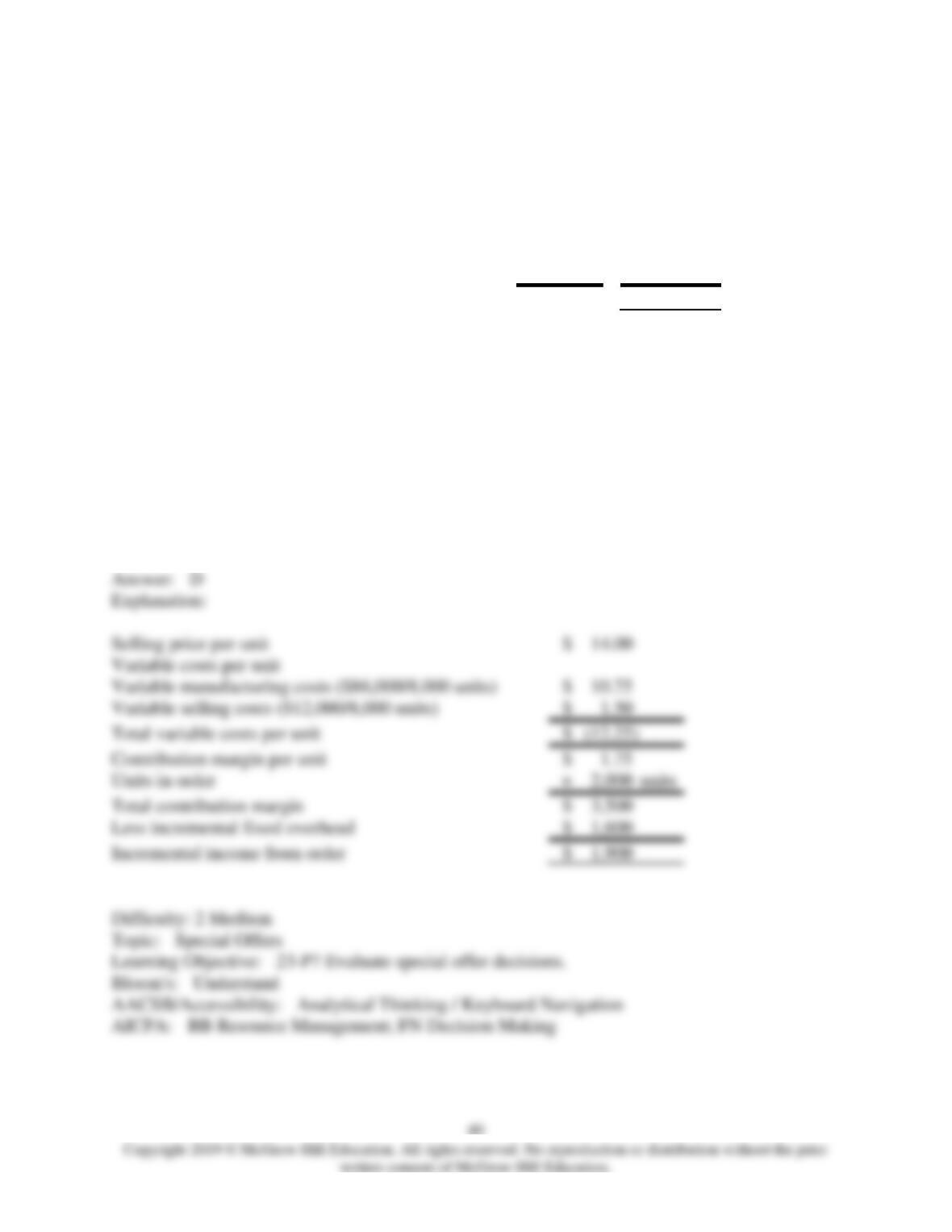
A foreign company offers to buy 2,000 units at $14 per unit. In addition to variable
manufacturing and administrative costs, selling these units would increase fixed overhead by
$1,600 for the purchase of special tools. Markson’s annual productive capacity is 12,000 units. If
Markson accepts this additional business, its profits will:
A) Increase by $3,500.
B) Decrease by $5,650.
C) Decrease by $1,600.
D) Increase by $1,900.
E) Decrease by $5,100.
Selling price per unit
$
Variable costs per unit
Variable manufacturing costs ($86,000/8,000 units)
$
10.75
Variable selling costs ($12,000/8,000 units)
$
1.50
Total variable costs per unit
$
(12.25
)
Contribution margin per unit
$
1.75
Units in order
×
2,000
units
Total contribution margin
$
3,500
Less incremental fixed overhead
$
1,600
Incremental income from order
$
1,900