68. Exhibit 23-6
Nora Company has a fiscal year ending on December 31. Its financial statements for the years ended December
31, 2010 and 2011, contained the following errors:
2010
2011
Ending inventory
$9,000 understated
$15,000 overstated
Bad debt expense
2,000 overstated
1,000 understated
Assume no correcting entries have been made.
Refer to Exhibit 23-6. By how much was Nora’s 2010 net income overstated or understated?
69. Exhibit 23-6
Nora Company has a fiscal year ending on December 31. Its financial statements for the years ended December
31, 2010 and 2011, contained the following errors:
2010
2011
Ending inventory
$9,000 understated
$15,000 overstated
Bad debt expense
2,000 overstated
1,000 understated
Assume no correcting entries have been made.
Refer to Exhibit 23-6. By how much was Nora’s 2011 net income overstated or understated?
70. Retrospective adjustments are expected to
71. Prospective adjustments are expected to
72. Exceptions exist in the retrospective restatement requirements when accounting for errors under
GAAP
IFRS
I.
No
No
II.
No
Yes
III.
Yes
Yes
IV.
Yes
No
73. IFRS differ from U.S. GAAP regarding the indirect effects of a change in accounting principle in that IFRS
74. On January 1, Year 1, the Gore Company purchased an asset that cost $154,000. The asset had an expected
useful life of seven years and no estimated residual value. The company initially decided to use
sum-of-the-years’-digits (SYD) depreciation for both financial accounting and income tax purposes.
Depreciation expense for the straight-line method and the sum-of-the-years’-digits method is as follows:
Straight-line
SYD over
Year
over 7 Years
7 Years
Difference
1
$ 22,000
$ 38,500
$ 16,500
2
22,000
33,000
11,000
3
22,000
27,500
5,500
4
22,000
22,000
0
5
22,000
16,500
(5,500)
6
22,000
11,000
(11,000)
7
22,000
5,500
(16,500)
$154,000
$154,000
$ 0
At the beginning of Year 4, Gore changed from the sum-of-the-years’-digits method to the straight-line method of depreciation for financial reporting
purposes. The company’s income tax rate is 30%. In Year 3 and Year 4, Gore had $90,000 pretax income before depreciation and income taxes.
Required:
a.
Complete the following section of the income statement:
Year 3
Year 4
Pretax income before depreciation
$90,000
$90,000
Depreciation expense
_______
_______
Income before income taxes
_______
_______
Income tax expense
_______
_______
Net income
_______
_______
b.
Prepare the journal entries to record the depreciation expense, tax expense, and the effect
of the accounting change (if any) in Year 4.
Year 3
Year 4
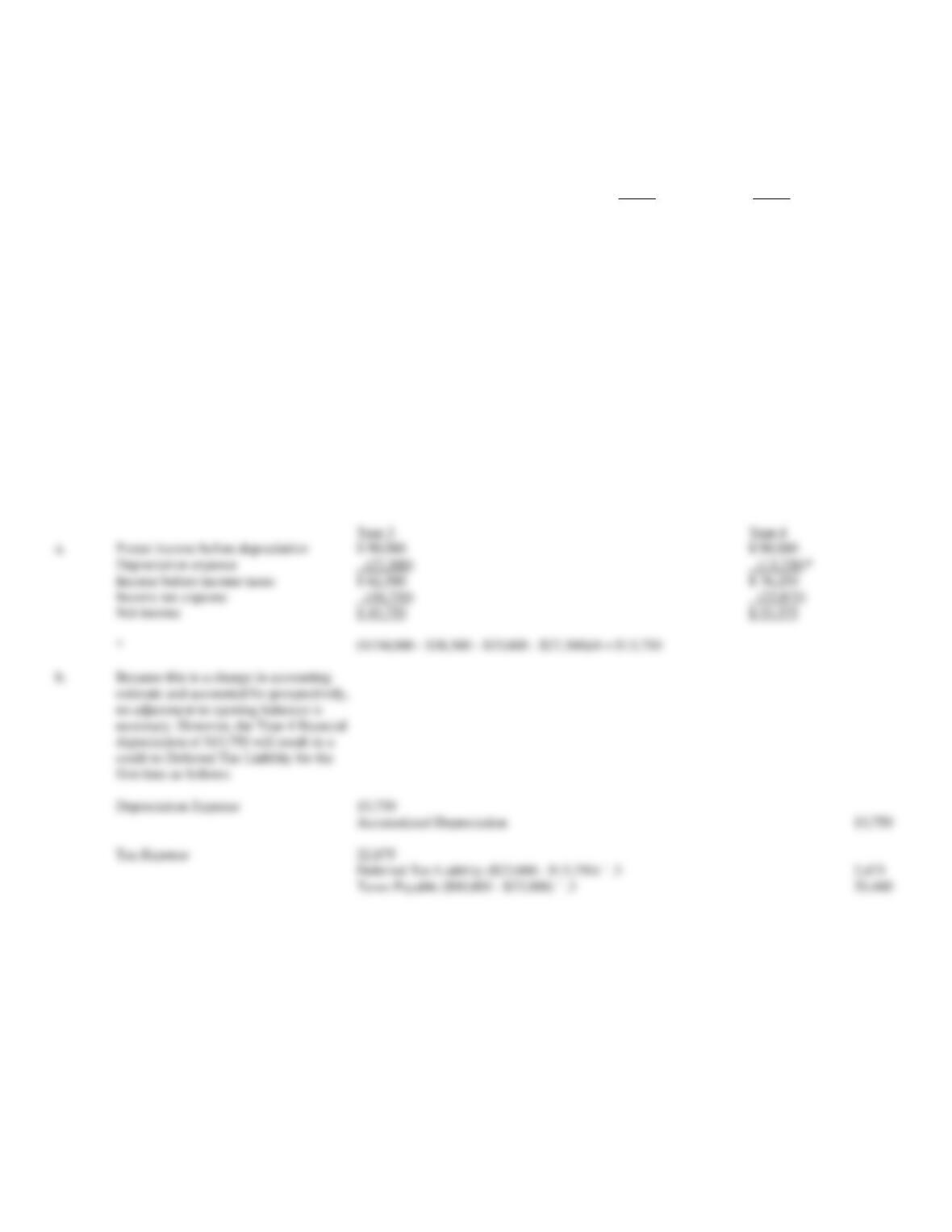
a.
Pretax income before depreciation
$ 90,000
$ 90,000
Depreciation expense
(27,500)
(13,750)*
Income before income taxes
$ 62,500
$ 76,250
Income tax expense
(18,750)
(22,875)
Net income
$ 43,750
$ 53,375
Depreciation Expense
13,750
Accumulated Depreciation
Tax Expense
22,875
Deferred Tax Liability ($22,000 – $13,750) ´ .3
Taxes Payable ($90,000 – $22,000) ´ .3
75. The Ophelia Company was incorporated and began operations on January 1, 2010. Ophelia used the
weighted-average method for costing inventories. Effective January 1, 2011, Ophelia changed to FIFO for
costing inventories and can justify the change. Information related to 2010 and 2011 inventory cost and net
income is presented below:
2010
2011
Ending inventory, using:
Weighted-average
$350,000
$320,000
FIFO
380,000
330,000
Net income
400,000
450,000
(using average)
(using FIFO)
Ophelia’s income tax rate is 30% for both 2010 and 2011.
Required:
Calculate the amount of the cumulative effect of the change on beginning retained earnings on January 1, 2011, that would appear on Ophelia’s
statement of retained earnings for the year ended December 31, 2011.
76. Iris Company decided to change from LIFO to FIFO inventory costing, effective January 1, 2012. The
following data were available:
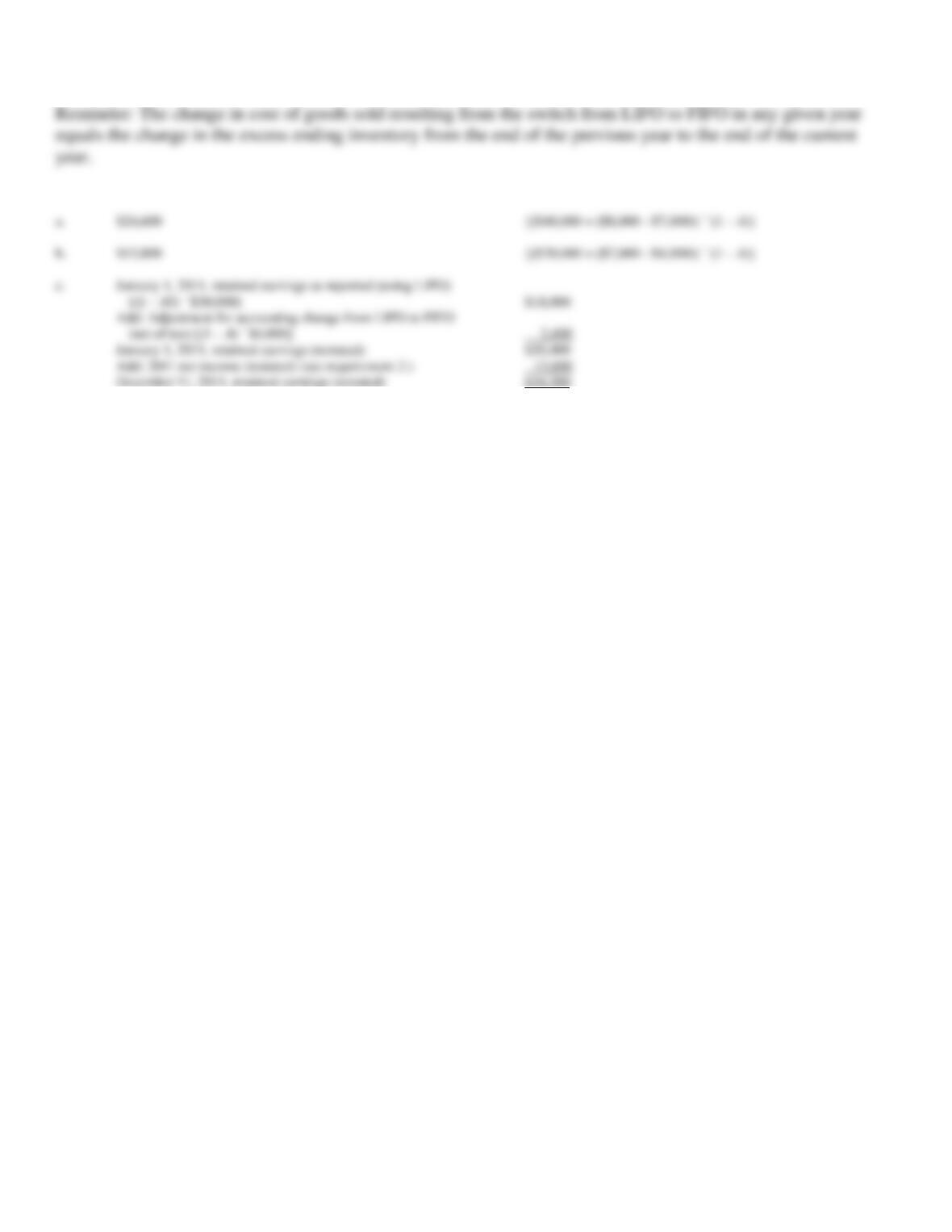
Excess of FIFO
Ending Inventory
Pretax Operating
over LIFO
Year
Income using LIFO
Ending Inventory
2012
$40,000
$8,000
2011
20,000
7,000
2010
30,000
4,000
The income tax rate is 40%. The company began operations on January 1, 2010, and has paid no dividends since inception.
Required:
Answer the following questions relating to the 2011-2012 comparative financial statements.
a.
What is net income for 2012?
b.
What is restated net income for 2011?
c.
Prepare the 2011 statement of retained earnings as it would appear in the comparative 2011-2012 financial statements.
2010 FIFO ending inventory
$ 380,000
2010 average cost ending inventory
(350,000)
Increase in income before tax
$ 30,000
Less: Income tax effect
(9,000)
Cumulative effect as of January 1, 2011, net of tax
$ 21,000
increase
77. The Karen Company, effective January 1, 2012, made the following accounting changes:
·
Karen changed its depreciation method from double-declining-balance to the straight-line method on equipment purchased on January
1, 2010, at a cost of $400,000. The equipment had an estimated useful life of five years and a $30,000 residual value.
·
Karen changed from the completed-contract method to the percentage-of-completion method for long-term construction contracts. Past
cumulative pretax incomes would have been $300,000 greater had the percentage–of-completion method been used in fiscal years
preceding January 1, 2012. The 2012 pretax income with the percentage-of-completion method in excess of pretax income with the
completed-contract method is $50,000.
Karen is subject to an income tax rate of 30% and can justify the changes.
Required:
Calculate the following amounts:
a.
2012 depreciation expense
b.
the December 31, 2012, accumulated depreciation balance on the equipment
c.
the adjustment to the January 1, 2012, retained earnings relating to the change in accounting for long-term construction contracts
d.
the total deferred tax liability increase in 2012 relating to the two accounting changes
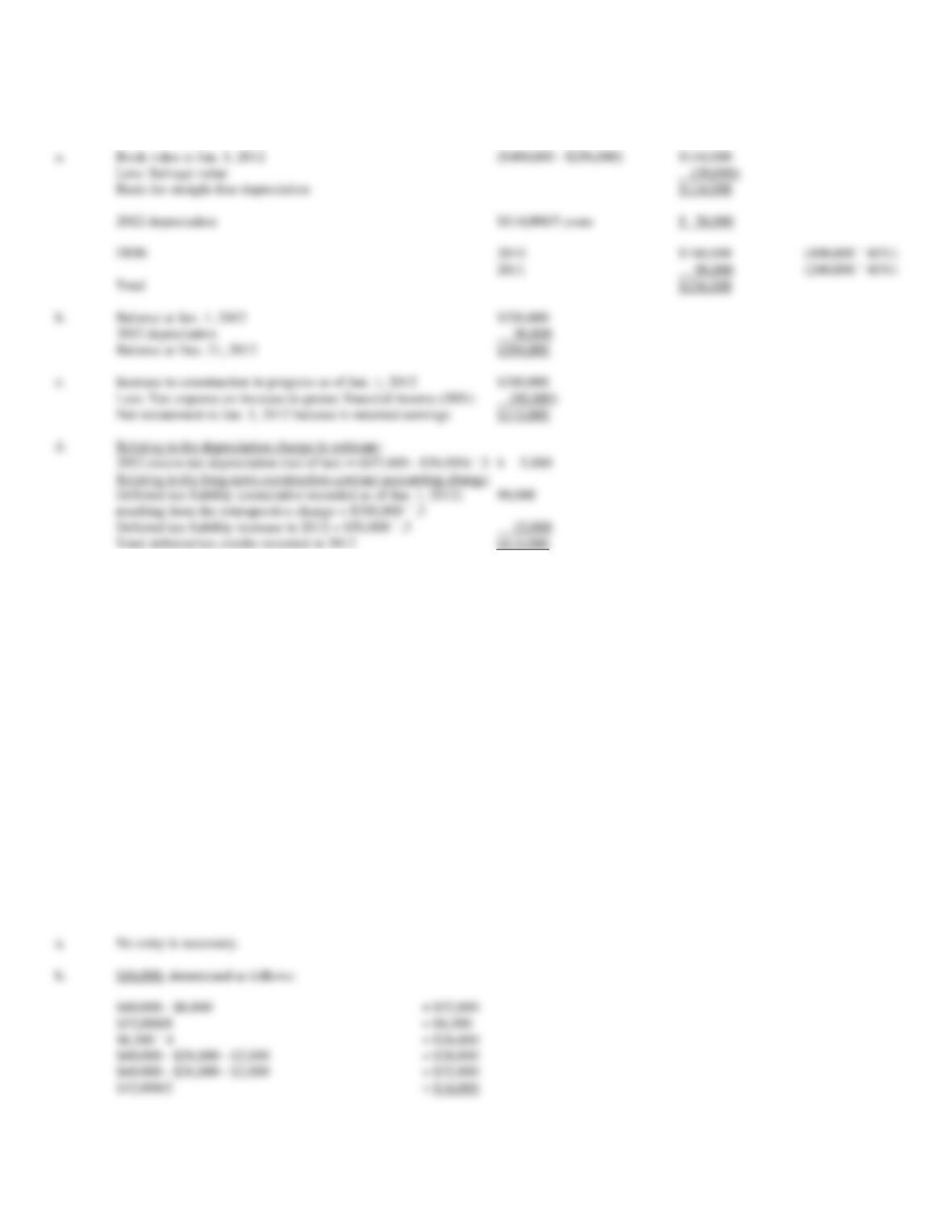
a.
$24,600
b.
$13,800
c.
January 1, 2011, retained earnings as reported (using LIFO)
[(1 – .40) ´ $30,000]
Add: Adjustment for accounting change from LIFO to FIFO
(net of tax) [(1 – .4) ´ $4,000]
January 1, 2011, retained earnings (restated)
Add: 2011 net income (restated) (see requirement 2.)
December 31, 2011, retained earnings (restated)
$34,200
78. On January 1, 2010, Arlene Company bought a machine for $60,000. It was then estimated that the useful
life of the machine would be eight years with a salvage value of $8,000. On January 1, 2014, it was decided that
the machine’s total life from acquisition date should have been only six years with a salvage value of only
$2000. The company used straight-line depreciation.
Required:
a.
If an adjusting entry is necessary on January 1, 2014, prepare it.
b.
Compute depreciation expense for 2014.
a.
No entry is necessary.
b.
$16,000, determined as follows:
$60,000 – $8,000
= $52,000
$6,500 ´ 4
= $26,000
$60,000 – $26,000 – $2,000
= $26,000
$60,000 – $26,000 – $2,000
= $32,000
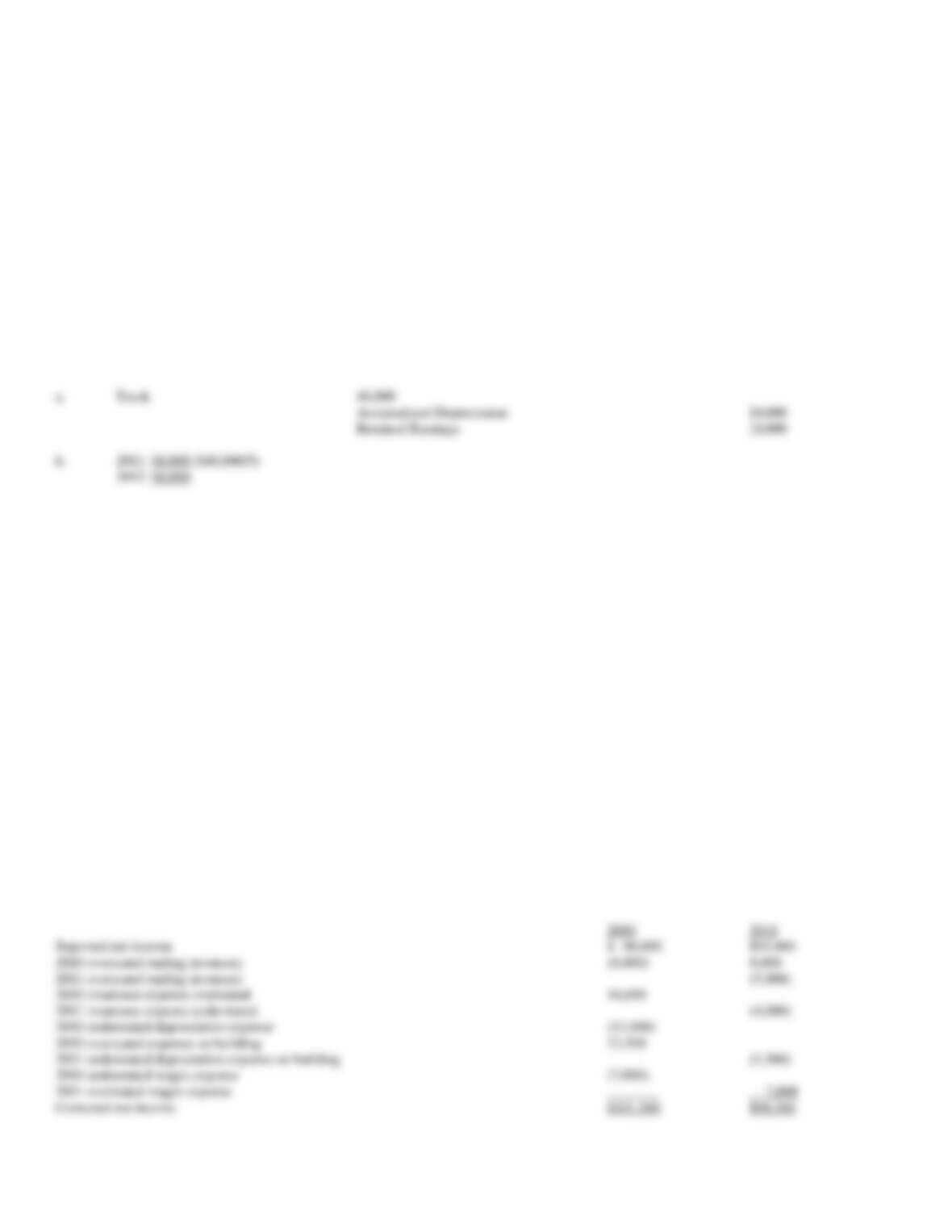
a.
Book value at Jan. 1, 2012
($400,000 – $256,000)
$144,000
Less: Salvage value
(30,000)
2012 depreciation
$114,000/3 years
$ 38,000
2011
96,000
(240,000 ´ 40%)
Total
$256,000
b.
Balance at Jan. 1, 2012
$256,000
Balance at Dec. 31, 2012
$294,000
c.
Increase to construction in progress as of Jan. 1, 2012
$300,000
Net restatement to Jan. 1, 2012 balance in retained earnings
$210,000
d.
Relating to the depreciation change in estimate:
Relating to the long-term construction contract accounting change:
Total deferred tax credits recorded in 2012
$110,880
79. On January 1, 2010, Jennifer Company purchased for $40,000 a truck that had an estimated life of five years
and no residual value at the end of its useful life. Jennifer uses straight-line depreciation. The cost of the truck
was charged to Repairs Expense when purchased in 2010.
Required:
a.
Ignoring income taxes, prepare the journal entry to correct the error if it was discovered and corrected on January 1, 2013 (Jennifer’s
year ends on December 31).
b.
When preparing the 2013 financial statements, how much depreciation expense should be reported on the comparative 2011 and 2012
income statements?
80. The 2010 and 2011 financial statements for Teresa Company had the following errors:
·
Ending inventory was overstated by $8,000 on December 31, 2010, and overstated by $5,000 on December 31, 2011.
·
A five-year insurance policy costing $20,000 was charged to expense when paid in advance on January 1, 2010.
·
Depreciation expense of $12,000 on new equipment was omitted from the 2010 financial statements.
·
Major improvements to Teresa’s manufacturing plant costing $25,000 were charged to expense in 2010 and should have been
capitalized. Consequently, annual depreciation expense of $2,500 was omitted from the 2010 and 2011 financial statements.
·
Wages of $7,000 earned in 2010 but not paid until 2011 were recorded as an expense in 2011 instead of 2010.
Teresa Company had reported net income of $90,000 in 2010 and $95,000 in 2011.
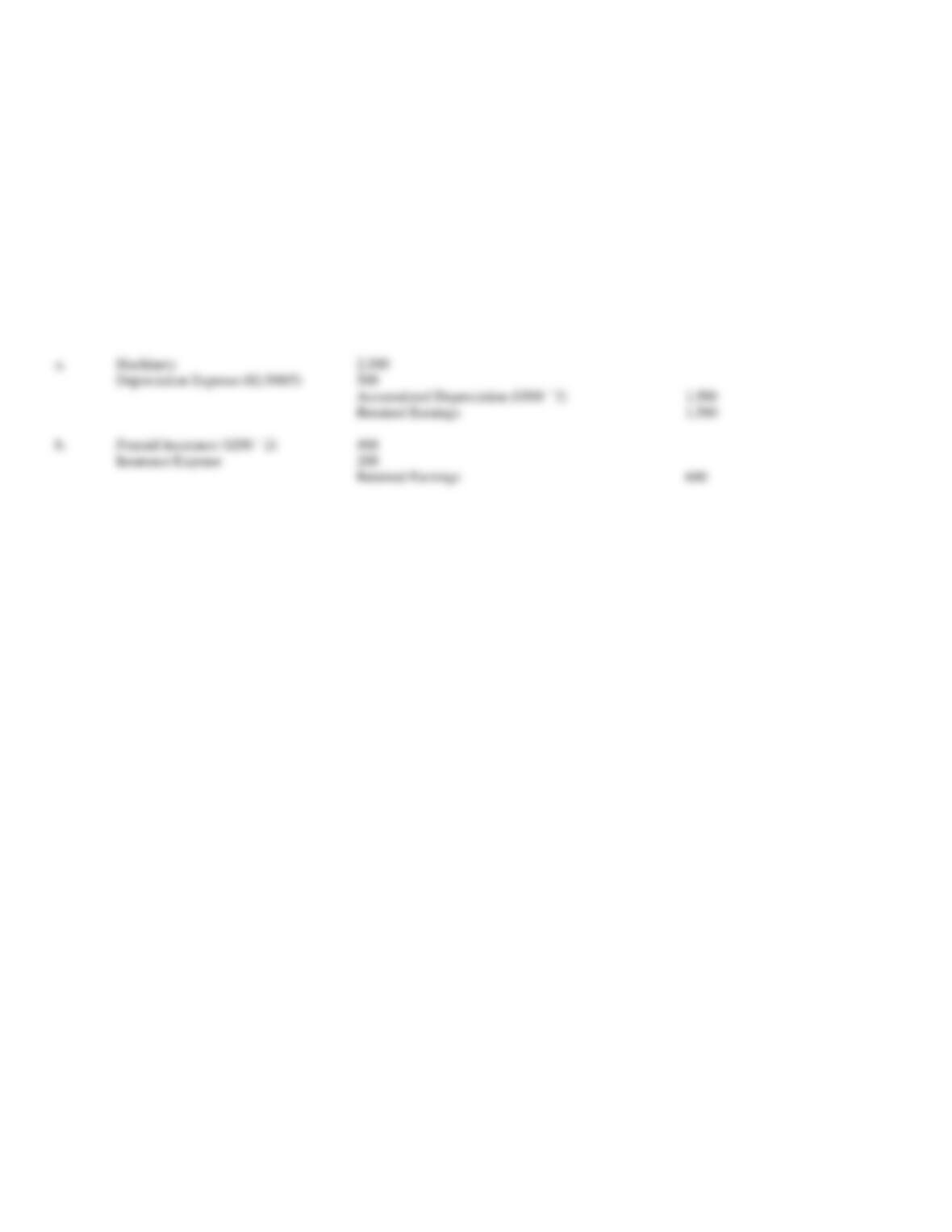
Required:
Prepare a schedule to determine the correct net income for 2010 and 2011. Begin the schedule with reported net income for 2010 and 2011 and work
to a corrected figure. Ignore income taxes.
2010
2011
Reported net income
$ 90,000
$95,000
2010 overstated ending inventory
(8,000)
8,000
2011 overstated ending inventory
(5,000)
2010 insurance expense overstated
16,000
2011 insurance expense understated
(4,000)
2010 understated depreciation expense
(12,000)
2010 overstated expense on building
22,500
2011 understated depreciation expense on building
(2,500)
Truck
40,000
Accumulated Depreciation
24,000
Retained Earnings
16,000
2011: $8,000 ($40,000/5)
2012: $8,000
81. The Sarah Co. has the following errors on its books as of December 31, 2012. The books for 2012 have not
yet been closed.
a.
On January 1, 2010, a machine had been purchased for $2,500. The machine had an estimated life of five years, but it was expensed in
error. Straight-line depreciation with no salvage value should have been used.
b.
On January 1, 2011, the company bought a four-year insurance policy for $800 and immediately charged the full premium to expense.
Required:
Prepare journal entries to correct these errors on December 31, 2012. Ignore income taxes.
82. Melissa Co. has the following errors on its books as of December 31, 2012. The books for 2012 have not yet
been closed.
a.
On January 1, 2010, a truck had been purchased for $20,000. The truck had an estimated life of eight years, but it was expensed in error.
Straight-line depreciation with $2,000 salvage value should have been used.
b.
On January 1, 2011, the company recorded the purchase of a machine in exchange for a four-year, noninterest-bearing note in the
amount of $20,000. Interest rates were then 10%, but no recognition was made of that fact. The present value of $1 at 10% for four
periods is 0.683013. (Ignore depreciation.)
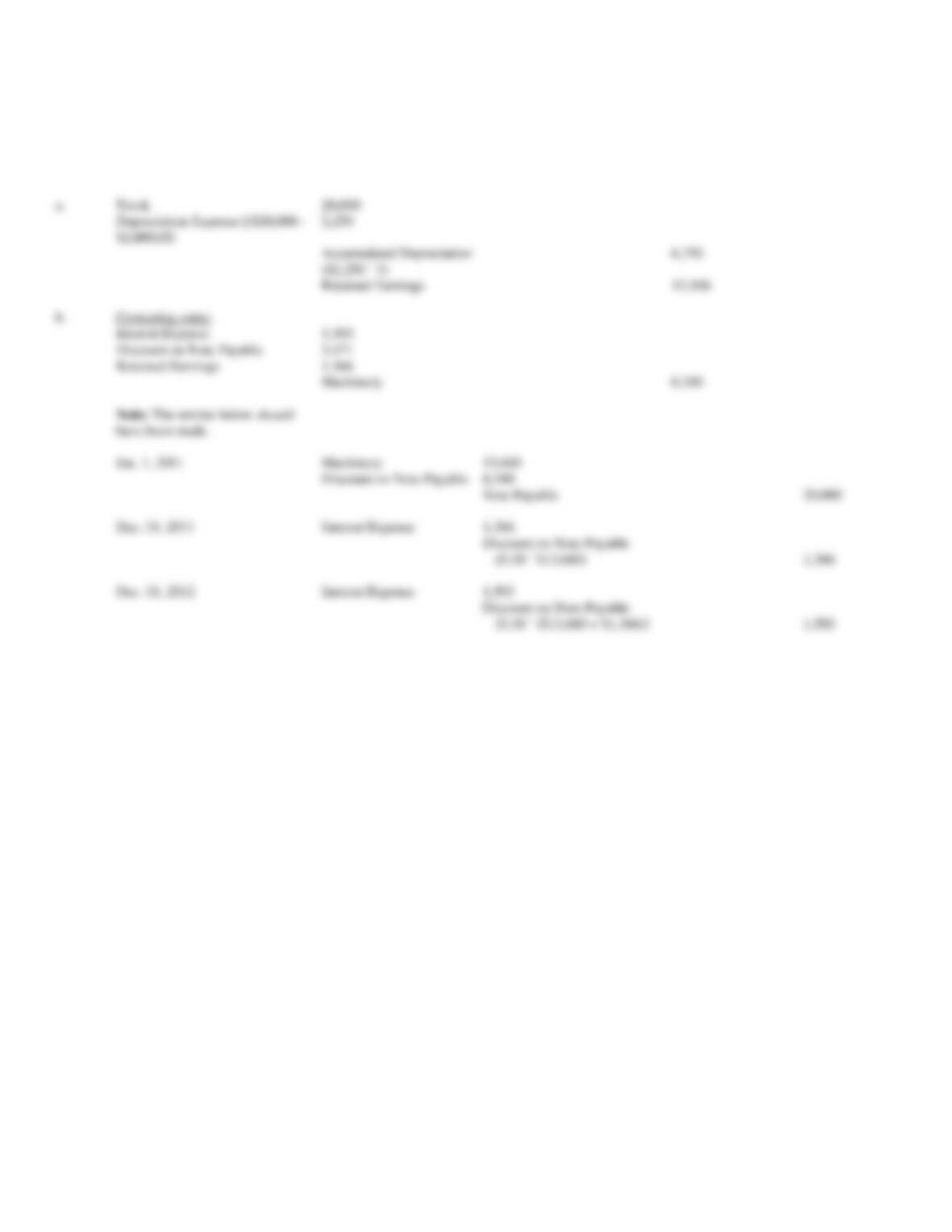
Depreciation Expense ($2,500/5)
500
b.
Prepaid Insurance ($200 ´ 2)
400
Required:
Prepare journal entries to correct these errors at December 31, 2012. Ignore income taxes.
83. The Angie Company has the following errors on its books as of December 31, 2011. The books for 2011
have not yet been closed.
a.
In 2011, fully depreciated equipment (with no residual value) that originally cost $8,000 was sold for $700 as scrap. The company
credited the $700 proceeds to Equipment.
b.
On January 1, 2010, the company recorded the purchase of equipment in exchange for a three-year, noninterest-bearing note payable in
the amount of $10,000. Interest rates were then 8%, but no recognition was made of this fact. The present value of $1 at 8% for three
periods is 0.7938. (Ignore depreciation.)
Accumulated Depreciation
($2,250 ´ 3)
6,750
Required:
Prepare journal entries to correct these errors at December 31, 2011. Ignore income taxes.
84. Several errors are listed below.
Effect on 2010
Net Income
a.
Failed to record a 2010 expense.
+
b.
Ending 2009 inventory is understated.
____
c.
Ending 2010 accrued expense is overstated.
____
d.
Ending 2010 inventory is overstated.
____
e.
Ending 2009 accrued revenue is understated.
____
f.
Ending 2010 prepaid expense is overstated.
____
g.
Ending 2009 unearned revenue is overstated.
____
h.
Ending 2010 accrued revenue was overstated.
____
i.
Ending 2009 prepaid expense was overstated.
____
j.
Ending 2009 accrued expense is overstated.
____
k.
Ending 2010 unearned revenue is understated.
____
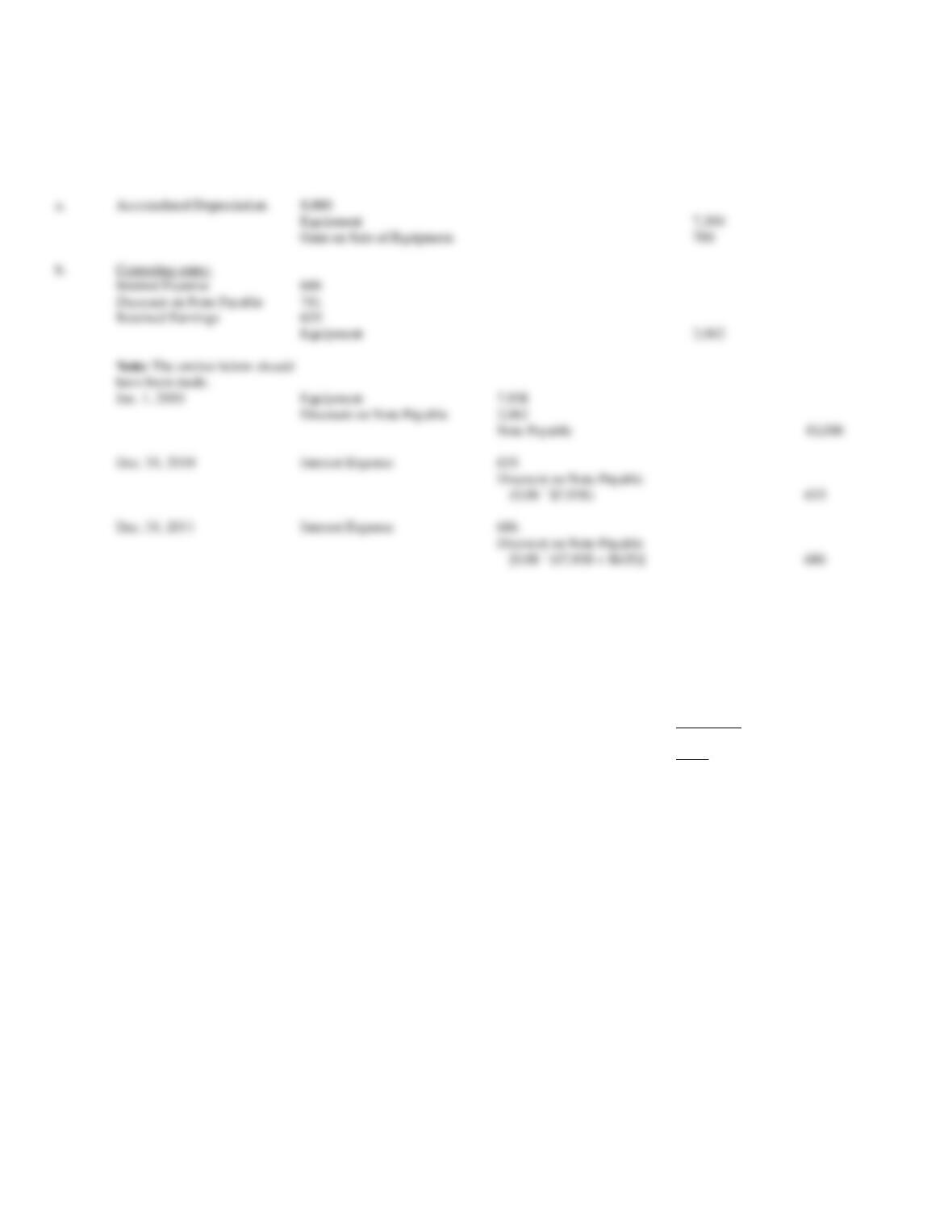
a.
Accumulated Depreciation
8,000
Equipment
7,300
Gain on Sale of Equipment
700
b.
Correcting entry:
Interest Expense
686
Discount on Note Payable
741
Retained Earnings
635
Equipment
2,062
Jan. 1, 2010
Equipment
7,938
Discount on Note Payable
2,062
Note Payable
10,000
Dec. 31, 2010
Interest Expense
635
Discount on Note Payable
(0.08 ´ $7,938)
635
Dec. 31, 2011
Interest Expense
686
Discount on Note Payable
[0.08 ´ ($7,938 + $635)]
686

Required:
Indicate the effect each error would have on 2010 net income by placing a plus sign (+), minus sign (-) or NI (no impact) in the space provided. Part
(a) has been completed as an example.
85. Several errors are listed below.
Effect on 2011
Net Income
a.
Failed to record a 2011 expense.
+
b.
Ending 2010 inventory was overstated.
____
c.
Ending 2011 accrued expense was understated.
____
d.
Ending 2011 inventory was understated.
____
e.
Ending 2010 accrued revenue was overstated.
____
f.
Ending 2011 prepaid expense was understated.
____
g.
Ending 2010 unearned revenue was understated.
____
h.
Ending 2011 accrued revenue was overstated.
____
i.
Ending 2010 accrued expense was understated.
____
j
Ending 2010 prepaid expense was overstated.
____
k.
Ending 2011 accrued expense was overstated.
____
Required:
Indicate the effect each error would have on 2011 net income by placing a plus sign (+), minus sign (-) or NI (no impact) in the space provided. Part
(a) has been completed as an example.
a.
+
g.
–
b.
–
h.
+
+
–
d.
–
j.
–
a.
+
g.
+
b.
+
h.
–
–
d.
+
j.
+
e.
+
k.
+
+

86. Generally accepted accounting principles have identified four types of accounting changes and two possible
methods to use in accounting for these changes, as follows:
Symbol
Type of Change
P
Change in accounting principle
E
Change in accounting estimate
EC
Error correction
RE
Change in reporting entity
Symbol
Type of Accounting Adjustment
RA
Retrospective adjustment
P
Prospective adjustment
RA–CS
Retrospective adjustment to report consolidated financial information for the same set of affiliated entities for all years
Required:
Following is a list of errors and changes. In the spaces provided, use the appropriate symbols selected from the above lists to indicate the type of
change and how the change should be treated in the financial statements.
Change
Adjustment
______
_______
a.
Company discovered that last year’s ending inventory was overstated.
______
_______
b.
Change to the “full cost” method of accounting by an oil company.
______
_______
c.
Change from the FIFO inventory costing method to the LIFO method (prior effect not
determinable).
______
_______
d.
Change in the method of recognizing income to a GAAP method as a result of an initial
first-time public sale of common stock.
______
_______
e.
Change in the residual value of a piece of equipment.
______
_______
f.
Change in the companies that are included in combined financial statements.
______
_______
g.
Change from the double-declining-balance method of depreciation to the straight-line
method.
Change
Adjustment
a.
EC
RA
P
c.
P
P
d.
P
RA
e.
E
P
g.
E
P
87. On January 1, 2010, Pamela Company purchased equipment for $48,000. The estimated life was five years
and the salvage value was estimated at $8,000. On January 1, 2012, it was determined that the equipment’s total
useful life should have been estimated at seven years and the salvage value should have been estimated at only
$4,000. The company used straight-line depreciation.
Required:
a.
What type of change did Pamela Company make on January 1, 2012, and how should Pamela account for the change?
b.
If an adjusting entry is necessary on January 1, 2012, prepare it.
c.
Compute the amount of depreciation expense on the equipment for 2012.
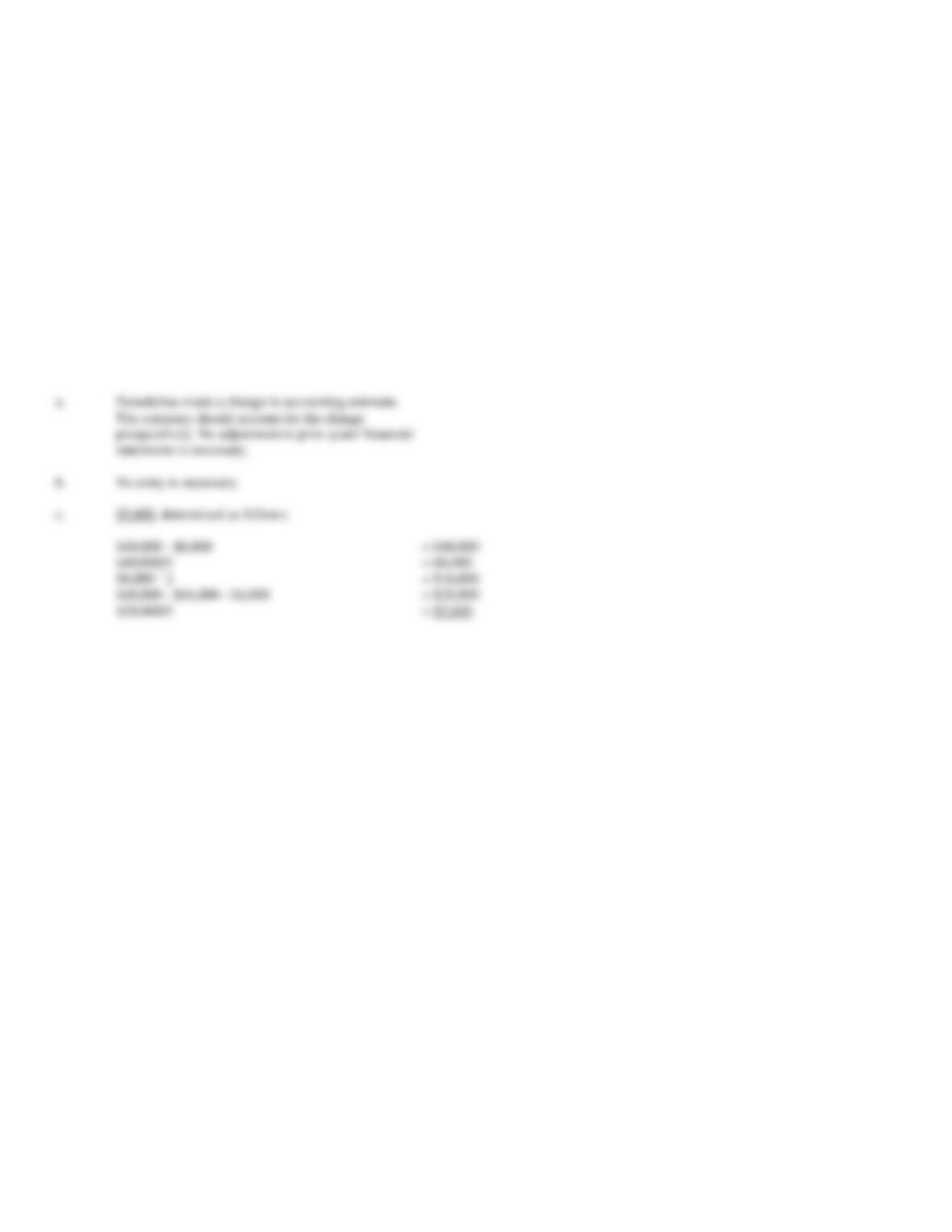
statements is necessary.
b.
No entry is necessary.
c.
$5,600, determined as follows:
$48,000 – $8,000
= $40,000
$40,000/5
= $8,000
$8,000 ´ 2
= $16,000
$48,000 – $16,000 – $4,000
= $28,000
$28,000/5

88. Several items related to accounting changes appear below.
Item
Retrospective
Adjustment
Current and
Prospective
a.
Reduction in remaining estimated service life of truck.
_______
X
b.
Expensed a truck when purchased.
_______
_______
c.
Write-down of inventory due to obsolescence.
_______
_______
d.
Receipt of damages won in court suit begun three years ago.
_______
_______
e.
A company is preparing to become a corporation and sell stock to the public.
At this time, it changed from accelerated to straight-line depreciation.
_______
_______
f.
Change from FIFO inventory to LIFO; recalculations are practicable.
_______
_______
g.
Increase in bad debt estimate from 2% to 3% of sales.
_______
_______
h.
Change from LIFO to FIFO.
_______
_______
i.
Change from individual statements to consolidated statements.
_______
_______
j.
Change from percentage-of-sales to percentage-of-receivables method of bad
debt estimation.
_______
_______
k.
Change from full costing to successful efforts.
_______
_______
Required:
Indicate the appropriate method of accounting for each case by placing an “X” in the appropriate column. Part (a) has been completed as an
example.
Item
Retrospective
Adjustment
Current and
Prospective
a.
X
b.
X
c.
X
d.
X
e.
X
X
g.
X
h.
X
j.
X
k.
X
89. Most changes in accounting principles are accounted for retrospectively. Discuss how a change in
accounting principle that causes a retrospective adjustment impacts the comparative financial statements issued
for the current year.
90. Current GAAP defines three types of changes:
a.
Changes in accounting principle
b.
Changes in accounting estimate
c.
Changes in reporting entity
Define each item, give an example, and describe how it should be accounted for.
a.
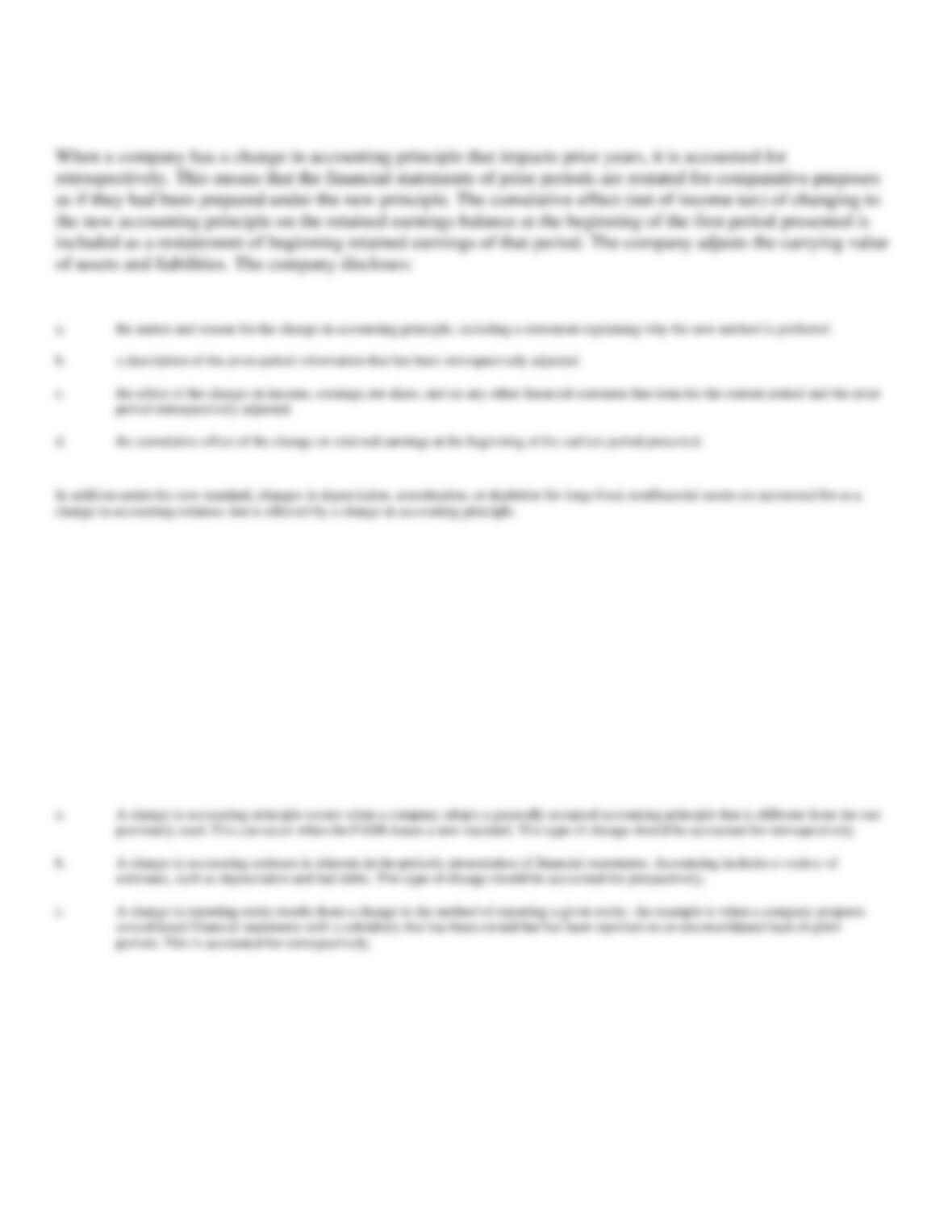
the nature and reason for the change in accounting principle, including a statement explaining why the new method is preferred.
b.
a description of the prior-period information that has been retrospectively adjusted.
the cumulative effect of the change on retained earnings at the beginning of the earliest period presented.
91. Most errors are discovered automatically through proper use of the double-entry system or by the internal or
external auditors. However, some errors escape detection until after they have been included in the published
financial statements of a company.
Required:
Describe three types of errors that occur in financial statements and indicate the appropriate corrective action to
take when the errors are discovered.