CHAPTER 23
STATEMENT OF CASH FLOWS
IFRS questions are available at the end of this chapter.
TRUE-FALSE—Conceptual
Answer No. Description
MULTIPLE CHOICE—Conceptual
Answer No. Description
Test Bank for Intermediate Accounting, Fifteenth Edition
23 – 2
MULTIPLE CHOICE—Conceptual (cont.)
Answer No. Description
MULTIPLE CHOICE—Computational
Answer No. Description
Statement of Cash Flows
23 – 3
MULTIPLE CHOICE—Computational (cont.)
Answer No. Description
Answer No. Description

Test Bank for Intermediate Accounting, Fifteenth Edition
23 – 4
BRIEF EXERCISES
Item Description
BE23-117 Direct and indirect methods (essay).
EXERCISES
E23-118 Effects of transactions on statement of cash flows.
E23-119 Effects of transactions on statement of cash flows.
E23-120 Calculations for statement of cash flows.
E23-121 Calculations for statement of cash flows.
E23-122 Cash flows from operating activities (direct/indirect).
E23-123 Statement of cash flows (indirect method).
E23-124 Preparation of statement of cash flows (format provided).
E23-125 Classification of cash flows.
E23-126 Classification of cash flows and transactions.
E23-127 Effects of transactions on statement of cash flows.
PROBLEMS
Item Description
P23-128 Statement of cash flows (indirect method).
P23-129 Statement of cash flows (direct/indirect).
P23-130 A complex statement of cash flows (indirect method).
CHAPTER LEARNING OBJECTIVES
1. Describe the purpose of the statement of cash flows.
2. Identify the major classifications of cash flows.
3. Prepare a statement of cash flows.
4. Differentiate between net income and net cash flow from operating activities.
5. Determine net cash flows from investing and financing activities.
6. Identify sources of information for a statement of cash flows.
7. Contrast the direct and indirect methods of calculating net cash flow from operating
activities.
8. Discuss special problems in preparing a statement of cash flows.
9. Explain the use of a worksheet in preparing a statement of cash flows.
10. Compare the statement of cash flows under GAAP and IFRS.
Statement of Cash Flows
23 – 5
SUMMARY OF LEARNING OBJECTIVES BY QUESTIONS
Item
Type
Item
Type
Item
Type
Item
Type
Item
Type
Item
Type
Item
Type
Learning Objective 1
1.
TF
2.
TF
21.
MC
22.
MC
S23.
MC
Learning Objective 2
3.
TF
4.
TF
5.
TF
S24.
MC
25.
MC
26.
MC
117.
E
Learning Objective 3
6.
TF
51.
MC
61.
MC
68.
MC
75.
MC
82.
MC
7.
TF
53.
MC
62.
MC
69.
MC
76.
MC
106.
MC
122.
E
8.
TF
54.
MC
63.
MC
70.
MC
77.
MC
109.
MC
123.
E
P27.
MC
57.
MC
64.
MC
71.
MC
78.
MC
110.
MC
124.
E
P28.
MC
58.
MC
65.
MC
72.
MC
79.
MC
118.
E
128.
P
S29.
MC
59.
MC
66.
MC
73.
MC
80.
MC
119.
E
129.
P
S30.
MC
60.
MC
67.
MC
74.
MC
81.
MC
130.
P
Learning Objective 4
9.
TF
10.
TF
29.
MC
30.
MC
S31.
MC
Learning Objective 5
32.
MC
83.
MC
87.
MC
108.
MC
114.
MC
119.
E
125.
E
52.
MC
84.
MC
88.
MC
111.
MC
115.
MC
120.
E
126.
E
55.
MC
85.
MC
89.
MC
112.
MC
116.
MC
121.
E
127.
E
56.
MC
86.
MC
107.
MC
113.
MC
118.
E
Learning Objective 6
11.
TF
34.
MC
38.
MC
42.
MC
93.
MC
97.
MC
125.
E
12.
TF
35.
MC
39.
MC
90.
MC
94.
MC
118.
E
127.
E
13.
TF
36.
MC
40.
MC
91.
MC
95.
MC
119.
E
129.
P
33.
MC
37.
MC
41.
MC
92.
MC
96.
MC
123.
E
124.
E
Learning Objective 7
14.
TF
15.
MC
43.
MC
44.
MC
45.
MC
46.
MC
117.
BE
122.
E
Learning Objective 8
16.
TF
48.
MC
98.
MC
102.
MC
118.
E
124.
E
128.
P
17.
TF
49.
MC
99.
MC
103.
MC
119.
E
125.
E
129.
P
18.
TF
S50.
MC
100.
MC
104.
MC
122.
E
126.
E
130.
P
47.
MC
76.
MC
101.
MC
105.
MC
123.
E
127.
E
Learning Objective 9
19.
TF
20.
TF
Learning Objective 10 – IFRS
1.
TF
4.
TF
7.
MC
10.
MC
13.
MC
16.
SA
2.
TF
5.
TF
8.
MC
11.
MC
14.
MC
3.
TF
6.
MC
9.
MC
12.
MC
15.
SA

Test Bank for Intermediate Accounting, Fifteenth Edition
23 – 6
Note: TF = True-False
MC = Multiple Choice
BE = Brief Exercise
E = Exercise
P = Problem

Statement of Cash Flows
23 – 7
TRUE FALSE—Conceptual
1. The primary purpose of the statement of cash flows is to provide cash-basis information
about the company’s operating, investing, and financing activities.
2. The statement of cash flows provides information to help investors and creditors assess
the cash and noncash investing and financing transactions during the period.
3. Companies classify some cash flows relating to investing or financing activities as
operating activities.
4. The first step in the preparation of the statement of cash flows is to determine the net cash
flow from operating activities.
5. The net increase (decrease) in cash reported on the statement of cash flows should
reconcile the beginning and ending cash balances reported in the comparative balance
sheets.
6. The FASB encourages the use of the indirect method over the direct method.
7. When accounts receivable decrease during a period, cash–basis revenues are higher than
revenues reported on an accrual basis.
8. When prepaid expenses decrease during a period, expenses on the accrual-basis are
lower than they are on a cash-basis.
9. Under the accrual basis of accounting, net income is usually the same as net cash flow
from operating activities.
10. A company can convert net income to net cash flow from operating activities through
either the direct method or the indirect method.
11. Income from an investment in common stock using the equity method is added to net
income in computing net cash provided from operating activities.
12. Cash receipts from customers are computed by adding a decrease in accounts receivable
to revenue from sales.
13. Cash payments for operating expenses are computed by subtracting an increase in
prepaid expenses and a decrease in accrued expenses payable from operating expenses.
14. The direct method, also called the reconciliation method, reports cash receipts and cash
disbursements from operating activities.
15. The indirect method adjusts net income for items that affected reported net income but did
not affect cash.
16. A company should add back bond premium amortization to net income to arrive at net
cash flow from operating activities.
Test Bank for Intermediate Accounting, Fifteenth Edition
23 – 8
17. Companies report the cash flows from purchases and sales of trading securities as cash
flows from operating activities.
18. Noncash investing and financing activities are disclosed either in a separate schedule or
in a separate note to the financial statements.
19. When numerous adjustments are necessary, companies often use a cash flow worksheet
instead of preparing a statement of cash flows.
20. The issuance of stock dividends is entered on the cash flow worksheet, but is not reported
in the statement of cash flows.
True-False Answers—Conceptual
Item
Ans.
Item
Ans.
Item
Ans.
Item
Ans.
MULTIPLE CHOICE—Conceptual
21. An objective of the statement of cash flows is to
a. disclose changes during the period in all asset and all equity accounts.
b. disclose the change in working capital during the period.
c. provide information about the operating, investing, and financing activities of an entity
during a period.
d. None of these answers are correct.
22. The primary purpose of the statement of cash flows is to provide information
a. about the operating, investing, and financing activities of an entity during a period.
b. that is useful in assessing future cash flow prospects.
c. about the cash receipts and cash payments of an entity during a period.
d. about the entity’s ability to meet its obligations and to pay dividends.
S23. Of the following questions, which one would not be answered by the statement of cash
flows?
a. Where did the cash come from during the period?
b. What was the cash used for during the period?
c. Were all the cash expenditures of benefit to the company during the period?
d. What was the change in the cash balance during the period?
S24. The first step in the preparation of the statement of cash flows requires the use of
information included in which comparative financial statements?
a. Statements of cash flows
b. Balance sheets
c. Income statements
d. Statements of retained earnings

Statement of Cash Flows
23 – 9
25. Cash equivalents are
a. treasury bills, commercial paper, and money market funds purchased with excess
cash.
b. investments with original maturities of three months or less.
c. readily convertible into known amounts of cash.
d. All of these answers are correct.
26. A company borrows $10,000 and signs a 90-day nontrade note payable. In preparing a
statement of cash flows (indirect method), this event would be reflected as a(n)
a. addition adjustment to net income in the cash flows from operating activities section.
b. cash outflow from investing activities.
c. cash inflow from investing activities.
d. cash inflow from financing activities.
P27. Xanthe Corporation had the following transactions occur in the current year:
1. Cash sale of merchandise inventory.
2. Sale of delivery truck at book value.
3. Sale of Xanthe common stock for cash.
4. Issuance of a note payable to a bank for cash.
5. Sale of a security held as an available–for-sale investment.
6. Collection of loan receivable.
How many of the above items will appear as a cash inflow from investing activities on a
statement of cash flows for the current year?
a. Five items
b. Four items
c. Three items
d. Two items
P28. Which of the following would be classified as a financing activity on a statement of cash
flows?
a. Declaration and distribution of a stock dividend
b. Deposit to a bond sinking fund
c. Sale of a loan receivable
d. Payment of interest to a creditor
S29. The amortization of bond premium on long-term debt should be presented in a statement
of cash flows (using the indirect method for operating activities) as a(n)
a. addition to net income.
b. deduction from net income.
c. investing activity.
d. financing activity.

Test Bank for Intermediate Accounting, Fifteenth Edition
23 – 10
S30. Crabbe Company reported $80,000 of selling and administrative expenses on its income
statement for the past year. The company had depreciation expense and an increase in
prepaid expenses associated with the selling and administrative expenses for the year.
Assuming use of the direct method, how would these items be handled in converting the
accrual based selling and administrative expenses to the cash basis?
Increase in
Depreciation Prepaid Expenses
a. Deducted From Deducted From
b. Added To Added To
c. Deducted From Added To
d. Added To Deducted From
S31. To arrive at net cash provided by operating activities, it is necessary to report revenues
and expenses on a cash basis. This is done by
a. re-recording all income statement transactions that directly affect cash in a separate
cash flow journal.
b. estimating the percentage of income statement transactions that were originally
reported on a cash basis and projecting this amount to the entire array of income
statement transactions.
c. eliminating the effects of income statement transactions that did not result in a
corresponding increase or decrease in cash.
d. eliminating all transactions that have no current or future effect on cash, such as
depreciation, from the net income computation.
32. In a statement of cash flows, the cash flows from investing activities section should report
a. the issuance of common stock in exchange for a factory building.
b. stock dividends received.
c. a major repair to machinery charged to accumulated depreciation.
d. the assignment of accounts receivable.
33. When preparing a statement of cash flows (indirect method), an increase in ending
inventory over beginning inventory will result in an adjustment to reported net earnings
because
a. cash was increased while cost of goods sold was decreased.
b. cost of goods sold on an accrual basis is lower than on a cash basis.
c. acquisition of inventory is an investment activity.
d. inventory purchased during the period was less than inventory sold resulting in a net
cash increase.
34. When preparing a statement of cash flows, a decrease in accounts receivable during a
period would cause which one of the following adjustments in determining cash flow from
operating activities?
Direct Method Indirect Method
a. Increase Decrease
b. Decrease Increase
c. Increase Increase
d. Decrease Decrease

Statement of Cash Flows
23 – 11
35. In determining net cash flow from operating activities, a decrease in accounts payable
during a period
a. means that income on an accrual basis is less than income on a cash basis.
b. requires an addition adjustment to net income under the indirect method.
c. requires an increase adjustment to cost of goods sold under the direct method.
d. requires a decrease adjustment to cost of goods sold under the direct method.
36. When preparing a statement of cash flows, an increase in accounts payable during a
period would require which of the following adjustments in determining cash flows from
operating activities?
Indirect Method Direct Method
a. Increase Decrease
b. Decrease Increase
c. Increase Increase
d. Decrease Decrease
37. When preparing a statement of cash flows, a decrease in prepaid insurance during a
period would require which of the following adjustments in determining cash flows from
operating activities?
Indirect Method Direct Method
a. Increase Decrease
b. Decrease Increase
c. Increase Increase
d. Decrease Decrease
38. When preparing a statement of cash flows, the following are used for which method in
determining cash flows from operating activities?
Gross Accounts Receivable Net Accounts Receivable
a. Indirect Direct
b. Direct Indirect
c. Direct Direct
d. Neither Indirect
39. Which of the following statements about the statement of cash flows is correct?
a. The indirect method starts with income before extraordinary items.
b. The direct method is known as the reconciliation method.
c. The direct method is more consistent with the primary purpose of the statement of
cash flows.
d. All of these answers are correct.
40. When using the indirect method to prepare the operating section of a statement of cash
flows, which of the following is added to net income to compute cash provided by/used by
operating activities?
a. Increase in accounts receivable.
b. Gain on sale of land.
c. Amortization of patent.
d. All of these are added to net income to arrive at cash flow from operating activities.

Test Bank for Intermediate Accounting, Fifteenth Edition
23 – 12
41. When using the indirect method to prepare the operating section of a statement of cash
flows, which of the following is deducted from net income to compute cash provided
by/used by operating activities?
a. Decrease in accounts receivable.
b. Gain on sale of land.
c. Amortization of patent.
d. All of the above are deducted from net income to arrive at cash flow from operating
activities.
42. Which of the following is false concerning the statement of cash flows?
a. When pension expense exceeds cash funding, the difference is deducted from
investing activities on the statement of cash flows.
b. The FASB requires companies to classify all income taxes paid as operating cash
outflows.
c. Under U.S. GAAP, the purchase of land by issuing stock will be shown as a cash
outflow under investing activities and a cash inflow under financing activities.
d. All of the above are true concerning the statement of cash flows.
43. An increase in inventory balance would be reported in a statement of cash flows using the
indirect method (reconciliation method) as a(n)
a. addition to net income in arriving at net cash flow from operating activities.
b. deduction from net income in arriving at net cash flow from operating activities.
c. cash outflow from investing activities.
d. cash outflow from financing activities.
44. A statement of cash flows typically would not disclose the effects of
a. capital stock issued at an amount greater than par value.
b. stock dividends declared.
c. cash dividends paid.
d. a purchase and immediate retirement of treasury stock.
45. When preparing a statement of cash flows (indirect method), which of the following is not
an adjustment to reconcile net income to net cash provided by operating activities?
a. A change in interest payable
b. A change in dividends payable
c. A change in income taxes payable
d. All of these are adjustments.
46. Declaration of a cash dividend on common stock affects cash flows from operating
activities under the direct and indirect methods as follows:
Direct Method Indirect Method
a. Outflow Inflow
b. Inflow Inflow
c. Outflow Outflow
d. No effect No effect
Statement of Cash Flows
23 – 13
47. Dolan Company reports its income from investments under the equity method and
recognized income of $25,000 from its investment in Moss Co. during the current year,
even though no dividends were declared or paid by Moss during the year. On Dolan’s
statement of cash flows (indirect method), the $25,000 should
a. not be shown.
b. be shown as cash inflow from investing activities.
c. be shown as cash outflow from financing activities.
d. be shown as a deduction from net income in the cash flows from operating activities
section.
48. In reporting extraordinary transactions on a statement of cash flows (indirect method), the
a. gross amount of an extraordinary gain should be deducted from net income.
b. net of tax amount of an extraordinary gain should be added to net income.
c. net of tax amount of an extraordinary gain should be deducted from net income.
d. gross amount of an extraordinary gain should be added to net income.
49. Which of the following is shown on a statement of cash flows?
a. A stock dividend
b. A stock split
c. An appropriation of retained earnings
d. None of these answers are correct.
S50. How should significant noncash transactions be reported in the statement of cash flows
according to FASB Statement No. 95?
a. They should be incorporated in the statement of cash flows in a section labeled,
“Significant Noncash Transactions.”
b. Such transactions should be incorporated in the section (operating, financing, or
investing) that is most representative of the major component of the transaction.
c. These noncash transactions are not to be incorporated in the statement of cash flows.
They may be summarized in a separate schedule at the bottom of the statement or
appear in a separate supplementary schedule to the financials.
d. They should be handled in a manner consistent with the transactions that affect cash
flows.
Multiple Choice Answers—Conceptual
Item
Ans.
Item
Ans.
Item
Ans.
Item
Ans.
Item
Ans.
Item
Ans.
Item
Ans.

Test Bank for Intermediate Accounting, Fifteenth Edition
23 – 14
MULTIPLE CHOICE—Computational
Use the following information for questions 51 through 55.
Harlan Mining Co. has recently decided to go public and has hired you as an independent CPA.
One statement that the enterprise is anxious to have prepared is a statement of cash flows.
Financial statements of Harlan Mining Co. for 2015 and 2014 are provided below.
BALANCE SHEETS
12/31/15 12/31/14
Cash $306,000 $ 144,000
Accounts receivable 270,000 162,000
Inventory 288,000 360,000
Property, plant and equipment $456,000 $720,000
Less accumulated depreciation (240,000) 216,000 (228,000) 492,000
$1,080,000 $1,158,000
Accounts payable $ 132,000 $ 72,000
Income taxes payable 264,000 294,000
Bonds payable 270,000 450,000
Common stock 162,000 162,000
Retained earnings 252,000 180,000
$1,080,000 $1,158,000
INCOME STATEMENT
For the Year Ended December 31, 2015
Sales revenue $6,300,000
Cost of sales 5,364,000
Gross profit 936,000
Selling expenses $450,000
Administrative expenses 144,000 594,000
Income from operations 342,000
Interest expense 54,000
Income before taxes 288,000
Income taxes 72,000
Net income $ 216,000
The following additional data were provided:
1. Dividends for the year 2015 were $144,000.
2. During the year, equipment was sold for $180,000. This equipment cost $264,000 originally
and had a book value of $216,000 at the time of sale. The loss on sale was incorrectly
charged to cost of sales.
3. All depreciation expense is in the selling expense category.
Questions 51 through 55 relate to a statement of cash flows (direct method) for the year ended
December 31, 2015, for Harlan Mining Company.
51. The net cash provided by operating activities is
a. $306,000.
b. $216,000.
c. $180,000.
d. $150,000.

Statement of Cash Flows
23 – 15
52. The net cash provided (used) by investing activities is
a. $(264,000).
b. $36,000.
c. $180,000.
d. $(216,000).
53. Under the direct method, the cash received from customers is
a. $6,408,000.
b. $6,192,000.
c. $6,300,000.
d. $6,330,000.
54. Under the direct method, the total taxes paid is
a. $72,000.
b. $30,000.
c. $42,000.
d. $102,000.
55. The net cash provided (used) by financing activities is
a. $(180,000).
b. $36,000.
c. $(324,000).
d. $144,000.
56. During 2015, Stout Inc. had the following activities related to its financial operations:
Carrying value of convertible preferred stock in Stout,
converted into common shares of Stout $ 360,000
Payment in 2015 of cash dividend declared in 2014 to
preferred shareholders 186,000
Payment for the early retirement of long-term bonds payable
(carrying amount $2,620,000) 2,650,000
Proceeds from the sale of treasury stock (on books at cost of $258,000) 300,000
The amount of net cash used in financing activities to appear in Stout’s statement of cash
flows for 2015 should be
a. $1,990,000.
b. $2,176,000.
c. $2,536,000.
d. $2,548,000.
57. Hager Company sold some of its plant assets during 2015. The original cost of the plant
assets was $750,000 and the accumulated depreciation at date of sale was $700,000.
The proceeds from the sale of the plant assets were $75,000. The information concerning
the sale of the plant assets should be shown on Hager’s statement of cash flows (indirect
method) for the year ended December 31, 2015, as a(n)
a. subtraction from net income of $25,000 and a $50,000 increase in cash flows from
financing activities.
b. addition to net income of $25,000 and a $75,000 increase in cash flows from investing
activities.
c. subtraction from net income of $25,000 and a $75,000 increase in cash flows from
investing activities.
d. addition of $75,000 to net income.

Test Bank for Intermediate Accounting, Fifteenth Edition
23 – 16
58. An analysis of the machinery accounts of Noller Company for 2015 is as follows:
Machinery, Net of
Accumulated Accumulated
Machinery Depreciation Depreciation
Balance at January 1, 2015 $500,000 $125,000 $375,000
Purchases of new machinery in 2015
for cash 200,000 — 200,000
Depreciation in 2015 — 100,000 (100,000)
Balance at Dec. 31, 2015 $700,000 $225,000 $475,000
The information concerning Noller’s machinery accounts should be shown in Noller’s
statement of cash flows (indirect method) for the year ended December 31, 2015, as a(n)
a. subtraction from net income of $100,000 and a $200,000 decrease in cash flows from
financing activities.
b. addition to net income of $100,000 and a $200,000 decrease in cash flows from
investing activities.
c. $100,000 increase in cash flows from financing activities.
d. $200,000 decrease in cash flows from investing activities.
59. Equipment which cost $213,000 and had accumulated depreciation of $114,000 was sold
for $111,000. This transaction should be shown on the statement of cash flows (indirect
method) as a(n)
a. addition to net income of $12,000 and a $111,000 cash inflow from financing activities.
b. deduction from net income of $12,000 and a $99,000 cash inflow from investing
activities.
c. deduction from net income of $12,000 and a $111,000 cash inflow from investing
activities.
d. addition to net income of $12,000 and a $99,000 cash inflow from financing activities.
60. During 2015, equipment was sold for $312,000. The equipment cost $524,000 and had a
book value of $288,000. Accumulated Depreciation—Equipment was $1,374,000 at
12/31/14 and $1,470,000 at 12/31/15. Depreciation expense for 2015 was
a. $96,000.
b. $192,000.
c. $332,000.
d. $384,000.
Use the following information for questions 61 and 62.
Equipment that cost $525,000 and had a book value of $234,000 was sold for $270,000. Data
from the comparative balance sheets are:
12/31/15 12/31/14
Equipment $3,240,000 $2,925,000
Accumulated Depreciation 990,000 855,000
61. Depreciation expense for 2015 was
a. $462,000.
b. $426,000.
c. $81,000.
d. $54,000.

Statement of Cash Flows
23 – 17
62. Equipment purchased during 2015 was
a. $840,000.
b. $525,000.
c. $315,000.
d. $549,000.
Use the following information for questions 63 through 67.
Financial statements for Kiner Company are given below:
Kiner Company
Balance Sheet
January 1, 2015
Assets Equities
Cash $ 640,000 Accounts payable $ 304,000
Accounts receivable 576,000
Buildings and equipment 2,400,000
Accumulated depreciation—
buildings and equipment (800,000) Common stock 1,840,000
Patents 288,000 Retained earnings 960,000
$3,104,000 $3,104,000
Kiner Company
Statement of Cash Flows
For the Year Ended December 31, 2015
Increase (Decrease) in Cash
Cash flows from operating activities
Net income $800,000
Adjustments to reconcile net income to net cash
provided by operating activities:
Increase in accounts receivable $(256,000)
Increase in accounts payable 128,000
Depreciation—buildings and equipment 240,000
Gain on sale of equipment (96,000)
Amortization of patents 32,000 48,000
Net cash provided by operating activities 848,000
Cash flows from investing activities
Sale of equipment 192,000
Purchase of land (400,000)
Purchase of buildings and equipment (768,000)
Net cash used by investing activities (976,000)
Cash flows from financing activities
Payment of cash dividend (240,000)
Sale of common stock 640,000
Net cash provided by financing activities 400,000
Net increase in cash 272,000
Cash, January 1, 2015 640,000
Cash, December 31, 2015 $912,000
Total assets on the balance sheet at December 31, 2015 are $4,432,000. Accumulated deprecia–
tion on the equipment sold was $224,000.

Test Bank for Intermediate Accounting, Fifteenth Edition
23 – 18
63. When the equipment was sold, the Buildings and Equipment account received a credit of
a. $192,000.
b. $416,000.
c. $320,000.
d. $224,000.
64. The book value of the buildings and equipment at December 31, 2015 was
a. $2,032,000.
b. $2,080,000.
c. $2,848,000.
d. $2,352,000.
65. The accounts payable at December 31, 2015 were
a. $176,000.
b. $432,000.
c. $128,000.
d. $592,000.
66. The balance in the Retained Earnings account at December 31, 2015 was
a. $720,000.
b. $1,760,000.
c. $1,520,000.
d. $2,000,000.
67. Capital stock (plus any additional paid-in capital) at December 31, 2015 was
a. $1,600,000.
b. $1,840,000.
c. $1,040,000.
d. $2,480,000.
Use the following information for questions 68 and 69.
The balance in retained earnings at December 31, 2014 was $1,080,000 and at December 31,
2015 was $873,000. Net income for 2015 was $750,000. A stock dividend was declared and
distributed which increased common stock $375,000 and paid-in capital $165,000. A cash
dividend was declared and paid.
68. The amount of the cash dividend was
a. $372,000.
b. $417,000.
c. $582,000.
d. $957,000.
69. The stock dividend should be reported on the statement of cash flows (indirect method) as
a. an outflow from financing activities of $375,000.
b. an outflow from financing activities of $540,000.
c. an outflow from investing activities of $540,000.
d. Stock dividends are not shown on a statement of cash flows.

Statement of Cash Flows
23 – 19
70. The following information was taken from the 2015 financial statements of Dunlop
Corporation:
Bonds payable, January 1, 2015 $ 600,000
Bonds payable, December 31, 2015 3,600,000
During 2015
• A $540,000 payment was made to retire bonds payable with a face amount of
$600,000.
• Bonds payable with a face amount of $240,000 were issued in exchange for
equipment.
In its statement of cash flows for the year ended December 31, 2015, what amount should
Dunlop report as proceeds from issuance of bonds payable?
a. $3,000,000
b. $3,300,000
c. $3,360,000
d. $3,840,000
71. Lindsay Corporation had net income for 2015 of $2,500,000. Additional information is as
follows:
Depreciation of plant assets $1,200,000
Amortization of intangibles 240,000
Increase in accounts receivable 420,000
Increase in accounts payable 540,000
Lindsay’s net cash provided by operating activities for 2015 was
a. $4,060,000.
b. $3,940,000.
c. $3,820,000.
d. $2,180,000.
72. Net cash flow from operating activities for 2015 for Spencer Corporation was $400,000.
The following items are reported on the financial statements for 2015:
Cash dividends paid on common stock $20,000
Depreciation and amortization 12,000
Increase in accounts receivables 24,000
Based on the information above, Spencer’s net income for 2015 was
a. $412,000.
b. $396,000.
c. $364,000.
d. $356,000.

Test Bank for Intermediate Accounting, Fifteenth Edition
23 – 20
73. During 2015, Orton Company earned net income of $464,000 which included deprecia-
tion expense of $78,000. In addition, the company experienced the following changes in
the account balances listed below:
Increases Decreases
Accounts payable $45,000 Accounts receivable $12,000
Inventory 36,000 Accrued liabilities 24,000
Prepaid insurance 33,000
Based upon this information what amount will be shown for net cash provided by
operating activities for 2015?
a. $572,000
b. $545,000
c. $365,000
d. $347,000
74. Minear Company reported net income of $450,000 for the year ended 12/31/15. Included
in the computation of net income were: depreciation expense, $60,000; amortization of a
patent, $32,000; income from an investment in common stock of Brett Inc., accounted for
under the equity method, $48,000; and amortization of a bond discount, $12,000. Minear
also paid an $80,000 dividend during the year. The net cash provided by operating
activities would be reported at
a. $506,000.
b. $426,000.
c. $394,000.
d. $314,000.
75. In preparing Titan Inc.’s statement of cash flows for the year ended December 31, 2015,
the following amounts were available:
Collect note receivable $410,000
Issue bonds payable 426,000
Purchase treasury stock 200,000
What amount should be reported on Titan, Inc.’s statement of cash flows for investing
activities?
a. $410,000
b. $210,000
c. $836,000
d. $226,000
76. In preparing Titan Inc.’s statement of cash flows for the year ended December 31, 2015,
the following amounts were available:
Collect note receivable $410,000
Issue bonds payable 426,000
Purchase treasury stock 200,000
What amount should be reported on Titan, Inc’s statement of cash flows for financing
activities?
a. $ 16,000
b. $836,000
c. $226,000
d. $210,000

Statement of Cash Flows
23 – 21
77. Jarvis, Inc. reported net income of $44,000 for the year ended December 31, 2015
Included in net income were depreciation expense of $8,400 and a gain on sale of
equipment of $1,700. Each of the following accounts increased during 2015:
Accounts receivable $2,200
Inventory $4,500
Prepaid rent $6,800
Available-for-sale securities $1,000
Accounts payable $5,000
What is the amount of cash provided by operating activities for Jarvis, Inc. for the year
ended December 31, 2015?
a. $41,200
b. $43,900
c. $32,200
d. $42,200
78. Jarvis, Inc. reported net income of $44,000 for the year ended December 31, 2015
Included in net income were depreciation expense of $8,400 and a gain on sale of
equipment of $1,700. The equipment had an historical cost of $40,000 and accumulated
depreciation of $24,000. Each of the following accounts increased during 2015:
Patents $5,500
Prepaid rent $6,800
Available-for-sale securities $1,000
Bonds payable $5,000
What is the amount of cash provided by or used by investing activities for Jarvis, Inc. for
the year ended December 31, 2015?
a. ( $ 4,800)
b. $16,700
c. $11,200
d. $12,200
79. Jarvis, Inc. reported net income of $44,000 for the year ended December 31, 2015.
Included in net income was a gain on early extinguishment of debt of $60,000 related to
bonds payable with a book value of $1,200,000. Each of the following accounts increased
during 2015: Notes receivable $45,000
Deferred tax liability $10,000
Treasury stock $120,000
What is the amount of cash used by financing activities for Jarvis, Inc. for the year ended
December 31, 2015?
a. $1,260,000
b. $1,270,000
c. $1,900,000
d. $ 225,000

Test Bank for Intermediate Accounting, Fifteenth Edition
23 – 22
80. During 2015, Greta Company earned net income of $212,000 which included depreciation
expense of $39,000. In addition, the company experienced the following changes in the
account balances listed below:
Decreases Increases
Accounts receivable ….. $ 6,000 Accounts payable…… $22,500
Prepaid expenses ………. 16,500 Inventory……………. ..18,000
Accrued liabilities ………… 12,000
Based upon this information what amount will be shown for net cash provided by
operating activities for 2015?
a. $266,000.
b. $252,500.
c. $162,500.
d. $153,500.
81. Cashman Company reported net income of $265,000 for the year ended 12/31/15.
Included in the computation of net income were: depreciation expense, $45,000;
amortization of a patent, $24,000; income from an investment in common stock of Linda
Inc., accounted for under the equity method, $36,000; and amortization of a bond
premium, $9,000. Cashman also paid a $60,000 dividend during the year. The net cash
provided by operating activities would be reported at
a. $289,000.
b. $241,000.
c. $229,000.
d. $181,000.
82. Net cash flow from operating activities for 2015 for Graham Corporation was $330,000.
The following items are reported on the financial statements for 2015:
Depreciation and amortization $ 20,000
Cash dividends paid on common stock 12,000
Increase in accounts receivable 24,000
Based only on the information above, Graham’s net income for 2015 was:
a. $286,000.
b. $294,000.
c. $326,000.
d. $334,000.
Use the following information for questions 83 and 84.
Napier Co. provided the following information on selected transactions during 2015:
Purchase of land by issuing bonds $500,000
Proceeds from issuing bonds 1,500,000
Purchases of inventory 1,900,000
Purchases of treasury stock 300,000
Loans made to affiliated corporations 700,000
Dividends paid to preferred stockholders 200,000
Proceeds from issuing preferred stock 800,000
Proceeds from sale of equipment 150,000

Statement of Cash Flows
23 – 23
83. The net cash provided (used) by investing activities during 2015 is
a. $150,000.
b. $(550,000).
c. $(1,050,000).
d. $(2,250,000).
84. The net cash provided by financing activities during 2015 is
a. $1,600,000.
b. $1,800,000.
c. $2,100,000.
d. $2,300,000.
Use the following information for questions 85 through 87.
The balance sheet data of Kohler Company at the end of 2015 and 2014 follow:
2015 2014
Cash $ 100,000 $ 140,000
Accounts receivable (net) 240,000 180,000
Inventory 280,000 180,000
Prepaid expenses 40,000 100,000
Buildings and equipment 360,000 300,000
Accumulated depreciation—buildings and equipment (72,000) (32,000)
Land 360,000 160,000
Totals $1,308,000 $1,028,000
Accounts payable $272,000 $220,000
Accrued expenses 48,000 72,000
Notes payable—bank, long–term 160,000
Mortgage payable 120,000
Common stock, $10 par 836,000 636,000
Retained earnings (deficit) 32,000 (60,000)
$1,308,000 $1,028,000
Land was acquired for $200,000 in exchange for common stock, par $200,000, during the year;
all equipment purchased was for cash. Equipment costing $20,000 was sold for $8,000; book
value of the equipment was $16,000 and the loss was reported as an ordinary item in net income.
Cash dividends of $40,000 were charged to retained earnings and paid during the year; the
transfer of net income to retained earnings was the only other entry in the Retained Earnings
account. In the statement of cash flows for the year ended December 31, 2015, for Naley
Company:
85. The net cash provided by operating activities was
a. $104,000.
b. $132,000.
c. $112,000.
d. $96,000.
86. The net cash provided (used) by investing activities was
a. $52,000.
b. $(80,000).
c. $(272,000).
d. $(72,000).

Test Bank for Intermediate Accounting, Fifteenth Edition
23 – 24
87. The net cash provided (used) by financing activities was
a. $ -0-.
b. $(40,000).
c. $(80,000).
d. $120,000.
88. The following information on selected cash transactions for 2015 has been provided by
Mancuso Company:
Proceeds from sale of land $210,000
Proceeds from long-term borrowings 400,000
Purchases of plant assets 144,000
Purchases of inventories 680,000
Proceeds from sale of Mancuso common stock 240,000
What is the cash provided (used) by investing activities for the year ended December 31,
2015, as a result of the above information?
a. $66,000
b. $256,000.
c. $210,000.
d. $850,000.
89. Selected information from Dinkel Company’s 2015 accounting records is as follows:
Proceeds from issuance of common stock $ 600,000
Proceeds from issuance of bonds 1,800,000
Cash dividends on common stock paid 220,000
Cash dividends on preferred stock paid 90,000
Purchases of treasury stock 180,000
Sale of stock to officers and employees not included above 150,000
Dinkel’s statement of cash flows for the year ended December 31, 2015, would show net
cash provided (used) by financing activities of
a. $90,000.
b. $(310,000).
c. $220,000.
d. $2,020,000.
90. Donnegan Company reported operating expenses of $325,000 for 2015. The following
data were extracted from the company’s financial records:
12/31/14 12/31/15
Prepaid Expenses $ 60,000 $69,000
Accrued Expenses 210,000 255,000
On a statement of cash flows for 2015, using the direct method, cash payments for
operating expenses should be
a. $379,000.
b. $361,000.
c. $289,000.
d. $271,000.

Statement of Cash Flows
23 – 25
91. The following information was taken from the 2015 financial statements of Jenny Gardner
Corporation:
Inventory, January 1, 2015 $ 90,000
Inventory, December 31, 2015 120,000
Accounts payable, January 1, 2015 75,000
Accounts payable, December 31, 2015 120,000
Sales revenue 600,000
Cost of goods sold 400,000
If the direct method is used in the 2015 statement of cash flows, what amount should
Jenny Gardner report as cash payments to suppliers?
a. $395,000
b. $415,000
c. $445,000
d. $475,000
92. Alex Company prepares its statement of cash flows using the direct method for operating
activities. For the year ended December 31, 2015, Alex Company reports the following
activity:
Sales on account $1,400,000
Cash sales 740,000
Decrease in accounts receivable 610,000
Increase in accounts payable 72,000
Increase in inventory 48,000
Cost of good sold 1,050,000
What is the amount of cash collections from customers reported by Alex Company for the
year ended December 31, 2015?
a. $2,140,000
b. $2,010,000
c. $2,750,000
d. $1,530,000
93. Alex Company prepares its statement of cash flows using the direct method for operating
activities. For the year ended December 31, 2015, Alex Company reports the following
activity:
Sales on account $1,400,000
Cash sales 740,000
Decrease in accounts receivable 610,000
Increase in accounts payable 72,000
Increase in inventory 48,000
Cost of goods sold 1,050,000
What is the amount of cash payments to suppliers reported by Alex Company for the year
ended December 31, 2015?
a. $1,026,000
b. $1,074,000
c. $1,170,000
d. $ 930,000

Test Bank for Intermediate Accounting, Fifteenth Edition
23 – 26
Questions 94 through 97 are based on the data shown below related to the statement of cash
flows for Putnam, Inc.: Putnam, Inc.
Comparative Balance Sheets
December 31,
2015 2014
Assets:
Current Assets:
Cash $ 1,380,000 $1,080,000
Accounts Receivable (net) 3,120,000 2,160,000
Inventory 3,900,000 2,520,000
Prepaid Expenses 702,000 630,000
Total Current Assets 9,102,000 6,390,000
Long-Term Investments 450,000
Plant Assets:
Property, Plant & Equipment 4,380,000 2,880,000
Accumulated Depreciation (900,000) (540,000)
Total Plant Assets 3,480,000 2,340,000
Total Assets $13,032,000 $8,730,000
Equities:
Current Liabilities:
Accounts Payable $ 2,550,000 $2,190,000
Accrued Expenses 618,000 564,000
Dividends Payable 402,000
Total Current Liabilities 3,570,000 2,754,000
Long-Term Notes Payable 1,650,000
Stockholders’ Equity:
Common Stock 6,000,000 4,800,000
Retained Earnings 1,812,000 1,176,000
Total Equities $13,032,000 $8,730,000
Putnam, Inc.
Comparative Income Statements
December 31,
2015 2014
Net Credit Sales $14,040,000 $7,506,000
Cost of Goods Sold 7,830,000 3,762,000
Gross Profit 6,210,000 3,744,000
Operating Expenses (including Income Tax) 5,172,000 2,748,000
Net Income $1,038,000 $ 996,000
Additional Information:
a. Accounts receivable and accounts payable relate to merchandise held for sale in the
normal course of business. The allowance for bad debts was the same at the end of
2015 and 2014, and no receivables were charged against the allowance. Accounts
payable are recorded net of any discount and are always paid within the discount
period.
b. The proceeds from the note payable were used to finance the acquisition of property,
plant, and equipment. Capital stock was sold to provide additional working capital.

Statement of Cash Flows
23 – 27
94. What amount of cash was collected from 2015 accounts receivable?
a. $15,000,000.
b. $14,040,000.
c. $13,080,000.
d. $6,540,000.
95. What amount of cash was paid on accounts payable to suppliers during 2015?
a. $9,210,000.
b. $8,850,000.
c. $8,190,000.
d. $7,470,000.
96. The amount to be shown on the cash flow statement as net cash provided by investing
activities would total what amount?
a. $450,000.
b. $1,500,000.
c. $1,590,000.
d. $1,950,000.
97. The amount to be shown on the cash flow statement as net cash provided by financing
activities would total what amount?
a. $2,850,000.
b. $1,650,000.
c. $1,200,000.
d. $816,000.
Use the following information for questions 98 and 99.
Fleming Company provided the following information on selected transactions during 2015:
Dividends paid to preferred stockholders $ 250,000
Loans made to affiliated corporations 700,000
Proceeds from issuing bonds 800,000
Proceeds from issuing preferred stock 1,050,000
Proceeds from sale of equipment 400,000
Purchases of inventories 1,200,000
Purchase of land by issuing bonds 300,000
Purchases of treasury stock 600,000
98. The net cash provided (used) by investing activities during 2015 is
a. $(600,000).
b. $(300,000).
c. $100,000.
d. $400,000.
99. The net cash provided (used) by financing activities during 2015 is
a. $(1,650,000).
b. $550,000.
c. $1,300,000.
d. $1,000,000.

Test Bank for Intermediate Accounting, Fifteenth Edition
23 – 28
100. The net cash provided by operating activities in Sosa Company’s statement of cash flows
for 2015 was $155,000. For 2015, depreciation on plant assets was $45,000, amortization
of patent was $8,000, and cash dividends paid on common stock was $54,000. Based
only on the information given above, Sosa’s net income for 2015 was
a. $155,000.
b. $102,000.
c. $8,000.
d. $156,000.
101. During 2015, Oldham Corporation, which uses the allowance method of accounting for
doubtful accounts, recorded a provision for bad debt expense of $35,000 and in addition it
wrote off, as uncollectible, accounts receivable of $10,000. As a result of these
transactions, net cash flows from operating activities would be calculated (indirect
method) by adjusting net income with a
a. $35,000 increase.
b. $10,000 increase.
c. $25,000 increase.
d. $25,000 decrease.
Use the following information for questions 102 and 103.
A flood damaged a building and contents. Floods are unusual and infrequent in this area. The
receipts from insurance companies totaled $500,000, which was $150,000 less than the book
values. The tax rate is 30%.
102. On the statement of cash flows (indirect method), the receipts from insurance companies
should
a. be shown as an addition to net income of $350,000.
b. be shown as an inflow from investing activities of $350,000.
c. be shown as an inflow from investing activities of $500,000.
d. not be shown.
103. On the statement of cash flows (indirect method), the flood loss should
a. be shown as an addition to net income of $105,000.
b. be shown as an addition to net income of $150,000.
c. be shown as an inflow from investing activities of $105,000.
d. not be shown.
104. Zook Incorporated, had net income for 2015 of $4,500,000. Additional information is as
follows:
Amortization of patents $ 45,000
Depreciation on plant assets 1,650,000
Long-term debt:
Bond premium amortization 65,000
Interest paid 900,000
Provision for doubtful accounts:
Current receivables 80,000
Long-term nontrade receivables 30,000
Statement of Cash Flows
23 – 29
What should be the net cash provided by operating activities in the statement of cash
flows for the year ended December 31, 2015, based solely on the above information?
a. $6,320,000.
b. $6,370,000.
c. $6,240,000.
d. $6,340,000.
105. The net income for the year ended December 31, 2015, for Oliva Company was
$1,900,000. Additional information is as follows:
Depreciation on plant assets $600,000
Amortization of leasehold improvements 340,000
Provision for doubtful accounts on short-term receivables 120,000
Provision for doubtful accounts on long-term receivables 100,000
Interest paid on short-term borrowings 80,000
Interest paid on long-term borrowings 60,000
Based solely on the information given above, what should be the net cash provided by
operating activities in the statement of cash flows for the year ended December 31, 2015?
a. $2,960,000.
b. $3,060,000.
c. $3,040,000.
d. $3,200,000.
Multiple Choice Answers—Computational
Item
Ans.
Item
Ans.
Item
Ans.
Item
Ans.
Item
Ans.
Item
Ans.
Item
Ans.

Test Bank for Intermediate Accounting, Fifteenth Edition
23 – 30
MULTIPLE CHOICE—CPA Adapted
Use the following information for questions 106 through 108.
Jamison Corp.’s balance sheet accounts as of December 31, 2015 and 2014 and information
relating to 2015 activities are presented below.
December 31,
2015 2014
Assets
Cash $ 440,000 $ 200,000
Short-term investments 600,000 —
Accounts receivable (net) 1,020,000 1,020,000
Inventory 1,380,000 1,200,000
Long-term investments 400,000 600,000
Plant assets 3,400,000 2,000,000
Accumulated depreciation (900,000) (900,000)
Patent 180,000 200,000
Total assets $6,520,000 $4,320,000
Liabilities and Stockholders’ Equity
Accounts payable and accrued liabilities $1,660,000 $1,440,000
Notes payable (nontrade) 580,000 —
Common stock, $10 par 1,600,000 1,400,000
Additional paid-in capital 800,000 500,000
Retained earnings 1,880,000 980,000
Total liabilities and stockholders’ equity $6,520,000 $4,320,000
Information relating to 2015 activities:
• Net income for 2015 was $1,300,000.
• Cash dividends of $400,000 were declared and paid in 2015.
• Equipment costing $1,000,000 and having a carrying amount of $320,000 was sold in 2015
for $360,000.
• A long-term investment was sold in 2015 for $320,000. There were no other transactions
affecting long-term investments in 2015.
• 20,000 shares of common stock were issued in 2015 for $25 a share.
• Short-term investments consist of treasury bills maturing on 6/30/16.
106. Net cash provided by Jamison’s 2015 operating activities was
a. $1,300,000.
b. $1,920,000.
c. $1,880,000.
d. $1,960,000.
107. Net cash used in Jamison’s 2015 investing activities was
a. $2,320,000.
b. $1,820,000.
c. $1,680,000.
d. $1,720,000.

Statement of Cash Flows
23 – 31
108. Net cash provided by Jamison’s 2015 financing activities was
a. $680,000.
b. $320,000.
c. $1,080,000.
d. $1,480,000.
109. Foxx Corp.’s comparative balance sheet at December 31, 2015 and 2014 reported
accumulated depreciation balances of $830,000 and $600,000, respectively. Property with
a cost of $50,000 and a carrying amount of $38,000 was the only property sold in 2015.
Depreciation charged to operations in 2015 was
a. $218,000.
b. $230,000.
c. $242,000.
d. $268,000.
110. Nagel Co.’s prepaid insurance was $95,000 at December 31, 2015 and $45,000 at
December 31, 2014. Insurance expense was $31,000 for 2015 and $27,000 for 2014.
What amount of cash disbursements for insurance would be reported in Nagel’s 2015 net
cash provided by operating activities presented on a direct basis?
a. $99,000.
b. $81,000.
c. $64,000.
d. $31,000.
Use the following information for questions 111 and 112.
A company acquired a building, paying a portion of the purchase price in cash and issuing a
mortgage note payable to the seller for the balance.
111. In a statement of cash flows, what amount is included in investing activities for the above
transaction?
a. Cash payment
b. Acquisition price
c. Zero
d. Mortgage amount
112. In a statement of cash flows, what amount is included in financing activities for the above
transaction?
a. Cash payment
b. Acquisition price
c. Zero
d. Mortgage amount

Test Bank for Intermediate Accounting, Fifteenth Edition
23 – 32
Use the following information for questions 113 and 114.
Smiley Corp.’s transactions for the year ended December 31, 2015 included the following:
• Purchased real estate for $625,000 cash which was borrowed from a bank.
• Sold available-for-sale securities for $500,000.
• Paid dividends of $600,000.
• Issued 500 shares of common stock for $250,000.
• Purchased machinery and equipment for $125,000 cash.
• Paid $450,000 toward a bank loan.
• Reduced accounts receivable by $100,000.
• Increased accounts payable $200,000.
113. Smiley’s net cash used in investing activities for 2015 was
a. $750,000.
b. $375,000.
c. $250,000.
d. $125,000.
114. Smiley’s net cash used in financing activities for 2015 was
a. $225,000.
b. $175,000.
c. $450,000.
d. $425,000.
Use the following information for questions 115 and 116.
Peavy Corp.’s transactions for the year ended December 31, 2015 included the following:
• Acquired 50% of Gant Corp.’s common stock for $200,000 cash which was borrowed from a
bank.
• Issued 5,000 shares of its preferred stock for land having a fair value of $320,000.
• Issued 500 of its 11% debenture bonds, due 2020, for $392,000 cash.
• Purchased a patent for $220,000 cash.
• Paid $120,000 toward a bank loan.
• Sold available-for-sale securities for $796,000.
• Had a net increase in returnable customer deposits (long-term) of $88,000.
115. Peavy’s net cash provided by investing activities for 2015 was
a. $276,000.
b. $376,000.
c. $576,000.
d. $596,000.
116. Peavy’s net cash provided by financing activities for 2015 was
a. $472,000.
b. $560,000.
c. $592,000.
d. $680,000.
Statement of Cash Flows
23 – 33
Multiple Choice Answers—CPA Adapted
Item
Ans.
Item
Ans.
Item
Ans.
Item
Ans.
Item
Ans.
Item
Ans.
DERIVATIONS — Computational
Test Bank for Intermediate Accounting, Fifteenth Edition
23 – 34
DERIVATIONS — Computational (cont.)
No. Answer Derivation
Statement of Cash Flows
23 – 35
DERIVATIONS — Computational (cont.)
No. Answer Derivation
DERIVATIONS — CPA Adapted
Test Bank for Intermediate Accounting, Fifteenth Edition
23 – 36
DERIVATIONS — CPA Adapted (cont.)
No. Answer Derivation
BRIEF EXERCISES
BE. 23-117—Direct and indirect methods.
Compare the direct method and the indirect method by explaining each method.
Solution 23-117
EXERCISES
Ex. 23-118—Effects of transactions on statement of cash flows.
Indicate for each of the following what should be disclosed on a statement of cash flows (indirect
method). If not disclosed, write “Not shown.” There may be more than one answer for some
items. For an item that is added to net income, write “Add,” and for an item that is deducted from
net income, write “Deduct.” Show financing and investing outflows in parentheses. For example,
an answer might be: Deduct $4,700 or Investing ($31,000). If the item is a noncash transaction
that should be disclosed separately, write “Noncash.”
(a) The deferred tax liability increased $10,000.
(b) The balance in Investment in Hoyt Co. Stock increased $12,000 as a result of using the
equity method.

Statement of Cash Flows
23 – 37
(c) Issuance of a stock dividend increased common stock $40,000 and paid-in capital $16,000.
(d) Amortization of bond discount, $1,600.
Test Bank for Intermediate Accounting, Fifteenth Edition
23 – 38
Ex. 23-118 (cont.)
(e) Machinery that cost $100,000 and had accumulated depreciation of $48,000 was sold for
$54,000.
(f) Issued 9,000 shares of common stock ($10 par) with a market price of $15 per share for
machinery. (Show the amount, too.)
(g) Amortization of patents, $3,000.
(h) Cash dividends paid, $60,000.
Solution 23-118
Ex. 23-119—Effects of transactions on statement of cash flows.
Indicate for each of the following what should be disclosed on a statement of cash flows (SCF)
(indirect method). If not disclosed, write “Not shown.” If an item is a noncash transaction that
should be shown separately, write “noncash.” If an item is added to net income, write “Add,” and
if an item is deducted from net income, write “Deduct.” Show financing and investing outflows in
parentheses. For example, an answer might be: Deduct $4,700 or Investing ($31,000). There is
more than one answer for some items.
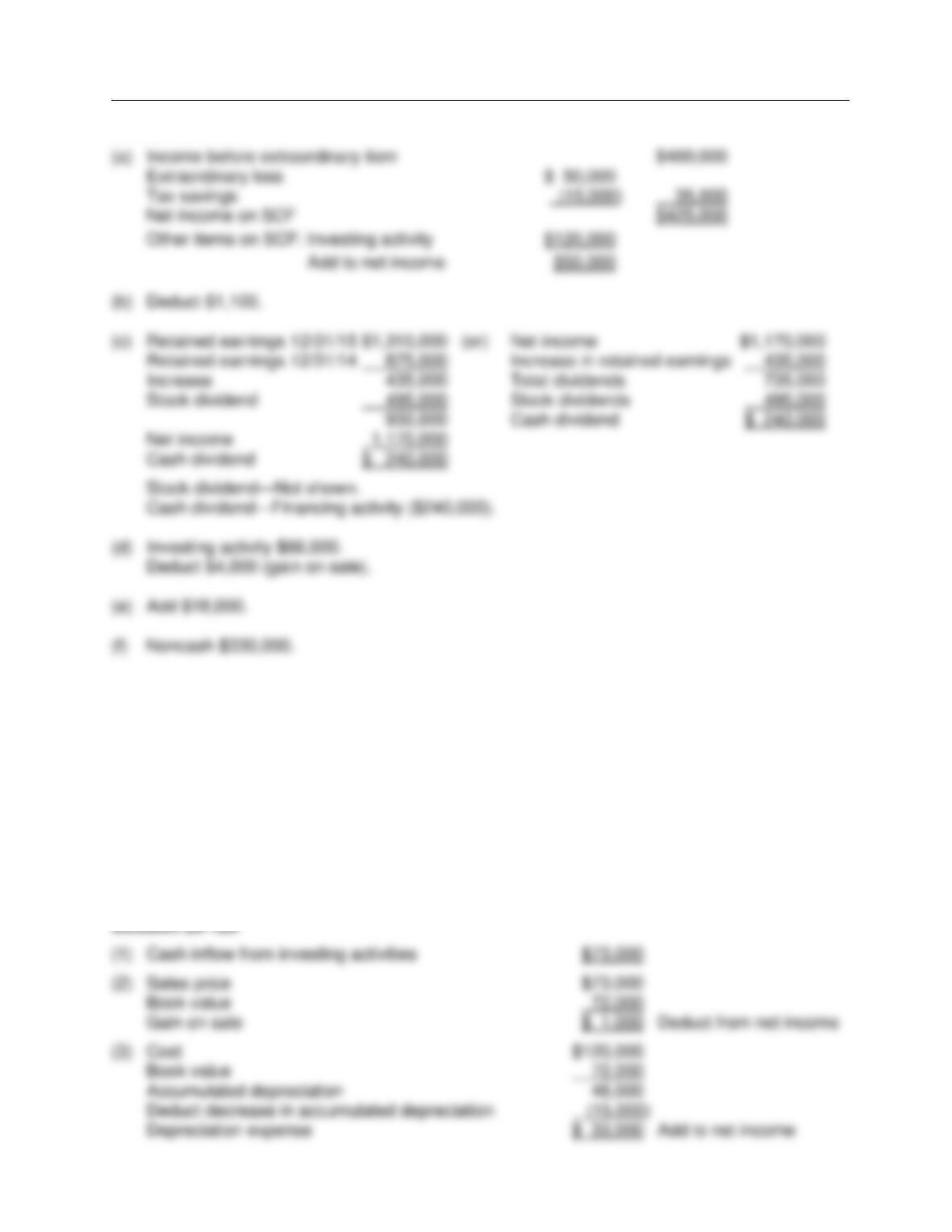
(a) For 2015, income before an extraordinary loss was $460,000. A tornado damaged a building
and its contents. The proceeds from insurance companies totaled $120,000, which was
$50,000 less than the book values. The tax rate was 30%. (Show the calculation of the net
income shown on the SCF, and indicate how other items should be shown on the SCF.)
(b) Amortization of bond premium, $1,100.
(c) The balance in Retained Earnings was $875,000 on December 31, 2014 and $1,310,000 on
December 31, 2015. Net income was $1,170,000. A stock dividend was declared and
distributed which increased common stock $325,000 and paid-in capital $170,000. (Show
calculation of the cash dividend and indicate how it and the stock dividend would be shown
on the SCF.)
(d) Equipment, that cost $115,000 and had accumulated depreciation of $53,000, was sold for
$66,000.
(e) The deferred tax liability increased $18,000.
(f) Issued 3,000 shares of preferred stock, $50 par, with a market value of $110 per share for
land. (Show the amount also.)
Statement of Cash Flows
23 – 39
Solution 23-119
Ex. 23-120—Calculations for statement of cash flows.
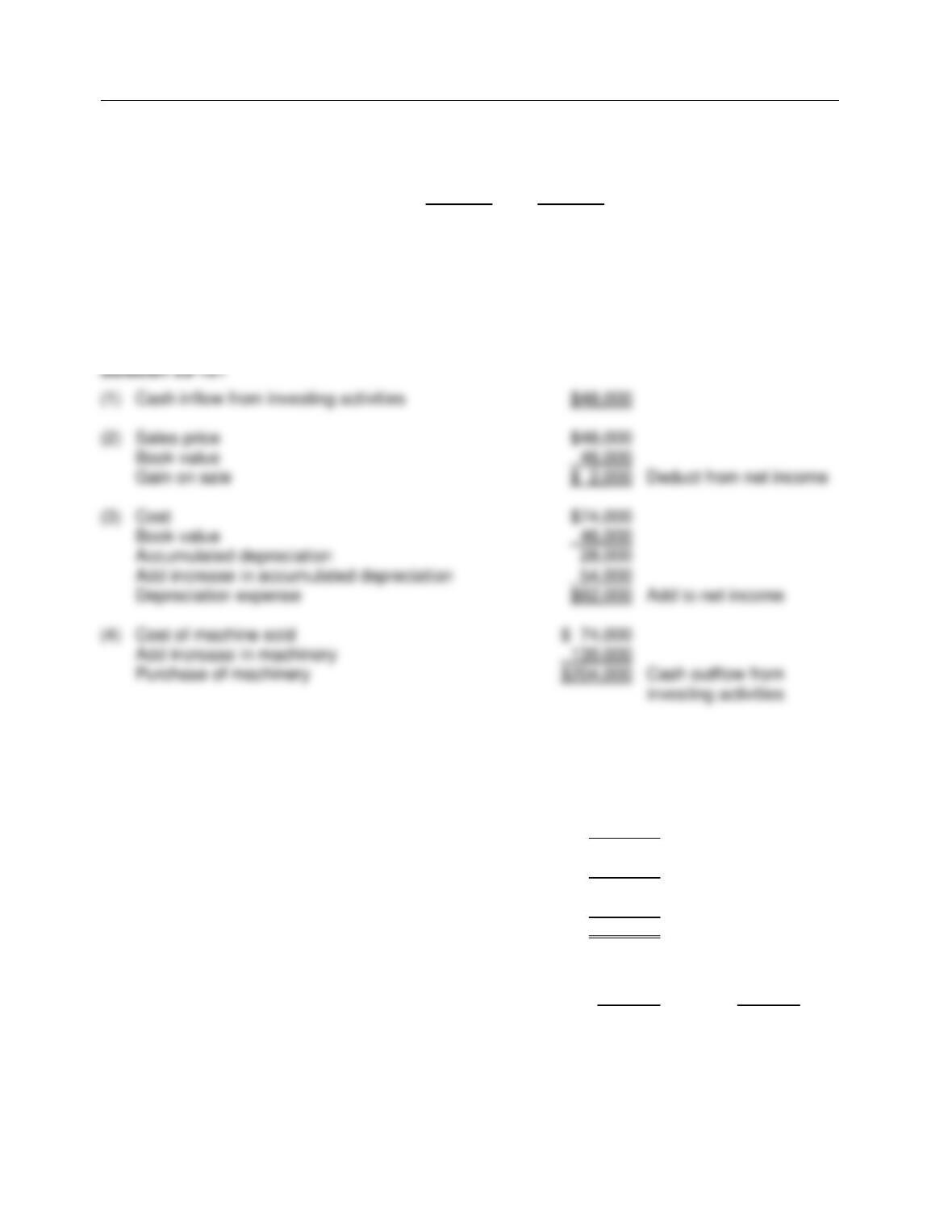
During 2015 equipment was sold for $73,000. This equipment cost $120,000 and had a book
value of $72,000. Accumulated depreciation for equipment was $325,000 at 12/31/14 and
$310,000 at 12/31/15.
Instructions
What three items would be shown on a statement of cash flows (indirect method) from this
information? Show your calculations.
Test Bank for Intermediate Accounting, Fifteenth Edition
23 – 40
Ex. 23-121—Calculations for statement of cash flows.
Milner Co. sold a machine that cost $74,000 and had a book value of $44,000 for $48,000. Data
from Milner’s comparative balance sheets are:
12/31/15 12/31/14
Machinery $800,000 $670,000
Accumulated depreciation 190,000 136,000
Instructions
What four items should be shown on a statement of cash flows (indirect method) from this
information? Show your calculations.
Ex. 23-122—Cash flows from operating activities (indirect and direct methods).
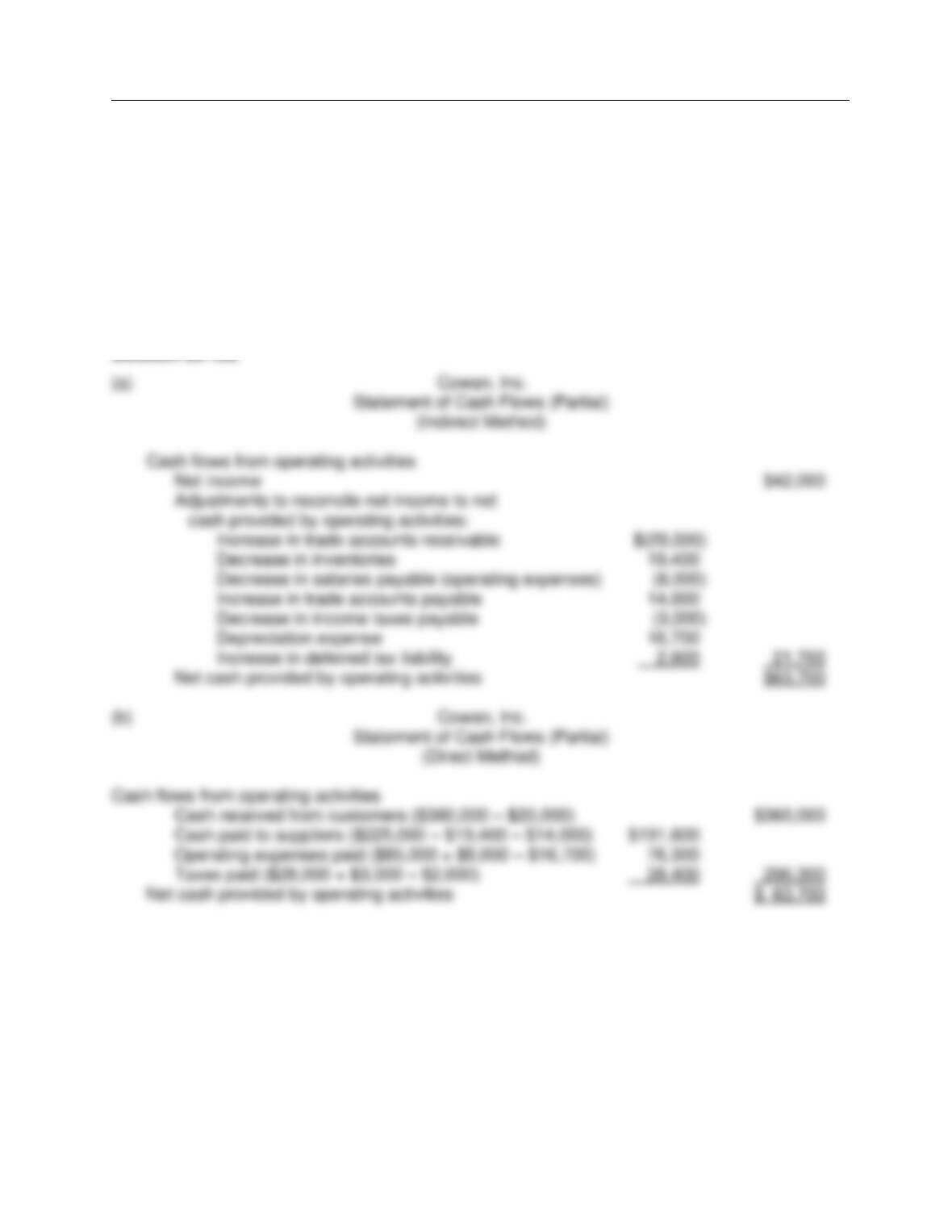
Presented below is the income statement of Cowan, Inc.:
Sales revenue $380,000
Cost of goods sold 225,000
Gross profit $155,000
Operating expenses 85,000
Income before income taxes 70,000
Income taxes 28,000
Net income $ 42,000
In addition, the following information related to net changes in working capital is presented:
Debit Credit
Cash $12,000
Accounts receivable 20,000
Inventories $19,400
Salaries payable (operating expenses) 8,000
Accounts payable 14,000
Income taxes payable 3,000
Statement of Cash Flows
23 – 41
Ex. 23–122 (cont.)
The company also indicates that depreciation expense for the year was $16,700 and that the
deferred tax liability account increased $2,600.
Instructions
Prepare a schedule computing the net cash flow from operating activities that would be shown on
a statement of cash flows:
(a) using the indirect method.
(b) using the direct method.

Test Bank for Intermediate Accounting, Fifteenth Edition
23 – 42
Ex. 23-123—Statement of cash flows (indirect method).
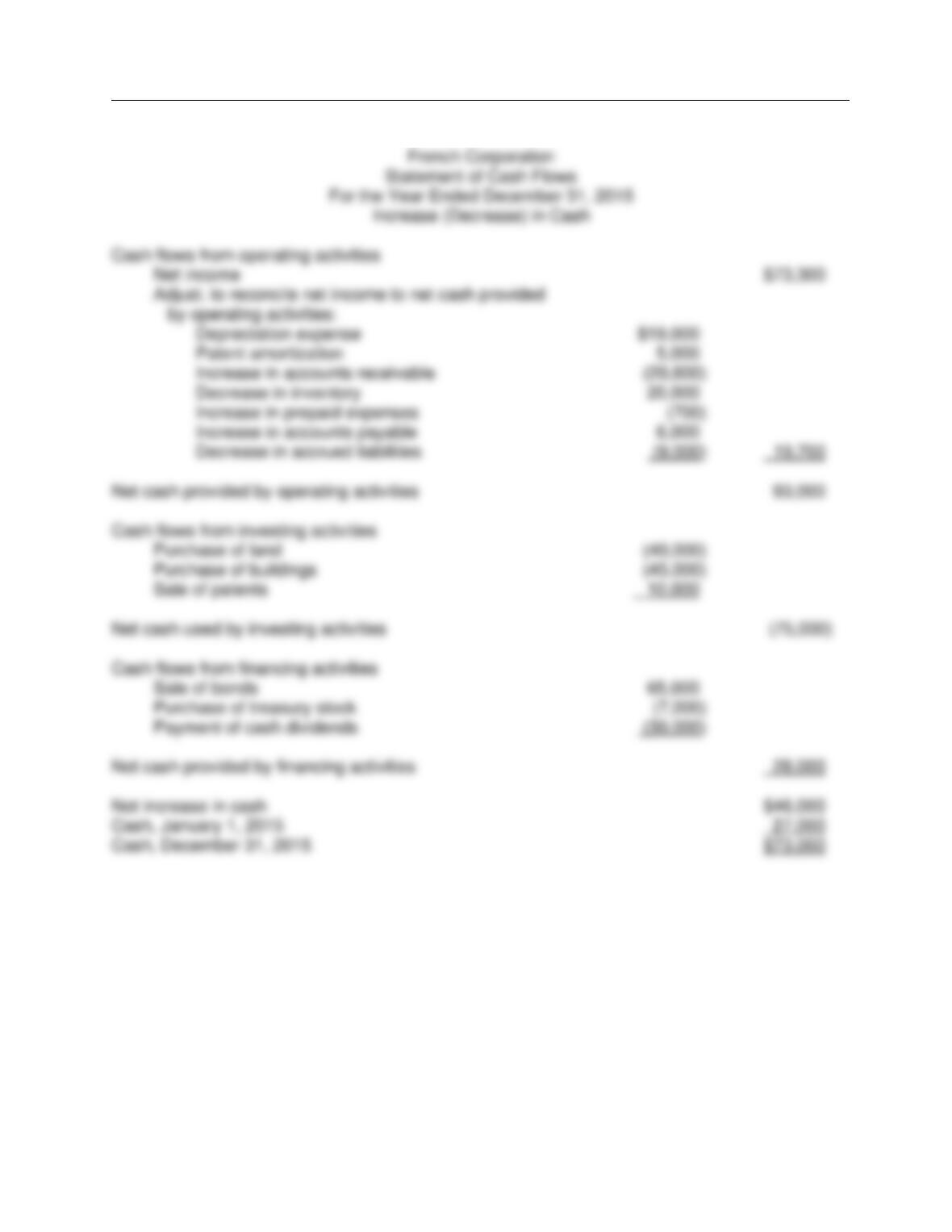
The following information is taken from French Corporation’s financial statements:
December 31
2015 2014
Cash $73,000 $ 27,000
Accounts receivable 102,000 80,000
Allowance for doubtful accounts (4,500) (3,100)
Inventory 155,000 175,000
Prepaid expenses 7,500 6,800
Land 100,000 60,000
Buildings 289,000 244,000
Accumulated depreciation (32,000) (13,000)
Patents 20,000 35,000
$710,000 $611,700
Accounts payable $ 90,000 $ 84,000
Accrued liabilities 54,000 63,000
Bonds payable 125,000 60,000
Common stock 100,000 100,000
Retained earnings—appropriated 80,000 10,000
Retained earnings—unappropriated 276,000 302,700
Treasury stock, at cost (15,000) (8,000)
$710,000 $611,700
For 2015 Year
Net income $73,300
Depreciation expense 19,000
Amortization of patents 5,000
Cash dividends declared and paid 30,000
Gain or loss on sale of patents none
Instructions
Prepare a statement of cash flows for French Corporation for the year 2015. (Use the indirect
method.)
Statement of Cash Flows
23 – 43
Solution 23-123

Test Bank for Intermediate Accounting, Fifteenth Edition
23 – 44
Ex. 23-124—Preparation of statement of cash flows (format provided).
The balance sheets for Kinder Company showed the following information. Additional information
concerning transactions and events during 2015 are presented below.
Kinder Company
Balance Sheet
December 31
2015 2014
Cash $ 35,900 $ 10,200
Accounts receivable (net) 38,300 20,300
Inventory 35,000 42,000
Long-term investments 0 15,000
Property, plant & equipment 236,500 150,000
Accumulated depreciation (37,700) (25,000)
$308,000 $212,500
Accounts payable $ 17,000 $ 26,500
Accrued liabilities 21,000 17,000
Long-term notes payable 70,000 50,000
Common stock 130,000 90,000
Retained earnings 70,000 29,000
$308,000 $212,500
Additional data:
1. Net income for the year 2015, $71,000.
2. Depreciation on plant assets for the year, $12,700.
3. Sold the long-term investments for $28,000 (assume gain or loss is ordinary).
4. Paid dividends of $30,000.
5. Purchased machinery costing $21,500, paid cash.
6. Purchased machinery and gave a $60,000 long-term note payable.
7. Paid a $40,000 long-term note payable by issuing common stock.
Instructions
Using the format provided on the next page, prepare a statement of cash flows (using the indirect
method) for 2015 for Kinder Company.

Statement of Cash Flows
23 – 45
Kinder Company
Statement of Cash Flows
For the Year Ended December 31, 2015
Increase (Decrease) in Cash
Cash flows from operating activities
Net income $__________
Adjustments to reconcile net income to net cash
provided by operating activities:
__________________________________ $__________
__________________________________ __________
__________________________________ __________
__________________________________ __________
__________________________________ __________
__________________________________ __________
__________________________________ __________ __________
Net cash provided (used) by operating activities __________
Cash flows from investing activities
___________________________________ __________
___________________________________ __________
___________________________________ __________
Net cash provided (used) by investing activities __________
Cash flows from financing activities
___________________________________ __________
___________________________________ __________
___________________________________ __________
Net cash provided (used) by financing activities __________
Net increase (decrease) in cash $
Cash, January 1, 2015
Cash, December 31, 2015 $
Test Bank for Intermediate Accounting, Fifteenth Edition
23 – 46
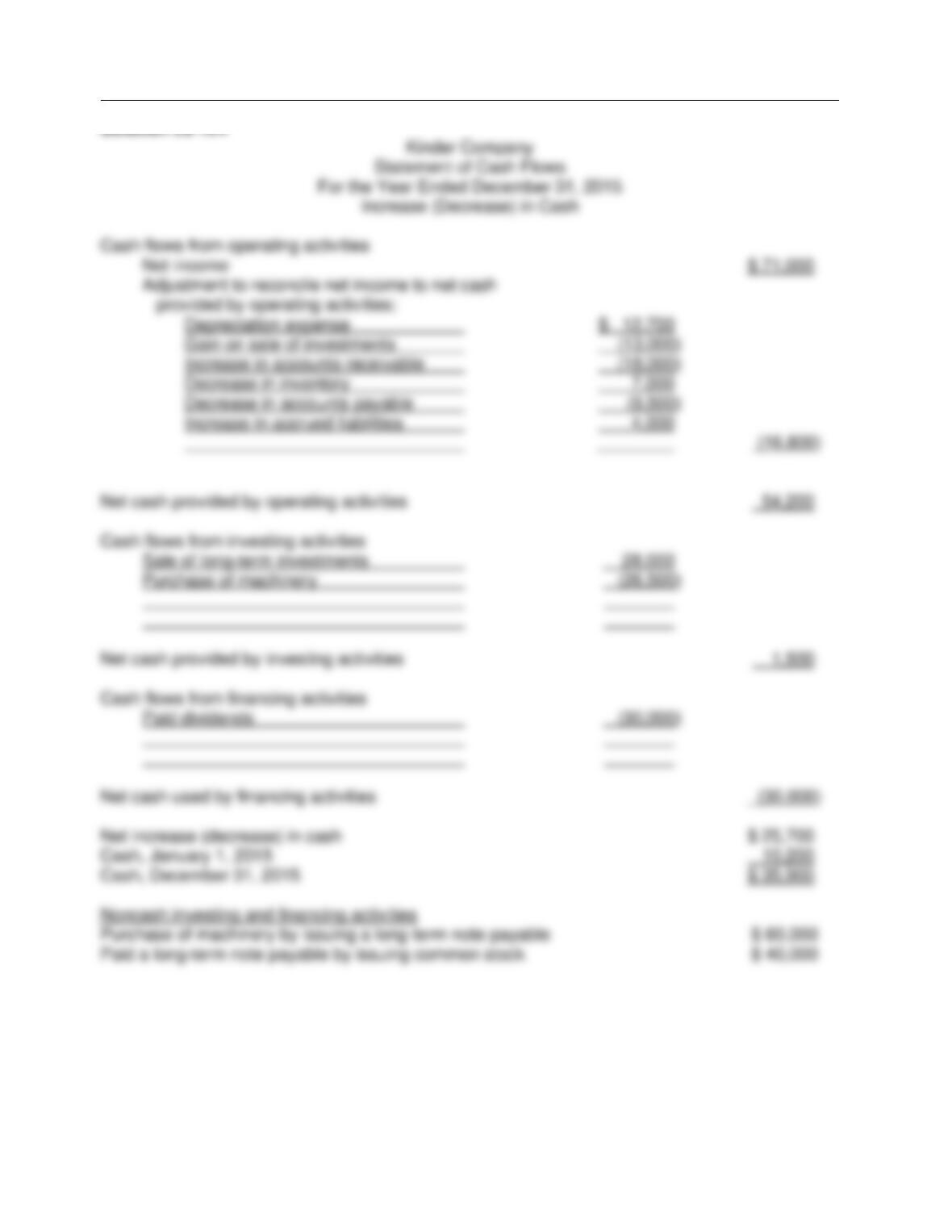
Solution 23-124 Kinder Company

Statement of Cash Flows
23 – 47
Ex. 23-125—Classification of cash flows.
Note that X in the following statement of cash flows identifies a dollar amount and the letters (A)
through (F) identify specific items which appear in the major sections of the statement prepared
using the indirect method. Statement of Cash Flows
Cash flows from operating activities
Net income X
Adjustments to reconcile net income to net cash
provided by operating activities:
Add +X (A)
Deduct –X (B)
Net cash provided by operating activities X
Cash flows from investing activities
Inflows +X (C)
Outflows –X (D)
Net cash provided (used) by investing activities X
Cash flows from financing activities
Inflows +X (E)
Outflows –X (F)
Net cash provided (used) by financing activities X
Net increase (decrease) in cash X
Instructions
For each of the following items, indicate by letter in the blank spaces below, the section or
sections where the effect would be reported. Use the code (A through F) from above. If the item is
not required to be reported on the statement of cash flows, write the word “none” in the blank.
Assume that generally accepted accounting principles have been followed in determining net
income and that there are no short-term securities which are considered cash equivalents.
____ 1. After the retirement of an officer, the insurance policy was canceled, and a cash
settlement was received by the firm. These proceeds were in excess of the book
value of the policy.
____ 2. Sales discounts lapsed and not taken by customers. (Sales are recorded at net
originally.)
____ 3. Accrued estimated income taxes for the period. These taxes will be paid next year.
____ 4. Amortization of premium on bonds payable.
____ 5. Premium amortized on investment in bonds.
____ 6. The book value of trading securities was reduced to fair value.
____ 7. Purchase of available-for-sale securities.
____ 8. Declaration of stock dividends (not yet issued).
____ 9. Issued preferred stock in exchange for equipment.
Test Bank for Intermediate Accounting, Fifteenth Edition
23 – 48
Ex. 23-125 (cont.)
____ 10. Bad debts (under allowance method) estimated and recorded for the period
(receivables classified as current).
____ 11. Gain on disposal of old machinery.
____ 12. Payment of cash dividends (previously declared in a prior period).
____ 13. Trading securities are sold at a loss.
____ 14. Two-year notes issued at discount for a patent.
____ 15. Amortization of Discount on Notes Receivable (long-term).
____ 16. Decrease in Retained Earnings Appropriated for Self-insurance.
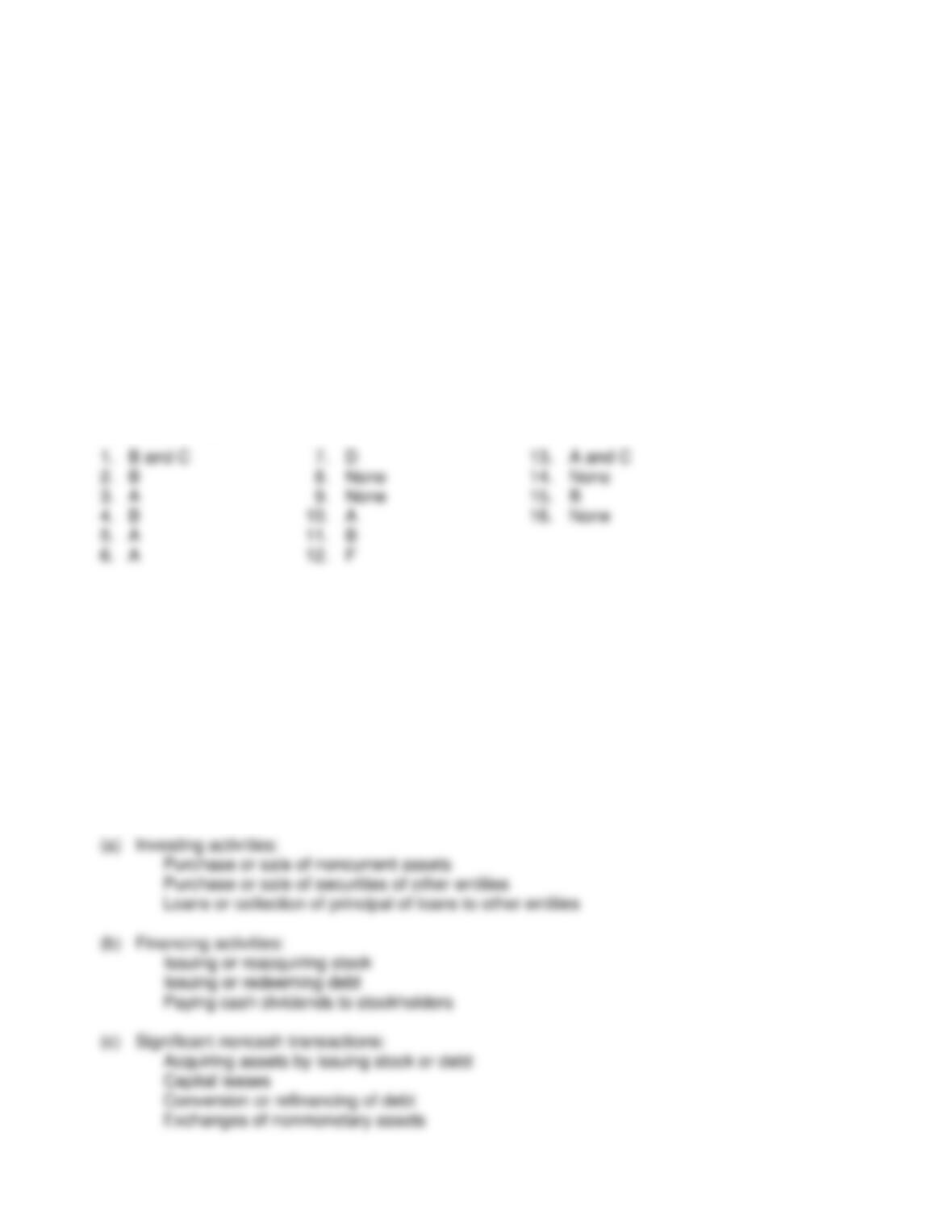
Solution 23-125
Ex. 23-126—Classification of cash flows and transactions.
Give:
(a) Three distinct examples of investing activities.
(b) Three distinct examples of financing activities.
(c) Three distinct examples of significant noncash transactions.
(d) Two examples of transactions not shown on a statement of cash flows.
Solution 23-126

Statement of Cash Flows
23 – 49
Ex. 23-126 (cont.)
(d) Not shown on statement of cash flows:
Stock dividends
Appropriations of retained earnings
Ex. 23-127—Effects of transactions on statement of cash flows.
Any given transaction may affect a statement of cash flows (using the indirect method) in one or
more of the following ways:
Cash flows from operating activities
a. Net income will be increased or adjusted upward.
b. Net income will be decreased or adjusted downward.
Cash flows from investing activities
c. Increase as a result of cash inflows.
d. Decrease as a result of cash outflows.
Cash flows from financing activities
e. Increase as a result of cash inflows.
f. Decrease as a result of cash outflows.
The statement of cash flows is not affected
g. Not required to be reported in the body of the statement.
Instructions
For each transaction listed below, list the letter or letters from above that describe(s) the effect of
the transaction on a statement of cash flows for the year ending December 31, 2015. (Ignore any
income tax effects.)
____ 1. Preferred stock with a carrying value of $44,000 was redeemed for $50,000 on
January 1, 2015.
____ 2. Uncollectible accounts receivable of $3,000 were written off against the allowance for
doubtful accounts balance of $12,200 on December 31, 2015.
____ 3. Machinery which originally cost $3,000 and has a book value of $1,800 is sold for
$1,400 on December 31, 2015.
____ 4. Land is acquired through the issuance of bonds payable on July 1, 2015.
____ 5. 1,000 shares of stock, stated value $10 per share, are issued for $25 per share in
2015.
____ 6. An appropriation of retained earnings for treasury stock of $35,000 is established in
2015.
____ 7. A cash dividend of $8,000 is paid on December 31, 2015.
____ 8. The portfolio of long-term investments (available-for-sale) is at an aggregate market
value higher than aggregate cost at December 31, 2015.

Test Bank for Intermediate Accounting, Fifteenth Edition
23 – 50
PROBLEMS
Pr. 23-128—Statement of cash flows (indirect method).
The net changes in the balance sheet accounts of Keating Corporation for the year 2015 are
shown below.
Account Debit Credit
Cash $ 72,000
Short-term investments $121,000
Accounts receivable 83,200
Allowance for doubtful accounts 13,300
Inventory 74,200
Prepaid expenses 22,800
Investment in subsidiary (equity method) 25,000
Plant and equipment 220,000
Accumulated depreciation 130,000
Accounts payable 80,700
Accrued liabilities 21,500
Deferred tax liability 15,500
8% serial bonds 70,000
Common stock, $10 par 90,000
Additional paid-in capital 150,000
Retained earnings—Appropriation for bonded indebtedness 60,000
Retained earnings—Unappropriated 38,000
$643,600 $643,600
An analysis of the Retained Earnings—Unappropriated account follows:
Retained earnings unappropriated, December 31, 2014 $1,300,000
Add: Net income 327,000
Transfer from appropriation for bonded indebtedness 60,000
Total $1,687,000
Deduct: Cash dividends $185,000
Stock dividend 240,000 425,000
Retained earnings unappropriated, December 31, 2015 $1,262,000
1. On January 2, 2015 short-term investments (classified as available–for-sale) costing $121,000
were sold for $155,000.
2. The company paid a cash dividend on February 1, 2015.
3. Accounts receivable of $16,200 and $19,400 were considered uncollectible and written off in
2015 and 2014, respectively.
4. Major repairs of $33,000 to the equipment were debited to the Accumulated Depreciation
account during the year. No assets were retired during 2015.
Statement of Cash Flows
23 – 51
Pr. 23-128 (cont.)
5. The wholly owned subsidiary reported a net loss for the year of $20,000. The loss was
recorded by the parent.
6. At January 1, 2015, the cash balance was $166,000.
Instructions
Prepare a statement of cash flows (indirect method) for the year ended December 31, 2015.
Keating Corporation has no securities which are classified as cash equivalents.
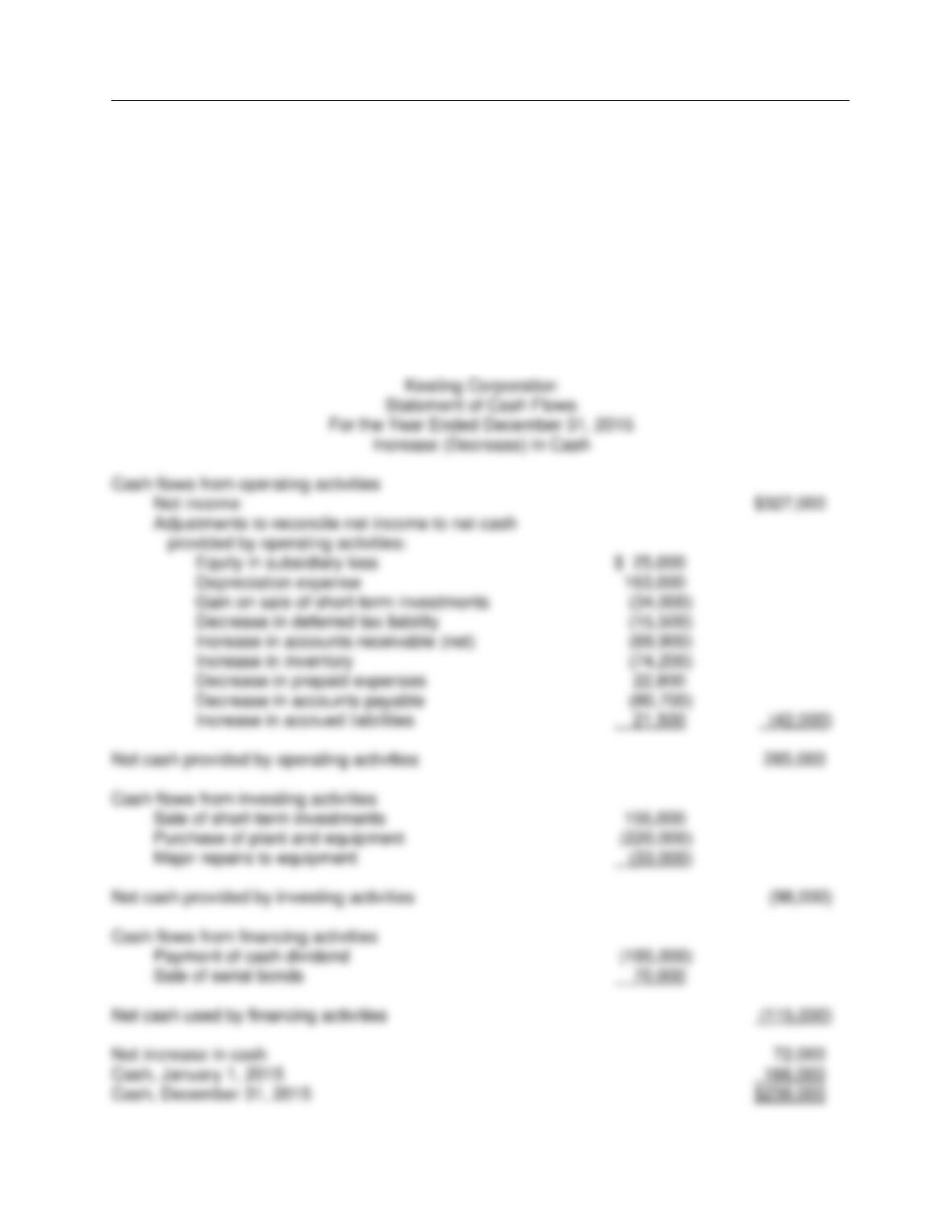
Solution 23-128

Test Bank for Intermediate Accounting, Fifteenth Edition
23 – 52
Pr. 23-129—Statement of cash flows (direct and indirect methods).
Hartman, Inc. has prepared the following comparative balance sheets for 2014 and 2015:
2015 2014
Cash $ 292,000 $ 153,000
Accounts receivable 149,000 117,000
Inventory 150,000 180,000
Prepaid expenses 18,000 27,000
Plant assets 1,275,000 1,050,000
Accumulated depreciation (450,000) (375,000)
Patent 153,000 174,000
$1,587,000 $1,326,000
Accounts payable $ 153,000 $ 168,000
Accrued liabilities 60,000 42,000
Mortgage payable — 450,000
Preferred stock 525,000 —
Additional paid-in capital—preferred 120,000 —
Common stock 600,000 600,000
Retained earnings 129,000 66,000
$1,587,000 $1,326,000
1. The Accumulated Depreciation account has been credited only for the depreciation expense
for the period.
2. The Retained Earnings account has been charged for dividends of $148,000 and credited for
the net income for the year.
The income statement for 2015 is as follows:
Sales revenue $1,980,000
Cost of sales 1,089,000
Gross profit 891,000
Operating expenses 680,000
Net income $ 211,000
Instructions
(a) From the information above, prepare a statement of cash flows (indirect method) for
Hartman, Inc. for the year ended December 31, 2015.
(b) From the information above, prepare a schedule of cash provided by operating activities
using the direct method.
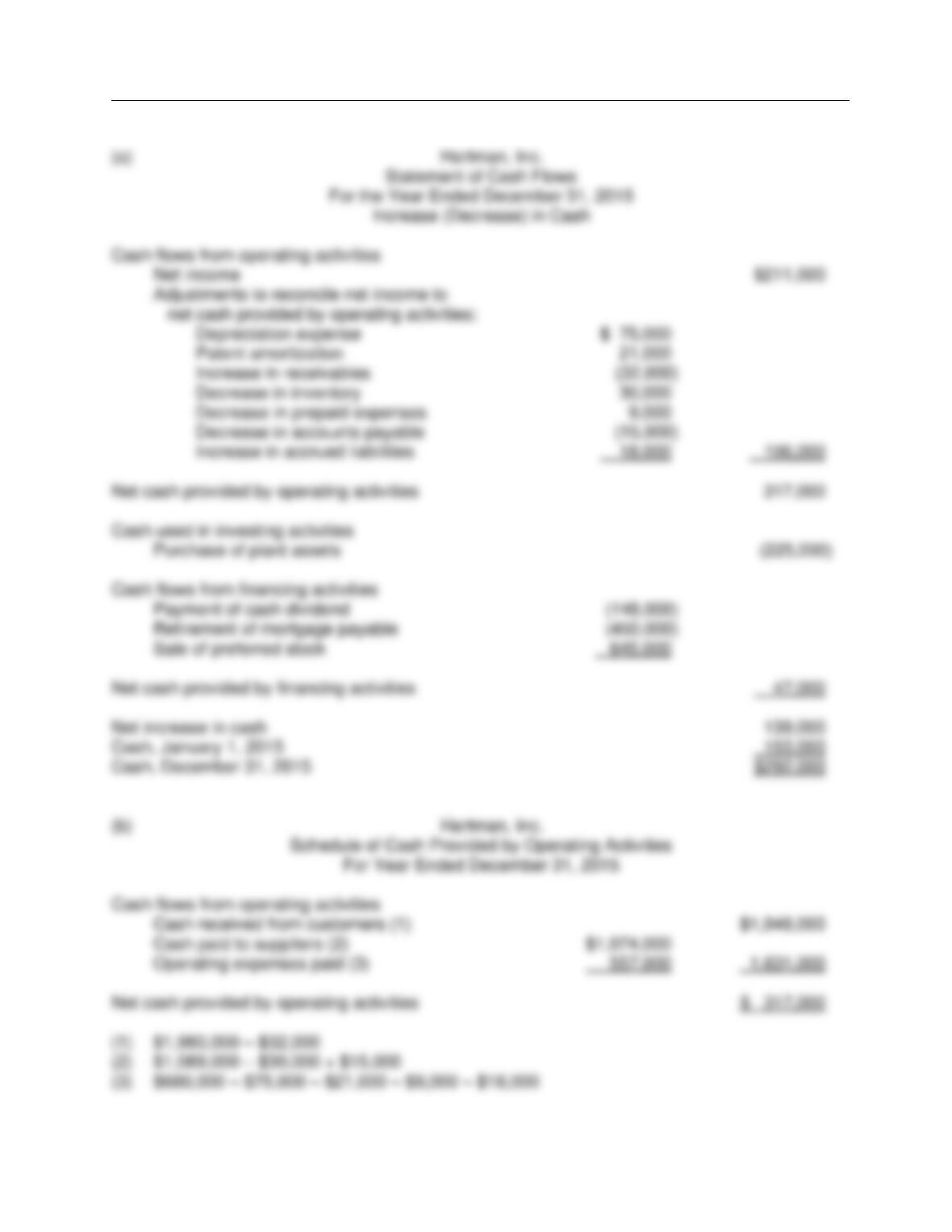
Statement of Cash Flows
23 – 53
Solution 23-129

Test Bank for Intermediate Accounting, Fifteenth Edition
23 – 54
Pr. 23-130—A complex statement of cash flows (indirect method).
The net changes in the balance sheet accounts of Eusey, Inc. for the year 2015 are shown below:
Account Debit Credit
Cash $ 95,600
Accounts receivable $ 64,000
Allowance for doubtful accounts 10,000
Inventory 197,200
Prepaid expenses 20,000
Long-term investments 144,000
Land 400,000
Buildings 650,000
Machinery 100,000
Equipment 28,000
Accumulated depreciation:
Buildings 24,000
Machinery 20,000
Equipment 12,000
Accounts payable 183,200
Accrued liabilities 72,000
Dividends payable 128,000
Premium on bonds 36,000
Bonds payable 900,000
Preferred stock ($50 par) 60,000
Common stock ($10 par) 156,000
Additional paid-in capital—common 223,200
Retained earnings 87,200
$1,805,200 $1,805,200
Additional information:
1. Income Statement Data for Year Ended December 31, 2015
Income before extraordinary item $272,000
Extraordinary loss: Condemnation of land 132,000
Net income $140,000
2. Cash dividends of $128,000 were declared December 15, 2015, payable January 15, 2016.
A 5% stock dividend was issued March 31, 2015, when the market value was $22.00 per
share.
3. The long-term investments were sold for $140,000.
4. A building and land which cost $480,000 and had a book value of $350,000 were sold for
$400,000. The cost of the land, included in the cost and book value above, was $20,000.
5. The following entry was made to record an exchange of an old machine for a new one:
Machinery …………………………………………………………………… 160,000
Accumulated Depreciation—Machinery …………………………... 40,000
Machinery ………………………………………………………… 60,000
Cash ……………………………………………………………….. 140,000
6. A fully depreciated copier machine which cost $28,000 was written off.
7. Preferred stock of $60,000 par value was redeemed for $80,000.
Statement of Cash Flows
23 – 55
Pr. 23-130 (cont.)
8. The company sold 12,000 shares of its common stock ($10 par) on June 15, 2015 for $25 a
share. There were 87,600 shares outstanding on December 31, 2015.
9. Bonds were sold at 104 on December 31, 2015.
10. Land that was condemned had a book value of $240,000.
Instructions
Prepare a statement of cash flows (indirect method). Ignore tax effects.
Solution 23-130
Test Bank for Intermediate Accounting, Fifteenth Edition
23 – 56
Solution 23-130 (cont.)
Statement of Cash Flows
23 – 57
Solution 23-130 (cont.)

Test Bank for Intermediate Accounting, Fifteenth Edition
23 – 58
IFRS QUESTIONS
True/False
1. Under IFRS, companies are not required to prepare a statement of cash flows if the
transactions are reported elsewhere in the financial statements.
2. A statement of cash flows prepared according to IFRS requirements must be prepared using
the direct method for operating activities.
3. Under IFRS, noncash investing and financing activities are excluded from the statement of
cash flows.
4. In certain circumstances under IFRS, bank overdrafts are considered part of cash and cash
equivalents.
5. IFRS requires that noncash investing and financing activities be excluded from the statement
of cash flows.
Answers to True/False:
Multiple Choice Questions
6. Which of the following is false with regard to IFRS and the statement of cash flows?
a. The IASB is strongly in favor of requiring use of the direct method for operating activities.
b. In certain circumstances under IFRS, bank overdrafts are considered part of cash and
cash equivalents.
c. IFRS requires that noncash investing and financing activities be excluded from the
statement of cash flows.
d. All of the above statements are false with regard to IFRS and the statement of cash flows.
7. Ocean Company follows IFRS for its external financial reporting. Which of the following
methods of reporting are acceptable under IFRS for the items shown?
Interest paid Dividends paid
a. Operating Investing
b. Investing Financing
c. Financing Investing
d. Operating Financing

Statement of Cash Flows
23 – 59
8. Ocean Company follows IFRS for its external financial reporting. Which of the following
methods of reporting are acceptable under IFRS for the items shown?
Interest received Dividends received
a. Operating Investing
b. Investing Financing
c. Financing Investing
d. Operating Financing
9. Wave, Inc. follows IFRS for its external financial reporting. The statement of cash flows
reports changes in cash and cash equivalents, which of the following is not considered cash
or a cash equivalent under IFRS?
a. Coin.
b. Bank overdrafts.
c. Commercial paper.
d. Accounts receivable.
10. Surf Company follows IFRS for its external financial reporting. The following amounts were
available at December 31, 2013:
Interest paid $22,000
Dividends paid 16,000
Taxes paid 37,000
Under IFRS, what is the maximum amount that could be reported for cash used by operating
activities for Surf Company for the year ended December 31, 2013?
a. $59,000
b. $38,000
c. $53,000
d. $75,000
11. Surf Company follows IFRS for its external financial reporting. The following amounts were
available at December 31, 2015:
Interest received $25,000
Dividends received 16,000
Under IFRS, what is the maximum amount that could be reported for cash provided by
operating activities for Surf Company for the year ended December 31, 2015?
a. $-0-
b. $25,000
c. $16,000
d. $41,000
12. Surf Company follows IFRS for its external financial reporting. The following amounts were
available at December 31, 2015:
Interest paid $25,000
Dividends paid 16,000
Taxes paid on operations 37,000
Under IFRS, what is the maximum amount that could be reported for cash used by financing
activities for Surf Company for the year ended December 31, 2015?
a. $62,000
b. $41,000
c. $53,000
d. $78,000
Test Bank for Intermediate Accounting, Fifteenth Edition
23 – 60
13. In the “On the Horizon” feature in the text, which of the following is discussed regarding
convergence of U.S. GAAP with IFRS?
a. Noncash investing and financing activities will be disclosed only in the notes.
b. Bank overdrafts will be classified as part of financing activities.
c. The statement of cash flows will present only changes in cash and will exclude changes in
cash equivalents.
d. All of the above are in “On the Horizon” regarding converging U.S. GAAP and IFRS.
14. Which of the following is true regarding the statement of cash flows and IFRS?
a. Cash and cash equivalents are defined differently under IFRS than under U.S. GAAP.
b. Companies preparing a complete set of financial statements under IFRS may exclude the
statement of cash flows if the cash flow activity is reported in the notes to the financial
statements.
c. Under IFRS most companies choose to use the direct method of reporting cash flows from
operating activities.
d. Under IFRS noncash investing and financing activities are excluded from the statement of
cash flows and instead are presented in the notes to the financial statements.
Answers to Multiple Choice:
Short Answer
15. Briefly describe some of the similarities and differences between U.S. GAAP and IFRS with
respect to cash flow reporting.
Statement of Cash Flows
23 – 61
16. What are some of the key obstacles for the FASB and IASB in their convergence project for
the statement of cash flows?