59. Accounting information from the records of the Singleton Corporation at the end of 2010 is shown below:
Net income
$100,000
Proceeds from sale of long-term investment in marketable securities
20,000
Proceeds from sale of building
80,000
Gain on sale of building
35,000
Increase in accounts receivable
5,000
Increase in accounts payable
7,000
Cash dividends declared
5,000
Depreciation expense
18,000
Patent amortization expense
1,000
Amortization of premium on bonds payable
1,500
Purchase of equipment
30,000
Issue of common stock
25,000
Increase in accrued liabilities
4,000
Decrease in prepaid expenses
2,000
Required:
Prepare Singleton’s 2010 Net Cash Flow from Operating Activities section of a statement of cash flows, using the indirect method.
60. The Perry Co. reported the following condensed income statement for 2010:
PERRY CO.
Condensed Income Statement
For the Year Ended December 31, 2010
Sales
$305,000
Cost of goods sold
150,000
Gross profit
$155,000
Operating expenses:
Depreciation.
$42,000
Insurance expense
5,000
Salaries expense
80,000
127,000
Income before taxes
$ 28,000
Income taxes
6,000
Net income
$ 22,000
Net income
$100,000
Add:
Depreciation expense
18,000
Patent amortization expense
1,000
Increase in accrued liabilities
4,000
Increase in accounts payable
7,000
Decrease in prepaid expenses
2,000
Less:
Amortization of premium on bonds payable
(1,500)
Gain on sale of building
(35,000)
Increase in accounts receivable
(5,000)
Net cash provided by operating activities
$ 90,500
Also during 2010, the company’s current assets and current liabilities changed as follows:
Increase (Decrease)
Cash
$49,500
Accounts receivable
11,000
Inventory
17,500
Prepaid insurance
(3,500)
Accounts payable (purchases)
35,000
Salaries payable
2,500
Income taxes payable
(1,500)
Required:
61. The following is a list of items to be included in the 2010 statement of cash flows for the Woods Company:
Beginning cash balance
$90,000
Decrease in accts. payable
4,000
Increase in accts. receivable
3,000
Payment of dividends
6,000
Loss on sale of equipment
3,000
Decrease in prepaid expenses
1,000
Proceeds from bonds
46,000
Depreciation expense
$12,000
Purchase of building
80,000
Net loss
32,000
Decrease in inventory
6,000
Proceeds from sale of equipment
10,000
December 31, 2010
Cash Inflows:
Collections from customers ($305,000 – $11,000)
Cash Outflows:
Payments to suppliers
($150,000 + $17,500 – $35,000)
$(132,500)
Payments for insurance ($5,000 – $3,500)
(1,500)
Payments to employees ($80,000 – $2,500)
(77,250)
Payments for income taxes ($6,000 + $1,500)
(7,500)
Required:
Prepare the 2010 statement of cash flows.
62. Rachel Company reported $70,000 of net income for 2010. During the year, machinery costing $10,000 and
with accumulated depreciation of $8,000 was sold at a loss of $500. Land and machinery were purchased during
the year for cash. Selected account information follows:
2010
December 31
January 1
Land
$40,000
$32,000
Machinery
28,000
25,000
Accumulated Depreciation: Machinery
7,000
12,000
Net loss
$(32,000)
Adjustments for difference between income
flows and cash flows from operating activities:
Add:
Depreciation
12,000
Decrease in inventory
6,000
Decrease in prepaid expenses
1,000
Loss on sale of equipment
3,000
Less:
Decrease in accounts payable
(4,000)
Increase in accounts receivable
(3,000)
Net cash used by operating activities
$(17,000)
Proceeds from sale of equipment
$ 10,000
Payment for purchase of building
(80,000)
Net cash used by investing activities
(70,000)
Proceeds from issuance of bonds
$ 46,000
Payment of dividends
(6,000)
Net cash provided by financing activities
40,000
Net Decrease in Cash
$(47,000)
Cash, January 1, 2010
90,000
Required:
Compute the net cash from investing activities for 2010.
63. On its January 1, 2010, balance sheet, Dilbert Company reported equipment of $50,000 and accumulated
depreciation of $20,000. During 2010, Dilbert sold equipment with an original cost of $5,000. Selected
information from Dilbert’s 2010 statement of cash flows follows:
Net income
$20,000
Depreciation expense on equipment
2,000
Gain on sale of equipment
600
Proceeds from sale of equipment
1,500
Purchase of equipment
8,000
Required:
Compute the amount of equipment and accumulated depreciation that should appear on Dilbert’s December 31, 2010, balance sheet.
*
Book value of equipment sold: $900 ($1,500 – 600)
Accumulated depreciation on equipment sold: $4,100 ($5,000 – $900)
64. The account balance information for Murphy Company at the end of 2010 and 2011 and related 2011
activities are presented below:
December 31
Liabilities and Equities:
2011
2010
Accounts Payable
$ 250,000
$ 230,000
Deferred Tax Liability, noncurrent
80,000
60,000
Bonds Payable, long-term
500,000
200,000
Common Stock, $1 par
110,000
80,000
Additional Paid-in Capital
445,000
130,000
Retained Earnings
470,000
390,000
Total Liabilities and Equities
$1,855,000
$1,090,000
Purchase of land
$ (8,000)
Purchase of machinery
(13,000)
Sale of machinery
1,500
Net cash used for investing activities
$(19,500)
Additional information for 2011 activities:
·
Bonds payable in the amount of $125,000 were converted into 12,000 shares of common stock.
·
Additional common stock was issued for cash of $11 per share.
·
The only changes in retained earnings in 2011 were a result of net income and cash dividends.
·
Other than the bond conversion, the only transaction affecting bonds payable during 2011 was the issue for cash at face value of new
bonds payable.
·
Net income for the year 2011 was $200,000.
Required:
Compute the net cash provided by financing activities for the Murphy Company.
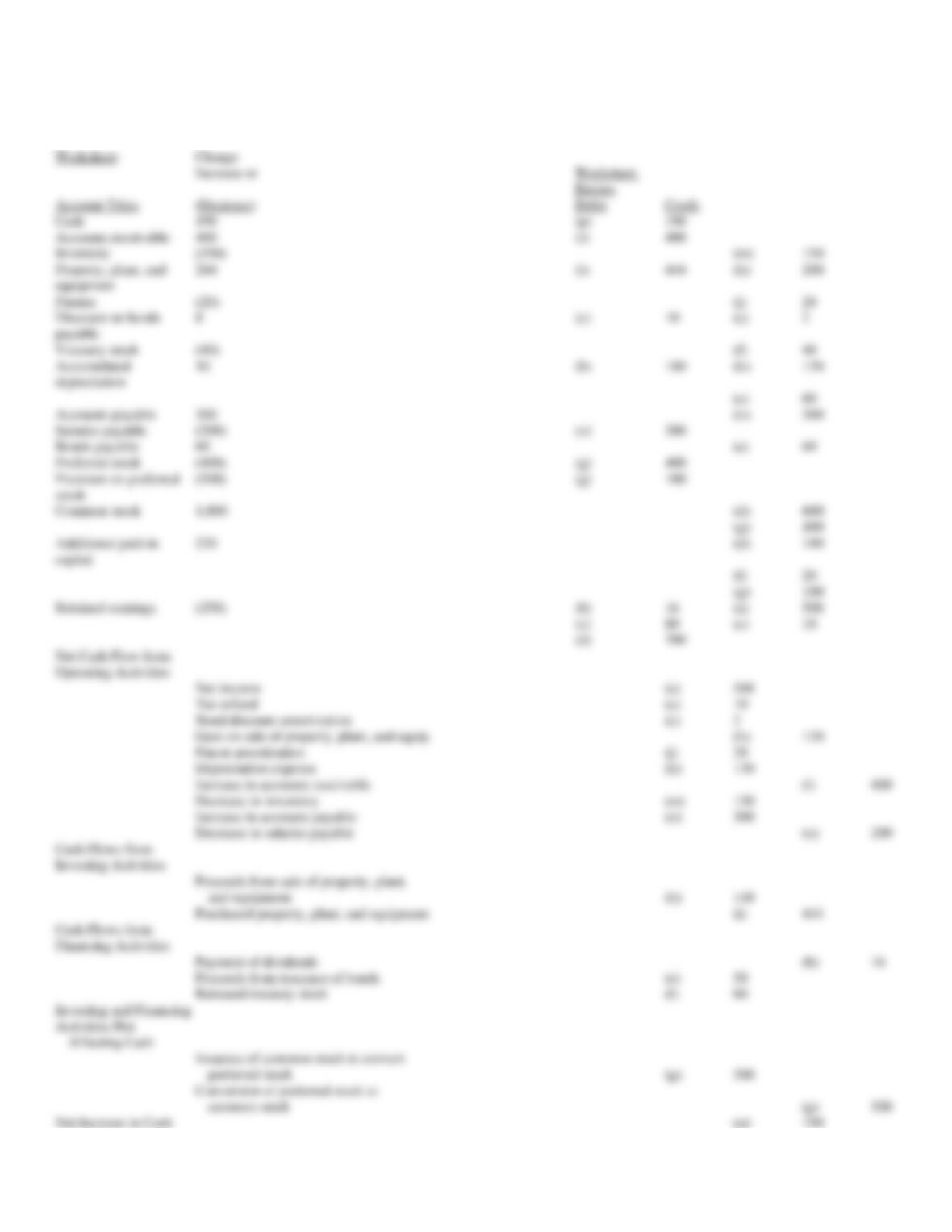
65. A worksheet for a statement of cash flows is presented below along with additional information.
Additional information:
·
Net income was $508.
·
Dividends paid amounted to $16.
·
Last year, depreciation expense was inadvertently understated by $60. The appropriate correction was made this year. The company
also received a related income tax refund of $10.
·
Six shares of $100 par common stock were issued as a small stock dividend. The current market value of the stock was $700 (in total).
·
Bonds payable were issued for $50. One year of amortization was recorded.
·
The treasury stock was reissued for $60.
·
The preferred stock was converted to an equal number of common shares. The book value method was used.
·
Property, plant, and equipment costing $200 was sold for a $120 gain. The assets were 90% depreciated.
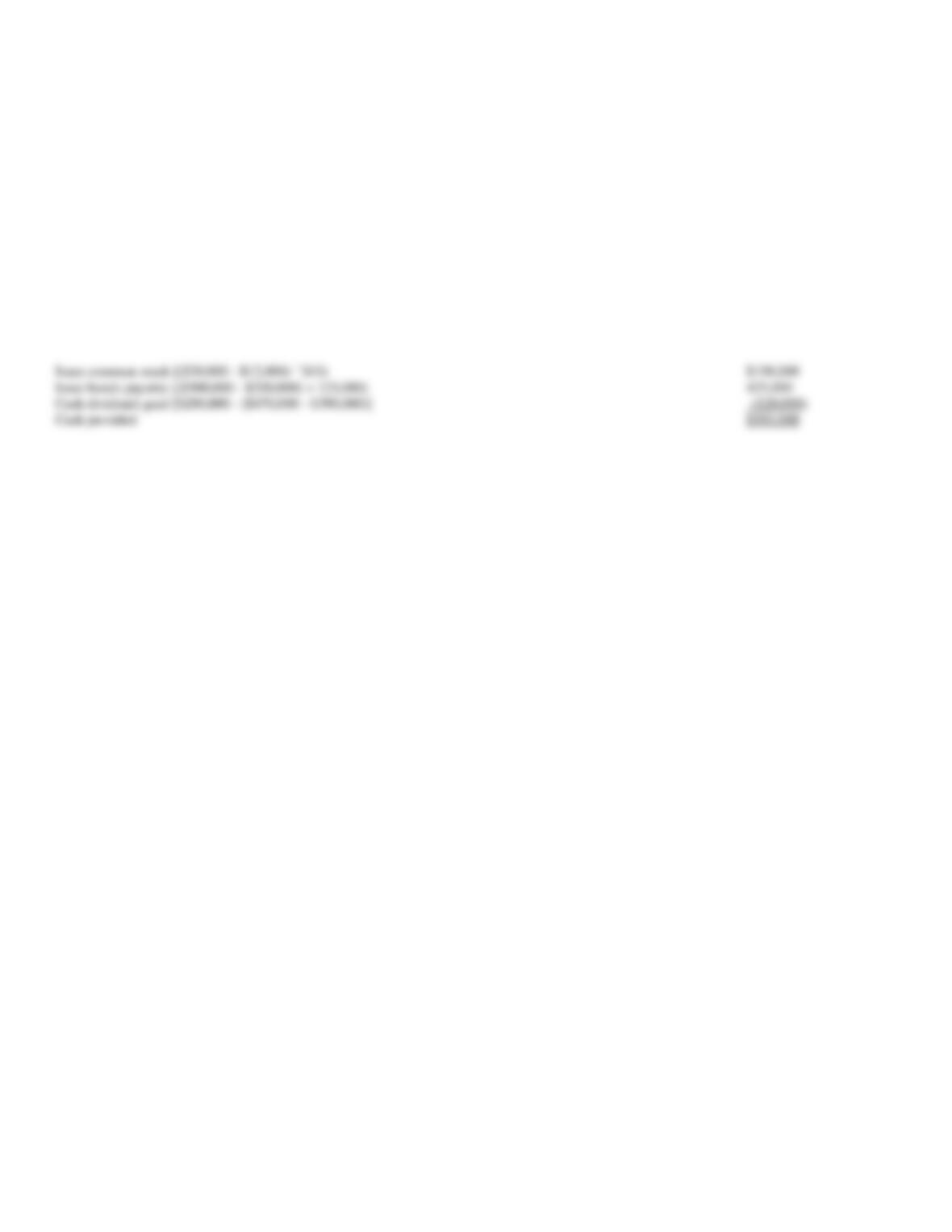
Issue common stock [($30,000 – $12,000) ´ $11)
$198,000
Issue bonds payable [($500,000 – $200,000) + 125,000]
425,000
Cash dividends paid [$200,000 – ($470,000 – $390,000)]
(120,000)
Cash provided
$503,000

Required:
Complete the worksheet:
Worksheet:
Change
Increase or
Worksheet Entries
Account Titles
(Decrease)
Debit
Credit
Cash
190
________
________
Account receivable
400
________
________
Inventory
(150)
________
________
Property, plant, and equipment
244
________
________
Patents
(20)
________
________
Discount on bonds payable
8
________
________
Treasury stock
(40)
________
________
Accumulated depreciation
10
________
________
Accounts payable
300
________
________
Salaries payable
(200)
________
________
Bonds payable
60
________
________
Preferred stock
(400)
________
________
Premium on preferred stock
(100)
________
________
Common stock, $100 par
1,000
________
________
Additional paid-in capital
220
________
________
________
________
________
________
Retained earnings
(258)
________
________
________
________
________
________
Net Cash Flow from Operating Activities
_________________________________
________
________
_________________________________
________
________
_________________________________
________
________
_________________________________
________
________
_________________________________
________
________
_________________________________
________
________
_________________________________
________
________
_________________________________
________
________
_________________________________
________
________
_________________________________
________
________
Cash Flows from Investing Activities
_________________________________
________
________
_________________________________
________
________
Cash Flows from Financing Activities
_________________________________
________
________
_________________________________
________
________
_________________________________
________
________
Investing and Financing Activities
Not Affecting Cash
_________________________________
________
________
_________________________________
________
________
Net Increase in Cash
________
________
66. The information below was taken from the records of the Phil Company for the year ended December 31,
2010:
Acquisition of building
$250,000
Amortization of premium on bonds payable
2,000
Decrease in deferred income taxes
8,000
Decrease in inventories
6,000
Decrease in salaries payable
2,000
Depreciation expense
24,000
Dividends paid
11,000
Loss on sale of land
18,000
Increase in accounts payable
14,000
Increase in accounts receivable
5,000
Issuance of long-term bonds payable
150,000
Net income
240,000
Patent amortization expense
4,000
Preferred stock issued to convert bonds
50,000
Retirement of bonds
100,000
Proceeds from sale of land
80,000
Ending cash balance
400,000
Required:
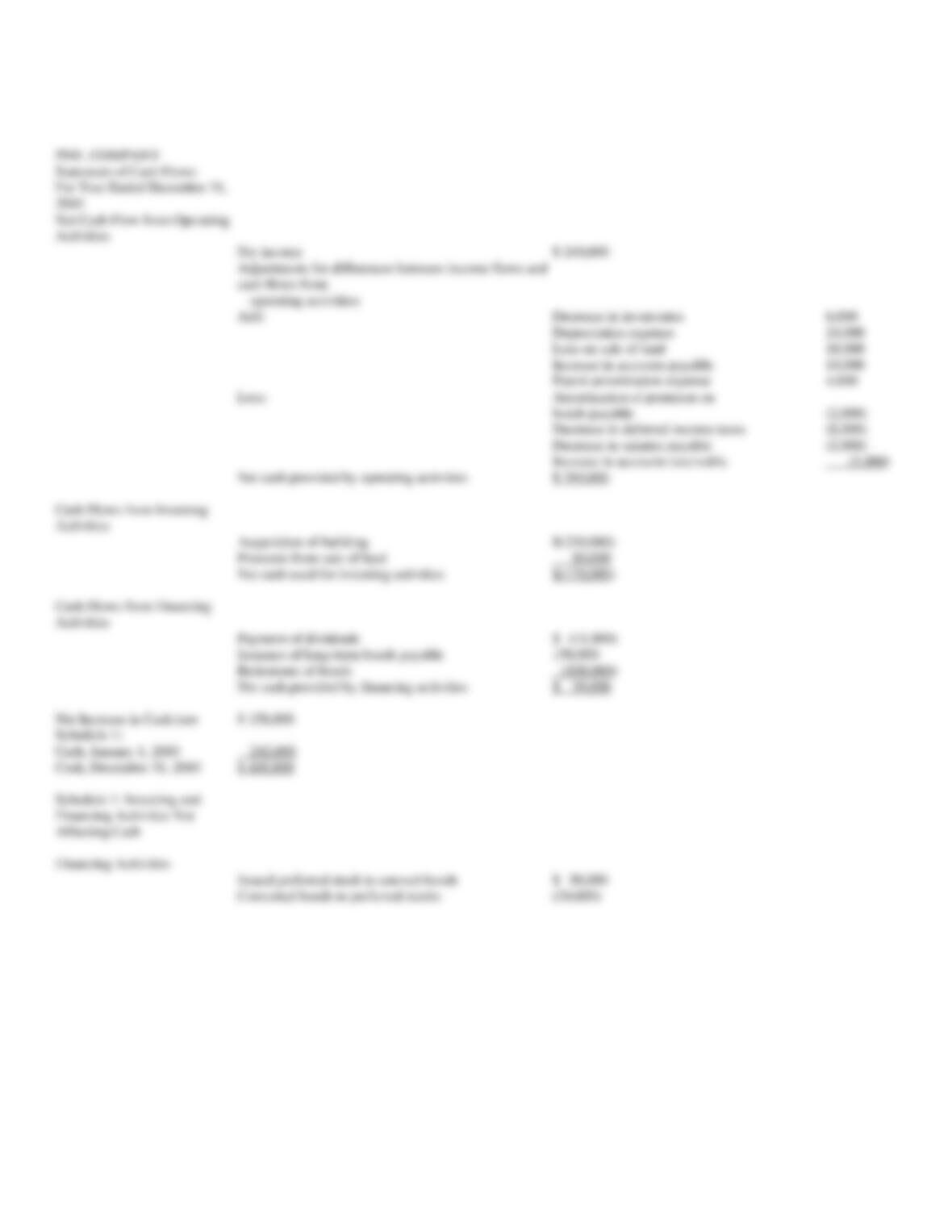
Prepare Phil’s statement of cash flows for 2010, using the indirect method.

67. The Farmer Company’s comparative balance sheets for 2010 and 2011, and additional information, are
presented below.
FARMER COMPANY
Comparative Balance Sheets
December 31,
December 31,
ASSETS
2011
2010
Cash
$ 14,000
$ 9,000
Accounts receivable
52,000
24,000
Inventory
87,000
40,000
Equipment
125,000
100,000
Accumulated depreciation
(42,000)
(34,000)
Prepaid expenses
4,000
2,000
Land
-0-
7,000
Building
50,000
-0-
Total Assets
$290,000
$148,000
LIABILITIES AND STOCKHOLDERS’
EQUITY
Accounts payable
$ 25,000
$ 14,000
Interest payable
8,000
6,000
Taxes payable
37,000
11,000
Short-term note payable
37,000
32,000
Bonds payable
75,000
50,000
Common stock, $10 par
75,000
25,000
Retained earnings
33,000
10,000
Total Liabilities and Stockholders’ Equity
$290,000
$148,000
Additional 2011 information:
Net income, $31,000
Sold land for gain of $3,000
Paid dividends of $8,000
Issued $50,000 stock to purchase building
Required:
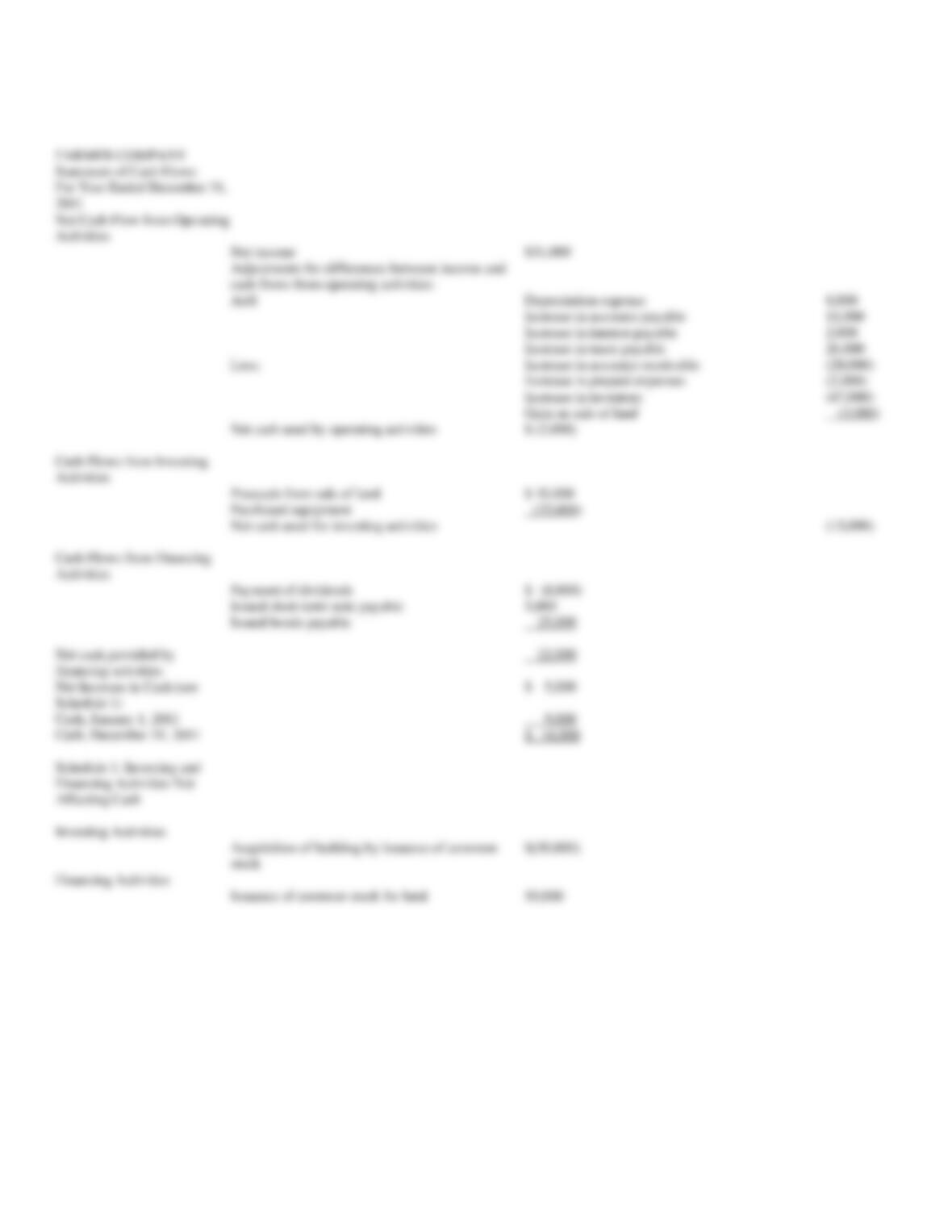
Prepare Farmer Company’s 2011 statement of cash flows.
68. An abbreviated set of financial statements for Cabrera, Inc. for 2011 and 2010 is shown below:
CABRERA, INC.
Income Statement
For the Year Ended December
31, 2011
Sales
$553,000
Investment income
26,000
Gain on sale of investments
3,500
$582,500
Less:
Selling & administrative expenses
$221,600
Depreciation expense
15,000
Interest expense
3,900
Income taxes expense
6,500
247,000
Net Income
$335,500
Comparative Balance Sheets
December 31
2011
2010
Cash
$209,000
$ 49,900
Accounts receivable
160,300
63,700
Investments
117,000
126,100
Equipment (net)
146,200
80,400
Land
312,000
276,300
Total Assets
$944,500
$596,400
Accounts payable
$130,000
$ 87,500
Mortgage payable
65,000
97,400
Common stock
266,500
238,000
Retained earnings
483,000
173,500
Total Liabilities & Stockholders’ Equity
$944,500
$596,400
Required:
Prepare the cash flows from investing and financing activities sections of the 2011 statement of cash flows.
Cash Flows from Investing Activities:
Proceeds from sale of investments
($126,100 – $117,000 + $3,500)
$ 12,600
Payment for purchase of equipment
[$146,200 – ($80,400 – $15,000)]
(80,800)
Payment for purchase of land
($312,000 – $276,300)
(35,700)
Net cash used by investing activities
$(103,900)
Cash Flows from Financing Activities:
Payment of mortgage ($97,400 – $65,000)
$(32,400)
Issuance of common stock
($266,500 – $238,000)
28,500
Payment of cash dividend
[$483,000 – ($173,500 + $335,500)]
(26,000)
Net cash used by financing activities
(29,900)
69. Your friend is in business and wants your advice on preparing and interpreting the statement of cash flows
for 2010. Information regarding the business is as follows:
Cash received from customers
$ 75,000
Cash paid to vendors
50,000
Cash paid to employees
160,000
Cash paid for interest
30,000
Depreciation expense
40,000
Cash paid in acquiring equipment
300,000
Cash received from issuing bonds
200,000
Cash received from issued common stock
300,000
Beginning cash balance
5,000
Required:
a.
Based upon the above information, prepare the statement of cash flows using the direct method.
b.
Explain what has happened during the year.
70. Maria, Inc. reported the following income statement, prepared on the accrual basis:
Sales
$6,000
Cost of goods sold
(4,700)
Gross profit
$1,300
Operating expenses:
Depreciation expense
$190
Other operating expenses
650
(840)
Income before taxes
$ 460
Income tax expense
(210)
Net income
$ 250
Changes during the year in selected accounts:
Accounts receivable
$100 decrease
Inventories
200 decrease
Accounts payable (on purchases)
150 increase
Salaries payable
60 decrease
Prepaid expenses
30 increase
Required:
For Maria, Inc., compute the cash flow pertaining to:
a.
Cash collections from customers.
b.
Cash paid for operating expenses.
c.
Cash paid for suppliers.
71. The statement of cash flows, along with other financial and operating information, enables investors,
creditors, and other users to assess a company’s liquidity, financial flexibility, and operating capability.
Distinguish between liquidity, financial flexibility, and operating capability.
a.
$6,100 ($6,000 + $100)
b.
$740 ($650 + $60 + $30)
c.
$4,350 ($4,700 – $200 – $150)
72. Current GAAP permits two methods of calculating and reporting a company’s net cash flow from operating
activities on its statement of cash flows.
Required:
Identify the two methods. Which method does the FASB prefer? Which method do most companies use and
why?
73. The statement of cash flows classifies cash inflows and outflows into three different activities: operating,
investing, and financing.
Required:
Describe the types of transactions that would be included under each of the statement of cash flow activities.
74. Because the statement of cash flows only reflects the cash flows from operating, investing, and financing
activities, certain noncash transactions are omitted from the body of the statement.
Required: