College Accounting, 14e (Slater)
Chapter 22 Analyzing Financial Statements
22.1 Learning Objective 22-1
1) Amounts of items compared on the same line of comparative financial reports describes:
A) vertical analysis.
B) ratio analysis.
C) horizontal analysis.
D) size analysis.
2) In a comparative balance sheet, the ending Cash for 2019 was $345,000 and is $333,000 for 2020. The net
increase or decrease from 2019 to 2020 is: (Round the final answer to two decimal places.)
A) 96.52%.
B) 3.48%.
C) 3.60%.
D) -3.48%.
3) Comparative reports in which each item is expressed as a percentage of a base amount without dollar
amounts are called:
A) comparative financial statements.
B) common-size statements.
C) cash flow analysis.
D) horizontal analysis.
4) In a comparative balance sheet, the ending Accounts Receivable for 2019 was $189,000 and is $301,000
for 2020. The net increase or decrease from 2019 to 2020 is: (Round your answer to two decimal places,
X.XX%.)
A) (59.26%).
B) 59.26%.
C) 37.21%.
D) (37.21%).
5) In a comparative balance sheet, the Accounts Payable balance for 2019 was $189,330 and total liabilities
and equity was $459,265. What is the vertical analysis for Accounts Payable? (Round your answer to two
decimal places, X.XX%.)
A) 41.22%
B) (41.22%)
C) 58.78%
D) (58.78%)
6) If Cash is $2,100 in 20X2 and $4,000 in 20X1, what is the percent of increase or (decrease) from 20X1 to
20X2?
A) -90%
B) 90%
C) 48%
D) –47%
7) If total assets are $14,000, what is the vertical analysis for Cash when it has a balance of $8,000? (Round
your answer two decimal places, X.XX%.)
A) 42.86%
B) 57.14%
C) 233.33%
D) 27.27%
8) What was the percentage of decrease in the Accounts Receivable account if the receivables were
$87,000 in Year 1, and $67,000 in Year 2? (Round your answer two decimal places, X.XX%.)
A) -22.99%
B) 29.85%
C) -29.85%
D) 22.99%
9) When doing a vertical analysis, which of the following is a typical comparison item set at 100%?
A) Total liabilities
B) Total stockholders’ equity
C) Total cash
D) Total assets
10) To find the percent of increase or decrease of an item in a comparative balance sheet you use the
formula: % change = amount of change/base (old year).
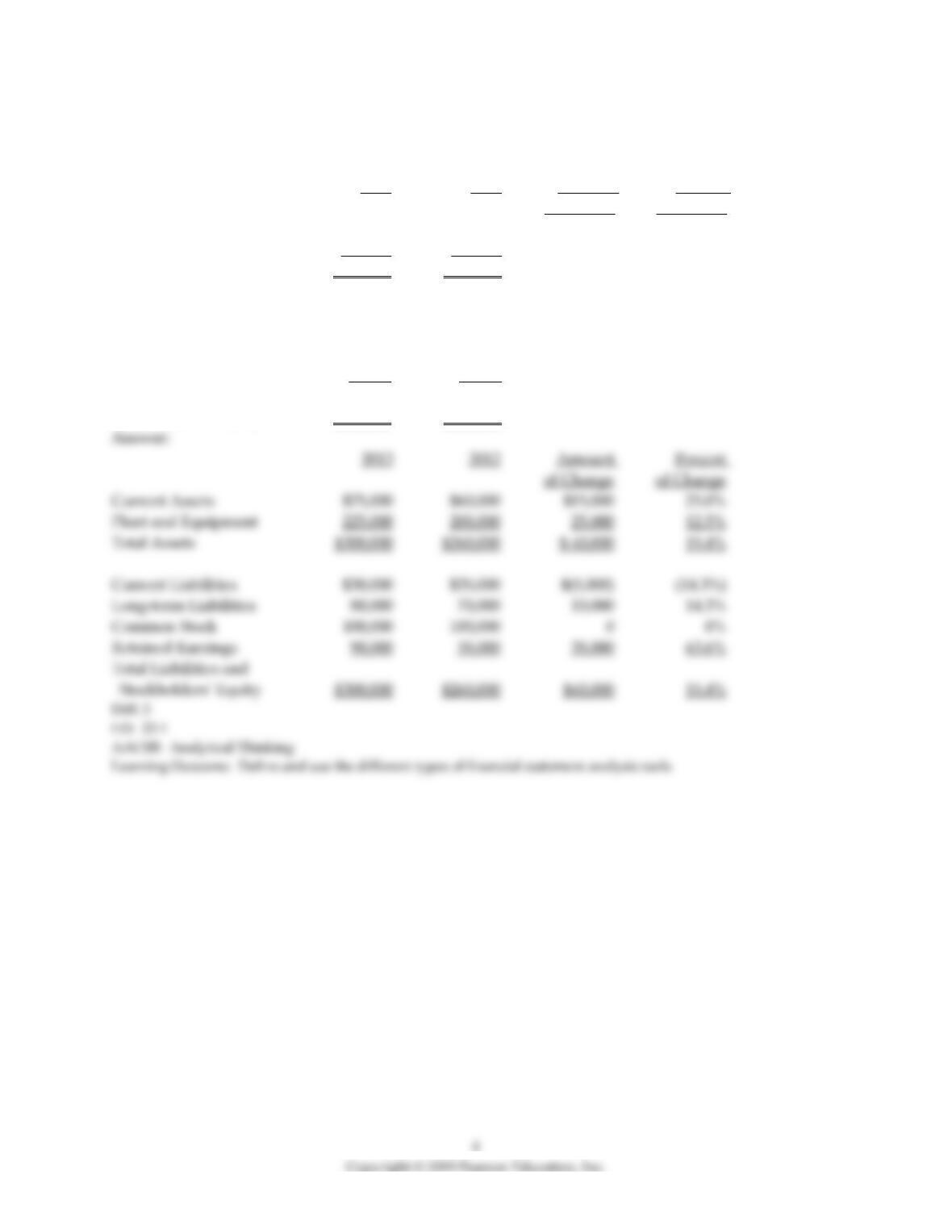
11) Complete the horizontal analysis of Soopy’s Used Cars. (Round all percentages to the nearest tenth of
a percent.)
2013 2012 Amount Percent
of Change of Change
Current Assets $75,000 $60,000
Plant and Equipment 225,000 200,000
Total Assets $300,000 $260,000
Current Liabilities $ 30,000 $ 35,000
Long-term Liabilities 80,000 70,000
Common Stock 100,000 100,000
Retained Earnings 90,000 55,000
Total Liabilities and
Stockholders’ Equity $300,000 $260,000
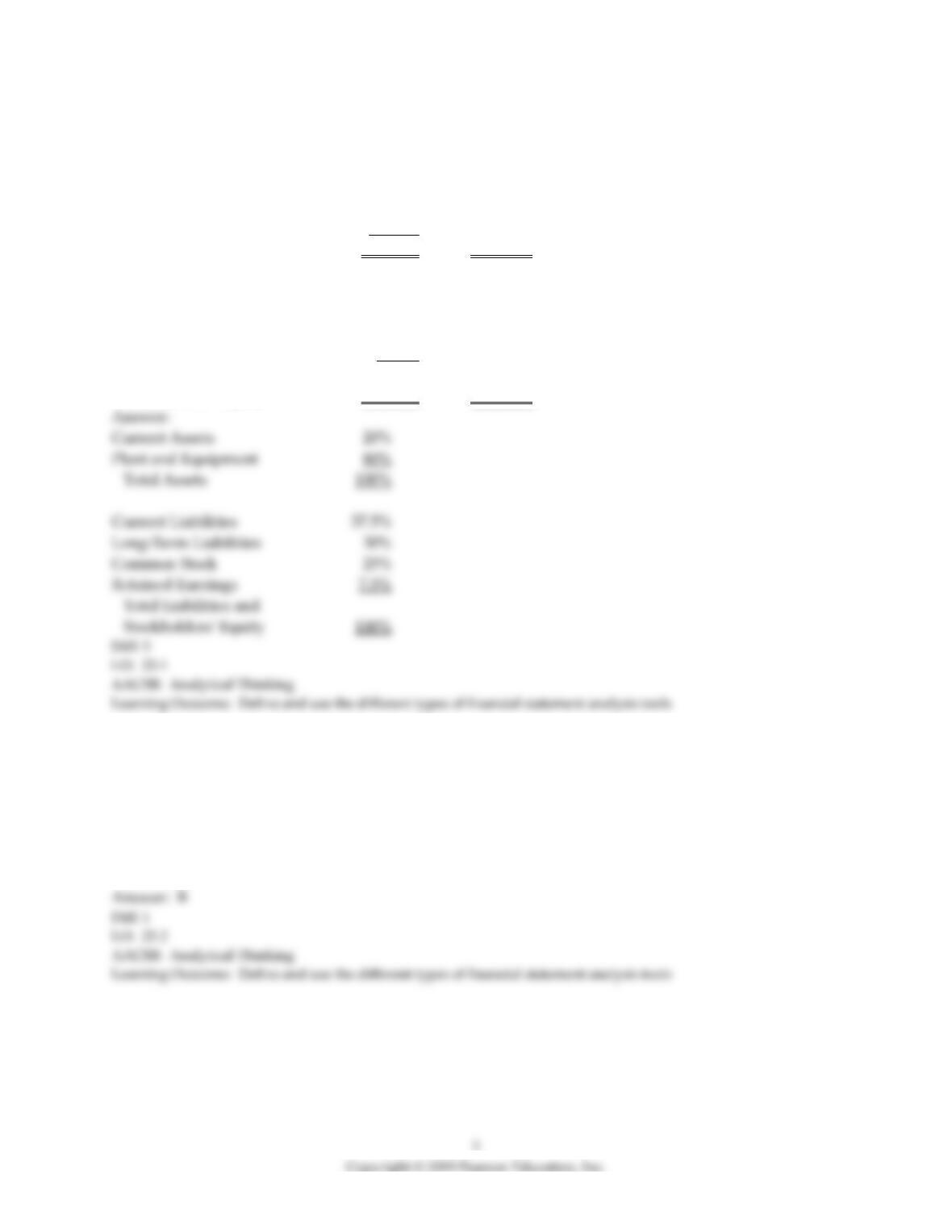
12) From the following balance sheet for Bricks Corporation, compute the common-size balance sheet
amounts. (Round all percentages to nearest tenth of a percent.)
Amount Percent
Current Assets $80,000 ________
Plant and Equipment 320,000 ________
Total Assets $400,000 ________
Current Liabilities $150,000 ________
Long-term Liabilities 120,000 ________
Common Stock 100,000 ________
Retained Earnings 30,000 ________
Total Liabilities and
Stockholders’ Equity $400,000 ________
22.2 Learning Objective 22-2
1) For vertical analysis purposes, the base item on an income statement is:
A) net income.
B) net sales.
C) total expenses.
D) total sales.
2) Which analysis compares line items on an income statement with those from the prior year?
A) Horizontal analysis
B) Vertical analysis
C) Statement analysis
D) None of the above are true.
3) Net sales were $115,000 in Year 1 and $65,000 in Year 2. The percentage increase or decrease in net sales
was: (Round your answer to two decimal places, X.XX%.)
A) (56.52%).
B) 56.52%.
C) (43.48%).
D) 43.48%.
4) Which analysis deals with comparing items in a financial report by expressing each item as a
percentage of a certain base total?
A) Vertical analysis
B) Ratio analysis
C) Trend analysis
D) Common-size statement
5) The Cost of Goods Sold for Years 1, 2, and 3 are $23,000, $48,000, $69,000, respectively. The trend
percentage for Year 3 is:
A) (300%).
B) 300%.
C) 208.70%.
D) (208.70%).
6) The sales of Mary’s Services for Years 1, 2, and 3 are $25,000, $52,000, $64,000 respectively. The trend
percentage for Year 2 is:
A) 39.06%.
B) 256.00%.
C) 208.00%.
D) 60.16%.
7) Net income was $65,000 in Year 1 and $50,000 in Year 2. The percentage increase or decrease in net
income was:
A) 30.00%.
B) 76.92%.
C) -23.08%.
D) -30.00%.
8) In a common-size income statement, advertising expenses are 10%. This means that they are 10% of:
A) net income.
B) net sales.
C) gross profit.
D) net profit.
9) If Cara’s Piano sales increased from $46,000 to $68,000 and its cost of goods sold decreased from
$29,000 to $16,000, then vertical analysis based on sales would show the following for cost of goods sold
(rounded to the nearest percent):
A) 63% and 24%.
B) 43% and 35%.
C) 55% and 68%.
D) 68% and 43%.
10) An expression of the amount of each item in a statement shown as a percentage of some designated
total for purposes of comparison is called:
A) horizontal analysis.
B) earnings per share analysis.
C) return on total assets.
D) vertical analysis.
11) If Rick’s sales increased from $49,000 to $81,000 and its cost of goods sold increased from $25,000 to
$66,000, then vertical analysis based on sales would show the following for cost of goods sold for the two
periods:
A) 81.48% and 51.02%.
B) 51.02% and 81.48%.
C) 122.73% and 196.00%.
D) 196.00% and 122.73%.
12) Net income was $24,000 in Year 1 and $40,000 in Year 2. The percentage increase or decrease in net
income was:
A) (66.67%).
B) (33.33%).
C) 33.33%.
D) 66.67%.
13) A trend analysis is a type of horizontal analysis.
14) A form of analysis in which each item on a report is shown as a percent of net sales is called a
horizontal analysis of the income statement.
15) A vertical analysis of an income statement compares net income (loss) to net sales within the same
year.
16) Common-size statements deal with the percentage of change in a certain item over several years.
17) A horizontal analysis for an income statement compares Cost of Goods Sold within the same year.
18) An accountant is completing a trend analysis for a company by comparing sales for years 2013
through 2023. The base year for the calculations is 2023.
19) Meranda Flower Corporation needs to develop a trend analysis for its sales and gross profit for the
past three years to make decisions for the future. Compute the trend percentages with the information
below and place your answers in the spaces provided.
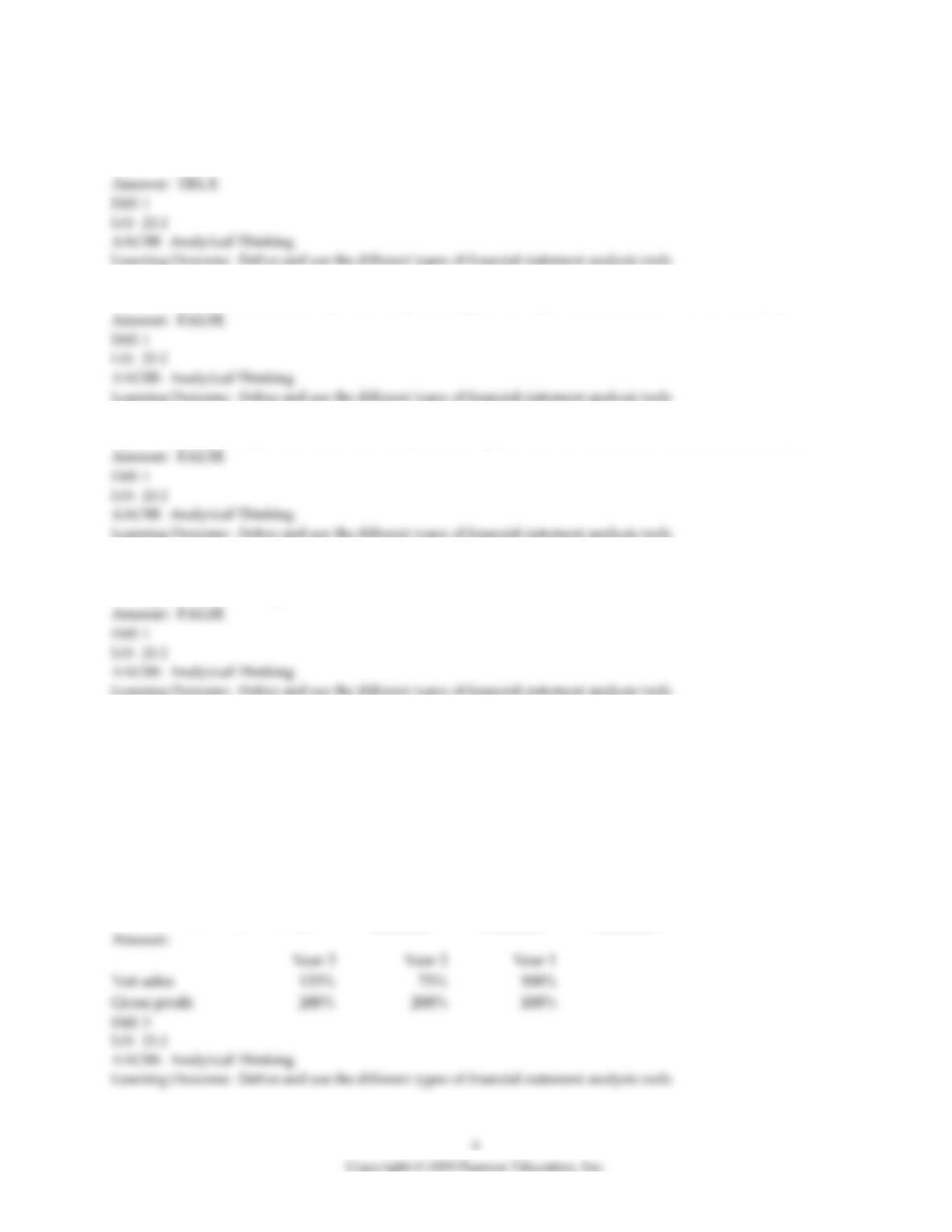
Year 3 Year 2 Year 1
Net sales $3,200 $1,800 $2,400
Gross profit 1,400 1,000 500
Net sales trend percentages ________ ________ ________
Gross profit trend percentages ________ ________ ________
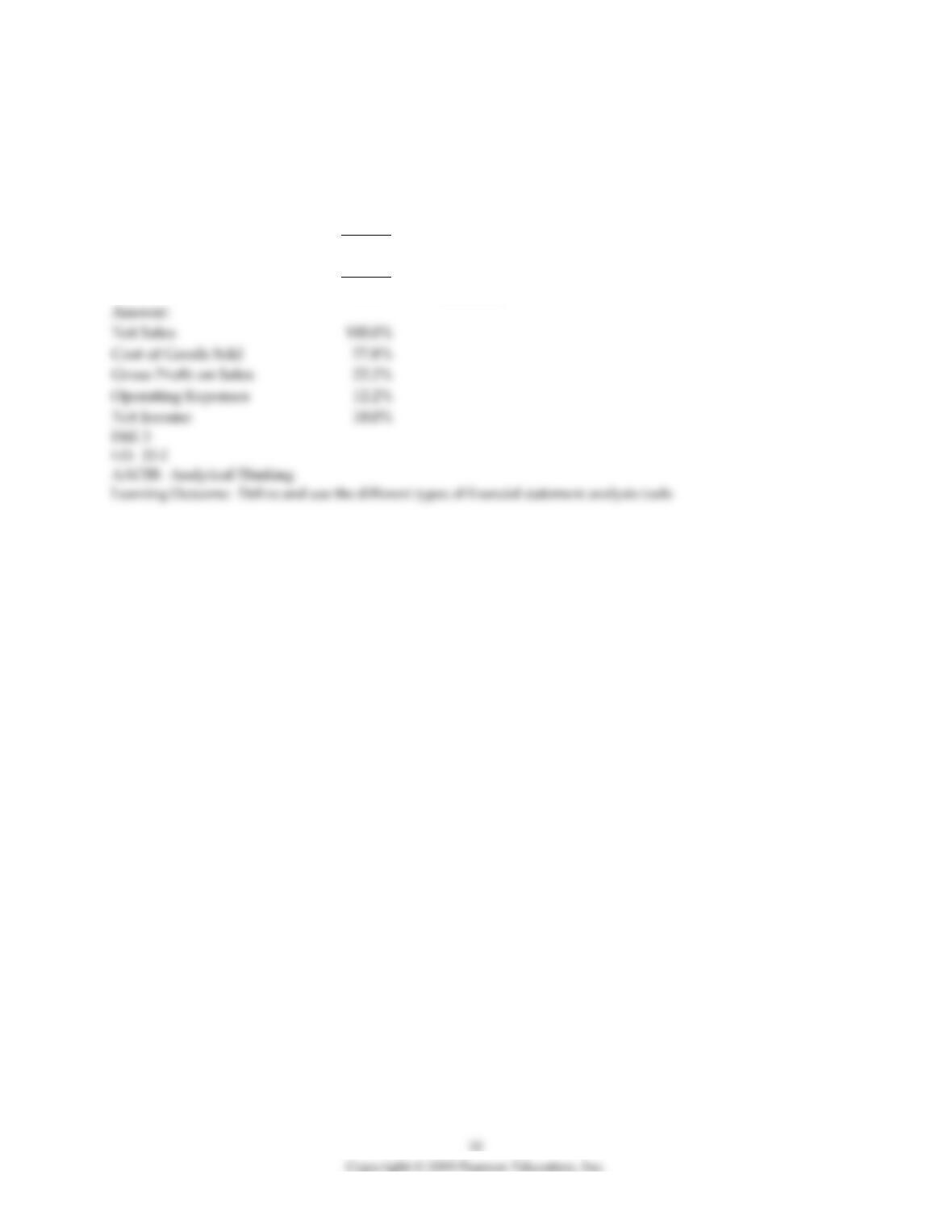
20) From the following, complete the common-size income statement for Isaiah’s Sporting Goods using
net sales as the base. (Round to nearest tenth of a percent.)
Amount Percent
Net Sales $900,000 ________
Cost of Goods Sold 700,000 ________
Gross Profit on Sales 200,000 ________
Operating Expenses 110,000 ________
Net Income 90,000 ________
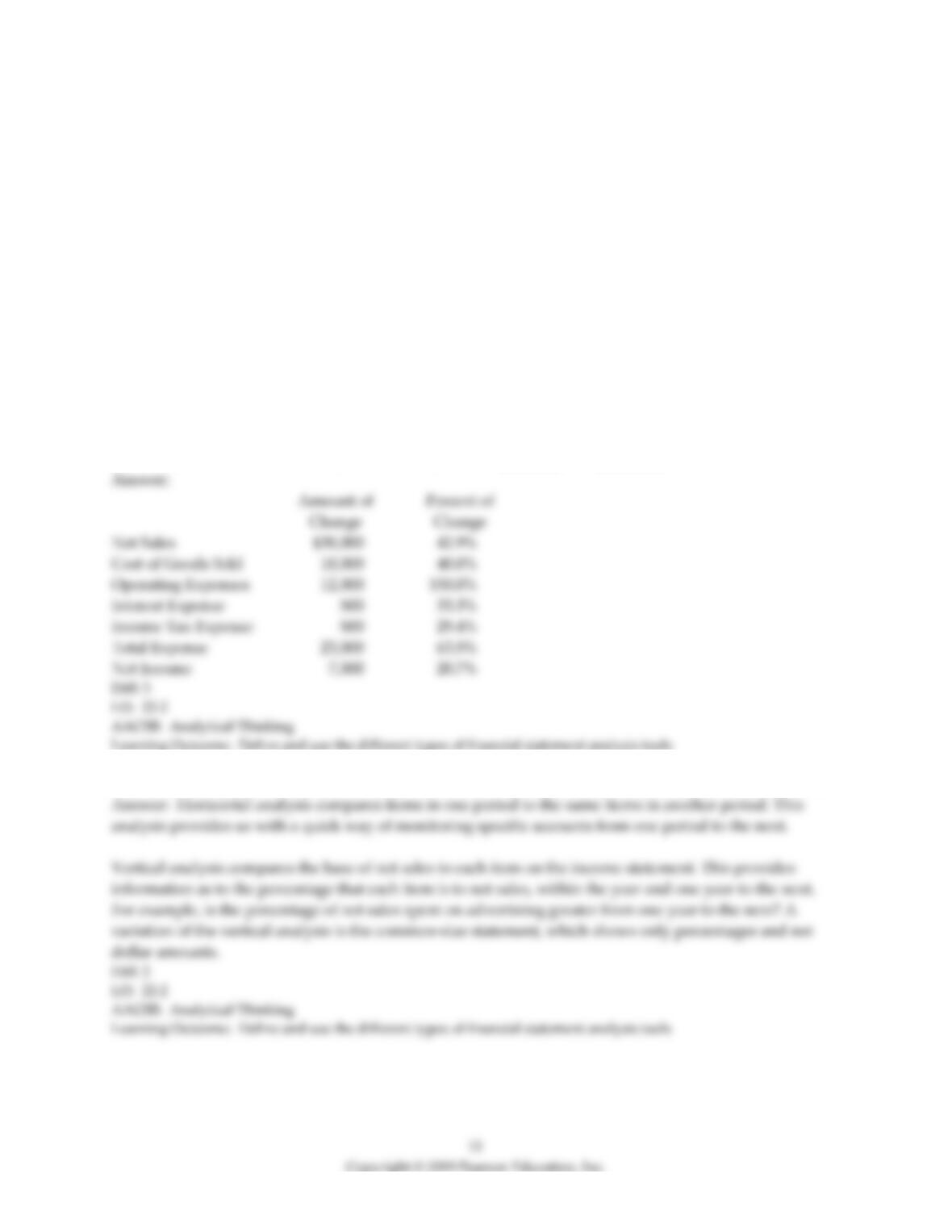
21) Complete the following horizontal analysis comparative income statements of Webster Corporation.
Round to one decimal place.
Webster Corporation
Comparative Income Statements
For the Years Ended December 31, Years 1 and 2
Amt. of Percent of
Year 2 Year 1 Change Change
Net Sales $100,000 $70,000 ________ ________
Expenses:
Cost of Goods Sold $35,000 $25,000 ________ ________
Operating Expense 20,000 8,000 ________ ________
Interest Expense 2,000 1,500 ________ ________
Income Tax Expense 2,200 1,700 ________ ________
Total Expenses $59,200 $36,200 ________ ________
Net Income $40,800 $33,800 ________ ________
22) Define two types of comparative income statements and compare the information provided by them.
22.3 Learning Objective 22-3
1) The ratios that measure a company’s ability to pay off short-term debt are known as:
A) Liquidity Ratios.
B) Debt Management Ratios.
C) Profitability Ratios.
D) None of the above
2) The ratios that measures a company’s mix of debt and equity financing are known as:
A) Liquidity Ratios.
B) Debt Management Ratios.
C) Profitability Ratios.
D) None of the above
3) The ratios that measure a company’s ability to earn profits are known as.
A) Liquidity Ratios.
B) Debt Management Ratios.
C) Profitability Ratios.
D) None of the above
4) The current ratio is:
A) quick assets divided by current liabilities.
B) assets divided by liabilities.
C) current assets divided by current liabilities.
D) net sales divided by current liabilities.
5) The current ratio determines the ability of a company to:
A) pay off all payables.
B) pay off current payables.
C) manage its ability to earn profit.
D) use its equity.
6) The current ratio for a company with current assets of $129,000, current liabilities of $51,000, total
assets of $152,000, and net sales of $84,000, would be: (Round your answers two decimal places, X.XX%.)
A) 2.98.
B) 0.40.
C) 2.53.
D) 0.34.
7) Accounts Receivable Turnover is an example of what type of ratio?
A) Liquidity
B) Asset Management
C) Debt Management
D) Profitability
8) Alliance Plus has total liabilities of $181,000, current liabilities $46,000, and stockholders’ equity
$310,000. What is the debt to total stockholders’ equity ratio? (Round your answer to two decimal places,
X.XX%.)
A) 171.27%
B) 25.41%
C) 14.84%
D) 58.39%
9) An acid test (quick) ratio of 0.75 to 1 would indicate:
A) a ratio that would not allow a company to pay off all current liabilities with quick assets.
B) for every $0.75 of short-term debt there is $1.00 of quick assets to meet short-term obligations.
C) for every $1 of current assets there is $0.75 of short-term debt.
D) Both A and B are correct.
10) A company has $54,000 in cash, $22,000 in accounts receivable, $33,000 in temporary investments and
$134,000 in merchandise inventory. The company has $56,000 in current liabilities. The company’s acid
test (quick) ratio is: (Round your answer two decimal places, X.XX%.)
A) 1.36.
B) 0.51.
C) 4.34.
D) 1.95.
11) With a beginning Accounts Receivable balance of $60,000, an ending balance of $66,000, and net credit
sales of $520,000, compute accounts receivable turnover ratio. (Round your answer two decimal places.)
A) 0.12
B) 8.25
C) 8.67
D) 7.88
12) May Cooperative has total assets of $456,000, current assets $133,000, total liabilities $263,000, and
current liabilities 87,000. What is the debt to total assets ratio?
A) 24.33%
B) 19.08%
C) 197%
D) 57.68%
13) May Cooperative has total liabilities of $263,000, current liabilities 87,000, and stockholders’ equity
$347,000. What is the debt to total stockholders’ equity ratio?
A) 33.08%
B) 75.79%
C) 25.07%
D) 24.21%
14) The ratio that indicates how many days it takes to turn accounts receivable into cash is the:
A) accounts receivable turnover ratio.
B) average turnover ratio.
C) average collection period.
D) quick assets turnover ratio.
15) Orange Designers has net income before taxes of $4,480,000, total assets of $3,500,000, and net sales of
$5,530,000. What is the return on net sales? (Round your answer to two decimal places, X.XX%.)
A) 23.44%
B) 81.01%
C) 63.29%
D) None of the above are correct.
16) If the average collection period is 35 days, this means:
A) from the date of purchase to the date of payment is 35 days.
B) from the date of sale to the date of receipt of payment is 35 days.
C) from the date of discount to the date of receipt of payment is 35 days.
D) None of these answers are correct.
17) The inventory turnover ratio calculates:
A) how many times the inventory turns over in one period.
B) number of times inventory is purchased in one period.
C) the dollar amount of change in inventory in one period.
D) None of these answers are correct.
18) If beginning and ending inventories are $12,000 and $29,000, respectively, and cost of goods sold is
$480,000, what is the inventory turnover ratio? (Round your answer two decimal places.)
A) 23.41
B) 11.71
C) 40.00
D) 16.55
19) Elegant Operators has net sales in the amount of $622,000, a cash amount of $333,000, and accounts
receivables of $50,000. What is the asset turnover ratio?
A) 12.44 times
B) 1.87 times
C) 1.62 times
D) 0.08 times
20) John’s Market’s total assets are $310,000, current assets $126,000, total liabilities $162,000, and current
liabilities $51,000. What is the debt to total assets ratio? (Round your answer to the nearest percentage.)
A) 40.65%
B) 77.78%
C) 52.26%
D) 37.50%
21) Profitability ratios:
A) measure a company’s ability to earn a profit.
B) measure a company’s ability to pay off short-term debts.
C) measure a company‘s mix of debt and equity financing.
D) All of the above are correct.
22) If management wishes to evaluate how effectively the assets of a business are being used, they could
use the:
A) asset turnover ratio.
B) rate of return on common stockholders’ equity.
C) acid test ratio.
D) debt to total stockholders’ equity ratio.
23) If management wishes to evaluate the ability of a business to use sales to cover the operating
expenses, they could use the:
A) rate of return on total assets.
B) rate of return on common stockholders’ equity.
C) gross profit rate.
D) times interest earned.
24) If management wishes to measure how effectively the assets were used in generating a profit, they
could use the:
A) rate of return on total assets.
B) rate of return on common stockholders’ equity.
C) return on sales.
D) times interest earned.
25) If management wishes to know how long it takes to collect from a charge customer, they could use
the:
A) rate of return on total assets.
B) average collection period.
C) acid test ratio.
D) current ratio.
26) If management wishes to evaluate the amount of assets which were financed by creditors, they could
use the:
A) debt to total assets.
B) rate of return on common stockholders’ equity.
C) debt to total liabilities.
D) times interest earned.
27) Maynard Co. has income before taxes of $568,700 and an interest expense of $76,000. What is the times
interest earned ratio? (Round your answer to two decimal places.)
A) 4.24 times
B) 8.48 times
C) 7.48 times
D) 6.48 times
28) Debt to total assets is an example of what type of ratio?
A) Liquidity
B) Asset Management
C) Debt Management
D) Profitability