
Name:
Class:
Date:
chapter 22
Indicate whether the statement is true or false.
1. If Division Inc. expects to sell 200,000 units in the current year, desires ending inventory of 24,000 units, and has
22,000 units on hand as of the beginning of the year, the budgeted volume of production for the year is 198,000 units.
a.
True
b.
False
2. If Division Inc. expects to sell 200,000 units in the current year, desires ending inventory of 24,000 units, and has
22,000 units on hand as of the beginning of the year, the budgeted volume of production for the year is 202,000 units.
a.
True
b.
False
3. The first operating budget to be prepared is usually the sales budget.
a.
True
b.
False
4. The budgeted volume of production is based on the sum of (1) the expected sales volume and (2) the desired ending
inventory, less (3) the estimated beginning inventory.
a.
True
b.
False
5. The first budget to be prepared is usually the cash budget.
a.
True
b.
False
6. Consulting the persons affected by a budget when it is prepared can provide an effective means of motivation and
cooperation.
a.
True
b.
False
7. Employees view budgeting more positively when goals are established for them by senior management.
a.
True
b.
False
8. Once a static budget has been determined, it is changed regularly as the underlying activity changes.
a.
True
b.
False
9. A process whereby the effect of fluctuations in the level of activity is built into the budgeting system is referred to as
flexible budgeting.
a.
True
b.
False
10. A budget procedure that provides for the maintenance at all times of a 12-month projection into the future is called
master budgeting.
a.
True

Name:
Class:
Date:
chapter 22
b.
False
11. Budgets are normally used only by profit-making businesses.
a.
True
b.
False
12. Budgets are prepared in the Accounting Department and monitored by various department managers.
a.
True
b.
False
13. A formal written statement of management’s plans for the future, expressed in financial terms, is called a budget.
a.
True
b.
False
14. The task of preparing a budget should be the sole task of the most important department in an organization.
a.
True
b.
False
15. After the sales budget is prepared, the production budget is normally prepared next.
a.
True
b.
False
16. The first operating budget to be prepared is usually the production budget.
a.
True
b.
False
17. The sales budget is the starting point for preparation of the direct labor cost budget.
a.
True
b.
False
18. Supervisor salaries, maintenance, and indirect factory wages would normally appear in the selling and administrative
expenses budget.
a.
True
b.
False
19. The cash budget summarizes future plans for acquisition of fixed assets.
a.
True
b.
False
20. The production budget is the starting point for preparation of the direct labor cost budget.
a.
True
b.
False
21. The sales budget is derived from the production budget.
a.
True

Name:
Class:
Date:
chapter 22
b.
False
22. The capital expenditures budget is part of the planned investing activities of a company.
a.
True
b.
False
23. The cash budget presents the expected inflow and outflow of cash for a specified period of time.
a.
True
b.
False
24. Detailed supplemental schedules based on department responsibility are often prepared for major items in the selling
and administrative expenses budget.
a.
True
b.
False
25. Supervisor salaries and indirect factory wages would normally appear in the direct labor cost budget.
a.
True
b.
False
26. The budgeted balance sheet assumes that all operating and financing plans are met.
a.
True
b.
False
27. The method of budgeting that requires managers to estimate sales, production, and other operating data as though
operations are being started for the first time is called zero-based budgeting.
a.
True
b.
False
28. A budget procedure that provides for the maintenance at all times of a 12-month projection into the future is called
continuous budgeting.
a.
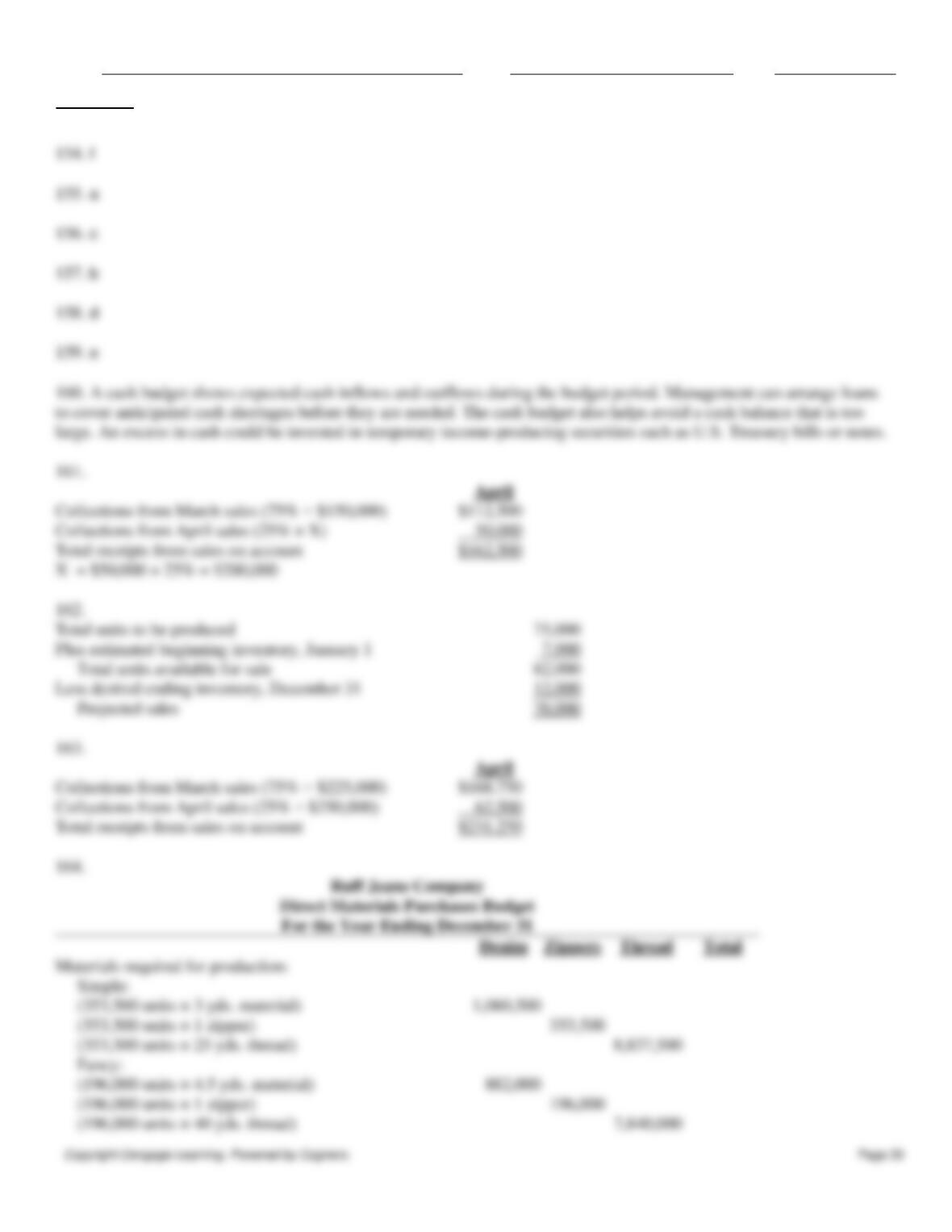
True
b.
False
29. The method of budgeting that requires all levels of management to start from zero in estimating sales, production, and
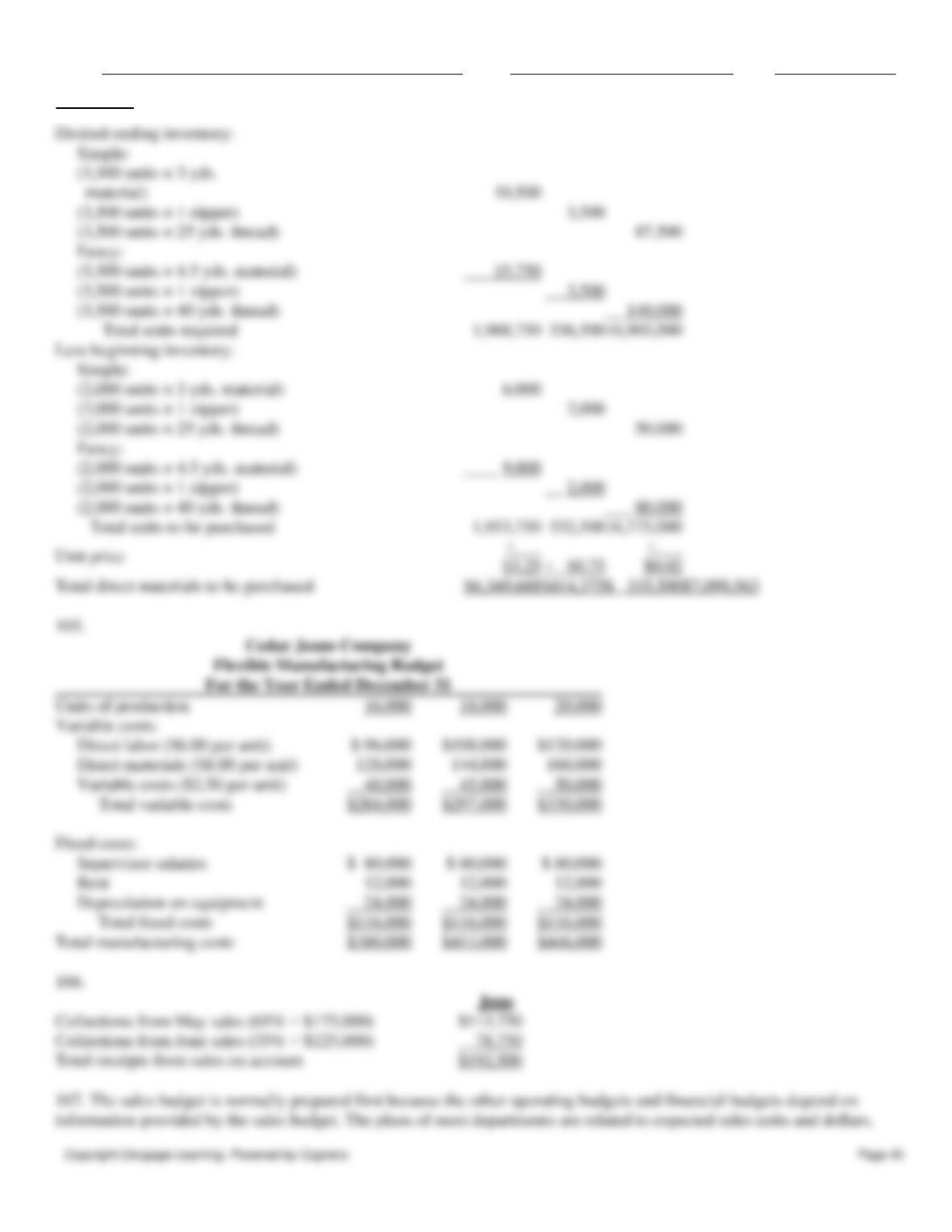
other operating data is called noncontinuous budgeting.
a.
True
b.
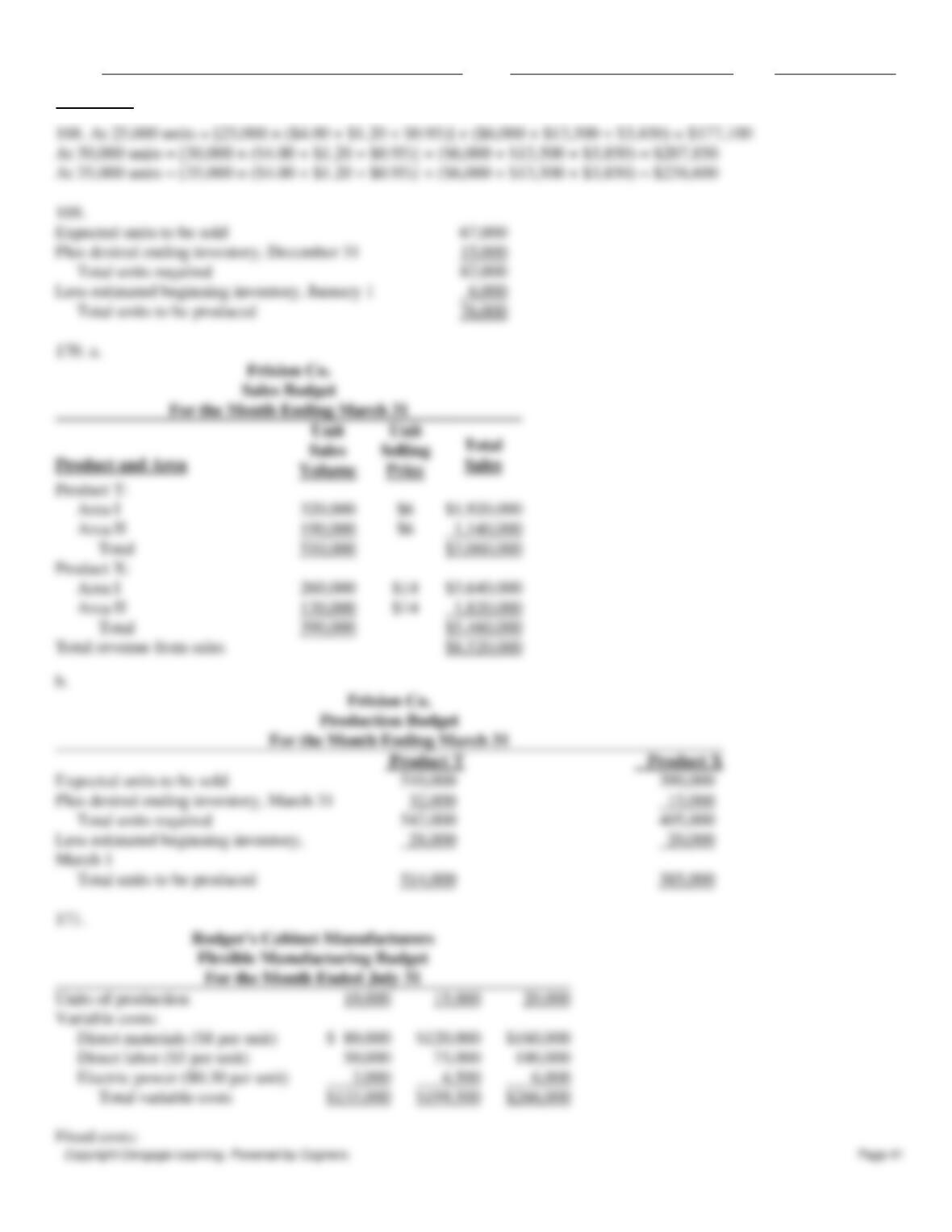
False
30. In preparing flexible budgets, the first step is to identify the fixed and variable components of the various costs and
expenses being budgeted.
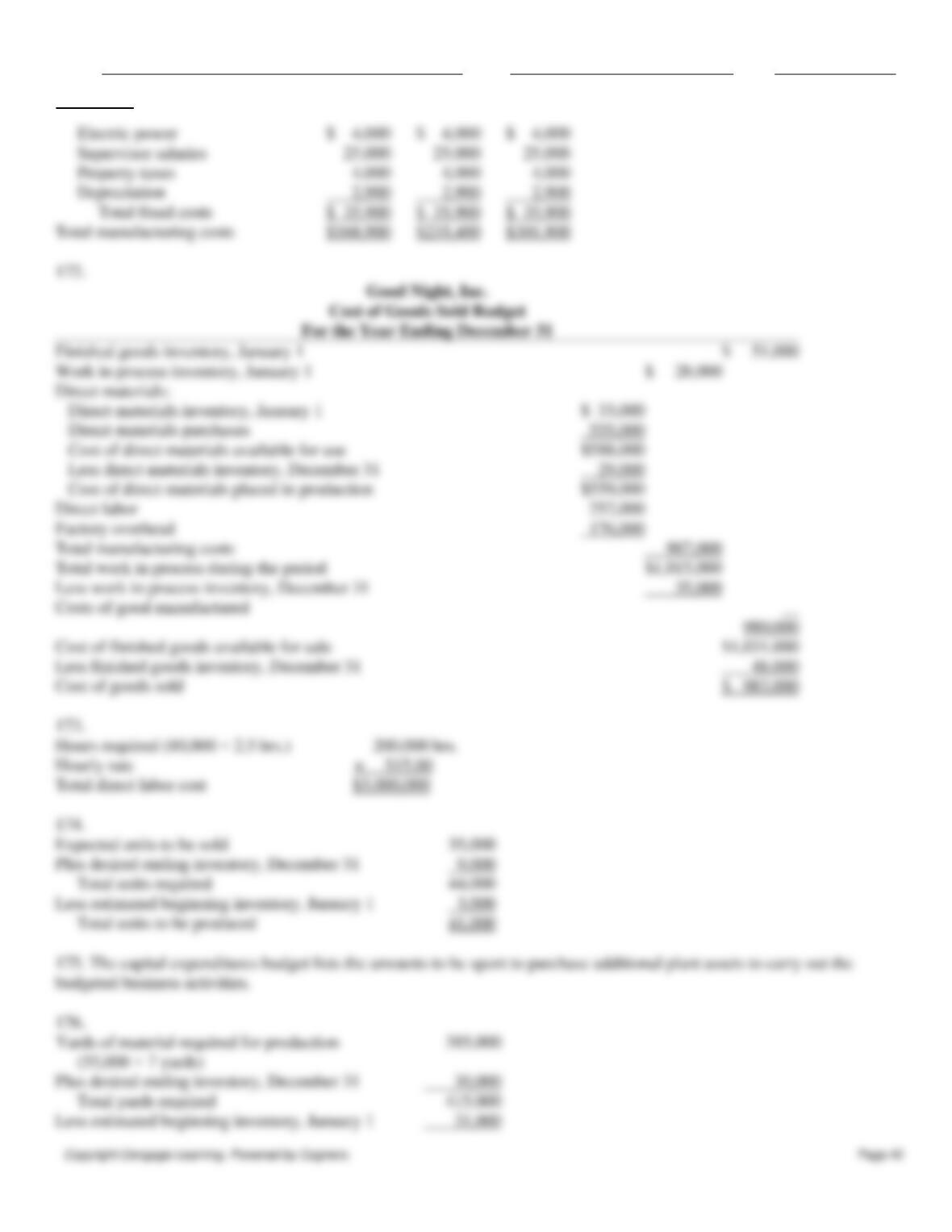
a.
True
b.
False
31. Part of the cash budget is based on information drawn from the capital expenditures budget.
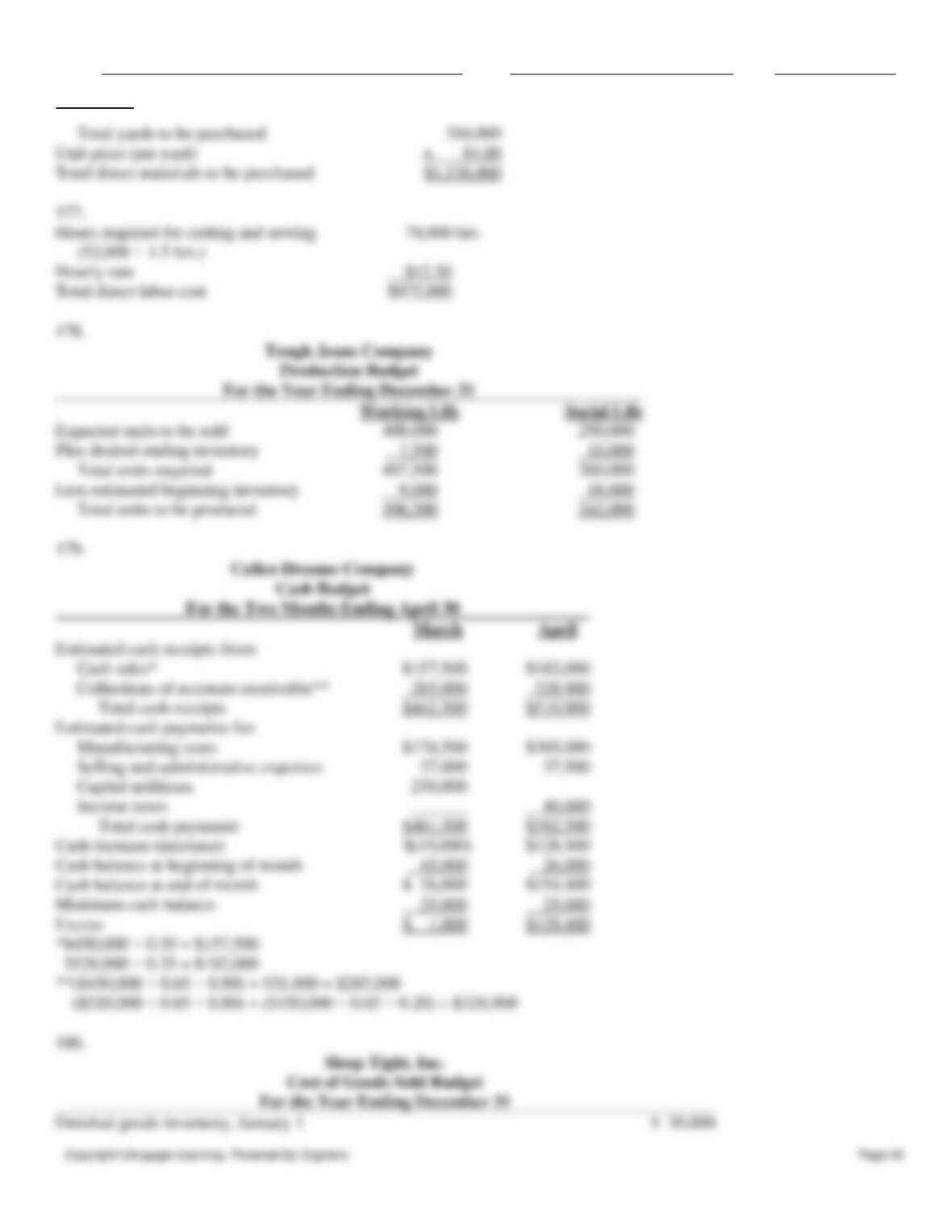
a.
True
b.
False

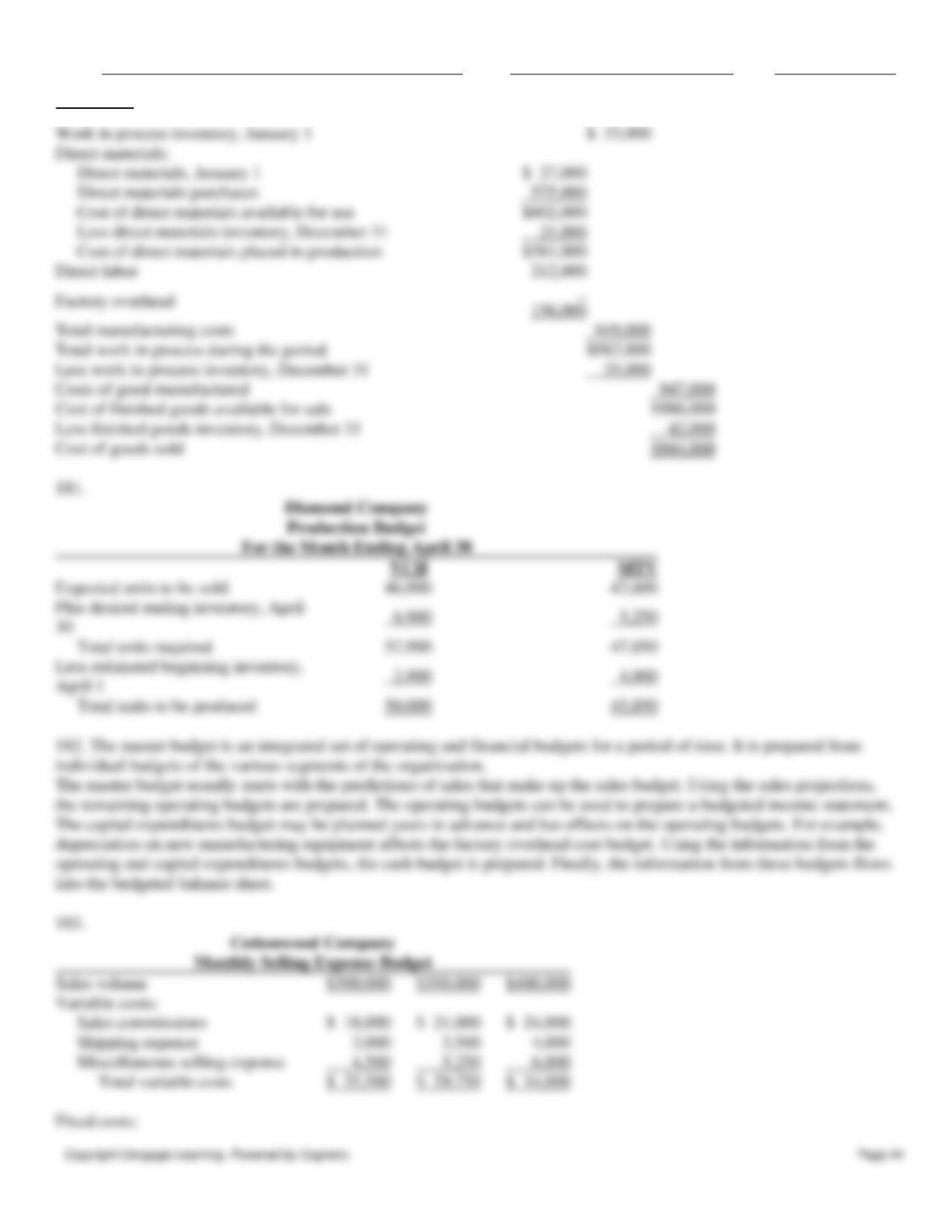
Name:
Class:
Date:
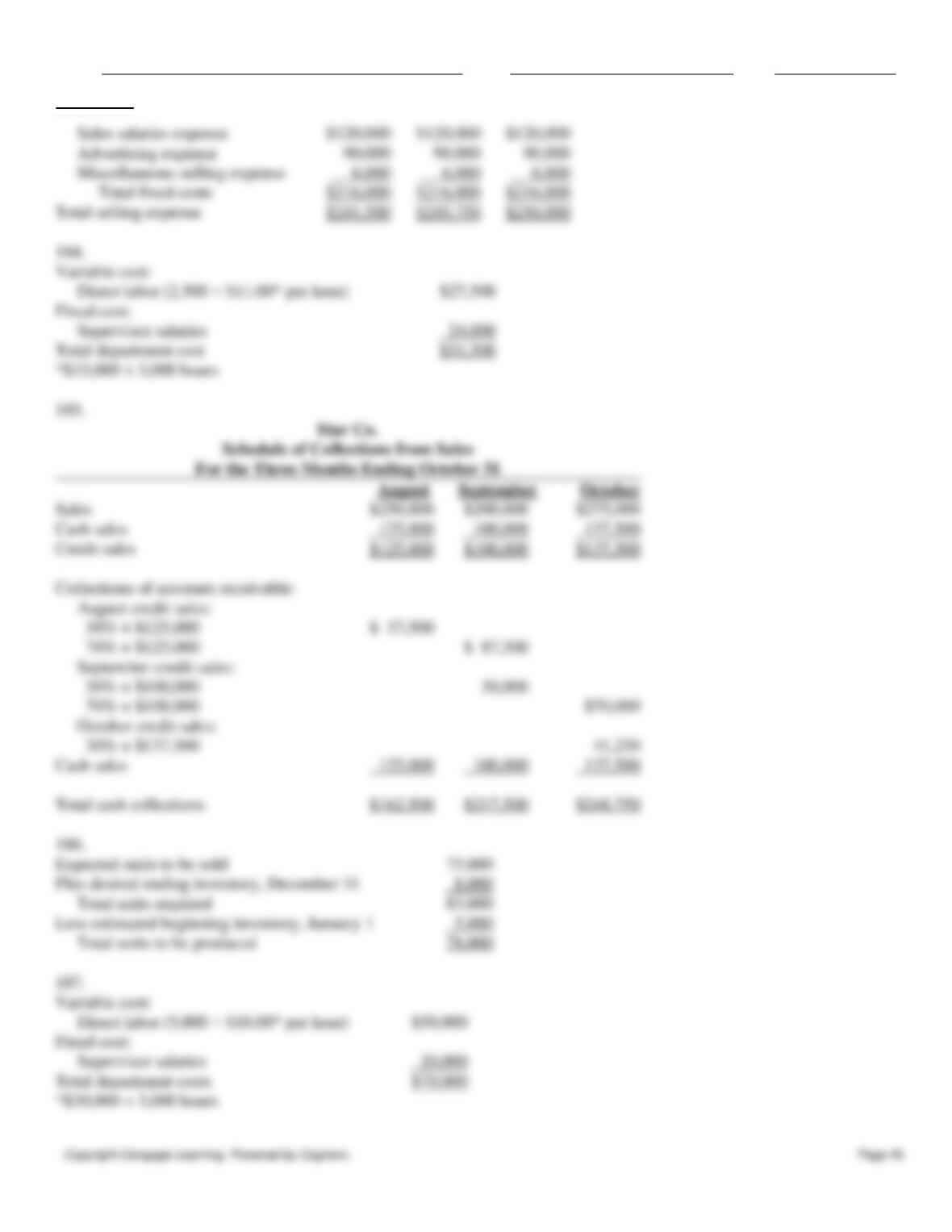
chapter 22
32. The responsibility for coordinating the preparation of a master budget should be assigned to the CEO of a firm.
a.
True
b.
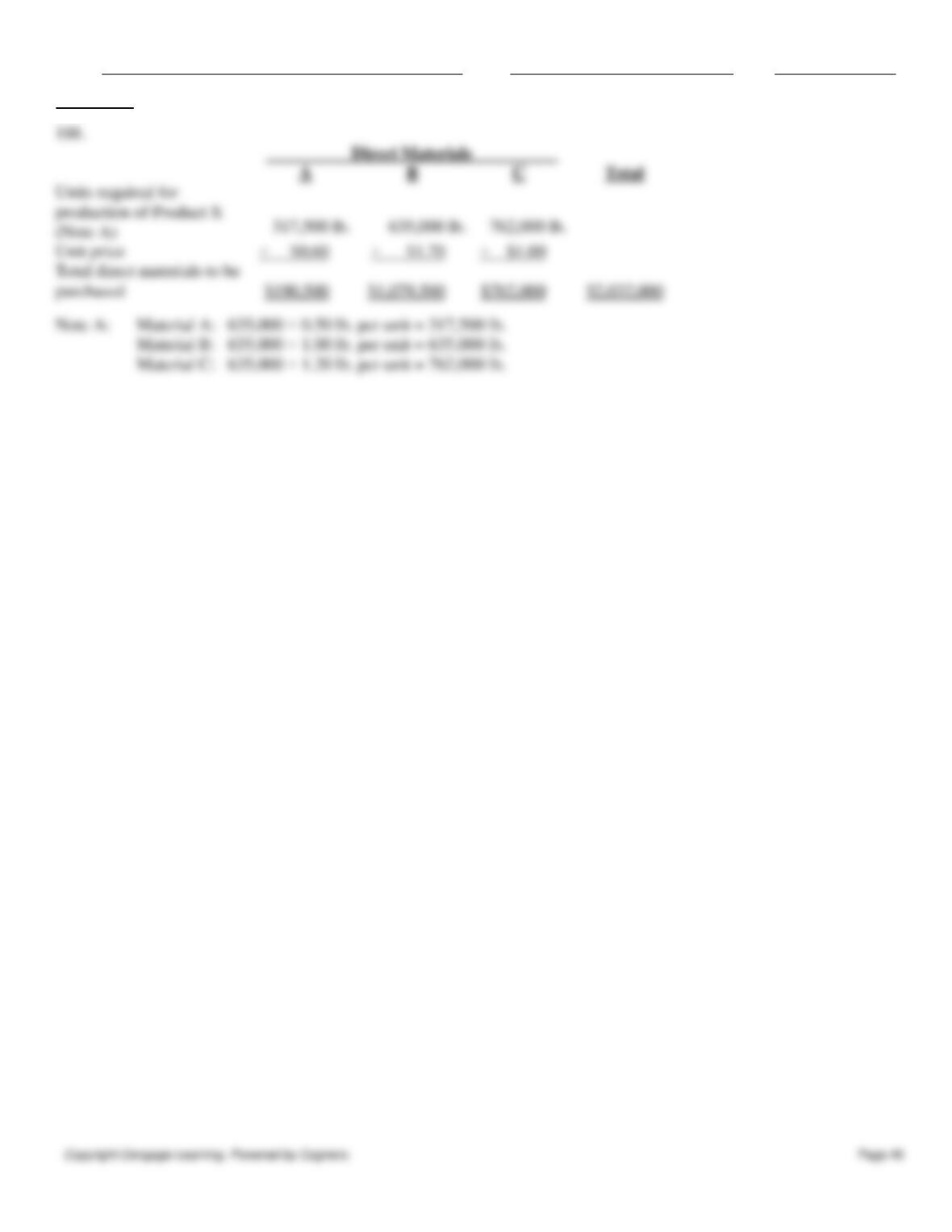
False
33. The capital expenditures budget details future plans for acquisition of fixed assets.
a.
True
b.
False
34. The budgeted volume of production is normally computed as the sum of (1) the expected sales volume and (2) the
desired ending inventory.
a.
True
b.
False
35. The financial budgets of a business include the cash budget, the budgeted income statement, and the budgeted balance
sheet.
a.
True
b.
False
36. Supervisor salaries, maintenance, and indirect factory wages would normally appear in the factory overhead cost
budget.
a.
True
b.
False
37. The cash budget is affected by the sales budget, the various budgets for manufacturing costs and operating expenses,
and the capital expenditures budget.
a.
True
b.
False
38. Flexible budgeting requires all levels of management to start from zero and estimate sales, production, and other
operating data as though operations were being started for the first time.
a.
True
b.
False
39. When slack is built into the budget, it may create inefficiencies.
a.
True
b.
False
40. Flexible budgeting builds the effect of changes in level of activity into the budget system.
a.
True
b.
False
41. The budget procedures used by a large manufacturer of automobiles would probably not differ from those used by a
small manufacturer of paper products.
a.
True
b.
False
42. A capital expenditures budget is prepared for 5 to 10 years into the future.

Name:
Class:
Date:
chapter 22
a.
True
b.
False
43. The master budget is an integrated set of budgets that tie together a company’s operating, financing, and investing
activities into an integrated plan for the coming year.
a.
True
b.
False
44. The flexible budget is, in effect, a series of static budgets for different levels of activity.
a.
True
b.
False
45. The budgeted direct materials purchases is normally computed as the sum of (1) the materials for production and (2)
the desired ending inventory.
a.
True
b.
False
46. Past performance is the best overall basis for evaluating current performance and assessing the need for corrective
action.
a.
True
b.
False
47. When budget goals are set too tight, the budget becomes less effective as a tool for planning and controlling
operations.
a.
True
b.
False
48. The objectives of budgeting are (1) establishing specific goals for future operations, (2) executing plans to achieve the
goals, and (3) periodically comparing actual results with these goals.
a.
True
b.
False
49. The budgeted direct materials purchases is based on the sum of (1) the materials needed for production and (2) the
desired ending materials inventory, less (3) the estimated beginning materials inventory.
a.
True
b.
False
Indicate the answer choice that best completes the statement or answers the question.
Use this information for Mandy Corporation to answer the questions that follow.
Mandy Corporation sells a single product. Budgeted sales for the year are anticipated to be 640,000 units, estimated
beginning inventory is 98,000 units, and desired ending inventory is 80,000 units. The quantities of direct materials
expected to be used for each unit of finished product are as follows:
Material A: 0.50 lb. per unit @ $0.60 per pound
Material B: 1.00 lb. per unit @ $1.70 per pound

Name:
Class:
Date:
chapter 22
Material C: 1.20 lb. per unit @ $1.00 per pound
50. The dollar amount of Material B to be used in production during the year is
a.
$1,057,400
b.
$1,193,400
c.
$1,026,800
d.
$1,224,000
51. Truliant Co. sells a product called Withitall and has predicted the following sales for the first 4 months of the current
year:
January
February
March
April
Sales in units
1,700
1,900
2,100
1,600
Ending inventory for each month should be 20% of the next month’s sales. How many units should be produced in
February?
a.
1,940
b.
1,800
c.
1,900
d.
1,850
Use this information about Finch Company to answer the questions that follow.
Finch Company began its operations on March 31 of the current year. Finch has the following projected costs:
April
May
June
Manufacturing costs (1)
$156,800
$195,200
$217,600
Insurance expense (2)
1,000
1,000
1,000
Depreciation expense
2,000
2,000
2,000
Property tax expense (3)
500
500
500
(1)
Of the manufacturing costs, three-fourths are paid for in the month they are incurred and one-fourth is paid for in the
following month.
(2)
Insurance expense is $1,000 a month; however, the insurance is paid four times yearly, in the first month of
the quarter (i.e., January, April, July, and October).
(3)
Property tax is paid once a year in November.
52. The cash payments expected for Finch Company in the month of June are
a.
$215,500
b.
$188,800
c.
$214,000
d.
$212,000
53. Gilbert’s expects its September sales to be 20% higher than its August sales of $150,000. Manufacturing costs were
$100,000 in August and are expected to be $120,000 in September. All sales are on credit and are collected as follows:
30% in the month of the sale and 70% in the following month. Payments of manufacturing costs are as follows: 25% in
the month of production and 75% in the following month. The beginning cash balance on September 1 is $7,500. The
ending balance on September 30 would be
a.
$61,500
b.
$75,000

Name:
Class:
Date:
chapter 22
c.
$72,300
d.
$71,500
54. A disadvantage of static budgets is that they
a.
are dependent on the previous year’s actual results
b.
cannot be used by service companies
c.
do not allow for possible changes in underlying activity levels
d.
show the expected results of a responsibility center for several levels of activity
55. Woodpecker Co. has $296,000 in accounts receivable on January 1. Budgeted sales for January are $860,000.
Woodpecker Co. expects to sell 20% of its merchandise for cash. Of the remaining 80% of sales on account, 75% are
expected to be collected in the month of sale and the remainder the following month. The January cash collections from
sales are
a.
$812,000
b.
$688,000
c.
$468,000
d.
$984,000
56. Consider Derek’s budget information: materials to be used, $64,750; direct labor, $198,400; factory overhead,
$394,800; work in process inventory on January 1, $189,100; and work in process inventory on December 31, $197,600.
What is the budgeted cost of goods manufactured for the year?
a.
$649,450
b.
$657,950
c.
$197,600
d.
$1,044,650
57. If the expected sales volume for the current period is 9,000 units, the desired ending inventory is 200 units, and the
beginning inventory is 300 units, the number of units set forth in the production budget, representing total production for
the current period, is
a.
9,000
b.
8,900
c.
8,700
d.
9,100
58. If the expected sales volume for the current period is 8,000 units, the desired ending inventory is 1,400 units, and the
beginning inventory is 1,200 units, the number of units set forth in the production budget, representing total production for
the current period, is
a.
10,600
b.
8,200
c.
66,000
d.
6,800
59. The process of developing budget estimates that require managers to estimate sales, production, and other operating
data as though operations were being initiated for the first time is referred to as
a.
flexible budgeting
b.
continuous budgeting

Name:
Class:
Date:
chapter 22
Estimated beginning inventory
c.
zero-based budgeting
d.
master budgeting
60. The primary difference between a static budget and a flexible budget is that a static budget
a.
is suitable in a volatile demand situation while a flexible budget is suitable in a stable demand situation
b.
is concerned only with future acquisitions of fixed assets, whereas a flexible budget is concerned with
expenses that vary with sales
c.
includes only fixed costs, whereas a flexible budget includes only variable costs
d.
is a plan for a single level of production, whereas a flexible budget can be converted to any level of production
Use this information about Theo Company to answer the questions that follow.
Theo Company is preparing its cash budget. Its cash balance on January 1 is $290,000, and it has a minimum cash
requirement of $340,000. The following data have been provided:
January
February
March
Cash receipts
$1,061,200
$1,182,400
$1,091,700
Cash payments
984,500
1,210,000
1,075,000
61. What is the amount of the deficiency or excess cash (after considering the minimum cash balance required) for
January?
a.
excess of $26,700
b.
deficiency of $136,700
c.
excess of $356,700
d.
excess of $60,000
62. At the beginning of the period, the Cutting Department budgeted direct labor of $155,000, direct materials of
$165,000, and fixed factory overhead of $15,000 for 9,000 hours of production. The department actually completed
10,000 hours of production. What is the appropriate total budget for the department, assuming it uses flexible budgeting?
Round hourly rates to two decimal places.
a.
$416,000
b.
$370,500
c.
$368,889
d.
$335,000
63. For March, sales revenue is $1,000,000, sales commissions are 5% of sales, the sales manager’s salary is $80,000,
advertising expenses are $65,000, shipping expenses total 1% of sales, and miscellaneous selling expenses are $2,100 plus
1% of sales. Total selling expenses for the month of March are
a.
$217,100
b.
$205,000
c.
$207,100
d.
$142,100
Use this information about Flushing Company to answer the questions that follow.
The budgeted production and sales information for Flushing Company for the month of December is as follows:
Product XXX
Product ZZZ

Name:
Class:
Date:
chapter 22
Desired ending inventory
34,000 units
17,000 units
Region I, anticipated sales
320,000 units
260,000 units
Region II, anticipated sales
180,000 units
140,000 units
The unit selling price for Product XXX is $5 and for Product ZZZ is $15.
64. Budgeted production for Product ZZZ during the month is
a.
403,000 units
b.
380,000 units
c.
397,000 units
d.
417,000 units
Use this information about Finch Company to answer the questions that follow.
Finch Company began its operations on March 31 of the current year. Finch has the following projected costs:
April
May
June
Manufacturing costs (1)
$156,800
$195,200
$217,600
Insurance expense (2)
1,000
1,000
1,000
Depreciation expense
2,000
2,000
2,000
Property tax expense (3)
500
500
500
(1)
Of the manufacturing costs, three-fourths are paid for in the month they are incurred and one-fourth is paid for in the
following month.
(2)
Insurance expense is $1,000 a month; however, the insurance is paid four times yearly, in the first month of
the quarter (i.e., January, April, July, and October).
(3)
Property tax is paid once a year in November.
65. The cash payments expected for Finch Company in the month of April are
a.
$122,600
b.
$120,600
c.
$123,100
d.
$121,100
66. Which of the following would not be used in preparing a cash budget for October?
a.
beginning cash balance on October 1
b.
budgeted salaries expense for October
c.
estimated depreciation expense for October
d.
budgeted sales and collections for October
Use this information about Flushing Company to answer the questions that follow.
The budgeted production and sales information for Flushing Company for the month of December is as follows:
Product XXX
Product ZZZ
Estimated beginning inventory
32,000 units
20,000 units
Desired ending inventory
34,000 units
17,000 units
Region I, anticipated sales
320,000 units
260,000 units
Region II, anticipated sales
180,000 units
140,000 units
The unit selling price for Product XXX is $5 and for Product ZZZ is $15.

Name:
Class:
Date:
chapter 22
67. Budgeted sales for the month are
a.
$3,180,000
b.
$5,820,000
c.
$1,800,000
d.
$8,500,000
68. Principal components of a master budget include
a.
production budget
b.
sales budget
c.
capital expenditures budget
d.
All of these choices
Use this information about July production to answer the questions that follow.
Production estimates for July are as follows:
Estimated inventory (units), July 1
8,500
Desired inventory (units), July 31
10,500
Expected sales volume (units), July
76,000
For each unit produced, the direct materials requirements are as follows:
Direct material A ($5 per lb.)
3 lb.
Direct material B ($18 per lb.)
½ lb.
69. The total direct materials purchases of Material A and Material B (assuming no beginning or ending material
inventory) required for July production is
a.
$1,080,000 for A; $648,000 for B
b.
$1,080,000 for A; $1,296,000 for B
c.
$1,170,000 for A; $702,000 for B
d.
$1,125,000 for A; $675,000 for B
70. Heedy Company is trying to decide how many units of merchandise to produce each month. The company policy is to
have 20% of the next month’s sales in inventory at the end of each month. Projected sales for August, September, and
October are 30,000 units, 20,000 units, and 40,000 units, respectively. How many units must be produced in September?
a.
24,000
b.
18,000
c.
28,000
d.
22,000
71. The operating budgets of a company include the
a.
cash budget
b.
capital expenditures budget
c.
financing budget
d.
production budget
72. The budget process involves doing all of the following except
a.
establishing specific goals

Name:
Class:
Date:
chapter 22
b.
executing plans to achieve the goals
c.
periodically comparing actual results with the goals
d.
dismissing all managers who fail to achieve operational goals specified in the budget
73. Production and sales estimates for June are as follows:
Estimated inventory (units), June 1
20,000
Desired inventory (units), June 30
19,000
Expected sales volume (units):
Area X
7,000
Area Y
4,000
Area Z
5,500
Unit sales price
$20
Budgeted production for June is
a.
11,000
b.
12,500
c.
15,500
d.
13,500
74. As of January 1 of the current year, Grackle Company had accounts receivable of $50,000. The sales for January,
February, and March were $120,000, $140,000, and $150,000, respectively. Of each month’s sales, 20% are for cash. Of
the remaining 80% (the credit sales), 60% are collected in the month of sale, with the remaining 40% collected in the
following month. What is the total cash collected (both from accounts receivable and cash sales) in the month of March?
a.
$74,800
b.
$146,800
c.
$102,000
d.
$116,800
Use this information about Bluebird Company to answer the questions that follow.
The following is the budgeted production and sales information for Bluebird Company for the month of December.
Product XXX
Product ZZZ
Estimated beginning inventory
30,000 units
18,000 units
Desired ending inventory
32,000 units
15,000 units
Anticipated sales
520,000 units
460,000 units
The unit selling price for Product XXX is $5 and for Product ZZZ is $14.
75. Budgeted production for Product ZZZ during the month is
a.
460,000 units
b.
475,000 units
c.
457,000 units
d.
463,000 units
76. Jase Manufacturing Co.’s static budget for 10,000 units of production includes $40,000 for direct labor and $4,000 for
variable electric power. Total fixed costs are $24,000. At 12,000 units of production, a flexible budget would show
a.
variable costs of $52,800 and $29,000 of fixed costs

Name:
Class:
Date:
chapter 22
b.
variable costs of $44,000 and $24,000 of fixed costs
c.
variable costs of $52,800 and $24,000 of fixed costs
d.
variable and fixed costs totaling $68,000
Use this information for August production to answer the questions that follow.
Production estimates for August are as follows:
Estimated inventory (units), August 1
12,000
Desired inventory (units), August 31
9,000
Expected sales volume (units), August
75,000
For each unit produced, the direct materials requirements are as follows:
Material A ($5 per lb.)
3 lb.
Material B ($18 per lb.)
½ lb.
77. The number of pounds of Material A and Material B required for August production is
a.
216,000 lb. of A; 72,000 lb. of B
b.
216,000 lb. of A; 36,000 lb. of B
c.
225,000 lb. of A; 37,500 lb. of B
d.
234,000 lb. of A; 39,000 lb. of B
Use this information about Cardinal Company to answer the questions that follow.
Cardinal Company had a finished goods inventory of 55,000 units on January 1. Its projected sales for the next four
months were: January, 200,000 units; February, 180,000 units; March, 210,000 units; and April, 230,000 units. Cardinal
Company wishes to maintain a desired ending finished goods inventory of 20% of the following month’s sales.
78. Determine the budgeted units of inventory for March 31.
a.
46,000
b.
36,000
c.
cannot be determined from the data given
d.
42,000
79. The first operating budget customarily prepared as part of an entity’s master budget is the
a.
production budget
b.
cash budget
c.
sales budget
d.
direct materials purchases budget
80. Miller and Sons’ static budget for 10,000 units of production includes $50,000 for direct materials, $44,000 for direct
labor, variable utilities of $5,000, and supervisor salaries of $24,000. A flexible budget for 12,000 units of production
would show
a.
the same cost structure in total
b.
direct materials of $60,000, direct labor of $52,800, utilities of $6,000, and supervisor salaries of $28,800
c.
total variable costs of $148,000
d.
direct materials of $60,000, direct labor of $52,800, utilities of $6,000, and supervisor salaries of $24,000
81. For February, sales revenue is $700,000, sales commissions are 5% of sales, the sales manager’s salary is $96,000,

Name:
Class:
Date:
chapter 22
advertising expenses are $90,000, shipping expenses total 2% of sales, and miscellaneous selling expenses are $2,500
plus ½ of 1% of sales. Total selling expenses for the month of February are
a.
$161,000
b.
$237,500
c.
$235,000
d.
$241,000
82. Production and sales estimates for May for Cardinal Co. are as follows:
Estimated inventory (units), May 1
19,500
Desired inventory (units), May 31
19,300
Expected sales volume (units):
Area W
6,000
Area X
7,000
Area Y
8,000
Unit sales price
$20
The number of units expected to be sold in May is
a.
21,000
b.
3,700
c.
22,800
d.
18,300
83. The budgetary unit of an organization that is led by a manager who has both the authority over and responsibility for
the unit’s performance is known as a
a.
control center
b.
budgetary area
c.
responsibility center
d.
managerial department
84. Estimated cash payments are planned reductions in cash from all of the following except
a.
manufacturing and operating expenses
b.
capital expenditures
c.
notes and accounts receivable collections
d.
payments for interest or dividends
Use this information for August production to answer the questions that follow.
Production estimates for August are as follows:
Estimated inventory (units), August 1
12,000
Desired inventory (units), August 31
9,000
Expected sales volume (units), August
75,000
For each unit produced, the direct materials requirements are as follows:
Material A ($5 per lb.)
3 lb.
Material B ($18 per lb.)
½ lb.
85. The total direct materials purchases (assuming no beginning or ending inventory of material) of Material A and
Material B required for August production is

Name:
Class:
Date:
chapter 22
a.
$1,080,000 for A; $1,296,000 for B
b.
$1,080,000 for A; $648,000 for B
c.
$1,125,000 for A; $675,000 for B
d.
$1,170,000 for A; $702,000 for B
Use this information about Nuthatch Corporation to answer the questions that follow.
Nuthatch Corporation began its operations on September 1 of the current year. Budgeted sales for the first 3 months of
business—September, October, and November—are $260,000, $375,000, and $400,000, respectively. The company
expects to sell 30% of its merchandise for cash. Of sales on account, 80% are expected to be collected in the month of the
sale and 20% in the month following the sale.
86. The cash collections expected in October from accounts receivable are estimated to be
a.
$246,400
b.
$262,500
c.
$210,000
d.
$294,500
Use this information about Bluebird Company to answer the questions that follow.
The following is the budgeted production and sales information for Bluebird Company for the month of December.
Product XXX
Product ZZZ
Estimated beginning inventory
30,000 units
18,000 units
Desired ending inventory
32,000 units
15,000 units
Anticipated sales
520,000 units
460,000 units
The unit selling price for Product XXX is $5 and for Product ZZZ is $14.
87. Budgeted production for Product XXX during the month is
a.
522,000 units
b.
552,000 units
c.
518,000 units
d.
520,000 units
Use this information about Cardinal Company to answer the questions that follow.
Cardinal Company had a finished goods inventory of 55,000 units on January 1. Its projected sales for the next four
months were: January, 200,000 units; February, 180,000 units; March, 210,000 units; and April, 230,000 units. Cardinal
Company wishes to maintain a desired ending finished goods inventory of 20% of the following month’s sales.
88. Determine the budgeted units of production for January.
a.
236,000
b.
181,000
c.
200,000
d.
219,000
Use this information about Product A and Product B to answer the questions that follow.
Next year’s sales forecast shows that 20,000 units of Product A and 22,000 units of Product B are going to be sold for

Name:
Class:
Date:
chapter 22
prices of $10 and $12 per unit, respectively. The desired ending inventory of Product A is 20% higher than its beginning
inventory of 2,000 units. The beginning inventory of Product B is 2,500 units. The desired ending inventory of Product B
is 3,000 units.
89. Budgeted production of Product A for the year would be
a.
22,400 units
b.
20,400 units
c.
20,000 units
d.
12,200 units
90. Total budgeted sales of both products for the year would be
a.
$42,000
b.
$200,000
c.
$264,000
d.
$464,000
91. Production and sales estimates for April are as follows:
Estimated inventory (units), April 1
9,000
Desired inventory (units), April 30
8,000
Expected sales volume (units):
Area A
3,500
Area B
4,750
Area C
4,250
Unit sales price
$20
The budgeted total sales for April is
a.
$200,000
b.
$230,000
c.
$270,000
d.
$250,000
Use this information about Flushing Company to answer the questions that follow.
The budgeted production and sales information for Flushing Company for the month of December is as follows:
Product XXX
Product ZZZ
Estimated beginning inventory
32,000 units
20,000 units
Desired ending inventory
34,000 units
17,000 units
Region I, anticipated sales
320,000 units
260,000 units
Region II, anticipated sales
180,000 units
140,000 units
The unit selling price for Product XXX is $5 and for Product ZZZ is $15.
92. Budgeted production for Product XXX during the month is
a.
498,000 units
b.
502,000 units
c.
534,000 units
d.
566,000 units

Name:
Class:
Date:
chapter 22
93. As of January 1 of the current year, Grayson Company had accounts receivable of $40,000. The sales for January,
February, and March were $120,000, $140,000, and $150,000, respectively. Of each month’s sales, 20% are for cash. Of
the remaining 80% (the credit sales), 60% are collected in the month of sale, with the remaining 40% collected in the
following month. What is the total cash collected (both from accounts receivable and for cash sales) in the month of
January?
a.
$64,000
b.
$107,000
c.
$61,600
d.
$121,600
Use this information about Cardinal Company to answer the questions that follow.
Cardinal Company had a finished goods inventory of 55,000 units on January 1. Its projected sales for the next four
months were: January, 200,000 units; February, 180,000 units; March, 210,000 units; and April, 230,000 units. Cardinal
Company wishes to maintain a desired ending finished goods inventory of 20% of the following month’s sales.
94. Determine the budgeted units of production for March.
a.
256,000
b.
206,000
c.
214,000
d.
298,000
95. The budgeting process does not involve which of the following activities?
a.
establishment of specific goals
b.
periodic comparison of actual results to goals
c.
execution of plans to achieve goals
d.
increase in sales by increasing marketing efforts
96. Stephanie Corporation sells a single product. Budgeted sales for the year are anticipated to be 640,000 units, estimated
beginning inventory is 108,000 units, and desired ending inventory is 90,000 units. The quantities of direct materials
expected to be used for each unit of finished product areas follows:
Material A: 0.50 lb. per unit @ $0.70 per pound
Material B: 1.00 lb. per unit @ $1.70 per pound
Material C: 1.20 lb. per unit @ $1.00 per pound
The dollar amount of Material A to be used in production during the year is
a.
$217,700
b.
$528,700
c.
$311,000
d.
$224,600
97. An October sales forecast projects that 7,000 units are going to be sold at a price of $11.50 per unit. The desired
ending inventory in units is 15% higher than the beginning inventory of 1,000 units. Total October sales are anticipated to
be
a.
$69,000
b.
$80,500
c.
$70,000

Name:
Class:
Date:
chapter 22
d.
$92,000
98. Which of the following budgets provides the starting point for the preparation of the direct labor cost budget?
a.
direct materials purchases budget
b.
cash budget
c.
production budget
d.
sales budget
99. Willow Valley’s April sales forecast projects that 7,000 units will sell at a price of $10.50 per unit. The desired ending
inventory is 30% higher than the beginning inventory, which was 1,000 units. Budgeted production in April would be
a.
8,000 units
b.
7,000 units
c.
7,300 units
d.
6,300 units
Use this information about Nuthatch Corporation to answer the questions that follow.
Nuthatch Corporation began its operations on September 1 of the current year. Budgeted sales for the first 3 months of
business—September, October, and November—are $260,000, $375,000, and $400,000, respectively. The company
expects to sell 30% of its merchandise for cash. Of sales on account, 80% are expected to be collected in the month of the
sale and 20% in the month following the sale.
100. The cash collections expected in September from accounts receivable are estimated to be
a.
$223,600
b.
$145,600
c.
$182,000
d.
$168,000
101. Production and sales estimates for April are as follows:
Estimated inventory (units), April 1
19,000
Desired inventory (units), April 30
18,000
Expected sales volume (units):
Area A
3,000
Area B
4,750
Area C
4,250
Unit sales price
$20
The number of units expected to be manufactured in April is
a.
11,000
b.
9,500
c.
12,000
d.
13,000
102. Motorcycle Manufacturers, Inc. projected sales of 78,000 machines for the year. The estimated January 1 inventory
is 6,500 units, and the desired December 31 inventory is 6,000 units. What is the budgeted production (in units) for the
year?
a.
78,500

Name:
Class:
Date:
chapter 22
b.
70,000
c.
77,500
d.
70,500
103. Chelsea Manufacturing Co.’s static budget for 5,000 units of production includes $40,000 for direct labor and $5,000
for variable electric power. Total fixed costs are $23,000. At 8,000 units of production, a flexible budget would show
a.
variable costs of $64,000 and $28,000 of fixed costs
b.
variable costs of $64,000 and $23,000 of fixed costs
c.
variable costs of $72,000 and $23,000 of fixed costs
d.
variable and fixed costs totaling $107,000
104. Production and sales estimates for March for Robin Co. are as follows:
Estimated inventory (units), March 1
18,000
Desired inventory (units), March 31
21,600
Expected sales volume (units):
Area M
7,000
Area L
8,000
Area O
9,000
Unit sales price
$15
Budgeted production for March is
a.
24,000
b.
27,000
c.
27,600
d.
21,600
105. As of January 1 of the current year, Gunner Company had accounts receivable of $50,000. The sales for January,
February, and March were $120,000, $140,000, and $150,000, respectively. Of each month’s sales, 20% are for cash. Of
the remaining 80% (the credit sales), 60% are collected in the month of sale, with the remaining 40% collected in the
following month. What is the accounts receivable balance as of March 31?
a.
$72,000
b.
$48,000
c.
$58,720
d.
$60,000
106. Production and sales estimates for May are as follows:
Estimated inventory (units), May 1
30,000
Desired inventory (units), May 31
25,000
Expected sales volume (units):
South region
20,000
West region
40,000
North region
20,000
Unit sales price
$10
The number of units expected to be manufactured in May is
a.
85,000
b.
80,000

Name:
Class:
Date:
chapter 22
c.
75,000
d.
105,000
Use this information about Nuthatch Corporation to answer the questions that follow.
Nuthatch Corporation began its operations on September 1 of the current year. Budgeted sales for the first 3 months of
business—September, October, and November—are $260,000, $375,000, and $400,000, respectively. The company
expects to sell 30% of its merchandise for cash. Of sales on account, 80% are expected to be collected in the month of the
sale and 20% in the month following the sale.
107. The cash collections expected in November from accounts receivable are projected to be
a.
$280,000
b.
$316,400
c.
$295,200
d.
$276,500
108. The benefits of comparing actual performance of the operations against planned goals include all of the following
except
a.
providing prompt feedback to employees about their performance relative to the goal
b.
preventing unplanned expenditures
c.
helping to establish spending priorities
d.
determining how managers are performing against prior years’ actual operating results
109. If budgeted beginning inventory is $8,000, budgeted ending inventory is $9,400, and budgeted cost of goods sold is
$10,260, budgeted production should be
a.
$1,400
b.
$9,600
c.
$11,660
d.
$11,550
110. Budgeting supports the planning process by encouraging all of the following activities except
a.
requiring all organizational units to establish their goals for the upcoming period
b.
increasing the motivation of managers and employees by providing agreed-upon expectations
c.
directing and coordinating operations during the period
d.
improving overall decision making by considering all viewpoints, options, and cost-reduction possibilities
111. Laurie Inc.’s static budget for 10,000 units of production includes $60,000 for direct materials, $44,000 for direct
labor, fixed utilities costs of $5,000, and supervisor salaries of $25,000. A flexible budget for 12,000 units of production
would show
a.
the same cost structure in total
b.
direct materials of $72,000, direct labor of $52,800, fixed utilities costs of $5,000, and supervisor salaries of
$25,000
c.
total variable costs of $159,800
d.
direct materials of $60,000, direct labor of $52,800, fixed utilities costs of $6,000, and supervisor salaries of
$25,000
112. The budgeted finished goods inventory and cost of goods sold for a manufacturing company for the year are as

Name:
Class:
Date:
chapter 22
follows: January 1 finished goods, $765,000; December 31 finished goods, $640,000; and cost of goods sold, $2,560,000.
The budgeted cost of goods manufactured is
a.
$1,405,000
b.
$2,560,000
c.
$2,435,000
d.
$3,965,000
113. A formal written statement of management’s plans for the future, expressed in financial terms, is a
a.
gross profit report
b.
responsibility report
c.
budget
d.
performance report
Use this information for Mandy Corporation to answer the questions that follow.
Mandy Corporation sells a single product. Budgeted sales for the year are anticipated to be 640,000 units, estimated
beginning inventory is 98,000 units, and desired ending inventory is 80,000 units. The quantities of direct materials
expected to be used for each unit of finished product are as follows:
Material A: 0.50 lb. per unit @ $0.60 per pound
Material B: 1.00 lb. per unit @ $1.70 per pound
Material C: 1.20 lb. per unit @ $1.00 per pound
114. The dollar amount of Material C to be used in production during the year is
a.
$746,400
b.
$724,800
c.
$824,400
d.
$758,160
115. Budgets need to be fair and attainable for employees to consider the budget important in their normal daily activities.
Which of the following is not considered a human behavior problem?
a.
setting goals among managers that conflict with one another
b.
setting goals too tightly, making it difficult to meet performance expectations
c.
allowing employees the opportunity to be a part of the budget process
d.
allowing goals to be set so low that employees develop a “spend it or lose it” attitude
116. Fashion Jeans, Inc. sells two lines of jeans—Simple Life and Fancy Life. Simple Life sells for $85, and Fancy Life
sells for $100. The company sells all of its jeans on credit and estimates that 60% is collected in the month of the sale,
35% is collected in the following month, and the rest is considered to be uncollectible. The estimated sales for Simple Life
are: January, 20,000 pairs of jeans; February, 27,500 pairs of jeans; and March, 25,000 pairs of jeans. The estimated sales
for Fancy Life are: January, 18,000 pairs of jeans; February, 19,000 pairs of jeans; and March, 20,500 pairs of jeans. What
are the expected cash receipts for the month of March?
a.
$3,988,125
b.
$2,505,000
c.
$2,125,000
d.
$4,175,000

Name:
Class:
Date:
chapter 22
117. As of January 1 of the current year, Grackle Company had accounts receivable of $50,000. The sales for January,
February, and March were $120,000, $140,000, and $150,000, respectively. Of each month’s sales, 20% are for cash. Of
the remaining 80% (the credit sales), 60% are collected in the month of sale, with the remaining 40% collected in the
following month. What is the total cash collected (both from accounts receivable and for cash sales) in the month of
February?
a.
$129,600
b.
$62,400
c.
$133,600
d.
$91,200
Use this information about Finch Company to answer the questions that follow.
Finch Company began its operations on March 31 of the current year. Finch has the following projected costs:
April
May
June
Manufacturing costs (1)
$156,800
$195,200
$217,600
Insurance expense (2)
1,000
1,000
1,000
Depreciation expense
2,000
2,000
2,000
Property tax expense (3)
500
500
500
(1)
Of the manufacturing costs, three-fourths are paid for in the month they are incurred and one-fourth is paid for in the
following month.
(2)
Insurance expense is $1,000 a month; however, the insurance is paid four times yearly, in the first month of
the quarter (i.e., January, April, July, and October).
(3)
Property tax is paid once a year in November.
118. The cash payments expected for Finch Company in the month of May are
a.
$185,600
b.
$149,900
c.
$187,600
d.
$189,100
Use this information about Theo Company to answer the questions that follow.
Theo Company is preparing its cash budget. Its cash balance on January 1 is $290,000, and it has a minimum cash
requirement of $340,000. The following data have been provided:
January
February
March
Cash receipts
$1,061,200
$1,182,400
$1,091,700
Cash payments
984,500
1,210,000
1,075,000
119. What is the amount of cash excess or deficiency (after considering the minimum cash balance required) for
February?
a.
deficiency of $109,100
b.
excess of $10,900
c.
deficiency of $900
d.
excess of $109,100
120. The budgeted finished goods inventory and cost of goods sold for a manufacturing company for the year are as
follows: January 1 finished goods, $765,000; December 31 finished goods, $540,000; and cost of goods sold for the year,

Name:
Class:
Date:
chapter 22
$2,560,000. The budgeted cost of goods manufactured for the year is
a.
$1,255,000
b.
$2,335,000
c.
$2,785,000
d.
$3,100,000
Use this information about Dove Corporation to answer the questions that follow.
Dove Corporation began its operations on September 1 of the current year. Budgeted sales for the first 3 months of
business—September, October, and November—are $250,000, $320,000, and $410,000, respectively. The company
expects to sell 25% of its merchandise for cash. Of sales on account, 70% are expected to be collected in the month of the
sale and 30% in the month following the sale.
121. The cash collections in November are
a.
$317,750
b.
$389,750
c.
$490,000
d.
$410,000
Use this information about Theo Company to answer the questions that follow.
Theo Company is preparing its cash budget. Its cash balance on January 1 is $290,000, and it has a minimum cash
requirement of $340,000. The following data have been provided:
January
February
March
Cash receipts
$1,061,200
$1,182,400
$1,091,700
Cash payments
984,500
1,210,000
1,075,000
122. What is the amount of cash excess or deficiency (after considering the minimum cash balance required) for March?
a.
excess of $214,200
b.
excess of $15,800
c.
deficiency of $60,000
d.
excess of $25,300
123. When preparing the cash budget, all of the following should be considered except
a.
cash receipts from customers
b.
depreciation expense
c.
cash payments to suppliers
d.
cash payments for equipment
Use this information about Product A and Product B to answer the questions that follow.
Next year’s sales forecast shows that 20,000 units of Product A and 22,000 units of Product B are going to be sold for
prices of $10 and $12 per unit, respectively. The desired ending inventory of Product A is 20% higher than its beginning
inventory of 2,000 units. The beginning inventory of Product B is 2,500 units. The desired ending inventory of Product B
is 3,000 units.
124. Budgeted production of Product B for the year would be
a.
24,500 units

Name:
Class:
Date:
chapter 22
b.
22,500 units
c.
26,500 units
d.
23,200 units
125. At the beginning of the period, the Assembly Department budgeted direct labor of $110,000, direct materials of
$170,000, and fixed factory overhead of $28,000 for 8,000 hours of production. The department actually completed
10,000 hours of production. What is the appropriate total budget for the department, assuming it uses flexible budgeting?
Round hourly rates to two decimal places.
a.
$288,000
b.
$305,000
c.
$350,000
d.
$378,000
126. Planning for capital expenditures is necessary for all of the following reasons except
a.
machinery and other fixed assets wear out
b.
expansion may be necessary to meet increased demand
c.
amounts spent for office equipment may be immaterial
d.
fixed assets may fall below minimum standards of efficiency
127. A series of static budgets for different levels of activity is termed a(n)
a.
flexible budget
b.
variable budget
c.
master budget
d.
activity budget
128. Tara Company’s budget shows the following credit sales for the current year: September, $25,000; October, $36,000;
November, $30,000; December, $32,000. Experience has shown that payment for credit sales is received as follows: 15%
in the month of sale, 60% in the first month after sale, 20% in the second month after sale, and 5% is uncollectible. How
much cash will Tara Company expect to collect in November as a result of current and past credit sales?
a.
$19,700
b.
$28,400
c.
$30,000
d.
$31,100
Use this information about July production to answer the questions that follow.
Production estimates for July are as follows:
Estimated inventory (units), July 1
8,500
Desired inventory (units), July 31
10,500
Expected sales volume (units), July
76,000
For each unit produced, the direct materials requirements are as follows:
Direct material A ($5 per lb.)
3 lb.
Direct material B ($18 per lb.)
½ lb.
129. The number of pounds of Material A and Material B required for July production is
a.
216,000 lb. of A; 36,000 lb. of B

Name:
Class:
Date:
chapter 22
b.
216,000 lb. of A; 72,000 lb. of B
c.
234,000 lb. of A; 39,000 lb. of B
d.
225,000 lb. of A; 37,500 lb. of B
Use this information about Cardinal Company to answer the questions that follow.
Cardinal Company had a finished goods inventory of 55,000 units on January 1. Its projected sales for the next four
months were: January, 200,000 units; February, 180,000 units; March, 210,000 units; and April, 230,000 units. Cardinal
Company wishes to maintain a desired ending finished goods inventory of 20% of the following month’s sales.
130. Determine the budgeted units of production for February.
a.
186,000
b.
181,000
c.
222,000
d.
174,000
131. The budget that summarizes future plans for the acquisition of fixed assets is the
a.
direct materials purchases budget
b.
production budget
c.
sales budget
d.
capital expenditures budget
Use this information about Dove Corporation to answer the questions that follow.
Dove Corporation began its operations on September 1 of the current year. Budgeted sales for the first 3 months of
business—September, October, and November—are $250,000, $320,000, and $410,000, respectively. The company
expects to sell 25% of its merchandise for cash. Of sales on account, 70% are expected to be collected in the month of the
sale and 30% in the month following the sale.
132. The cash collections expected in October are
a.
$320,000
b.
$248,000
c.
$304,250
d.
$382,500
133. Southern Company is preparing a cash budget for April. The company has $12,000 cash at the beginning of April
and anticipates $30,000 in cash receipts and $34,500 in cash disbursements during April. Southern Company has an
agreement with its bank to maintain a minimum cash balance of $10,000. To maintain the required balance during April,
the company must
a.
borrow $4,500
b.
borrow $2,500
c.
borrow $7,500
d.
borrow $5,000
134. The production budgets are used to prepare which of the following budgets?
a.
operating expenses
b.
direct materials purchases, direct labor cost, and factory overhead cost

Name:
Class:
Date:
chapter 22
c.
16,500
c.
sales in dollars
d.
sales in units
135. For April, sales revenue is $700,000, sales commissions are 5% of sales, the sales manager’s salary is $98,000,
advertising expenses are $90,000, shipping expenses total 2% of sales, and miscellaneous selling expenses are $2,100
plus ½ of 1% of sales. Total selling expenses for the month of April are
a.
$159,100
b.
$242,600
c.
$186,000
d.
$182,100
136. Production and sales estimates for June are as follows:
Estimated inventory (units), June 1
8,000
Desired inventory (units), June 30
9,000
Expected sales volume (units):
Area X
4,000
Area Y
10,000
Area Z
6,000
Unit sales price
$25
The budgeted total sales for June is
a.
$225,000
b.
$500,000
c.
$525,000
d.
$200,000
137. If the expected sales volume for the current period is 7,000 units, the desired ending inventory is 400 units, and the
beginning inventory is 400 units, the number of units set forth in the production budget, representing total production for
the current period, is
a.
6,700
b.
7,400
c.
7,100
d.
7,000
138. Production and sales estimates for June are as follows:
Estimated inventory (units), June 1
16,000
Desired inventory (units), June 30
18,000
Expected sales volume (units):
Area X
4,000
Area Y
6,000
Area Z
5,500
Unit sales price
$20
The number of units expected to be manufactured in June is
a.
15,500
b.
17,500

Name:
Class:
Date:
chapter 22
d.
13,500
139. Which of the following budgets allows for adjustments in activity levels?
a.
static budget
b.
continuous budget
c.
zero-based budget
d.
flexible budget
140. A company’s history indicates that 20% of its sales are for cash and the rest are on credit. Collections on credit sales
are 20% in the month of the sale, 50% in the next month, 25% the following month, and 5% is uncollectible. Projected
sales for December, January, and February are $60,000, $85,000, and $95,000, respectively. The February expected cash
receipts from all current and prior credit sales are
a.
$61,200
b.
$57,000
c.
$66,400
d.
$90,250
141. A variant of fiscal-year budgeting whereby a 12-month projection into the future is maintained at all times is termed
a.
flexible budgeting
b.
continuous budgeting
c.
zero-based budgeting
d.
master budgeting
142. Which of the following budgets is not directly associated with the production budget?
a.
direct materials purchases budget
b.
sales budget
c.
capital expenditures budget
d.
direct labor cost budget
143. When a manager seeks to achieve personal departmental objectives that may work to the detriment of the rest of the
company, the organization is experiencing
a.
budgetary slack
b.
padding
c.
goal conflict
d.
cushions
Match each of the following phrases with the term (a–e) it best describes.
a.
Static budget
b.
Flexible budget
c.
Master budget
d.
Sales budget
e.
Production budget
144. Integrated set of operating and financial budgets for a period of time

Name:
Class:
Date:
chapter 22
145. Begins by estimating the quantity of sales
146. Shows expected results at several activity levels
147. Estimates the number of units to be manufactured to meet sales and inventory levels
148. Shows expected results at only one activity level
Match each of the following phrases with the term (a–e) it best describes.
a.
Planning
b.
Directing
c.
Controlling
d.
Budgetary slack
e.
Goal conflict
149. Actions to achieve budgeted goals
150. Setting goals
151. Occurs when budgets are set too loose
152. Occurs when employee self-interests are different from company goals
153. Compares actual performance against budgeted goals
Match each of the following phrases with the term (a–f) it best describes.
a.
Budget
b.
Capital expenditures budget
c.
Sales budget
d.
Production budget
e.
Cash budget
f.
Budgeted balance sheet
154. An accounting report that presents predicted amounts of the company’s assets, liabilities, and equity as of the end of
the budget period
155. Plays an important role for organizations in planning, directing, and controlling a company’s future goals
156. A plan showing the units of goods to be sold and the sales to be derived; usually the starting point in the budgeting
process
157. A plan that lists dollar amounts to be spent on purchasing additional plant assets to carry out the budgeted business
activities
158. A plan showing the number of units to be produced each month
159. A plan that shows the expected cash inflows and outflows during the budget period, including receipts from loans
needed to maintain a minimum cash balance and repayments of such loans

Name:
Class:
Date:
chapter 22
160. What is a cash budget? How does management use a cash budget?
161. Big Wheel, Inc., collects 25% of its sales on account in the month of the sale and 75% in the month following the
sale. Sales on account are budgeted to be $150,000 for March and receipts from sales on account total $162,500 in April.
What are the budgeted sales on account for April?
162. To meet projected annual sales, Bluegill Manufacturers, Inc. needs to produce 75,000 machines for the year. The
estimated January 1 inventory is 7,000 units, and the desired December 31 inventory is 12,000 units. What are projected
sales units for the year?
163. Big Wheel, Inc., collects 25% of its sales on account in the month of the sale and 75% in the month following the
sale. Sales on account are budgeted to be $225,000 for March and $250,000 for April. What are the budgeted cash receipts
from sales on account for April?
164. Ruff Jeans Company produces two different types of jeans, Simple Life and Fancy Life. The company sales budget
estimates that 350,000 of the Simple Life jeans and 200,000 of the Fancy Life jeans will be sold during the current year.
The production budget requires 353,500 units of Simple Life and 196,000 of Fancy Life to be manufactured. Simple Life
jeans require 3 yards of denim material, a zipper, and 25 yards of thread. Fancy Life jeans require 4.5 yards of denim
material, a zipper, and 40 yards of thread. Each yard of denim material costs $3.25, each zipper costs $0.75, and the thread
is $0.02 per yard. There is enough material to make 2,000 jeans of each type at the beginning of the year. The desired
amount of materials left in ending inventory is to have enough to manufacture 3,500 jeans of each type. Prepare a direct
materials purchases budget.
165. Cedar Jeans Company produces one product in a single manufacturing department. Prepare a flexible manufacturing
budget for the year using production levels of 16,000, 18,000, and 20,000 units produced. The following is additional
information necessary to complete the budget:
Variable costs
Direct labor
$6.00 per unit
Direct materials
$8.00 per unit
Variable manufacturing costs
$2.50 per unit
Fixed costs
Supervisor salaries
$80,000
Rent
12,000
Depreciation on equipment
24,000
166. Flanders Industries collects 35% of its sales on account in the month of the sale and 65% in the month following the
sale. Sales on account are budgeted to be $175,000 for May and $225,000 for June. What are the budgeted cash receipts
from sales on account for June?
167. Why is the sales budget usually the first of the operating budgets prepared?
168. Doran Technologies produces a single product. Expected manufacturing costs are as follows:
Variable costs

Name:
Class:
Date:
chapter 22
Direct materials
$4.00 per unit
Direct labor
$1.20 per unit
Manufacturing overhead
$0.95 per unit
Fixed costs per month
Depreciation
$ 6,000
Supervisor salaries
13,500
Other fixed costs
3,850
Estimate manufacturing costs for production levels of 25,000 units, 30,000 units, and 35,000 units per month.
169. Kid’s World Industries has projected sales of 67,000 machines for the current year. The estimated January 1
inventory is 6,000 units, and the desired December 31 inventory is 15,000 units. What is the budgeted production (in
units) for the year?
170. Based on the following production and sales data of Frixion Co. for March of the current year, prepare (a) a sales
budget and (b) a production budget.
Product T
Product X
Estimated inventory, March 1
28,000 units
20,000 units
Desired inventory, March 31
32,000 units
15,000 units
Expected sales volume:
Area I
320,000 units
260,000 units
Area II
190,000 units
130,000 units
Unit sales price
$6
$14
171. Rodger’s Cabinet Manufacturers produces one product in a single manufacturing department. It uses flexible budgets
that are based on the following manufacturing data for the month of July:
Direct materials
$8 per unit
Direct labor
$5 per unit
Electric power (variable)
$0.30 per unit
Electric power (fixed)
$4,000 per month
Supervisor salaries
$25,000 per month
Property taxes on factory
$4,000 per month
Straight-line depreciation
$2,900 per month
Prepare a flexible manufacturing budget for Rodger’s based on production of 10,000, 15,000, and 20,000 units.
172. Good Night, Inc., manufactures comforters. The estimated inventories on January 1 for finished goods, work in
process, and materials were $51,000, $28,000, and $33,000, respectively. The desired inventories on December 31 for
finished goods, work in process, and materials were $48,000, $35,000, and $29,000, respectively. Direct materials
purchases were $555,000. Direct labor was $252,000 for the year. Factory overhead was $176,000. Prepare a cost of
goods sold budget for Good Night, Inc.
173. Good Eats, Inc. manufactures flatware sets. The budgeted production is for 80,000 sets this year. Each set requires
2.5 hours to polish the material. If polishing labor costs $15.00 per hour, determine the direct labor cost budget for
polishing for the year.
174. Future Technologies projected sales of 35,000 computers for this year. The estimated January 1 inventory is 3,000
units, and the desired December 31 inventory is 9,000 units. What is the budgeted production (in units) for the year?

Name:
Class:
Date:
chapter 22
175. What is a capital expenditures budget?
176. Magnolia, Inc., manufactures bedding sets. The budgeted production is for 55,000 comforters this year. Each
comforter requires 7 yards of material. The estimated January 1 beginning inventory is 31,000 yards with the desired
ending balance of 30,000 yards of material. If the material costs $4.00 per yard, prepare the direct materials purchases
budget for the year.
177. Sleep Tight, Inc., manufactures bedding sets. The budgeted production is for 52,000 comforters this year. Each
comforter requires 1.5 hours to cut and sew the material. The cost of cutting and sewing labor is $12.50 per hour.
Determine the direct labor cost budget for this year.
178. Tough Jeans Company produces two different styles of jeans, Working Life and Social Life. The company sales
budget estimates that 400,000 of the Working Life jeans and 250,000 of the Social Life jeans will be sold during the year.
The company begins with 9,000 pairs of Working Life and 18,000 pairs of Social Life in finished goods inventory. The
company desires ending inventory of 7,500 of Working Life and 10,000 of Social Life. Prepare a production budget for
the year ended December 31.
179. The treasurer of Calico Dreams Company has accumulated the following budget information for the first 2 months of
the coming fiscal year:
March
April
Sales
$450,000
$520,000
Manufacturing costs
290,000
350,000
Selling and administrative expenses
41,400
46,400
Capital additions
250,000
—
The company expects to sell about 35% of its merchandise for cash. Of sales on account, 80% are collected in full in the
month of the sale and the remainder in the month following the sale. One-fourth of the manufacturing costs are paid in the
month in which they are incurred and the other three-fourths in the following month. Depreciation, insurance, and
property taxes represent $6,400 of the monthly selling and administrative expenses. Insurance is paid in February, and
property taxes are paid yearly in September. A $40,000 installment on income taxes is to be paid in April. Of the
remainder of the selling and administrative expenses, one-half is to be paid in the month in which they are incurred and
the balance in the following month. Capital additions of $250,000 are paid in March.
Current assets as of March 1 are composed of cash of $45,000 and accounts receivable of $51,000. Current liabilities as of
March 1 are accounts payable of $121,500 ($102,000 for materials purchases and $19,500 for operating expenses).
Management desires to maintain a minimum cash balance of $25,000.
Prepare a monthly cash budget for March and April.
180. Sleep Tight, Inc., manufactures comforters. The estimated inventories on January 1 for finished goods, work in
process, and materials were $39,000, $33,000, and $27,000, respectively. The desired inventories on December 31 for
finished goods, work in process, and materials were $42,000, $35,000, and $21,000, respectively. Direct materials
purchases were $575,000, direct labor was $212,000 for the year, and factory overhead was $156,000. Prepare a cost of
goods sold budget for Sleep Tight, Inc.
181. Diamond Company manufactures two models of cassette recorders, VCH and MTV. Based on the following
production data for April, prepare a production budget.
VCH
MTV
Estimated inventory (units), April 1
2,900
4,000
Desired inventory (units), April 30
6,900
5,250

Name:
Class:
Date:
chapter 22
Expected sales volume (units):
Eastern zone
12,500
12,960
Midwest zone
19,000
19,800
Western zone
14,500
9,840
182. Describe a master budget and the ways in which the individual budgets within the master budget interrelate.
183. Prepare a monthly flexible selling expense budget for Cottonwood Company for sales volumes of $300,000,
$350,000, and $400,000, based on the following data:
Sales commissions
6% of sales
Sales manager’s salary
$120,000 per month
Advertising expense
$90,000 per month
Shipping expense
1% of sales
Miscellaneous selling expense
$6,000 per month plus 1.5% of sales
184. At the beginning of the period, the Molding Department budgeted direct labor of $33,000 and supervisor salaries of
$24,000 for 3,000 hours of production. The department actually completed 2,500 hours of production. Determine the
budget for the department assuming that it uses flexible budgeting.
185. Star Co. was organized on August 1 of the current year. Projected sales for the next three months are as follows:
August
$250,000
September
200,000
October
275,000
The company expects to sell 50% of its merchandise for cash. Of the sales on account, 30% are expected to be collected in
the month of the sale and the remainder in the following month.
Prepare a schedule of collections from sales for August, September, and October.
186. Osprey Cycles, Inc. projected sales of 75,000 bicycles for the year. The estimated January 1 inventory is 5,000 units,
and the desired December 31 inventory is 8,000 units. What is the budgeted production (in units) for the year?
187. At the beginning of the period, the Cutting Department budgeted direct labor of $30,000 and supervisor salaries of
$20,000 for 3,000 hours of production. The department actually completed 5,000 hours of production. Determine the
budget for the department assuming that it uses flexible budgeting.
188. Purple Co.’s production budget for Product X for the year ended December 31 is as follows:
Product X
Expected units to be sold
640,000
Plus desired ending inventory, December 31
85,000
Total units required
725,000
Less estimated beginning inventory, January 1
90,000
Total units to be produced
635,000
In Purple’s production operations, Materials A, B, and C are required to make Product X.
The quantities of direct materials expected to be used for each unit of product are as follows:
Material A
0.50 lb. per unit
Material B
1.00 lb. per unit
Material C
1.20 lb. per unit

Name:
Class:
Date:
chapter 22
The prices of direct materials are as follows:
Material A
$0.60 per lb.
Material B
$1.70 per lb.
Material C
$1.00 per lb.
Prepare a direct materials purchases budget for Product X, assuming that there are no beginning or ending inventories for
direct materials (all units purchased are used in production).
Name:
Class:
Date:
chapter 22
Answer Key
Name:
Class:
Date:
chapter 22
Name:
Class:
Date:
chapter 22
Name:
Class:
Date:
chapter 22
Name:
Class:
Date:
chapter 22
Name:
Class:
Date:
chapter 22
Name:
Class:
Date:
chapter 22
Name:
Class:
Date:
chapter 22
Name:
Class:
Date:
chapter 22
Name:
Class:
Date:
chapter 22
Name:
Class:
Date:
chapter 22
Name:
Class:
Date:
chapter 22
Name:
Class:
Date:
chapter 22
Name:
Class:
Date:
chapter 22