Financial and Managerial Accounting, 8e (Wild)
Chapter 22 Performance Measurement and Responsibility Accounting
1) Evaluation of the performance of an investment center involves only financial measures.
2) Profit center managers are evaluated on their ability to generate revenues in excess of costs.
3) Departmental information is usually distributed to the public as part of the company’s annual
report and footnotes.
4) Investment center is another name for profit center.
5) Investment center managers are evaluated on their use of investment center assets to generate
income.
6) A department can never be considered to be a profit center.
7) A cost center does not directly generate revenues.
8) A selling department is usually evaluated as a profit center.
9) Product lines are often evaluated as profit centers.
10) A profit center generates revenue, incurs costs, and has the authority to make significant
investing decisions.
11) Cost center managers are evaluated on their success in controlling costs compared to
budgeted costs.
12) Indirect expenses are allocated to departments based upon the benefits received by each
department.
13) Indirect expenses are incurred for the joint benefit of more than one department; they cannot
be readily traced to only one department.
14) Direct expenses are incurred for the joint benefit of more than one department; they cannot
be readily traced to only one department.
15) Direct expenses require allocation across departments because they cannot be readily traced
to one department.
16) Departmental salary expenses are direct expenses of that department.
17) The concepts of direct expenses and uncontrollable costs are essentially the same; also,
indirect expenses and controllable costs are essentially the same.
18) The number of hours that a department uses equipment and machinery is a reasonable basis
for allocating depreciation.
19) Direct expenses are costs readily traced to a department because they are incurred for that
department’s sole benefit.
20) Advertising expense can be reasonably allocated to departments on the basis of each
department’s proportion of sales.
21) No standard rule identifies the best basis of allocating expenses across departments, so it is
impossible to allocate costs in a manner that will be perceived as fair.
22) No standard rule identifies the best basis of allocating expenses across departments.
23) A department’s direct expenses are usually considered uncontrollable costs.
24) An example of a controllable cost is equipment depreciation expense.
25) A responsibility accounting performance report usually compares actual costs to budgeted
costs amounts by management level.
26) Joint costs are costs incurred in producing or purchasing a single product.
27) Joint costs can be allocated either using a physical basis or a value basis.
28) A joint cost of producing two products can be allocated between those products on the basis
of the relative physical quantities of each product produced.
29) In producing oat bran, the joint cost of milling the oats into bran, oatmeal, and animal feed is
considered a direct cost to the oat bran, because the oat bran cannot be produced without
incurring the joint cost.
30) Investment center managers are typically evaluated using performance measures that
combine income and assets.
31) Return on investment is a useful measure to evaluate the performance of a cost center
manager.
32) Measures used to evaluate the manager of an investment center include investment turnover
and profit margin.
33) A useful measure used to evaluate the performance of an investment center is investment
center residual income.
34) An example of a service department is the human resources department.
35) Allocating costs to service departments involves accumulating revenues and direct expenses,
allocating indirect expenses, and preparing the department income statement.
36) Since service departments do not generate revenues, it is unnecessary to accumulate and
allocate their costs.
37) The process of preparing departmental income statements begins with allocating service
department expenses.
38) Departmental income statements are prepared for service departments but not operating
departments.
39) Departmental income statements are prepared for operating departments (profit centers) but
not service departments (cost centers).
40) Departmental contribution to overhead is the amount of sales for that department, less its
direct expenses.
41) Departmental contribution to overhead is the same as gross profit generated by that
department.
42) Decentralization refers to companies that have multiple locations.
43) In a decentralized organization, decisions are made by managers throughout the company
rather than by a few top executives.
44) A cost center is a unit of a business that incurs costs without directly generating revenues.
All of the following are considered cost centers except:
A) Accounting department at Warner Bros.
B) Purchasing department at Best Buy.
C) Research department at Microsoft.
D) Advertising department at Hertz.
E) Juice division at Coca Cola.
45) A unit of a business that generates revenues and incurs costs is called a:
A) Performance center.
B) Profit center.
C) Cost center.
D) Responsibility center.
E) Expense center.
46) The type of department that generates revenues and incurs costs, and its manager is
responsible for the investments made in operating assets is called a(n):
A) Profit center
B) Cost center
C) Service department
D) Investment center
E) Responsibility center
47) An accounting system that accumulates and reports costs incurred by each service
department for management to evaluate the performance of a department is a:
A) Departmental accounting system.
B) Cost accounting system.
C) Service accounting system.
D) Revenue accounting system.
E) Standard accounting system.
48) A department that incurs costs without directly generating revenues is a:
A) Service center.
B) Production center.
C) Profit center.
D) Cost center.
E) Performance center.
49) The difference between a profit center and an investment center is
A) An investment center incurs costs, but does not directly generate revenues.
B) An investment center incurs no costs but does generate revenues.
C) An investment center is responsible for investments made in operating assets.
D) An investment center provides services to profit centers.
E) There is no difference; investment center and profit center are synonymous.
50) An expense that is readily traced to a department because it is incurred for that department’s
sole benefit is a(n):
A) Common expense.
B) Indirect expense.
C) Direct expense.
D) Administrative expense.
E) Recurring expense.
51) Expenses that are easily traced and assigned to a specific department because they are
incurred for the sole benefit of that department are called:
A) Direct expenses.
B) Indirect expenses.
C) Controllable expenses.
D) Uncontrollable expenses.
E) Fixed expenses.
52) Expenses that are not easily traced to a specific department, and which are incurred for the
joint benefit of more than one department, are:
A) Fixed expenses.
B) Indirect expenses.
C) Direct expenses.
D) Uncontrollable expenses.
E) Variable expenses.
53) Regardless of the system used in departmental cost analysis:
A) Direct costs are allocated, indirect costs are not.
B) Indirect costs are allocated, direct costs are not.
C) Both direct and indirect costs are allocated.
D) Neither direct nor indirect costs are allocated.
E) Total departmental costs will always be the same.
54) The salaries of employees who spend all their time working in one department are:
A) Variable expenses.
B) Indirect expenses.
C) Direct expenses.
D) Responsibility expenses.
E) Unavoidable expenses.
55) A challenge in calculating the total costs and expenses of a department is:
A) Determining the gross profit ratio.
B) Assigning direct costs to the department.
C) Allocating indirect expenses to the department.
D) Determining the amount of sales of the department.
E) Determining the direct expenses of the department.
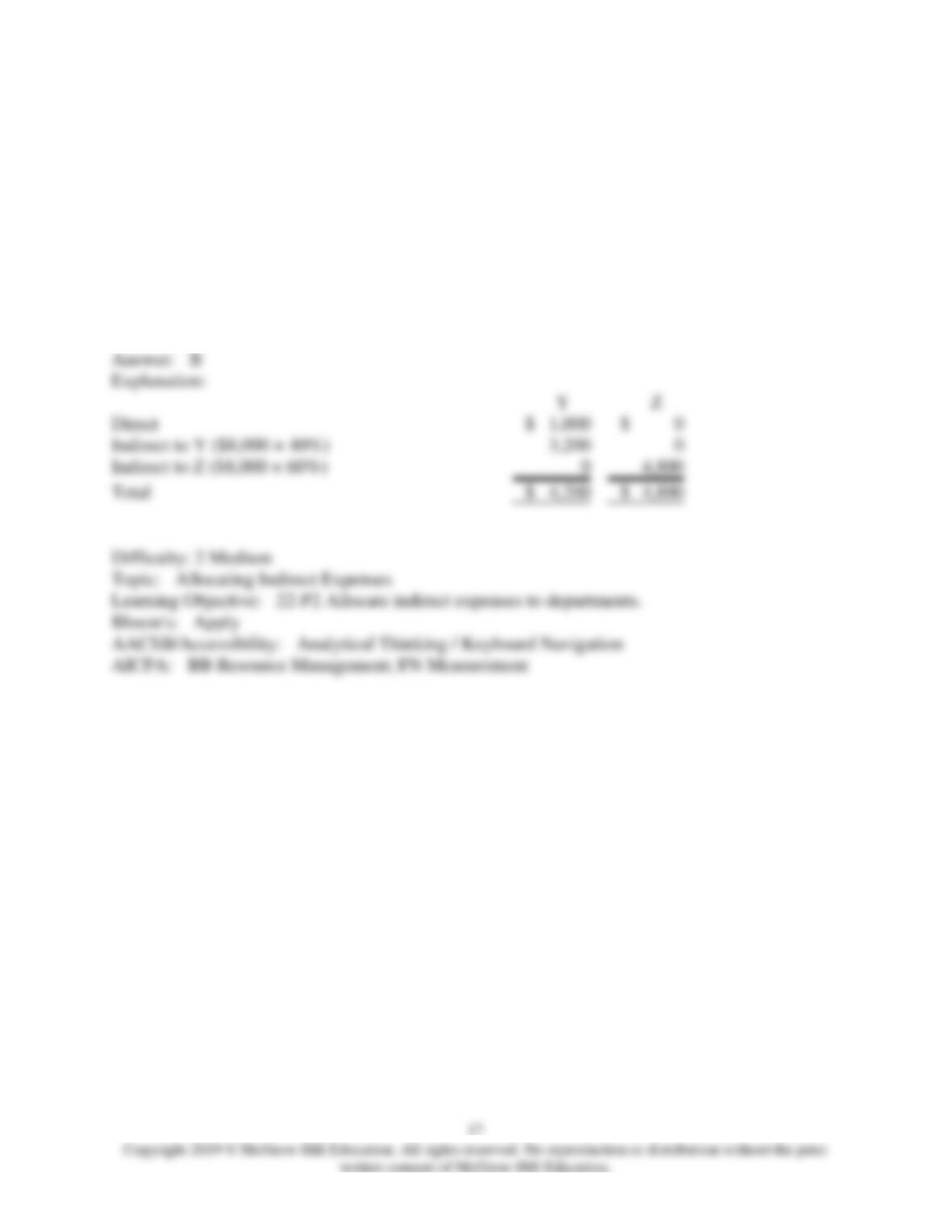
56) A company has two departments, Y and Z that incur delivery expenses. An analysis of the
total delivery expense of $9,000 indicates that Dept. Y had a direct expense of $1,000 for
deliveries and Dept. Z had no direct expense. The indirect expenses are $8,000. The analysis also
indicates that 40% of regular delivery requests originate in Dept. Y and 60% originate in Dept.
Z. Departmental delivery expenses for Dept. Y and Dept. Z, respectively, are:
A) $4,500; $4,500.
B) $4,200; $4,800.
C) $5,500; $3,500.
D) $4,800; $4,200.
E) $5,400; $3,600.
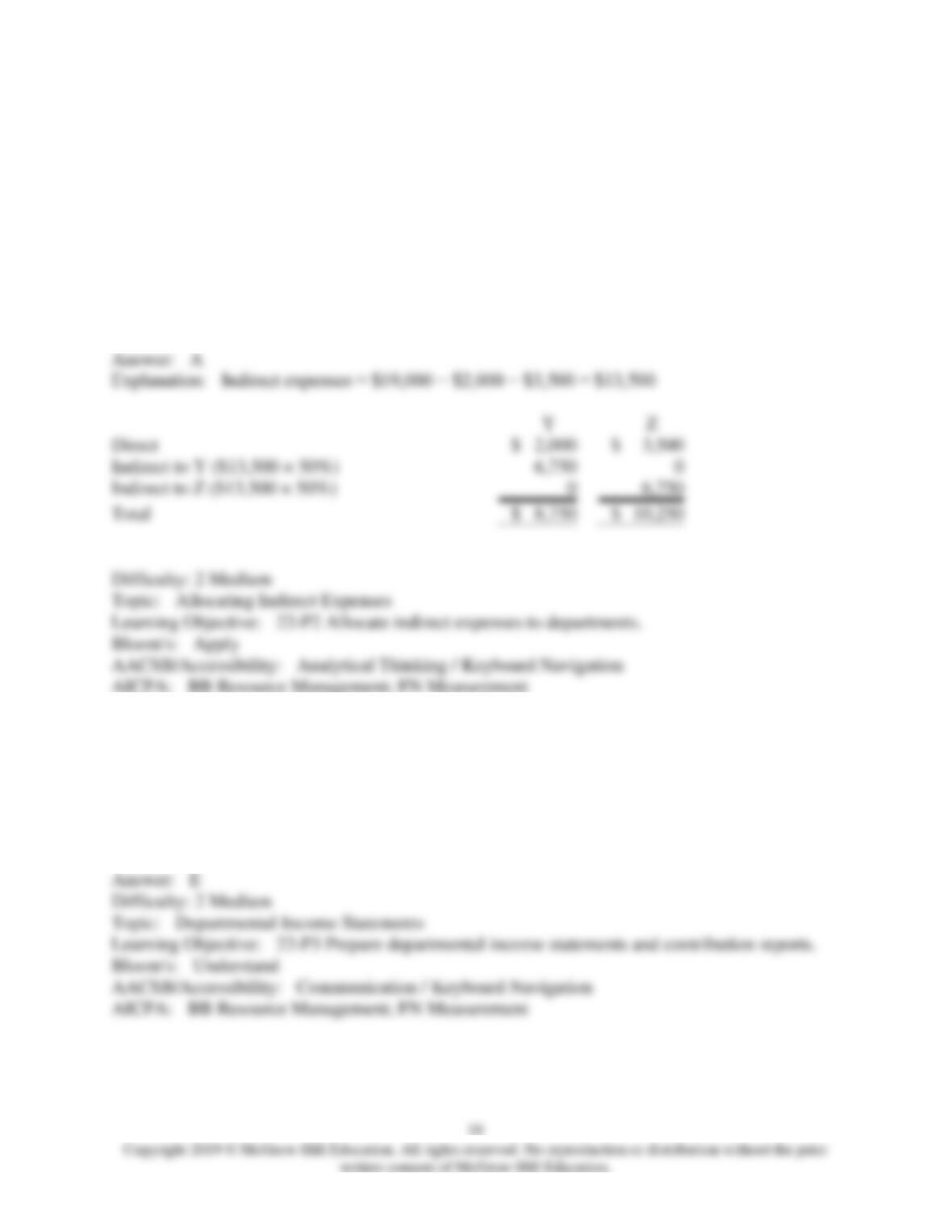
57) A company has two departments, Y and Z that incur wage expenses. An analysis of the total
wage expense of $19,000 indicates that Dept. Y had a direct wage expense of $2,000 and Dept. Z
had a direct wage expense of $3,500. The remaining expenses are indirect and analysis indicates
they should be allocated evenly between the two departments. Departmental wage expenses for
Dept. Y and Dept. Z, respectively, are:
A) $8,750; $10,250.
B) $10,250; $8,750.
C) $9,500; $9,500.
D) $2,000; $3,500.
E) $6,750; $6,750.
58) Which of the following is not a step in creating operating department income statements?
A) Prepare the departmental income statements.
B) Accumulate revenues and direct expenses by department.
C) Allocate indirect expenses across departments.
D) Allocate service department expenses to operating departments.
E) Eliminate the uncontrollable costs for each department.
59) The most useful allocation basis for the departmental costs of an advertising campaign for a
storewide sale is likely to be:
A) Floor space of each department.
B) Relative number of items each department had on sale.
C) Number of customers to enter each department.
D) An equal amount of cost for each department.
E) Proportion of sales of each department.
60) Costs that the manager has the power to determine or significantly affect are called:
A) Uncontrollable costs.
B) Controllable costs.
C) Joint costs.
D) Direct costs.
E) Indirect costs.
61) A report that accumulates the actual expenses that a manager is responsible for and their
budgeted amounts is a:
A) Segmental accounting report.
B) Managerial cost report.
C) Controllable expense report.
D) Departmental accounting report.
E) Responsibility accounting performance report.
62) An accounting system that is set up to control costs and evaluate managers’ performance by
assigning costs to the managers responsible for controlling them is called a(n):
A) Cost accounting system.
B) Managerial accounting system.
C) Responsibility accounting system.
D) Financial accounting system.
E) Activity-based accounting system.