
119
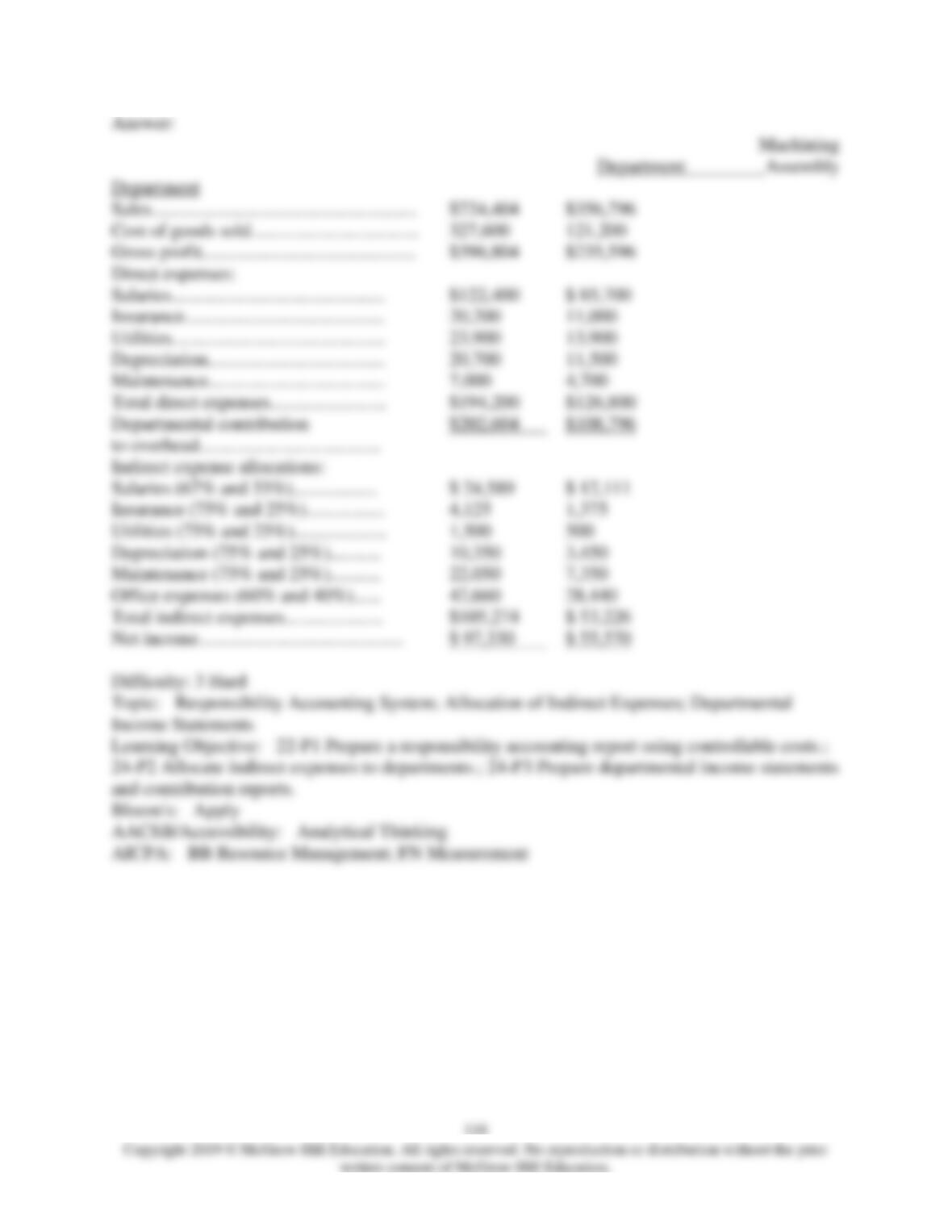
190) Holliday, Inc., operates a retail store with two departments, A and B. Its departmental
income statement for the current year follows:
Holliday, Inc.
Departmental Income Statement
For Year Ended December 31
Dept. A Dept. B Combined
Sales $180,000 $200,000 $380,000
Direct expenses 129,900 142,870 272,770
Contributions to overhead $ 50,100 $ 57,130 $107,230
Indirect expenses:
Depreciation—Building 10,000 11,760 21,760
Maintenance 1,600 1,700 3,300
Utilities 6,200 6,320 12,520
Office expenses 1,800 2,000
3,800
Total indirect expenses $ 19,600 $ 21,780 $ 41,380
Net income $ 30,500 $ 35,350 $ 65,850
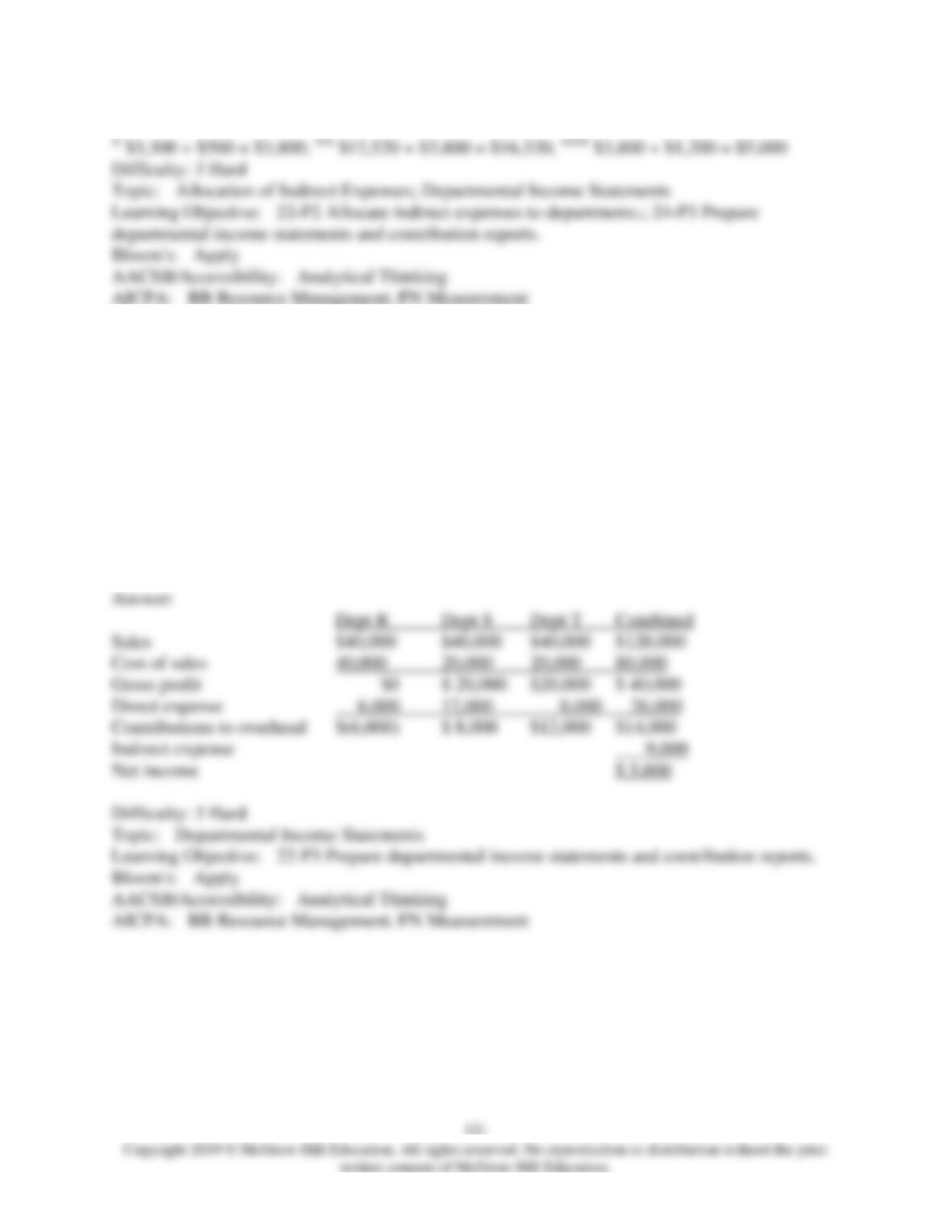
Holliday allocates building depreciation, maintenance, and utilities on the basis of square
footage. Office expenses are allocated on the basis of sales.
Management is considering an expansion to a three-department operation. The proposed
Department C would generate $120,000 in additional sales and have a 17.5% contribution to
overhead. The company owns its building. Opening Department C would redistribute the square
footage to each department as follows: A, 19,040; B, 21,760 sq. ft.; C, 13,600. Increases in
indirect expenses would include: maintenance, $500; utilities, $3,800; and office expenses,
$1,200.
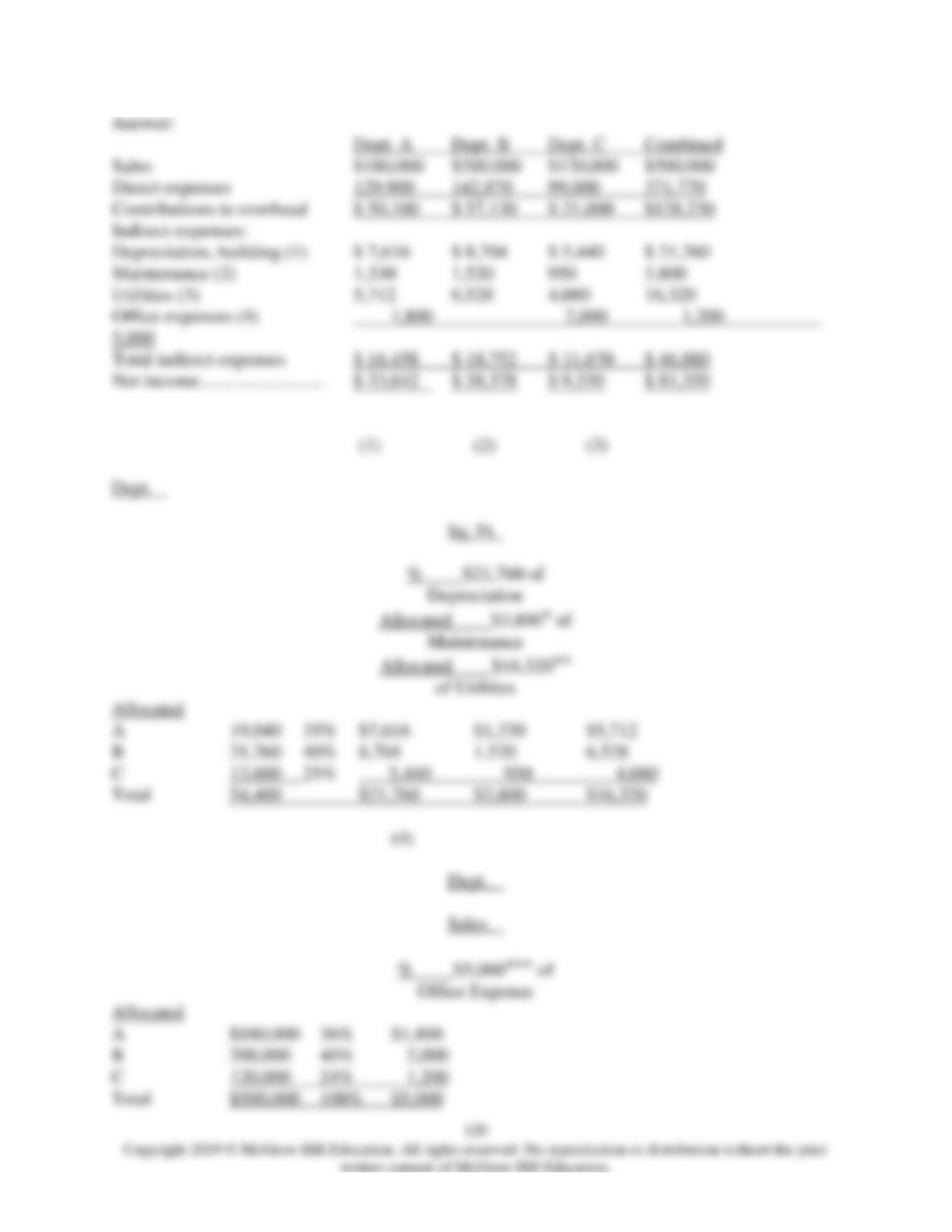
Complete the following departmental income statements, showing projected results of operations
for the three sales departments. (Round amounts to the nearest whole dollar.)
Dept. A Dept. B Dept. C Combined
Sales $180,000 $200,000
Direct expenses 129,900 142,870
Contributions to overhead $ 50,100 $ 57,130
Indirect expenses
Depreciation–building
Maintenance
Utilities
Office expenses
Total indirect expenses
Net income
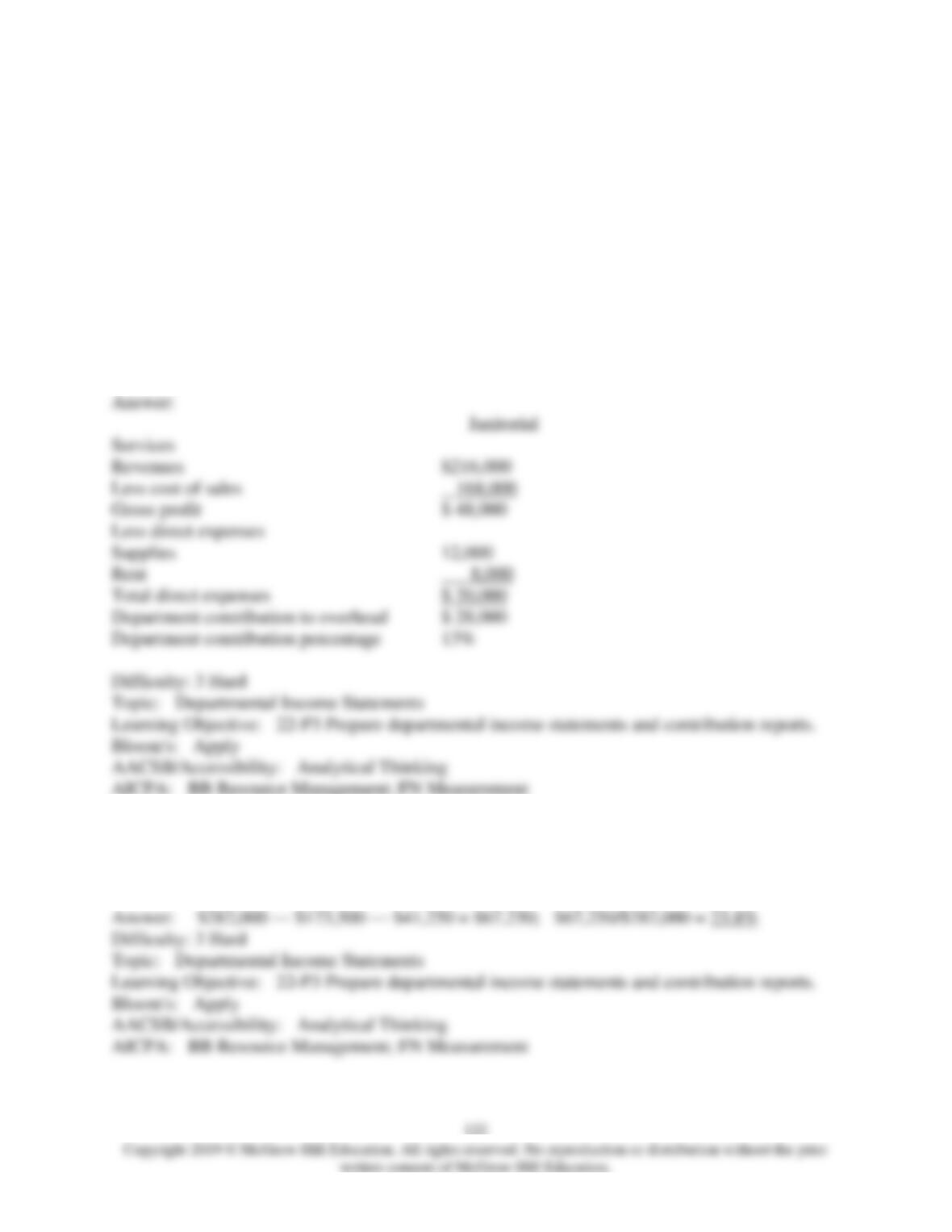
191) Williams Co. operates three separate departments (R, S, T). The data below is provided for
the current year:
Total Sales…………………. $120,000 ($40,000 from each department)
Cost of Goods Sold………… $ 80,000 (50% from R; 25% from S; 25% from T)
Direct Expense……………… $ 26,000 ($6,000 from R; $12,000 from S; $8,000 from T)
Indirect Expenses…………… $ 9,000
Required:
Prepare an income statement showing the departmental contributions to overhead for the current
year.
192) The following data is available for the Janitorial Services Department of Glitterol Co.
Revenues $216,000
Cost of Sales 168,000
Expenses:
Supplies-Direct 12,000
Salaries-Indirect Allocated 34,000
Rent-Direct 8,000
Rent-Indirect Allocated 4,500
Required: Calculate departmental contribution to overhead for the Janitorial Services
Department, including the department’s contribution as a percentage of revenues.
193) The Linens Department of the Krafton Department Store had sales of $282,000, cost of
goods sold of $173,500, indirect expenses of $19,875, and direct expenses of $41,250 for the
current period. What is the Linens Department’s contribution to overhead as a percent of sales?

123
194) Marsha Hansen, the manager of the Flint Plant of the Michigan Company is responsible for
all of the plant’s costs except her own salary. There are two operating departments within the
plant, Departments A and B. Each department has its own manager. There is also a maintenance
department that provides services equally to the two operating departments. The following
information is available.
A Budget
B Total A Actual
B Total
Employee wages $3,500 $4,000 $7,500 $3,200 $4,700 $7,900
Department
Manager’s salary 800 800 1,600 800 800 1,600
Supplies 750 600 1,350 700 590 1,290
Building rent 1,500 1,500 3,000 1,400 1,400 2,800
Utilities 300 300 600 375 375 750
Maintenance 3,300 3,300 6,600 3,000 3,000 6,000
Totals $10,150 $10,500 $20,650 $9,475 $10,865 $20,340
Department managers are responsible for the wages and supplies in their department. They are
not responsible for their own salary. Building rent, utilities, and maintenance are allocated to
each department based on square footage.
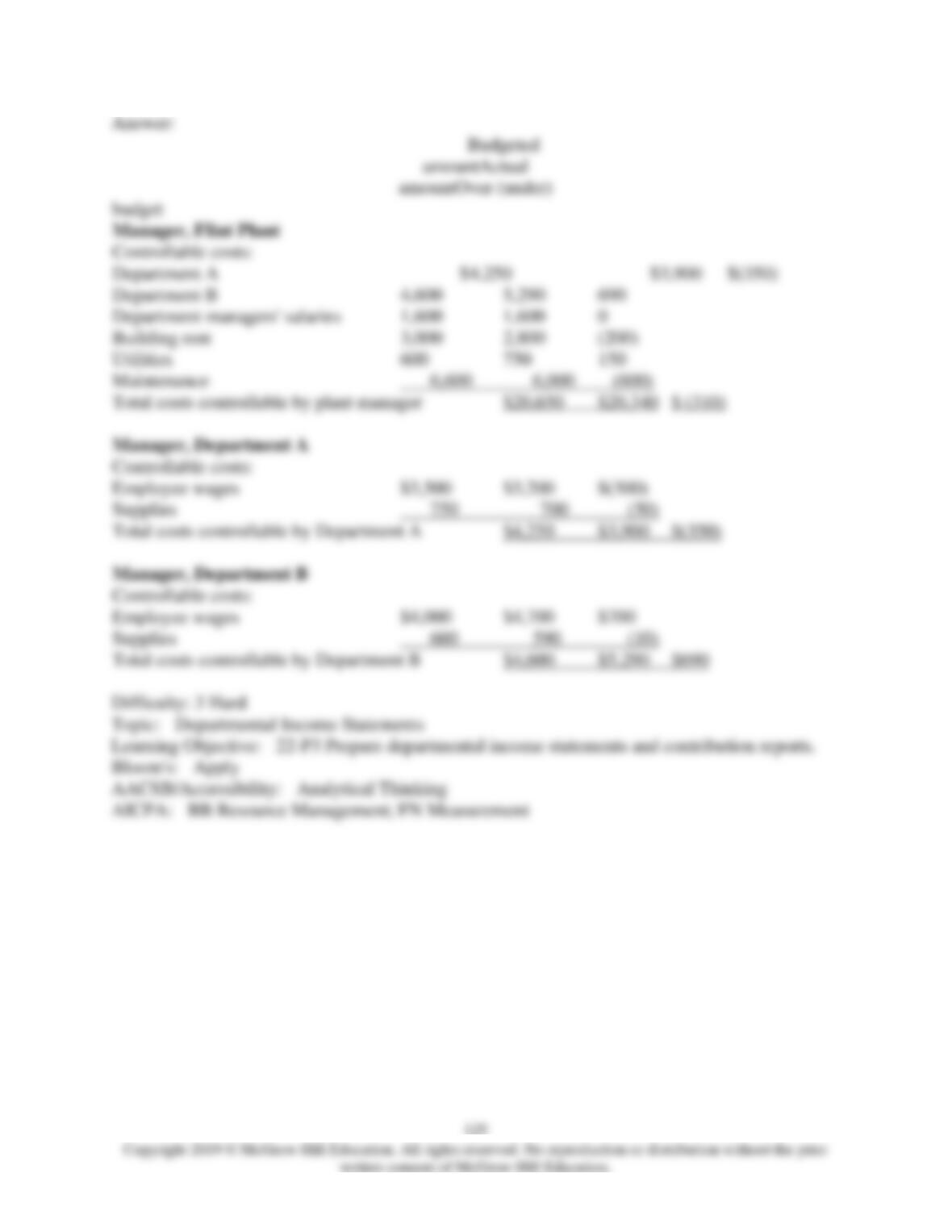
Required: Complete the responsibility accounting performance reports below that list costs
controllable by the manager of Department A, the manager of Department B, and the manager of
the Flint plant.

124
Budgeted
amountActual
amountOver (under)
budget
Manager, Flint Plant
Controllable costs:
Manager, Department A
Controllable costs:
Manager, Department B
Controllable costs:

126
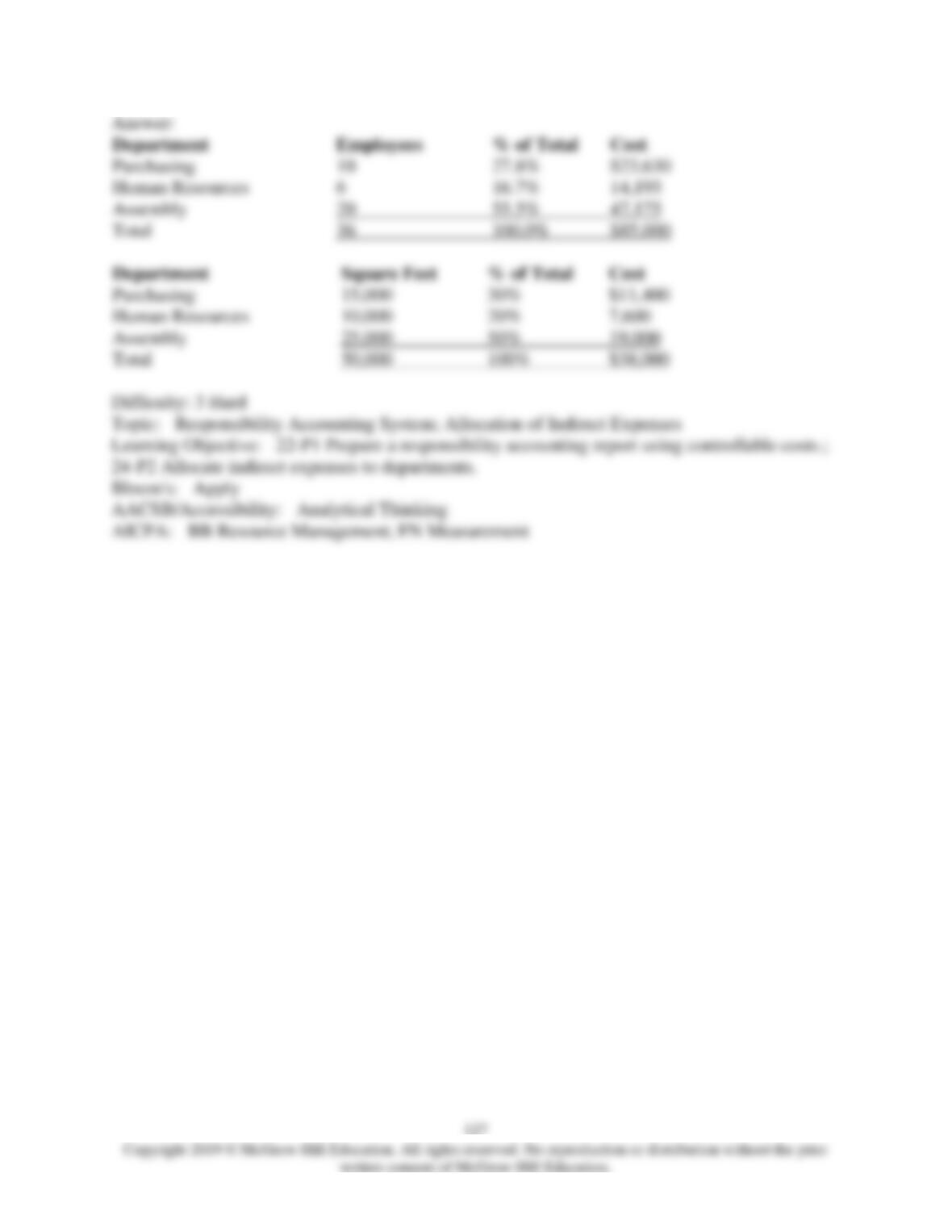
195) Franklin Co. has three departments: purchasing, human resources, and assembly. In a recent
month the three departments incurred two shared indirect expenses. The amounts of the indirect
expenses and the bases used to allocate them follow. Use this information to allocate each of the
two indirect expenses across the three departments using the tables provided below.
Indirect Expense Cost Allocation Base
Supervision $85,000 Number of employees
Utilities and Insurance 38,000 Square feet occupied
Total 123,000
Departmental data for the company’s recent reporting period follow.
Department Employees Square Feet
Purchasing 10 15,000
Human Resources 6 10,000
Assembly 20 25,000
Total 36 50,000
Supervision
Purchasing
Human Resources
Assembly
Total
Utilities and Insurance
Purchasing
Human Resources
Assembly
Total

128
196) Boiano Corp. operates a retail store and has two service departments and two operating
departments, Hardware and Automotive. During the current year, the departments had the
following direct expenses and occupied the following amount of floor space.
Department Direct Expenses Square Feet
Advertising $50,000 750
Administrative 100,000 1,500
Hardware 150,000 3,000
Automotive 200,000 9,750
The advertising department developed and aired 150 spots. Of these spots, 60 spots were for
Hardware and 90 spots were for Automotive. The store sold $1,500,000 of merchandise during
the year; $675,000 in Hardware and $825,000 in Automotive. Indirect expenses include rent,
utilities, and insurance expense. Total indirect expenses of $220,000 are allocated to all
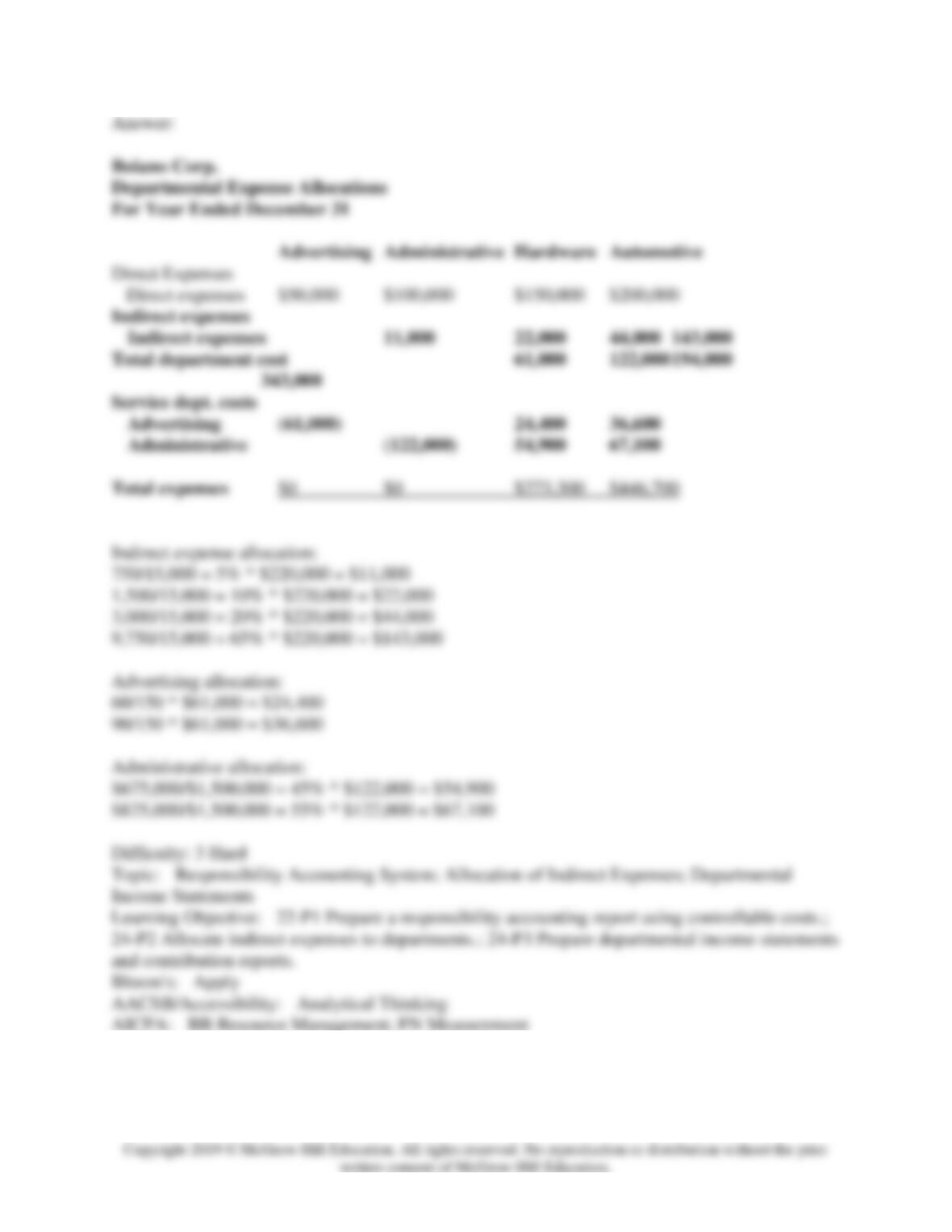
departments. Prepare a departmental expense allocation spreadsheet for Boiano. The spreadsheet
should assign (1) direct expenses to each of the four departments, (2) allocate the indirect
expenses to each department on the basis of floor space occupied, (3) the advertising
department’s expenses to the two operating departments on the basis of ad spots placed
promoting each department’s products, (4) the administrative department’s expenses based on the
amount of sales. Complete the departmental expense allocation spreadsheet below. Provide
supporting computations for the expense allocations below the spreadsheet.
Boiano Corp.
Departmental Expense Allocations
For Year Ended December 31
Advertising Administrative Hardware Automotive
Direct Expenses
Direct expenses
Indirect expenses
Indirect expenses
129
197) The cash conversion cycle is calculated by days’ sales in accounts receivable plus ________
less days’ payable outstanding.
198) The ________ measures the average time it takes to convert cash outflows into cash inflows
from customers.
199) A ________ generates revenues and incurs costs.
200) A ________ incurs costs without directly generating revenues.
201) A ________ provides information for managers to use to evaluate the profitability or cost
effectiveness of each department’s activities.
202) A ________ helps control costs and expenses and evaluates managers’ performance by
assigning costs and expenses to the managers responsible for controlling them.
203) Jarrett Department Store operates three departments (A, B and C). If total costs of $4,500
are to be allocated on the basis of square feet of space (Dept. A = 1,500 Sq. Ft.; Dept. B = 900
Sq. Ft.; Dept. C = 600 Sq. Ft.) then Dept. A’s share (in percent) of the $4,500 cost would be
________%; Dept. B would be ______%, and Dept. C would be ________%. The amount of
cost allocated to Dept. C would be $________.
204) A ________ accumulates and reports costs and expenses that a manager is responsible for,
including budgeted amounts.
205) ________ are costs incurred to produce or purchase two or more products at the same time.
206) A(n) ________ is a department that generates revenues and incurs costs and whose manager
is also responsible for using the center’s assets to generate income for the center.
207) The investment center return on investment is ________ divided by ________.
208) In the two-stage cost allocation, ________ costs are allocated to operating departments, and
the operating department costs are allocated to ________.
209) The first three steps in preparing a departmental income statement are: (1) accumulate
________ of the department, (2) allocate ________ to the department, and (3) allocate ________
to the operating departments.
210) The ________ is a report of the amount of sales less direct expenses for a department.