63) Costs that the manager does not have the power to determine or at least significantly affect
are:
A) Variable costs.
B) Uncontrollable costs.
C) Indirect costs.
D) Direct costs.
E) Joint costs.
64) All of the following are associated with reporting controllable costs except:
A) At lower levels, management have fewer controllable costs.
B) Responsibility and control broaden for higher-level managers.
C) Lower-level managers are responsible for detailed costs and so receive detailed reports.
D) Uncontrollable costs are allocated equally.
E) Higher-level managers receive summarized reports for focusing on broader issues.
65) Within an organizational structure, the person most likely to be evaluated in terms of
controllable costs would be:
A) A payroll clerk.
B) A cost center manager.
C) A production line worker.
D) A maintenance worker.
E) A sales representative.
66) The most useful data for evaluation of a manager’s cost performance is based on:
A) Controllable costs.
B) Contribution percentages.
C) Departmental contributions to overhead.
D) Uncontrollable expenses.
E) Direct costs.
67) In a responsibility accounting system:
A) Managers are responsible for their departments’ controllable costs.
B) Each accounting report contains all items allocated to a responsibility center.
C) Organized and clear lines of authority and responsibility are only incidental.
D) All managers at a given level have equal authority and responsibility.
E) Outputs of the departments are not part of the evaluation process.
68) Responsibility accounting performance reports:
A) Become more detailed at higher levels of management.
B) Are usually summarized at higher levels of management.
C) Are equally detailed at all levels of management.
D) Are useful in any format.
E) Are irrelevant at the highest level of management.
69) A responsibility accounting performance report displays:
A) Only actual costs.
B) Only budgeted costs.
C) Both actual costs and budgeted costs.
D) Only direct costs.
E) Only indirect costs.
70) Which of the following is not true regarding a responsibility accounting system?
A) It is designed to measure the performance of managers in terms of controllable costs.
B) It assigns responsibility for costs to the appropriate managerial level that controls those costs.
C) It should not hold a manager responsible for costs over which the manager has no influence.
D) It can be applied at any level of an organization.
E) It is only relevant in manufacturing companies.
71) A cost incurred to produce or purchase two or more products at the same time is a(n):
A) Product cost.
B) Incremental cost.
C) Differential cost.
D) Joint cost.
E) Fixed cost.
72) In regard to joint cost allocation, the “split-off point” is:
A) A physical basis method to allocate costs based on ratio of some physical characteristic.
B) The difference between the actual and market value of joint costs.
C) The point at which some products are sold and some remain in inventory.
D) The point at which separate products can be identified.
E) Not acceptable when using the value basis for allocating joint costs.
73) Allocating joint costs to products using a value basis method is based on their relative:
A) Sales values.
B) Direct costs.
C) Gross margins.
D) Total costs.
E) Variable costs.
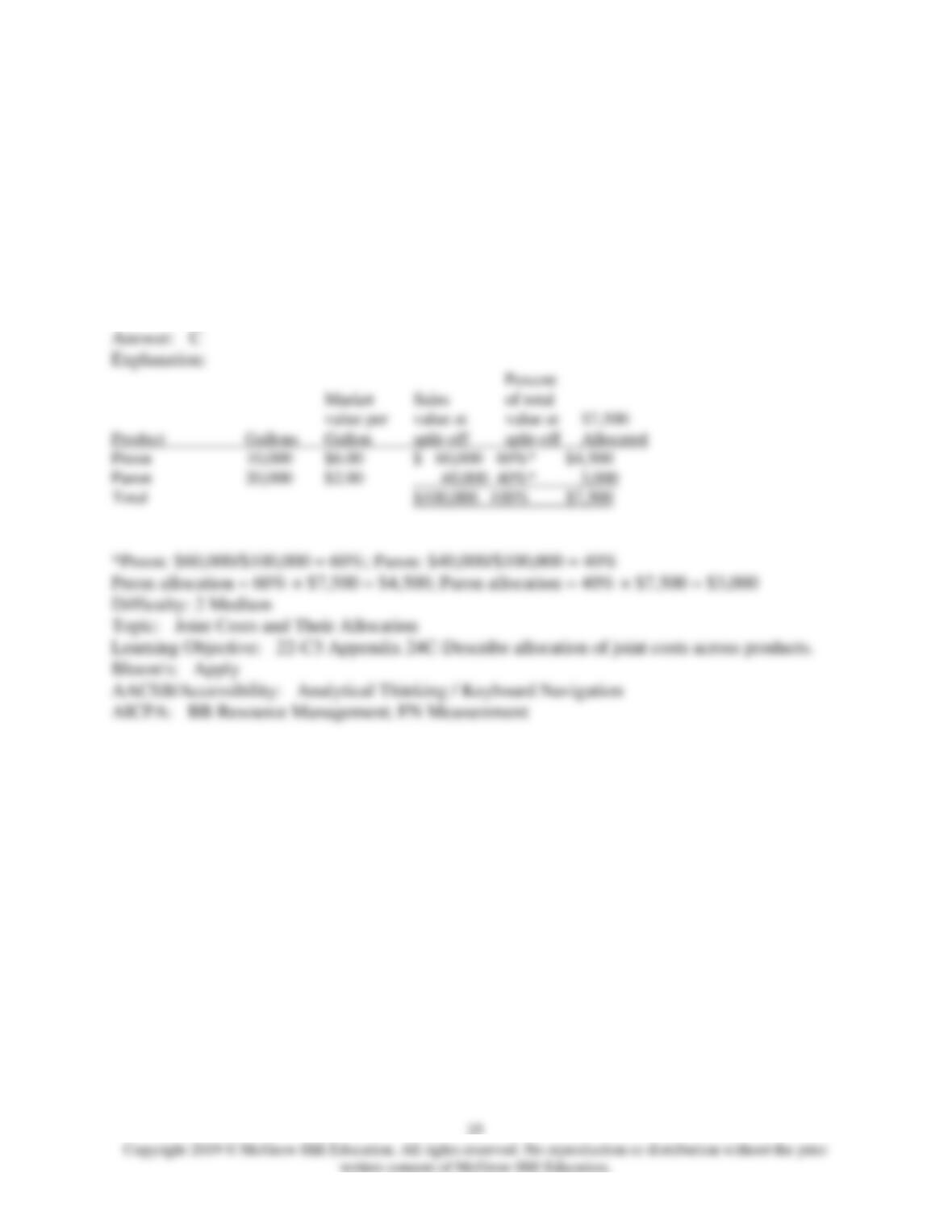
74) Differential Chemical produced 10,000 gallons of Preon and 20,000 gallons of Paron. Joint
costs incurred in producing the two products totaled $7,500. At the split-off point, Preon has a
market value of $6.00 per gallon and Paron $2.00 per gallon. Compute the portion of the joint
costs to be allocated to Preon if the value basis is used.
A) $2,500.
B) $3,000.
C) $4,500.
D) $5,625.
E) $1,500.
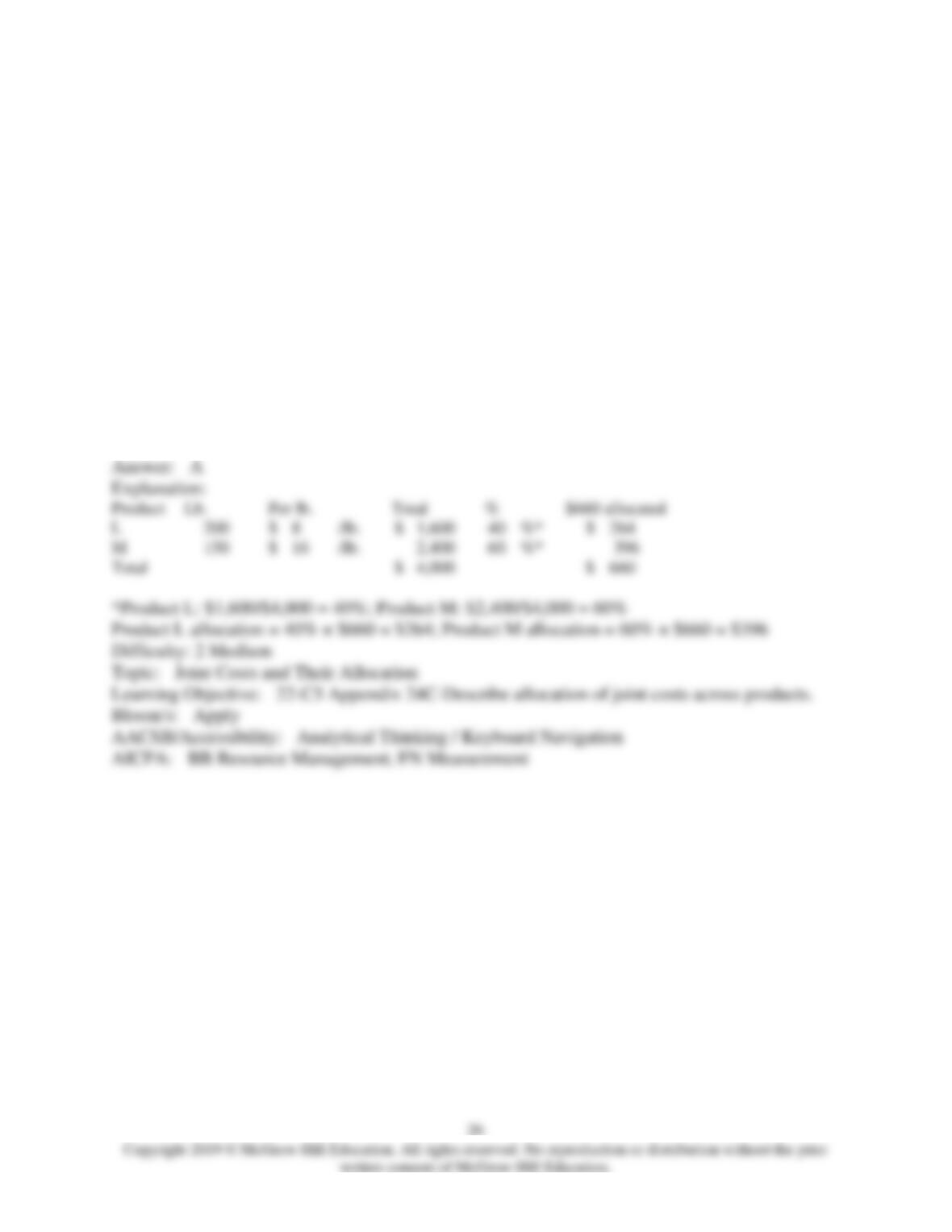
75) Data pertaining to a company’s joint production for the current period follows:
L M
Quantities produced 200 lbs. 150 lbs.
Market value at split-off point $ 8 /lb. $ 16 /lb.
Compute the cost to be allocated to Product L for this period’s $660 of joint costs if the value
basis is used. (Do not round your intermediate calculations.)
A) $264.
B) $396.
C) $330.
D) $1,364.
E) $796.
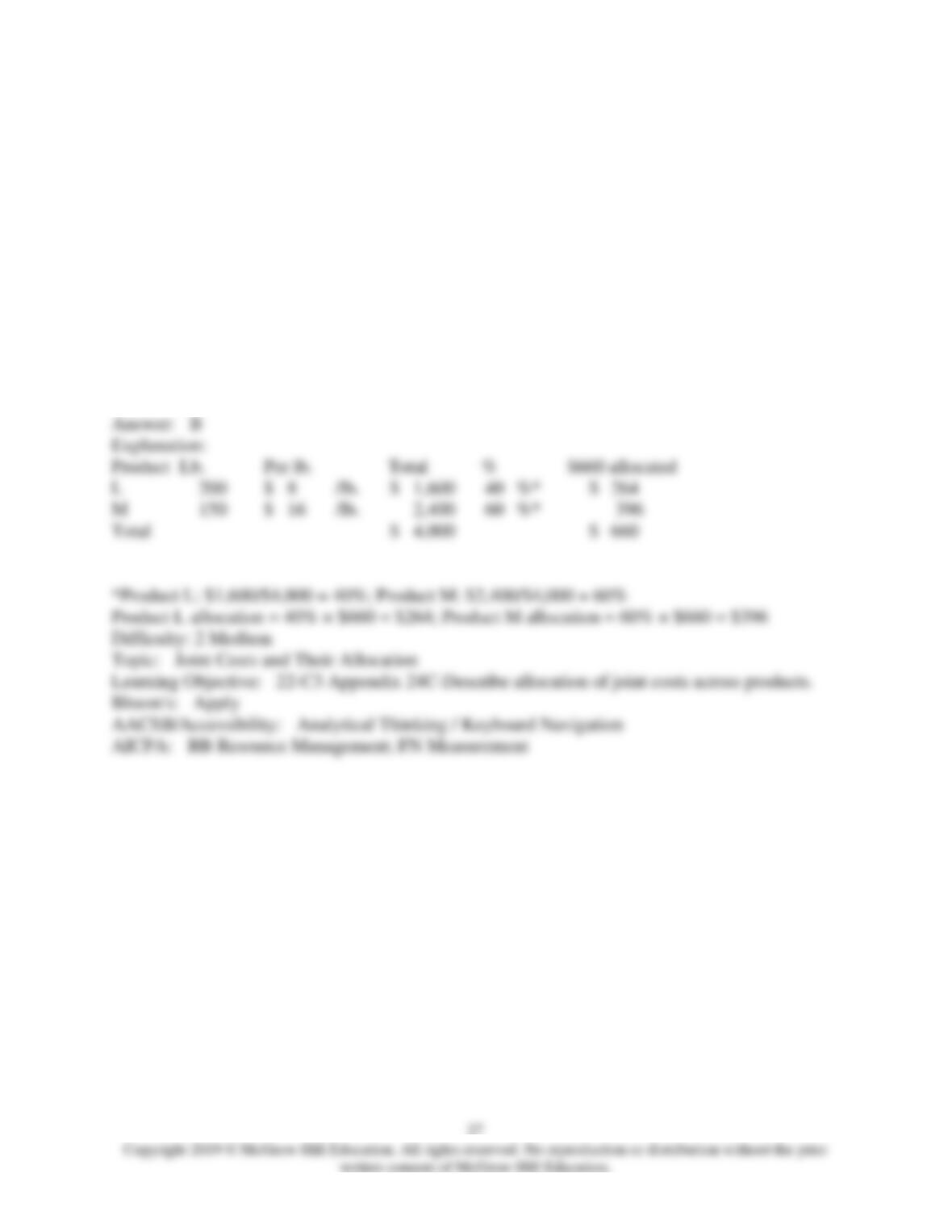
76) Data pertaining to a company’s joint production for the current period follows:
L M
Quantities produced 200 lbs. 150 lbs.
Market value at split-off point $ 8 /lb. $ 16 /lb.
Compute the cost to be allocated to Product M for this period’s $660 of joint costs if the value
basis is used.
A) $264.
B) $396.
C) $330.
D) $1,364.
E) $796.
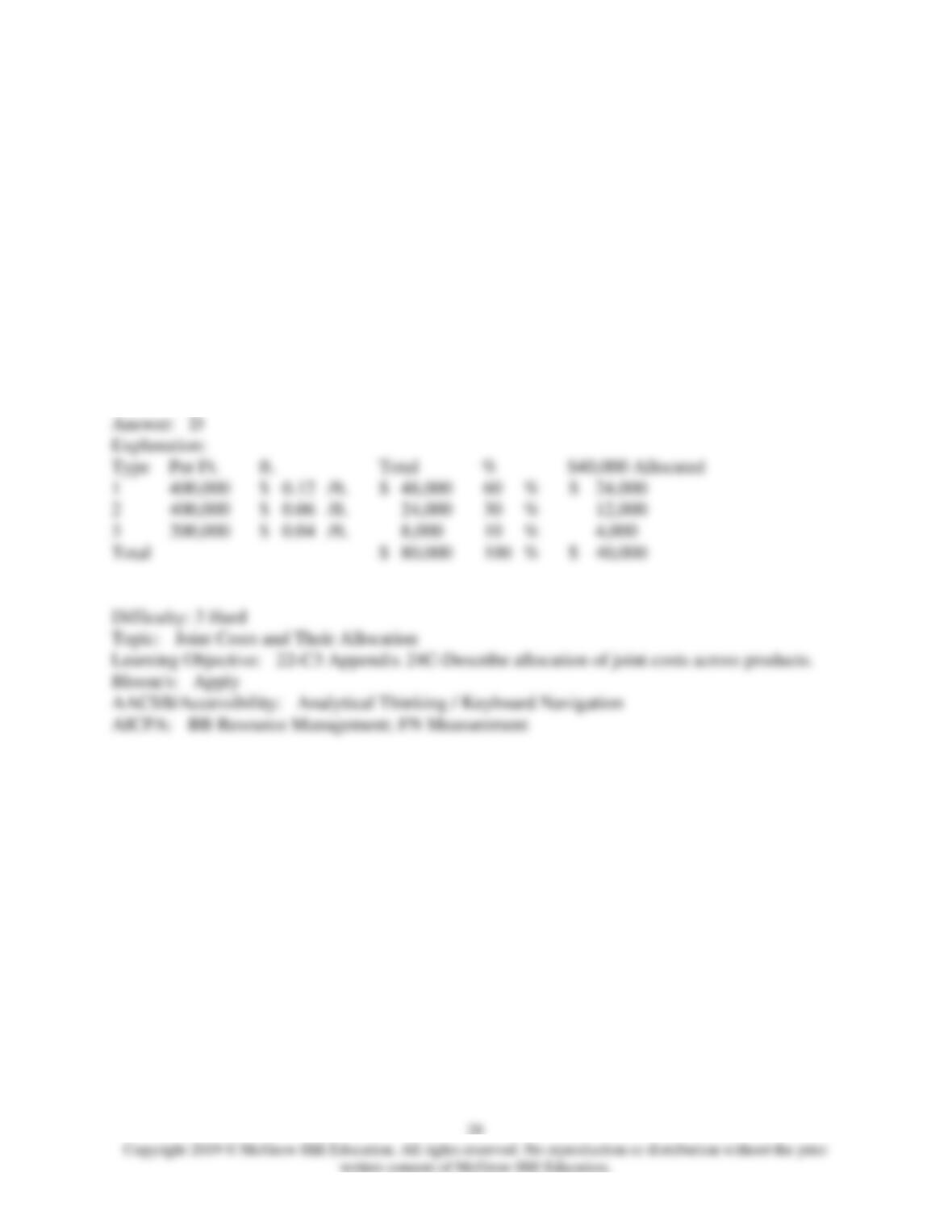
77) A lumber mill bought a shipment of logs for $40,000. When cut, the logs produced a million
board feet of lumber in the following grades. Compute the cost to be allocated to Type 1 and
Type 2 lumber, respectively, if the value basis is used.
Type 1—400,000 bd. ft. priced to sell at $0.12 per bd. ft.
Type 2— 400,000 bd. ft. priced to sell at $0.06 per bd. ft.
Type 3— 200,000 bd. ft. priced to sell at $0.04 per bd. ft.
A) $16,000; $16,000.
B) $13,333; $4,444.
C) $40,000; $24,000.
D) $24,000; $12,000.
E) $24,000; $8,000.
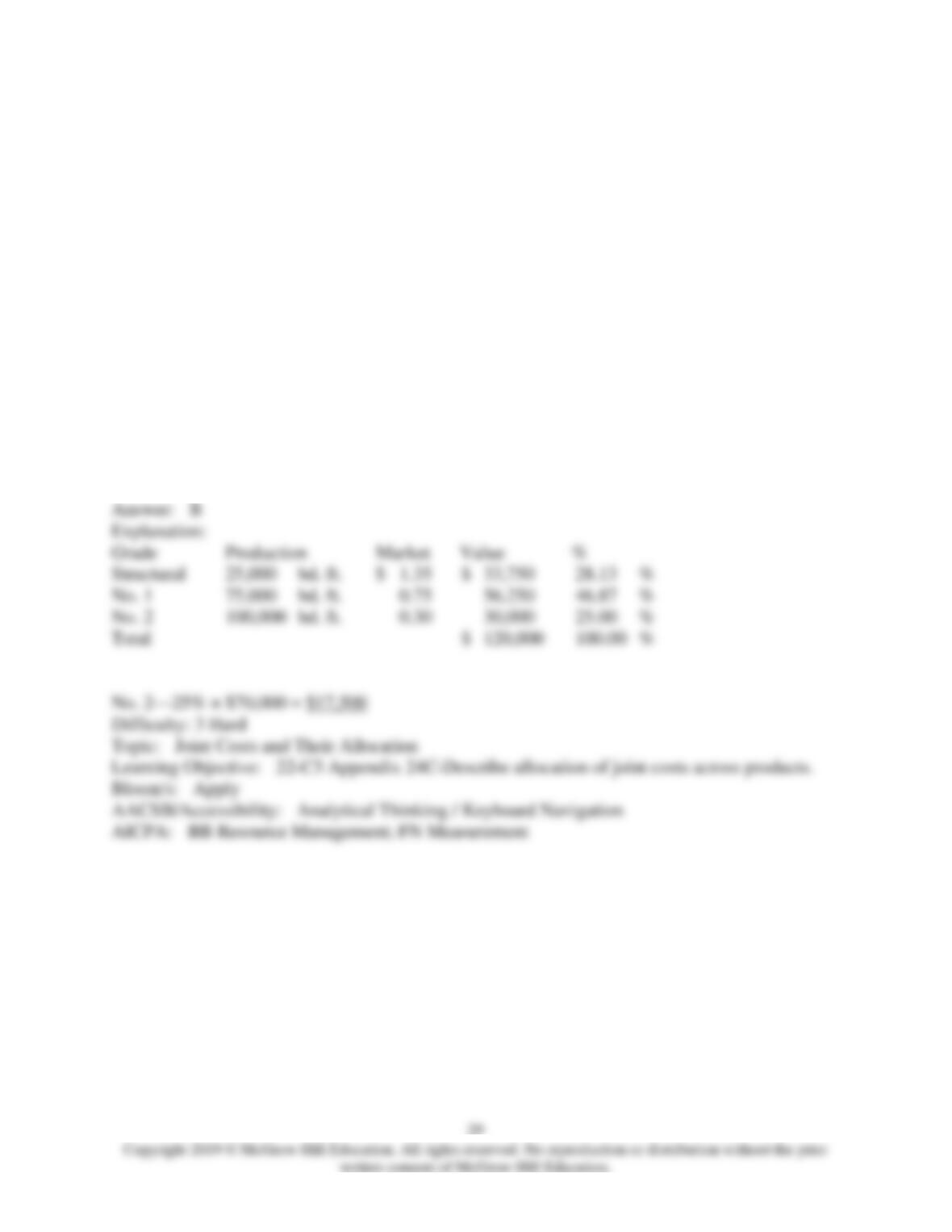
78) A lumber mill paid $70,000 for logs that produced 200,000 board feet of lumber in 3
different grades and amounts as follows:
Grade Production Market Price
Structural 25,000 board feet $ 1,350/1,000 bd. ft.
No. 1 Common 75,000 board feet $ 750/1,000 bd. ft.
No. 2 Common 100,000 board feet $ 300/1,000 bd. ft.
Compute the portion of the $70,000 joint cost to be allocated to No. 2 Common if the value basis
is used.
A) $0.
B) $17,500.
C) $23,333.
D) $35,000.
E) $70,000.
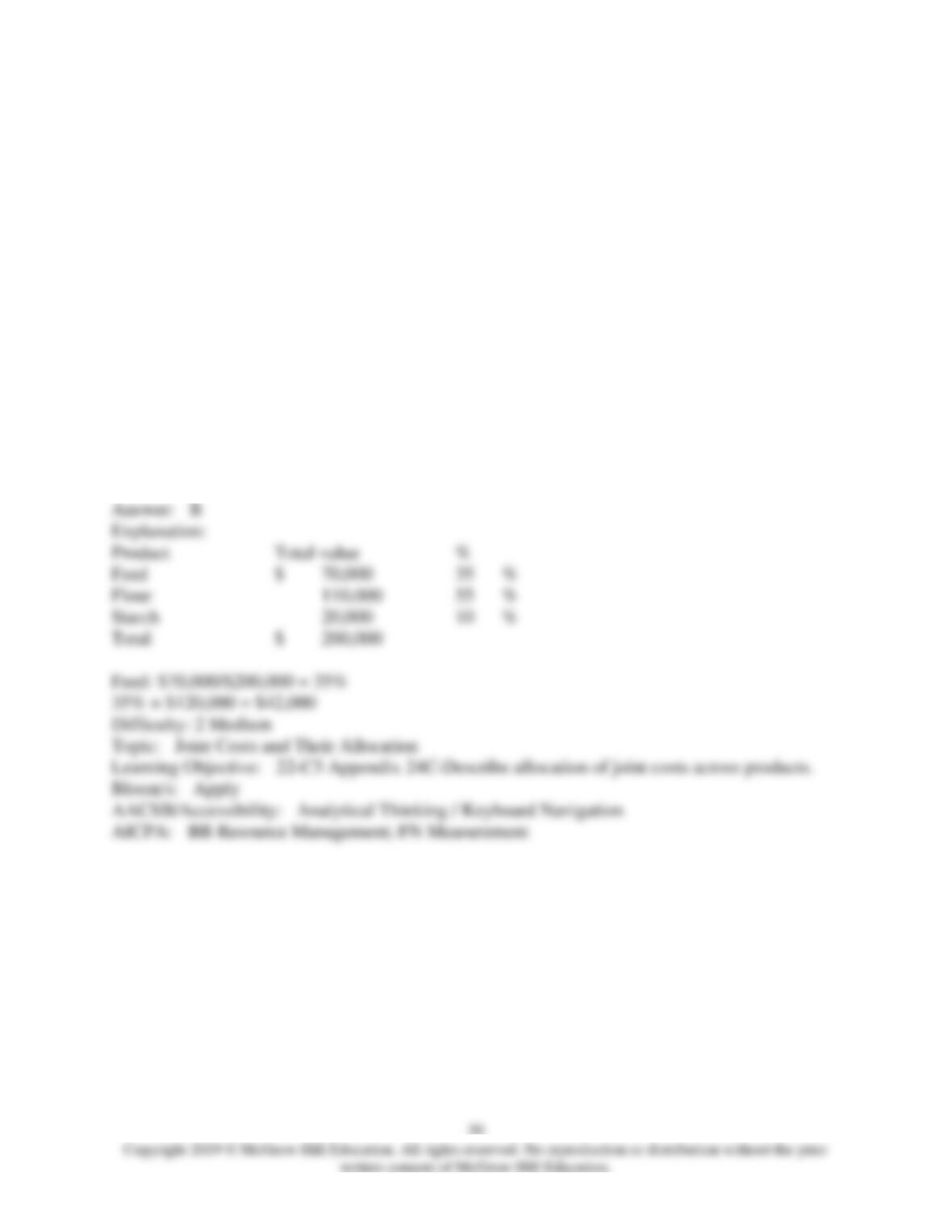
79) A granary allocates the cost of unprocessed wheat to the production of feed, flour, and
starch. For the current period, unprocessed wheat was purchased for $120,000, and the following
quantities of product and sales revenues were produced.
Product Pounds Price per Pound
Feed 100,000 $ 0.70
Flour 50,000 2.20
Starch 20,000 1.00
How much of the $120,000 cost should be allocated to feed if the value basis is used?
A) $12,250.
B) $42,000.
C) $45,000.
D) $70,000.
E) $100,000.
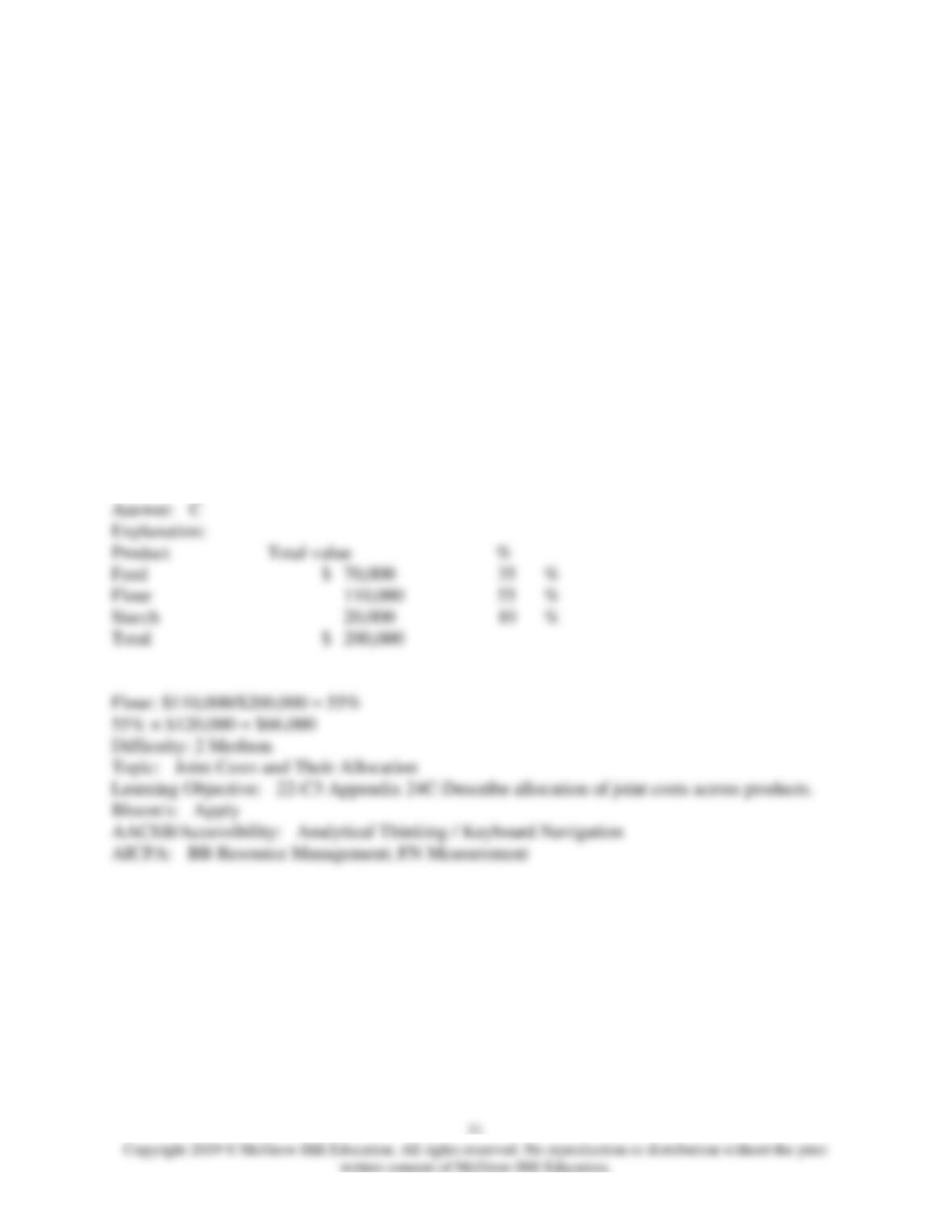
80) A granary allocates the cost of unprocessed wheat to the production of feed, flour, and
starch. For the current period, unprocessed wheat was purchased for $120,000, and the following
quantities of product and sales revenues were produced.
Product Pounds Price per pound
Feed 100,000 $ 0.70
Flour 50,000 2.20
Starch 20,000 1.00
How much of the $120,000 cost should be allocated to flour if the value basis is used?
A) $24,500.
B) $84,000.
C) $66,000.
D) $70,000.
E) $200,000.
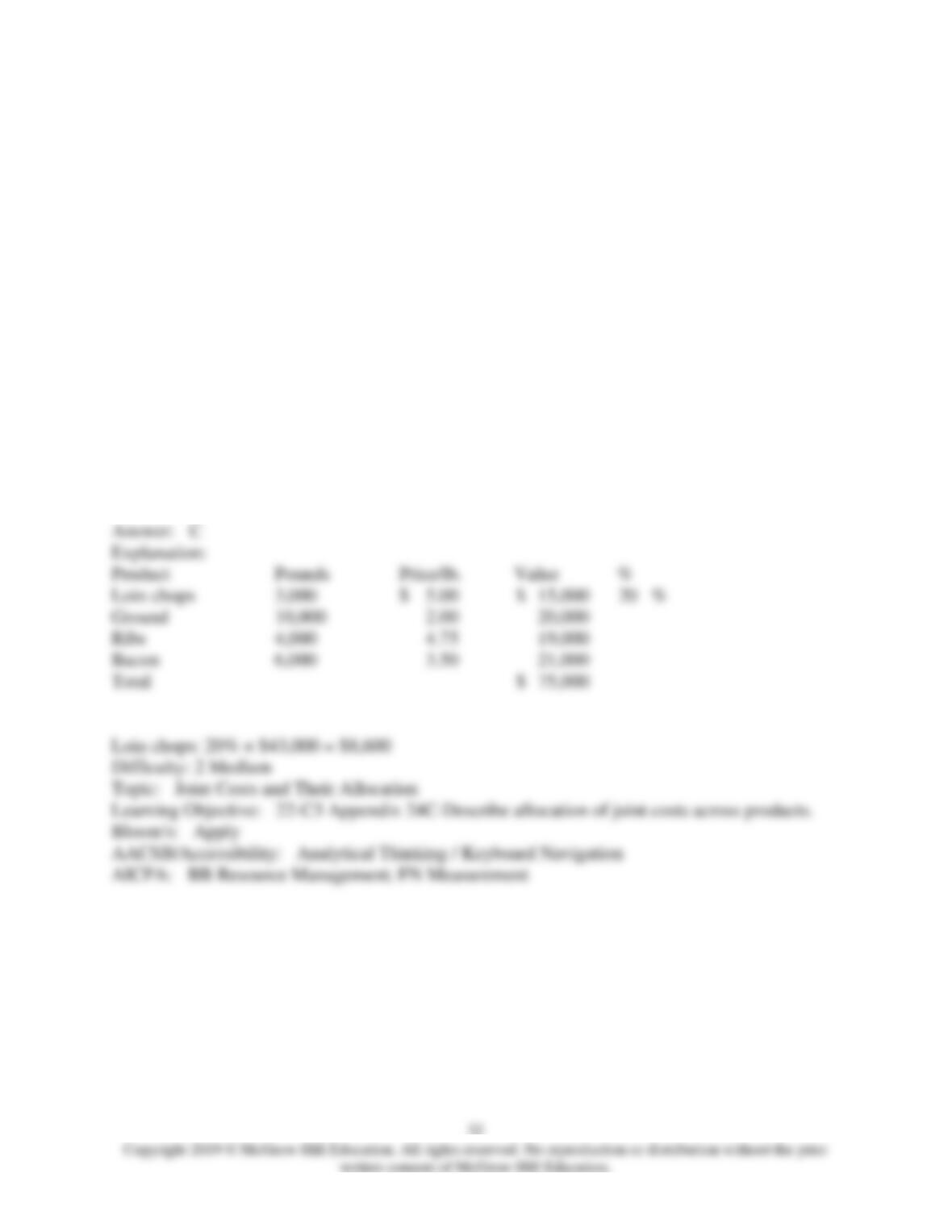
81) Wren Pork Company uses the value basis of allocating joint costs in its production of pork
products. Relevant information for the current period follows:
Product Pounds Price/lb.
Loin chops 3,000 $ 5.00
Ground 10,000 2.00
Ribs 4,000 4.75
Bacon 6,000 3.50
The total joint cost for the current period was $43,000. How much of this cost should Wren Pork
allocate to Loin chops?
A) $0.
B) $5,909.
C) $8,600.
D) $10,750.
E) $43,000.
82) Calculating return on investment for an investment center is defined by the following
formula:
A) Contribution margin/Ending assets.
B) Gross profit/Ending assets.
C) Net income/Ending assets.
D) Income/Average invested assets.
E) Contribution margin/Average invested assets.
83) Investment center managers are usually evaluated using performance measures
A) that combine income and assets.
B) that combine income and capital.
C) based on assets only.
D) based on income only.
E) that combine assets and capital.
84) Two investment centers at Marshman Corporation have the following current-year income
and asset data:
Investment Center A Investment
Center B
Investment center income $ 415,000 $ 525,000
Investment center average invested assets $ 2,400,000 $ 1,950,000
The return on investment (ROI) for Investment Center A is:
A) 578.3%
B) 24.1%
C) 17.3%
D) 39.2%
E) 19.1%
85) Two investment centers at Marshman Corporation have the following current-year income
and asset data:
Investment Center A Investment
Center B
Investment center income $ 415,000 $ 525,000
Investment center average invested assets $ 2,400,000 $ 1,950,000
The return on investment (ROI) for Investment Center B is:
A) 371.4%
B) 26.9%
C) 24.1%
D) 39.2%
E) 21.7%
86) A retail store has three departments, S, T, and U, and does general advertising that benefits
all departments. Advertising expense totaled $50,000 for the year, and departmental sales were
as follows. Allocate advertising expense to Department T based on departmental sales.
Department S $ 110,000
Department T 213,750
Department U 151,250
Total $ 475,000
A) $11,000.
B) $14,000.
C) $16,667.
D) $22,500.
E) $50,000.
87) Riemer, Inc. has four departments. Information about these departments is listed below.
Maintenance is a service department. If allocated maintenance cost is based on floor space
occupied by each of the other departments, compute the amount of maintenance cost allocated to
the Cutting Department.
Maintenance Cutting Assembly Packaging
Direct costs $ 18,000 $ 30,000 $ 70,000 $ 45,000
Sq. ft. of space 500 1,500 2,000 2,500
No. of employees 2 3 16 4
A) $500.
B) $4,500.
C) $3,724.
D) $6,000.
E) $4,153.
88) CakeCo, Inc. has three operating departments. Information about these departments is listed
below. Maintenance is service department at CakeCo that incurred $12,000 of costs during the
period. If allocated maintenance cost is based on floor space occupied by each of the operating
departments, compute the amount of maintenance cost allocated to the Baking Department.
Mixing Baking Packaging
Direct costs $ 21,000 $ 15,000 $ 9,000
Sq. ft. of space 1,000 1,500 500
A) $400.
B) $1,200.
C) $4,000.
D) $7,500.
E) $6,000.
89) Marks Corporation has two operating departments, Drilling and Grinding, and an office. The
three categories of office expenses are allocated to the two departments using different allocation
bases. The following information is available for the current period:
Office Expenses Total Allocation Basis
Salaries $ 30,000 Number of employees
Depreciation 20,000 Cost of goods sold
Advertising 40,000 Net sales
Item Drilling Grinding Total
Number of employees 1,000 1,500 2,500
Net sales $ 325,000 $ 475,000 $ 800,000
Cost of goods sold $ 75,000 $ 125,000 $ 200,000
The amount of the total office expenses that should be allocated to Grinding for the current
period is:
A) $35,750.
B) $45,000.
C) $54,250.
D) $90,000.
E) $600,000.
90) Marks Corporation has two operating departments, Drilling and Grinding, and an office. The
three categories of office expenses are allocated to the two departments using different allocation
bases. The following information is available for the current period:
Office Expenses Total Allocation Basis
Salaries $ 30,000 Number of employees
Depreciation 20,000 Cost of goods sold
Advertising 40,000 Net sales
Item Drilling Grinding Total
Number of employees 1,000 1,500 2,500
Net sales $ 325,000 $ 475,000 $ 800,000
Cost of goods sold $ 75,000 $ 125,000 $ 200,000
The amount of salaries that should be allocated to Grinding for the current period is:
A) $30,000.
B) $18,000.
C) $15,000.
D) $10,000.
E) $12,500.