Accounting, 9e (Horngren)
Chapter 22 The Master Budget and Responsibility Accounting
Learning Objective 22-1
1) Budgeting is a technique that is used to plan for future cash inflows and outflows.
2) A goal of the budgeting process is to assist managers with coordinating and implementing the business plan.
3) Budgets provide benchmarks that help managers evaluate performance.
4) A goal of the budgeting process is to communicate a consistent set of plans throughout the company.
5) Management must get employees to accept the budget’s goals in order to effectively use the budget as a
benchmark for evaluating performance.
6) A budgeted income statement is based on estimated amounts and not actual amounts.
7) A budget focuses primarily on financial information, but does not reflect specific business strategies.
8) Which of the following is NOT a characteristic of the budgeting process?
A) The budget process aids in performance evaluation.
B) The budget process helps coordinate the activities of the organization.
C) The budget process forces management to plan ahead.
D) The budget process ensures that the business will make a profit.
9) Which of the following statements about budgeting is INCORRECT?
A) Budgeting is an accounting function and does not need involvement of operations personnel.
B) Budgeting is an aid to planning and control.
C) Budgets help to coordinate the activities of the entire organization.
D) Budgets promote communication and coordination between departments.
10) Which of the following is an example of the planning function of a budget?
A) A budget demands integrated input from different business units and functions.
B) Employees are motivated to achieve the goals set by the budget.
C) Budget figures are used to evaluate the performance of managers.
D) The budget outlines a specific course of action for the coming period.
11) Which of the following is an example of the coordination and communication function of a budget?
A) A budget demands integrated input from different business units and functions.
B) Employees are motivated to achieve the goals set by the budget.
C) Budget figures are used to evaluate the performance of managers.
D) The budget outlines a specific course of action for the coming period.
12) Which of the following is an example of the benchmarking function of a budget?
A) A budget demands integrated input from different business units and functions.
B) Budgeting requires close cooperation between accountants and operational personnel.
C) Budget figures are used to evaluate the performance of managers.
D) The budget outlines a specific course of action for the coming period.
Learning Objective 22-2
1) The capital expenditure budget is part of the operating budget.
2) The master budget includes 3 components-the operating budget, the capital expenditures budget and the financial
budget.
3) The production budget must be prepared before any other component of the operating budget.
4) The capital expenditure budget stands alone and is not part of either the operating budget or the financial budget.
5) Which of the following budgets focuses on the income statement and its supporting schedules?
A) Operating budget
B) Cash budget
C) Capital expenditures budget
D) Sales budget
6) The starting point in the budgeting process is the preparation of the:
A) cash budget.
B) budgeted statement of cash flows.
C) sales budget.
D) budgeted income statement.
7) In preparing an operating budget, the sales budget is prepared first. Which of the following is prepared next?
A) Capital expenditures
B) Budgeted income statement
C) Operating expenses
D) Inventory, purchases and cost of goods sold
8) In preparing an operating budget, the sales budget is prepared first. Which of the following is the last component
of the operating budget?
A) Capital expenditures
B) Budgeted income statement
C) Operating expenses
D) Inventory, purchases and cost of goods sold
9) In order to prepare a budgeted income statement, several other budgets need to be prepared first. Which of the
following is NOT one of the budgets needed to prepare the budgeted income statement?
A) Capital expenditures
B) Sales
C) Operating expenses
D) Inventory, purchases and cost of goods sold
10) The financial budget includes all of the following EXCEPT the:
A) budgeted balance sheet.
B) budgeted income statement.
C) cash budget.
D) budgeted statement of cash flows.
11) Which of the following statements is TRUE about the operating budget?
A) It is a part of the financial budget.
B) It includes the capital expenditures budget.
C) It includes the operating expenses budget.
D) Its final component is the cash budget.
12) Which of the following statements is TRUE about the capital expenditures budget?
A) It is a part of the financial budget.
B) It must be completed before the budgeted income statement is prepared.
C) It includes the sales budget.
D) It must be completed before the cash budget can be prepared.
13) Which of the following statements is TRUE about the financial budget?
A) It includes the capital expenditures budget.
B) It must be completed before the budgeted income statement is prepared.
C) It includes the sales budget.
D) It includes the cash budget and the budgeted balance sheet.
Learning Objective 22-3
1) Budgeted operating expenses for the current year include the expiration of insurance that was paid for in a
previous period.
2) A department store has budgeted cost of sales of $36,000 for its men‘s suits in March. Management also wants to
have $15,000 of men’s suits in inventory at the end of March to prepare for the summer season. Beginning
inventory of men’s suits for March is expected to be $9,000. What dollar amount of men‘s suits should be purchased
in March?
A) $42,000
B) $45,000
C) $51,000
D) $60,000
3) Lan Corporation had beginning inventory of $42,000 and expects cost of sales of $96,000 units during the month.
Desired ending inventory is $31,000. How much inventory should Lan Corporation purchase?
A) $65,000
B) $73,000
C) $85,000
D) $107,000
4) Liu Electronics budgeted sales of $400,000 for the month of November; cost of goods sold is equal to 65% of
sales. Beginning inventory for November was $80,000 and ending inventory for November should be $72,000. How
much are the budgeted purchases for November?
A) $252,000
B) $254,800
C) $264,800
D) $265,200
5) Norton Company prepared the following sales budget:
Month Budgeted Sales
March $200,000
April $180,000
May $220,000
June $260,000
Cost of goods sold is budgeted at 60% of sales, and the inventory at the end of February was $36,000. Desired
inventory levels at the end of each month are 30% of the next month’s cost of goods sold. What is the desired
beginning inventory on June 1?
A) $36,000
B) $39,600
C) $43,200
D) $46,800
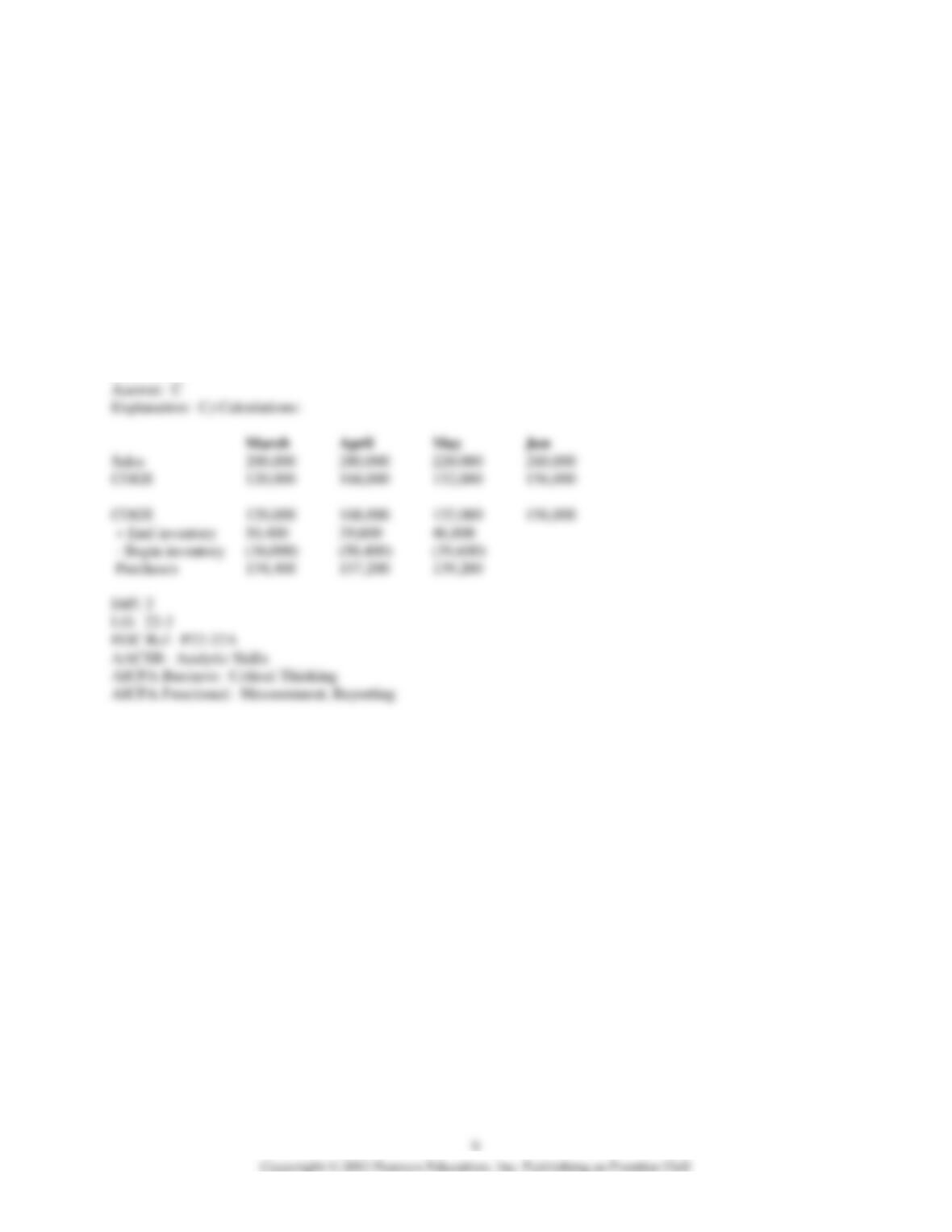
6) Norton Company prepared the following sales budget:
Month Budgeted Sales
March $200,000
April $180,000
May $220,000
June $260,000
Cost of goods sold is budgeted at 60% of sales, and the inventory at the end of February was $36,000. Desired
inventory levels at the end of each month are 30% of the next month’s cost of goods sold. How much are the
budgeted purchases for the month of March?
A) $214,400
B) $123,900
C) $134,400
D) $99,700
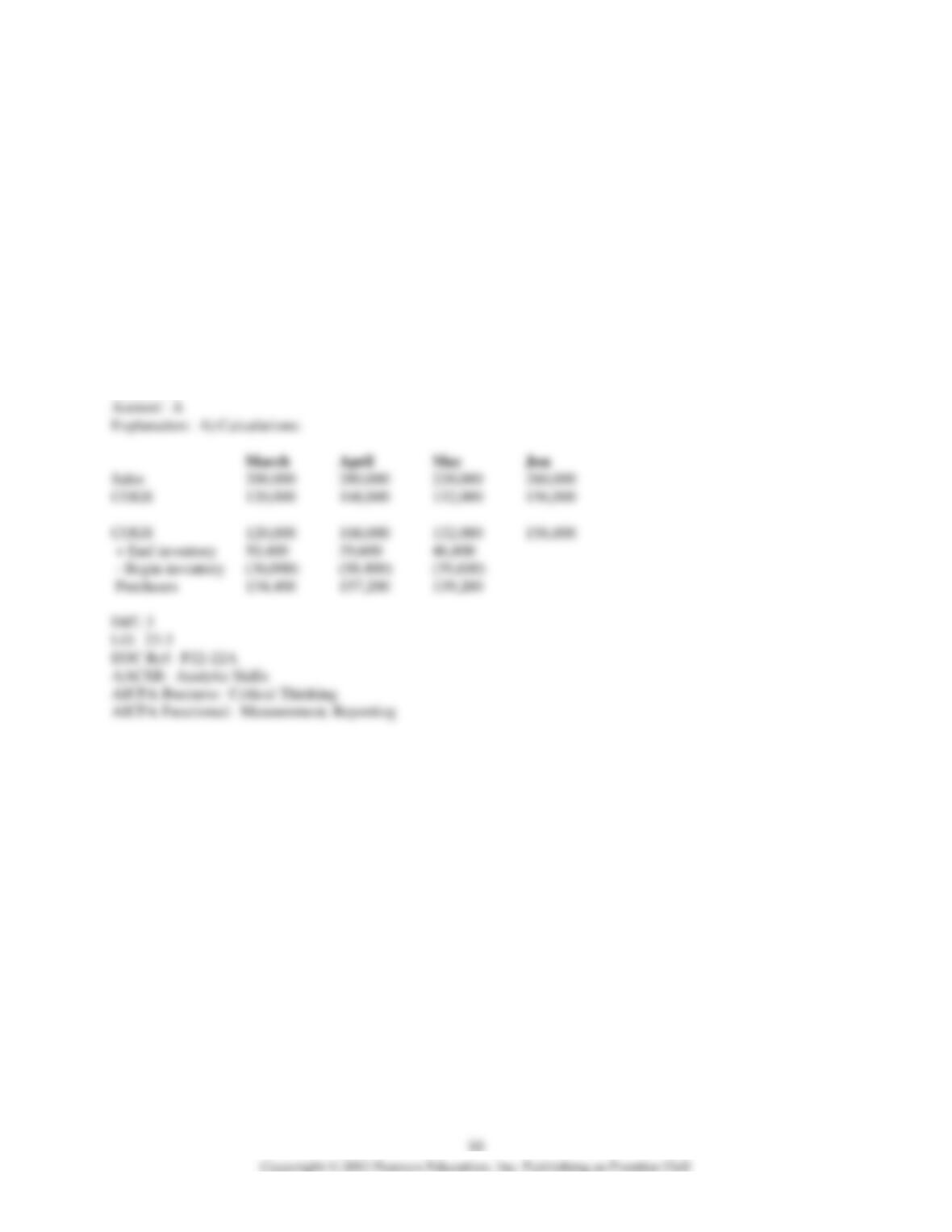
7) Norton Company prepared the following sales budget:
Month Budgeted Sales
March $200,000
April $180,000
May $220,000
June $260,000
Cost of goods sold is budgeted at 60% of sales, and the inventory at the end of February was $36,000. Desired
inventory levels at the end of each month are 30% of the next month’s cost of goods sold. How much are the
budgeted purchases for the month of April?
A) $157,200
B) $123,900
C) $134,400
D) $99,700
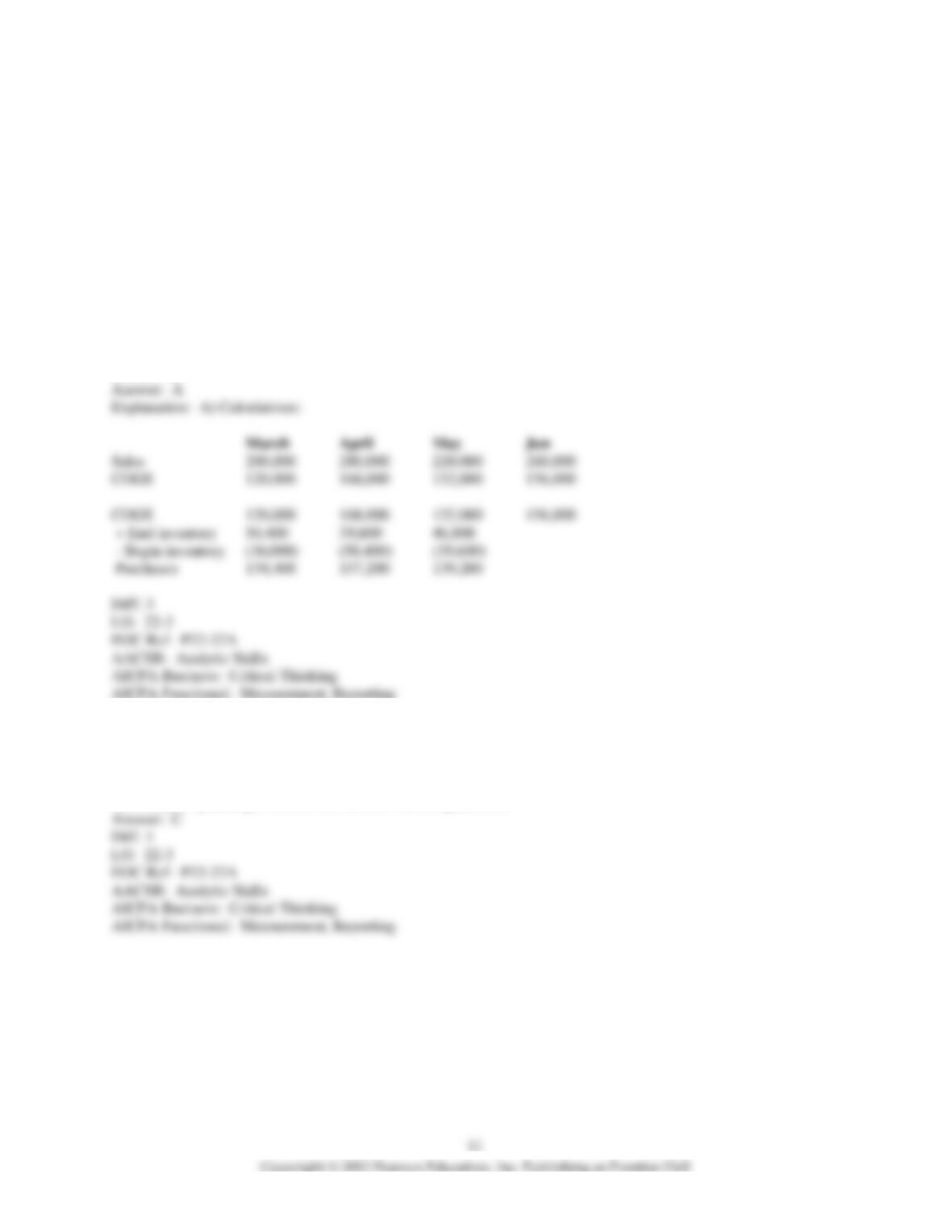
8) Norton Company prepared the following sales budget:
Month Budgeted Sales
March $200,000
April $280,000
May $220,000
June $260,000
Cost of goods sold is budgeted at 60% of sales, and the inventory at the end of February was $36,000. Desired
inventory levels at the end of each month are 30% of the next month’s cost of goods sold. How much are the
budgeted purchases for the month of May?
A) $139,200
B) $123,900
C) $108,200
D) $90,700
9) Which of the following describes the sales budget?
A) It aids in planning to ensure the company has adequate inventory on hand.
B) It captures the variable and fixed expenses of the business.
C) It depicts the breakdown of sales based on terms of collection.
D) It helps in planning to ensure the business has adequate cash.
10) Which of the following describes the inventory, purchases, and cost of goods sold budget?
A) It aids in planning to ensure the company has adequate inventory on hand.
B) It captures the variable and fixed expenses of the business.
C) It depicts the breakdown of sales based on terms of collection.
D) It helps in planning to ensure the business has adequate cash.
11) Which of the following describes the operating expenses budget?
A) It aids in planning to ensure the company has adequate inventory on hand.
B) It captures the variable and fixed expenses of the business.
C) It depicts the breakdown of sales based on terms of collection.
D) It helps in planning to ensure the business has adequate cash.
12) Which of the following describes the cash budget?
A) It aids in planning to ensure the company has adequate inventory on hand.
B) It captures the variable and fixed expenses of the business.
C) It depicts the breakdown of sales based on terms of collection.
D) It helps in planning to ensure the business has adequate cash.
13) Argyle Company forecasts sales of $50,000 in January, $60,000 in February, $70,000 in March, and $75,000 in
April. The inventory balance at January 1 is $12,000. Cost of goods sold is budgeted at 40% of sales revenue.
Argyle wishes to have inventory levels at the end of each month equal to 60% of the cost of goods sold for the
following month, plus a “safety cushion” of $1,000. How much should be budgeted for inventory purchases in
January?
A) $21,000
B) $22,100
C) $26,400
D) $23,400
14) Argyle Company forecasts sales of $50,000 in January, $60,000 in February, $70,000 in March, and $75,000 in
April. The inventory balance at January 1 is $12,000. Cost of goods sold is budgeted at 40% of sales revenue.
Argyle wishes to have inventory levels at the end of each month equal to 60% of cost of goods sold for the
following month, plus a “safety cushion” of $1,000. How much should be budgeted for inventory purchases in
February?
A) $21,000
B) $22,100
C) $26,400
D) $23,400
15) Argyle Company forecasts Sales of $50,000 in January, $60,000 in February, $70,000 in March, and $75,000 in
April. The inventory balance at January 1 is $12,000. Cost of goods sold is budgeted at 40% of sales revenue.
Argyle wishes to have inventory levels at the end of each month equal to 60% of the cost of goods sold for the
following month, plus a “safety cushion” of $1,000. How much should be budgeted for inventory purchases in
March?
A) $21,000
B) $22,100
C) $29,200
D) $23,400
16) Argyle Company is preparing the operating budget for the first quarter of 2012. They forecast sales of $50,000
in January, $60,000 in February, and $70,000 in March. Variable and fixed expenses are as follows:
Variable: Power cost (40% of Sales)
Miscellaneous expenses (5% of Sales)
Fixed: Salary expense: $8,000 per month
Rent expense: $5,000 per month
Depreciation expense: $1,200 per month
Power cost/fixed portion: $800 per month
Miscellaneous expenses/fixed portion: $1,000 per month
How much is the total operating expense for January?
A) $38,500
B) $47,500
C) $41,700
D) $43,000
17) Argyle Company is preparing the operating budget for the first quarter of 2012. They forecast sales of $50,000
in January, $60,000 in February, and $70,000 in March. Variable and fixed expenses are as follows:
Variable: Power cost (40% of Sales)
Miscellaneous expenses (5% of Sales)
Fixed: Salary expense: $8,000 per month
Rent expense: $5,000 per month
Depreciation expense: $1,200 per month
Power cost/fixed portion: $800 per month
Miscellaneous expenses/fixed portion: $1,000 per month
How much is the total operating expense for February?
A) $38,500
B) $47,500
C) $41,700
D) $43,000
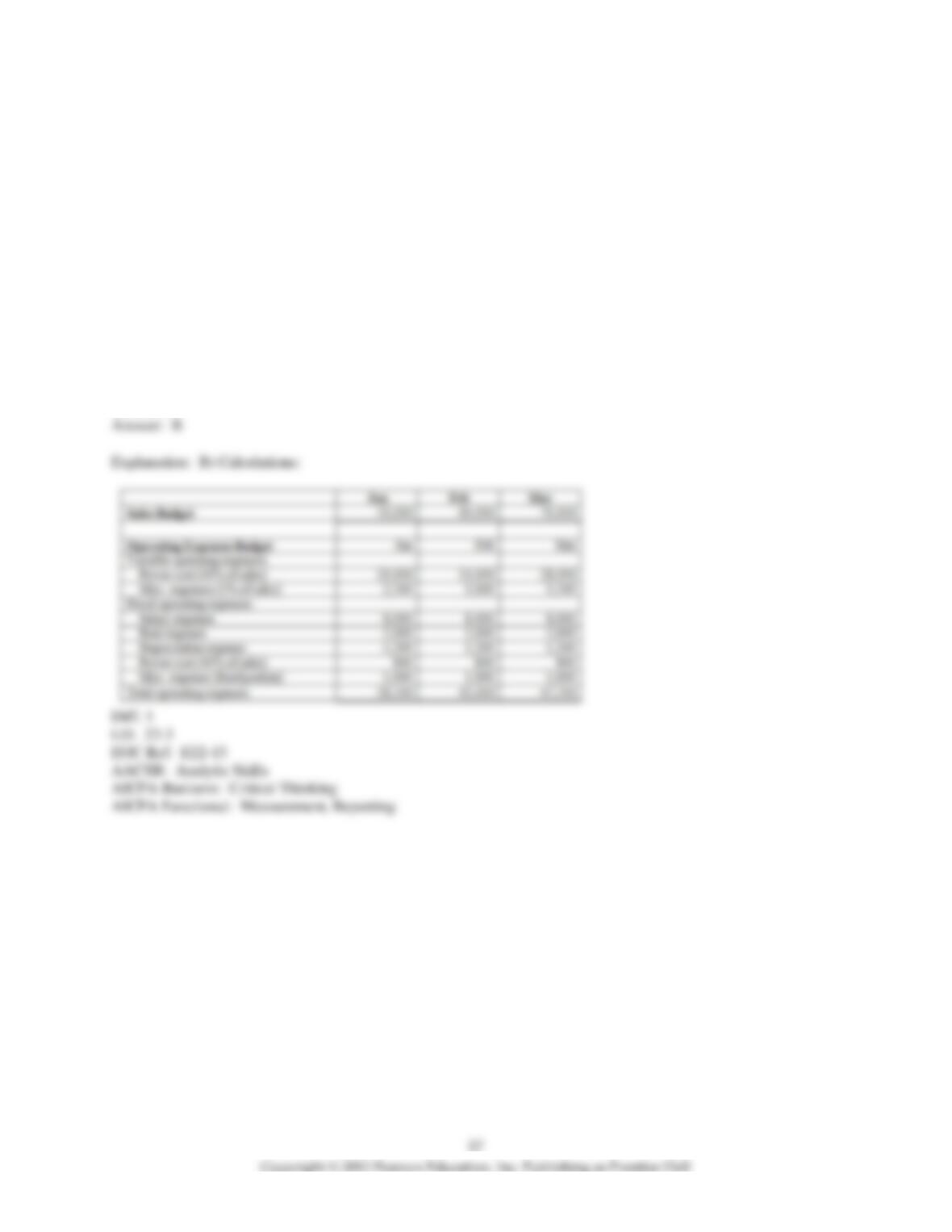
18) Argyle Company is preparing the operating budget for the first quarter of 2012. They forecast sales of $50,000
in January, $60,000 in February, and $70,000 in March. Variable and fixed expenses are as follows:
Variable: Power cost (40% of Sales)
Miscellaneous expenses (5% of Sales)
Fixed: Salary expense: $8,000 per month
Rent expense: $5,000 per month
Depreciation expense: $1,200 per month
Power cost/fixed portion: $800 per month
Miscellaneous expenses/fixed portion: $1,000 per month
How much is the total operating expense for March?
A) $38,500
B) $47,500
C) $41,700
D) $43,000
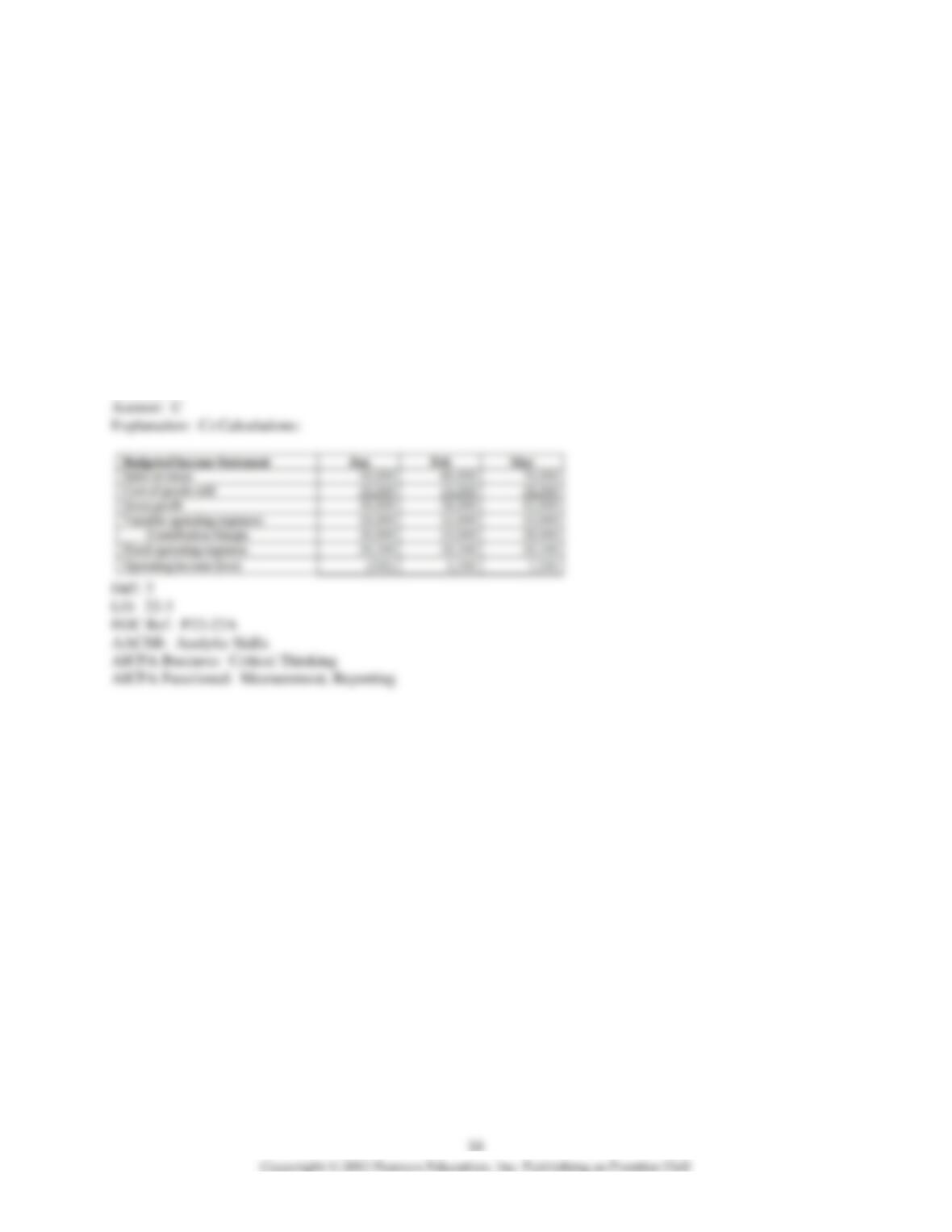
19) Bartholomew Manufacturing Company is preparing the operating budget for the first quarter of 2012. They
forecast sales of $50,000 in January, $60,000 in February, and $70,000 in March. Cost of goods sold is budgeted at
40% of Sales. Variable and fixed expenses are as follows:
Variable: Miscellaneous expenses : 20% of Sales
Fixed: Salary expense: $11,000 per month
Rent expense: $5,000 per month
Depreciation expense: $1,200 per month
Miscellaneous expenses/fixed portion: $3,300 per month
How much is the operating net income/(loss) for January?
A) $3,500
B) $1,450
C) ( $500)
D) $7,500
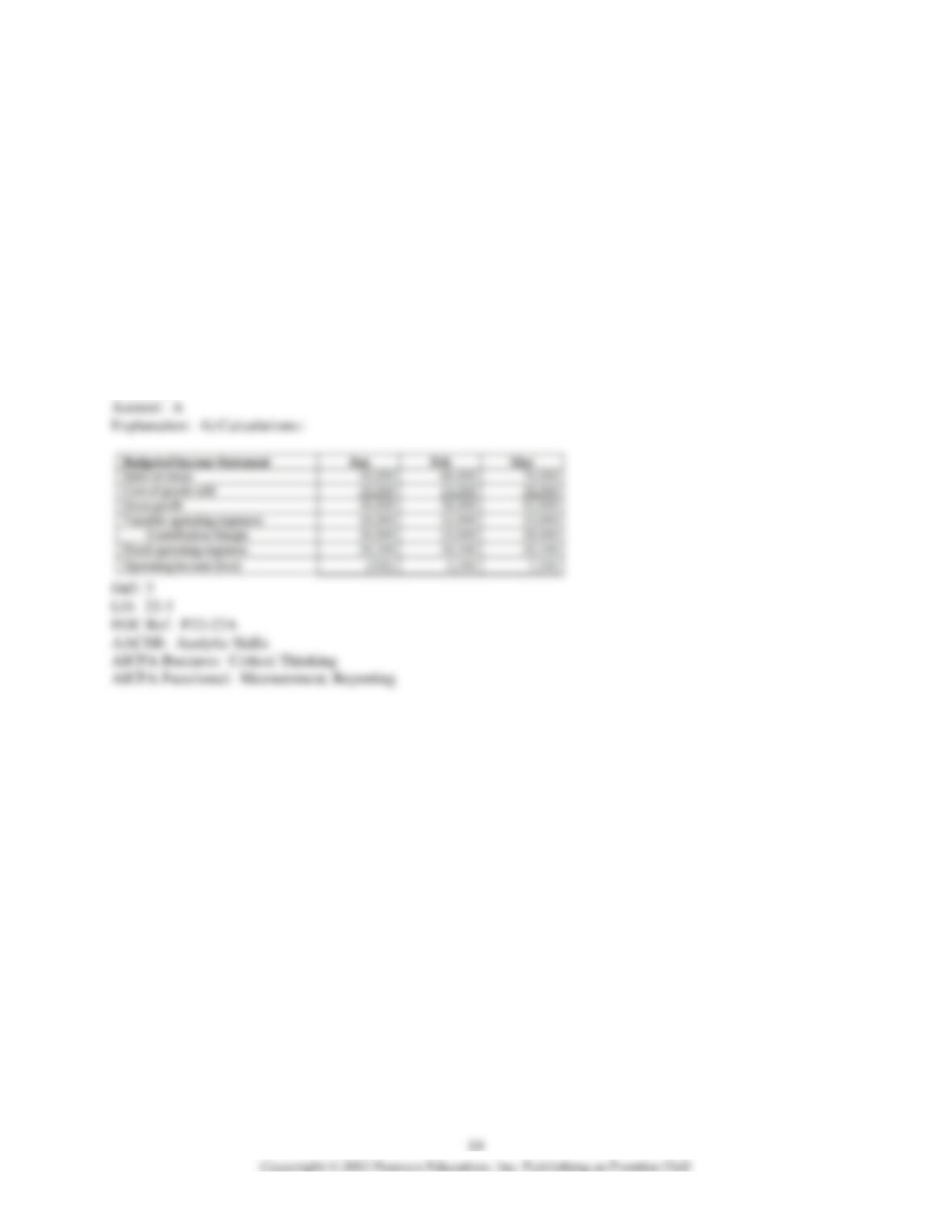
20) Bartholomew Manufacturing Company is preparing the operating budget for the first quarter of 2012. They
forecast sales of $50,000 in January, $60,000 in February, and $70,000 in March. Cost of goods sold is budgeted at
40% of Sales. Variable and fixed expenses are as follows:
Variable: Miscellaneous expenses : 20% of Sales
Fixed: Salary expense: $11,000 per month
Rent expense: $5,000 per month
Depreciation expense: $1,200 per month
Miscellaneous expenses/fixed portion: $3,300 per month
How much is the operating net income/(loss) for February?
A) $3,500
B) $1,450
C) ($500)
D) $7,500
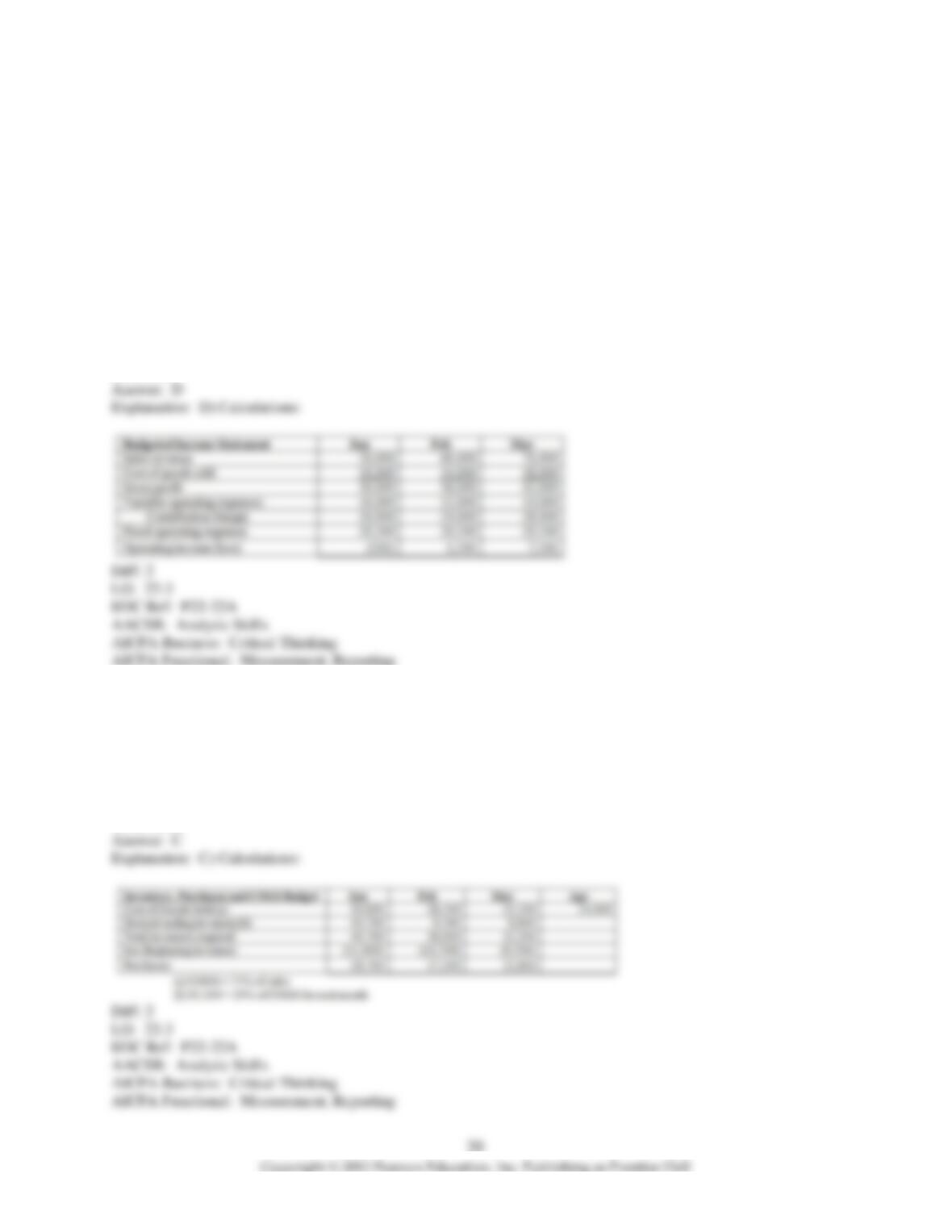
21) Bartholomew Manufacturing Company is preparing the operating budget for the first quarter of 2012. They
forecast sales of $50,000 in January, $60,000 in February, and $70,000 in March. Cost of goods sold is budgeted at
40% of Sales. Variable and fixed expenses are as follows:
Variable: Miscellaneous expenses : 20% of Sales
Fixed: Salary expense: $11,000 per month
Rent expense: $5,000 per month
Depreciation expense: $1,200 per month
Miscellaneous expenses/fixed portion: $3,300 per month
How much is the operating net income/(loss) for March?
A) $3,500
B) $1,450
C) ($500)
D) $7,500
22) Caskill Company forecasts $40,000 of sales in January, $38,000 in February, $30,000 in March, and $32,000 in
April. Cost of goods sold is budgeted at 75% of sales. Caskill should have inventory on hand at the end of each
month equal to $5,000 plus 20% of the following month’s cost of goods sold. How much are budgeted purchases for
January?
A) $22,800
B) $27,300
C) $29,700
D) $24,900