Accounting for Leases
21 – 39
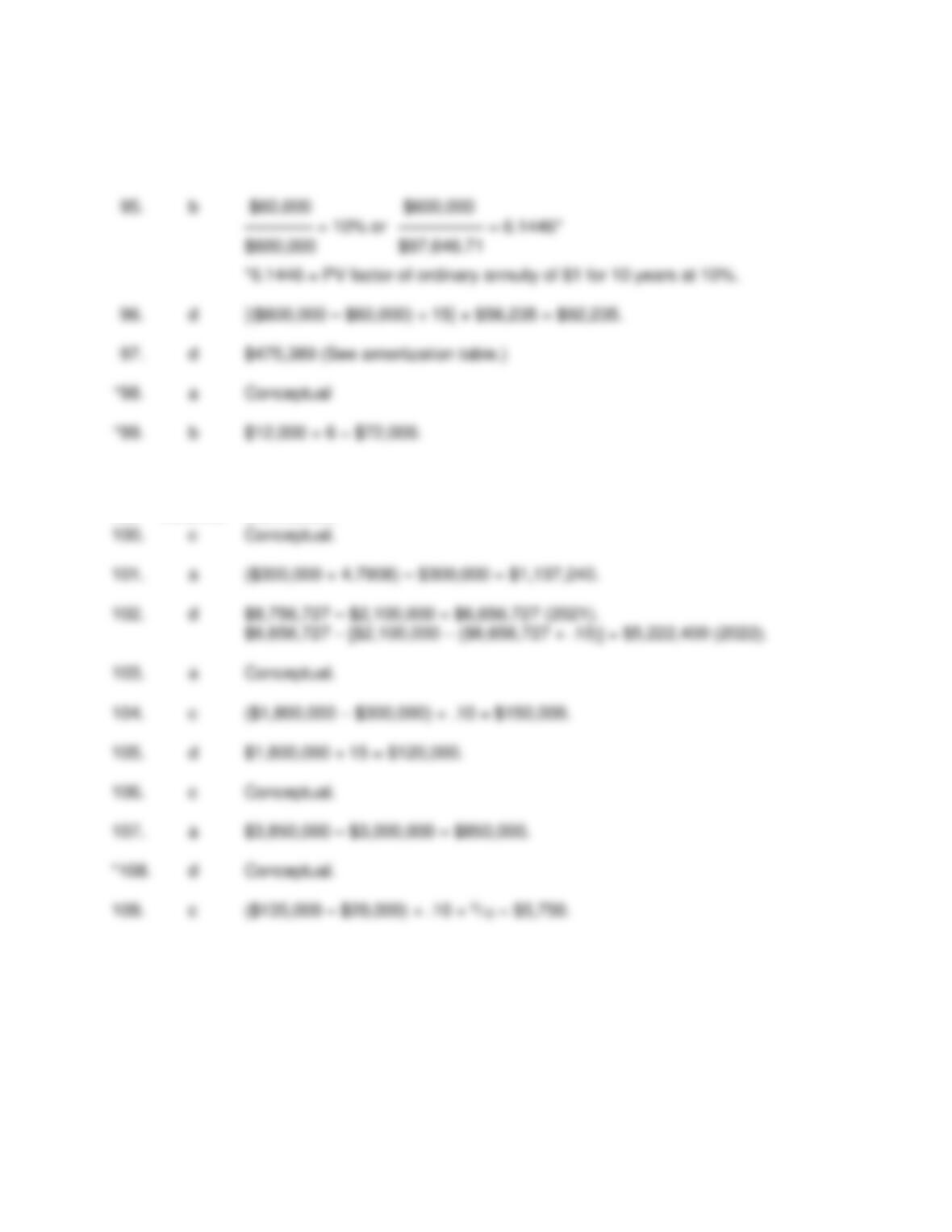
DERIVATIONS — Computational (cont.)
No. Answer Derivation
DERIVATIONS — CPA Adapted
No. Answer Derivation
Test Bank for Intermediate Accounting, Seventeenth Edition
21 – 40
BRIEF EXERCISES
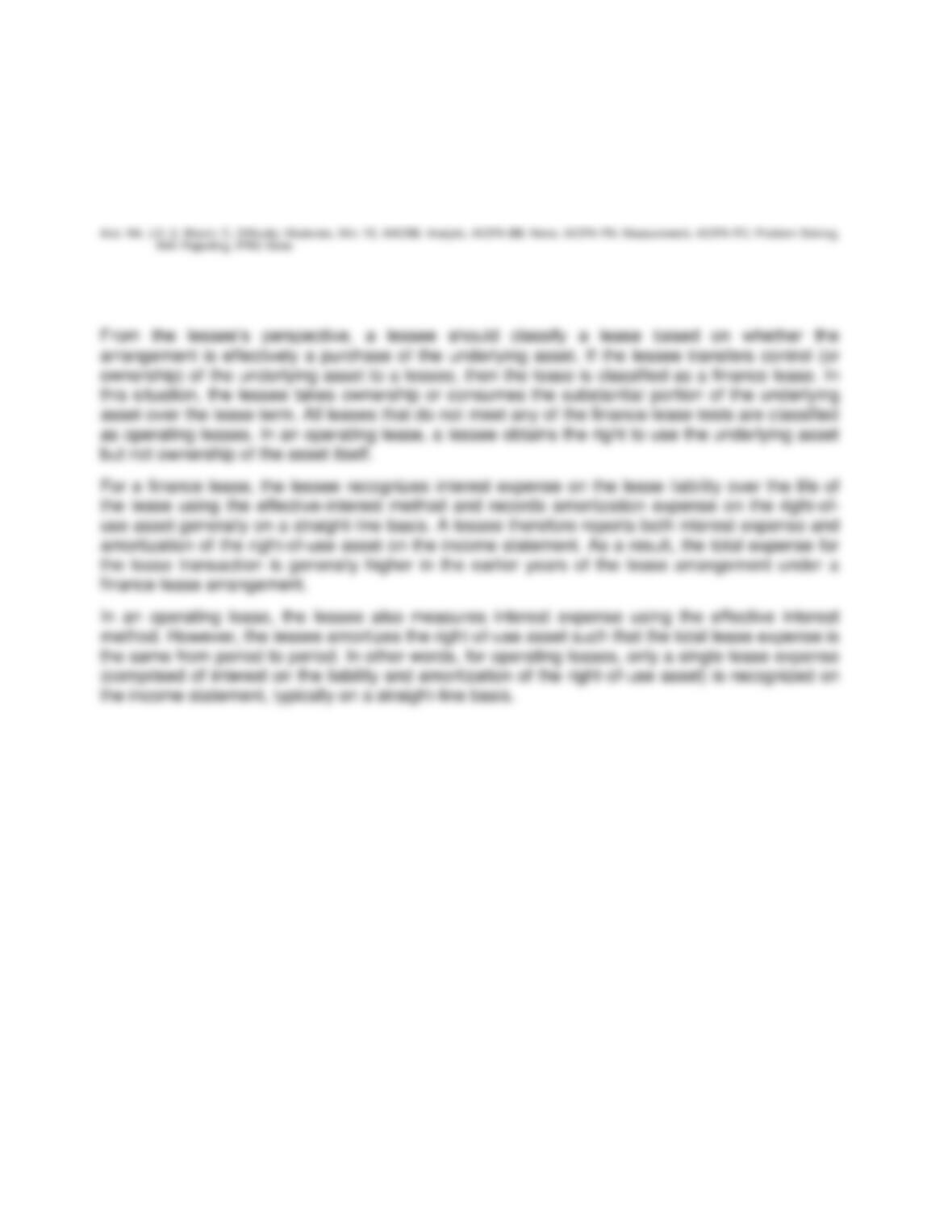
BE. 21–110—Finance lease (Essay).
Distinguish between a finance lease and an operating lease from a lessee’s perspective.
Solution 21-110
Accounting for Leases
21 – 41
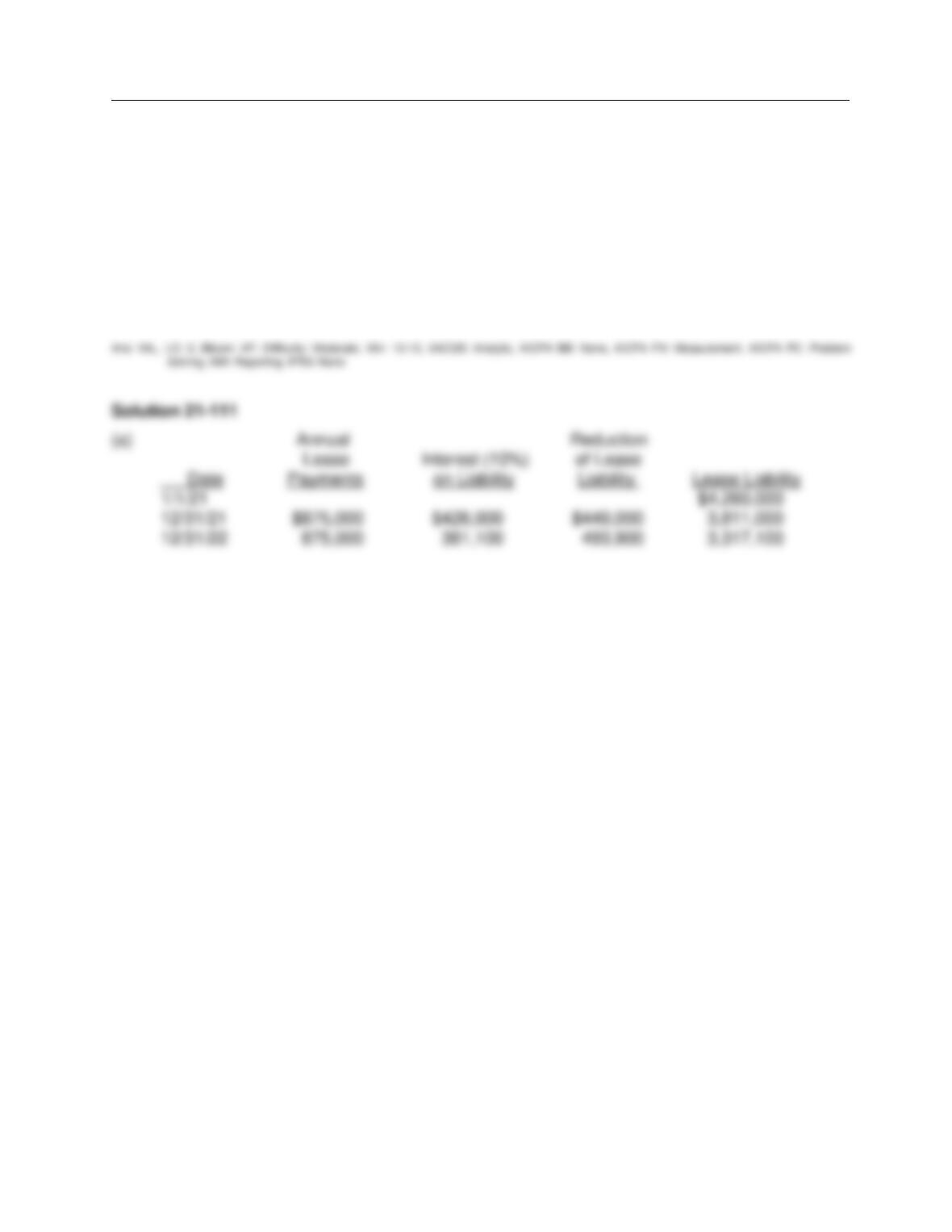
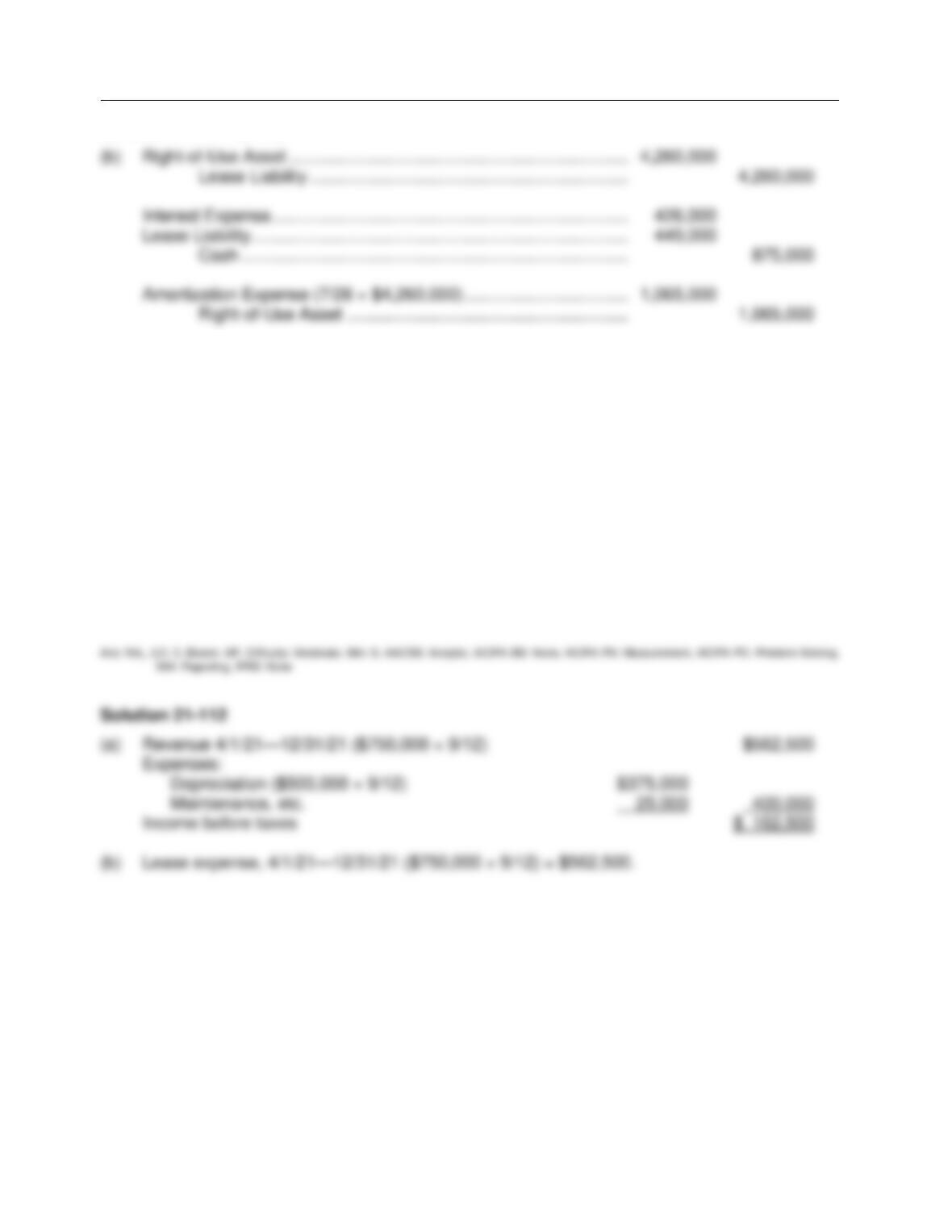
BE. 21–111—Finance lease amortization and journal entries.
Hughey Co. as lessee records a finance lease of machinery on January 1, 2021. The seven
annual lease payments of $875,000 are made at the end of each year. The present value of the
lease payments at 10% is $4,260,000. Hughey uses the effective-interest method of amortization
and sum-of–the-years’-digits depreciation (no residual value).
Instructions (Round to the nearest dollar.)
(a) Prepare an amortization table for 2021 and 2022.
(b) Prepare all of Hughey’s journal entries for 2021.
Test Bank for Intermediate Accounting, Seventeenth Edition
21 – 42
Solution 21-111 (cont.)
BE. 21–112—Operating lease.
Maris Co. purchased a machine on January 1, 2021, for $2,500,000 for the express purpose of
leasing it. The machine is expected to have a five-year life, no salvage value, and be depreciated
on a straight-line monthly basis. On April 1, 2021, Maris leased the machine to Dunbar Company
for $750,000 a year for a four-year period ending March 31, 2025. Maris incurred total
maintenance and other related costs under the provisions of the lease of $25,000 relating to the
year ended December 31, 2021. Harley paid $750,000 to Maris on April 1, 2021.
Instructions
(a) Assuming an operating lease, what should be the income before income taxes derived by
Maris Co. from this lease for the year ended December 31, 2021?
(b) What should be the total amount of lease expense incurred by Dunbar from this lease for
the year ended December 31, 2021?
Accounting for Leases
21 – 43
EXERCISES
Ex. 21-113—Lease classification tests.
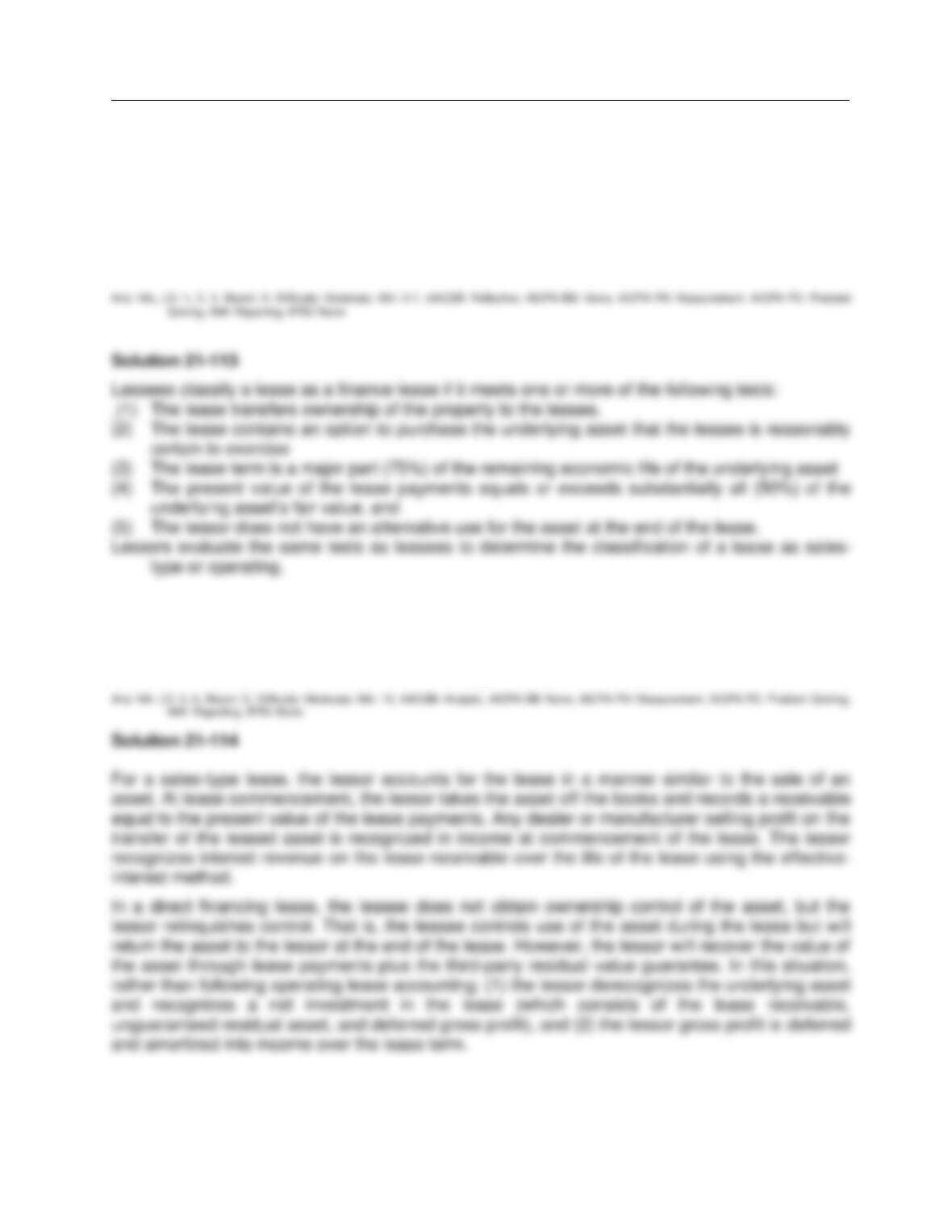
What are the lease classification tests used to determine whether a company should use the
finance lease approach or the operations lease approach?
Ex. 21-114—Direct-financing lease and sales-type lease.
Explain the differences between a direct-financing lease and a sales-type lease.
Test Bank for Intermediate Accounting, Seventeenth Edition
21 – 44
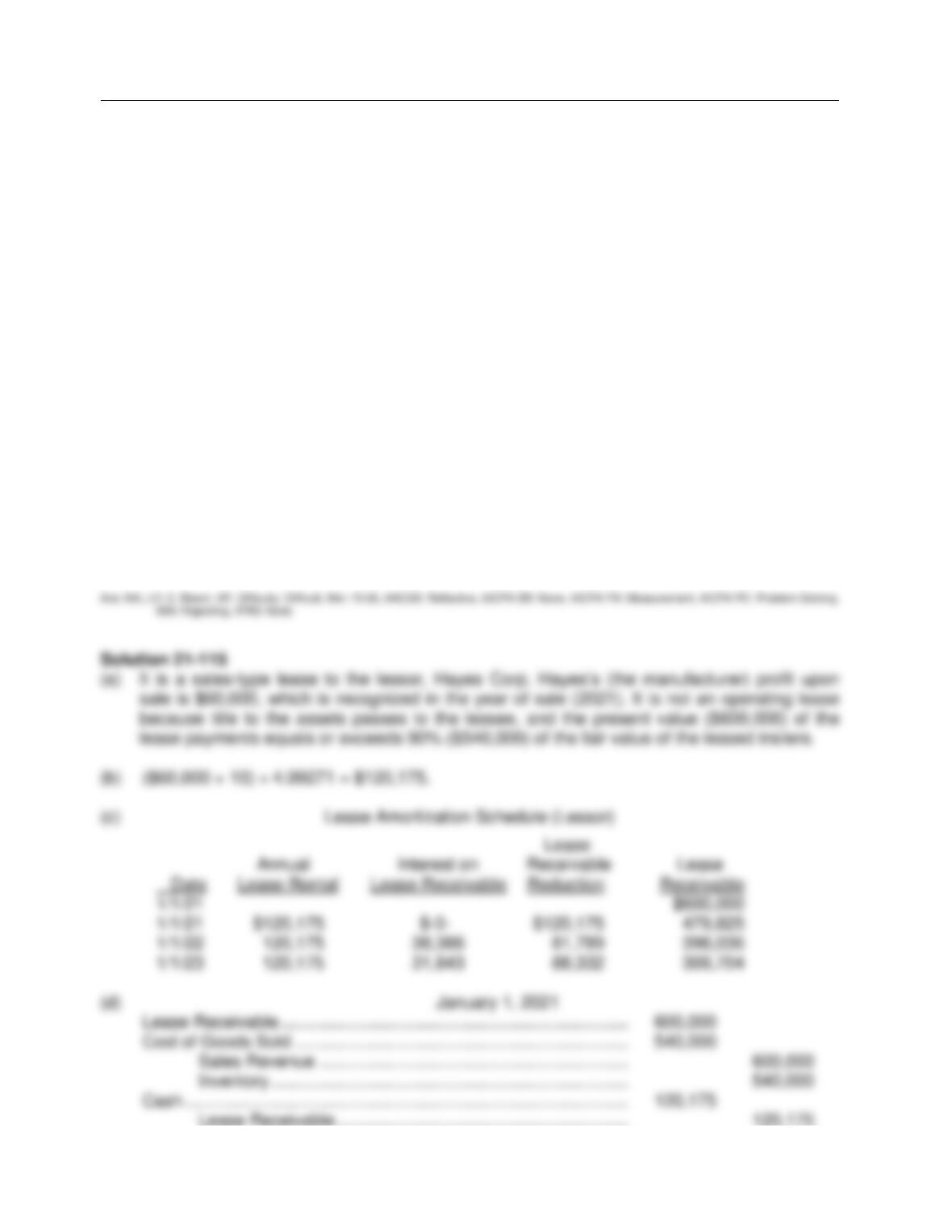
Ex. 21-115—Lessor accounting—sales-type lease.
Hayes Corp. is a manufacturer of truck trailers. On January 1, 2021, Hayes Corp. leases ten
trailers to Lester Company under a six-year noncancelable lease agreement. The following
information about the lease and the trailers is provided:
1. Equal annual payments that are due on January 1 each year provide Hayes Corp. with an
8% return on net investment (present value factor for 6 periods at 8% is 4.99271).
2. Titles to the trailers pass to Lester at the end of the lease.
3. The fair value of each trailer is $60,000. The cost of each trailer to Hayes Corp. is $54,000.
Each trailer has an expected useful life of nine years.
4. Collectibility of the lease payments is probable.
Instructions
(a) What type of lease is this for the lessor? Discuss.
(b) Calculate the annual lease payment. (Round to nearest dollar.)
(c) Prepare a lease amortization schedule for Hayes Corp. for the first three years.
(d) Prepare the journal entries for the lessor for 2021 to record the lease agreement, the receipt
of the lease rentals, and the recognition of revenue (assume the use of a perpetual
inventory method and round all amounts to the nearest dollar).
Accounting for Leases
21 – 45
Solution 21-115 (cont.)
*Ex. 21-116—Sale-Leaseback.
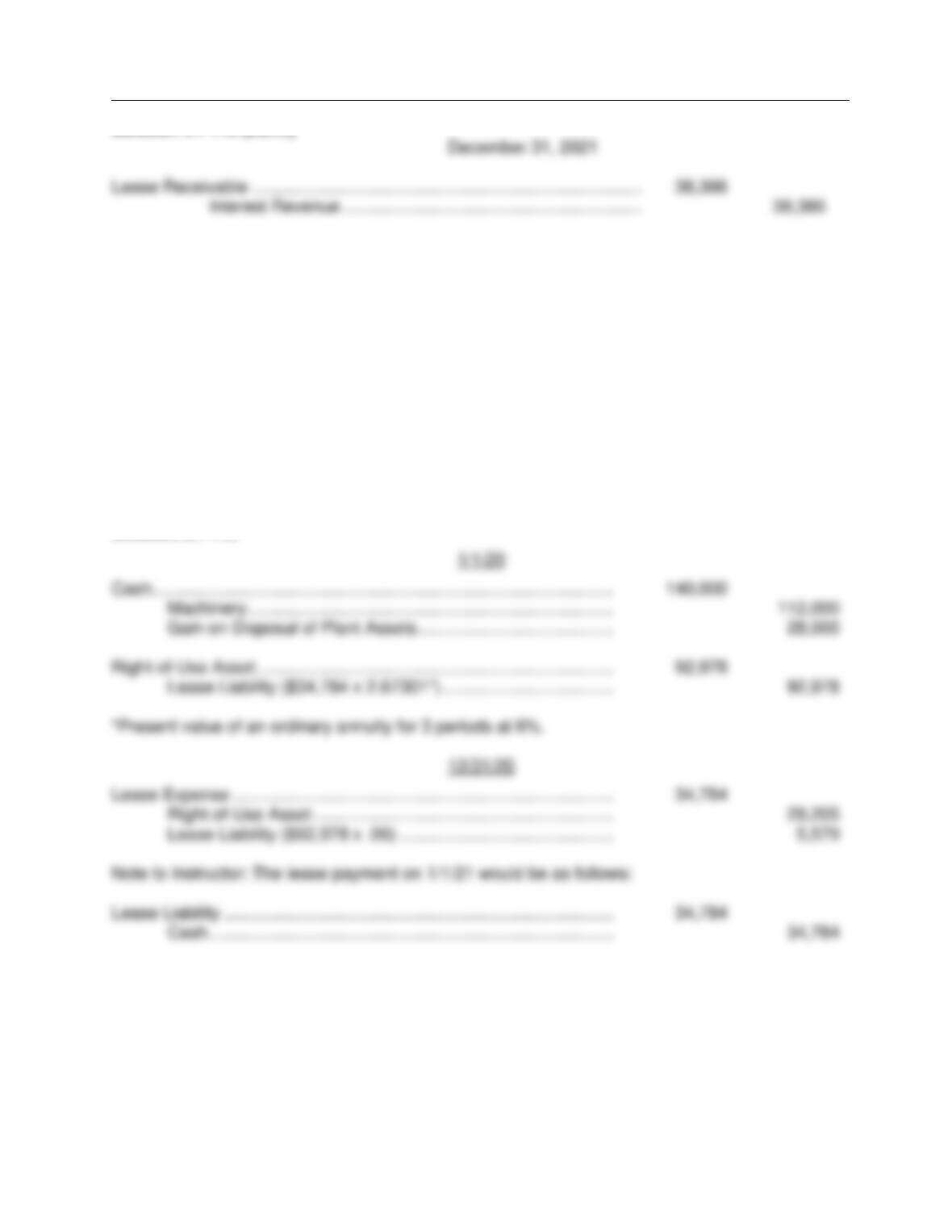
On January 1, 2020, Haley Corporation sold a machine to Quick Finance for $140,000 and
immediately leased it back. The machine was carried on Haley’s books at $112,000. The term of
the lease is 3 years, there is no bargain purchase option, and title does not transfer to Haley at
lease-end. The lease requires three equal rental payments of $34,784 at the end of each year
(first payment on January 1, 2021). The appropriate rate of interest is 6%, the machine has a
useful life of 5 years, and the residual value at the end of the lease term is expected to be
$56,000, none of which is guaranteed.
Instructions
Prepare Haley’s 2020 journal entries.
Solution 21-116
Test Bank for Intermediate Accounting, Seventeenth Edition
21 – 46
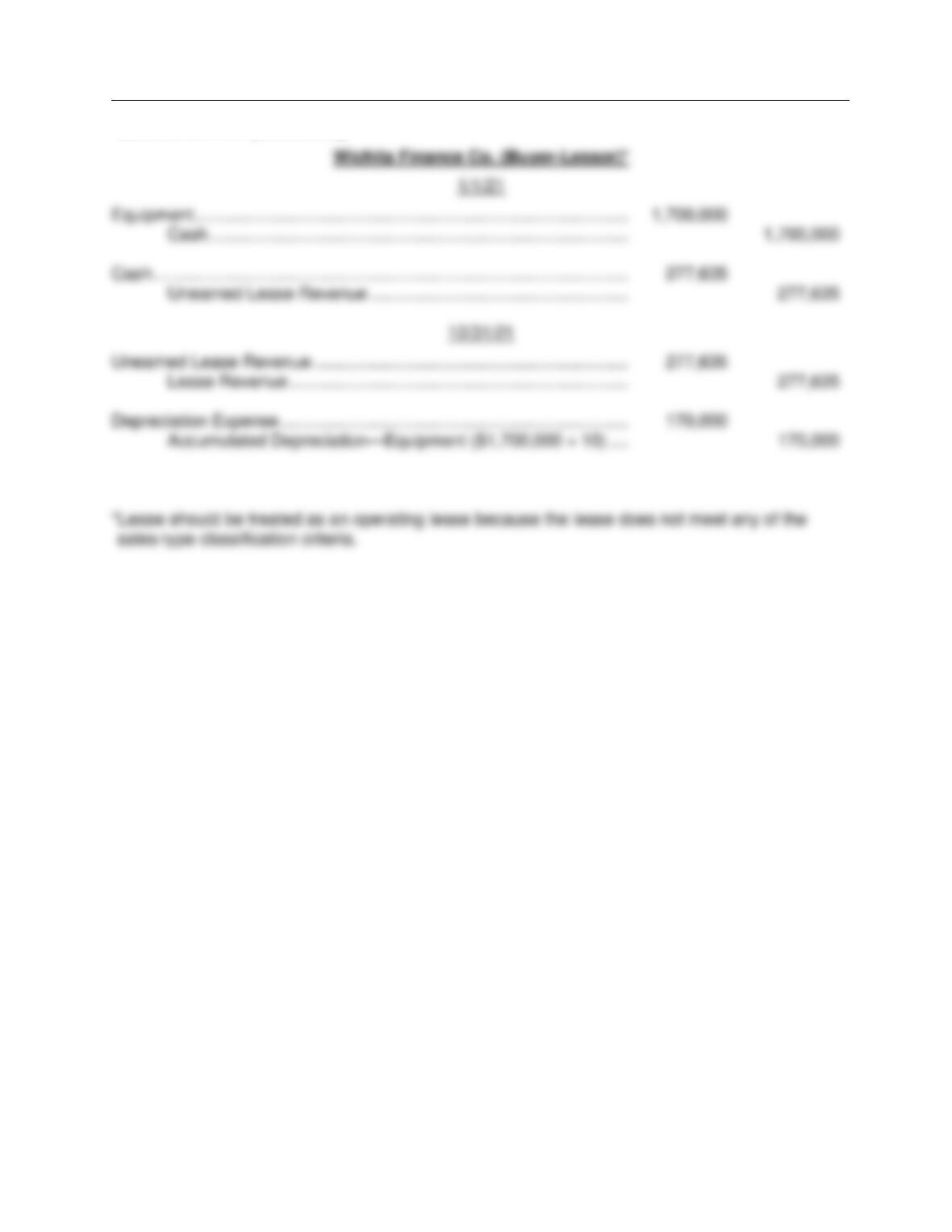
*Ex. 21-117—Sale-Leaseback.
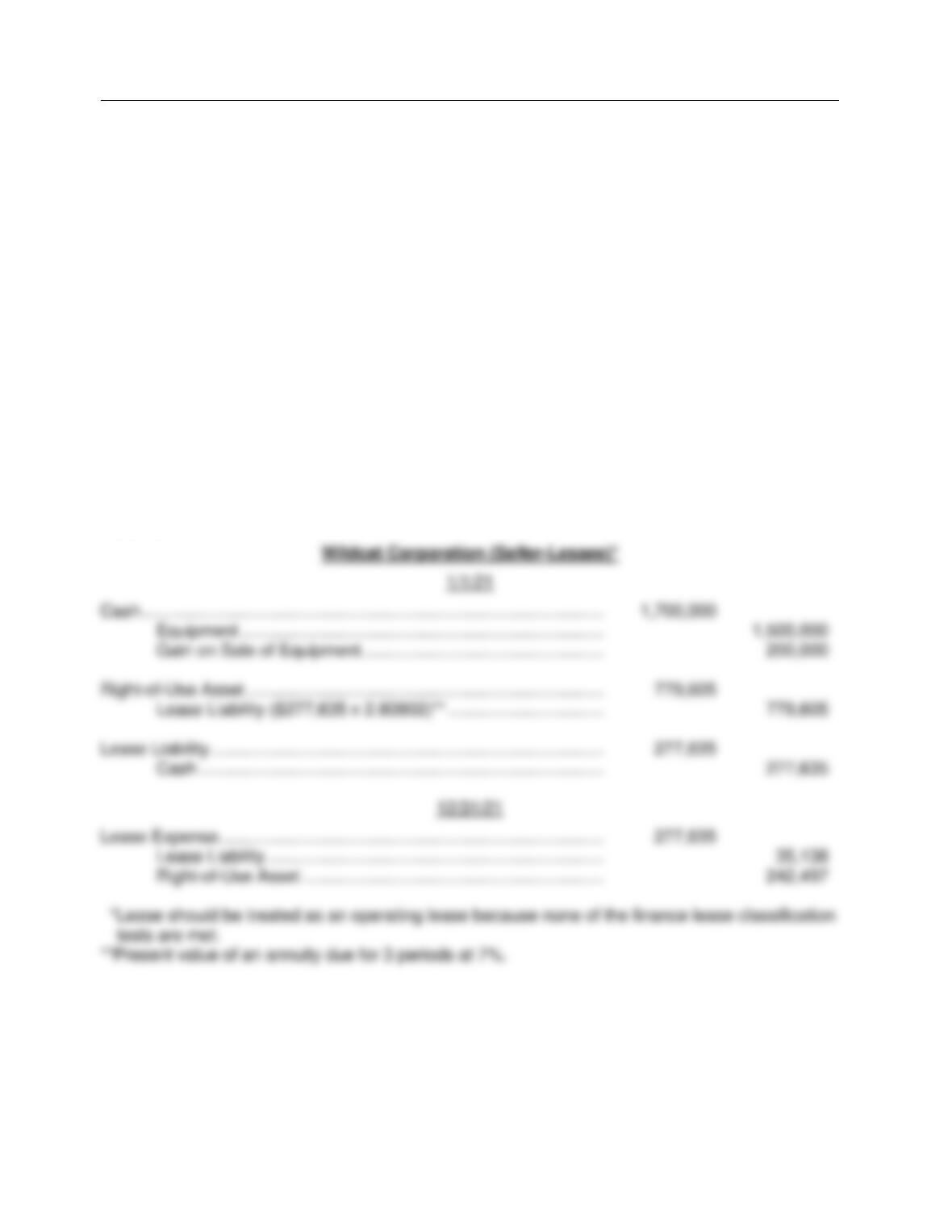
Assume that on January 1, 2021, Wildcat Corporation sells equipment to Wichita Finance Co. for
$1,700,000 and immediately leases back the equipment. The relevant information is as follows.
1. The equipment was carried on Wildcats books at a value of $1,500,000.
2. The term of the non-cancelable lease is 3 years; title will not transfer to Wildcats, and the
expected residual value at the end of the lease is 125,000, all of which is unguaranteed.
3. The lease agreement requires equal rental payments of $277,635 at the beginning of each
year.
4. The incremental borrowing rate for Wildcat is 7%. Wildcat is aware that Wichita Finance set
the annual rental to ensure a rate of return of 7%.
5. The equipment has a fair value of $1,700,000 on January 1, 2021, and an estimated
economic life of 10 years.
Instructions
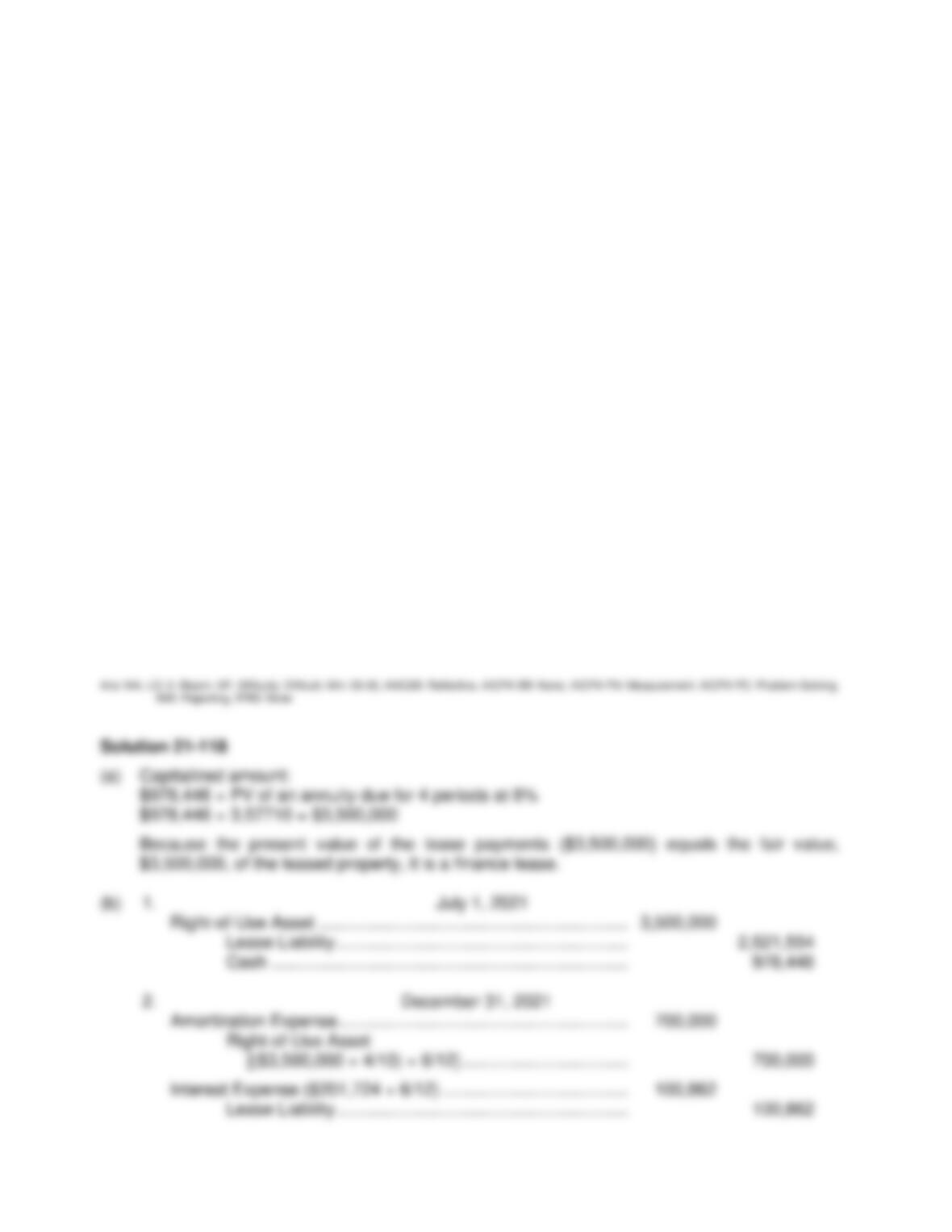
Prepared the journal entries for both the lessee and the lessor for 2021 to reflect the sale and
leaseback agreement.
*Solution 21-117
Accounting for Leases
21 – 47
*Solution 21-117 (Continued)
Test Bank for Intermediate Accounting, Seventeenth Edition
21 – 48
PROBLEMS
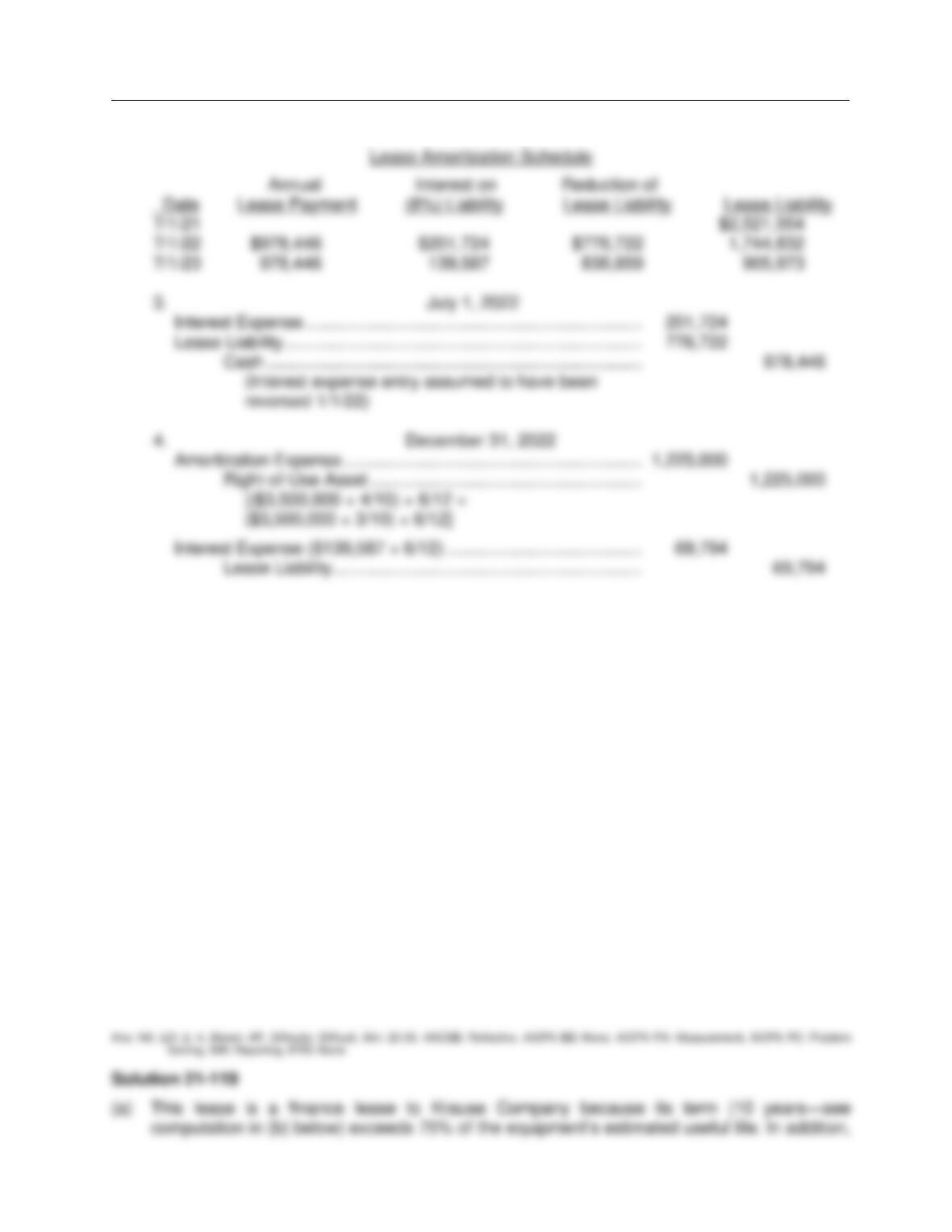
Pr. 21-118—Lessee accounting—finance lease.
Eubank Company, as lessee, enters into a lease agreement on July 1, 2021, for equipment. The
following data are relevant to the lease agreement:
1. The term of the noncancelable lease is 4 years. Payments of $978,446 are due on July 1 of
each year.
2. The fair value of the equipment on July 1, 2021 is $3,500,000. The equipment has an
economic life of 6 years with no salvage value.
3. Eubank depreciates similar machinery it owns on the sum-of–the-years’-digits basis.
4. The lessee pays all executory costs.
5. Eubank’s incremental borrowing rate is 10% per year. The lessee is aware that the lessor
used an implicit rate of 8% in computing the lease payments (present value factor for 4
periods at 8%, 3.57710; at 10%, 3.48685).
Instructions
(a) Indicate the type of lease Eubank Company has entered into and what accounting treatment
is applicable.
(b) Prepare the journal entries on Eubank’s books that relate to the lease agreement for the
following dates: (Round all amounts to the nearest dollar. Include a partial amortization
schedule.)
1. July 1, 2021.
2. December 31, 2021.
3. July 1, 2022.
4. December 31, 2022.
Accounting for Leases
21 – 49
Solution 21-118 (cont.)
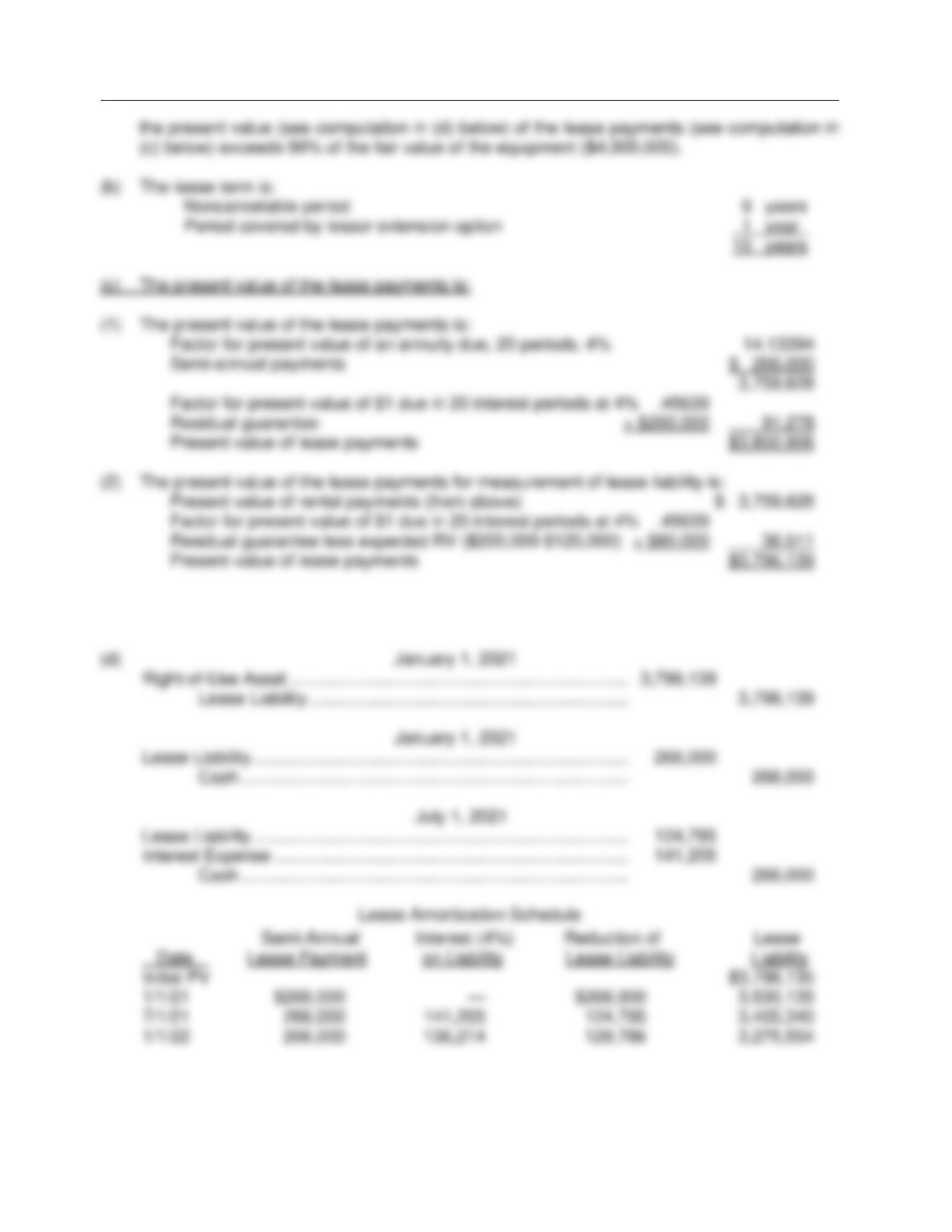
Pr. 21-119—Lessee accounting—finance lease.
Krause Company on January 1, 2021, enters into a nine-year noncancelable lease for equipment
having an estimated useful life of 10 years and a fair value to the lessor, Daly Corp., at the
inception of the lease of $4,000,000. Krause’s incremental borrowing rate is 8%. Krause uses the
straight-line method to depreciate its assets. The lease contains the following provisions:
1. Rental payments of $266,000 are payable at the beginning of each six-month period.
2. An option allowing the lessor to extend the lease one year beyond the lease term.
3. A guarantee by Krause Company that Daly Corp. will realize $200,000 from selling the asset
at the expiration of the lease. However, the actual residual value is expected to be $120,000.
Instructions
(a) What kind of lease is this to Krause Company?
(b) What should be considered the lease term?
(c) What is the present value of the lease payments (1) for classification of the lease and (2) for
measurement of the lease liability? (PV factor for annuity due of 20 semi-annual payments
at 8% annual rate, 14.13394; PV factor for amount due in 20 semi-annual interest periods at
8% annual rate, .45639.) (Round to nearest dollar.)
(d) What journal entries would Krause record during the first year of the lease? (Include an
amortization schedule through 1/1/22 and round to the nearest dollar.)
Test Bank for Intermediate Accounting, Seventeenth Edition
21 – 50
Accounting for Leases
21 – 51
Solution 21-119 (cont.)
*Pr. 21-120—Direct-financing lease.
Merando Corporation leases a building to Fernetti, Inc. on January 1, 2020. The following facts
pertain to the lease agreement.
1. The lease term is 10 years with equal annual rental payments of $51,735 at the end of each
year.
2. Ownership does not transfer at the end of the lease term, there is no bargain purchase option,
and the asset is not of a specialized nature.
3. The building has a fair value of $510,000, a book value to Merando of $330,000, and a useful
life of 15 years.
4. At the end of the lease term, Merando and Fernetti expect the residual value of the building to
be $180,000, and this amount is guaranteed by Baden, Inc., a third party.
5. Merando wants to earn a 5% return on the lease, and collectability of the payments is probable.
Instructions
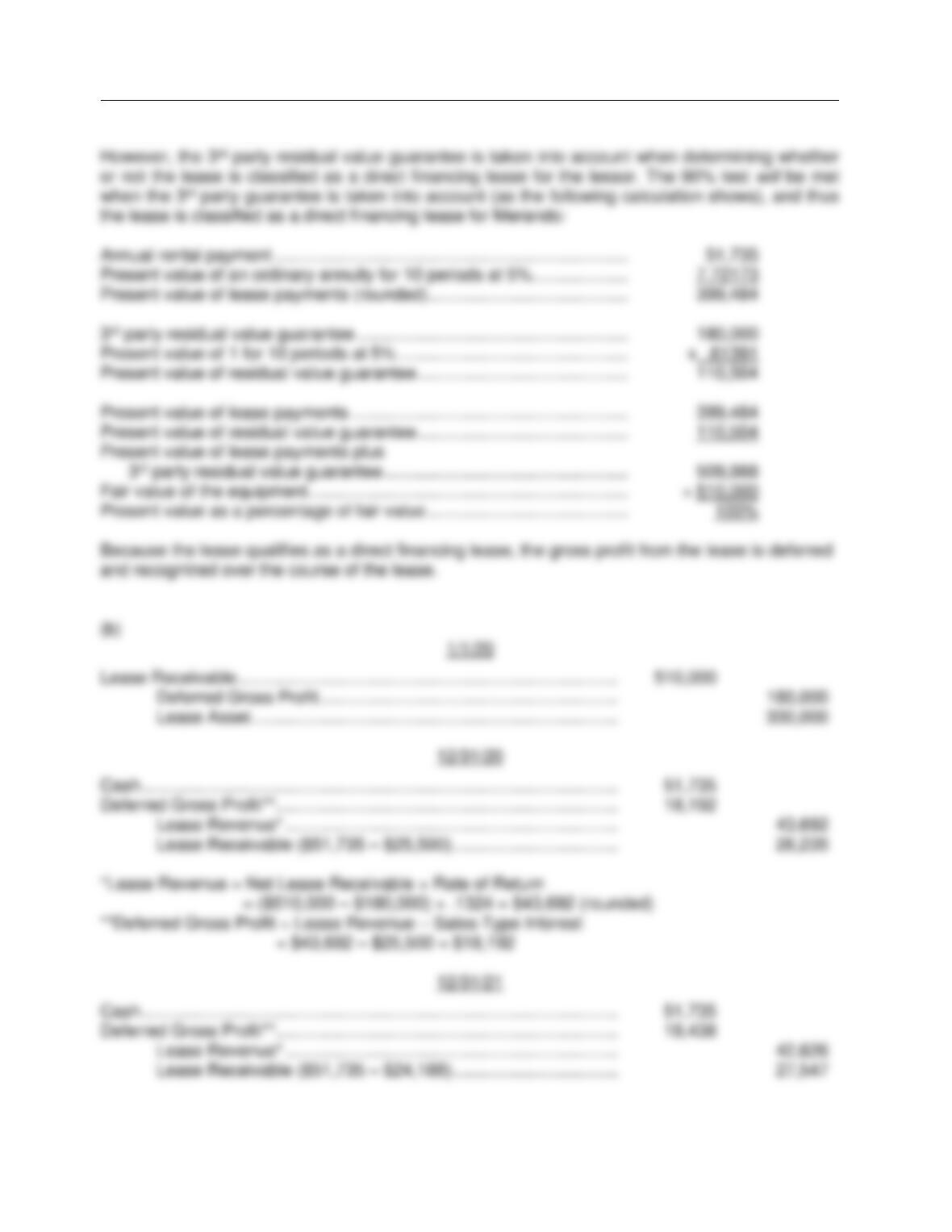
(a) Describe the nature of this lease to both Merando and Fernetti.
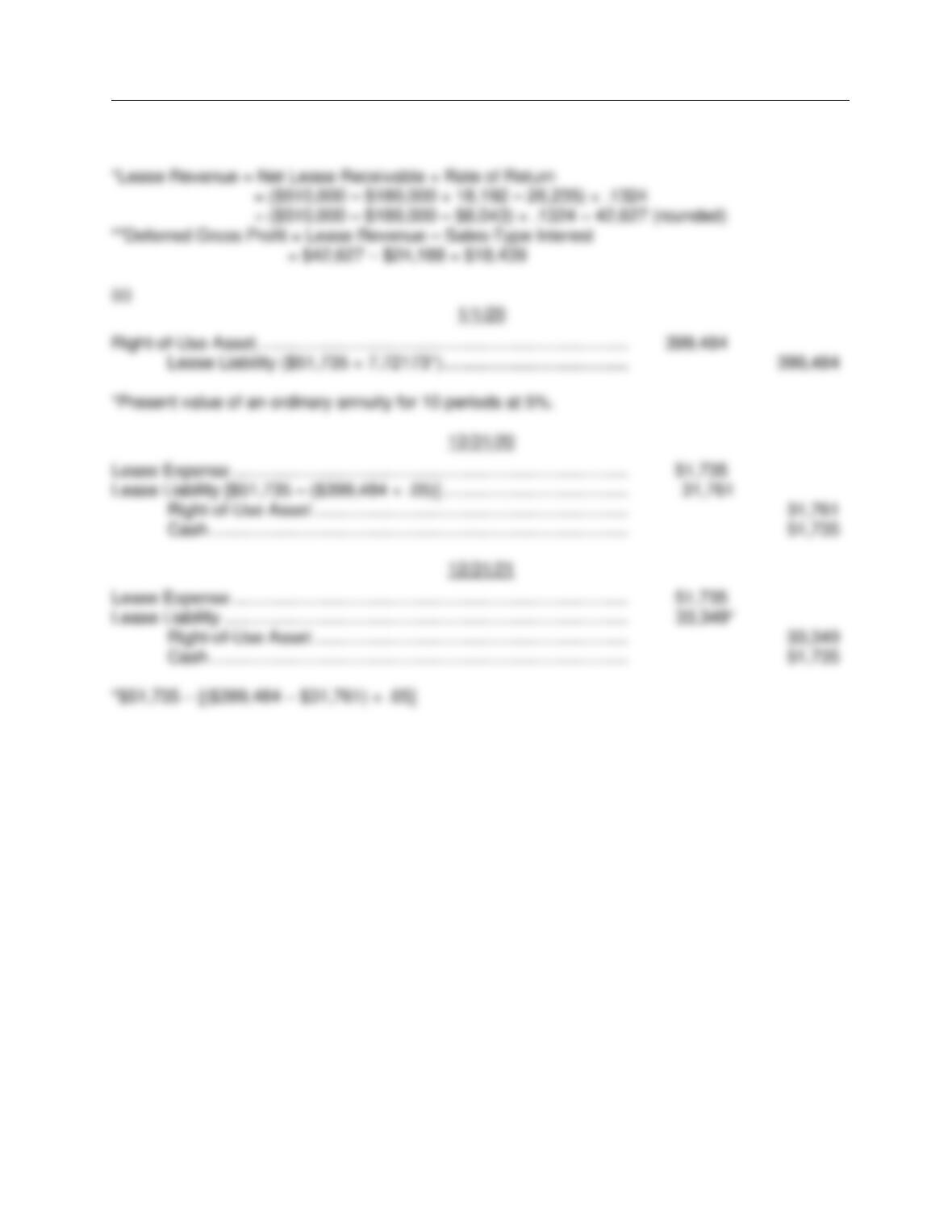
(b) Assume the rate of return to amortize the net lease receivable to zero is 13.24%. Prepare
the journal entries to record the entries for Merando for 2020 and 2021.
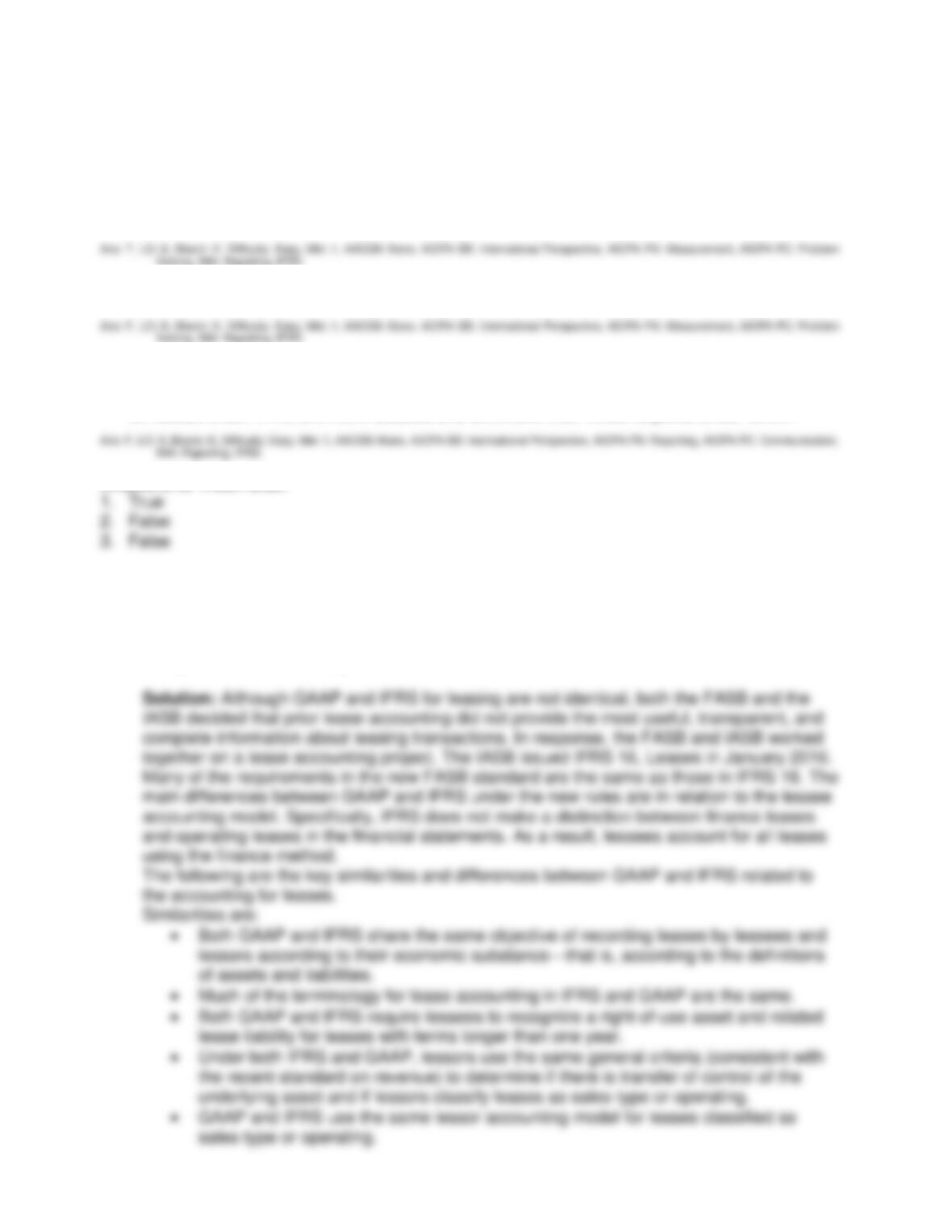
(c) Prepare the journal entries for Fernetti (the lessee) for 2020 and 2021, assuming the rate
implicit in the lease is known to Fernetti.
*Solution 21-120
Test Bank for Intermediate Accounting, Seventeenth Edition
21 – 52
*Solution 21-120 (cont.)
Accounting for Leases
21 – 53
*Solution 21-120 (cont.)
Test Bank for Intermediate Accounting, Seventeenth Edition
21 – 54
IFRS QUESTIONS
True/False
1. IFRS requires lessees to recognize a right–of-use asset and related liability for leases with
terms longer than one year.
2. IFRS distinguishes between sales-type and direct financing leases for lessors.
3. Because IFRS is very general in its provisions for lease accounting, the required disclosures
for leases under IFRS are more detailed and extensive than those required under GAAP.
Answers to True/False:
Short Answer
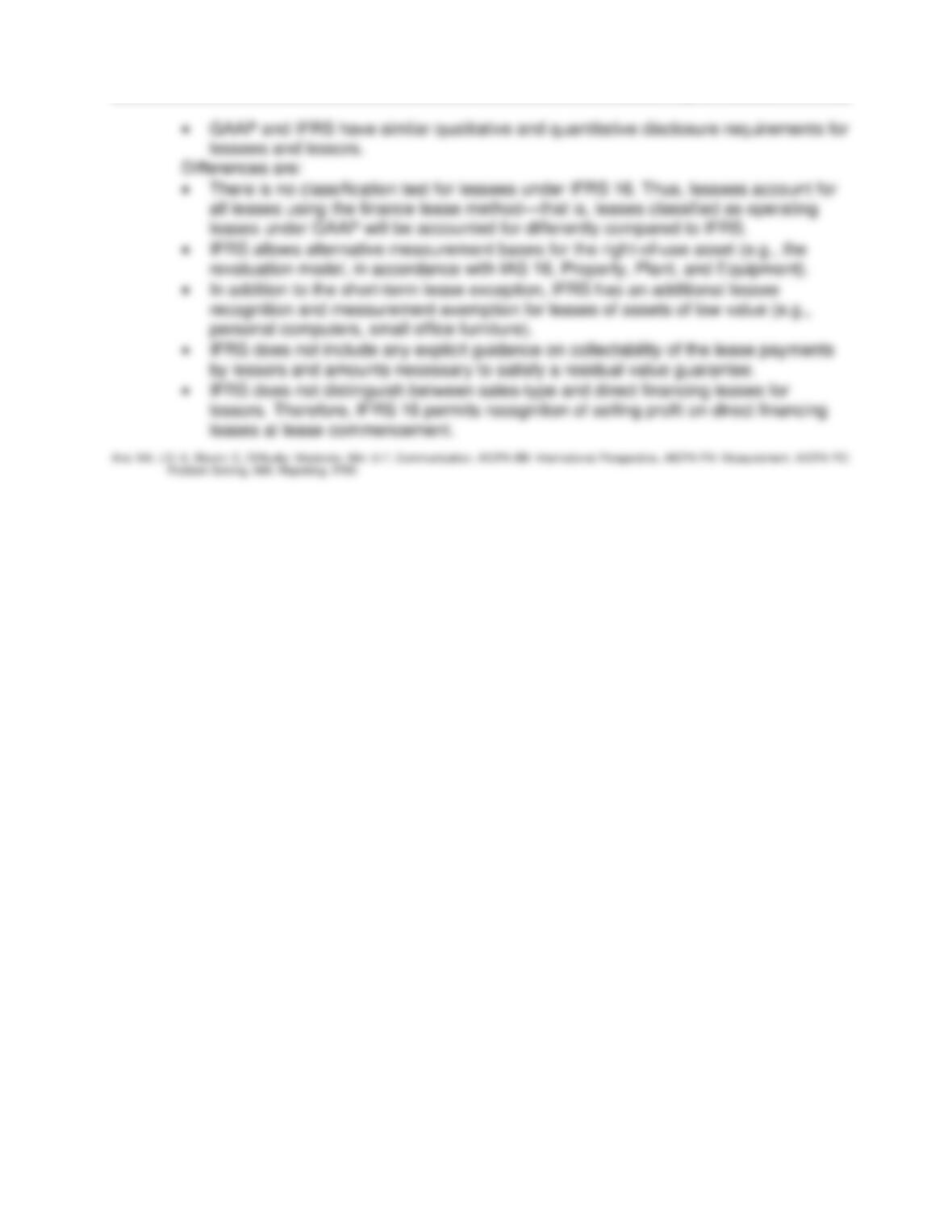
4. Briefly describe some of the similarities and differences between GAAP and IFRS with
respect to the accounting for leases.
Accounting for Leases
21 – 55