115. Tempe Corp. leased some equipment to Glendale, Inc. on January 1, 2010. The lease required six annual
payments, with the first payment due on December 31, 2010. The cost, and also fair value, of the equipment
was $140,000, and there was no estimated residual value at the end of the six-year period. The lease was a
direct financing lease and does qualify as a capital lease for Tempe. Tempe’s desired rate of return is 9%. Use
the following factors for 6 periods:
9%
Present value of an ordinary annuity
4.485919
Present value of annuity due
4.889651
Required:
(For all answers, round to the nearest dollar.)
a.
Compute the amount of equal annual payments.
b.
Prepare Tempe’s 1/1/10 entry.
c.
Prepare all December 31, 2010 entries on Tempe’s books.
d.
Assume the same information, except that payments are due on January 1 of each year and the first payment was due on January 1,
2010. Determine the amount of the equal annual payments and determine the amount of interest revenue Tempe should recognize for
the year 2010.
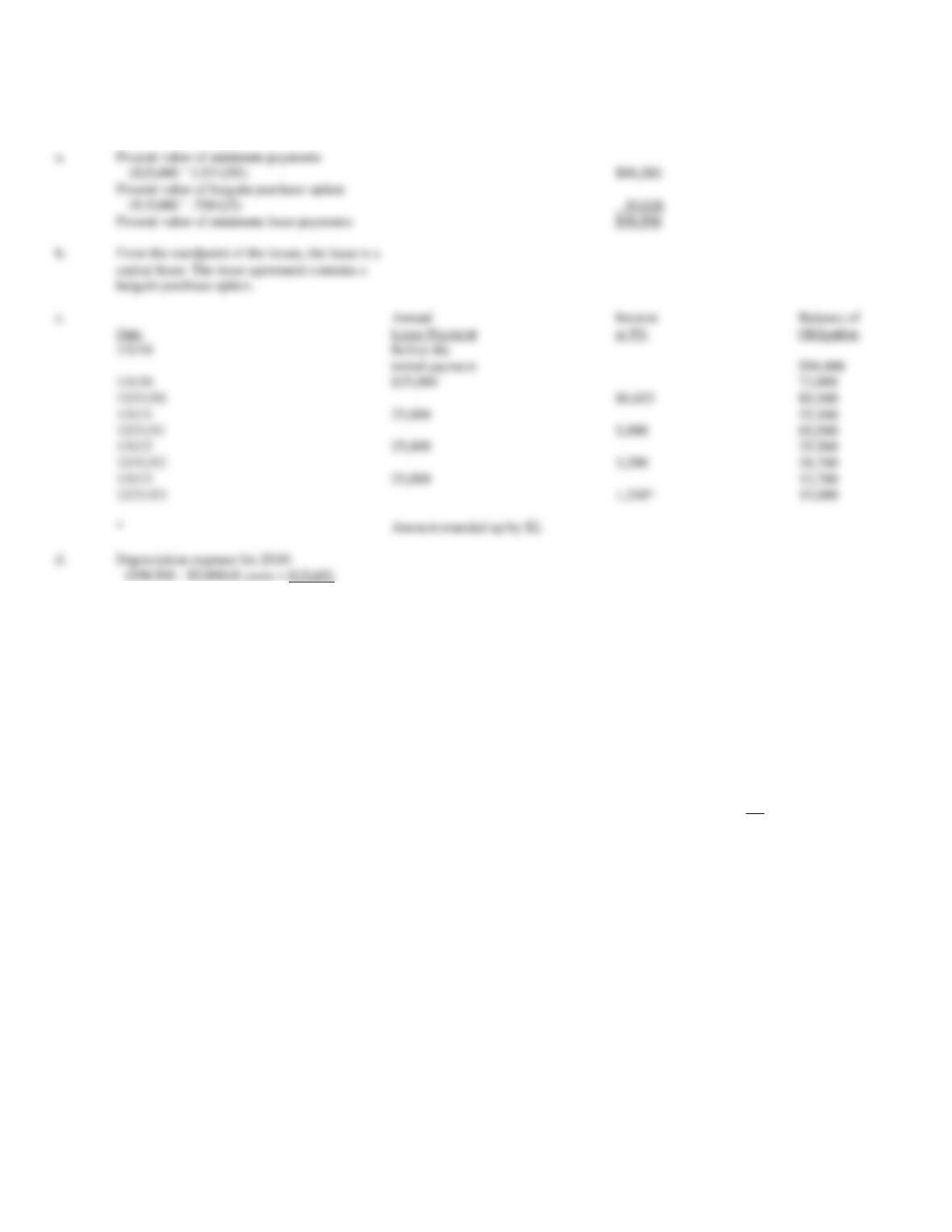
a.
Present value of minimum payments
($25,000 ´ 3.531295)
$88,282
Present value of bargain purchase option
($15,000 ´ .708425)
10,626
Present value of minimum lease payments
$98,908
b.
From the standpoint of the lessee, the lease is a
c.
Annual
Interest
Balance of
Date
Lease Payment
at 9%
Obligation
1/1/10
Before the
initial payment
$98,908
1/1/10
$25,000
73,908
$6,652
80,560
1/1/11
25,000
55,560
5,000
60,560
1/1/12
25,000
35,560
3,200
38,760
1/1/13
25,000
13,760
1,240*
15,000
*
Amount rounded up by $2.
d.
Depreciation expense for 2010:
($98,908 – $5,000)/6 years = $15,651
116. Durham Financing leased some equipment to Chapel Hill Company on January 1, 2010. The lease required
six annual payments with the first payment due on December 31, 2010. The cost, and also fair value, of the
equipment was $100,000. The equipment had an estimated residual value of $10,000 at the end of the six-year
period. The residual value was guaranteed by the lessee. The lease was a direct financing lease and qualifies as
a capital lease for Chapel Hill. Durham’s desired rate of return is 8%.
Required:
(For all answers, round to the nearest dollar.)
a.
Compute the amount of the equal annual payments.
b.
Prepare all December 31, 2010 journal entries on Chapel Hill’s books.
c.
Use the same information, but assume that the payments are due on January 1 of each year with the first payment due January 1, 2010.
Determine the amount of the equal annual payments and determine the amount of interest revenue Durham would recognize for the year
ended December 31, 2010.
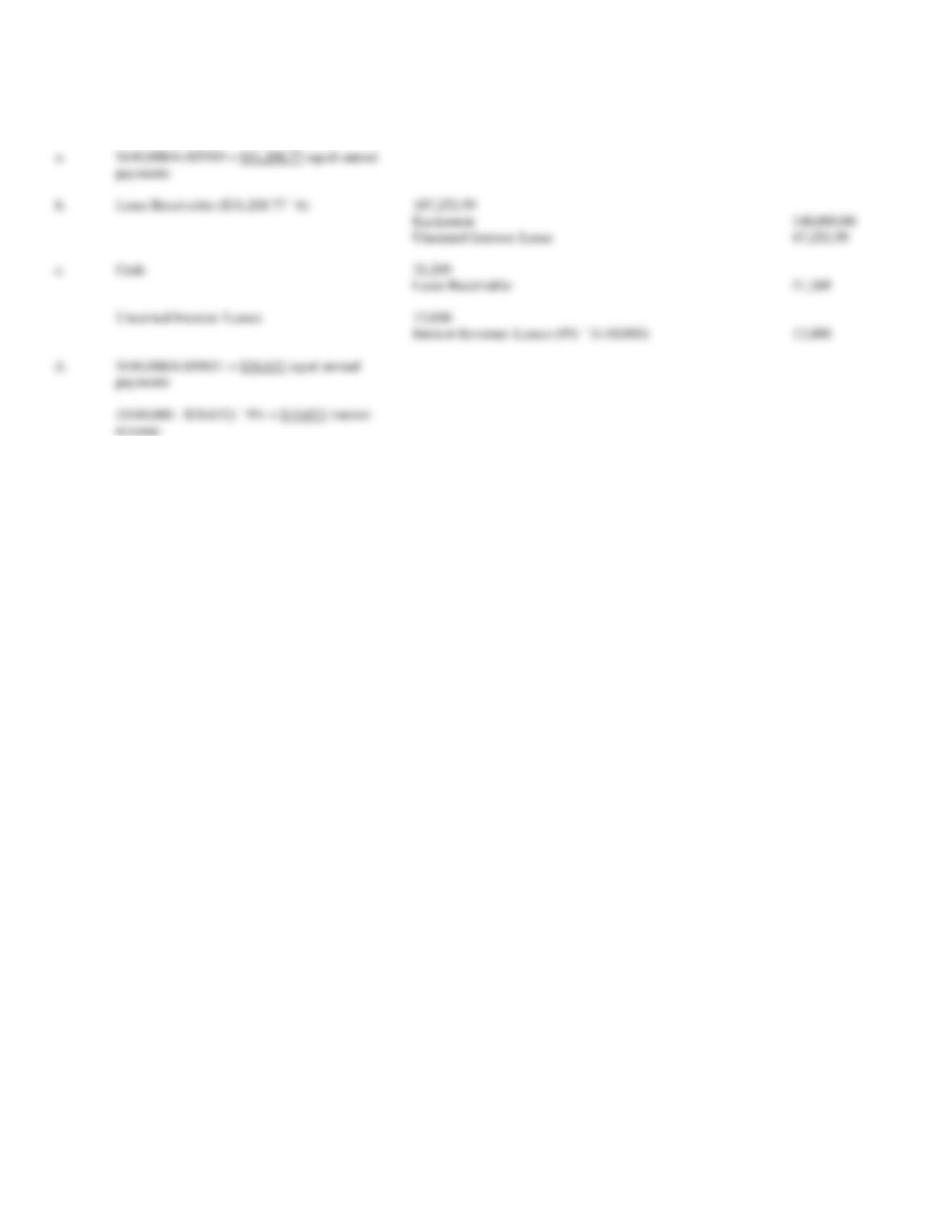
payments
Lease Receivable ($31,208.77 ´ 6)
187,252.59
Equipment
140,000.00
Unearned Interest: Lease
47,252.59
c.
Cash
31,209
Lease Receivable
31,209
Unearned Interest: Leases
12,600
Interest Revenue: Leases (9% ´ $140,000)
12,600
payments
revenue
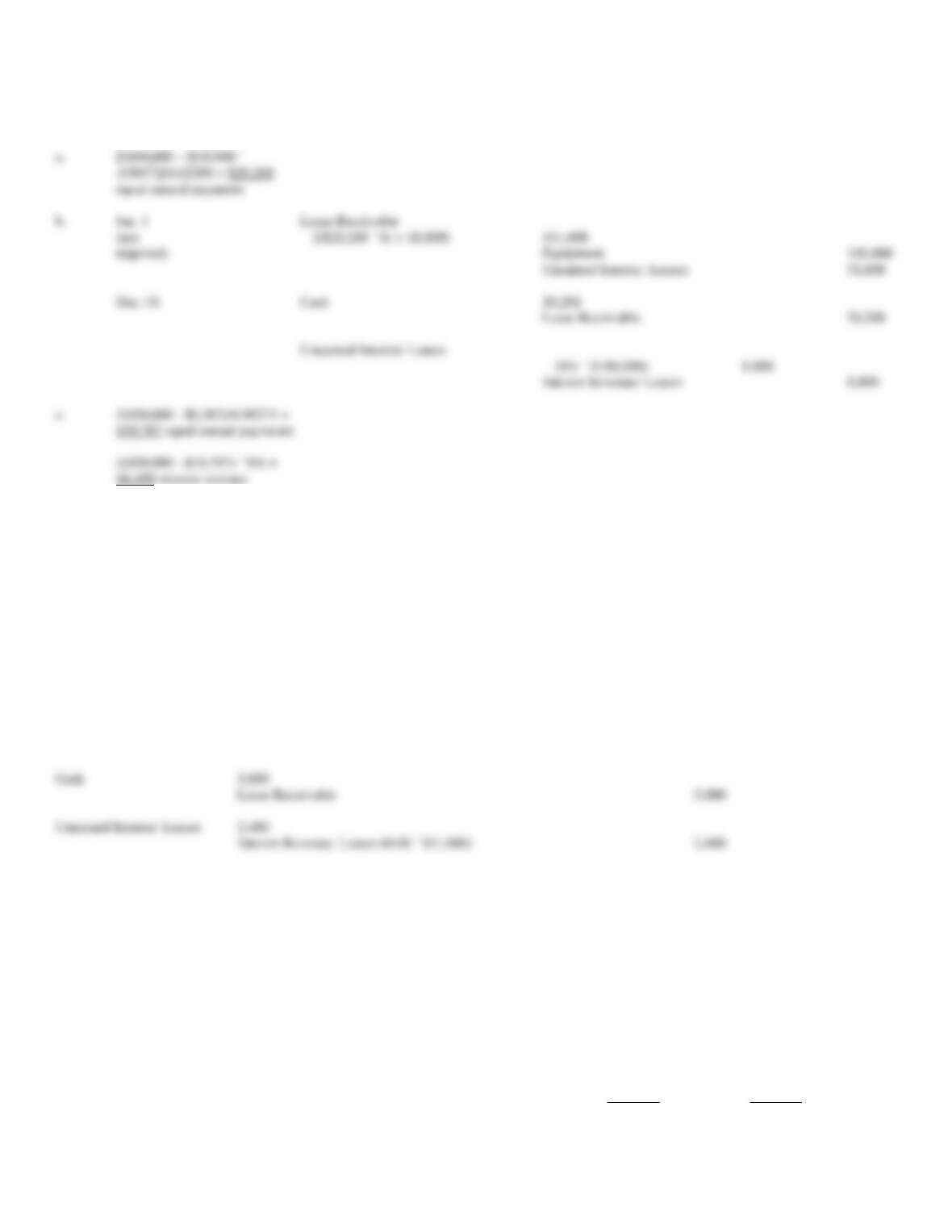
117. Iowa City, Inc. leased some equipment from Des Moines Company on January 1, 2010. Annual December
31 payments of $5,000 were required. The present value of these payments, discounted at 8% for nine years, is
$31,000 (rounded). The lease is a direct financing lease.
Required:
Prepare all December 31, 2010, entries for Des Moines.
118. Eugene, Inc. purchased equipment at a cost of $97,220 on January 1, 2010. Eugene immediately leased the
equipment to Corvalis Company for a seven-year period with rental payments of $17,223 to be paid at the
beginning of each year. The lessor’s implicit interest rate in connection with the lease is 9%. The equipment is
expected to have a guaranteed residual value of $5,000 at the end of the lease term, and an estimated useful life
of 11 years. Eugene paid $6,000 initial direct costs for the lease. The lessor knows all costs, and collection of
lease payments is expected.
6 Periods
7 Periods
Present value of an ordinary annuity at 9%
4.486
5.033
Present value of an annuity due at 9%
4.890
5.486
Present Value of $1, at 9%
0.596
0.547
Required:
a.
Determine the present value of the minimum lease
payments.
b.
Classify the lease from the standpoint of the lessor,
giving reasons.
c.
Prepare the journal entries of the lessor.
(1)
To record the lease agreement.
(2)
To record all entries regarding the initial direct costs.
d.
Explain the impact and rationale of the journal
entry made related to the initial direct costs.
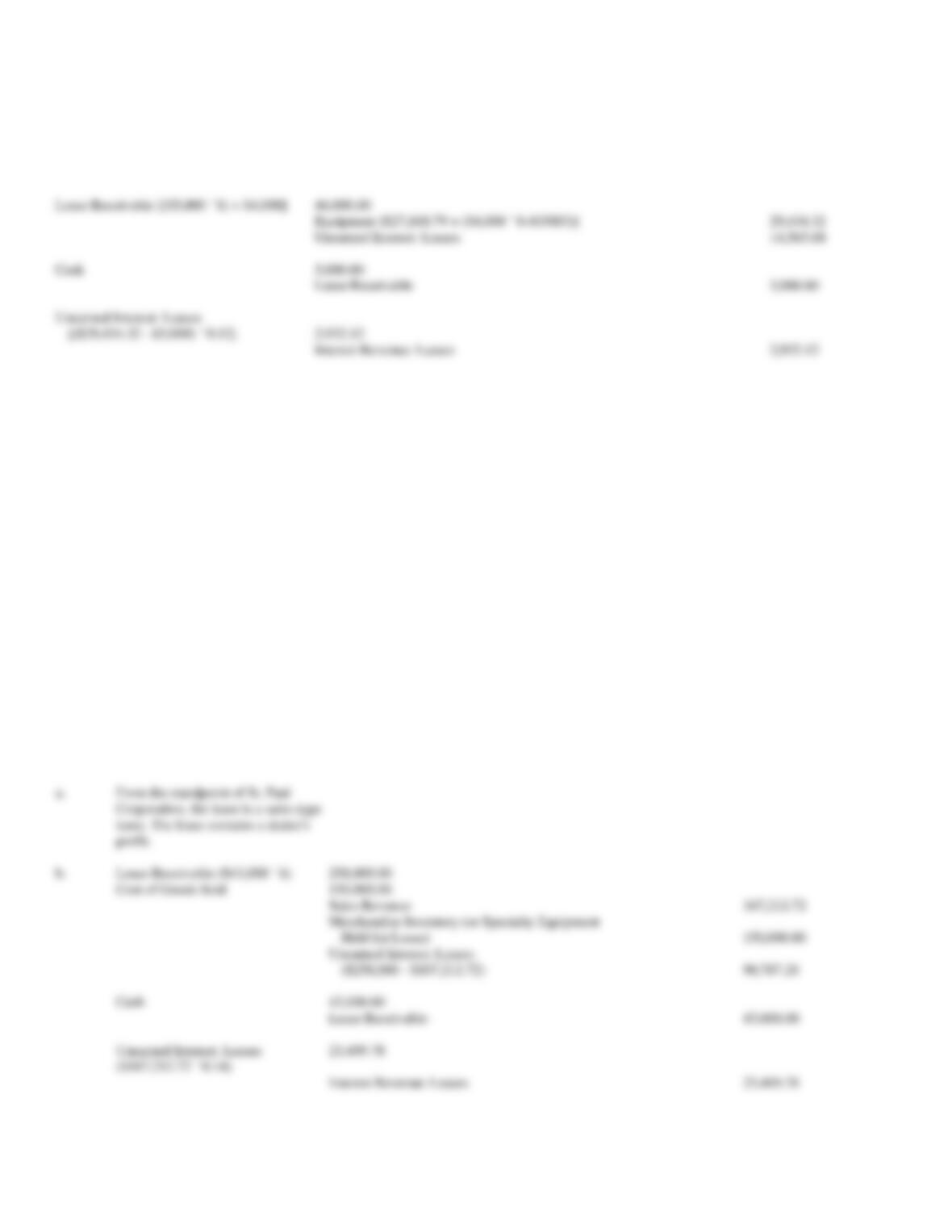
119. The Denver Company leased office equipment to the Boulder Corporation on January 1, 2010. Information
regarding the lease agreement is as follows:
·
The lease qualifies as a direct financing lease.
·
The term of the lease is eight years, with annual rentals of $5,000 to be paid at the beginning of each year. There is no bargain purchase
option.
·
The estimated unguaranteed residual value of the equipment at the end of the lease term is $4,000.
·
The Boulder Corporation will pay the executory costs of $5,000.
·
The present value of the minimum lease payments, yielding a return of 12%, is $27,818.79
·
The factor for the present value of $1 for eight years at 12% is 0.403883.
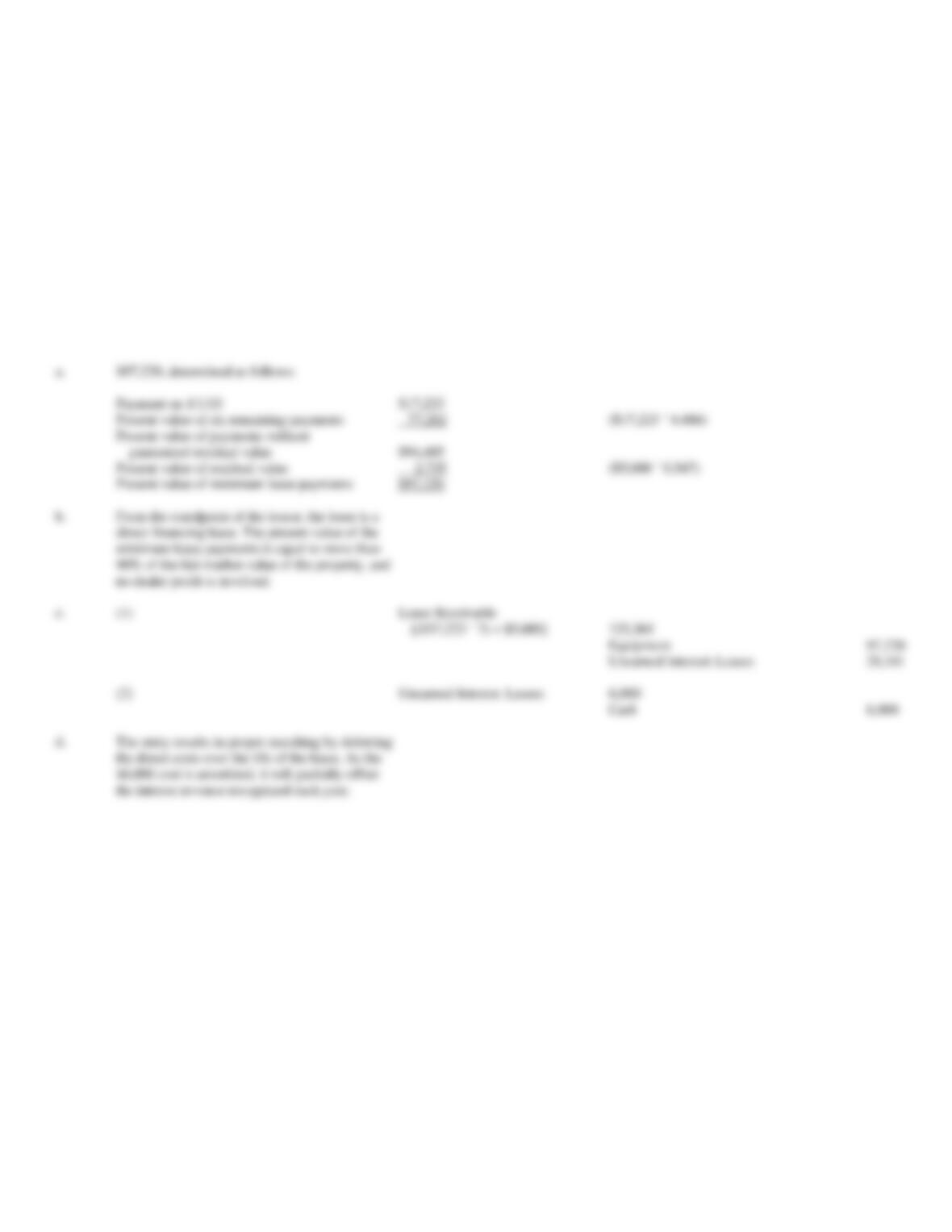
a.
$97,220, determined as follows:
Payment on 1/1/10
$17,223
Present value of six remaining payments
77,262
($17,223 ´ 4.486)
Present value of payments without
guaranteed residual value
$94,485
Present value of residual value
2,735
($5,000 ´ 0.547)
Present value of minimum lease payments
$97,220
(1)
Lease Receivable
[($17,223 ´ 7) + $5,000]
125,561
Unearned Interest: Leases
28,341
(2)
Unearned Interest: Leases
6,000
Cash
6,000
Required:
Prepare the Denver Company’s 2010 journal entries regarding the lease.
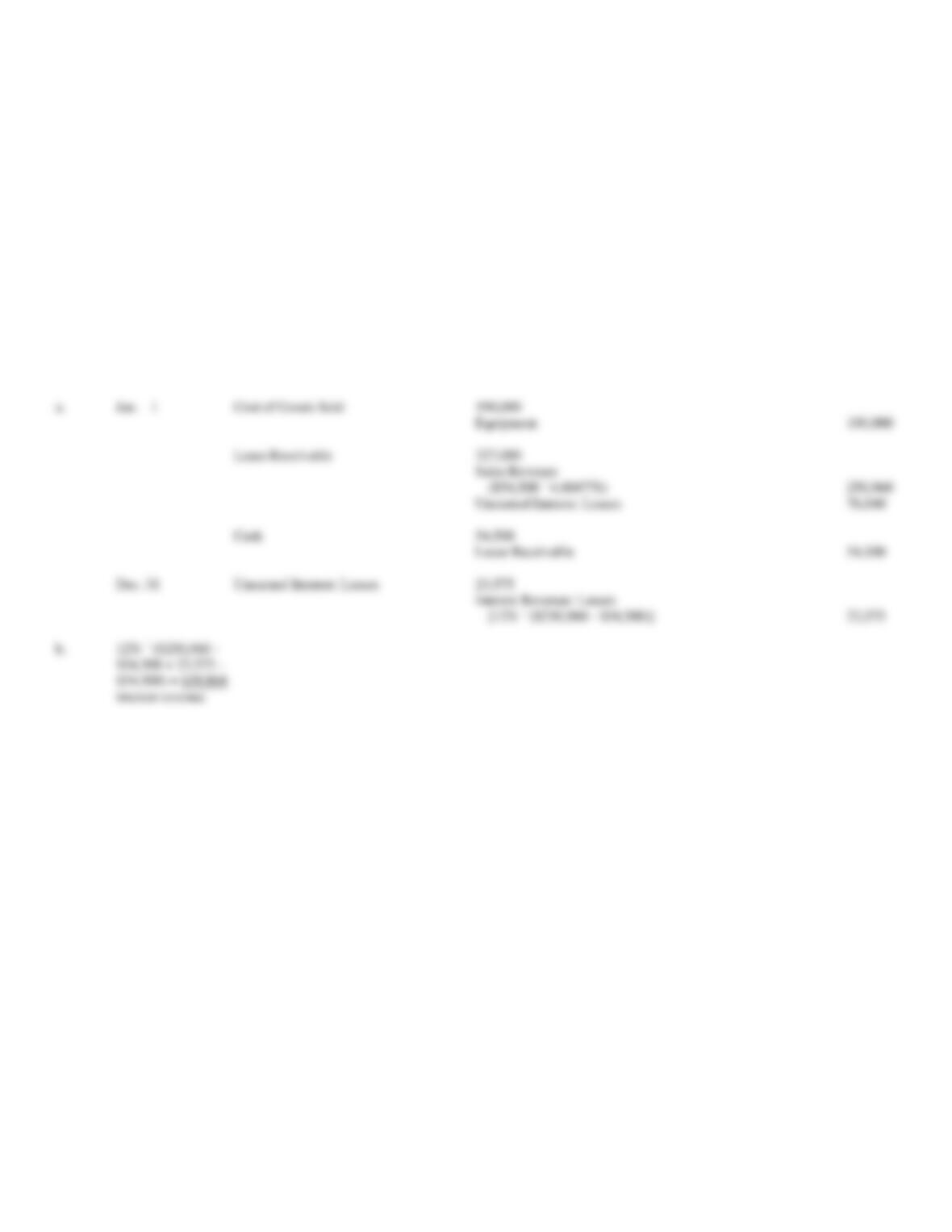
120. St. Paul Corporation purchased equipment in December 2009 for $150,000. St. Paul leased the equipment
to the Minneapolis Company on January 1, 2010. Lease payments of $43,000 are to be made at the end of each
year for six years. The present value of the minimum lease payments at 14% interest is $167,212.72 at the time
of the lease. At the end of the lease term, ownership of the equipment will be transferred to Minneapolis. The
collectibility of the lease payments is reasonably assured, and there are no important uncertainties surrounding
the amount of unreimbursable costs yet to be incurred by the lessor.
Required:
a.
Classify the lease from the St. Paul Corporation’s standpoint.
b.
Prepare the 2010 journal entries regarding the lease for the St. Paul Corporation.
Cost of Goods Sold
150,000.00
Merchandise Inventory (or Specialty Equipment
Unearned Interest: Leases
($258,000 – $167,212.72)
90,787.28
Lease Receivable
43,000.00
Lease Receivable [($5,000 ´ 8) + $4,000]
44,000.00
Equipment [$27,818.79 + ($4,000 ´ 0.403883)]
29,434.32
Unearned Interest: Leases
14,565.68
Cash
5,000.00
Lease Receivable
5,000.00
Unearned Interest: Leases
Interest Revenue: Leases
2,932.12
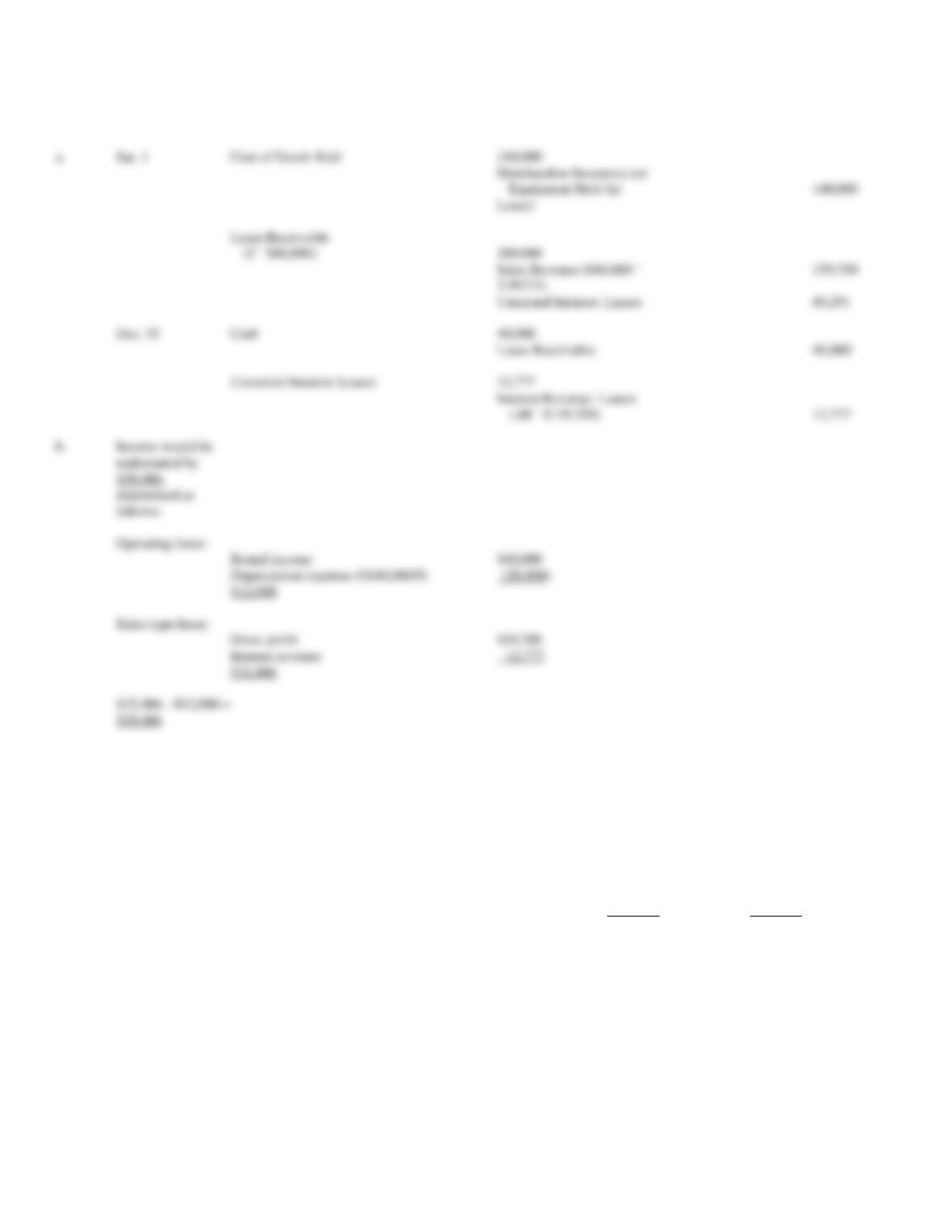
121. El Paso Company leased equipment to Las Cruces Company on January 1, 2010. The lease was for six
years and required annual payments of $54,500 on January 1 of each year with the first payment due January 1,
2010. The equipment had a cost to El Paso of $190,000 and no expected residual value at the end of the lease
term. The lease was appropriately accounted for as a sales-type lease by El Paso. El Paso used a 12% rate of
return to establish the lease payments.
Required:
a.
Prepare all 2010 journal entries for El Paso related to the lease.
b.
What amount of interest revenue would El Paso recognize for the year ended December 31, 2011?
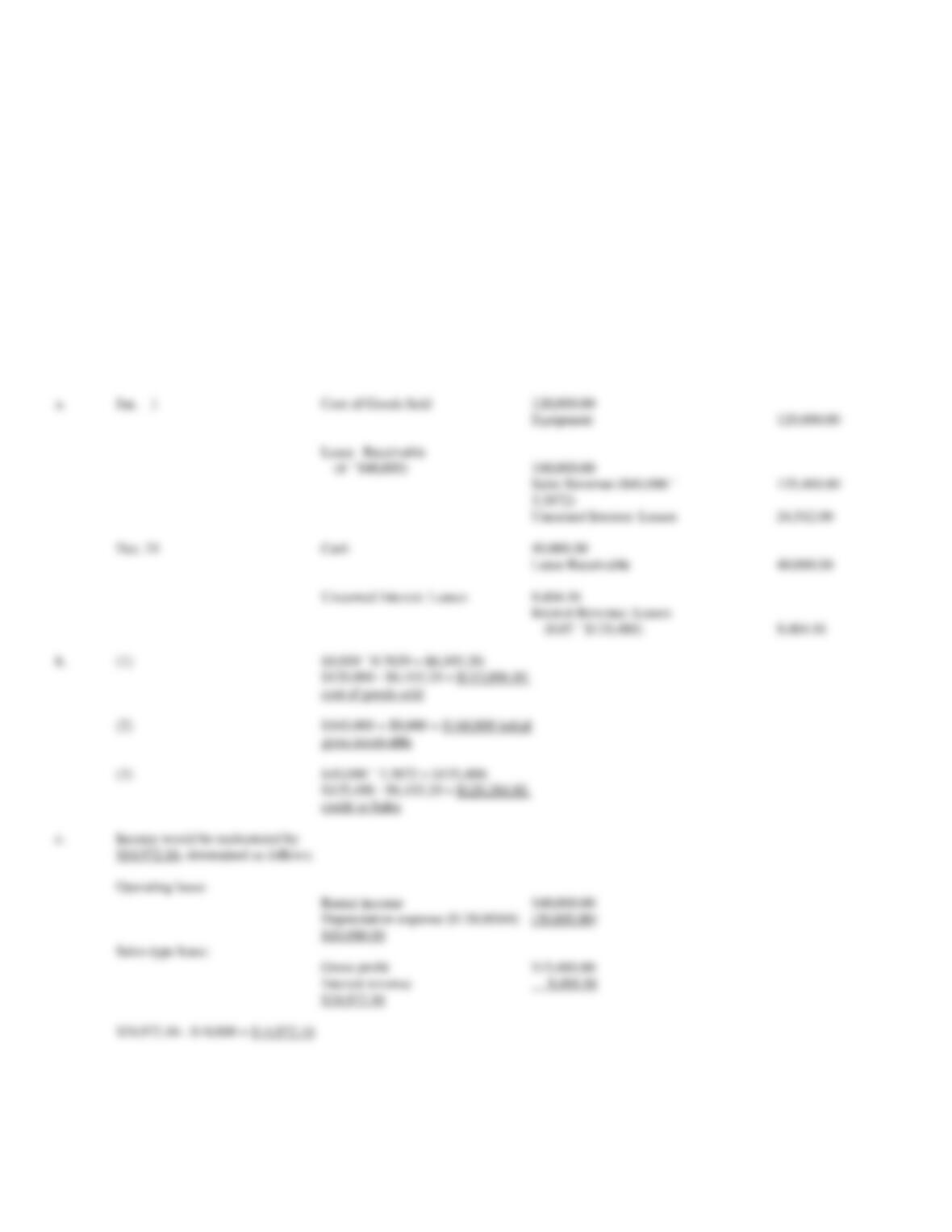
122. Poway, Inc. (the lessor) entered into a sales-type lease with another company on January 1, 2010. The
lease was for five years with $40,000 due at the end of each year. The cost of the equipment on Poway’s books
was $140,000. Poway uses an interest rate of 8%.
Required:
(Round all answers to the nearest dollar.)
a.
Prepare all journal entries for Poway for the year 2010.
b.
If Poway has mistakenly accounted for this lease as an operating lease, by how much would the company’s 2010 income be overstated
or understated because of this error? (Be sure to indicate under or over.)
a.
Jan. 1
Cost of Goods Sold
190,000
Lease Receivable
327,000
Sales Revenue
Unearned Interest: Leases
Cash
54,500
Dec. 31
Unearned Interest: Leases
23,575
Interest Revenue: Leases
123. Tucson, a lessor, entered into a sales-type lease with another company on January 1, 2010. The lease was
for four years with $40,000 payments due at the end of each year. The cost of the equipment on Tucson’s books
was $120,000. Actuarial information for 7%, the implicit rate, follows:
3 Periods
4 Periods
Amount of $1
1.2250
1.3108
Amount of annuity of $1
3.1249
4.4399
Present value of $1
0.8163
0.7629
Present value of annuity of $1
2.6243
3.3872
Jan. 1
Cost of Goods Sold
140,000
Merchandise Inventory (or
Lease Receivable
(5 ´ $40,000)
200,000
Unearned Interest: Leases
40,291
Dec. 31
Cash
40,000
Lease Receivable
40,000
Unearned Interest: Leases
12,777
Interest Revenue: Leases
(.08 ´ $159,709)
12,777
Operating lease:
Rental income
$40,000
Depreciation expense ($140,000/5)
(28,000)
$12,000
Sales-type lease:
Gross profit
$19,709
Interest revenue
12,777
$32,486
Required:
a.
Prepare all journal entries for Tucson for the year 2010.
b.
Use the same information as above, but assume that there is an
unguaranteed residual value of $8,000. Answer the following
questions:
(1)
What would be the charge to Cost of Goods Sold?
(2)
What would be the charge to the initial gross receivable?
(3)
What would be the credit to Sales?
c.
Refer to Part a. If Tucson had mistakenly accounted for this lease
as an operating lease, by how much would the company’s 2010
income be overstated or understated because of this error? Be sure
to indicate overstated or understated.
a.
Jan. 1
Cost of Goods Sold
120,000.00
Lease Receivable
(4 ´ $40,000)
160,000.00
Unearned Interest: Leases
Lease Receivable
Unearned Interest: Leases
9,484.16
(0.07 ´ $135,488)
b.
(1)
$8,000 ´ 0.7629 = $6,103.20;
$120,000 – $6,103.20 = $113,896.80
cost of goods sold
(3)
$40,000 ´ 3.3872 = $135,488;
$135,488 – $6,103.20 = $129,384.80
Rental income
$40,000.00
Depreciation expense ($120,000/4)
(30,000.00)
$10,000.00
Gross profit
$15,488.00
Interest revenue
9,484.16
$24,972.16
$24,972.16 – $10,000 = $14,972.16
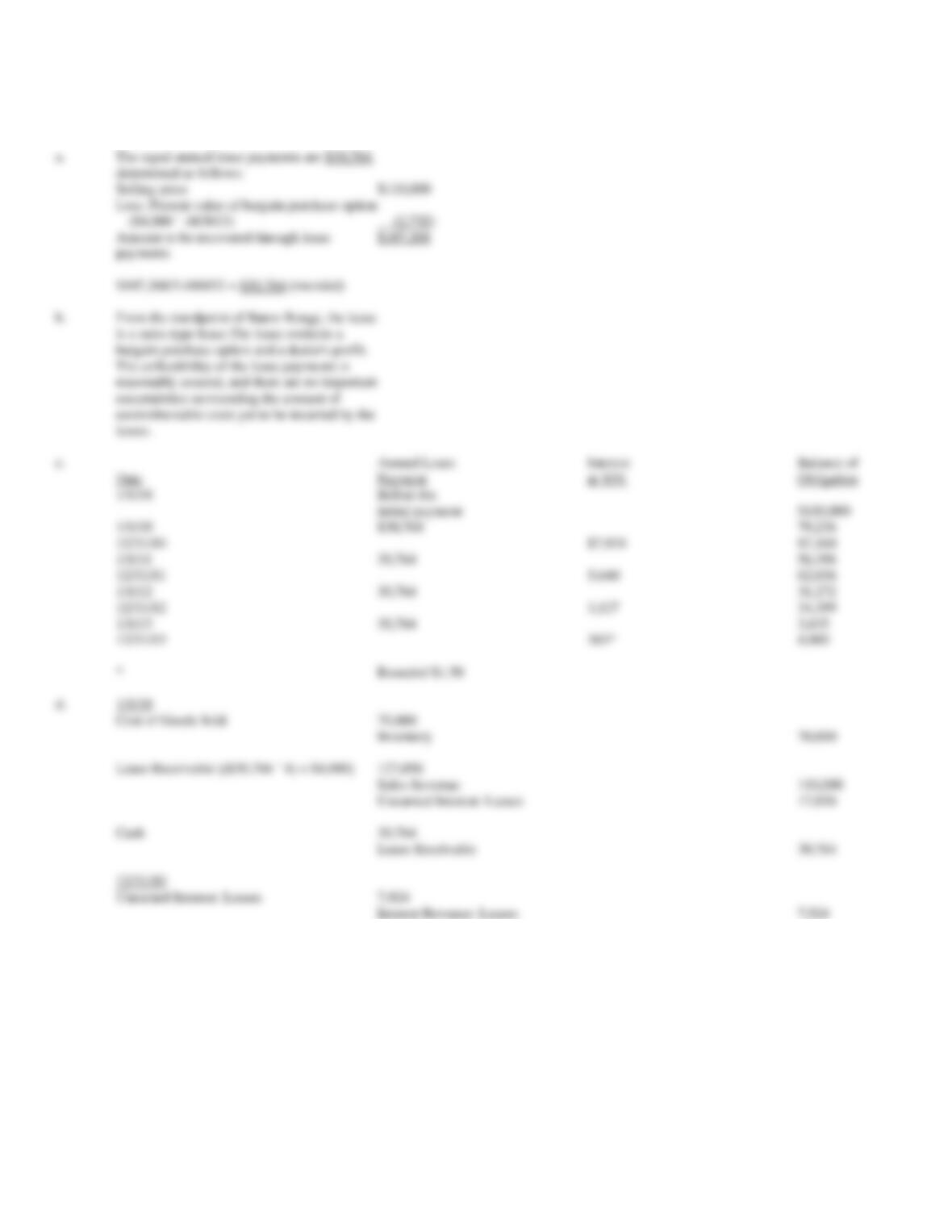
124. Baton Rouge Company leased equipment to New Orleans Company on January 1, 2010. The lease term is
for a four-year period. The annual lease payments must be made on January 1 of each year, with the first
payment due on January 1, 2010. Additional information relating to the lease is as follows:
·
The cost of equipment to Baton Rouge was $70,000, and the normal selling price for this type of equipment is $110,000.
·
Baton Rouge requires a 10% rate of return on its investments, so this is the interest rate used to calculate the annual lease payments.
·
The lease contains a bargain purchase option. On December 31, 2013, the lessee may acquire the equipment for $4,000.
·
The equipment has an expected economic life of six years. The residual value of the equipment at that time is estimated to be $1,000.
·
The collectibility of the lease payments is reasonably assured, and there are no important uncertainties surrounding the amount of
unreimbursable costs yet to be incurred by the lessor.
Required:
a.
Compute the amount of the equal annual lease payments. (Round your answer to the nearest dollar.)
b.
Classify the lease from Baton Rouge Company’s viewpoint (the lessor), stating the reason for the classification.
c.
Prepare a lease amortization schedule for the four-year term for Baton Rouge. (Round amounts to the nearest dollar.)
d.
Prepare all entries for 2010 required by the Baton Rouge Company.
125. On January 1, 2010, East Lansing Co. sold some land to another company and immediately leased it back
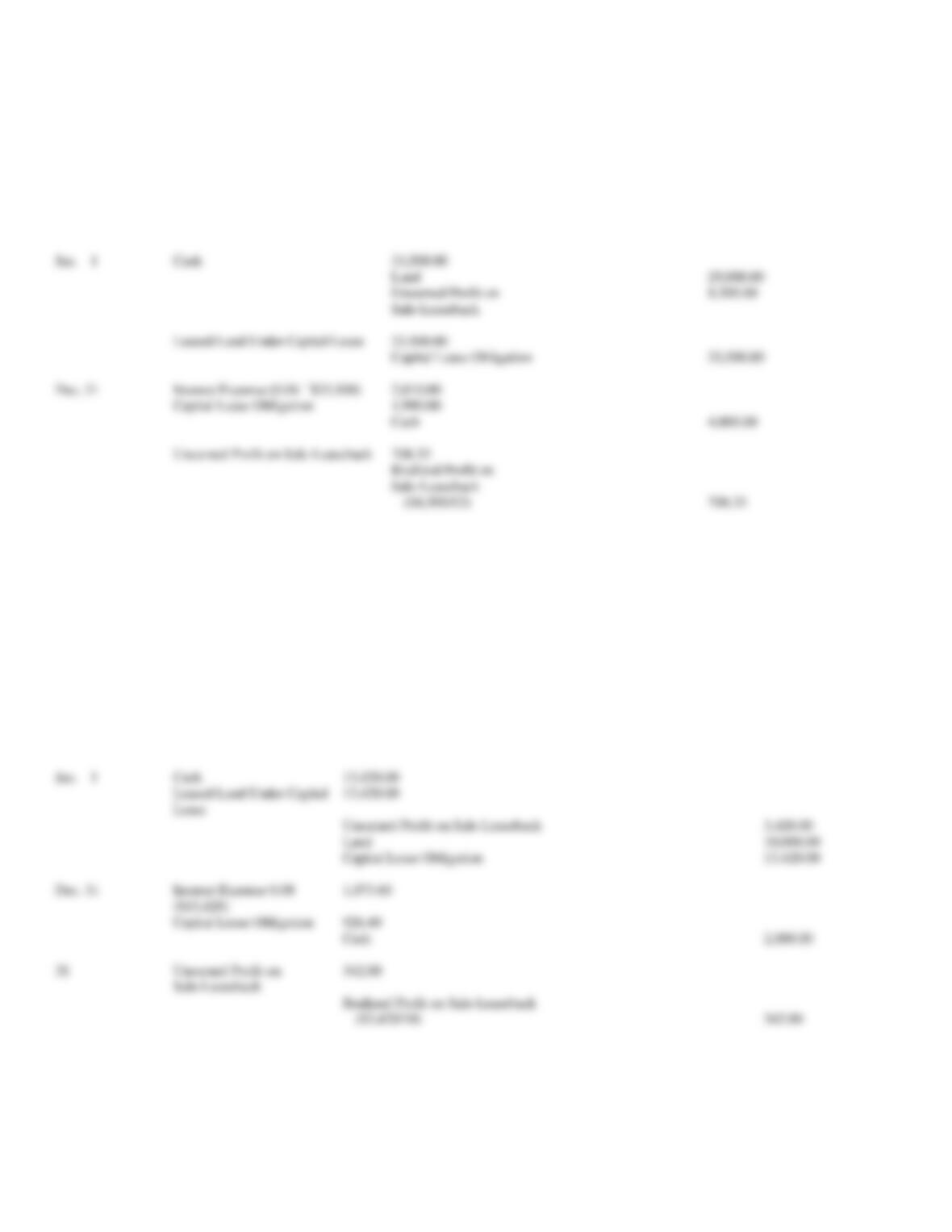
again. The sale price was $33,500, and the leaseback requires $4,000 payments at the end of each of the next 12
years. An interest rate of 6% was used. The cost of the land on East Lansing’s books was $25,000.
Required:
Prepare all 2010 journal entries for East Lansing Co.
126. On January 1, 2010, Sacramento sold some land to another company and immediately leased it back again.
The sale price was $13,420, and the leaseback requires $2,000 payments at the end of each of the next ten years.
An interest rate of 8% was used. The cost of the land on Sacramento’s books was $10,000.
Required:
Prepare all 2010 journal entries on the books of Sacramento.
127. Current GAAP requires a lessee to account for certain leases as capital leases.
Required:
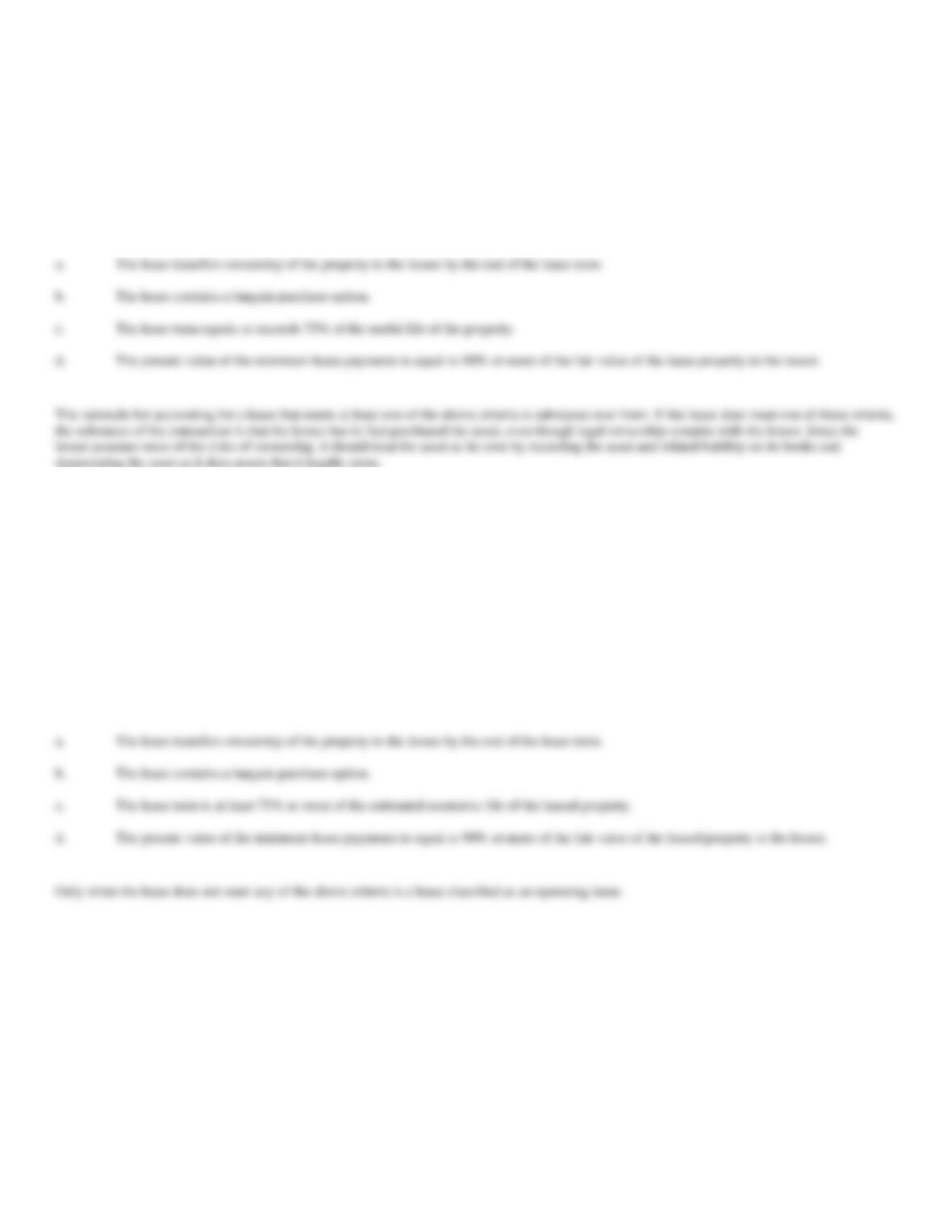
What is the rationale for requiring companies to account for leases as capital leases?
For a lessee to account for a lease as a capital lease, at least one of the following criteria must be met:
128. Lessees may classify a lease as one of two types: (1) capital lease, or (2) operating lease. Current GAAP
provides the criteria for determining which classification is appropriate.
Required:
Identify the criteria that a lessee uses to classify leases as either capital or operating leases.
A lease that meets any one of the following criteria is a capital lease for a lessee:
129. The Reno Equipment Company has had a flat pattern of sales revenue for the past five years. A consultant
for the company has stated that the company could experience an estimated 25% sales revenue growth if it
permitted customers to lease equipment in addition to its normal sales procedures.
Required:
a.
Describe the accounting procedures that should be used by the Reno Equipment Company if the lease agreements were classified as
“sales-type” leases.
b.
List two reasons why sales might increase if customers are permitted to lease the equipment.
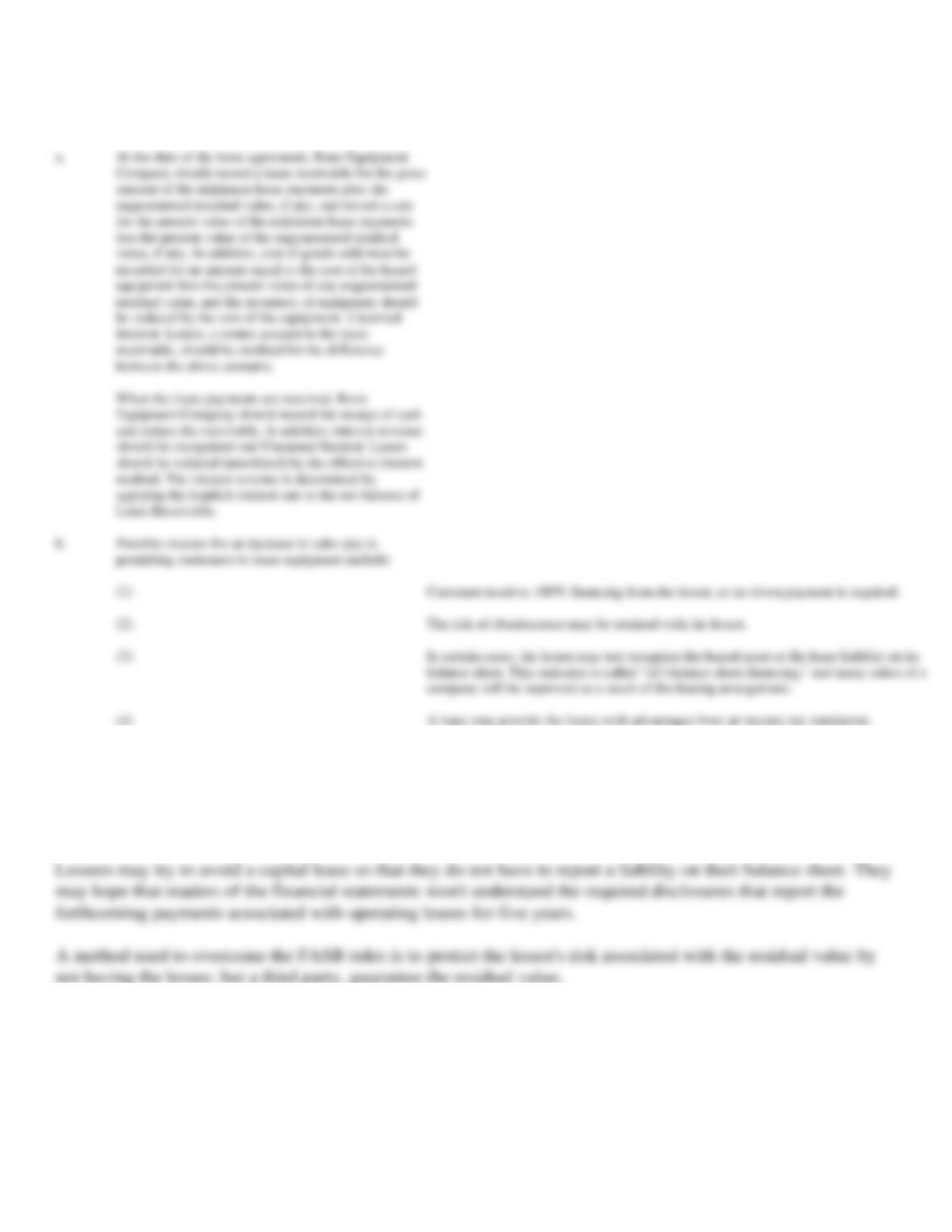
130. Lessees may try to avoid having a lease be classified as a capital lease. Explain why a lessee might want to
avoid a capital lease and how the FASB rules may be overcome to allow classification as an operating lease.

131. In certain respects, IFRS provide more principles-based guidance in accounting for lease transactions.
Describe the differences between IFRS and GAAP in lease capitalization criteria that demonstrate the more
principles-based approach of the IFRS.