174) A product has a sales price of $20. Based on a 15,000-unit production level, the variable
costs are $12 per unit and the fixed costs are $6 per unit. Using a flexible budget for an actual
production and sales level of 18,000 units, what is the budgeted operating income?

102
175) Engineworks Co. provides the following fixed budget data for the year:
Sales (20,000 units) …………………………….
$600,000
Cost of sales:
Direct materials ……………………………..
$200,000
Direct labor …………………………………
160,000
Variable overhead …………………………..
60,000
Fixed overhead ……………………………..
80,000
500,000
Gross profit …………………………………….
$100,000
Operating expenses:
Fixed ………………………………………..
$12,000
Variable …………………………………….
40,000
52,000
Income from operations ………………………..
$ 48,000
The company’s actual activity for the year follows:
Sales (21,000 units) …………………………….
$651,000
Cost of goods sold:
Direct materials ……………………………..
$231,000
Direct labor …………………………………
168,000
Variable overhead …………………………..
73,500
Fixed overhead ……………………………..
77,500
550,000
Gross profit …………………………………….
$101,000
Operating expenses:
Fixed ……………………………………….
12,000
Variable …………………………………….
39,500
51,500
Income from operations ……………………….
$ 49,500
Required:
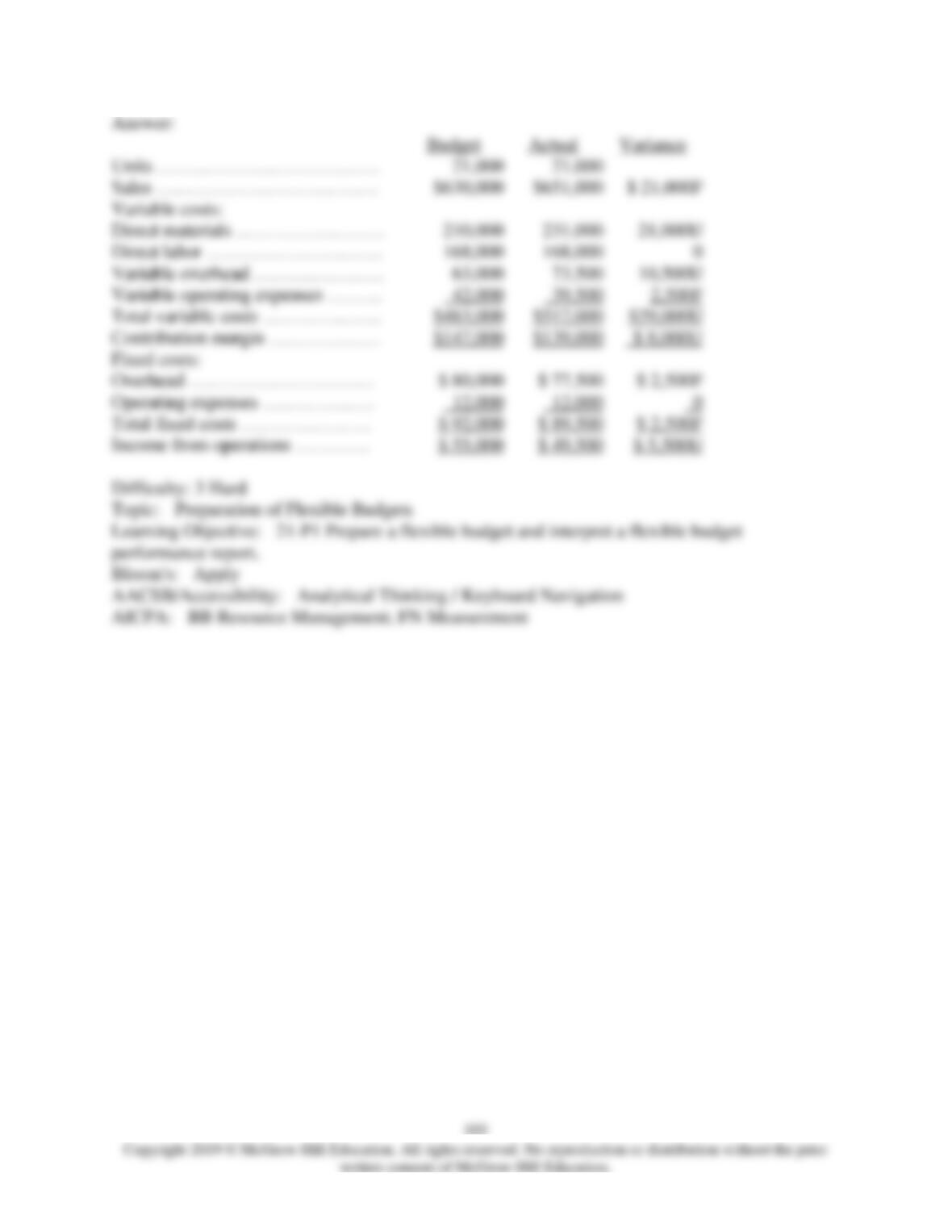
Prepare a flexible budget performance report for the year using the contribution margin format.
176) Zip-up Company provides the following data developed for its master budget:
Sales price ………………………
$11.00 per unit
Costs:
Direct materials ……………….
$3.00 per unit
Direct labor ……………………
$4.75 per unit
Variable overhead …………….
$0.50 per unit
Factory depreciation ………….
$12,000 per month
Supervision ……………………
$13,000 per month
Selling expense ………………..
$0.25 per unit
Administrative cost ……………
$9,000 per month
Required:
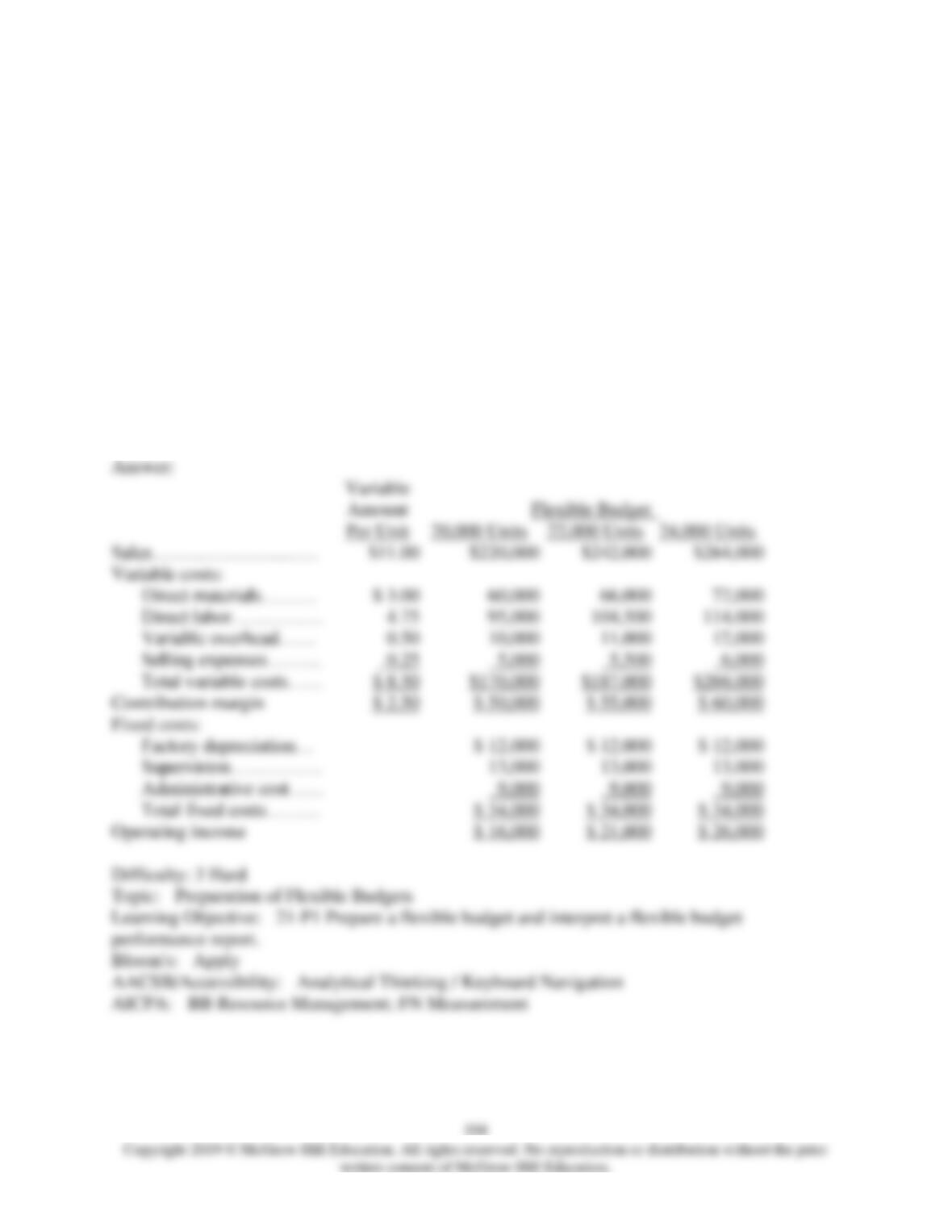
Prepare flexible budgets for sales of 20,000, 22,000 and 24,000 units. Use a contribution margin
format.
Variable costs:
Direct materials………
Direct labor……………
Variable overhead……
Selling expenses………
Total variable costs……
Contribution margin
Fixed costs:
Factory depreciation…
Supervision……………
Administrative cost……
Total fixed costs………
Operating income

105
177) Jake Co. has prepared the following fixed budget for the year, assuming production and
sales of 30,000 units. This level of production represents 80% of capacity.
Jake Co.
Fixed Budget
For Year Ending December 31
Sales ………………………………………………
$1,500,000
Cost of goods sold:
Direct materials ……………………………
$540,000
Direct labor …………………………………
300,000
Indirect materials (variable) ………………
15,000
Indirect labor (variable) ……………………
21,000
Depreciation ………………………………
180,000
Salaries ……………………………………
90,000
Utilities (80% fixed) ………………………
54,000
Maintenance (40% variable) ………………
33,000
1,233,000
Gross profit ………………………………………
$ 267,000
Operating expenses:
Commissions ………………………………
$ 45,000
Advertising (fixed) …………………………
60,000
Wages (variable) ……………………………
15,000
Rent …………………………………………
30,000
Total operating expenses ……………………
150,000
Income from operations …………………………
$ 117,000
Calculate the following flexible budget amounts at the indicated levels of capacity:
Operations at
60% of Capacity
Operations at
75% of Capacity
Sales
Total variable costs
Total fixed costs
Income from operations

107
178) Whidbey Co. fixed budget for the year is shown below:
Sales (50,000 units) …………………………
$1,300,000
Cost of goods sold:
Direct materials …………………………
$150,000
Direct labor ……………………………
450,000
Overhead (includes $2 per unit variable
overhead) ……………………………………
240,000
840,000
Gross profit ……………………………
$ 460,000
Selling expenses:
Sales commissions (all variable) ………
60,000
Rent (all fixed) …………………………
40,000
Insurance (all fixed) ……………………
35,000
General and administrative expenses:
Salaries (all fixed) ………………………
72,000
Rent (all fixed) …………………………
54,000
Depreciation (all fixed) …………………
31,000
292,000
Net income from operations …………………
$ 168,000
Prepare a flexible budget for Whidbey Co. that shows a detailed budget for its actual sales
volume of 42,000 units. Use the contribution margin format.
179) Lavoie Company planned to use 18,500 pounds of material costing $2.50 per pound to
make 4,000 units of its product. In actually making 4,000 units, the company used 18,800 pounds
that cost $2.54 per pound. Calculate the direct materials price variance.
180) Lavoie Company planned to use 18,500 pounds of material costing $2.50 per pound to
make 4,000 units of its product. In actually making 4,000 units, the company used 18,800 pounds
that cost $2.54 per pound. Calculate the direct materials quantity variance.
181) Job #411 was budgeted to require 3.5 hours of labor at $11.00 per hour. However, it was
completed in 3 hours by a person who worked for $14.00 per hour. What is the total labor cost
variance for Job #4115?
182) LJ Co. produces picture frames. It takes 3 hours of direct labor to produce a frame. LJ’s
standard labor cost is $11.00 per hour. During March, LJ produced 4,000 frames and used 12,400
hours at a total cost of $133,920. What is LJ’s labor rate variance for March?
183) In producing 700 units of product last period, Azure Company used 5,000 pounds of
Material K, costing $34,250. The company has established the standard of using 7.2 pounds of
Material K per unit of product, at a price of $7.50 per pound. Calculate the materials price and
quantity variances associated with producing the 700 units, and indicate whether they are
favorable or unfavorable:
184) Use the following cost information to calculate the direct labor rate and efficiency variances
and indicate whether they are favorable or unfavorable.
Actual costs and quantities:
Direct labor cost incurred …………………
$360,000
Direct labor hours used ……………………
20,000
hours
Units produced ……………………………
45,000
units
Standard costs and quantities:
Direct labor rate per hour …………………
$16.50
Hours to produce one unit …………………
0.5
hours
AH * AR
AH * SR
Direct labor rate variance …………………………
AH * SR
AH x SR
185) The following information describes production activities of the Midtown Corp.:
Raw materials used ………………………
16,000 lbs. at $4.05 per lb.
Factory payroll …………………………
5,545 hours for a total of $72,085
30,000 units were completed during the year
Budgeted standards for each unit produced:
1/2 lb. of raw material at $4.15 per lb.
10 minutes of direct labor at $12.50 per hour
Compute the direct materials price and quantity and the direct labor rate and efficiency
variances. Indicate whether each variance is favorable or unfavorable.
Direct materials:
Direct materials price variance……………….
Direct materials quantity variance……………
Direct labor:
Direct labor rate variance
Direct labor efficiency variance………………
186) Ransom, Inc. budgets direct materials cost at $1.10/liter and each product requires 4 liters
per unit of finished product. April’s activities show usage of 832 liters to complete 196 units at a
cost of $798.72. Compute the direct materials price and quantity variances. Indicate if the
variance is favorable or unfavorable.

115
187) Lionaire, Inc. has developed the following standard cost data based on 60,000 direct labor
hours, which is 75% of capacity.
Per Unit
Direct materials (6 lbs. @ $2.00/lb.)
$12.00
Direct labor (1 hrs. @ $8.00/hr.)
8.00
During the last period, the company operated at 80% of capacity and produced 128,000 units.
Actual costs were:
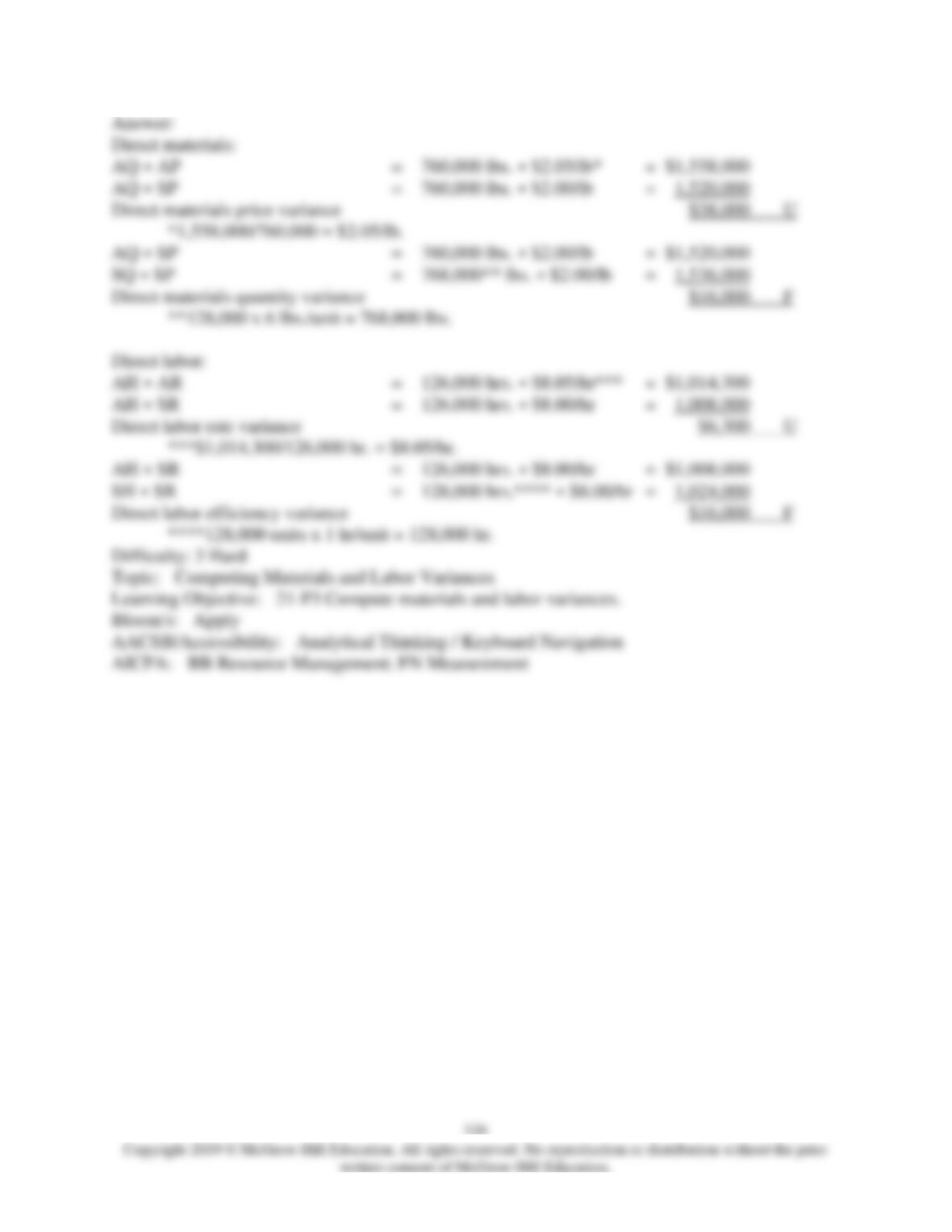
Direct materials (760,000 lbs.)
$1,558,000
Direct labor (126,000 hrs.)
1,014,300
Determine the direct materials price and quantity variances and the direct labor rate and
efficiency variances. Indicate whether each variance is favorable or unfavorable.
Direct materials:
Price variance
Quantity variance
Direct labor:
Rate variance
Efficiency variance
188) Maxwell Co. collected the following information about its production activities for the
current year.
a. Compute the direct materials price and quantity variances and indicate whether each is
favorable or unfavorable.
b. Prepare the journal entry to record the issuance of direct materials into production.
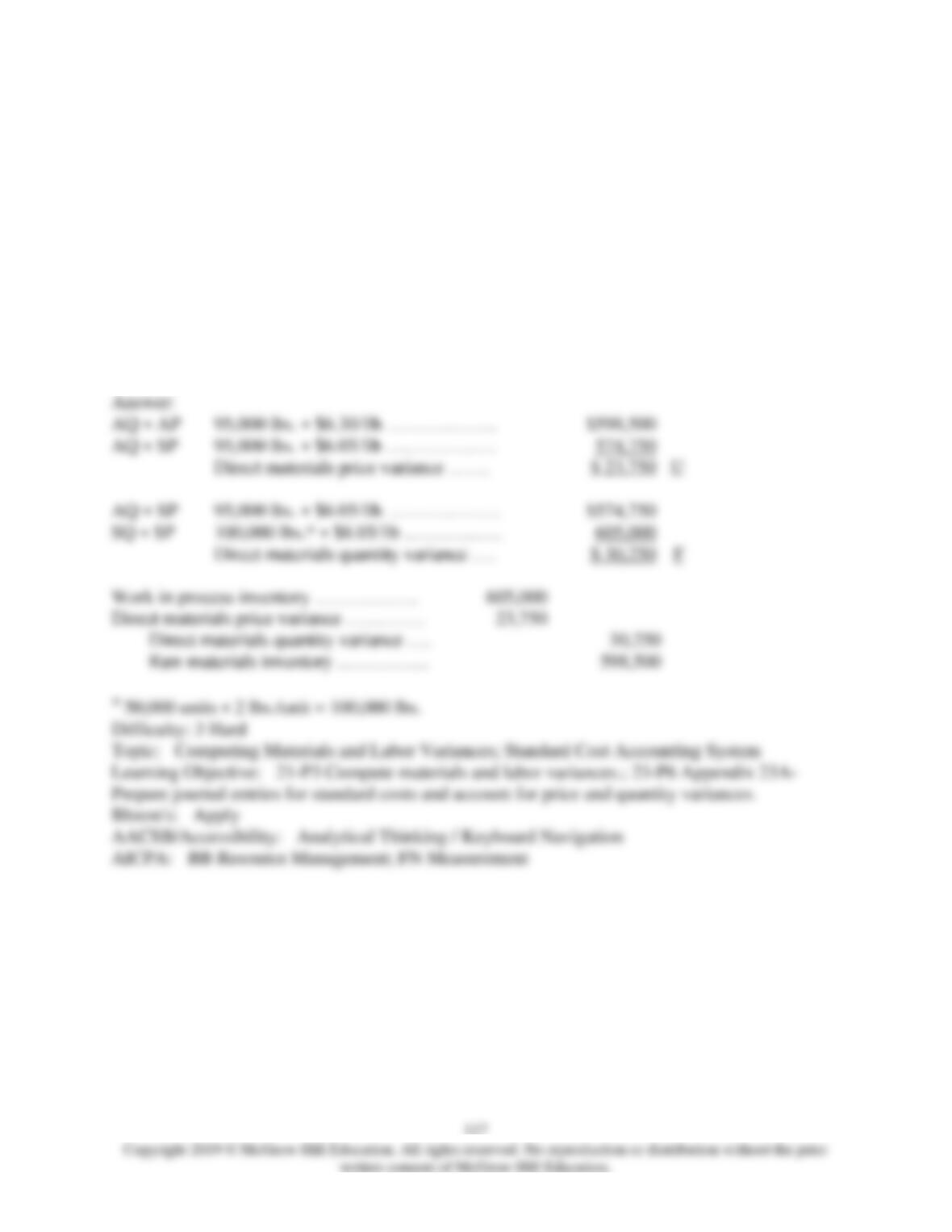
Actual costs and quantities:
Direct materials used 95,000 lbs. @ $6.30 per lb.
Units completed during the year, 50,000 units
Standard costs and quantities:
Price per lb. of direct material, $6.05
Two lbs. of direct material per unit
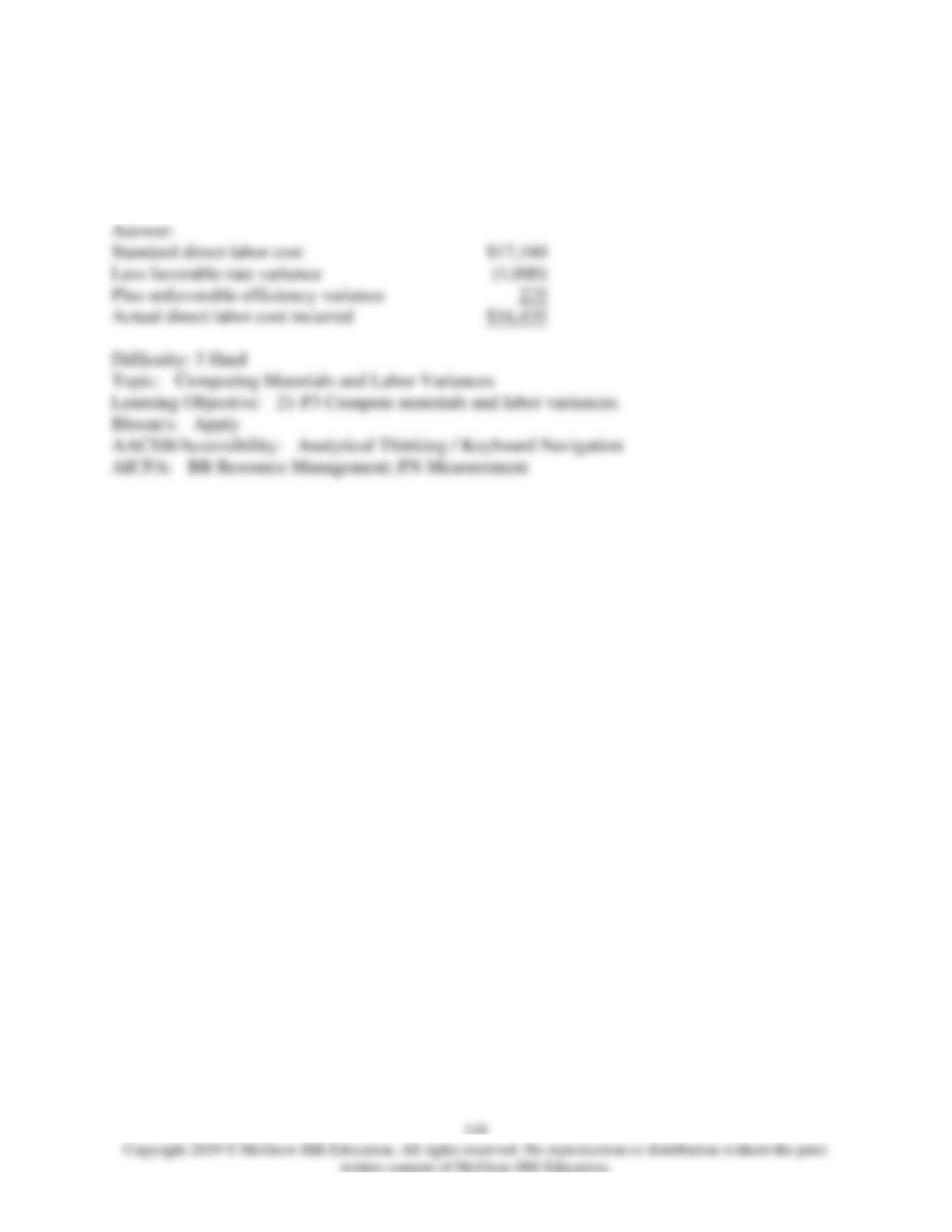
189) Linx Company’s output for a period was assigned the standard direct labor cost of $17,160.
If the company had a favorable direct labor rate variance of $1,000 and an unfavorable direct
labor efficiency variance of $275, what was the total actual cost of direct labor incurred during
the period?

119
190) Tiger, Inc. budgeted the following overhead costs for the current year assuming operations
at 80% of capacity, or 40,000 units:
Total variable overhead …………….
$240,000
Total fixed overhead ……………….
560,000
Total overhead …………………….
$800,000
The standard cost per unit when operating at this same 80% capacity level is:
Direct materials (5 lbs. @ $4/1b.) …………
$20.00
Direct labor (2 hrs. @ $8.75 hr.) ………….
17.50
Variable overhead (2 hrs. @ $3/hr.) …………
6.00
Fixed overhead (2 hrs. @ $7/hr.) ………….
14.00
Total cost per unit ………………………….
$57.50
The actual production achieved in the current year was 60% of capacity, or 30,000 units. The
actual costs were:
Direct materials (150,350 lbs.) ………….
$616,435
Direct labor (59,800 hrs.) ……………….
520,260
Variable overhead ………….……………
192,000
Fixed overhead ………….………….……
552,000
Calculate the following variances and indicate whether each is favorable or unfavorable.
Direct materials:
Price variance
Quantity variance
Direct labor:
Rate variance
Efficiency variance
Variable overhead:
Spending variance
Efficiency variance
Fixed overhead:
Spending variance
Volume variance