61
Listed below are the reporting classifications for a statement of cash flows using the direct
method for reporting operating cash flows. Match the reporting classifications with the
transactions described below.
A) Cash collection of a nontrade note receivable.
B) Cash collected on accounts receivable.
C) Issuance of a long-term note payable for cash.
D) Cash purchase of securities issued by another corporation.
E) Payment of a property dividend.
130) Operating cash inflow
131) Noncash financing and investing activity
132) Investing cash outflow
133) Financing cash inflow
134) Investing cash inflow
63
Listed below are reporting classifications for a statement of cash flows using the indirect method
for reporting operating cash flows. Match the reporting classifications with the transactions
described below.
A) Issuance of bonds at a discount for cash.
B) Depreciation expense.
C) Acquisition of a building for cash.
D) Payment of semi-annual interest on bonds payable.
E) Decrease in accounts payable.
135) Operating activity, negative adjustment to net income
136) Operating activity, no adjustment to net income
137) Operating activity, positive adjustment to net income
138) Investing cash outflow
64
139) Financing cash inflow

65
140) Listed below are several transactions that typically produce either an increase or a decrease
in cash. Indicate by letter whether the cash effect of each transaction is reported on a statement
of cash flows as an operating (O), investing (I), or financing (F) activity.
Transactions
____ Sale of preferred stock
____ Sale of equipment
____ Purchase of treasury stock
____ Merchandise sales
____ Issuance of a short-term note payable
____ Purchase of inventory
____ Repayment of note payable
____ Employee salaries
____ Sale of land
____ Issuance of bonds
____ Acquisition of bonds of another corporation
____ Payment of semiannual interest on bonds payable
____ Payment of a cash dividend
____ Purchase of an office building
____ Collection of nontrade note receivable (principal amount)
____ Loan to another company
____ Purchase of the company shares for their retirement
____ Payment of income taxes
____ Issuance of a long-term note payable
____ Sale of a patent
67
141) Listed below are the reporting classifications for a statement of cash flows using the direct
method for reporting operating cash flows. Indicate the reporting classification that would apply
to each of the five transactions described below by placing the number of the reporting
classification in the space provided by each transaction.
CLASSIFICATION
TRANSACTIONS
NUMBER
1.Not reported for the
statement of cash flows
Payment of cash dividends.
____
2.Noncash financing and
investing activity
Purchase of treasury stock.
____
3.Financing cash outflow
Investment of excess cash in an interest-bearing
security classified as a cash equivalent.
____
4.Financing cash inflow
Appropriation of retained earnings for expansion
of the R&D program.
____
5.Not reported for the
statement of cash flows
Acquisition of equipment under a finance lease
agreement.
____
CLASSIFICATION
TRANSACTIONS
NUMBER
1.Not reported for the
statement of cash flows
Payment of cash dividends.
3
investing activity
Purchase of treasury stock.
3
3.Financing cash outflow
Investment of excess cash in an interest-bearing
security classified as a cash equivalent.
1
4.Financing cash inflow
Appropriation of retained earnings for
expansion of the R&D program.
1
5.Not reported for the
statement of cash flows
Acquisition of equipment under a finance lease
agreement.
2
68
142) Listed below are the reporting classifications for a statement of cash flows using the direct
method for reporting operating cash flows. Indicate the reporting classification that would apply
to each of the five transactions described below by placing the number of the reporting
classification in the space provided by each transaction.
CLASSIFICATION
TRANSACTIONS
NUMBER
1.Investing cash outflow
Acquisition of equipment by issuing
bonds payable.
____
2.Noncash financing and
investing activity
Repayment of long-term debt by issuing
preferred stock.
____
3.Financing cash outflow
Interest received on trading securities.
____
4.Investing cash inflow
Cash sale of a patent at book value.
____
5.Operating cash inflow
Loan of cash to a supplier in exchange
for a six-month note receivable.
____
Answer:
CLASSIFICATION
TRANSACTIONS
NUMBER
1.Investing cash outflow
bonds payable.
2
2.Noncash financing and investing
activity
Repayment of long-term debt by
issuing preferred stock.
2
3. Financing cash outflow
Interest received on trading
securities.
5
4.Investing cash inflow
Cash sale of a patent at book value.
4
5.Operating cash inflow
exchange for a six-month note
receivable.
1
69
143) Listed below are reporting classifications for a statement of cash flows using the indirect
method for reporting operating cash flows. Indicate the reporting classification that would apply
to each of the five transactions described below by placing the number of the reporting
classification in the space provided by each transaction.
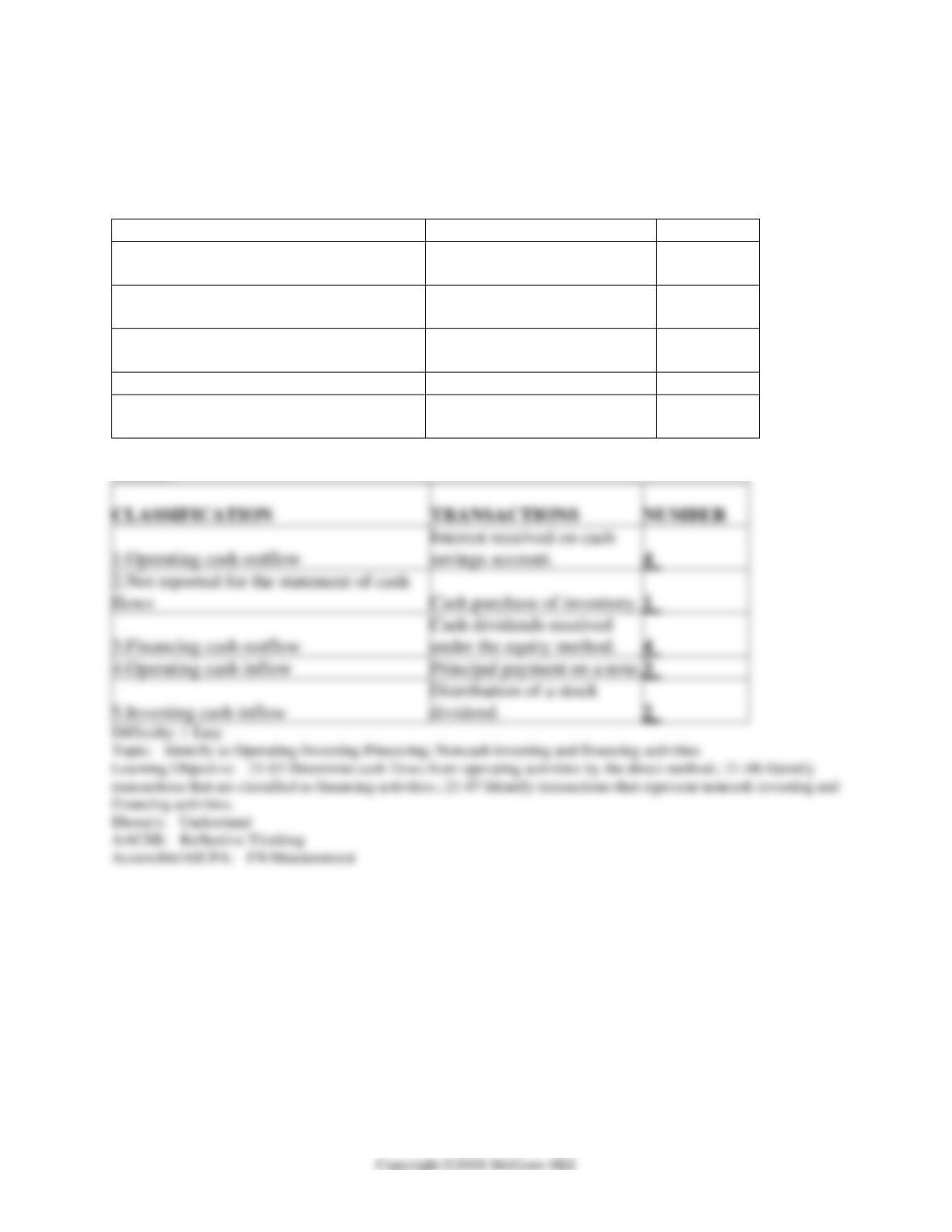
CLASSIFICATION
TRANSACTIONS
NUMBER
1.Operating activity, no adjustment to net
income
Increase in inventory
account.
____
2.Operating activity, negative adjustment to
net income
Payment of cash dividends.
____
3.Financing cash outflow
Cash sales.
____
4.Investing cash inflow
Prepayment of an insurance
premium for six months.
____
5.Operating activity, positive adjustment to net
income
Cash proceeds from sale of
equipment.
____
Answer:
CLASSIFICATION
TRANSACTIONS
NUMBER
1.Operating activity, no adjustment to net
income
Increase in inventory
account.
2
2.Operating activity, negative adjustment
to net income
Payment of cash
dividends.
3
3.Financing cash outflow
Cash sales.
1
4.Investing cash inflow
insurance premium for
six months.
2
5.Operating activity, positive adjustment
to net income
Cash proceeds from sale
of equipment.
4
70
144) Listed below are the reporting classifications for a statement of cash flows using the direct
method for reporting operating cash flows. Indicate the reporting classification that would apply
to each of the five transactions described below by placing the number of the reporting
classification in the space provided by each transaction.
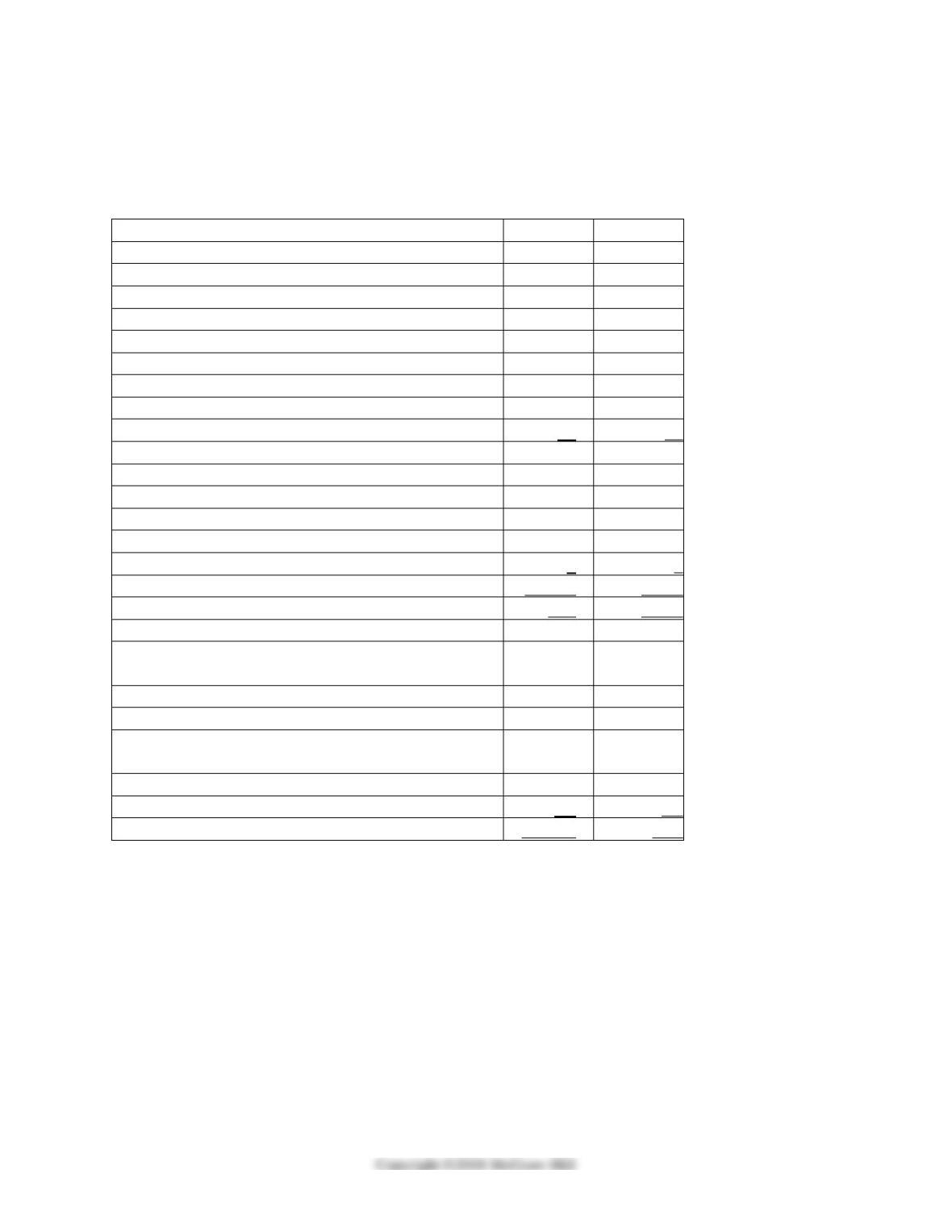
CLASSIFICATION
TRANSACTIONS
NUMBER
1.Operating cash outflow
Interest received on cash
savings account.
____
2.Not reported for the statement of cash
flows
Cash purchase of inventory.
____
3.Financing cash outflow
Cash dividends received under
the equity method.
____
4.Operating cash inflow
Principal payment on a note.
____
5.Investing cash inflow
Distribution of a stock
dividend.
____
Answer:
CLASSIFICATION
TRANSACTIONS
NUMBER
1.Operating cash outflow
Interest received on cash
savings account.
4
2.Not reported for the statement of cash
flows
Cash purchase of inventory.
1
3.Financing cash outflow
under the equity method.
4
4.Operating cash inflow
Principal payment on a note.
3
5.Investing cash inflow
Distribution of a stock
dividend.
2
71
Use the information below to answer the following question(s).
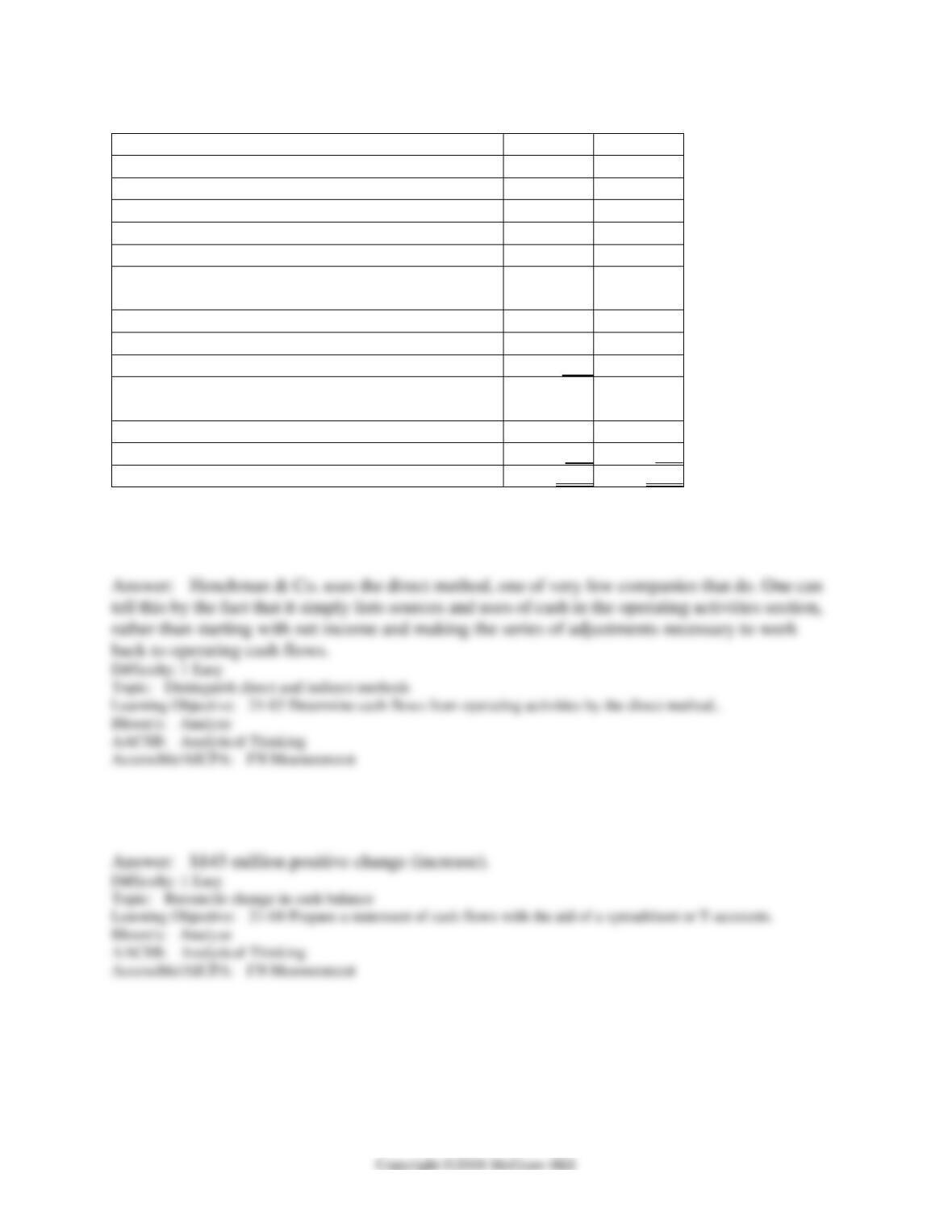
In its 2018 Annual Report to Shareholders, Henchman & Co. provided the following Statement
of Cash Flows:
Years ended December 31 ($ in millions)
2018
2017
Operating Activities
Cash Inflows
Cash received from customers
Progress payments
$3,102
$1,438
Other collections
11,148
7,003
Proceeds from litigation settlement
220
Interest received
17
17
Income tax refunds received
23
15
Other cash receipts
24
10
Cash provided by operating activities
14,534
8,483
Cash Outflows
Cash paid to suppliers and employees
13,251
7,250
Interest paid
333
165
Income taxes paid
126
57
Other cash payments
7
1
Cash used in operating activities
13,717
7,473
Net cash provided by operating activities
817
1,010
Investing Activities
Payment for businesses purchased, net of cash
acquired
(3,061)
(510)
Additions to property, plant, and equipment
(393)
(274)
Collection of note receivable
148
Proceeds from sale of property, plant, and
equipment
86
44
Proceeds from sale of businesses
18
668
Other investing activities
(2)
(6)
Net cash used in investing activities
(3,204)
(78)
72
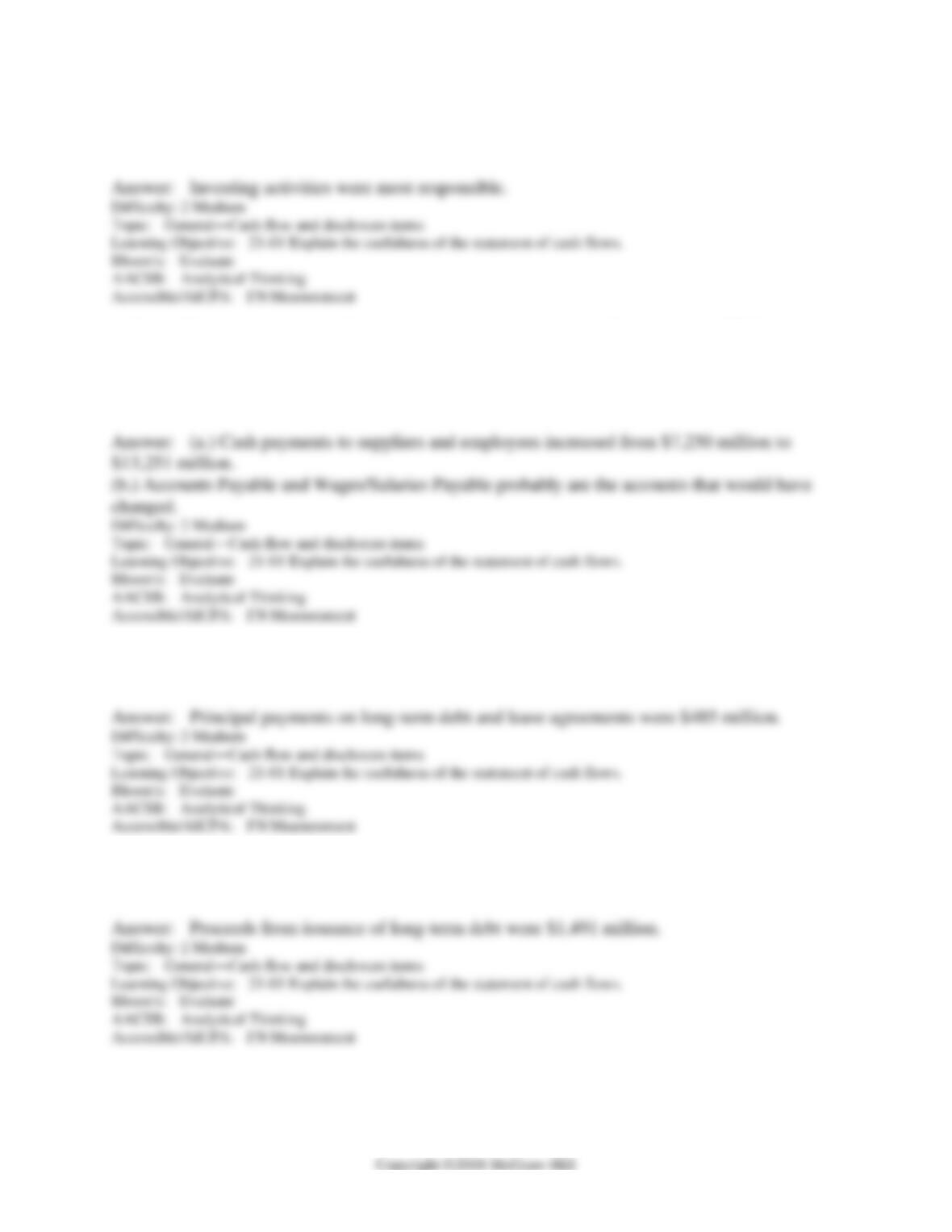
Years ended December 31 ($ in millions)
2018
2017
Financing Activities
Proceeds from issuance of long-term debt
1,491
Proceeds from equity security units
690
Borrowings under lines of credit
1,173
Repayment of borrowings under lines of Credit
(1,306)
(175)
Principal payments of long-term debt/lease
agreements
(119)
(485)
Proceeds from issuance of stock
825
19
Dividends paid
(158)
(114)
Other financing activities
(64)
_____
Net cash provided by (used in) financing
activities
2,532
(755)
Increase in cash and cash equivalents
145
177
Cash and cash equivalents at beginning of year
319
142
Cash and cash equivalents at end of year
$464
$319
145) What method (direct or indirect) does Henchman & Co. use to present its Statement of
Cash Flows? Explain how you can determine which method is used.
146) What was the net change in cash and cash equivalents experienced by Henchman & Co.
during 2018? Was it positive or negative?
73
147) Which type of activity (operating, investing, financing) was most responsible for the cash
flow experienced by Henchman & Co. during 2018?
148) (a.) What is the most significant change in operating cash outflow activity in 2018 relative
to 2017?
(b.) What balance sheet accounts would likely have changed during 2018 in relation to the cash
flow change that you identify in (a)?
149) What was most responsible for the negative cash flow from financing activities during
2017? What amount was paid?
150) What was most responsible for the positive cash flow from financing activities during
2018? What amount was received?
74
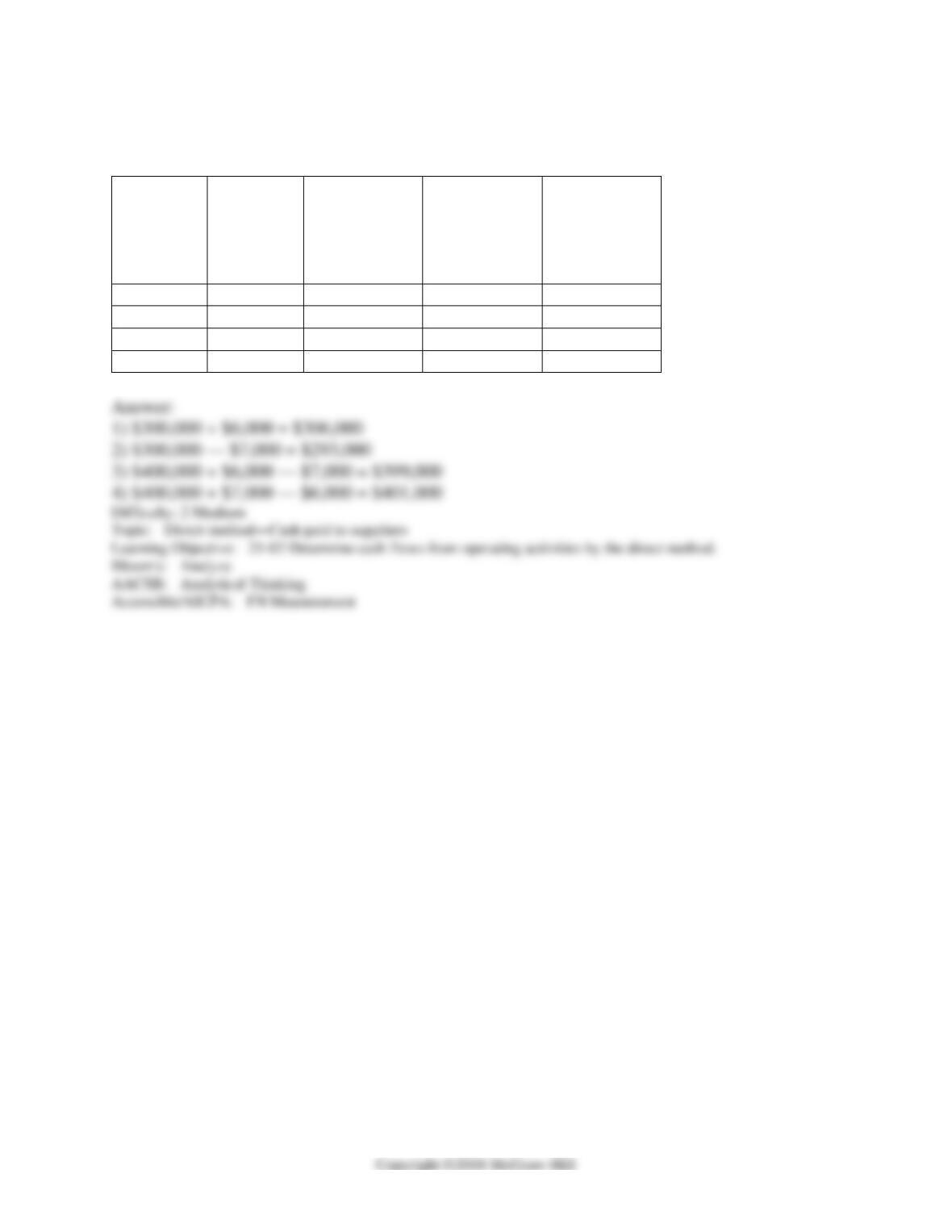
151) Determine the amount of cash paid to suppliers for each of the four independent situations
below.
Situation
Cost of
goods
sold
Inventory
incr.
(decr.)
Accounts
payable
incr.
(decr.)
Cash paid
to suppliers
1
$300,000
$6,000
$0
$
2
300,000
0
7,000
$
3
400,000
6,000
7,000
$
4
400,000
(6,000)
(7,000)
$
75
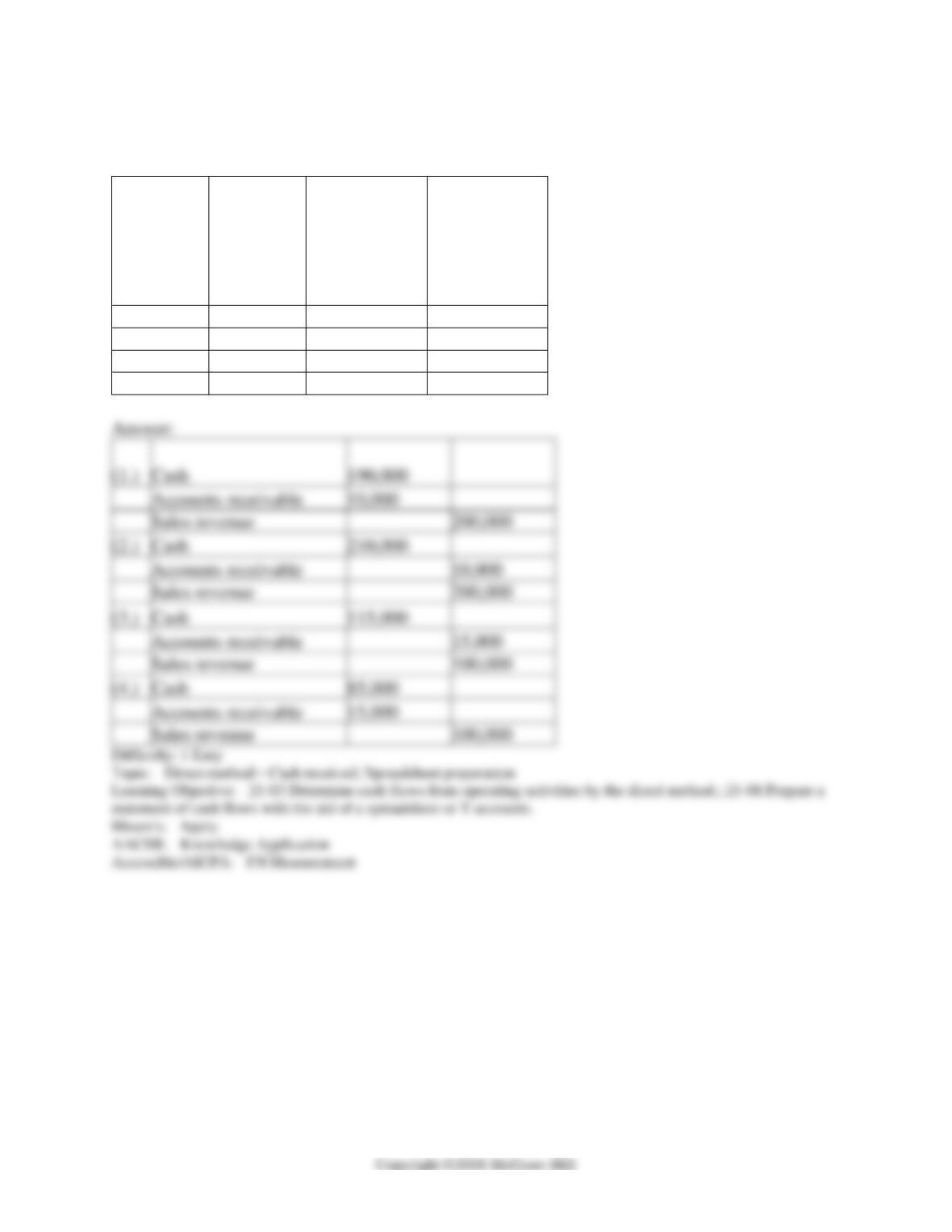
152) Prepare the summary entries necessary to determine the amount of cash received from
customers for each of the four independent situations below.
Situation
Sales
revenue
Accounts
receivable
incr.
(decr.)
Cash
received
from
customers
1
200,000
10,000
?
2
200,000
(10,000)
?
3
100,000
(15,000)
?
4
100,000
15,000
?
(1.)
Cash
190,000
Accounts receivable
10,000
Sales revenue
200,000
(2.)
Cash
210,000
Accounts receivable
10,000
Sales revenue
200,000
(3.)
Cash
115,000
Sales revenue
100,000
(4.)
Cash
85,000
Accounts receivable
15,000
Sales revenue
100,000
76
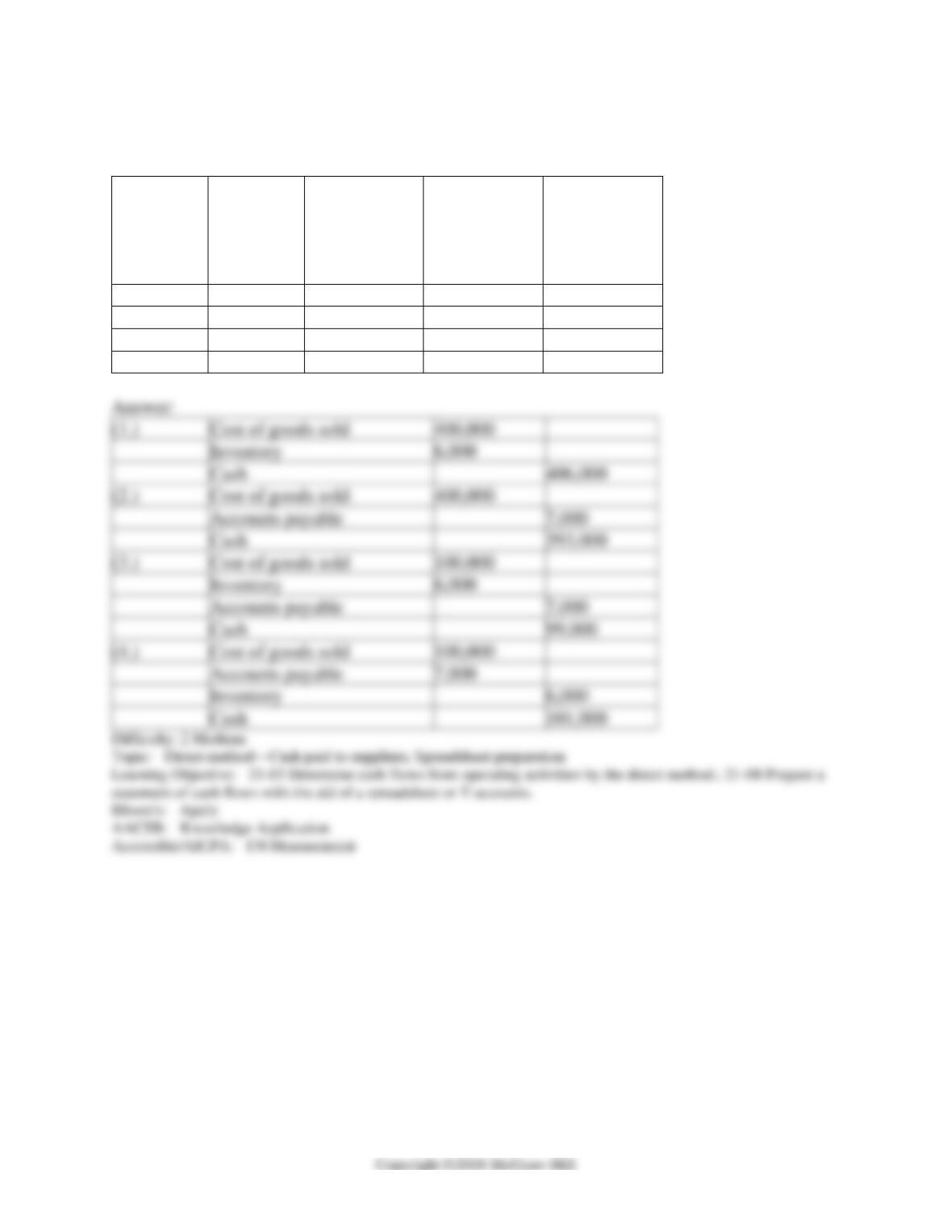
153) Prepare the summary entries necessary to determine the amount of cash paid to suppliers
for each of the four independent situations below.
Situation
Cost of
goods
sold
Inventory
incr.
(decr.)
Account
payable
incr.
(decr.)
Cash paid
to suppliers
1
400,000
6,000
0
2
400,000
0
7,000
3
100,000
6,000
7,000
4
100,000
(6,000)
(7,000)
(1.)
Cost of goods sold
400,000
Inventory
6,000
Cash
406,000
(2.)
Cost of goods sold
400,000
Accounts payable
7,000
Cash
393,000
(3.)
Cost of goods sold
100,000
Inventory
6,000
Accounts payable
7,000
Cash
99,000
(4.)
Cost of goods sold
100,000
Accounts payable
7,000
Inventory
6,000
Cash
101,000
77
154) Partial balance sheets and additional information are listed below for Monaco Company.
Monaco Company
Partial Balance Sheets
as of December 31
Assets
2018
2017
Cash
$40,000
$20,000
Accounts
receivable
60,000
90,000
Inventory
25,000
40,000
Liabilities
Accounts
payable
$60,000
$72,000
Additional information for 2018:
Net income was $270,000.
Depreciation expense was $30,000.
Sales totaled $800,000.
Cost of goods sold totaled $305,000.
Required:
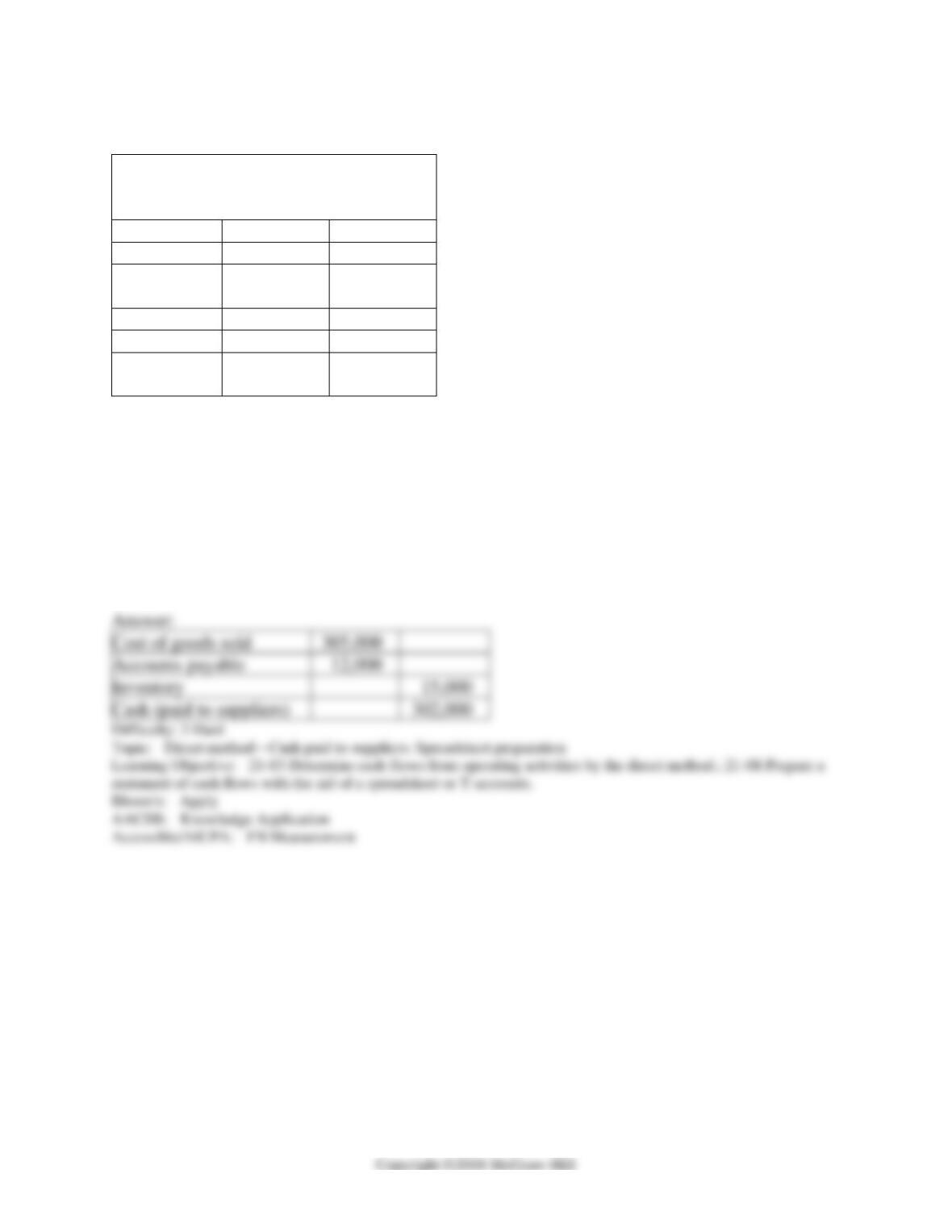
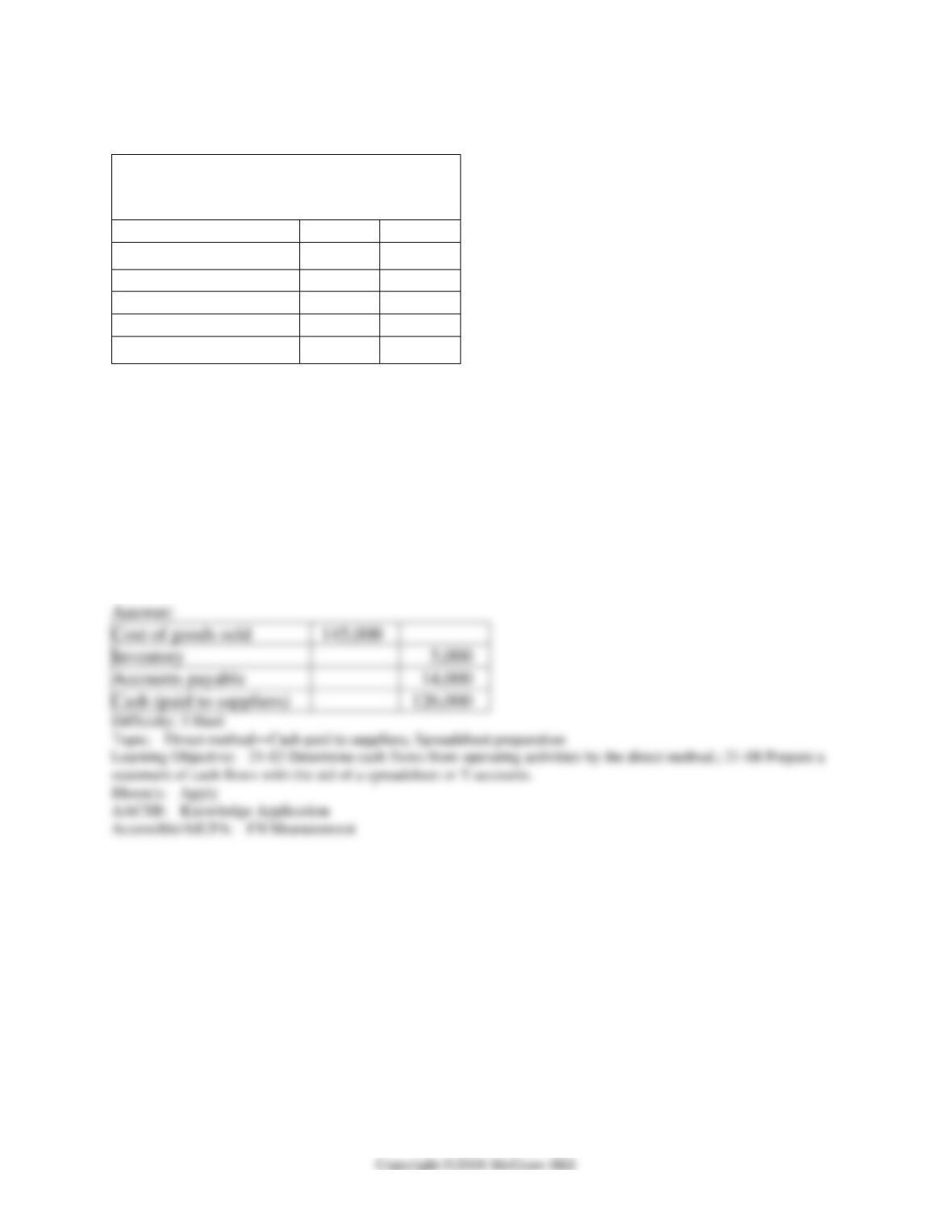
Prepare the summary entry for the amount of cash paid to merchandise suppliers during 2018.
Accounts payable
Inventory
Cash (paid to suppliers)
78
155) Partial balance sheets and additional information are listed below for Ensign Company.
Ensign Company
Partial Balance Sheets
as of December 31
Assets
2018
2017
Cash
$20,000
$40,000
Accounts receivable
90,000
60,000
Inventory
20,000
25,000
Liabilities
Accounts payable
$72,000
$58,000
Additional information for 2018:
Net income was $170,000.
Depreciation expense was $30,000.
Sales totaled $400,000.
Cost of goods sold totaled $145,000.
Required:
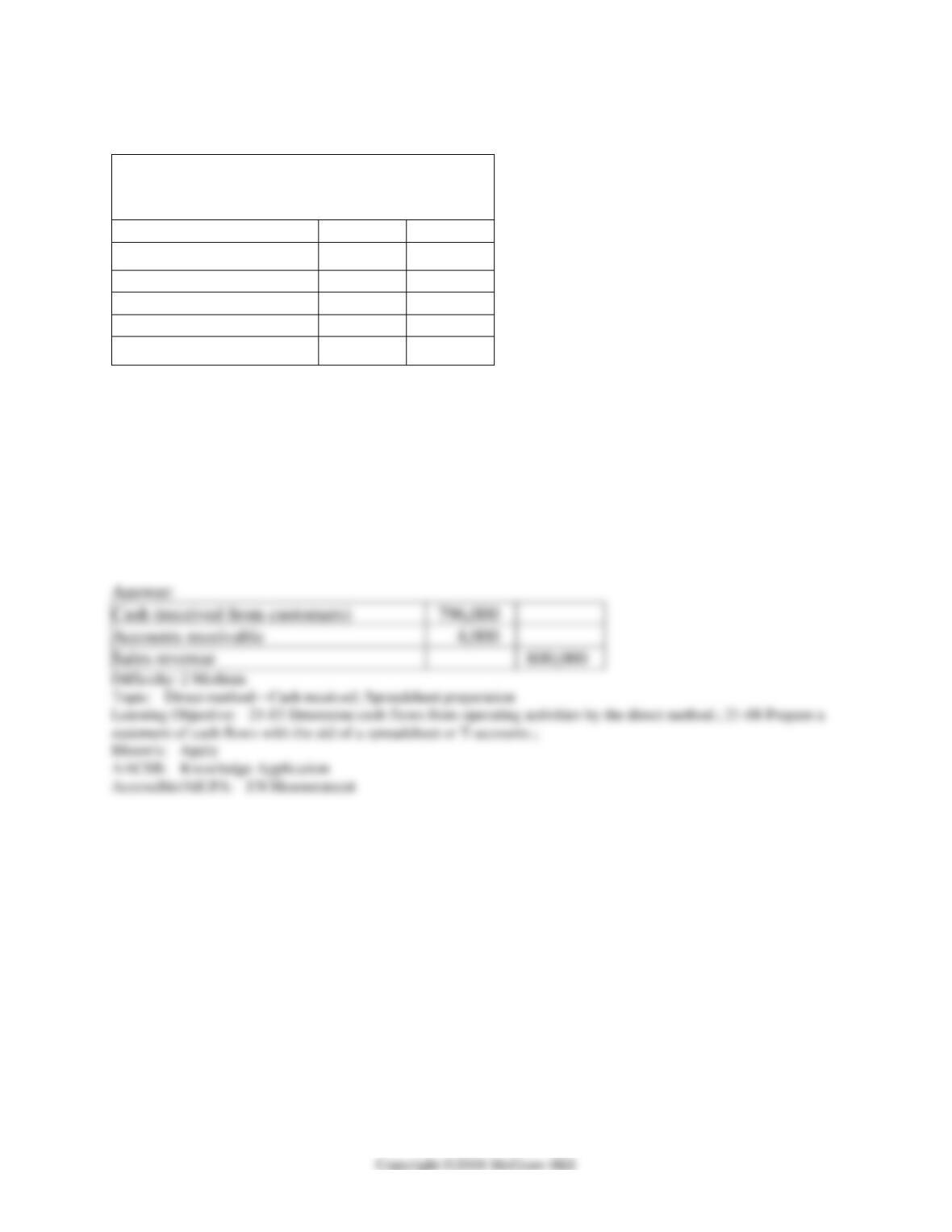
Prepare the summary entry for the amount of cash paid to merchandise suppliers during 2018.
Cost of goods sold
145,000
Inventory
Accounts payable
Cash (paid to suppliers)
126,000
79
156) Partial balance sheets and additional information are listed below for Funk Company.
Funk Company
Partial Balance Sheets
as of December 31
Assets
2018
2017
Cash
$40,000
$20,000
Accounts receivable
94,000
90,000
Inventory
25,000
40,000
Liabilities
Accounts payable
$58,000
$72,000
Additional information for 2018:
Net income was $170,000.
Depreciation expense was $30,000.
Sales totaled $800,000.
Cost of goods sold totaled $325,000.
Required:
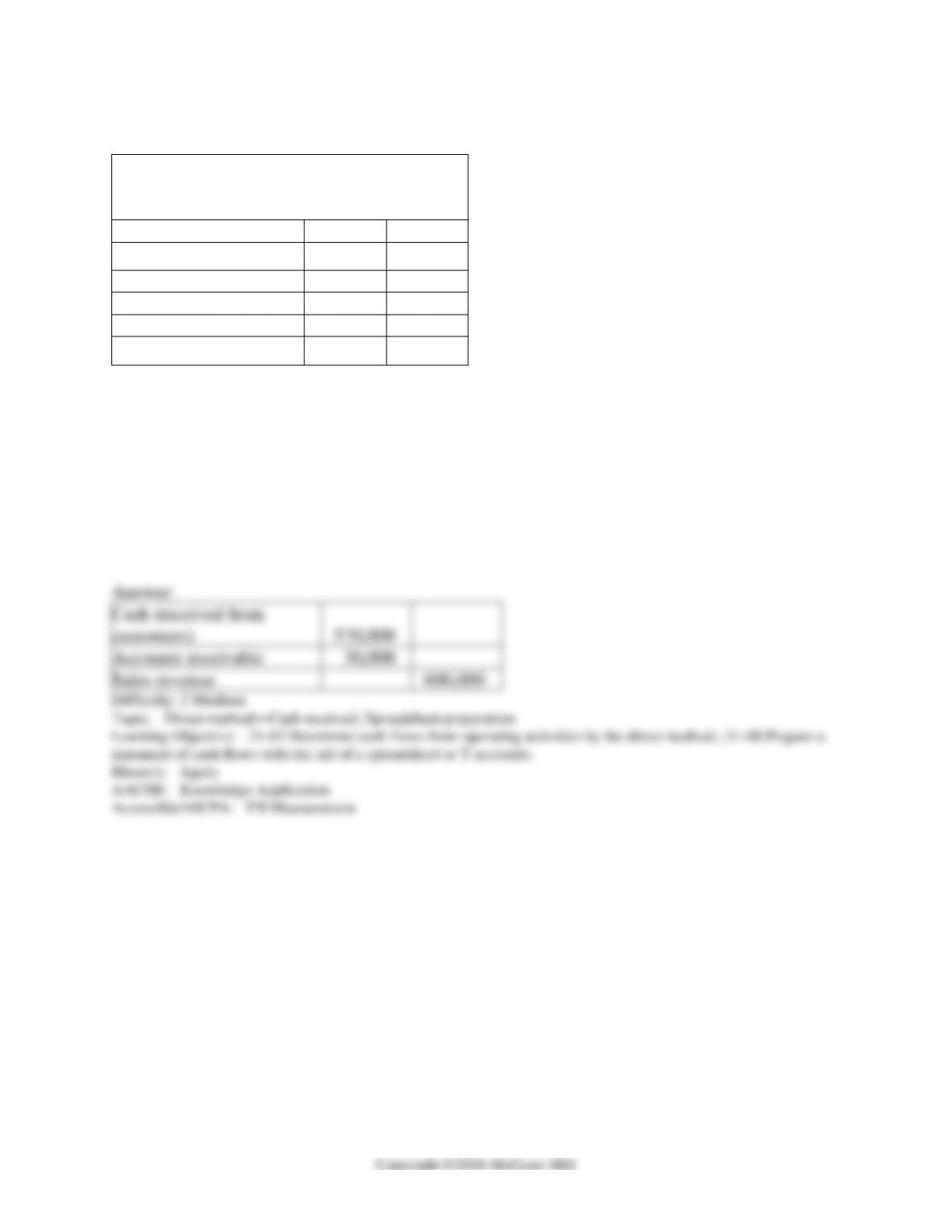
Prepare the summary entry for the amount of cash received from customers during 2018.
Cash (received from customers)
Accounts receivable
Sales revenue
800,000
80
157) Partial balance sheets and additional information are listed below for Julius Company.
Julius Company
Partial Balance Sheets
as of December 31
Assets
2018
2017
Cash
$20,000
$40,000
Accounts receivable
90,000
60,000
Inventory
40,000
25,000
Liabilities
Accounts payable
$72,000
$58,000
Additional information for 2018:
Net income was $70,000.
Depreciation expense was $30,000.
Sales totaled $600,000.
Cost of goods sold totaled $325,000.
Required:
Prepare the summary entry for the amount of cash received from customers during 2018.
customers)
Accounts receivable
Sales revenue