
Name:
Class:
Date:
chapter 21
Indicate whether the statement is true or false.
1. A rental cost of $20,000 plus $0.70 per machine hour of use is an example of a mixed cost.
a.
True
b.
False
2. Only a single line, which represents the difference between total sales revenues and total costs, is plotted on the profit-
volume chart.
a.
True
b.
False
3. If direct materials cost per unit increases, the break-even point will decrease.
a.
True
b.
False
4. If fixed costs are $450,000 and the unit contribution margin is $50, the sales necessary to earn a target profit of $50,000
are 10,000 units.
a.
True
b.
False
5. Assuming no other changes, income from operations will be the same under both the variable and absorption costing
methods when the number of units manufactured equals the number of units sold.
a.
True
b.
False
6. If direct materials cost per unit increases, the break-even point will increase.
a.
True
b.
False
7. If the unit selling price is $40, the volume of sales is $3,000,000, sales at the break-even point amount to $2,500,000,
and the maximum possible sales are $3,300,000, the margin of safety is 14,500 units.
a.
True
b.
False
8. Variable costs as a percentage of sales are equal to 100% minus the contribution margin ratio.
a.
True
b.
False
9. If employees accept a wage contract that increases the unit contribution margin, the break-even point will decrease.
a.
True
b.
False
10. The reliability of cost-volume-profit analysis does not depend on the assumption that costs can be accurately divided
into fixed and variable components.
a.
True
b.
False

Name:
Class:
Date:
chapter 21
11. Because variable costs are assumed to change in direct proportion to changes in the activity level, the graph of the
variable costs when plotted against the activity level appears as a circle.
a.
True
b.
False
12. If direct materials cost per unit decreases, the amount of sales necessary to earn a desired amount of profit will
decrease.
a.
True
b.
False
13. Unit variable cost does not change as the number of units of activity changes.
a.
True
b.
False
14. If fixed costs are $650,000 and the unit contribution margin is $30, the sales necessary to earn a target profit of
$30,000 are 14,000 units.
a.
True
b.
False
15. The point in operations at which revenues and expenses are exactly equal is called the break-even point.
a.
True
b.
False
16. The relevant activity base for a cost depends on which base is most closely associated with the cost and the decision-
making needs of management.
a.
True
b.
False
17. Variable costs are costs that vary in total in direct proportion to changes in the activity level.
a.
True
b.
False
18. The ratio that indicates the percentage of each sales dollar available to cover the fixed costs and to provide income
from operations is termed the contribution margin ratio.
a.
True
b.
False
19. If sales total $2,000,000, fixed costs total $800,000, and variable costs are 60% of sales, the contribution margin ratio
is 40%.
a.
True
b.
False
20. Garmo Co. has an operating leverage of 5. Next year’s sales are expected to increase by 10%. The company’s income
from operations will increase by 50%.
a.
True
b.
False

Name:
Class:
Date:
chapter 21
21. Even if a business sells six products, it is possible to estimate the break-even point.
a.
True
b.
False
22. The dollars available from each unit of sales to cover fixed costs and profit are the unit variable cost.
a.
True
b.
False
23. If a business sells two products, it is not possible to estimate the break-even point.
a.
True
b.
False
24. A production supervisor’s salary that does not vary with the number of units produced is an example of a fixed cost.
a.
True
b.
False
25. If employees accept a wage contract that decreases the unit contribution margin, the break-even point will decrease.
a.
True
b.
False
26. If fixed costs are $850,000 and the unit contribution margin is $50, the break-even point is 15,000 units.
a.
True
b.
False
27. Variable costs are costs that remain constant in total dollar amount as the level of activity changes.
a.
True
b.
False
28. A low operating leverage is normal for highly automated industries.
a.
True
b.
False
29. Rental charges of $40,000 per year plus $3 for each machine hour over 18,000 hours are an example of a fixed cost.
a.
True
b.
False
30. The fixed cost per unit varies with changes in the level of activity.
a.
True
b.
False
31. Break-even analysis is one type of cost-volume-profit analysis.
a.
True
b.
False
32. If the property tax rates are increased, this change in fixed costs will result in a decrease in the break-even point.
a.
True

Name:
Class:
Date:
chapter 21
b.
False
33. If the volume of sales is $6,000,000 and sales at the break-even point amount to $4,800,000, the margin of safety is
25%.
a.
True
b.
False
34. A mixed cost has characteristics of both variable and fixed costs.
a.
True
b.
False
35. Absorption costing is required for financial reporting under generally accepted accounting principles.
a.
True
b.
False
36. Direct materials cost that varies with the number of units produced is an example of a fixed cost of production.
a.
True
b.
False
37. Only a single line, which represents the difference between total sales revenues and total costs, is plotted on the cost-
volume-profit chart.
a.
True
b.
False
38. The adoption of variable costing for managerial decision making is based on the premise that fixed factory overhead
costs are related to productive capacity of the manufacturing plant and are normally not affected by the number of units
produced.
a.
True
b.
False
39. Variable costs are costs that vary on a per-unit basis with changes in the activity level.
a.
True
b.
False
40. The relevant range is useful for analyzing cost behavior for management decision-making purposes.
a.
True
b.
False
41. The range of activity over which changes in cost are of interest to management is called the relevant range.
a.
True
b.
False
42. In order to choose the proper activity base for a cost, a managerial accountant must be familiar with the operations of
the entity.
a.
True
b.
False

Name:
Class:
Date:
chapter 21
43. Cost behavior refers to the methods used to estimate costs for use in managerial decision making.
a.
True
b.
False
44. For purposes of analysis, mixed costs can generally be separated into their variable and fixed components.
a.
True
b.
False
45. Direct materials and direct labor costs are examples of variable costs of production.
a.
True
b.
False
46. Cost behavior refers to the manner in which a cost changes as the related activity changes.
a.
True
b.
False
47. The data required for determining the break-even point for a business are the total estimated fixed costs for a period,
stated as a percentage of net sales.
a.
True
b.
False
48. If a business sells four products, it is not possible to estimate the break-even point.
a.
True
b.
False
49. If yearly insurance premiums are increased, this change in fixed costs will result in an increase in the break-even
point.
a.
True
b.
False
50. Total variable costs change as the level of activity changes.
a.
True
b.
False
51. If fixed costs are $500,000 and variable costs are 60% of break-even sales, profit is $0 when sales revenue is
$930,000.
a.
True
b.
False
52. Companies with large amounts of fixed costs will generally have a high operating leverage.
a.
True
b.
False
53. If the volume of sales is $7,000,000 and sales at the break-even point amount to $4,800,000, the margin of safety is
45.8%.
a.
True
Name:
Class:
Date:
chapter 21
b.
False
54. If sales total $2,000,000, fixed costs total $800,000, and variable costs are 60% of sales, the contribution margin ratio
is 60%.
a.
True
b.
False
55. The contribution margin ratio is the same as the profit-volume ratio.
a.
True
b.
False
56. If the unit selling price is $40, the volume of sales is $3,000,000, sales at the break-even point amount to $2,500,000,
and the maximum possible sales are $3,300,000, the margin of safety is 11,500 units.
a.
True
b.
False
57. Variable costs are costs that remain constant on a per-unit basis as the level of activity changes.
a.
True
b.
False
58. Total fixed costs change as the level of activity changes.
a.
True
b.
False
59. Cost-volume-profit analysis can be presented in both equation form and graphic form.
a.
True
b.
False
60. In an absorption costing income statement, the manufacturing margin is the excess of sales over the variable cost of
goods sold.
a.
True
b.
False
Indicate the answer choice that best completes the statement or answers the question.
61. If sales are $820,000, variable costs are 55% of sales, and income from operations is $260,000, what is the
contribution margin ratio?
a.
45%
b.
55%
c.
62%
d.
32%
62. Given the following costs and activities for Dance Company, use the high-low method to determine Dance’s variable
electrical costs per machine hour.
Costs
Machine Hours
August
$11,700
15,000
Name:
Class:
Date:
chapter 21
September
13,200
17,500
October
11,400
14,500
a.
$2.08
b.
$6.00
c.
$0.60
d.
$1.20
63. If fixed costs are $300,000, the unit selling price is $31, and the unit variable costs are $22, what is the break-even
point in sales units if fixed costs are reduced by $30,000?
a.
30,000 units
b.
8,710 units
c.
12,273 units
d.
20,000 units
64. Which of the following is not an example of a cost that varies in total as the number of units produced changes?
a.
electricity per kilowatt-hour to operate factory equipment
b.
direct materials cost
c.
insurance premiums on factory building
d.
wages of assembly worker
65. The graph of a variable cost when plotted against its related activity base appears as a
a.
circle
b.
rectangle
c.
straight line
d.
curved line
Use this information for Carter Co. to answer the questions that follow.
Carter Co. sells two products, arks and bins. Last year, Carter sold 14,000 units of arks and 56,000 units of bins. Related
data are as follows:
Product
Unit Selling
Price
Unit Variable
Cost
Unit Contribution
Margin
Arks
$120
$80
$40
Bins
80
60
20
66. What was Carter Co.’s sales mix last year?
a.
20% arks, 80% bins
b.
12% arks, 28% bins
c.
70% arks, 30% bins
d.
40% arks, 20% bins
67. If sales are $400,000, variable costs are 80% of sales, and income from operations is $40,000, what is the operating
leverage?
a.
0.0
b.
7.5
Name:
Class:
Date:
chapter 21
c.
2.0
d.
1.3
Use this information for Carter Co. to answer the questions that follow.
Carter Co. sells two products, arks and bins. Last year, Carter sold 14,000 units of arks and 56,000 units of bins. Related
data are as follows:
Product
Unit Selling
Price
Unit Variable
Cost
Unit Contribution
Margin
Arks
$120
$80
$40
Bins
80
60
20
68. What was Carter Co.’s variable cost of E?
a.
$140
b.
$70
c.
$64
d.
$60
69. With the aid of spreadsheets, managers can vary assumptions regarding selling prices, costs, and volume and can
immediately see the effects of each change on the break-even point and profit. This is called
a.
“what if” or sensitivity analysis
b.
vary the data analysis
c.
computer-aided analysis
d.
data gathering
70. Variable costs as a percentage of sales for Lemon Inc. are 80%, current sales are $600,000, and fixed costs are
$130,000. How much will income from operations change if sales increase by $40,000?
a.
$8,000 increase
b.
$8,000 decrease
c.
$30,000 decrease
d.
$30,000 increase
71. Zipee Inc.’s unit selling price is $90, unit variable costs are $40.50, fixed costs are $170,000, and current sales are
12,000 units. How much will income from operations change if sales increase by 5,000 units?
a.
$125,000 decrease
b.
$175,000 increase
c.
$75,000 increase
d.
$247,500 increase
72. Flying Cloud Co. has the following operating data for its manufacturing operations:
Unit selling price
$ 250
Unit variable cost
100
Total fixed costs
840,000
The company has decided to increase the wages of hourly workers which will increase the unit variable cost by 10%.
Increases in the salaries of factory supervisors and property taxes for the factory will increase fixed costs by 4%. If sales
Name:
Class:
Date:
chapter 21
prices are held constant, the next break-even point for Flying Cloud Co. will be
a.
increased by 640 units
b.
increased by 400 units
c.
decreased by 640 units
d.
increased by 800 units
73. Which of the following describes the behavior of the fixed cost per unit?
a.
decreases with increasing production
b.
decreases with decreasing production
c.
remains constant with changes in production
d.
increases with increasing production
Use this information for Timmer Corporation to answer the questions that follow.
Timmer Corporation just started business in January. There were no beginning inventories. During the year, it
manufactured 12,000 units of product and sold 10,000 units. The selling price of each unit was $20. Variable
manufacturing costs were $4 per unit, and variable selling and administrative costs were $2 per unit. Fixed manufacturing
costs were $24,000, and fixed selling and administrative costs were $6,000.
74. What would Timmer’s income from operations be for the year using variable costing?
a.
$114,000
b.
$110,000
c.
$4,000
d.
$106,000
75. Strait Co. manufactures office furniture. During the most productive month of the year, 3,000 desks were
manufactured at a total cost of $59,000. In the month of lowest production, the company made 1,125 desks at a cost of
$38,000. Using the high-low method of cost estimation, total fixed costs are
a.
$21,000
b.
$25,400
c.
$42,000
d.
$13,000
76. As production increases, variable costs per unit
a.
stay the same
b.
increase
c.
decrease
d.
either increase or decrease, depending on the fixed costs
77. Payton Industries has fixed costs of $490,000, the unit selling price is $35, and the unit variable costs are $20. What is
the break-even point in sales units if fixed costs are reduced by $40,000?
a.
32,667 units
b.
14,000 units
c.
30,000 units
d.
24,500 units

Name:
Class:
Date:
chapter 21
78. Which of the following is not an example of a cost that varies in total as the number of units produced changes?
a.
electricity per kilowatt-hour to operate factory equipment
b.
direct materials cost
c.
straight-line depreciation on factory equipment
d.
wages of assembly worker
79. If fixed costs are $1,200,000, the unit selling price is $240, and the unit variable costs are $110, what is the amount of
sales in units (rounded to a whole number) required to realize a target profit of $200,000?
a.
9,231 units
b.
12,000 units
c.
10,769 units
d.
5,833 units
80. Thompson Company manufactures and sells cookware. Because of current trends, it expects to increase sales by 15%
next year. If this expected level of production and sales occurs and plant expansion is not needed, how should this
increase affect next year’s total amounts for the following costs?
Variable Costs Fixed Costs Mixed Costs
a.
increase increase increase
b.
increase no change increase
c.
no change no change increase
d.
decrease increase increase
81. Understanding how costs behave is useful to management for all the following reasons except
a.
predicting customer demand
b.
predicting profits as sales and production volumes change
c.
estimating costs
d.
changing an existing product production
82. Bryce Co. sales are $914,000, variable costs are $498,130, and income from operations is $196,000. What is the
contribution margin ratio?
a.
52.2%
b.
28.4%
c.
54.5%
d.
45.5%
83. Zeke Company sells 25,000 units at $21 per unit. Variable costs are $10 per unit, and fixed costs are $75,000. The
contribution margin ratio (rounded to the nearest whole percent) and the unit contribution margin are
a.
47% and $11 per unit, respectively
b.
53% and $7 per unit, respectively
c.
47% and $8 per unit, respectively
d.
52% and $11 per unit, respectively
84. Which of the following costs is a mixed cost?
a.
salary of a factory supervisor
b.
electricity costs of $3 per kilowatt-hour
Name:
Class:
Date:
chapter 21
c.
rental costs of $10,000 per month plus $0.30 per machine hour of use
d.
straight-line depreciation on factory equipment
85. Assume that Corn Co. sold 8,000 units of Product A and 2,000 units of Product B during the past year. The unit
contribution margins for Products A and B are $30 and $60, respectively. Corn has fixed costs of $378,000. The break-
even point in sales units is
a.
8,000 units
b.
6,300 units
c.
12,600 units
d.
10,500 units
86. Charlotte Co. has budgeted salary increases to factory supervisors totaling 9%. If selling prices and all other cost
relationships are held constant, next year’s break-even point
a.
will decrease by 9%
b.
will increase by 9%
c.
cannot be determined from the data given
d.
will increase at a rate greater than 9%
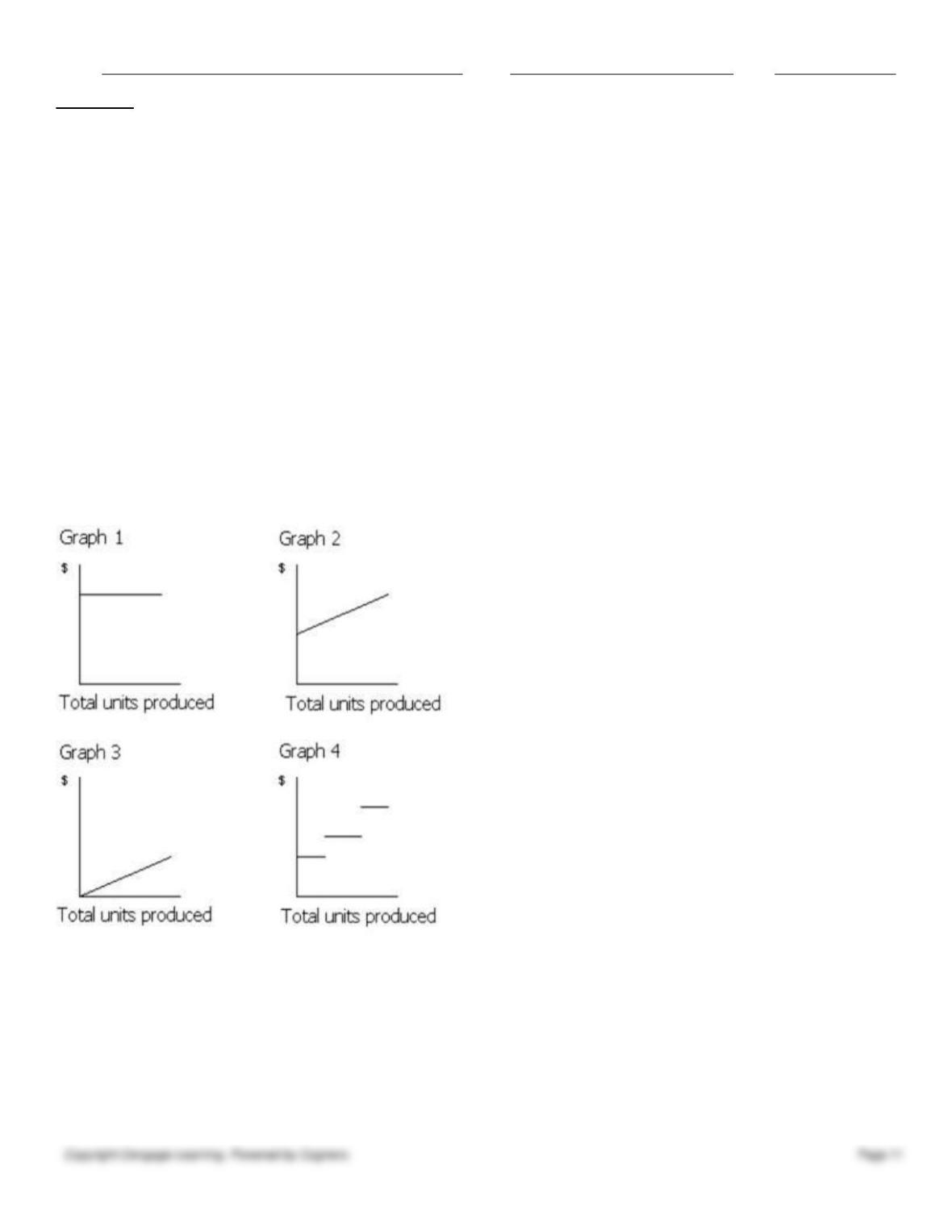
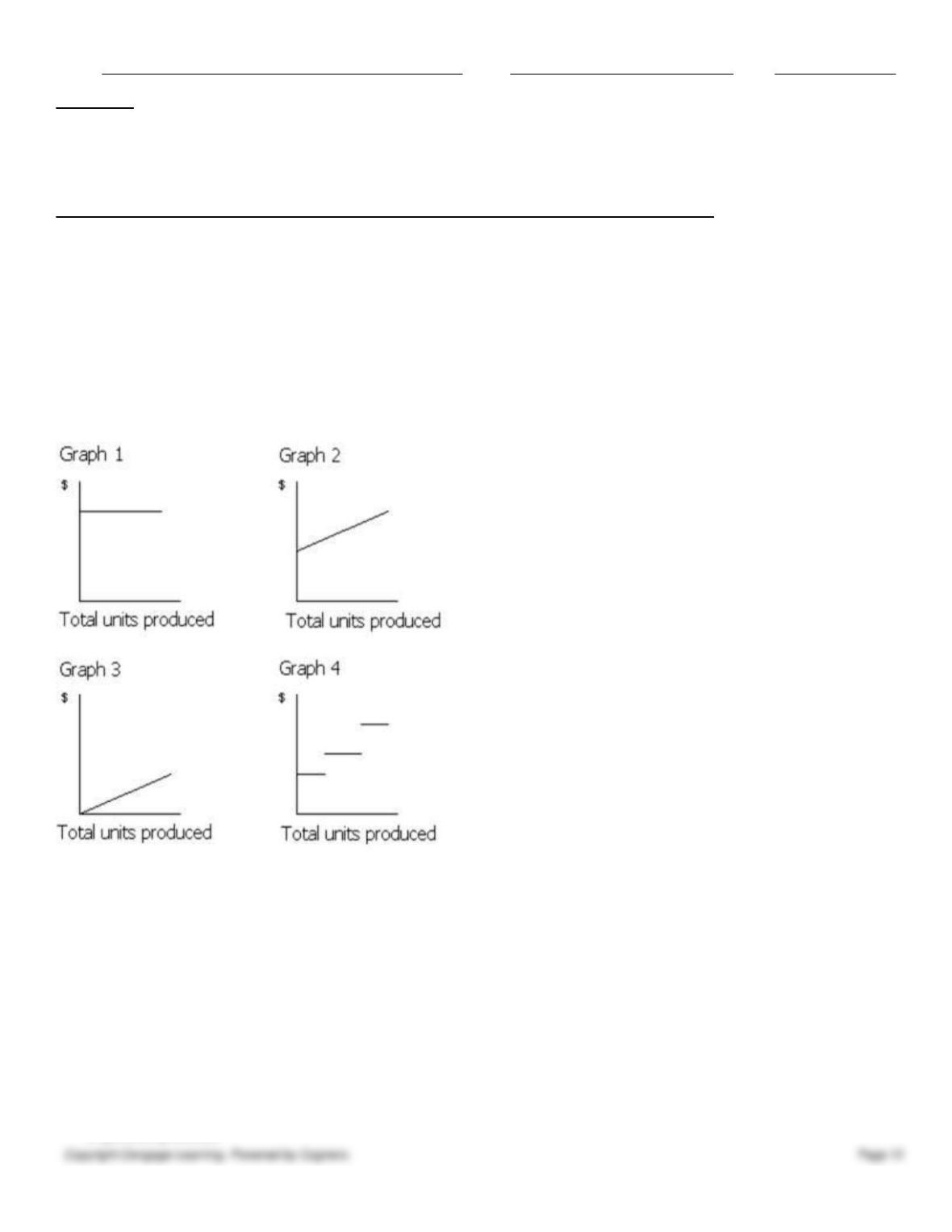
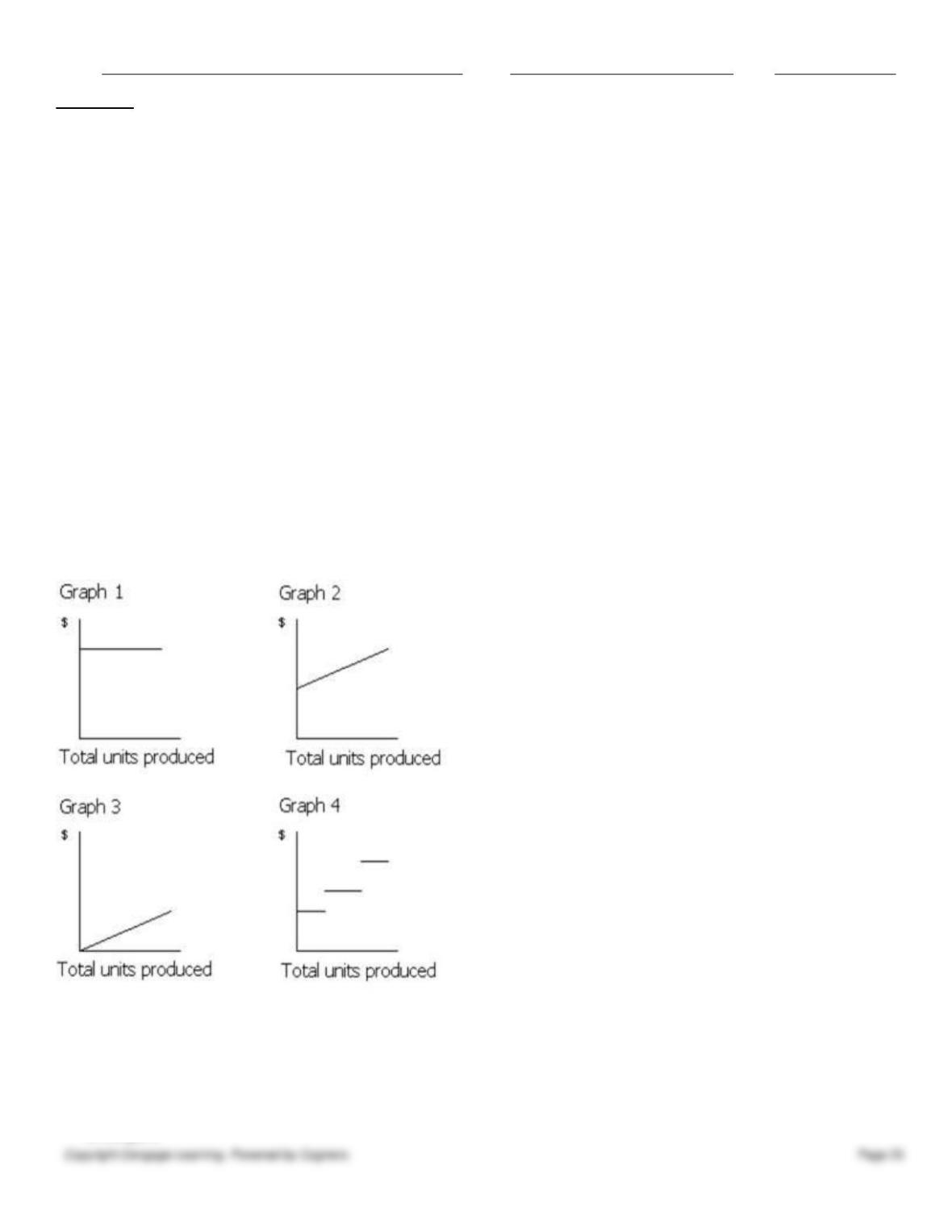
Figure 21-1
87. Which of the graphs in Figure 21-1 illustrates the behavior of a total fixed cost?
a.
Graph 2
b.
Graph 3
c.
Graph 4
d.
Graph 1
Use this information for Rusty Co. to answer the questions that follow.
Name:
Class:
Date:
chapter 21
Rusty Co. sells two products, X and Y. Last year, Rusty sold 5,000 units of X and 35,000 units of Y. Related data are as
follows:
Unit Selling Price
Unit Variable
Unit Contribution
Product
Price
Cost
Margin
X
$110
$70
$40
Y
70
50
20
88. What was the unit contribution margin of Rusty’s one overall enterprise product, E? Do not round interim
computations.
a.
$60.00
b.
$20.00
c.
$40.00
d.
$22.50
Figure 21-1
89. Which of the graphs in Figure 21-1 illustrates the behavior of a total variable cost?
a.
Graph 2
b.
Graph 3
c.
Graph 4
d.
Graph 1
90. The relative distribution of sales among the various products sold by a business is the
a.
business’s basket of goods
b.
contribution margin mix
c.
sales mix
d.
product portfolio
Name:
Class:
Date:
chapter 21
91. If fixed costs are $250,000, the unit selling price is $125, and the unit variable costs are $73, what is the break-even
point in sales units (rounded to a whole number)?
a.
3,425 units
b.
2,381 units
c.
2,000 units
d.
4,808 units
92. Given the following cost and activity observations for George Company’s utilities, use the high-low method to
determine George’s variable utilities cost per machine hour.
Cost
Machine Hours
May
$16,500
105,000
June
18,000
120,000
July
16,000
100,000
August
17,500
117,000
a.
$100.00
b.
$1.00
c.
$10.00
d.
$0.10
93. If a business had sales of $4,000,000 and a margin of safety of 25%, the break-even point in sales dollars was
a.
$5,000,000
b.
$3,000,000
c.
$12,000,000
d.
$1,000,000
94. Most operating decisions of management focus on a narrow range of activity called the
a.
relevant range of production
b.
strategic level of production
c.
optimal level of production
d.
tactical operating level of production
95. Which of the following conditions would cause the break-even point to increase?
a.
total fixed costs increase
b.
unit selling price increases
c.
unit variable cost decreases
d.
total fixed costs decrease
96. O’Boyle Co.’s fixed costs are $256,000, the unit selling price is $36, and the unit variable costs are $20. What is the
break-even point in sales units?
a.
12,800 units
b.
4,571 units
Name:
Class:
Date:
chapter 21
c.
16,000 units
d.
7,111 units
97. Lee Industry’s sales are $525,000, variable costs are 53% of sales, and income from operations is $19,000. What is the
contribution margin ratio?
a.
47%
b.
26.5%
c.
9.5%
d.
53%
98. If fixed costs are $450,000, the unit selling price is $75, and the unit variable costs are $50, what are the old and new
break-even points in sales units (rounded to a whole number) if the unit selling price increases by $10?
a.
6,000 units and 5,294 units, respectively
b.
18,000 units and 6,000 units, respectively
c.
18,000 units and 12,857 units, respectively
d.
9,000 units and 15,000 units, respectively
99. The point where the sales line and the total costs line intersect on the cost-volume-profit chart represents the
a.
maximum possible operating loss
b.
maximum possible operating profit
c.
total fixed costs
d.
break-even point
100. A firm operated at 80% of capacity for the past year, during which fixed costs were $330,000, variable costs were
70% of sales, and sales were $1,000,000. Income (loss) from operations was
a.
$140,000
b.
$(30,000)
c.
$370,000
d.
$670,000
101. Harley Company has sales of $500,000, variable costs are 75% of sales, and income from operations is $40,000.
What is Harley’s operating leverage?
a.
0.0
b.
1.2
c.
1.3
d.
3.1
Use this information for Rusty Co. to answer the questions that follow.
Rusty Co. sells two products, X and Y. Last year, Rusty sold 5,000 units of X and 35,000 units of Y. Related data are as
follows:
Unit Selling Price
Unit Variable
Unit Contribution
Product
Price
Cost
Margin
X
$110
$70
$40
Y
70
50
20
Name:
Class:
Date:
chapter 21
102. Assuming that last year’s fixed costs totaled $675,000, what was Rusty Co.’s break-even point in sales units? Do not
round interim computations.
a.
16,875 units
b.
30,100 units
c.
30,000 units
d.
11,250 units
103. The point where the profit line intersects the horizontal axis on the profit-volume chart represents the
a.
maximum possible operating loss
b.
maximum possible operating profit
c.
total fixed costs
d.
break-even point
104. The systematic examination of the relationships among selling prices, sales and production volume, costs, expenses,
and profits is termed
a.
contribution margin analysis
b.
cost-volume-profit analysis
c.
budgetary analysis
d.
gross profit analysis
105. If fixed costs are $750,000 and variable costs are 60% of sales, what is the break-even point in sales dollars?
a.
$1,250,000
b.
$450,000
c.
$1,875,000
d.
$300,000
106. What ratio indicates the percentage of each sales dollar that is available to cover fixed costs and to provide a profit?
a.
margin of safety ratio
b.
contribution margin ratio
c.
costs and expenses ratio
d.
profit ratio
107. Manley Co. manufactures office furniture. During the most productive month of the year, 4,500 desks were
manufactured at a total cost of $86,625. In its slowest month, the company made 1,800 desks at a cost of $49,500. Using
the high-low method of cost estimation, total fixed costs
a.
are $61,875
b.
are $33,875
c.
are $24,750
d.
cannot be determined from the data given
108. Which of the following costs is an example of a cost that remains the same in total as the number of units produced
changes?
a.
direct labor
b.
salary of a factory supervisor
Name:
Class:
Date:
chapter 21
c.
units-of-production depreciation on factory equipment
d.
direct materials
109. Costs that remain constant in total dollar amount as the level of activity changes are called
a.
fixed costs
b.
mixed costs
c.
product costs
d.
variable costs
110. Which of the following describes the behavior of a variable cost per unit?
a.
varies in increasing proportion with changes in the activity level
b.
varies in decreasing proportion with changes in the activity level
c.
remains constant with changes in the activity level
d.
varies in direct proportion with the activity level
111. Cost behavior refers to the manner in which a cost
a.
changes as the related activity changes
b.
is allocated to products
c.
is used in setting selling prices
d.
is estimated
112. Given the following cost and activity observations for Bounty Company’s utilities, use the high-low method to
determine Bounty’s variable utilities cost per machine hour. Round to the nearest cent.
Cost
Machine Hours
March
$3,100
15,000
April
2,700
10,000
May
2,900
12,000
June
3,600
18,000
a.
$10.00
b.
$0.67
c.
$0.63
d.
$0.11
113. If fixed costs are $600,000 and the unit contribution margin is $40, what is the break-even point in sales units if fixed
costs are increased by $90,000?
a.
17,250
b.
15,000
c.
8,333
d.
9,667
114. If the contribution margin ratio for France Company is 45%, sales were $425,000, and fixed costs were $100,000,
what was the income from operations?
a.
$233,750
b.
$91,250

Name:
Class:
Date:
chapter 21
c.
$191,250
d.
$133,750
115. For purposes of analysis, mixed costs are
a.
classified as fixed costs
b.
classified as variable costs
c.
classified as period costs
d.
separated into their variable and fixed cost components
Use this information for Timmer Corporation to answer the questions that follow.
Timmer Corporation just started business in January. There were no beginning inventories. During the year, it
manufactured 12,000 units of product and sold 10,000 units. The selling price of each unit was $20. Variable
manufacturing costs were $4 per unit, and variable selling and administrative costs were $2 per unit. Fixed manufacturing
costs were $24,000, and fixed selling and administrative costs were $6,000.
116. What would be the difference in Timmer’s income from operations for the year if it used variable costing instead of
absorption costing?
a.
no difference
b.
$2,000 greater
c.
$4,000 less
d.
$6,000 less
117. In a cost-volume-profit chart, the
a.
total cost line begins at zero
b.
slope of the total cost line is dependent on the fixed cost per unit
c.
total cost line begins at the total fixed cost value on the vertical axis
d.
total cost line normally ends at the highest sales value
118. Rocky Company reports the following data:
Sales
$800,000
Variable costs
300,000
Fixed costs
120,000
Rocky Company’s operating leverage is
a.
6.7
b.
2.7
c.
1.0
d.
1.3
119. Which of the following activity bases would be the most appropriate for food costs of a hospital?
a.
number of nurses scheduled to work
b.
number of MRIs taken
c.
number of patients who stay in the hospital
d.
quantity of prescriptions filled
Name:
Class:
Date:
chapter 21
120. If fixed costs are $46,800, the unit selling price is $42, and the unit variable costs are $24, what is the break-even
point in sales units if the variable costs are decreased by $2?
a.
2,127
b.
1,114
c.
2,340
d.
1,950
121. Contribution margin is
a.
the excess of sales over variable costs
b.
another term for volume in the “cost-volume-profit” analysis
c.
profit
d.
the same as sales revenue
122. If fixed costs are $500,000 and the unit contribution margin is $20, what is the break-even point in sales units if fixed
costs are reduced by $80,000?
a.
25,000
b.
29,000
c.
4,000
d.
21,000
123. The contribution margin ratio is the
a.
same as the variable cost ratio
b.
same as profit
c.
portion of equity contributed by stockholders
d.
same as the profit-volume ratio
Use this information for Carter Co. to answer the questions that follow.
Carter Co. sells two products, arks and bins. Last year, Carter sold 14,000 units of arks and 56,000 units of bins. Related
data are as follows:
Product
Unit Selling
Price
Unit Variable
Cost
Unit Contribution
Margin
Arks
$120
$80
$40
Bins
80
60
20
124. What was Carter Co.’s unit selling price of E, with E representing one overall “enterprise” product?
a.
$200
b.
$100
c.
$80
d.
$88
125. Connor Company’s fixed costs are $400,000, the unit selling price is $25, and the unit variable costs are $15. What is
the break-even point in sales units if the variable costs are increased by $2?
a.
50,000 units
b.
30,770 units
Name:
Class:
Date:
chapter 21
c.
40,000 units
d.
26,667 units
Use this information for Carter Co. to answer the questions that follow.
Carter Co. sells two products, arks and bins. Last year, Carter sold 14,000 units of arks and 56,000 units of bins. Related
data are as follows:
Product
Unit Selling
Price
Unit Variable
Cost
Unit Contribution
Margin
Arks
$120
$80
$40
Bins
80
60
20
126. Assuming that last year’s fixed costs totaled $960,000, what was Carter Co.’s break-even point in sales units?
a.
40,000 units
b.
12,000 units
c.
35,000 units
d.
28,000 units
127. The three most common cost behavior classifications are
a.
variable costs, product costs, and sunk costs
b.
fixed costs, variable costs, and mixed costs
c.
variable costs, period costs, and differential costs
d.
variable costs, sunk costs, and opportunity costs
128. If fixed costs are $850,000 and variable costs are 60% of sales, what is the break-even point in sales dollars?
a.
$2,125,000
b.
$340,000
c.
$3,400,000
d.
$1,416,666
129. Which of the following conditions would cause the break-even point to increase?
a.
total fixed costs decrease
b.
unit selling price increases
c.
unit variable cost decreases
d.
unit variable cost increases
130. If fixed costs are $561,000 and the unit contribution margin is $8.00, what is the break-even point in sales units if
variable costs are decreased by $0.50 a unit?
a.
66,000
b.
70,125
c.
74,800
d.
60,000
131. If fixed costs are $500,000, the unit selling price is $55, and the unit variable costs are $30, what is the break-even
point in sales units if fixed costs are increased by $80,000?
Name:
Class:
Date:
chapter 21
a.
10,545 units
b.
19,333 units
c.
23,200 units
d.
25,000 units
132. Kaden Company’s fixed costs are $46,800, the unit selling price is $42, and the unit variable costs are $24. The
break-even point in sales units is
a.
2,400
b.
1,950
c.
1,114
d.
2,600
133. A firm operated at 90% of capacity for the past year, during which fixed costs were $420,000, variable costs were
40% of sales, and sales were $1,000,000. Income from operations was
a.
$180,000
b.
$420,000
c.
$1,080,000
d.
$980,000
134. If sales are $425,000, variable costs are 62% of sales, and income from operations is $50,000, what is the
contribution margin ratio?
a.
38%
b.
26.8%
c.
11.8%
d.
62%
135. Which of the following activity bases would be the most appropriate for gasoline costs of a delivery service?
a.
number of truck drivers
b.
total miles driven
c.
number of trucks in service
d.
number of packages picked up
136. Given the following cost data, what type of cost is shown?
Total Cost
Number of Units
$20
1
40
2
60
3
80
4
a.
mixed cost
b.
variable cost
c.
fixed cost
d.
period cost
137. Given the following cost data, what type of cost is shown?
Name:
Class:
Date:
chapter 21
Total Cost
Number of Units
$8,000
1
8,500
2
9,000
3
9,500
4
a.
mixed cost
b.
variable cost
c.
fixed cost
d.
period cost
Use this information for Carter Co. to answer the questions that follow.
Carter Co. sells two products, arks and bins. Last year, Carter sold 14,000 units of arks and 56,000 units of bins. Related
data are as follows:
Product
Unit Selling
Price
Unit Variable
Cost
Unit Contribution
Margin
Arks
$120
$80
$40
Bins
80
60
20
138. What was Carter Co.’s unit contribution margin of E?
a.
$24
b.
$60
c.
$92
d.
$20
139. If fixed costs increased and variable costs per unit decreased, the break-even point
a.
would increase
b.
would decrease
c.
would remain the same
d.
cannot be determined from the data provided
140. If fixed costs are $400,000 and the unit contribution margin is $20, what is the break-even point in sales units?
a.
25,000 units
b.
10,000 units
c.
400,000 units
d.
20,000 units
Use this information for Rusty Co. to answer the questions that follow.
Rusty Co. sells two products, X and Y. Last year, Rusty sold 5,000 units of X and 35,000 units of Y. Related data are as
follows:
Unit Selling Price
Unit Variable
Unit Contribution
Product
Price
Cost
Margin
X
$110
$70
$40
Y
70
50
20

Name:
Class:
Date:
chapter 21
141. What was Rusty Co.’s sales mix last year?
a.
58% X, 42% Y
b.
60% X, 40% Y
c.
30% X, 70% Y
d.
12.5% X, 87.5% Y
142. Piper Technology’s fixed costs are $1,500,000, the unit selling price is $250, and the unit variable costs are $130.
What is the amount of sales in units (rounded to a whole number) required to realize a target profit of $200,000?
a.
14,167 units
b.
12,500 units
c.
16,000 units
d.
11,538 units
143. If variable costs per unit increased because of an increase in hourly wage rates, the break-even point would
a.
decrease
b.
increase
c.
remain the same
d.
increase or decrease, depending on the percentage increase in wage rates
144. As production increases, the fixed cost per unit
a.
increases
b.
decreases
c.
remains the same
d.
either increases or decreases, depending on the variable costs
145. Reynold’s Grocery has fixed costs of $350,000, the unit selling price is $29, and the unit variable costs are $20. What
is the break-even point in sales units (rounded to a whole number) if the unit variable costs are decreased by $4?
a.
26,923 units
b.
12,069 units
c.
21,875 units
d.
38,889 units
146. Which of the following is not an assumption underlying cost-volume-profit analysis?
a.
The break-even point will be passed during the period.
b.
Total sales and total costs can be represented by straight lines.
c.
Costs can be accurately divided into fixed and variable components.
d.
The sales mix is constant.
147. Jacob Inc. has fixed costs of $240,000, a unit selling price of $32, and unit variable costs of $20. What are the old
and new break-even points in sales units if the unit selling price increases by $4?
a.
7,500 units and 6,667 units, respectively
b.
20,000 units and 30,000 units, respectively
c.
20,000 units and 15,000 units, respectively
d.
12,000 units and 15,000 units, respectively
Name:
Class:
Date:
chapter 21
148. When units manufactured exceed units sold, variable costing income
a.
equals absorption costing income
b.
is less than absorption costing income
c.
is greater than absorption costing income
d.
is greater by the number of units produced multiplied by the variable cost ratio
149. A cost that has characteristics of both a variable cost and a fixed cost is called a
a.
variable/fixed cost
b.
mixed cost
c.
discretionary cost
d.
sunk cost
150. Johnson Plumbing’s fixed costs are $700,000 and the unit contribution margin is $17. What amount of units (rounded
to a whole number) must be sold in order to realize a target profit of $100,000?
a.
5,000
b.
41,176
c.
47,059
d.
58,882
151. Spice Inc.’s unit selling price is $60, unit variable costs are $35, fixed costs are $125,000, and current sales are
10,000 units. How much will income from operations change if sales increase by 8,000 units?
a.
$150,000 decrease
b.
$175,000 increase
c.
$200,000 increase
d.
$150,000 increase
Use this information for Rusty Co. to answer the questions that follow.
Rusty Co. sells two products, X and Y. Last year, Rusty sold 5,000 units of X and 35,000 units of Y. Related data are as
follows:
Unit Selling Price
Unit Variable
Unit Contribution
Product
Price
Cost
Margin
X
$110
$70
$40
Y
70
50
20
152. What was the unit variable cost of Rusty’s one overall enterprise product, E? Do not round interim computations.
a.
$52.50
b.
$70.00
c.
$120.00
d.
$50.00
153. The difference between the current sales revenue and the sales at the break-even point is called the
a.
contribution margin
b.
margin of safety
Name:
Class:
Date:
chapter 21
c.
price factor
d.
operating leverage
154. Beemer’s sales are $400,000, variable costs are 75% of sales, and income from operations is $50,000. The operating
leverage is
a.
2.5
b.
7.5
c.
2.0
d.
0.0
155. Given the following cost and activity observations for Smithson Company’s utilities, use the high-low method to
determine Smithson’s fixed costs per month. Do not round intermediate computations.
Cost
Machine Hours
January
$52,200
20,000
February
75,000
29,000
March
57,000
22,000
April
64,000
24,500
a.
$1,533
b.
$2,530
c.
$22,800
d.
$50,600
156. Given the following cost data, what type of cost is shown?
Cost per Unit
Number of Units
$6,000
1
3,000
2
2,000
3
1,500
4
a.
mixed cost
b.
variable cost
c.
fixed cost
d.
period cost
157. When a business sells more than one product at varying selling prices, the business’s break-even point can be
determined as long as the number of products does not exceed
a.
two
b.
three
c.
fifteen
d.
There is no limit.
158. Forde Co. has an operating leverage of 4. Sales are expected to increase by 12% next year. Income from operations is
a.
unaffected
b.
expected to increase by 3%
c.
expected to increase by 48%
Name:
Class:
Date:
chapter 21
d.
expected to increase by 4%
159. Which of the following statements regarding fixed and variable costs is true?
a.
Both costs are constant when considered on a per-unit basis.
b.
Both costs are constant when considered on a total basis.
c.
Fixed costs are constant in total, and variable costs are constant per unit.
d.
Variable costs are constant in total, and fixed costs vary in total.
160. Costs that vary in total in direct proportion to changes in an activity level are called
a.
fixed costs
b.
sunk costs
c.
variable costs
d.
differential costs
161. If variable costs per unit decreased because of a decrease in utility rates, the break-even point would
a.
decrease
b.
increase
c.
remain the same
d.
increase or decrease, depending on the percentage increase in utility rates
Figure 21-1
162. Which of the graphs in Figure 21-1 illustrates the nature of a mixed cost?
a.
Graph 2
b.
Graph 3
c.
Graph 4
d.
Graph 1
Name:
Class:
Date:
chapter 21
c.
$4,000
163. In cost-volume-profit analysis, all costs are classified into which of the following two categories?
a.
mixed costs and variable costs
b.
sunk costs and fixed costs
c.
discretionary costs and sunk costs
d.
variable costs and fixed costs
Use this information for Rusty Co. to answer the questions that follow.
Rusty Co. sells two products, X and Y. Last year, Rusty sold 5,000 units of X and 35,000 units of Y. Related data are as
follows:
Unit Selling Price
Unit Variable
Unit Contribution
Product
Price
Cost
Margin
X
$110
$70
$40
Y
70
50
20
164. What is the unit selling price of Rusty’s one overall enterprise product, E? Do not round interim computations.
a.
$180
b.
$75
c.
$100
d.
$110
165. When Isaiah Company has fixed costs of $120,000 and the contribution margin is $30, the break-even point in sales
units is
a.
16,000 units
b.
8,000 units
c.
6,000 units
d.
4,000 units
166. Cost-volume-profit analysis cannot be used if which of the following occurs?
a.
Costs cannot be properly classified into fixed and variable costs.
b.
The total fixed costs change.
c.
The per-unit variable costs change.
d.
Per-unit sales prices change.
Use this information for Timmer Corporation to answer the questions that follow.
Timmer Corporation just started business in January. There were no beginning inventories. During the year, it
manufactured 12,000 units of product and sold 10,000 units. The selling price of each unit was $20. Variable
manufacturing costs were $4 per unit, and variable selling and administrative costs were $2 per unit. Fixed manufacturing
costs were $24,000, and fixed selling and administrative costs were $6,000.
167. What would Timmer’s income from operations be for the year using absorption costing?
a.
$114,000
b.
$110,000
Name:
Class:
Date:
chapter 21
d.
$106,000
168. Which of the following conditions would cause the break-even point to decrease?
a.
total fixed costs increase
b.
unit selling price decreases
c.
unit variable cost decreases
d.
unit variable cost increases
169. The manufacturing costs of Calico Industries for 3 months of the year are as follows:
Total Cost
Production
(units)
April
$120,000
280,000
May
74,000
165,000
June
90,900
230,000
Using the high-low method, the variable cost per unit and the total fixed costs are
a.
$0.78 per unit and $4,000, respectively
b.
$0.40 per unit and $8,000, respectively
c.
$4.00 per unit and $800, respectively
d.
$7.80 per unit and $4,000, respectively
170. Which of the following is an example of a cost that varies in total as the number of units produced changes?
a.
salary of a production supervisor
b.
direct materials cost
c.
property taxes on factory buildings
d.
straight-line depreciation on factory equipment
Match each of the following costs of producing T-shirts to its proper classification (a–c).
a.
Variable cost
b.
Fixed cost
c.
Mixed cost
171. Ink used for screen printing
172. Warehouse rent of $8,000 per month plus $0.50 per square foot of storage used
173. Thread
174. Electricity costs of $0.038 per kilowatt-hour
175. Janitorial costs of $4,000 per month
176. Advertising costs of $12,000 per month
177. Accounting salaries
Name:
Class:
Date:
chapter 21
178. Color dyes for producing different colors of T-shirts
179. Salary of the production supervisor
180. Straight-line depreciation on sewing machines
181. Salaries of internal pattern designers
182. Hourly wages of sewing machine operators
183. Property taxes on factory, building, and equipment
184. Cotton and polyester cloth
185. Maintenance costs with sewing machine company (The cost is $2,000 per year plus $0.001 for each machine hour of
use.)
Match each of the following descriptions with the term (a–e) it best describes.
a.
Relevant range
b.
Break-even point
c.
Contribution margin
d.
Fixed costs
e.
Variable costs
186. Vary in proportion to changes in activity levels
187. Remain the same in total dollar amount as the level of activity changes
188. Where a business’s revenues exactly equal costs
189. A specific activity range over which the cost changes are of interest
190. The excess of sales revenues over variable costs
Match each of the following costs to the cost graph (a–e) that best depicts its cost behavior as the number of units
produced and sold increases.
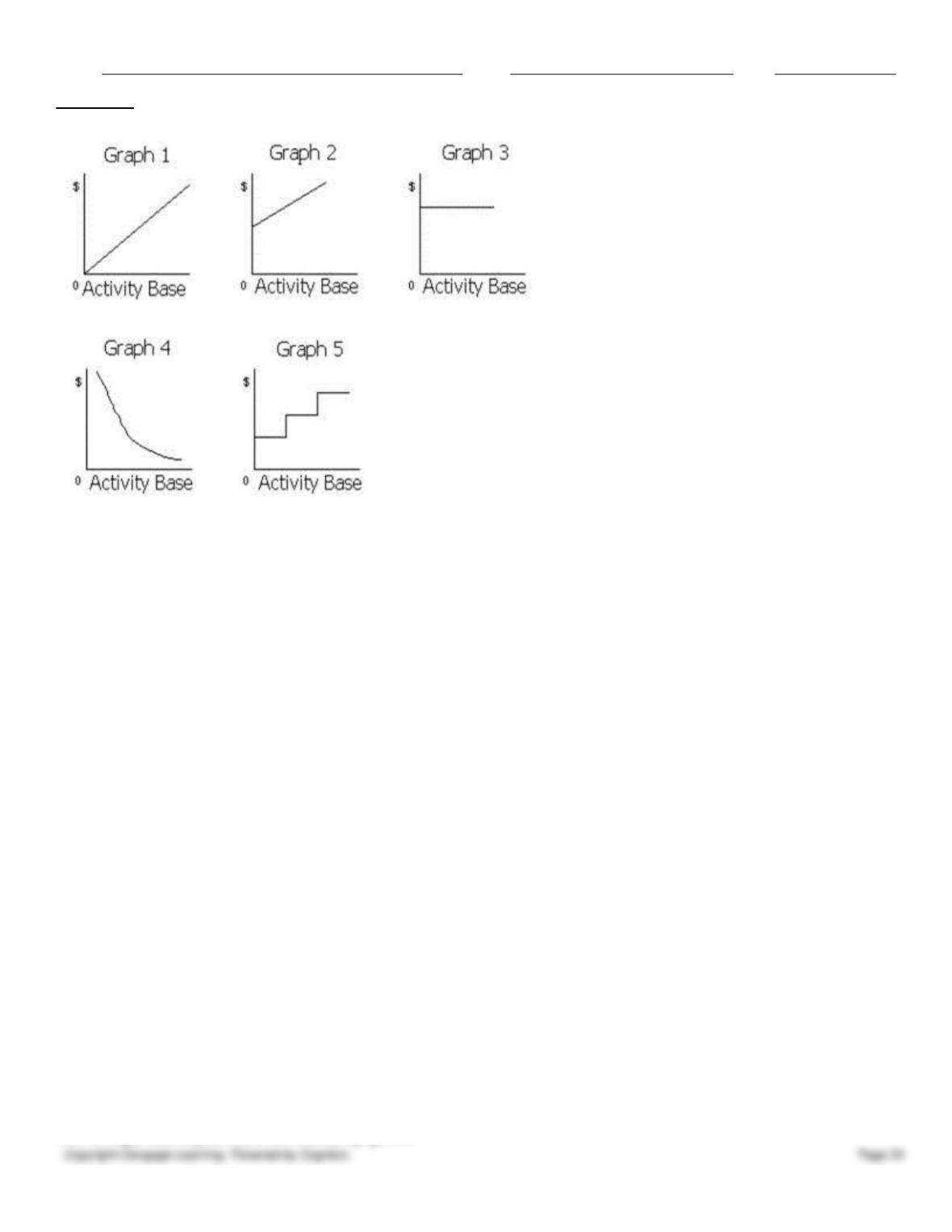
Name:
Class:
Date:
chapter 21
a.
Graph 1
b.
Graph 2
c.
Graph 3
d.
Graph 4
e.
Graph 5
191. Sales commissions of $6,000 plus $0.05 for each item sold
192. Rent on warehouse of $12,000 per month
193. Insurance costs of $2,500 per month
194. Per-unit cost of direct labor
195. Total employer pension costs of $0.35 per direct labor hour
196. Per-unit straight-line depreciation costs
197. Per-unit cost of direct materials
198. Total direct materials cost
199. Electricity costs of $5,000 per month plus $0.0004 per kilowatt-hour
200. Per-unit cost of plant superintendent’s salary
201. Salary of the night-time security guard of $3,800 per month
202. Total direct labor cost
203. Straight-line depreciation on factory equipment
Name:
Class:
Date:
chapter 21
Match each of the following descriptions with the term (a–e) it best describes.
a.
Profit-volume chart
b.
Cost-volume-profit chart
c.
Sales mix
d.
Operating leverage
e.
Margin of safety
204. Indicates the possible decrease in sales that may occur before operating loss results
205. Contribution margin divided by income from operations
206. Graphically shows costs, sales, and operating profit or loss at various levels of units sold
207. Plots only the difference between total sales and total costs
208. The relative distribution of sales among products sold by a company
209. Grant Company has sales of $300,000, and the break-even point in sales dollars is $225,000. Determine the
company’s margin of safety percentage.
210. For the current year ending April 30, Hal Company expects fixed costs of $60,000, a unit variable cost of $70, and
anticipated break-even of 1,715 sales units.
a.
Compute the unit sales price. Round answer to the nearest dollar.
b.
Compute the sales (units) required to realize a target profit of $8,000. Round intermediate
calculations and final answer to the nearest whole number.
211. Waterfall Company sells a product for $150 per unit. The variable cost is $80 per unit, and fixed costs are $270,000.
Determine the (a) break-even point in sales units and (b) break-even point in sales units if the company desires a target
profit of $36,000. Round answers to the nearest whole number.
212. Explain how variable costing income from operations will be different from absorption costing income from
operations under the following situations:
a. A company had no beginning or ending inventory. During the year, it produced and sold 10,000 units.
b. A company had no beginning inventory. During the year, it produced 10,000 units and sold 8,000 units.
c. A company had 2,000 units in beginning inventory. During the year, it produced 10,000 units and sold 12,000 units.
213. Swannanoa Company’s budgeted sales are $1,000,000, fixed costs are $350,000, and variable costs are $600,000
a. What is the budgeted contribution margin ratio?
b. If the contribution margin ratio is 30%, sales are $900,000, and fixed costs are $200,000, what is the income from
operations?
214. Douglas Company has a contribution margin ratio of 30%. If Douglas has $336,420 in fixed costs, what amount of
sales dollars will need to be generated in order for the company to break even?
215. Penny Company sells 25,000 units at $59 per unit. Variable costs are $29 per unit, and loss from operations is
Name:
Class:
Date:
chapter 21
$(50,000). Determine the (a) unit contribution margin (b) contribution margin ratio, and (c) fixed costs per unit at
production of 25,000 units. If required, round to two decimal places.
216. Consider the following information:
Variable cost per unit $5
July fixed cost per unit $7
Units sold and produced in July 28,000
What is the total estimated cost for August if 30,000 units are projected to be produced and sold?
217. Bobby Company has fixed costs of $160,000. The unit selling price, variable cost per unit, and contribution margin
per unit for the company’s two products are as follows:
Product
Selling Price per Unit
Variable Cost per Unit
Contribution Margin
per Unit
X
$180
$100
$80
Y
100
60
40
The sales mix for products X and Y is 60% and 40%, respectively. Determine the break-even point in units of X and Y.
218. Perfect Stampers makes and sells aftermarket hubcaps. The variable cost for each hubcap is $4.75, and the hubcap
sells for $9.95. Perfect Stampers has fixed costs per month of $3,120. Compute the contribution margin per unit and the
break-even point in sales units and in sales dollars for the month.
219. Louis Company sells a single product at a price of $65 per unit. Variable costs per unit are $45, and total fixed costs
are $625,500. Louis is considering the purchase of a new piece of equipment that would increase the fixed costs to
$800,000, but decrease the variable costs per unit to $42. If Louis Company expects to sell 44,000 units next year, should
it purchase this new equipment?
220. Bluegill Company sells 45,000 units at $18 per unit. Fixed costs are $62,000, and income from operations is
$298,000. Determine the (a) variable cost per unit, (b) unit contribution margin, and (c) contribution margin ratio.
221. For the current year ending January 31, Harp Company expects fixed costs of $188,500 and a unit variable cost of
$51.50. For the coming year, a new wage contract will increase the unit variable cost to $55.50. The selling price of
$70.00 per unit is expected to remain the same.
a.
Compute the break-even point in sales units for the current year. Round answer to the
nearest whole number.
b.
Compute the anticipated break-even point in sales units for the coming year, assuming the
new wage contract is signed.
222. A business had a margin of safety ratio of 20%, variable costs of 75% of sales, fixed costs of $240,000, a break-even
point of $960,000, and income from operations of $60,000 for the current year. Compute the current year’s sales.
223. Atlantic Company sells a product with a break-even point of 3,000 sales units. The variable cost is $60 per unit, and
fixed costs are $270,000. Determine the (a) unit sales price and (b) break-even point in sales units if the company desires a
target profit of $36,000.
224. If a business had a capacity of $10,000,000 of sales, actual sales of $6,000,000, break-even sales of $4,200,000, fixed
costs of $1,800,000, and variable costs of 60% of sales, what is the margin of safety expressed as a percentage of sales?
225. Gladstorm Enterprises sells a product for $60 per unit. The variable cost is $20 per unit, while fixed costs are
Name:
Class:
Date:
chapter 21
$85,000. Determine the (a) break-even point in sales units and (b) break-even point in sales units if the selling price
increased to $80 per unit. Round answers to the nearest whole number.
226. Define operating leverage. Explain the relationship between a company’s operating leverage and how a change in
sales is expected to impact profits.
227. Silver River Company sells products S and T and has made the following estimates for the coming year:
Product
Unit Selling Price
Unit Variable Cost
Sales Mix
S
$30
$24
60%
T
70
56
40
Fixed costs are estimated at $202,400. Determine (a) the estimated sales in units of the overall product necessary to reach
the break-even point for the coming year, (b) the estimated number of units of each product necessary to be sold to reach
the break-even point for the coming year, and (c) the estimated sales in units of the overall product necessary to realize a
target profit of $119,600 for the coming year.
228. Consider the following:
Variable cost as a percentage of sales 60%
Unit variable cost $30
Fixed costs $200,000
What is the break-even point in sales units?
229. For the past year, Pedi Company had fixed costs of $70,000, unit variable costs of $32, and a unit selling price of
$40. For the coming year, no changes are expected in revenues and costs, except that property taxes are expected to
increase by $10,000. Determine the break-even point in sales units for (a) the past year and (b) the coming year.
230. Racer Industries sells a product for $250 per unit. The variable cost is $130 per unit, and fixed costs are $900,000.
a. How many units must Racer sell in order to break even?
b. How many units must Racer sell in order to earn a profit of $480,000?
c. A new employee suggests that Racer Industries sponsor a 10K marathon as a form of advertising. The cost to
sponsor the event is $7,200. How many more units must be sold to cover this cost?
231. Safari Co. sells two products, orks and zins. Last year, Safari sold 21,000 units of orks and 14,000 units of zins.
Related data are as follows:
Product
Unit Selling
Price
Unit Variable
Cost
Unit Contribution
Margin
Orks
$120
$80
$40
Zins
80
60
20
Compute the following:
a. Safari Co.’s sales mix
b. Safari Co.’s unit selling price of E
c. Safari Co.’s unit contribution margin of E
d. Safari Co.’s break-even point in sales units assuming that last year’s fixed costs were $160,000
232. Dean Company has sales of $500,000, and the break-even point in sales dollars is $300,000. Determine the
company’s margin of safety percentage.
Name:
Class:
Date:
chapter 21
233. Mia Enterprises sells a product for $90 per unit. The variable cost is $40 per unit, while fixed costs are $75,000.
Determine the (a) break-even point in sales units and (b) break-even point in sales units if the selling price increased to
$100 per unit.
234. The following data are available from the accounting records of Willow Creek Co. for the month ended May 31.
During the accounting period, 17,000 units were manufactured and sold at a price of $60 per unit. There were no
beginning inventories, and all units were completed (no work in process).
Cost
Total Cost
Number of Units
Unit Cost
Manufacturing costs:
Variable
$442,000
17,000
$26
Fixed
170,000
17,000
10
Total
$612,000
$36
Selling and administrative expenses:
Variable ($2 per unit sold)
$34,000
Fixed
32,000
Total
$66,000
a.
Prepare a variable costing income statement.
b.
Prepare an absorption costing income statement.
235. Copper Hill Inc. manufactures laser printers within a relevant range of production of 70,000 to 100,000 printers per
year. The following partially completed manufacturing cost schedule has been prepared:
Number of Printers Produced
70,000
90,000
100,000
Total costs:
Total variable costs
$350,000
(d)
(j)
Total fixed costs
630,000
(e)
(k)
Total costs
$980,000
(f)
(l)
Cost per unit:
Variable cost per unit
(a)
(g)
(m)
Fixed cost per unit
(b)
(h)
(n)
Total cost per unit
(c)
(i)
(o)
Complete the preceding cost schedule, identifying each cost by the appropriate letter (a–o).
236. For the coming year, River Company estimates fixed costs at $109,000, the unit variable cost at $21, and the unit
selling price at $85. Determine (a) the break-even point in sales units, (b) the unit sales required to realize a target profit of
$150,000, and (c) the expected income from operations if sales total $500,000. Round units to the nearest whole number
and percentage to one decimal place.
237. The manufacturing cost of Carrie Industries for the first 3 months of the year are provided as follows:
Total Cost
Production
January
$ 91,500
2,300 units
February
115,500
3,100
March
79,500
1,900
Using the high-low method, determine the (a) variable cost per unit and (b) the total fixed cost. If required, round answer
to the nearest cent.
Name:
Class:
Date:
chapter 21
238. A company has a margin of safety of 25%, a contribution margin ratio of 30%, and sales of $1,000,000.
a.
What is the break-even point in sales dollars?
b.
What is the income from operations?
c.
If neither the relationship between variable costs and sales nor the amount of fixed costs is
expected to change in the next year, how much additional income from operations can be
earned by increasing sales by $110,000?
239. A company with a break-even point at $900,000 in sales revenue had fixed costs of $225,000. When actual sales
were $1,000,000, variable costs were $750,000. Determine (a) the margin of safety expressed in dollars, (b) the margin of
safety expressed as a percentage of sales, (c) the contribution margin ratio, and (d) the income from operations.
240. Klein Company reports the following data:
Sales
$980,000
Variable costs
500,000
Fixed costs
350,000
Determine Klein Company’s operating leverage. Round answer to two decimal places.
241. Blane Company has the following data:
Total sales
$800,000
Total variable costs
$300,000
Fixed costs
$200,000
Units sold
50,000 units
What will income from operations be if units sold double to 100,000 units?
242. Steven Company has fixed costs of $160,000. The unit selling price, variable cost per unit, and contribution margin
per unit for the company’s two products are as follows:
Product
Selling Price per Unit
Variable Cost per Unit
Contribution Margin
per Unit
X
$180
$80
$100
Y
100
50
50
The sales mix for products X and Y is 60% and 40%, respectively. Determine the break-even point in units of X and Y.
243. Tom Company reports the following data:
Sales
$600,000
Variable costs
400,000
Fixed costs
100,000
Determine Tom Company’s operating leverage.
244. Currently, the unit selling price is $50, the variable cost is $34, and the total fixed costs are $108,000. A proposal is
being evaluated to increase the selling price to $54.
a.
Compute the current break-even point in sales units.
b.
Compute the anticipated break-even point in sales units, assuming that the unit selling price
is increased and all costs remain constant.
Name:
Class:
Date:
chapter 21
245. Cordell, Inc., has an operating leverage of 3. Sales are expected to increase by 9% next year. What is the expected
change in income from operations next year?
246. Roller Paint Co. reported the following data for the month of September. There were no beginning inventories and all
units were completed (no work in process).
Total Cost
Number
of Units
Unit Cost
Manufacturing costs:
Variable
$465,000
30,000
$15.50
Fixed
210,000
30,000
7.00
Total
$675,000
$22.50
Selling and administrative expenses:
Variable
$2.00 per unit sold
Fixed
$39,000
In the month of September, 28,000 of the 30,000 units manufactured were sold at a price of $80.00 per unit.
a.
Prepare a variable costing income statement.
b.
Prepare an absorption costing income statement.
c.
Briefly explain why there is a difference in income from operations between the two
methods.
247. Trail Bikes, Inc., sells three Deluxe bikes for every seven Standard bikes. The Deluxe bike sells for $1,800 and has
variable costs of $1,200. The Standard bike sells for $600 and has variable costs of $200.
a. If Trail Bikes has fixed costs that total $1,702,000, how many bikes must be sold in order for the company to
break even?
b. How many of these bikes will be Deluxe bikes, and how many will be Standard bikes?
248. Carrolton, Inc., currently sells widgets for $80 per unit. The variable cost is $30 per unit, and total fixed costs equal
$240,000 per year. Sales are currently 20,000 units annually. The company is considering a 20% drop in selling price that
it believes will raise units sold by 20%. Assuming all costs stay the same, what is the impact on income if this change is
made?
249. Global Publishers has collected the following data for recent months:
Month Issues Published Total Cost
March 20,500 $21,190
April 21,800 22,464
May 17,750 18,495
June 21,200 21,876
a. Using the high-low method, find the variable cost per unit and total fixed costs. If required, round answers to the nearest
cent.
b. What is the estimated cost for a month in which 19,000 issues are published?
250. For the past year, Iris Company had fixed costs of $6,708,000, a unit variable cost of $444, and a unit selling price of
$600. For the coming year, no changes are expected in revenues and costs, except that a new wage contract will increase
variable costs by $6 per unit. Determine the break-even point in sales units for (a) the past year and (b) the coming year.
251. The manufacturing costs of Mocha Industries for 3 months of the year are as follows:
Name:
Class:
Date:
chapter 21
Total Cost
Production
April
$ 63,100
1,100 units
May
80,740
1,800
June
100,900
2,600
Using the high-low method, determine the (a) variable cost per unit and (b) the total fixed costs. If required, round answer
to the nearest cent.
Name:
Class:
Date:
chapter 21
Answer Key
Name:
Class:
Date:
chapter 21
Name:
Class:
Date:
chapter 21
Name:
Class:
Date:
chapter 21
Name:
Class:
Date:
chapter 21
Name:
Class:
Date:
chapter 21
Name:
Class:
Date:
chapter 21
Name:
Class:
Date:
chapter 21
Name:
Class:
Date:
chapter 21
Name:
Class:
Date:
chapter 21
Name:
Class:
Date:
chapter 21
Name:
Class:
Date:
chapter 21
Name:
Class:
Date:
chapter 21
Name:
Class:
Date:
chapter 21
Name:
Class:
Date:
chapter 21