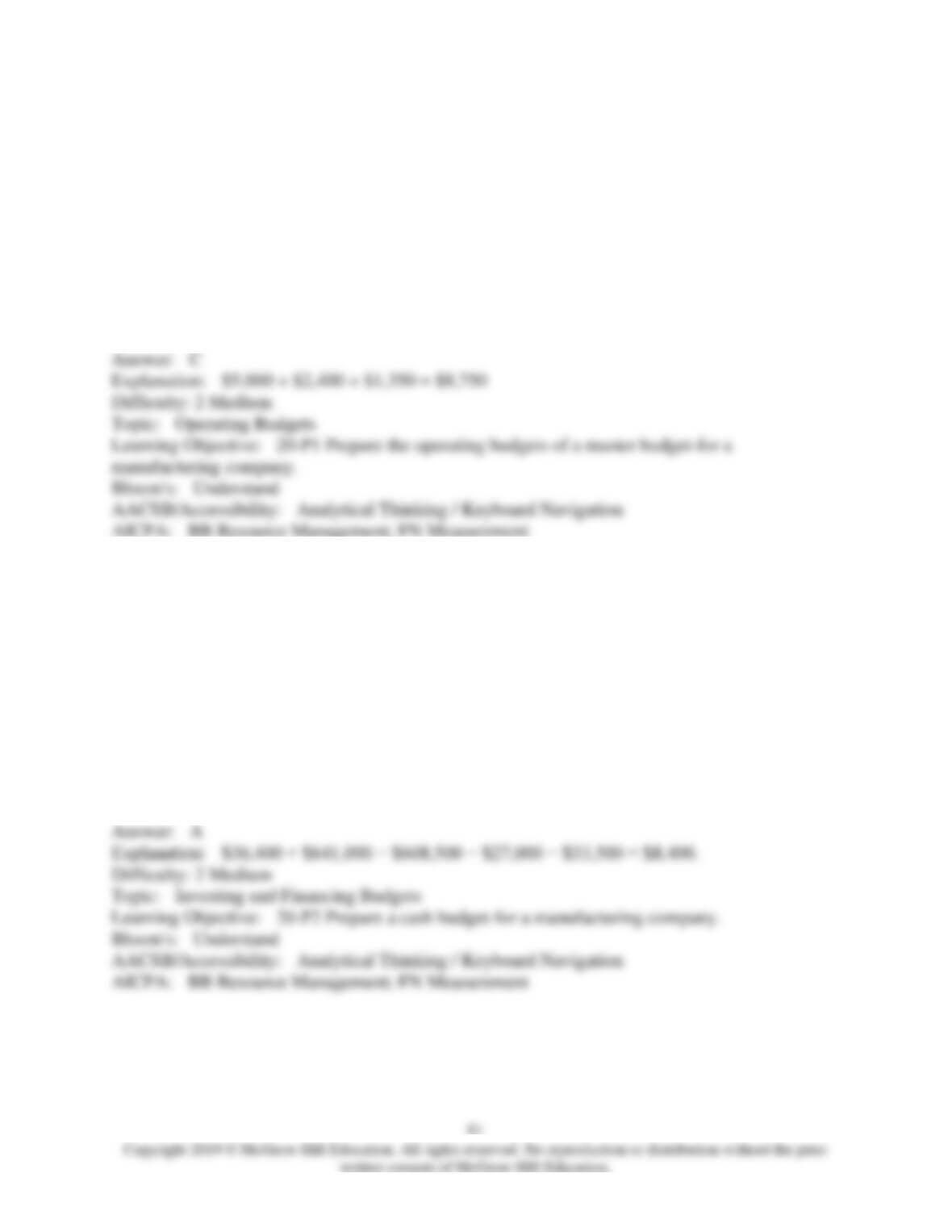
160) Webster Corporation’s monthly projected general and administrative expenses include
$5,000 administrative salaries, $2,400 of other cash administrative expenses, $1,350 of
depreciation expense on the administrative equipment, and 0.5% monthly interest on an
outstanding bank loan of $10,000. Compute the total budgeted general and administrative
expenses budget per month.
A) $17,400.
B) $7,400.
C) $8,750.
D) $5,050.
E) $8,800.
161) Webster Corporation is preparing its cash budget for April. The March 31 cash balance is
$36,400. Cash receipts are expected to be $641,000 and cash payments for purchases are
expected to be $608,500. Other cash expenses expected are $27,000 selling and $33,500 general
and administrative. The company desires a minimum cash balance at the end of each month of
$30,000. If necessary, the company borrows enough cash to meet the minimum using a short-
term note. Webster’s preliminary cash balance before loan activity for April is expected to be:
A) $8,400.
B) $21,600.
C) $30,000.
D) ($28,000).
E) $68,900.
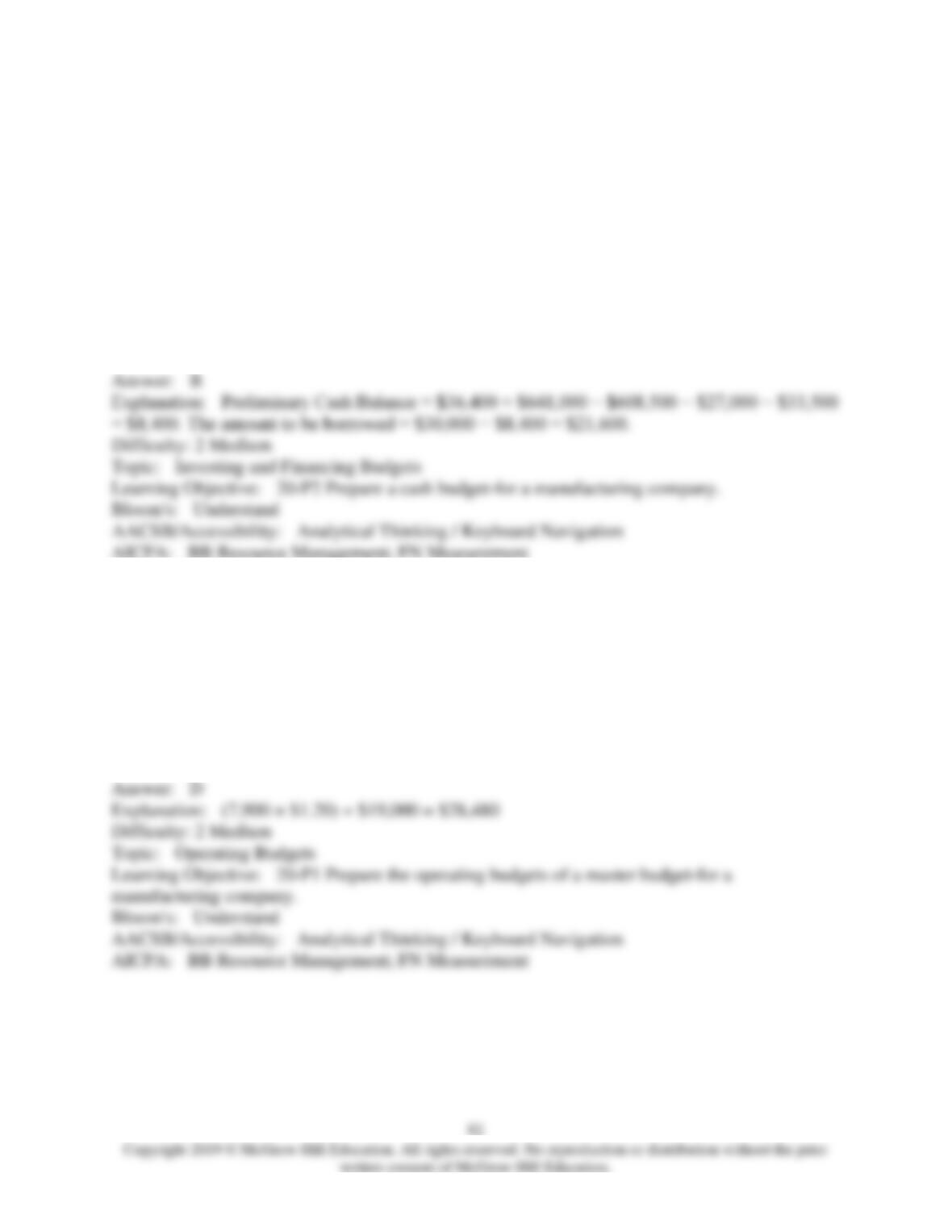
162) Webster Corporation is preparing its cash budget for April. The March 31 cash balance is
$36,400. Cash receipts are expected to be $641,000 and cash payments for purchases are
expected to be $608,500. Other cash expenses expected are $27,000 selling and $33,500 general
and administrative. The company desires a minimum cash balance at the end of each month of
$30,000. If necessary, the company borrows enough cash to meet the minimum using a short-
term note. The amount Webster must borrow during April is:
A) $0.
B) $21,600.
C) $8,400.
D) $98,900.
E) $58,000.
163) Flagstaff Company has budgeted July production of 7,900 units. Variable factory overhead
is $1.20 per unit. Budgeted fixed factory overhead is $19,000, which includes $3,000 of factory
equipment depreciation. Compute the total budgeted overhead for July.
A) $25,480.
B) $19,000.
C) $23,900.
D) $28,480.
E) $9,480.
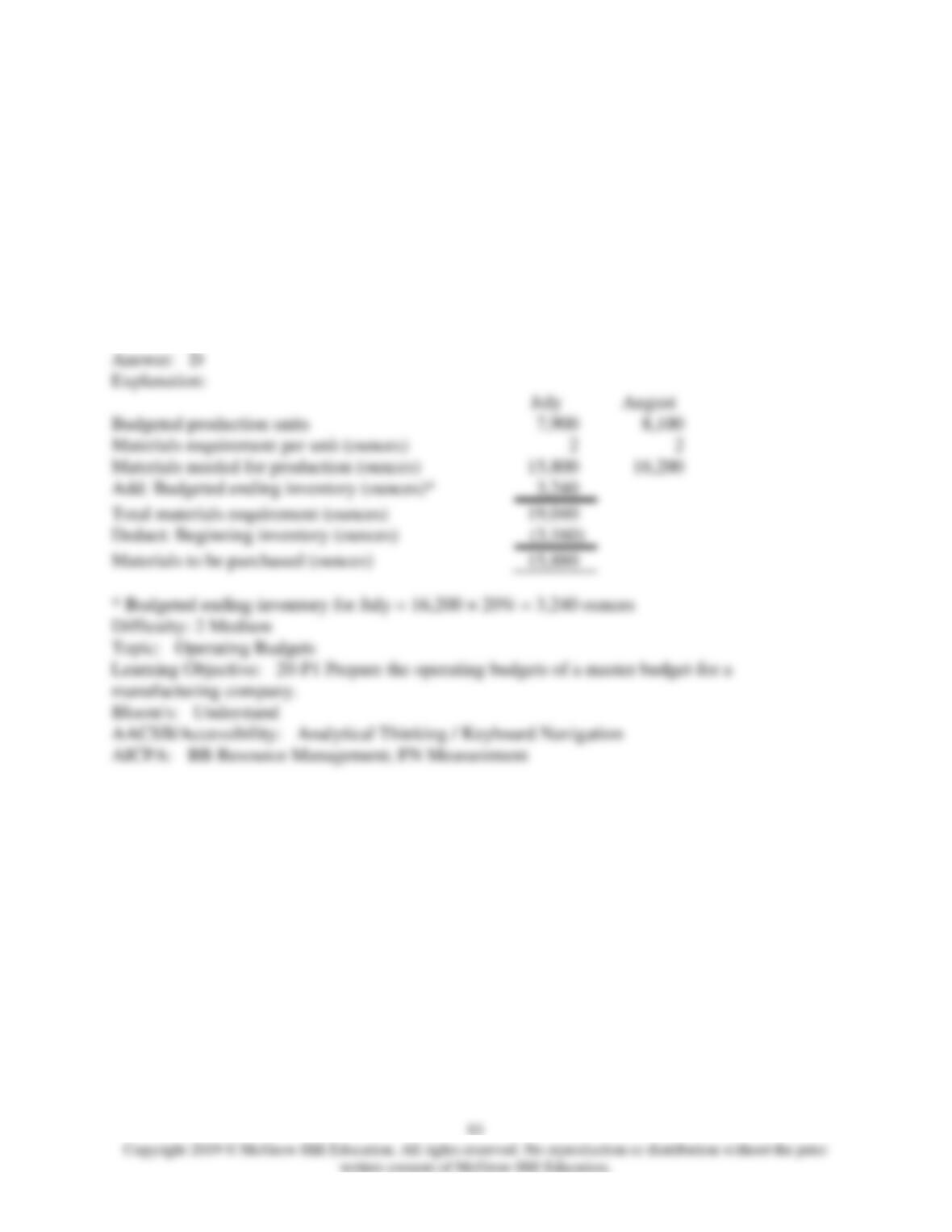
164) Flagstaff Company has budgeted production units of 7,900 for July and 8,100 for August.
The direct materials requirement per unit is 2 ounces (oz.). The company requires to have safety
stock of direct materials on hand at the end of each month to complete 20% of the units of
budgeted production in the following month. There was 3,160 ounces of direct material in
inventory at the start of July. The total ounces of direct materials to be purchased in July is:
A) 15,800 oz.
B) 16,200 oz.
C) 19,040 oz.
D) 15,880 oz.
E) 15,720 oz.
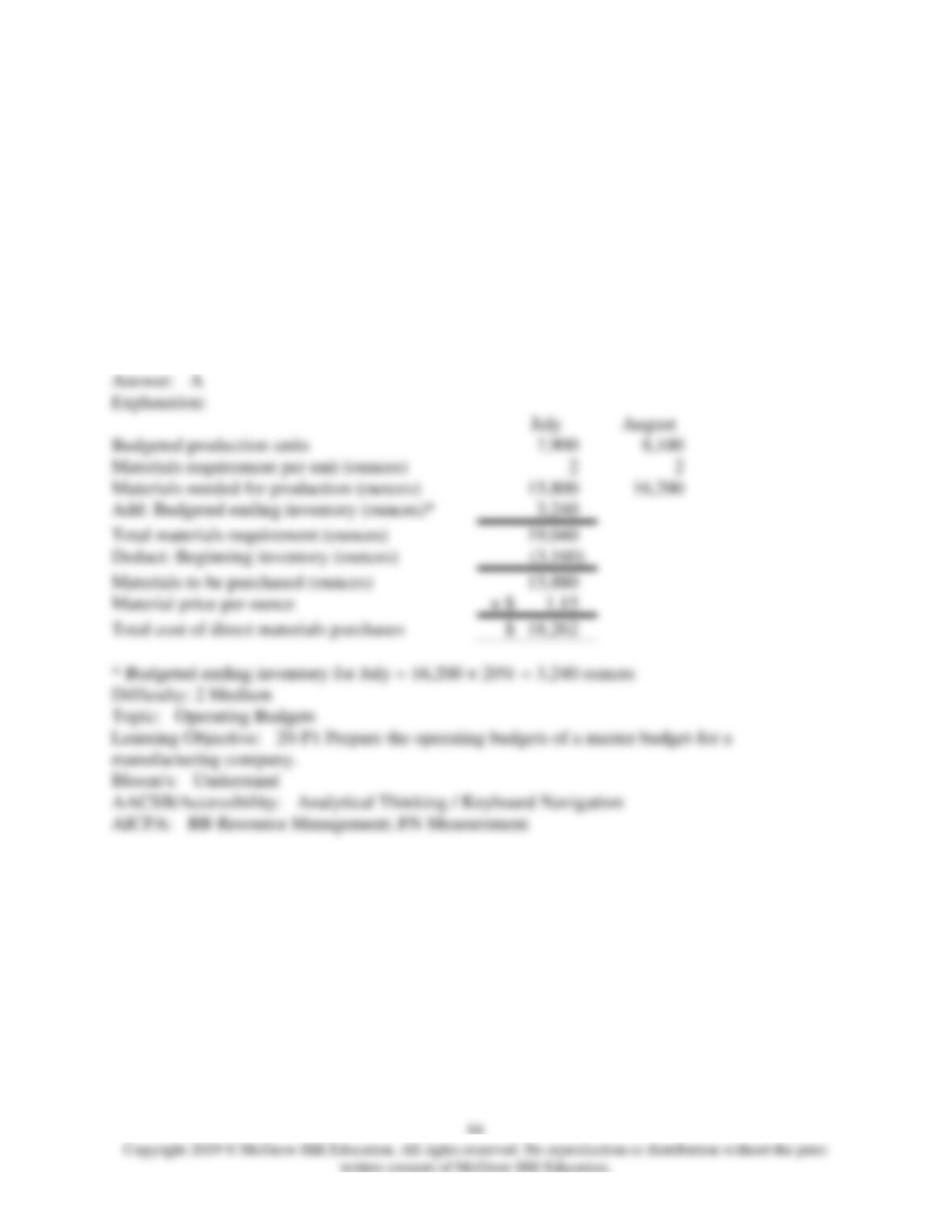
165) Flagstaff Company has budgeted production units of 7,900 for July and 8,100 for August.
The direct materials requirement per unit is 2 ounces (oz.). The company has determined that it
wants to have safety stock of direct materials on hand at the end of each month to complete 20%
of the units of budgeted production in the following month. There was 3,160 ounces of direct
material in inventory at the start of July. The total cost of direct materials purchases for the July
direct materials budget, assuming the materials cost $1.15 per ounce, is:
A) $18,262.
B) $21,896.
C) $14,536.
D) $18,078.
E) $18,170.
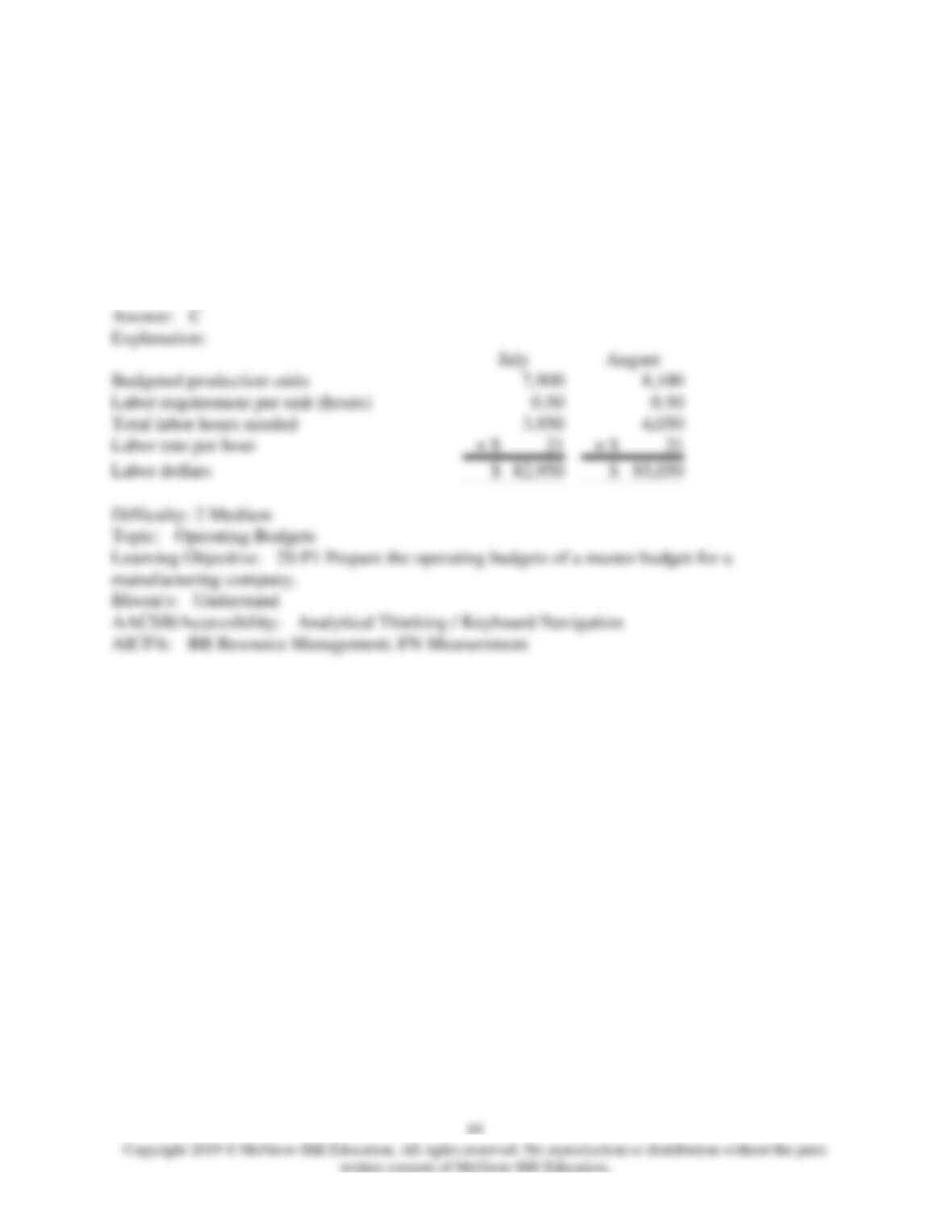
166) Flagstaff Company has budgeted production units of 7,900 for July and 8,100 for August.
The direct labor requirement per unit is 0.50 hours. Labor is paid at the rate of $21 per hour. The
total cost of direct labor budgeted for the month of August is:
A) $82,950.
B) $4,050.
C) $85,050.
D) $3,950.
E) $168,000.
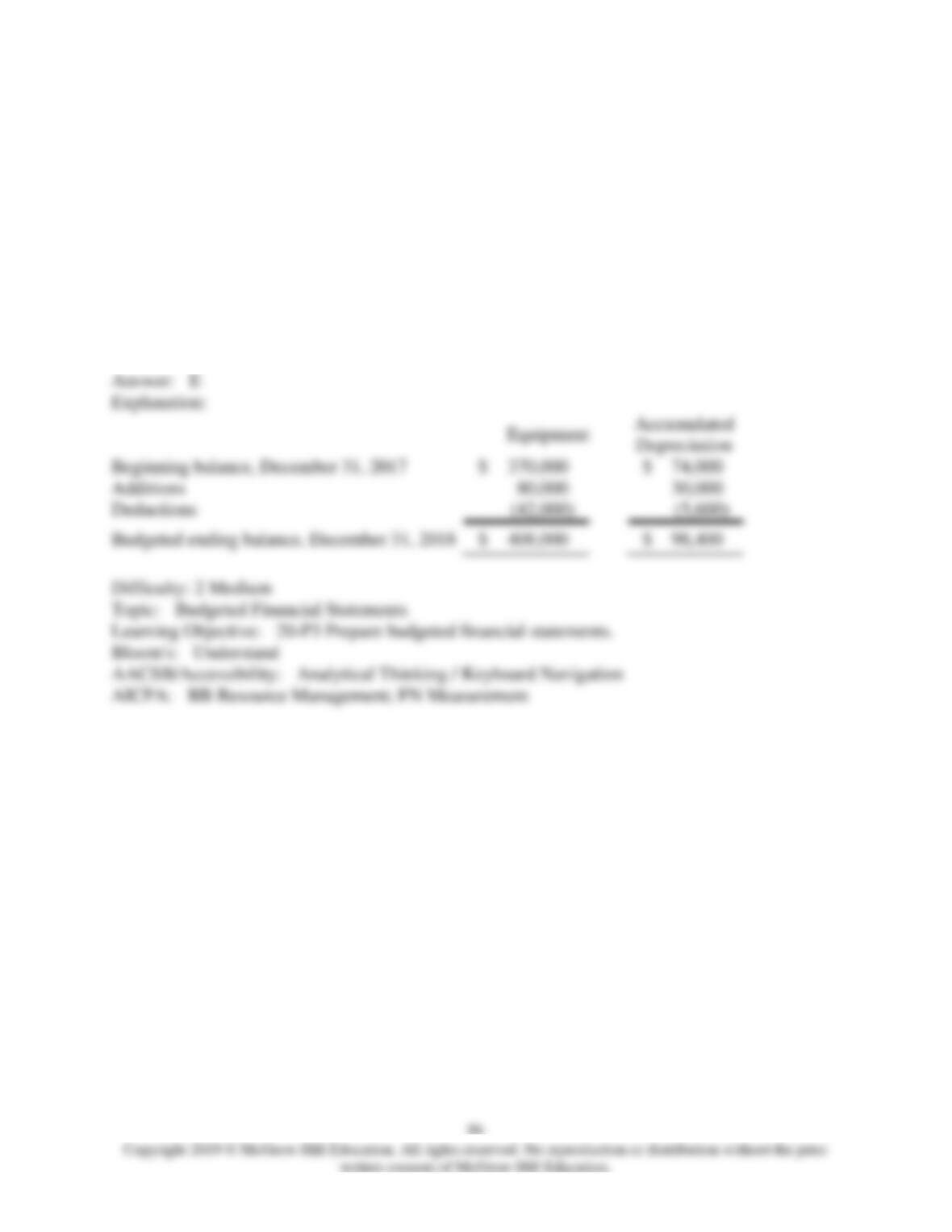
167) On its December 31, 2017, balance sheet, Calgary Industries reports equipment of $370,000
and accumulated depreciation of $74,000. During 2018, the company plans to purchase
additional equipment costing $80,000 and expects depreciation expense of $30,000.
Additionally, it plans to dispose of equipment that originally cost $42,000 and had accumulated
depreciation of $5,600. The balances for equipment and accumulated depreciation, respectively,
on the December 31, 2018 budgeted balance sheet are:
A) $328,000; $74,000.
B) $450,000; $98,400.
C) $450,000; $104,000.
D) $408,000; $104,000.
E) $408,000; $98,400.
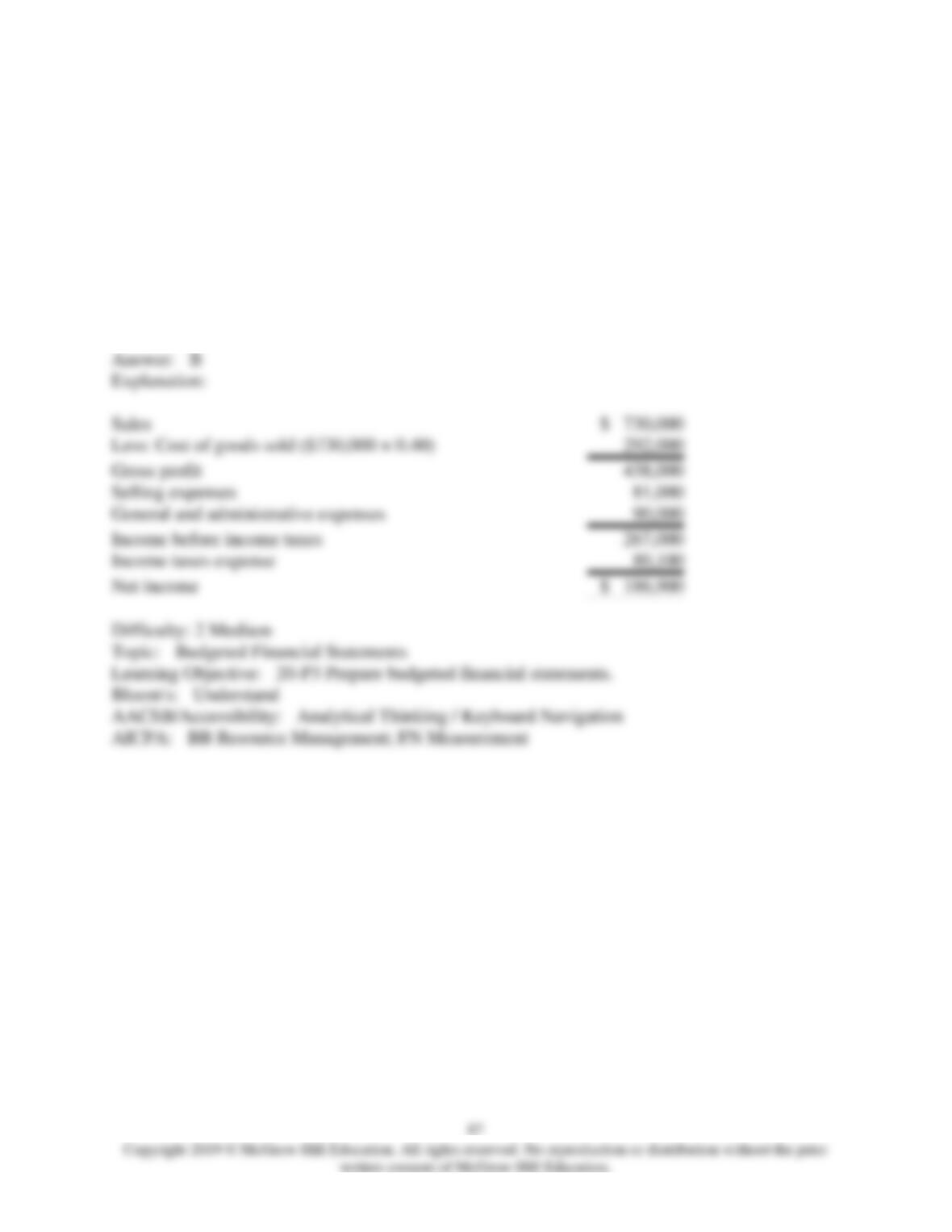
168) Calgary Industries is preparing a budgeted income statement for 2018. Predicted sales for
the year are $730,000 and cost of goods sold is 40% of sales. The expected selling expenses are
$81,000 and the expected general and administrative expenses are $90,000, which includes
$23,000 of depreciation. The company’s income tax rate is 30%. The budgeted net income for
2018 is:
A) $438,000.
B) $186,900.
C) $267,000.
D) $84,700.
E) $80,100.
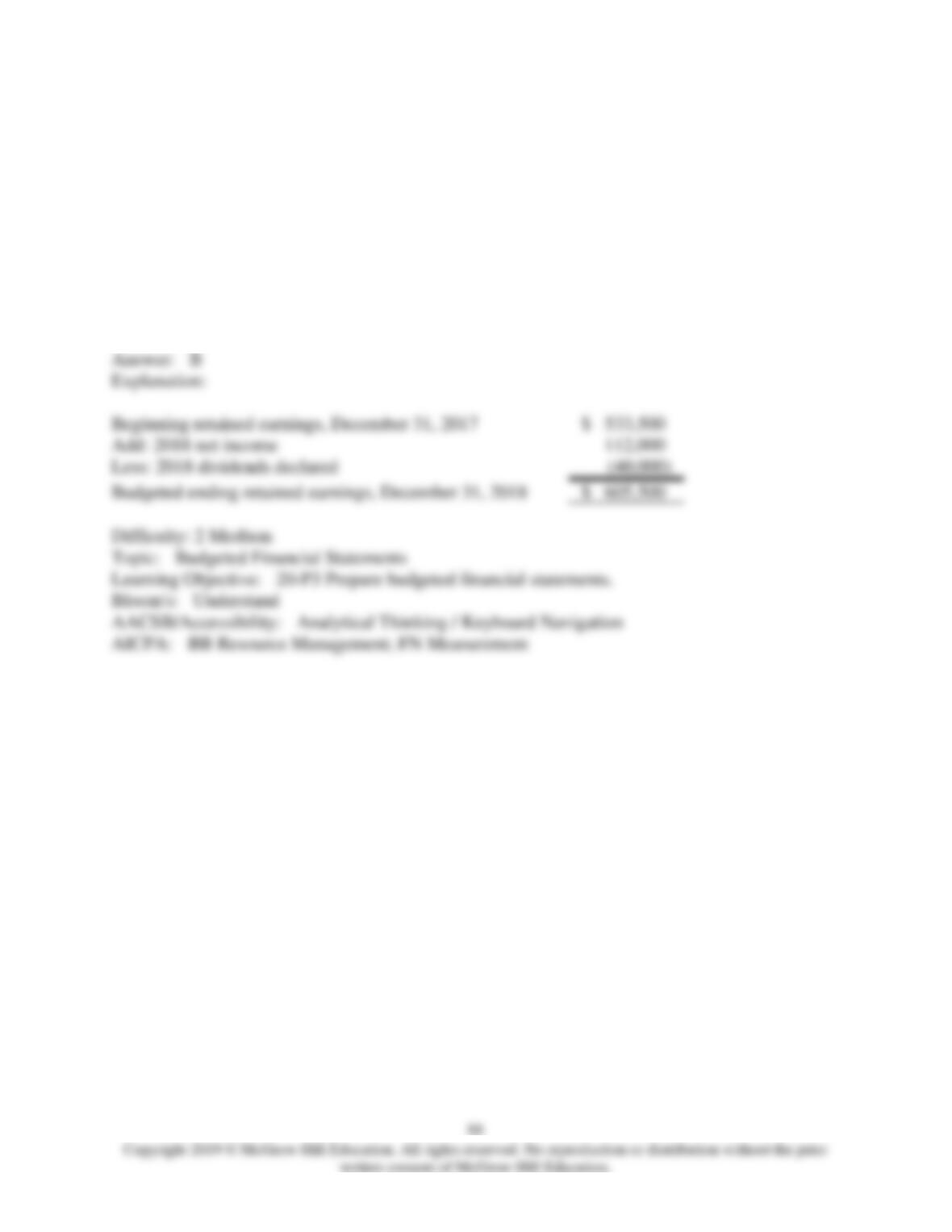
169) Grason Corporation is preparing a budgeted balance sheet for 2018. The retained earnings
balance at December 31, 2017 was $533,500. The 2018 budgeted income statement shows
expected net income of $112,000. The company expects to declare dividends during 2018
amounting to $40,000. The expected balance in retained earnings on the 2018 budgeted balance
sheet is:
A) $533,500.
B) $605,500.
C) $645,500.
D) $493,500.
E) $685,500.
170) Match the definitions 1 through 9 with the correct term or phrase (a) through (i).
(a) Master budget
(b) General and administrative expense budget
(c) Budget
(d) Safety stock
(e) Budgeted income statement
(f) Budgeted balance sheet
(g) Sales budget
(h) Cash budget
(i) Merchandise purchases budget
______(1) A plan that shows the units and dollars of merchandise to be purchased during the
budget period.
______(2) A managerial accounting report that shows predicted amounts of the company’s
assets, liabilities, and balances as of the end of the budget period.
______(3) A plan that shows the expected sales units and the dollars from these sales.
______(4) A managerial accounting report that shows predicted amounts of sales and expenses
for the budget period.
______(5) A quantity of inventory that provides protection against lost sales caused by
unfulfilled demand from customers or delays in shipments from suppliers.
______(6) A formal, comprehensive plan for a company’s future that includes several individual
budgets that are linked with each other to form a coordinated plan.
______(7) A formal statement of a company’s future plans, usually expressed in monetary terms.
______(8) A plan that plans the predicted operating expenses not included in the selling
expenses or manufacturing budgets.
______(9) A plan that shows the expected cash inflows and cash outflows during the budget
period.
171) Presented below are terms or phrases preceded by letters (a) through (j) and followed by a
list of definitions 1 through 10. Match the correct definitions with the terms or phrases by
placing the letter of the term or phrase in the answer space provided at the beginning of the
definition.
(a) Budget
(b) Capital expenditures budget
(c) Activity-based budgeting
(d) Sales budget
(e) Production budget
(f) Cash budget
(g) Budgeted balance sheet
(h) Continuous budgeting
(i) Selling expense budget
(j) Rolling budgets
_____ (1) A plan that lists the types and amounts of selling expenses expected during the budget
period.
_____ (2) A plan that shows expected activities and their levels for the budget period used to
estimate resources required to perform the activities.
_____ (3) A managerial accounting report that presents predicted amounts of the company’s
assets, liabilities, and equity as of the end of the budget period.
_____ (4) A formal statement of future plans, usually expressed in monetary terms.
_____ (5) A plan showing the expected sales units and dollars from the sales; the starting point
in the budgeting process.
_____ (6) A plan that lists dollar amounts estimated to be received from disposing of plant assets
and spent on purchasing additional plant assets to carry out the budgeted business activities.
______(7) The practice of revising budgets as time passes.
______(8) A plan showing the number of units to be produced each period, based on the units
projected in the sales budget, along with inventory considerations.
______ 9) A plan that shows the expected cash inflows and outflows during the budget period,
including receipts from loans needed to maintain a minimum cash balance and repayments of
such loans.
______(10) Additional monthly or quarterly budgets to replace the ones that have lapsed as each
budget period goes by.
172) Describe at least five benefits of budgeting.
173) List the three important guidelines that should be followed in the budgeting process.
174) What are rolling budgets? Why are rolling budgets prepared?
175) Briefly describe the process by which budgets are developed and administered.
176) Briefly describe a master budget and the sequence in which the individual budgets within
the master budget are prepared.
177) What is activity-based budgeting?
178) Why is the sales budget usually prepared first?
179) What is a sales budget? How is the sales budget prepared?
180) What is a merchandise purchases budget? How is the merchandise purchases budget
prepared?
181) What is a capital expenditures budget?
182) What is a cash budget? How can management use a cash budget?
183) What is a production budget?
184) A department store has budgeted cost of goods sold for March of $60,000 for its women’s
shorts. Management wants to have $12,000 of shorts in inventory at the end of the month to
prepare for the summer season. Beginning inventory in March was $8,000. What dollar amount
of shorts should be purchased to meet the above plans?
185) A sporting goods store budgeted August purchases of ski jackets at $140,000. The store had
ski jackets costing $12,000 in its inventory at the beginning of August; and to cover part of
anticipated September sales, they expect to have $25,000 of ski jackets in inventory at the end of
the month of August. What is the budgeted cost of goods sold for August?
186) In preparing a budget for the last three months of the current year, Cozy Company is
planning the units of merchandise it must order each month. The company’s policy is to have
15% of the next month’s sales in its inventory at the end of each month. Projected sales for
October, November, and December are 27,000 units, 29,500 units, and 31,000 units,
respectively. How many units must be ordered in November?
187) Dado, Inc. is preparing its budget for the second quarter. The following unit sales are
forecasted:
April May June July August
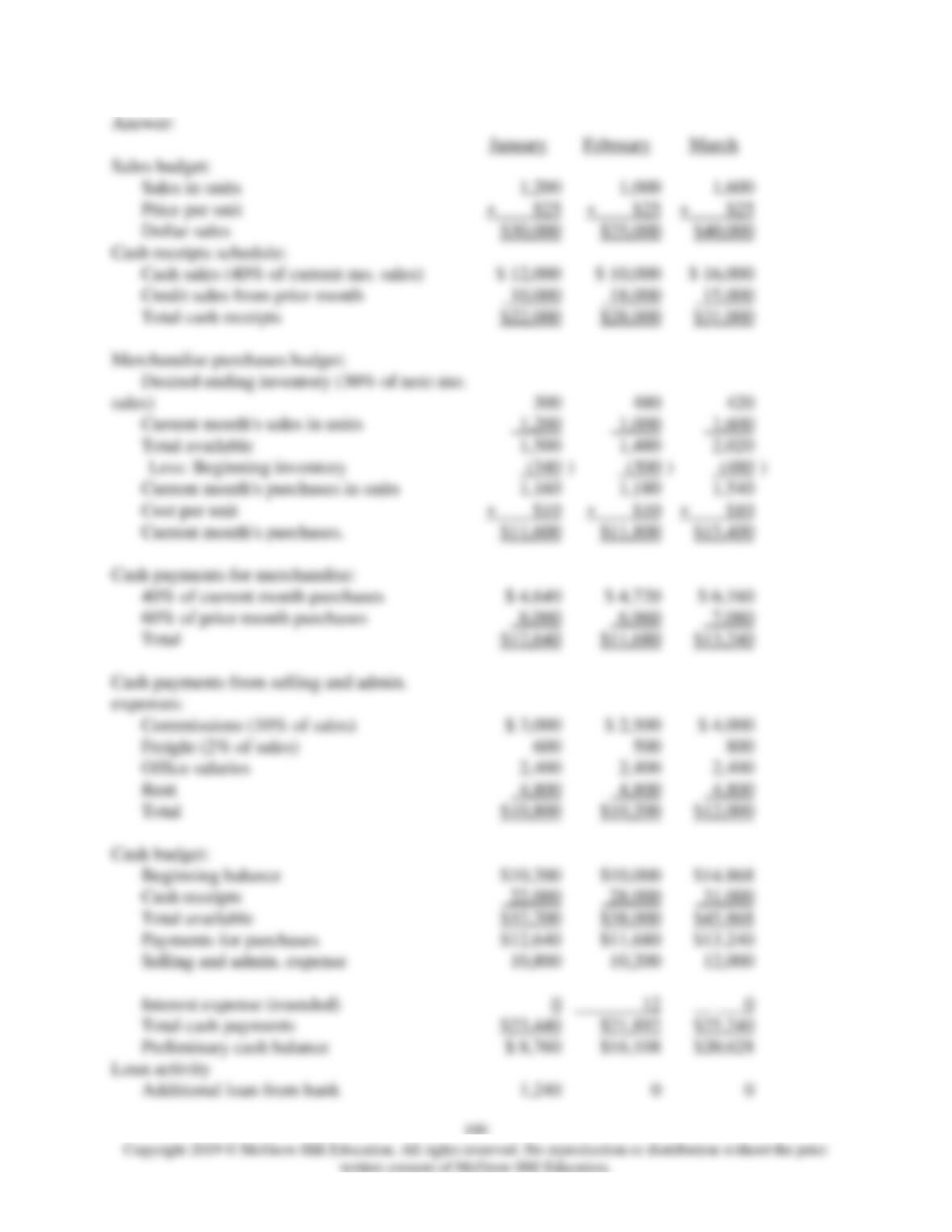
Unit sales……………………… 640 720 780 620 660
Additional information follows:
Inventory on March 31: 192 Units
Desired ending inventory each month: 30% of next month’s sales
Prepare a merchandise purchases budget for the total units to be purchased in each of the months
of April, May, and June, as well as the total unit purchases for the entire quarter.
188) Greco Company has prepared the following forecasts of monthly unit sales:
July August September October
Sales (in units)………………… 4,500 5,300 4,000 3,700
Greco wants the number of units in its inventory at the end of each month to equal 25% of the
next month’s sales. The budgeted cost per unit is $30.
(1) How many units should be in July’s beginning inventory?
(2) What amount should be budgeted for the cost of merchandise purchases in July?

99
189) Hammerly Corporation is preparing its master budget for the quarter ending March 31. It
sells a single product for $25 a unit. Budgeted sales are 40% cash and 60% on credit. All credit
sales are collected in the month following the sales. Budgeted unit sales for the next four months
follow:
January
February
March
April
Sales in units ……………….
1,200
1,000
1,600
1,400
At December 31, the balance in accounts receivable is $10,000, which represents the uncollected
portion of December sales. The company desires merchandise inventory equal to 30% of the next
month’s sales in units. The December 31 balance of merchandise inventory is 340 units, and
inventory cost is $10 per unit. 40% of purchases are paid in the month of purchase and 60% are
paid in the following month. At December 31, the balance of Accounts Payable is $8,000, which
represents the unpaid portion of December’s purchases.
Operating expenses are paid in the month incurred and consist of:
· Sales commissions (10% of sales)
· Freight (2% of sales)
· Office salaries ($2,400 per month)
· Rent ($4,800 per month)
Depreciation expense is $4,000 per month. The income tax rate is 40%, and income taxes will be
paid on April 1. A minimum cash balance of $10,000 is required, and the cash balance at
December 31 is $10,200. Loans are obtained at the end of a month in which a cash shortage
occurs. Interest is 1% per month, based on the beginning of the month loan balance, and must be
paid each month (The interest payment is rounded to the nearest whole dollar). If the ending cash
balance exceeds the minimum, the excess will be applied to repaying any outstanding loan
balance. At December 31, the loan balance is $0.
Prepare a master budget (round all dollar amounts to the nearest whole dollar) for each of the
months of January, February, and March that includes the:
· Sales budget
· Schedule of cash receipts
· Merchandise purchases budget
· Schedule of cash payments for merchandise purchases
· Schedule of cash payments for selling and administrative expenses (combined)
· Cash budget, including information on the loan balance
· Budgeted income statement for the quarter