67) Which of the following budgets is not an operating budget?
A) Sales budget.
B) Cash budget.
C) General and administrative expense budget.
D) Selling expenses budget.
E) Production budget.
68) A budget system based on expected activities and their levels that enables management to
plan for resources required to perform the activities is:
A) Traditional budgeting.
B) Management budgeting.
C) Master budgeting.
D) Activity-based budgeting.
E) Cash budgeting.
69) A budget that plans the types and amounts of operating expenses expected that are not
included in the selling expenses or manufacturing budget is a:
A) General and administrative expense budget.
B) Sales budget.
C) Cash payments budget.
D) Overhead budget.
E) Selling expense budget.
70) Cameroon Corp. manufactures and sells electric staplers for $16 each. If 10,000 units were
sold in December, and management forecasts 4% growth in sales each month, the dollar amount
of electric stapler sales budgeted for February should be:
A) $187,177
B) $166,400
C) $179,978
D) $173,056
E) $160,000
71) Cameroon Corp. manufactures and sells electric staplers for $16 each. If 10,000 units were
sold in December, and management forecasts 4% growth in sales each month, the number of
units of electric stapler sales budgeted for March should be:
A) 10,000
B) 11,249
C) 10,400
D) 10,816
E) 11,000
72) Cameroon Corp. manufactures and sells electric staplers for $16 each. If 10,000 units were
sold in December, and management forecasts 4% growth in sales each month, the number of
units of electric stapler sales budgeted for February should be:
A) 10,000
B) 11,249
C) 10,400
D) 10,816
E) 11,000
73) A July sales forecast projects that 6,000 units are going to be sold at a price of $10.50 per
unit. Management forecasts 2% growth in sales each month. Total July sales are anticipated to
be:
A) $63,000.
B) $67,500.
C) $61,250.
D) $64,260.
E) $60,000.
74) A July sales forecast projects that 6,000 units are going to be sold at a price of $10.50 per
unit. Management forecasts 2% growth in sales each month. Total August sales are anticipated to
be:
A) $63,000.
B) $67,500.
C) $61,250.
D) $64,260.
E) $60,000.
75) Bengal Co. provides the following unit sales forecast for the next three months:
July
August
September
Sales units
5,000
5,700
5,560
The company wants to end each month with ending finished goods inventory equal to 25% of the
next month’s sales. Finished goods inventory on June 30 is 1,250 units. The budgeted production
units for July are:
A) 6,250 units.
B) 3,750 units.
C) 6,425 units.
D) 2,500 units.
E) 5,175 units.
76) Bengal Co. provides the following unit sales forecast for the next three months:
July
August
September
Sales units
5,000
5,700
5,560
The company wants to end each month with ending finished goods inventory equal to 25% of the
next month’s sales. Finished goods inventory on June 30 is 1,250 units. The budgeted production
units for August are:
A) 6,950 units.
B) 4,310 units.
C) 7,090 units.
D) 5,665 units.
E) 4,135 units.
77) Ruiz Co. provides the following unit sales forecast for the next three months:
January
February
March
Sales units
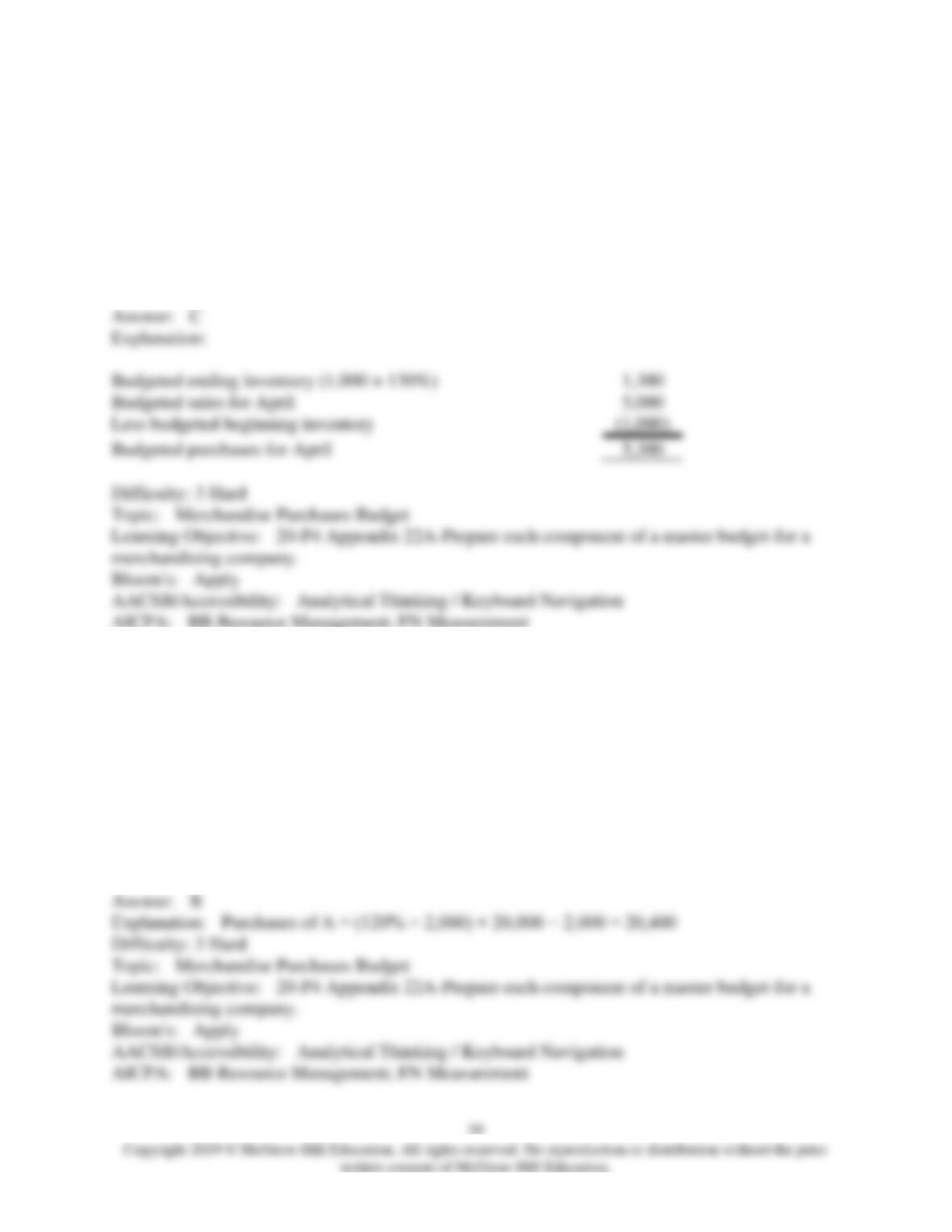
3,000
4,200
5,000
The company wants to end each month with ending finished goods inventory equal to 10% of the
next month’s sales. Finished goods inventory on December 31 is 300 units. The budgeted
production units for January are:
A) 3,000 units.
B) 3,420 units.
C) 3,720 units.
D) 3,120 units.
E) 2,880 units.
78) Ruiz Co. provides the following unit sales forecast for the next three months:
January
February
March
Sales units
3,000
4,200
5,000
The company wants to end each month with ending finished goods inventory equal to 10% of the
next month’s sales. Finished goods inventory on December 31 is 300 units. The budgeted
production units for February are:
A) 5,000 units.
B) 4,200 units.
C) 4,700 units.
D) 4,120 units.
E) 4,280 units.
79) A plan that lists dollar amounts to be received from disposing of plant assets and dollar
amounts to be spent on purchasing additional plant assets is called a:
A) Cash budget.
B) Capital expenditures budget.
C) Rolling budget.
D) Sales budget.
E) Production budget.
80) A merchandiser, provides the following information for its December budgeting process:
The November 30 inventory was 1,800 units.
Budgeted sales for December are 4,000 units.
Desired December 31 inventory is 2,840 units.
Budgeted purchases are:
A) 5,040 units.
B) 1,240 units.
C) 6,840 units.
D) 4,000 units.
E) 5,800 units.
81) A plan that reports the units or costs of merchandise to be purchased by a merchandising
company during the budget period is called a:
A) Selling expenses budget.
B) Merchandise purchases budget.
C) Sales budget.
D) Cash budget.
E) Capital expenditures budget.
82) The usual starting point in the budgeting process is a plan showing the planned sales units
and the revenue expected from these sales. This plan is called the:
A) Operating budget.
B) Business plan.
C) Income statement budget.
D) Merchandise purchases budget.
E) Sales budget.
83) A plan that lists the types and amounts of selling expenses expected during the budget period
is called a(n):
A) Sales budget.
B) General and administrative budget.
C) Capital expenditures budget.
D) Selling expense budget.
E) Purchases budget.
84) Which of the following factors is least likely to be considered in preparing a sales budget?
A) Business capacity.
B) Forecasted economic and market conditions.
C) Prediction of unit sales.
D) The capital expenditures budget.
E) Proposed selling expenses, such as advertising.
85) A department store has budgeted sales of 12,000 men’s coats in September. Management
wants to have 6,000 coats in inventory at the end of the month to prepare for the winter season.
Beginning inventory for September is expected to be 4,000 coats. What is the dollar amount of
the purchase of suits if each coat has a cost of $75?
A) $750,000.
B) $900,000.
C) $1,050,000.
D) $1,200,000.
E) $1,350,000.
86) A sporting equipment store expects to purchase $8,000 of ski boots in October. The store had
$2,000 of ski boots in merchandise inventory at the beginning of October, and expects to have
$3,000 of ski boots in merchandise inventory at the end of October to cover part of anticipated
November sales. What is the budgeted cost of goods sold for October?
A) $5,000.
B) $7,000.
C) $8,000.
D) $9,000.
E) $10,000.
87) Masterson Company’s budgeted production calls for 56,000 units in April and 52,000 units in
May of a key raw material that costs $1.85 per unit. Each month’s ending raw materials
inventory should equal 30% of the following month’s budgeted materials. The April 1 inventory
for this material is 16,800 unit. What is the budgeted materials needed in units for April?
A) 71,600 units.
B) 39,200 units.
C) 57,600 units.
D) 56,000 units.
E) 54,800 units.
88) A sporting goods manufacturer budgets production of 45,000 pairs of ski boots in the first
quarter and 30,000 pairs in the second quarter of the upcoming year. Each pair of boots requires
2 kilograms (kg) of a key raw material. The company aims to end each quarter with ending raw
materials inventory equal to 20% of the following quarter’s material needs. Beginning inventory
for this material is 18,000 kg and the cost per kg is $8. What is the budgeted materials needed in
kg. in the first quarter?
A) 90,000 kg.
B) 84,000 kg.
C) 108,000 kg.
D) 102,000 kg.
E) 120,000 kg.
89) A sporting goods manufacturer budgets production of 45,000 pairs of ski boots in the first
quarter and 30,000 pairs in the second quarter of the upcoming year. Each pair of boots requires
2 kilograms (kg) of a key raw material. The company aims to end each quarter with ending raw
materials inventory equal to 20% of the following quarter’s material needs. Beginning inventory
for this material is 18,000 kg and the cost per kg is $8. What is the budgeted materials purchases
cost for the first quarter?
A) $720,000.
B) $672,000.
C) $576,000.
D) $729,600.
E) $864,000.
90) A quantity of inventory that provides protection against lost sales caused by unfulfilled
demands from customers is called:
A) Just-in-time inventory.
B) Budgeted stock.
C) Continuous inventory.
D) Capital stock.
E) Safety stock.
91) Alliance Company budgets production of 24,000 units in January and 28,000 units in the
February. Each finished unit requires 4 pounds of raw material K that costs $2.50 per pound.
Each month’s ending raw materials inventory should equal 40% of the following month’s
budgeted materials. The January 1 inventory for this material is 38,400 pounds. What is the
budgeted materials needed in pounds for January?
A) 102,400 pounds.
B) 96,000 pounds.
C) 57,600 pounds.
D) 140,800 pounds.
E) 83,200 pounds.
92) Alliance Company budgets production of 24,000 units in January and 28,000 units in the
February. Each finished unit requires 4 pounds of raw material K that costs $2.50 per pound.
Each month’s ending raw materials inventory should equal 40% of the following month’s
budgeted materials. The January 1 inventory for this material is 38,400 pounds. What is the
budgeted materials cost for January?
A) $240,000.
B) $352,000.
C) $256,000.
D) $144,000.
E) $208,000.
93) Schrank Company is trying to decide how many units of merchandise to order each month.
Company policy is to have 20% of the next month’s sales in inventory at the end of each month.
Projected sales for August, September, and October are 30,000 units, 20,000 units, and 40,000
units, respectively. How many units must be purchased in September?
A) 14,000.
B) 20,000.
C) 22,000.
D) 24,000.
E) 28,000.
94) Masterson Company’s budgeted production calls for 56,000 units in April and 52,000 units in
May of a key raw material that costs $1.85 per unit. Each month’s ending raw materials
inventory should equal 30% of the following month’s budgeted materials. The April 1 inventory
for this material is 16,800 units. What is the budgeted materials purchases for April?
A) $106,560.
B) $101,380.
C) $103,600.
D) $72,520.
E) $132,460.
95) Boulware Company’s budgeted production calls for 5,000 units in October and 8,000 units in
November. Each unit requires 8 pounds (lbs.) of raw material A. Each month’s ending inventory
of raw materials should equal 20% of the following month’s budgeted materials requirements.
The October 1 inventory for this material is 8,000 pounds. What is the budgeted materials
purchases in pounds for October?
A) 40,000 lbs.
B) 44,800 lbs.
C) 52,800 lbs.
D) 60,800 lbs.
E) 35,200 lbs.
96) When preparing the cash budget, all of the following should be considered except:
A) Cash receipts from customers.
B) Cash payments for merchandise.
C) Depreciation expense.
D) Cash payments for income taxes.
E) Cash payments for capital expenditures.
97) Bioclean Co., a merchandiser, sells a biodegradable cleaning product and has predicted the
following unit sales for the first four months of the current year:
Jan.
Feb.
March
April
Sales in units
1,800
2,000
2,100
1,600
Ending inventory for each month should be 20% of the next month’s sales, and the December 31
inventory is consistent with that policy. How many units should be purchased in February?
A) 2,000.
B) 2,420.
C) 2,020.
D) 1,600.
E) 2,820.
Budgeted ending inventory (20% × 2,100)
Budgeted sales for February
2,000
Less budgeted beginning inventory (20% × 2,000)
)
Budgeted purchases for February
2,020
98) Garcia Corporation’s April sales forecast projects that 5,000 units will sell at a price of
$10.50 per unit. The desired ending inventory is 30% higher than the beginning inventory of
1,000 units. Budgeted purchases in April would be:
A) 5,000 units.
B) 6,000 units.
C) 5,300 units.
D) 6,300 units.
E) None of the choices are correct.
99) The sales budget for Modesto Corp. shows that 20,000 units of Product A and 22,000 units
of Product B are going to be sold for prices of $10 and $12, respectively. The desired ending
inventory of Product A is 20% higher than its beginning inventory of 2,000 units. The beginning
inventory of Product B is 2,500 units. The desired ending inventory of Product B is 3,000 units.
Budgeted purchases of Product A for the year would be:
A) 22,400 units.
B) 20,400 units.
C) 20,000 units.
D) 19,500 units.
E) 12,200 units.
100) The sales budget for Modesto Corp. shows that 20,000 units of Product A and 22,000 units
of Product B are going to be sold for prices of $10 and $12, respectively. The desired ending
inventory of Product A is 20% higher than its beginning inventory of 2,000 units. The beginning
inventory of Product B is 2,500 units. The desired ending inventory of Product B is 3,000 units.
Budgeted purchases of Product B for the year would be:
A) 24,500 units.
B) 22,500 units.
C) 16,500 units.
D) 26,500 units.
E) 20,500 units.
101) The sales budget for Modesto Corp. shows that 20,000 units of Product A and 22,000 units
of Product B are going to be sold for prices of $10 and $12, respectively. The desired ending
inventory of Product A is 20% higher than its beginning inventory of 2,000 units. The beginning
inventory of Product B is 2,500 units. The desired ending inventory of Product B is 3,000 units.
Total budgeted sales of both products for the year would be:
A) $42,000.
B) $200,000.
C) $264,000.
D) $464,000.
E) $500,000.