93) A broadcasting company failed to make a year-end accrual of $400,000 for fines due to a
violation of FCC rules. Its tax rate is 30%. As a result of this error, net income was:
A) Unaffected.
B) Overstated by $400,000.
C) Overstated by $280,000.
D) Overstated by $120,000.
94) In the previous year, a firm failed to record premium amortization of $40,000 and $30,000,
respectively, on its bonds payable and held to maturity bond investments. These errors affect
both income before tax and taxable income. The firm’s tax rate is 30%. As a result of this
error, net income was:
A) Understated by $7,000.
B) Overstated by $7,000.
C) Understated by $33,000.
D) Overstated by $33,000.
95) Which of the following statements is not true regarding the correction of an error?
A) The correction is reported prospectively and previous financial statements are not revised.
B) A journal entry is needed to correct any account balances that are incorrect as a result of the
error.
C) Prior years’ financial statements are restated to reflect the correction of the error (if the error
affected those statements).
D) A disclosure note should describe the nature of the error and the impact of its correction on
net income, income from continuing operations, and earnings per share.
96) In 2018, management discovered that Dual Production had debited expense for the full
cost of an asset purchased on January 1, 2015, at a cost of $36 million with no expected
residual value. Its useful life was 5 years. Dual uses straight-line depreciation. The correcting
entry, assuming the error was discovered in 2018 before preparation of the adjusting and
closing entries, includes:
A) A debit to accumulated depreciation of $14.4 million.
B) A credit to accumulated depreciation of $21.6 million.
C) A credit to an asset of $36 million.
D) A debit to retained earnings of $14.4 million.
97) Early in 2018, Benton Well Supplies discovered that a five-year insurance premium
payment of $50,000 at the beginning of 2015 was debited to insurance expense. The correcting
entry would include:
A) A credit to retained earnings of $20,000.
B) A debit to insurance expense of $20,000.
C) A debit to prepaid insurance of $30,000.
D) A debit to prepaid insurance of $50,000.
98) Green Company overstated its inventory by $50 million at the end of 2018. The discovery
of this error during 2019, before adjusting or closing entries, would require:
A) An increase in retained earnings.
B) A prospective adjustment in the 2019 income statement.
C) A debit to inventory of $50 million.
D) None of these answer choices are correct.
99) Which of the following statements is true regarding correcting errors in previously issued
financial statements prepared in accordance with International Financial Reporting Standards
(IFRS)?
A) The error can be reported in the current period if it’s not considered practicable to report it
retrospectively.
B) The error can be reported in the current period if it’s not considered practicable to report it
prospectively.
C) The error can be reported prospectively if it’s not considered practicable to report it
retrospectively.
D) Retrospective application is required with no exception.
100) Using International Financial Reporting Standards (IFRS), which of the following
statements is true regarding correcting errors in previously issued financial statements?
A) Retrospective application is required with no exception.
B) The error can be reported in the current period if it’s not considered practicable to report it
prospectively.
C) The error can be reported prospectively if it’s not considered practicable to report it
retrospectively.
D) The error can be reported in the current period if it’s not considered practicable to report it
retrospectively.
101) Doug Smith Industries purchased warehouses for $55 million (no residual value) at the
beginning of 2015. The warehouses were being depreciated over a 10-year life using the sum-
of-the-years’-digits method. At the beginning of 2018, management decided to change to
straight-line. Ignoring taxes, the 2018 adjusting entry will include a debit to depreciation
expense of:
A) $3.6 million
B) $4 million
C) $4.3 million
D) $34 million
8) / 55]}. Thus, the undepreciated value at the beginning of 2018 is $28 million ($55 million –
102) Doug Smith Industries purchased warehouses for $55 million (no residual value) at the
beginning of 2015. The warehouses were being depreciated over a 10-year life using the sum-
of-the-years’-digits method. At the beginning of 2018, management decided to change to
straight-line. An accompanying disclosure note would include each of the following except:
A) The cumulative effect of the change.
B) Justification that the change is preferable.
C) The effect of a change on any financial statement line items affected for all periods
reported.
D) The effect of a change on per share amounts affected for all periods reported.
103) Early in 2018, Ashland Granite discovered that a five-year insurance premium payment
of $750,000 at the beginning of 2015 was debited to insurance expense. The correcting entry
would include:
A) A debit to prepaid insurance of $750,000.
B) A debit to insurance expense of $300,000.
C) A debit to prepaid insurance of $450,000.
D) A credit to retained earnings of $300,000.
104) C. Good Eyeglasses overstated its inventory by $30,000 at the end of 2018. In 2019, the
discovery of this error, before adjusting or closing entries, would require:
A) An increase in retained earnings.
B) A debit to inventory of $30,000.
C) A prospective adjustment in the 2019 income statement.
D) None of these answer choices are correct.
105) C. Good Eyeglasses overstated its inventory by $30,000 at the end of 2018. If the error is
not discovered until 2020, before adjusting or closing entries, C. Good would need:
A) An increase in 2020 retained earnings.
B) A debit to inventory of $30,000 in 2020.
C) A prospective adjustment in the 2019 income statement.
D) None of these answer choices are correct.
106) The modified retrospective approach requires:
A) a modification of prior years’ financial statements.
B) a journal entry to adjust account balances in the beginning of the year of change.
C) both a modification of prior years’ financial statements and a journal entry to adjust account
balances in the beginning of the year of change.
D) neither a modification of prior years’ financial statements nor a journal entry to adjust
account balances in the beginning of the year of change.
107) Prospective approach
108) Disclosure note
109) Error corrections
110) Changes in accounting principle
111) Changes in reporting entity
Difficulty: 2 Medium
Topic: Change in accounting principle-Prospective; Change in accounting principle-Retrospective; Change in
reporting entity; Error correction
Learning Objective: 20-02 Describe how changes in accounting principle typically are reported.; 20-03 Explain
how and why some changes in accounting principle are reported prospectively.; 20-05 Describe the situations that
constitute a change in reporting entity.; 20-06 Understand and apply the four-step process of correcting and
reporting errors, regardless of the type of error or the timing of its discovery.
Bloom’s: Understand
AACSB: Reflective Thinking
Accessible/AICPA: FN Measurement
112) Changes in accounting estimates
113) Cumulative effect adjustment to income statement
114) Prior period adjustment
115) Prospective approach
116) Pro forma disclosure
Difficulty: 2 Medium
Topic: Change in accounting estimate; Change in accounting principle-Prospective; Change in accounting
principle-Retrospective; Change in reporting entity; Distinguish retrospective and prospective; Error correction
Learning Objective: 20-01 Differentiate among the three types of accounting changes and distinguish among the
retrospective, modified retrospective, and prospective approaches to accounting for and reporting accounting
changes.; 20-03 Explain how and why some changes in accounting principle are reported prospectively.; Explain
how and why changes in estimates are reported prospectively.; 20-05 Describe the situations that constitute a change
in reporting entity.; 20-06 Understand and apply the four-step process of correcting and reporting errors, regardless
of the type of error or the timing of its discovery.
Bloom’s: Understand
AACSB: Reflective Thinking
Accessible/AICPA: FN Measurement

52
117) Indicate the nature of each of the situations described below using the following three-
letter code.
CODE DESCRIPTION
CPR: Change in principle reported retrospectively
CPP: Change in principle reported prospectively
CES: Change in estimate
CRE: Change in reporting entity
PPA: Prior period adjustment required
_____ Technological advance that renders worthless a patent with an unamortized cost of
$45,000.
_____ Change from LIFO inventory costing to average inventory costing.
_____ Including in the consolidated financial statements a subsidiary acquired several years
earlier that was appropriately not included in previous years.
_____ Change from FIFO inventory method to LIFO.
_____ Pension plan assets for a defined benefit pension plan achieving a rate of return in
excess of the amount anticipated.
_____ Change from the pay-as-you-go method to estimating warranty expense in the period
the related product is sold.
_____ Change from declining balance depreciation to straight-line.
_____ Change from determining lower of cost or net realizable value for inventories by the
individual item approach to the aggregate approach.
_____ Settling a lawsuit for less than the amount accrued previously as a loss contingency.
_____ Change in the estimated useful life of office equipment.
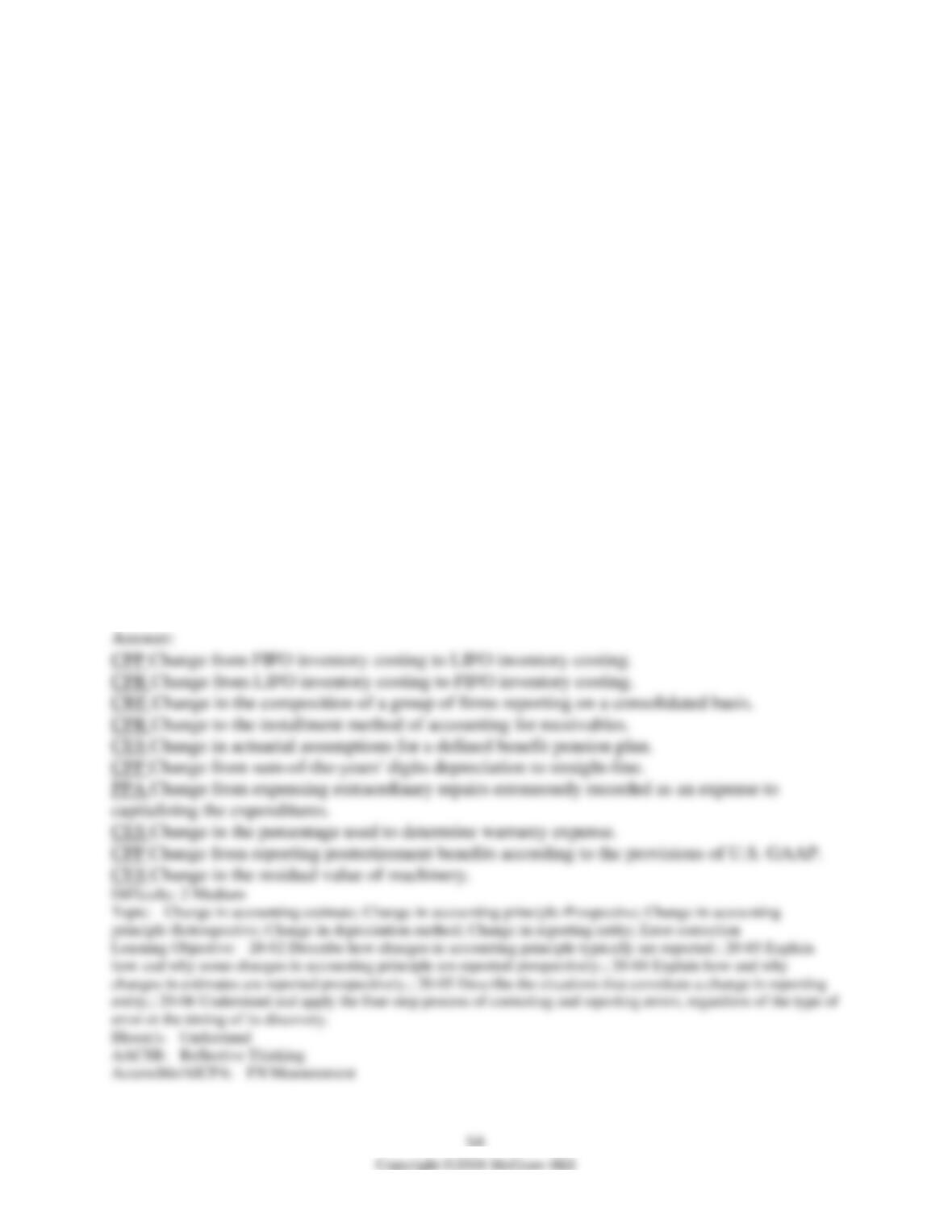
118) Indicate the nature of each of the situations described below using the following three-
letter code.
CODE DESCRIPTION
CPR: Change in principle reported retrospectively
CPP: Change in principle reported prospectively
CES: Change in estimate
CRE: Change in reporting entity
PPA: Prior period adjustment required
____ Change from FIFO inventory costing to LIFO inventory costing.
____ Change from LIFO inventory costing to FIFO inventory costing.
____ Change in the composition of a group of firms reporting on a consolidated basis.
____ Change to the installment method of accounting for receivables.
____ Change in actuarial assumptions for a defined benefit pension plan.
____ Change from sum-of-the-years’ digits depreciation to straight-line.
____ Change from expensing extraordinary repairs erroneously recorded as an expense to
capitalizing the expenditures.
____ Change in the percentage used to determine warranty expense.
____ Change from reporting postretirement benefits according to the provisions of U.S.
GAAP.
____ Change in the residual value of machinery.
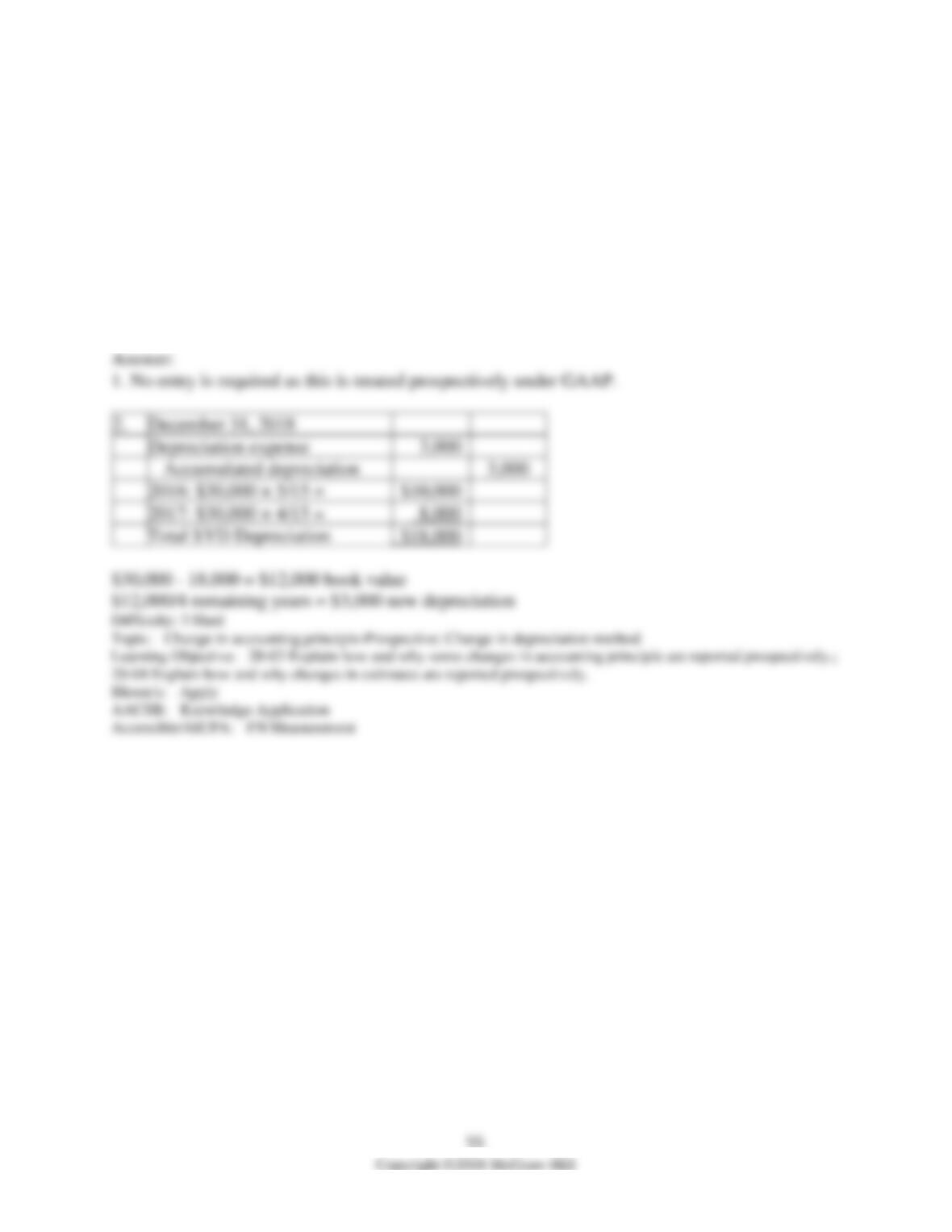
119) Lugar Company purchased a piece of machinery for $30,000 on January 1, 2016, and has
been depreciating the machine using the sum-of-the-years’-digits method based on a five-year
estimated useful life and no salvage value. On January 1, 2018, Lugar decided to switch to the
straight-line method of depreciation. The salvage value is still zero and the estimated useful
life is changed to a total of six years from the date of purchase. Ignore income taxes.
Required:
(1.) Prepare the appropriate journal entry, if any, to record the accounting change.
(2.) Prepare the journal entry to record depreciation for 2018.
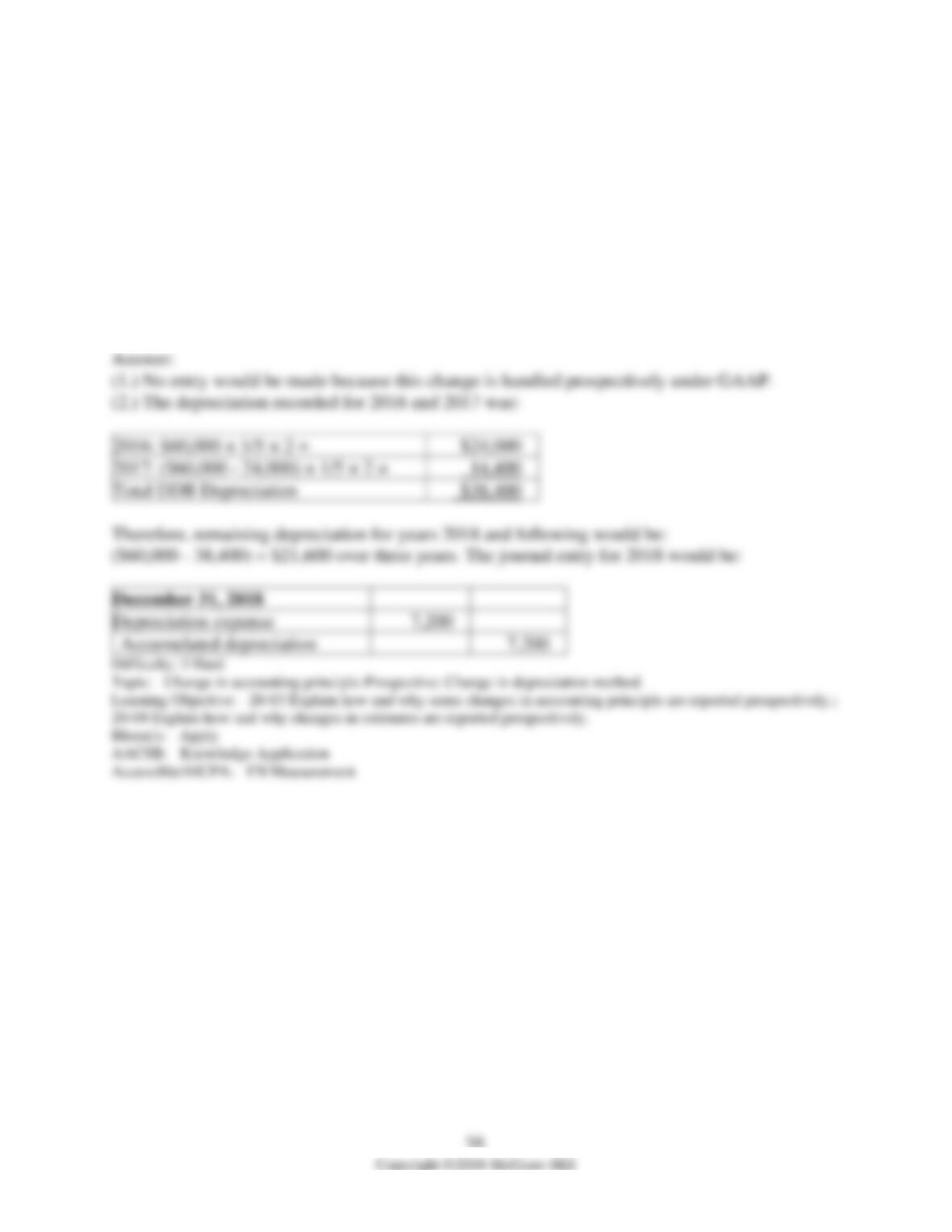
120) Albatross Company purchased a piece of machinery for $60,000 on January 1, 2016, and
has been depreciating the machine using the double-declining-balance method based on a five-
year estimated useful life and no salvage value. On January 1, 2018, Albatross decided to
switch to the straight-line method of depreciation. The salvage value is still zero and the
estimated useful life did not change. Ignore income taxes.
Required:
(1.) Prepare the appropriate journal entry, if any, to record the accounting change.
(2.) Prepare the journal entry to record depreciation for 2018.
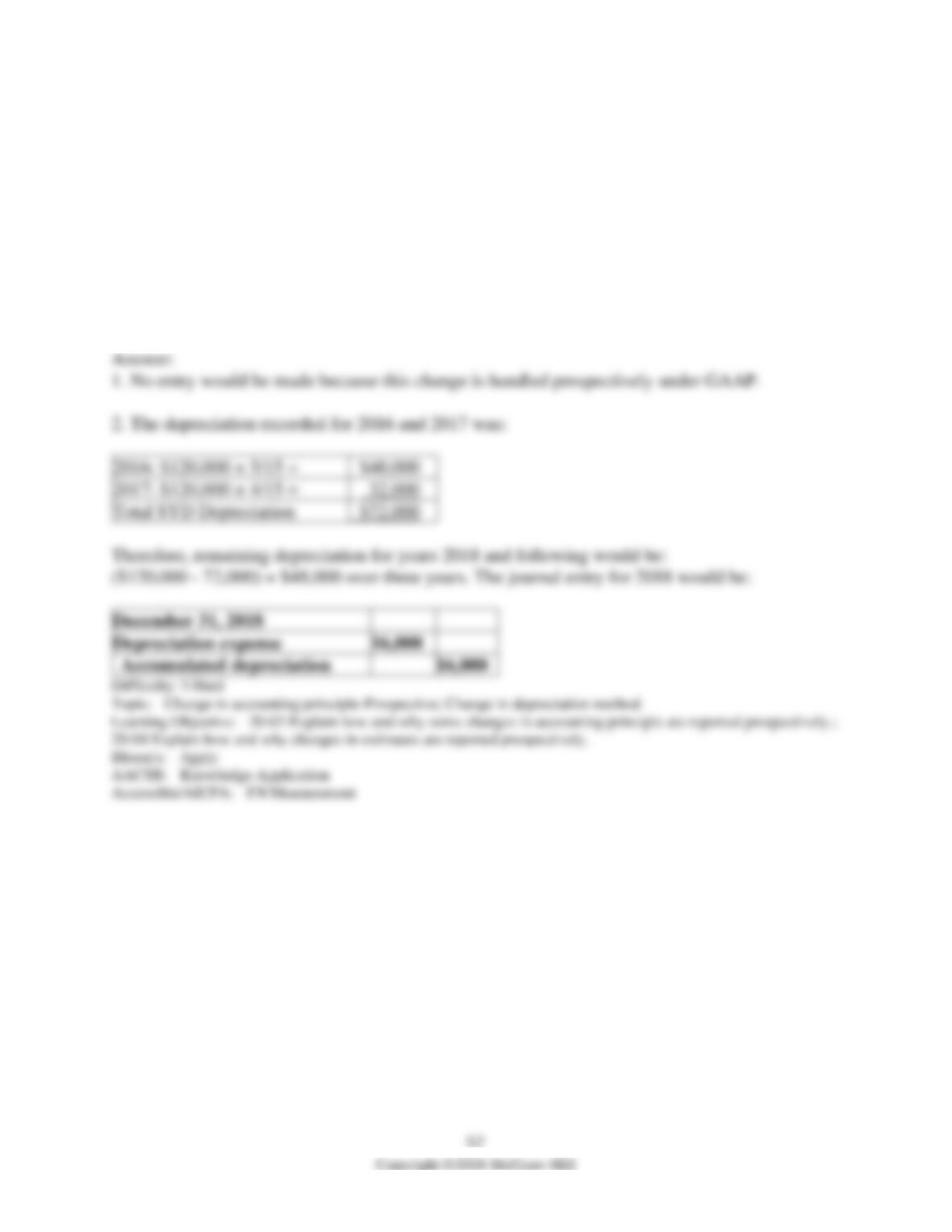
121) Colorado Consulting Company has been using the sum-of-the-years’-digits depreciation
method to depreciate some office equipment that was acquired at the beginning of 2016. At the
beginning of 2018, Colorado Consulting decided to change to the straight-line method. The
equipment cost $120,000 and is expected to have no salvage value. The estimated useful life of
the equipment is five years. Ignore income taxes.
Required:
1. Prepare the appropriate journal entry, if any, to record the accounting change.
2. Prepare the journal entry to record depreciation for 2018.
122) Pinnacle Corporation has been using the straight-line depreciation method to depreciate
some office equipment that was acquired at the beginning of 2015. At the beginning of 2018,
Pinnacle decided to change to the double-declining-balance method. The equipment cost
$120,000 and is expected to have no salvage value. The estimated useful life of the equipment
is five years. The tax rate is 30%.
Required:
Prepare the journal entry, if any, to record the accounting change at the beginning of 2018.
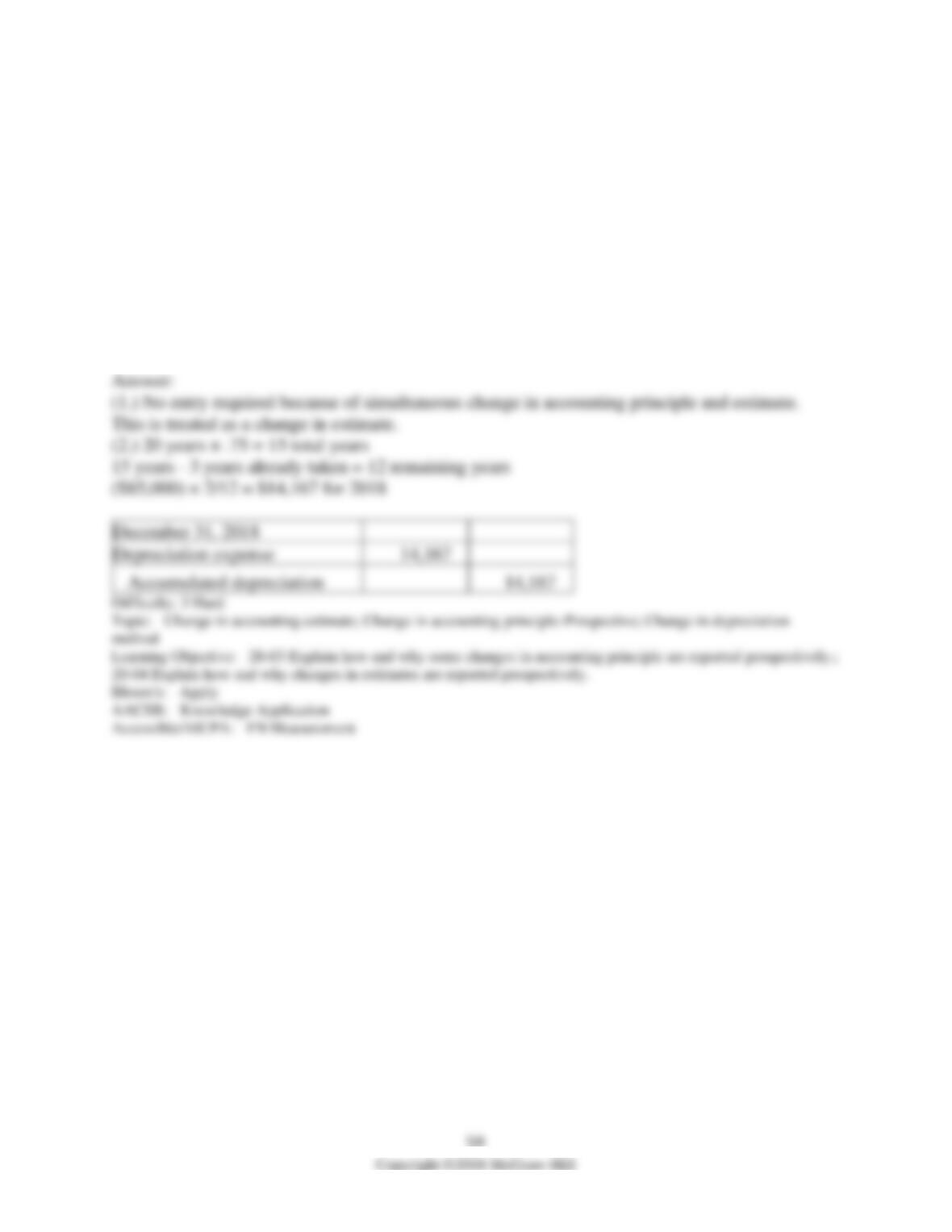
123) Annual depreciation expense on a building purchased a few years ago (using the straight-
line method) is $5,000. The cost of the building was $100,000. The current book value of the
equipment (January 1, 2018) is $85,000. At the time of purchase, the asset was estimated to
have a zero salvage value. On January 1, 2018, the company decided to reduce the original
useful life by 25% and to establish a salvage value of $5,000. The firm also decided double-
declining-balance depreciation was more appropriate. Ignore tax effects.
Required:
(1.) Record the journal entry, if any, to report the accounting change.
(2.) Record the annual depreciation for 2018.
124) Green Co. constructed a machine at a total cost of $70 million. Construction was
completed at the end of 2014 and the machine was placed in service at the beginning of 2015.